Question 1
Number BasesFind (1012)2, expressing the answer in base 2.
- A.10101
- B.11001
- C.10010
- D.11101
- E.10110.
Show the answer and explanation
Answer: B (11001)
Explanation
1012 = 5, and 5² = 25. In base 2, 25 = 16 + 8 + 1 = 110012.
58 questions. Try each one, then open the answer to check yourself and read the explanation.
Find (1012)2, expressing the answer in base 2.
Answer: B (11001)
1012 = 5, and 5² = 25. In base 2, 25 = 16 + 8 + 1 = 110012.
If 3 children share N10.50 among themselves in ratio 6:7:8, how much is the largest share?
Answer: C (N4.00)
Total parts = 6 + 7 + 8 = 21. Largest share = 8/21 × N10.50 = N4.00.
Express 0.000834 in standard form.
Answer: A (8.34 × 10⁻⁴)
Move the decimal point 4 places to the right to get 8.34, so 0.000834 = 8.34 × 10⁻⁴.
Simplify: 0.027-1/3
Answer: A (3 1/3)
0.0271/3 = 0.3, so 0.027-1/3 = 1/0.3 = 10/3 = 3 1/3.
Given that log2a = log84, find a.
Answer: D (22/3)
log84 = 2/3 because 82/3 = 4. So log2a = 2/3 and a = 22/3.
By selling some crates of soft drinks for N600.00, a dealer makes a profit of 50%. How much did the dealer pay for the drinks?
Answer: D (N400.00)
Selling price = 150% of cost price, so cost = 600 × 100/150 = N400.00.
Find the nth term Un of the A.P., 11, 4, −3,........
Answer: C (Un = 18 − 7n)
a = 11 and d = −7, so Un = 11 + (n − 1)(−7) = 18 − 7n.
If 16/9, x, 1, y are in Geometric Progression (G.P.), find the product of x and y.
Answer: C (1)
1 is the third term: 16/9 × r² = 1 gives r = 3/4. Then x = 16/9 × 3/4 = 4/3 and y = 1 × 3/4 = 3/4, so xy = 1.
If R = [2, 4, 6, 7] and S = [1, 2, 4, 8], then R∪S equal
Answer: A ([1,2,4,6,7,8])
The union contains every element in R or S: {1, 2, 4, 6, 7, 8}.
In the diagram below, the shaded portion is
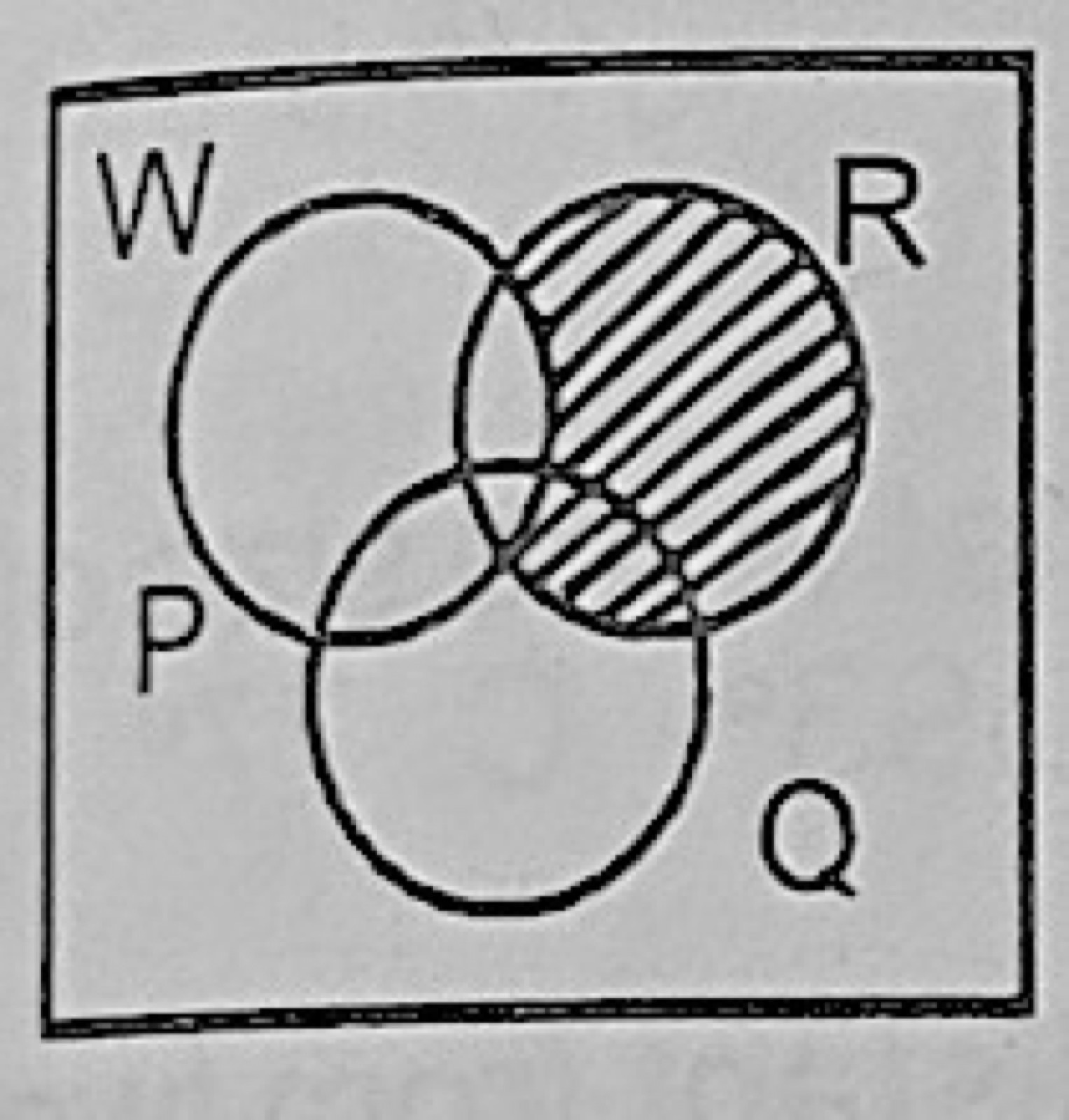
Answer: A (P'∩R)
The shaded part is all of R except the part inside P (it includes the part of R inside Q), which is P'∩R.
Find the values of x for which the expression is underlined: (6x − 1)/(x2 + 4x − 5)
Answer: B (−5 or +1)
The expression is undefined when the denominator is zero: x² + 4x − 5 = (x + 5)(x − 1) = 0, so x = −5 or x = 1.
Solve the inequality: 1/3(2x − 1) < 5.
Answer: D (x < 8)
Multiply by 3: 2x − 1 < 15, so 2x < 16 and x < 8.
What is the smaller value of x for which x2 − 3x + 2 = 0?
Answer: A (1)
x² − 3x + 2 = (x − 1)(x − 2) = 0, so x = 1 or 2. The smaller is 1.
Factorize the expression x(a − c) + y(c − a)
Answer: B ((a − c)(x − y))
y(c − a) = −y(a − c), so the expression is (a − c)x − (a − c)y = (a − c)(x − y).
If y ∝ 1/x2 and x = 3 when y = 4, find y when x = 2
Answer: C (9)
y = k/x²; 4 = k/9 gives k = 36. When x = 2, y = 36/4 = 9.
Solve the equation 3x2 + 25x − 18 = 0
Answer: D (−9,2/3)
3x² + 25x − 18 = (3x − 2)(x + 9) = 0, so x = 2/3 or x = −9.
Solve the equation (x + 2)(x − 7) = 0
Answer: B (x = −2 or 7)
Either x + 2 = 0 or x − 7 = 0, so x = −2 or x = 7.
Solve the following simultaneous equations: x + y = 3/2; x − y = 5/2 and use your result to find the value of 2y + x
Answer: D (1)
Adding the equations gives 2x = 4, so x = 2 and y = −½. Then 2y + x = −1 + 2 = 1.
Use the graph of y = 3x2 + x − 7 to answer this question. What is the minimum value of y?
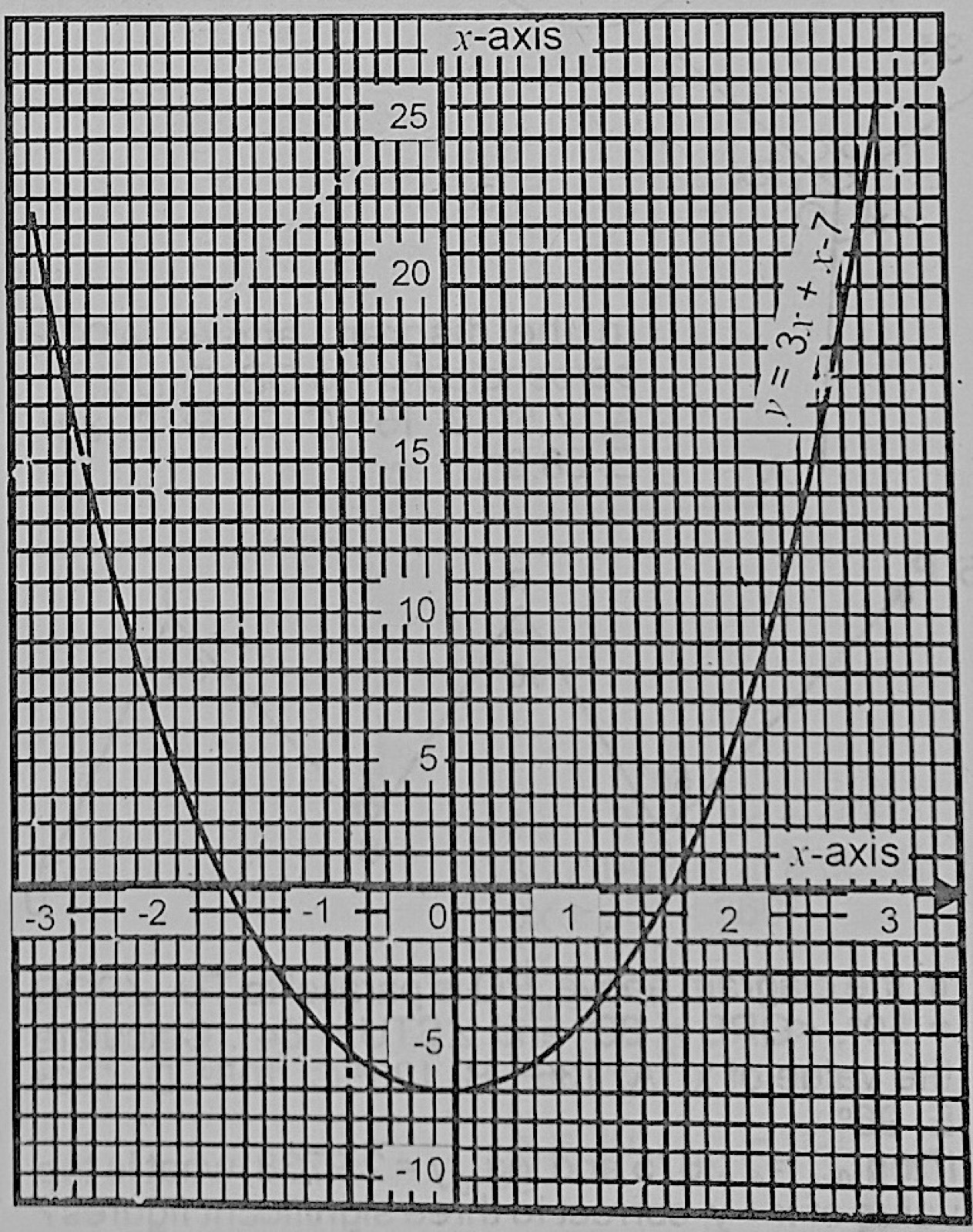
Answer: B (−7)
The lowest point of the curve is just below the y-axis at about y = −7 (exactly −7 1/12 at x = −1/6).
Use the graph of y = 3x2 + x − 7 to answer this question. Find the roots of the equation y = 3x2 + x − 7
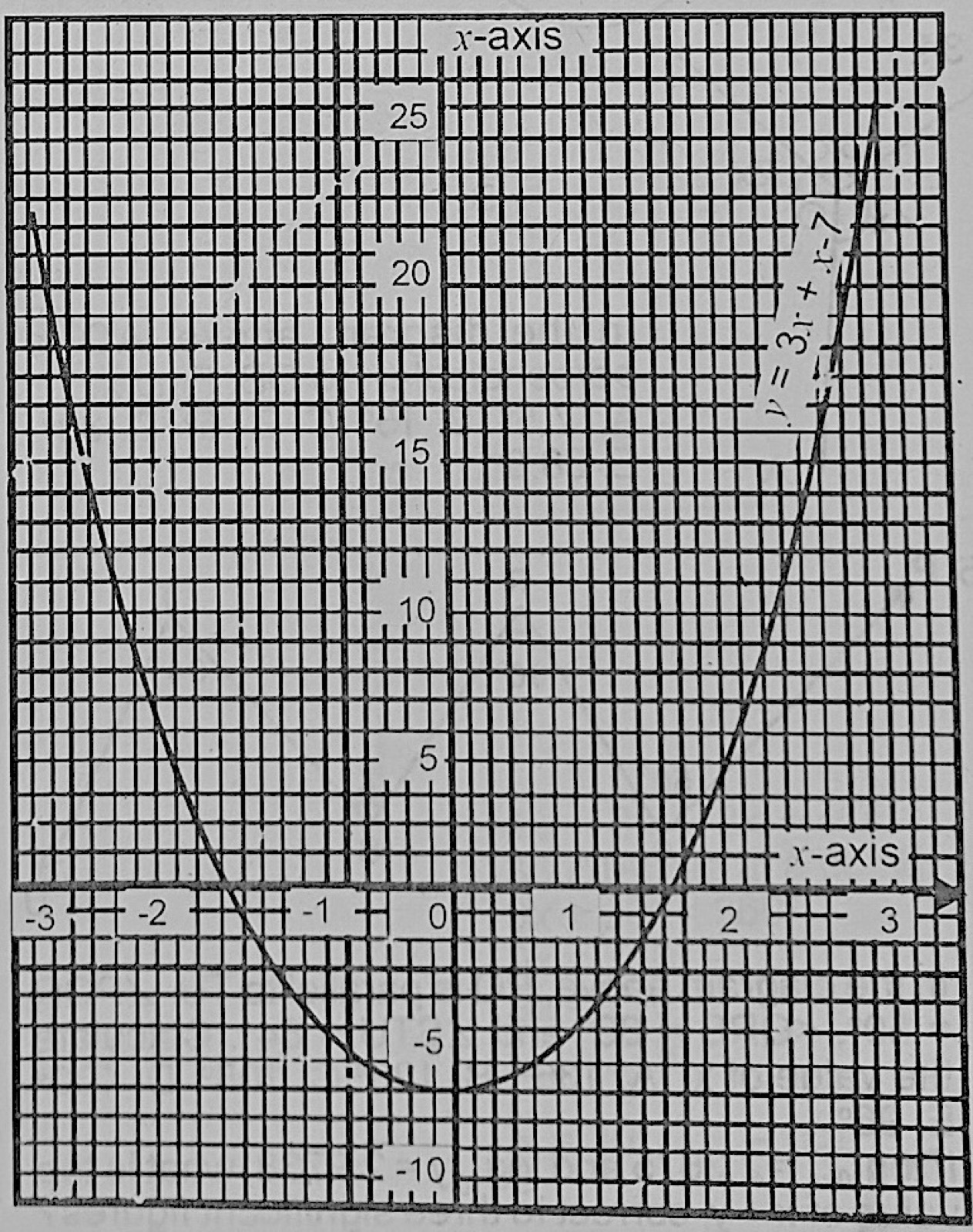
Answer: C (1.4 and −1.7)
The roots are where the curve cuts the x-axis: about x = 1.4 and x = −1.7 (the formula gives (−1 ± √85)/6).
In the diagram below. |AB| = 12cm, |AE| = 8cm, |DC| = 9cm and AB||DC. Calculate |EC|.
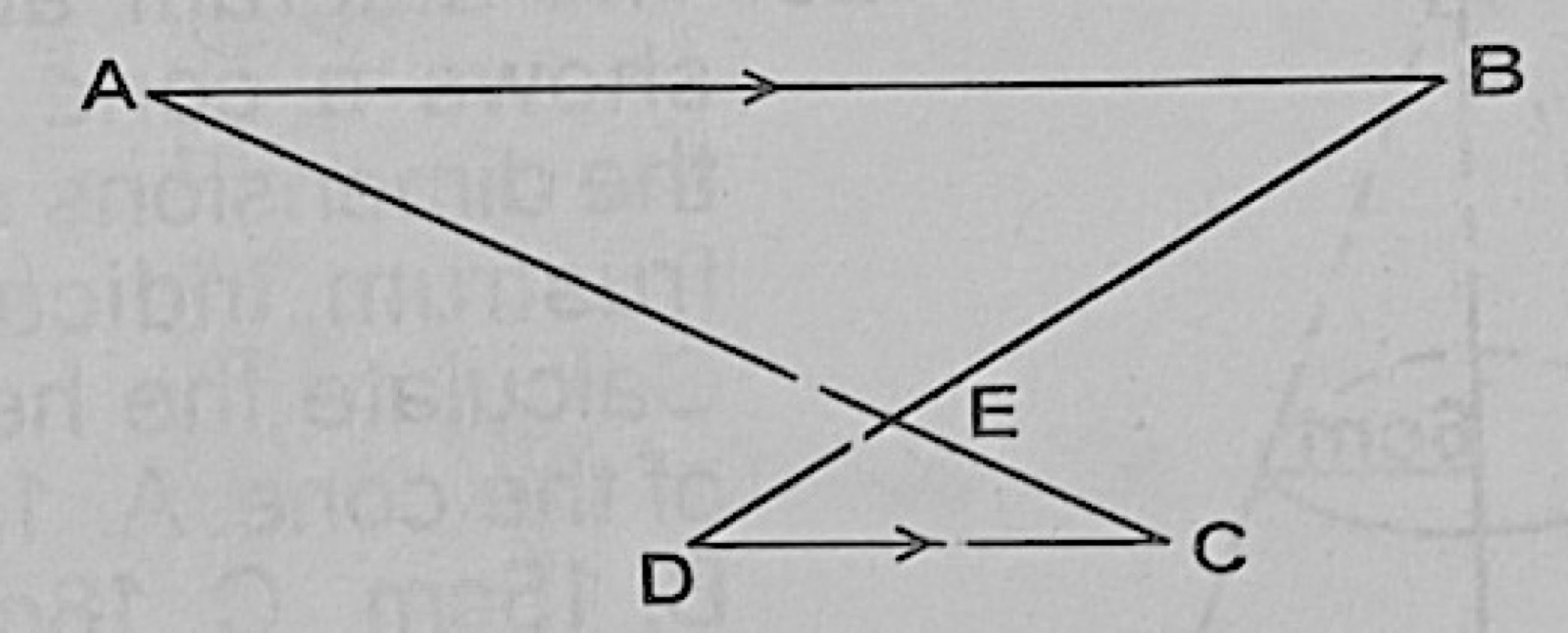
Answer: E (6cm.)
Triangles ABE and CDE are similar (AB ∥ DC), so EC/AE = DC/AB: EC = 8 × 9/12 = 6 cm.
The diagonals AC and BD of a rhombus ABCD are 16cm and 12cm long respectively. Calculate the area of the rhombus.
Answer: E (96cm2)
Area of a rhombus = ½ × product of diagonals = ½ × 16 × 12 = 96 cm².
A water tank of height ½m has a square base of side 1½m. If it is filled with water from a water tanker holding 1500 litres, how many litres of water are left in the water tanker? [1000 litres = 1m3]
Answer: B (375 litres)
Tank volume = 1.5 × 1.5 × 0.5 = 1.125 m³ = 1125 litres. Water left = 1500 − 1125 = 375 litres.
Find the total surface area of solid circular cone with base radius 3cm and slant height 4cm. [Take π = 22/7]
Answer: B (66cm2)
Total surface area = πr² + πrl = π(9 + 12) = 22/7 × 21 = 66 cm².
A hollow sphere has a volume of kcm3 and a surface area of kcm2. Calculate the diameter of the sphere.
Answer: B (6cm)
Set 4/3 πr³ = 4πr²; dividing by 4πr² gives r/3 = 1, so r = 3 cm and the diameter is 6 cm.
The diagram above shows a cone with the dimensions of its frustrum indicated. Calculate the height of the cone.
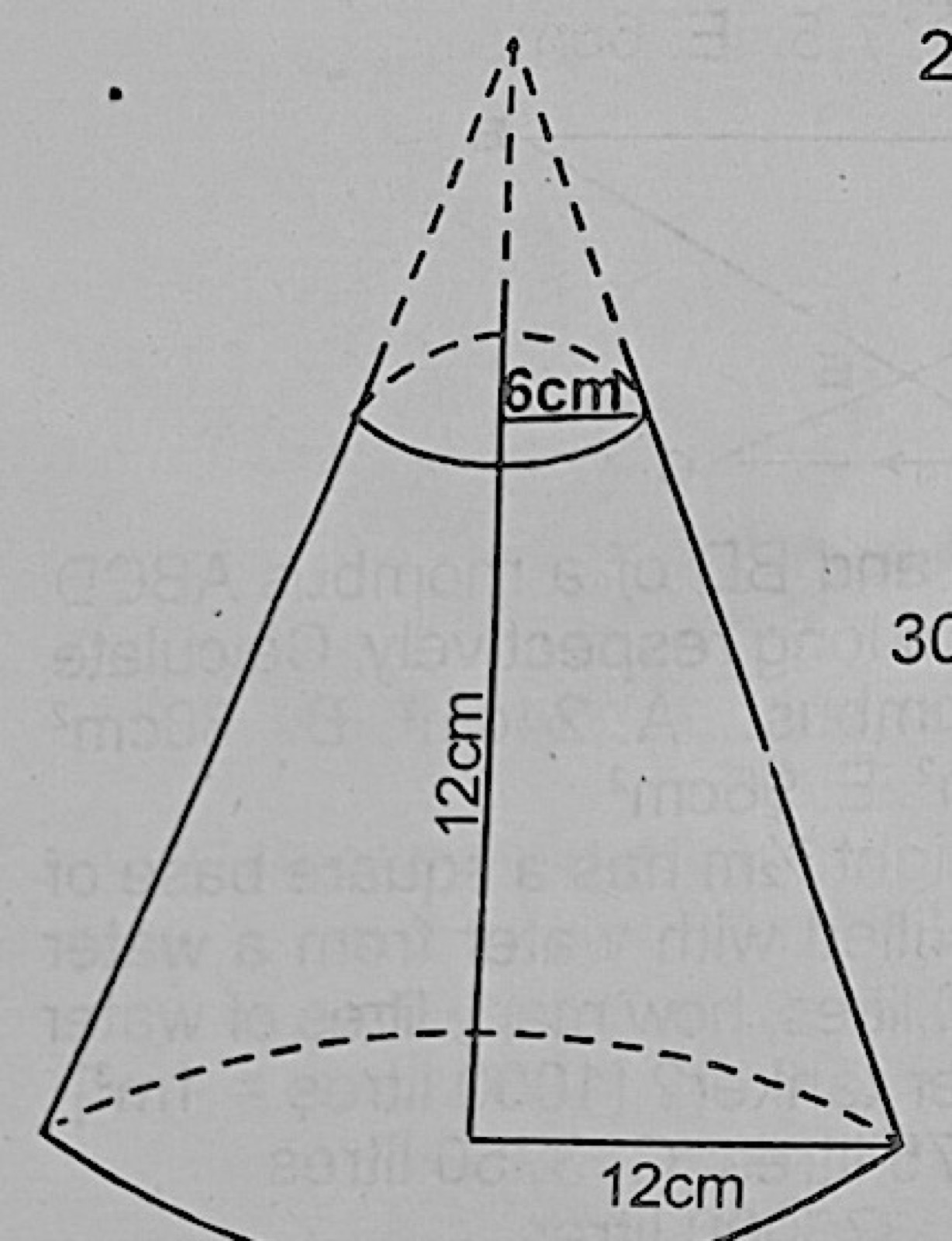
Answer: D (24cm)
The small cone cut off is similar to the whole cone. With height H: (H − 12)/H = 6/12, so 2H − 24 = H and H = 24 cm.
The positions of two countries P and Q are (15°N, 12°E) and (65°N, 12°E) respectively. What is the difference in latitude?
Answer: D (50°)
Both are in the northern hemisphere, so subtract: 65° − 15° = 50°.
A 120° sector of a circle of radius 21cm is bent to form a cone. What is the base radius of the cone?
Answer: B (7cm)
The arc becomes the base circumference: 120/360 × 2π × 21 = 2πr, so r = 21/3 = 7 cm.
The angle of a sector of a circle is 108°. If the radius of the circle is 3½cm, find the perimeter of the sector
Answer: E (13 3/5cm.)
Arc = 108/360 × 2 × 22/7 × 3.5 = 6.6 cm. Perimeter = 6.6 + 3.5 + 3.5 = 13.6 cm = 13 3/5 cm.
In the diagram below; O is the centre of the circle and |BD| = |DC|. If ∠DCB = 35°, find ∠BAO.
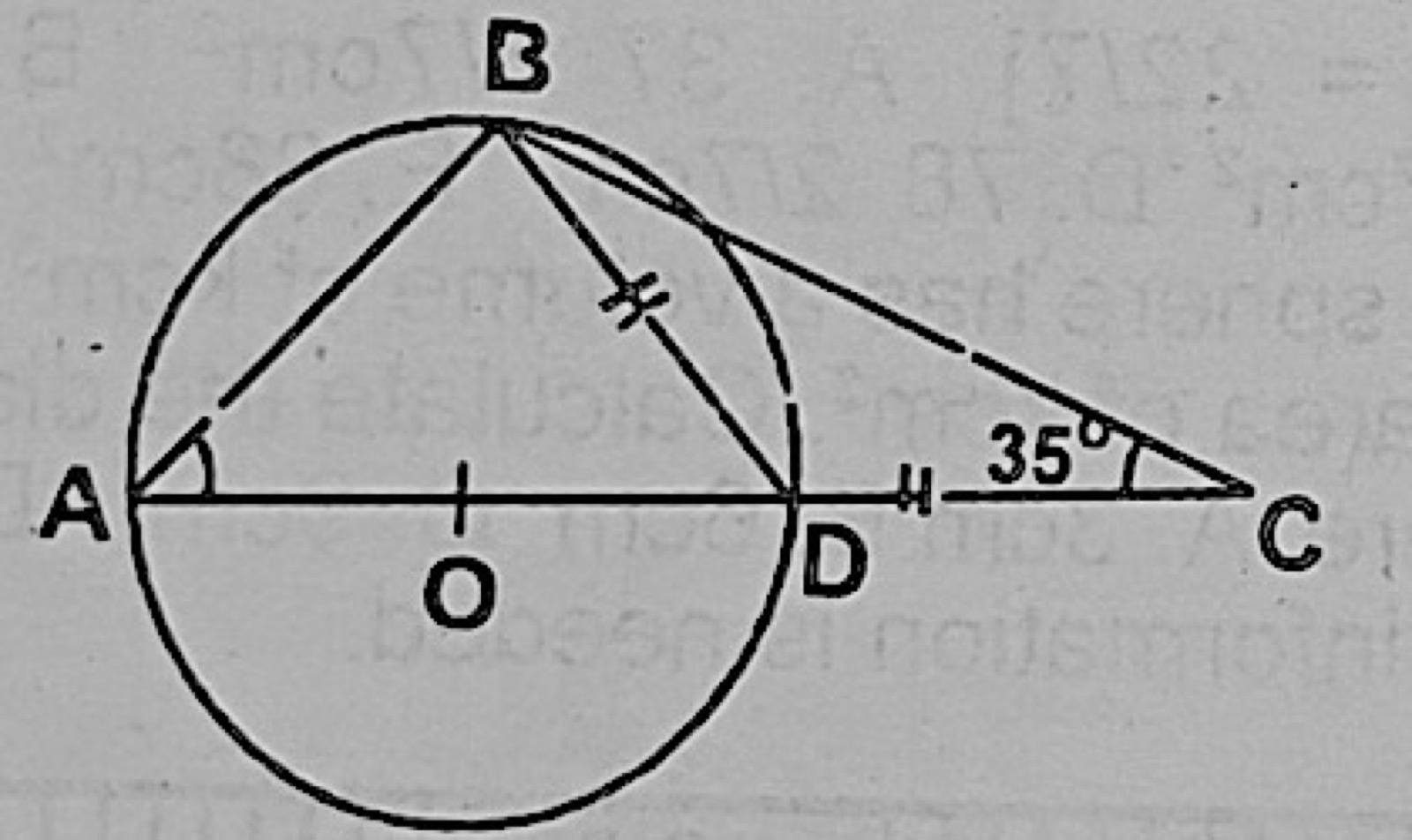
Answer: A (20°)
∠DBC = 35° (isosceles triangle), so the exterior angle ∠BDA = 35° + 35° = 70°. AD is a diameter, so ∠ABD = 90°. Then ∠BAO = 180° − 90° − 70° = 20°.
In the diagram above, AO is perpendicular to OB. Find x.
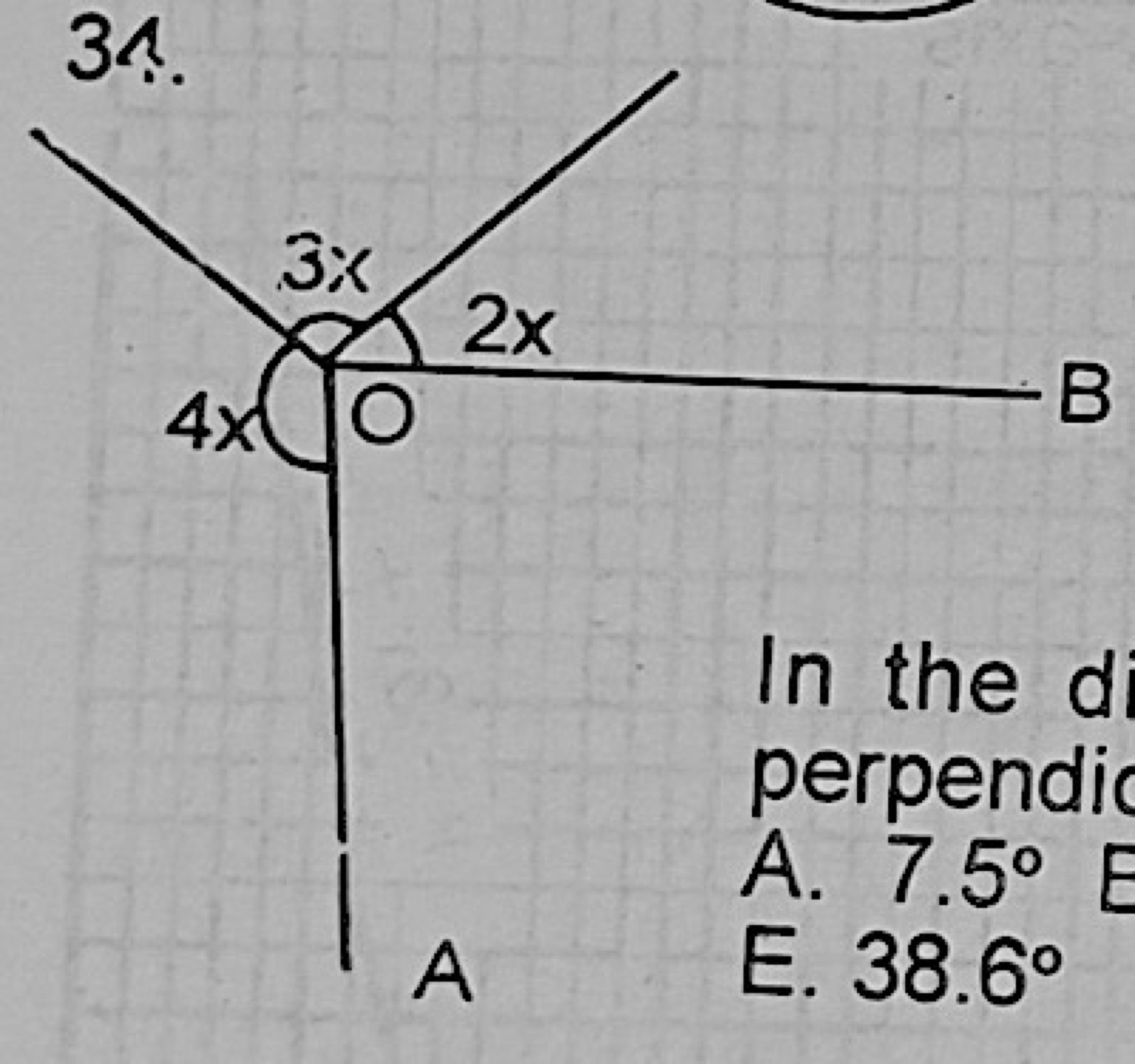
Answer: D (30°)
Angles at a point add up to 360°: 4x + 3x + 2x + 90° = 360°, so 9x = 270° and x = 30°.
In the diagram above, PQ is parallel to TU, ∠PQR = 50°, ∠QRS = 86° and ∠STU = 64°. Calculate the value of x.
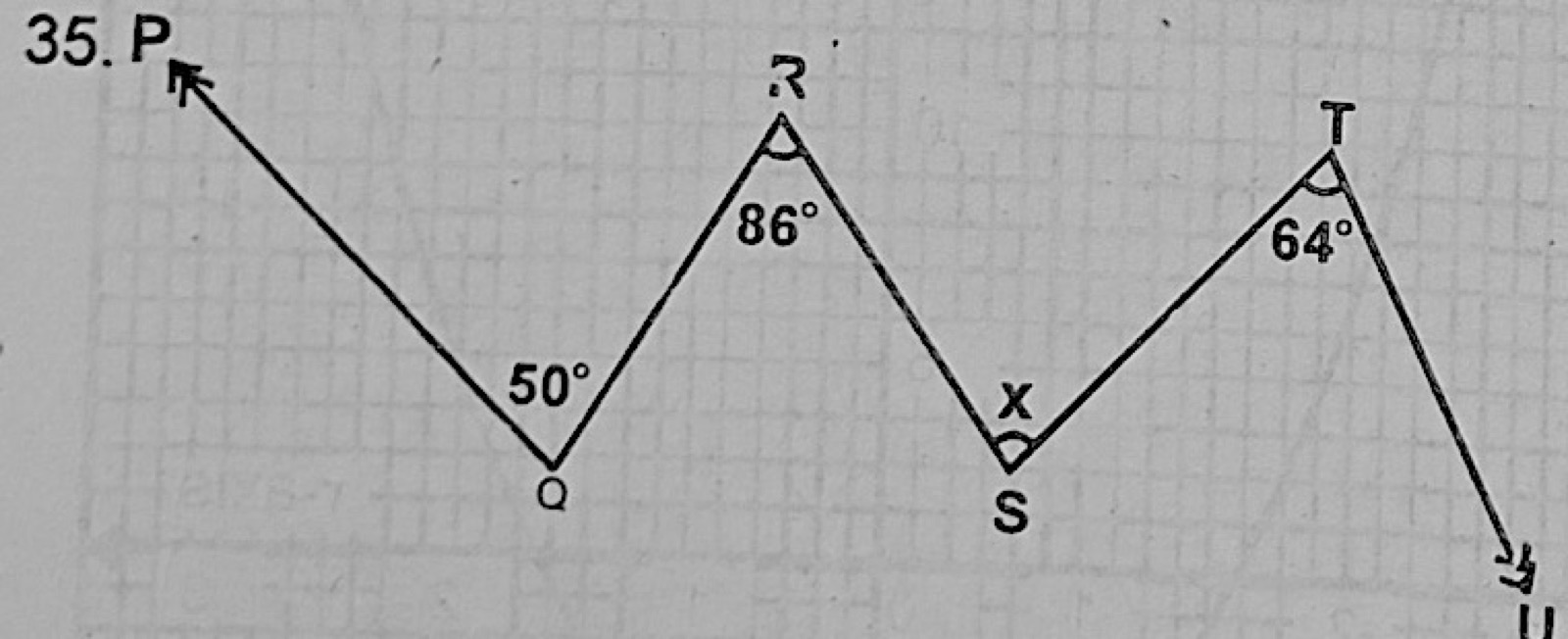
Answer: D (100°)
Draw lines through R and S parallel to PQ. Using alternate angles, ∠QRS splits into 50° + 36°, and ∠RST splits into 36° + 64°. So x = 36° + 64° = 100°.
If log10x = 2̄.3675 and log10y = 2̄.9738, what is the value of x + y, correct to three significant figures?
Answer: A (0.117)
x = antilog 2̄.3675 = 0.02331 and y = antilog 2̄.9738 = 0.09415. x + y = 0.11746 ≈ 0.117.
In the diagram below, AB//CD, the bisector of ∠BAC and ∠ACD meet at E. Find the value of ∠AEC.
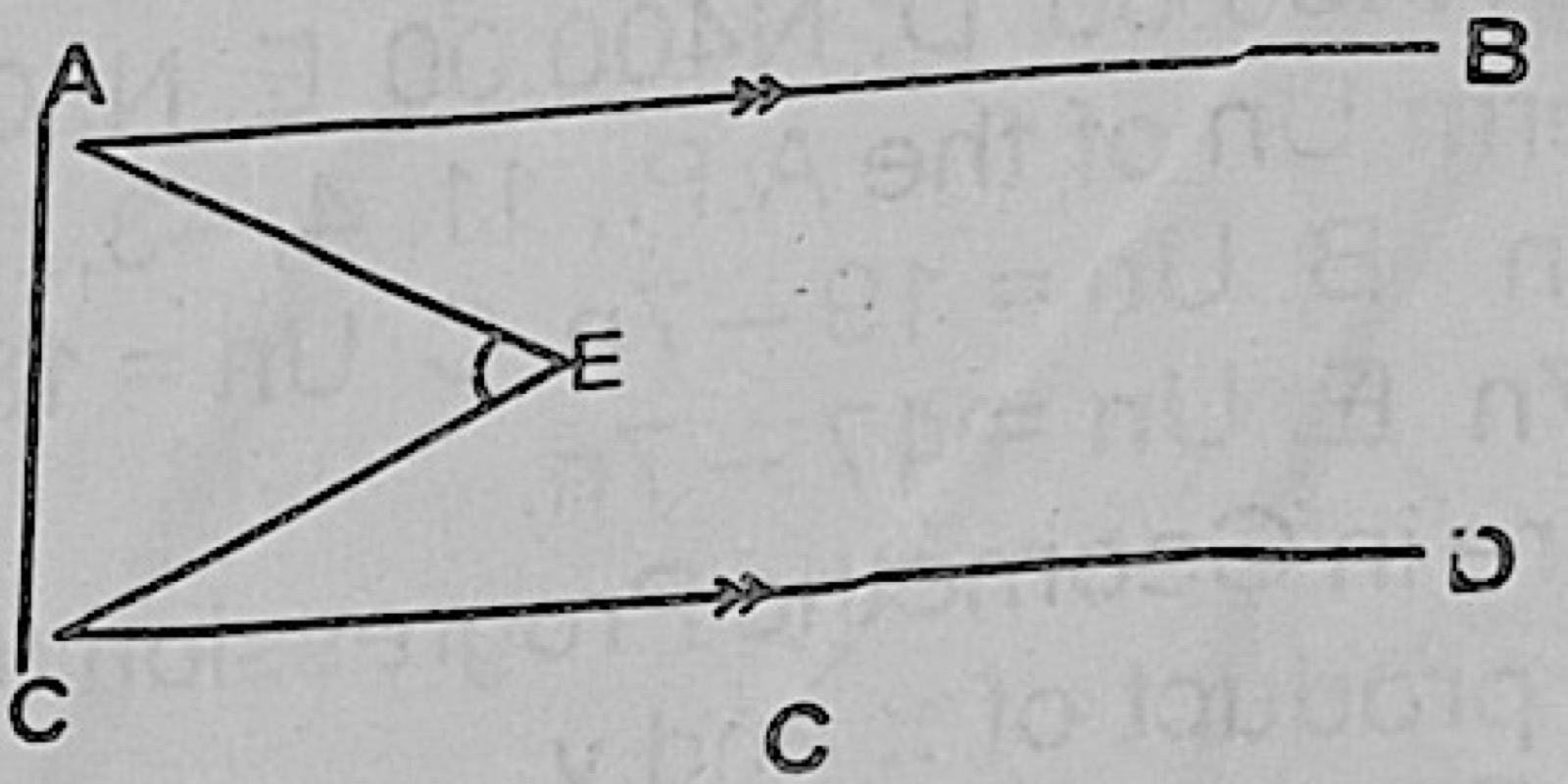
Answer: E (90°)
∠BAC + ∠ACD = 180° (co-interior angles), so their halves add up to 90°. In triangle AEC, ∠AEC = 180° − 90° = 90°.
In the diagram above, AB//CD. What is the size of the angle marked x?
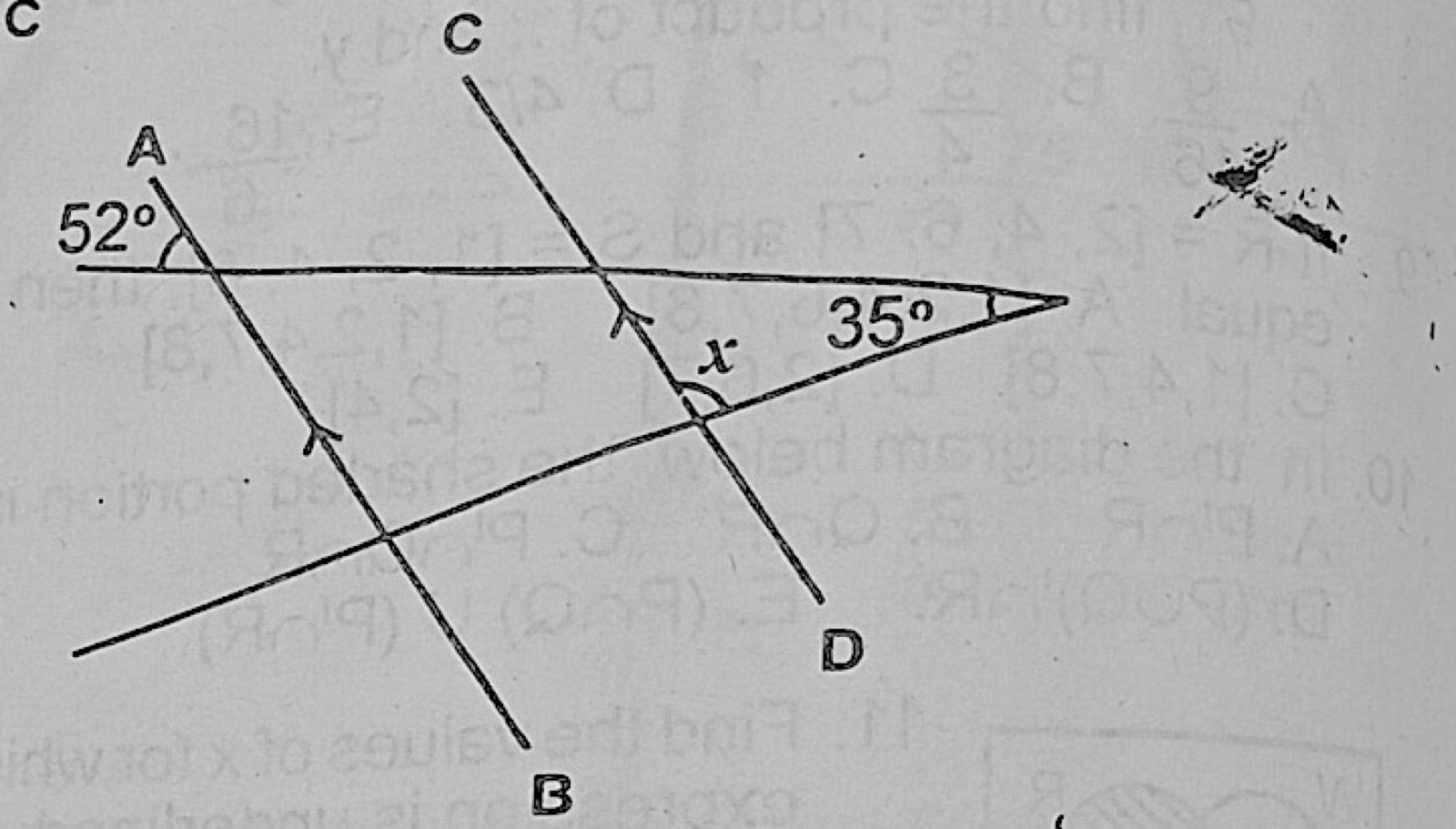
Answer: B (93°)
The 52° angle at A is repeated where the upper line crosses CD (corresponding angles). In the triangle formed with the 35° angle, x = 180° − 52° − 35° = 93°.
The locus of a point which is equidistant from two given fixed points is the
Answer: A (perpendicular bisector of the straight line joining them)
Every point equally far from two fixed points lies on the perpendicular bisector of the line joining them.
Which of the following angles is an exterior angle of a regular polygon?
Answer: E (72°)
An exterior angle of a regular polygon must divide 360° exactly. 360° ÷ 72° = 5 (a regular pentagon); none of the others divide 360° exactly.
In ΔABC above, BC is produced to D, |AB| = |AC| and ∠BAC = 50°: Find ∠ACD
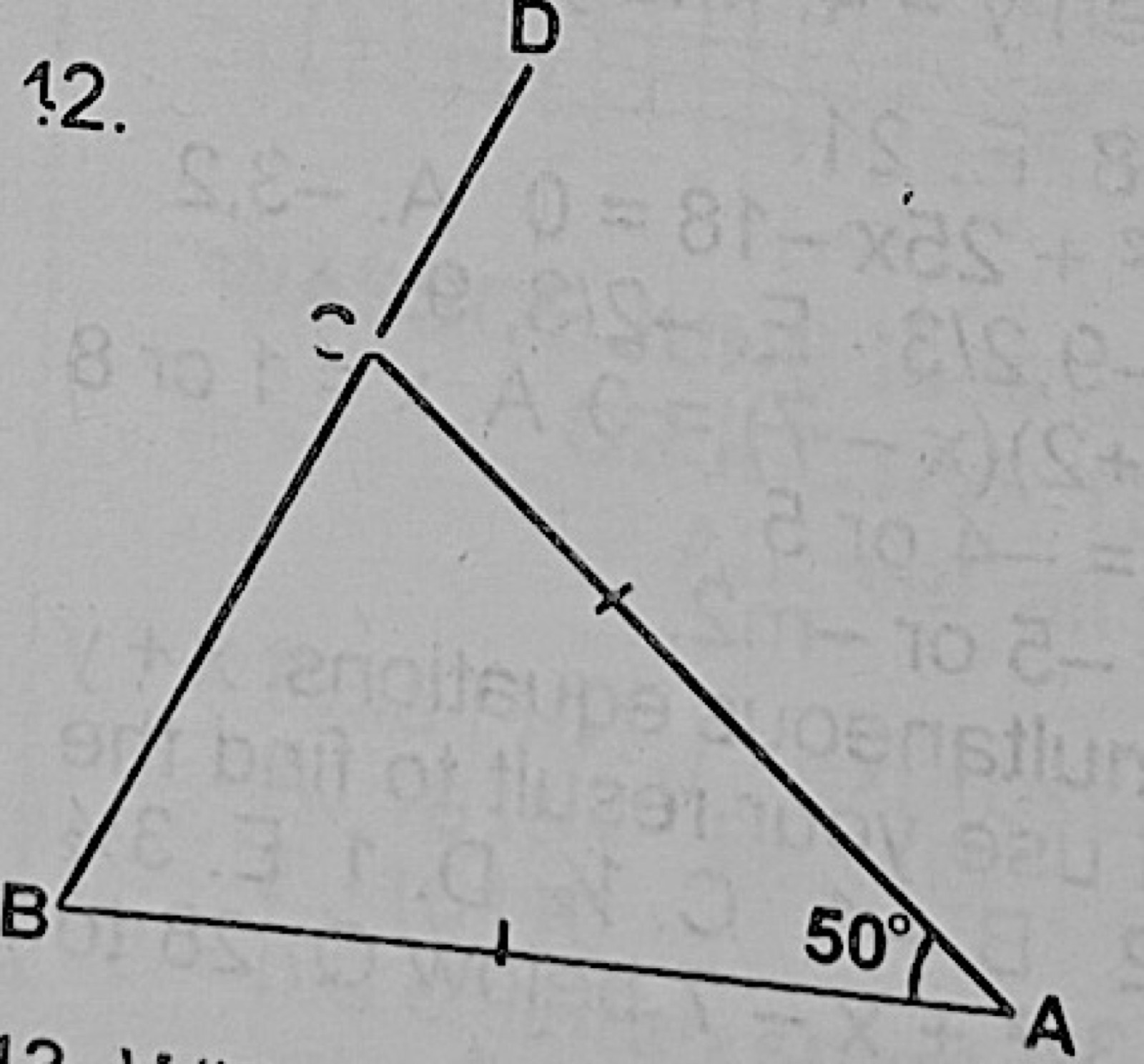
Answer: E (115°)
The base angles are equal: ∠ACB = (180° − 50°)/2 = 65°. Then ∠ACD = 180° − 65° = 115° (angles on a straight line).
Without using tables, find the value of sin 20°/cos 70° + cos 25°/sin 65°
Answer: A (2)
sin 20° = cos 70° and cos 25° = sin 65° (complementary angles), so each fraction equals 1 and the sum is 2.
In the diagram below, ∠PRQ = 90°, ∠QPR = 30° and |PQ| = 12cm. Find y.
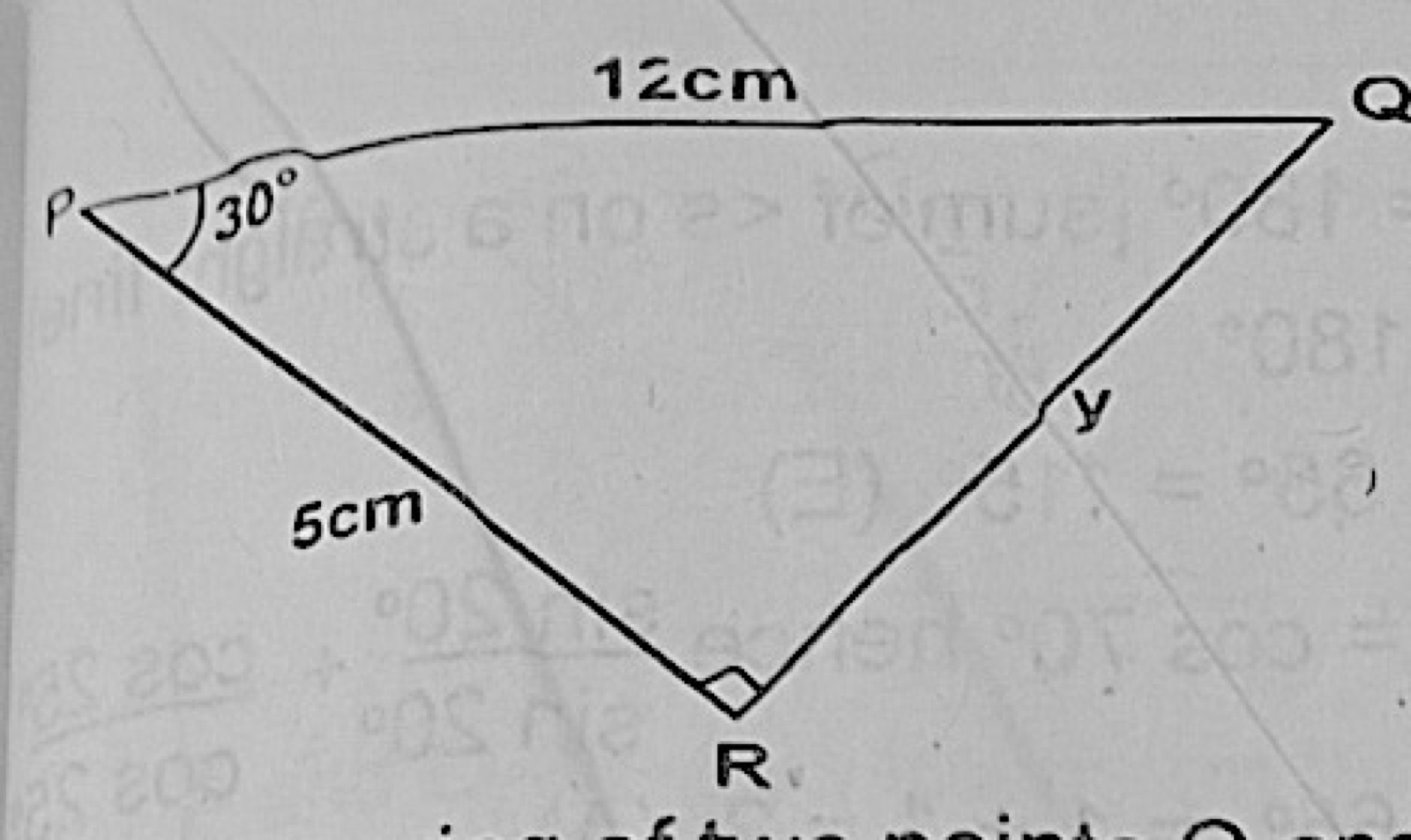
Answer: A (6cm)
y is opposite the 30° angle and PQ is the hypotenuse, so y = 12 sin 30° = 12 × ½ = 6 cm.
The bearing of two points Q and R from a point P are 030° and 120° respectively. If |PQ| = 12m and |PR| = 5m, find the distance QR.
Answer: A (13m)
The angle QPR = 120° − 30° = 90°, so by Pythagoras QR = √(12² + 5²) = √169 = 13 m.
What is the mode of the numbers 8, 10, 9, 9, 10, 8, 11, 8, 10, 9, 8 and 14?
Answer: A (8)
8 appears four times, more than any other number, so the mode is 8.
The mean of 20 observations in an experiment is 4. If the observed largest value is 23, find the mean of the remaining observations.
Answer: B (3)
Total = 20 × 4 = 80. Removing 23 leaves 57 for 19 observations, so the mean is 57 ÷ 19 = 3.
Find the median of the following numbers: 2.64, 2.50, 2.72, 2.91 and 2.35.
Answer: C (2.64)
In order: 2.35, 2.50, 2.64, 2.72, 2.91. The middle (3rd) value is 2.64.
Two fair dice are tossed together once. Find the probability that the sum of the outcome is at least 10.
Answer: C (1/6)
Sums of 10 or more: (4,6), (5,5), (6,4), (5,6), (6,5), (6,6), which is 6 of the 36 outcomes, so 6/36 = 1/6.
From a box containing 2 red, 6 white and 5 black balls, a ball is randomly selected. What is the probability that the selected ball is black?
Answer: B (5/13)
There are 2 + 6 + 5 = 13 balls and 5 are black, so the probability is 5/13.
(a) Factorize: px − 2qx − 4qy + 2py.
(b) Given that the universal set U = [1,2,3,4,5,6,7,8,9,10], P = [1,2,4,6,10] and Q = [2,3,6,9], show that [P∪Q]' = P'∩Q'.
(a) Group: x(p − 2q) + 2y(p − 2q) = (p − 2q)(x + 2y)
(b) P∪Q = {1, 2, 3, 4, 6, 9, 10}, so (P∪Q)' = {5, 7, 8}
P' = {3, 5, 7, 8, 9}, Q' = {1, 4, 5, 7, 8, 10}, so P'∩Q' = {5, 7, 8}
Both sets are {5, 7, 8}, so (P∪Q)' = P'∩Q'
Group the terms in pairs that share a common factor.
The quantity y is partly constant and partly varies inversely as the square of x. (a) Write down the relationship between x and y. (b) When x = 1, y = 11 and when x = 2, y = 5, find the value of y when x = 4.
(a) y = k + a/x2, where k and a are constants
(b) x = 1, y = 11: k + a = 11
x = 2, y = 5: k + a/4 = 5, i.e. 4k + a = 20
Subtract: 3k = 9, k = 3, a = 8, so y = 3 + 8/x2
When x = 4: y = 3 + 8/16 = 3½
'Partly constant and partly varies' means a sum of a constant and a varying part.
(a) In the diagram below, PQSR and SRYZ are parallelograms and PQYZ is a straight line. If |QY| = 2cm and RS = 3cm, find |PZ|.
(b) P and Q are two towns on the earth's surface on latitude 56°N. Their longitudes are 25°E and 95°E respectively. Find the distance PQ along their parallel of latitude, correct to the nearest km. [Take radius of the earth as 6400km and π = 22/7].
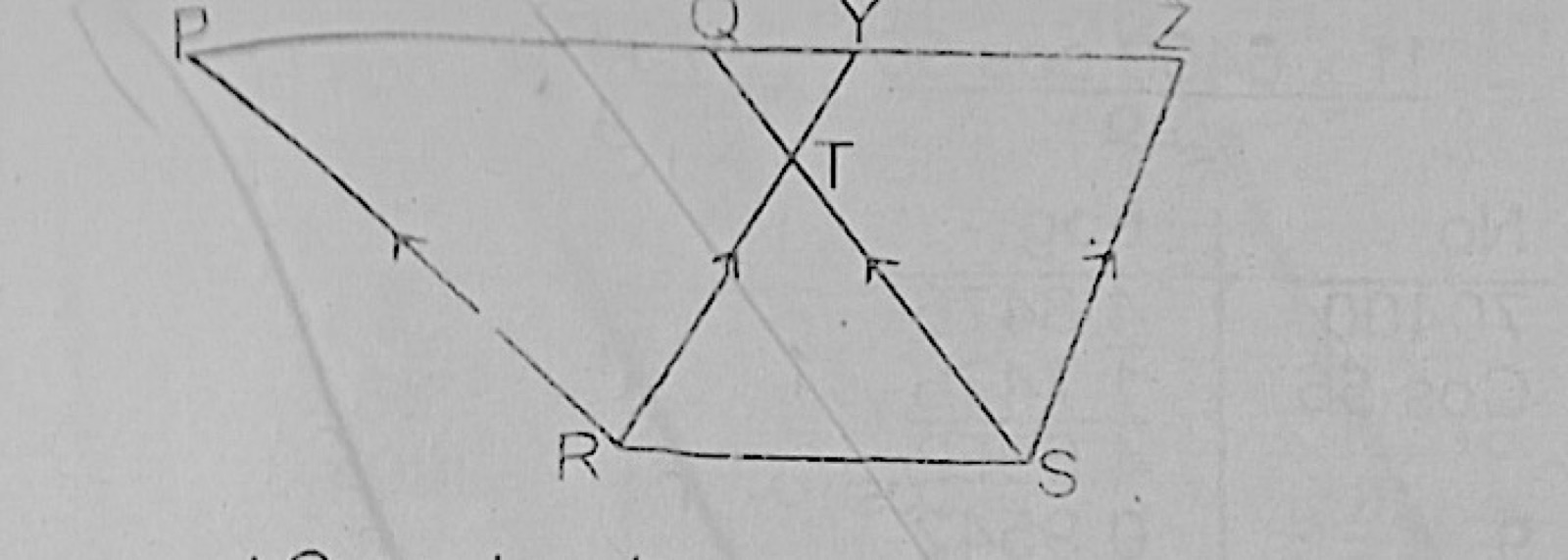
(a) Opposite sides of a parallelogram are equal: |PQ| = |RS| = 3 cm and |YZ| = |RS| = 3 cm
|PZ| = 3 + 2 + 3 = 8 cm
(b) Difference in longitude = 95° − 25° = 70°
PQ = 70/360 × 2 × 22/7 × 6400 × cos 56°
= 7822.2 × 0.5592 ≈ 4374 km
Along a parallel of latitude, use radius R cos(latitude).
(a) A pack of 52 playing cards in shuffled and a card is drawn at random. Calculate the probability that it is either a five or a red nine. [Hint: There are 4 fives and 2 red nines in a pack of 52 cards].
(b) P, Q and R are points in the same horizontal plane. The bearing of Q from P is 150° and the bearing of R from Q is 060°. If |PQ| = 5cm and |QR| = 3m, find the bearing of R from P, correct to the nearest degree.
(a) P(five or red nine) = 4/52 + 2/52 = 6/52 = 3/26
(b) Sketch: the bearing of P from Q is 330°, so ∠PQR = 360° − 330° + 60° = 90°
tan ∠QPR = 3/5 = 0.6, so ∠QPR ≈ 31°
R lies to the east side of PQ, so the bearing of R from P = 150° − 31° = 119°
Find the angle at Q from the back bearing first; it is a right angle here.
(a) The frequency table shows the marks scored by 32 students in a test.
Marks scored: 1, 2, 3, 4, 5, 6, 7, 8, 9, 10
No. of Students: 2, 3, 4, 4, 4, 4, 5, 3, 2, 1
Find the: (a) (i) Mean (ii) Median (iii) Mode
(b)(i) Find the number of students that scored at least 8 marks. (b) Caculate the percentage that scored at least 8 marks.
(a)(i) Σfx = 2 + 6 + 12 + 16 + 20 + 24 + 35 + 24 + 18 + 10 = 167; mean = 167/32 ≈ 5.2
(ii) Median is the average of the 16th and 17th marks; both are 5, so median = 5
(iii) Mode = 7 (frequency 5)
(b) At least 8 marks: 3 + 2 + 1 = 6 students
Percentage = 6/32 × 100% = 18.75%
With 32 values the median is the mean of the 16th and 17th values in order.
(a) Using mathematical tables, find; (i) 2 sin 63.35° (ii) log cos 44.74°
(b) Find the value of K given that log K − log (K − 2) = log 5.
(c) Use logarithm tables to evaluate (3.68)2 × 6.705/√0.3581
(a)(i) sin 63.35° = 0.8938, so 2 sin 63.35° = 1.7876
(ii) cos 44.74° = 0.7103, log 0.7103 = 1̄.8514
(b) log(K/(K − 2)) = log 5, so K = 5(K − 2), 4K = 10, K = 2.5
(c) log 3.68 = 0.5658; × 2 = 1.1316; + log 6.705 (0.8264) = 1.9580
log 0.3581 = 1̄.5540; ÷ 2 for the root = 1̄.7770
1.9580 − 1̄.7770 = 2.1810; antilog ≈ 151.7
To take a square root with logs, halve the log (handle the negative characteristic carefully).
(a) Given that p = x + ym3, find m in terms of p, x and y.
(b) Using the method of completing the square, find the roots of the equations x2 − 6x + 7 = 0, correct to 1 decimal place.
(c) The product of two consecutive positive odd numbers is 195. By constructing a quadratic equation and solving it, find the two numbers.
(a) ym3 = p − x, m3 = (p − x)/y, m = ∛((p − x)/y)
(b) x2 − 6x = −7; add 9: (x − 3)2 = 2
x − 3 = ±√2 = ±1.414, x = 4.4 or 1.6
(c) Let the numbers be n and n + 2: n(n + 2) = 195
n2 + 2n − 195 = 0, (n − 13)(n + 15) = 0
n = 13 (n = −15 rejected, not positive); the numbers are 13 and 15
To complete the square, add (half the coefficient of x)² to both sides.
(a) Copy and complete the table for the relation y = 2 cos 2x − 1
x: 0°, 30°, 60°, 90°, 120°, 150°, 180°
y = 2cos 2x − 1: 10, 0, __, __, __, __, 1.0
(b) Using a scale of 2 cm = 30° on the x-axis and 2cm = 1 unit on the y-axis, draw the graph of y = 2 cos 2x − 1 for 0° ≤ x ≤ 180°
(c) On the same axis draw the graph of y = 1/180 (x − 360).
(d) Use your graphs to find the: (i) values of x for which 2 cos 2x + ½ = 0; (ii) roots of the equation 2 cos 2x − x/180 + 1 = 0.
(a) x = 0°: 1.0; 30°: 0; 60°: −2; 90°: −3; 120°: −2; 150°: 0; 180°: 1.0
(b) Plot the points and join with a smooth curve.
(c) Straight line through (0°, −2) and (180°, −1).
(d)(i) 2 cos 2x + ½ = 0 means 2 cos 2x − 1 = −1½: draw y = −1½ and read x ≈ 52° and x ≈ 128°
(ii) The equation rearranges to 2 cos 2x − 1 = (x − 360)/180, so read where the curve meets the line: x ≈ 55° and x ≈ 131°
Rearrange each equation so one side is the plotted curve; the other side gives the line to draw.
(a) Using a ruler and a pair of compasses only construct triangle ABC with |AB| = 7.5cm, |BC| = 8.1cm and ∠ABC = 105°.
(b) Locate a point D on BC such that |BD| : |DC| is 3:2
(c) Through D, construct a line l perpendicular to BC.
(d) If the line l meets AC at P, measure |BP|
(a) Draw BC = 8.1 cm; construct 105° at B (90° + 15°, i.e. bisect between 90° and 120°); mark A with BA = 7.5 cm; join AC.
(b) Divide BC in the ratio 3 : 2: draw a line from B, step off 5 equal units, join the 5th to C and draw a parallel through the 3rd mark; BD ≈ 4.86 cm.
(c) Construct the perpendicular to BC at D.
(d) |BP| ≈ 5.4 cm
Show all construction arcs; dividing a line in a ratio uses equal steps and parallel lines.
(a) A man travels from a village X on a bearing of 060° to a village Y which is 20km away. From Y, he travels to a village Z, on a bearing of 195°. If Z is directly east of X, calculate, correct to three significant figures, the distance of: (i) Y from Z (ii) Z from X.
(b) An aircraft flies due south from an airfield on latitude 36°N longitude 138°E to an airfield on latitude 36°S longitude 138°E. (i) Calculate the distance travelled, correct to three significant figures (ii) if the speed of the aircraft is 800km per hour, calculate the time taken, correct to the nearest hour. [Take π = 22/7 R = 6400km].
(a) ∠YXZ = 90° − 60° = 30°; ∠XYZ = 240° − 195° = 45°; ∠XZY = 105°
(i) YZ = 20 sin 30°/sin 105° = 10/0.9659 ≈ 10.4 km
(ii) XZ = 20 sin 45°/sin 105° = 14.14/0.9659 ≈ 14.6 km
(b)(i) Angle between the latitudes = 36° + 36° = 72° along a meridian (a great circle)
Distance = 72/360 × 2 × 22/7 × 6400 ≈ 8046 km ≈ 8050 km
(ii) Time = 8046 ÷ 800 ≈ 10 hours
Draw north lines at X and Y to find the angles of the triangle, then use the sine rule.
The table below shows the scores of 2000 candidates in an entrance examination into a private secondary school.
% Marks: 11-20, 21-30, 31-40, 41-50, 51-60, 61-70, 71-80, 81-90
No. of Pupils: 68, 184, 294, 402, 480, 310, 164, 98
(a) Prepare a cumulative frequency table and draw the cumulative frequency curve for the distribution.
(b) Use your curve to estimate the: (i) cut-off mark, if 300 candidates are to be offered admission. (ii) probability that a candidate picked at random scored at least 45%.
(a) Upper class boundaries 20.5, 30.5, 40.5, 50.5, 60.5, 70.5, 80.5, 90.5 with cumulative frequencies 68, 252, 546, 948, 1428, 1738, 1902, 2000; plot and draw a smooth ogive
(b)(i) 300 admitted means 2000 − 300 = 1700 below the cut-off; reading at 1700 gives about 69%
(ii) About 710 candidates scored below 45%, so about 1290 scored at least 45%
Probability ≈ 1290/2000 ≈ 0.65
Plot cumulative frequency against upper class boundaries; the top 300 lie above the 1700th candidate.
A box contains 5 blue balls, 3 black balls and 2 red balls of the same size. A ball is selected at random from the box and then replaced. A second ball is then selected. Find the probability of obtaining; (a) two red balls: (b) two blue balls or two black balls; (c) one black ball and one red ball in any order.
Total = 10 balls; draws are independent (with replacement)
(a) P(two red) = 2/10 × 2/10 = 1/25
(b) P(two blue) + P(two black) = (5/10)2 + (3/10)2 = 25/100 + 9/100 = 17/50
(c) P(black, red) + P(red, black) = 2 × 3/10 × 2/10 = 12/100 = 3/25
'In any order' means add both orders.