WAEC Commerce 2023 past questions and answers

55 questions. Try each one, then open the answer to check yourself and read the explanation.

Question 1

Computers in Commerce

Buying and selling products through a network of digital devices is

  1. A.e-transfer.
  2. B.e-payment
  3. C.e-mail.
  4. D.e-commerce.
Show the answer and explanation

Answer: D (e-commerce.)

Explanation

E-commerce is buying and selling goods and services over the internet and other digital networks.

Open this question

Question 3

Occupation

Industrial, commercial and service are types of

  1. A.specialization.
  2. B.occupation.
  3. C.manufacturing.
  4. D.extraction.
Show the answer and explanation

Answer: B (occupation.)

Explanation

Occupations are grouped into industrial, commercial and services (direct and indirect).

Open this question

Question 5

Business Units

A document in which the internal regulations of a company are stated is

  1. A.Partnership Deed.
  2. B.Memorandum of Association.
  3. C.Certificate of Incorporation.
  4. D.Articles of Association.
Show the answer and explanation

Answer: D (Articles of Association.)

Explanation

The Articles of Association set out the internal rules of a company; the Memorandum deals with its relations with outsiders.

Open this question

Question 6

Business Units

A business that can obtain capital through the sale of shares is a

  1. A.sole proprietorship.
  2. B.public corporation.
  3. C.public company.
  4. D.cooperative society.
Show the answer and explanation

Answer: C (public company.)

Explanation

A public limited company invites the general public to buy its shares. Sole traders, public corporations (funded by government) and cooperatives do not sell shares to the public.

Open this question

Question 7

Money

A problem associated with barter is

  1. A.difficulty in collecting debt.
  2. B.inability to measure what is to be exchanged.
  3. C.inability to produce enough goods.
  4. D.poor road network delaying transportion of goods.
Show the answer and explanation

Answer: B (inability to measure what is to be exchanged.)

Explanation

Barter has no common measure of value, so it is hard to decide how much of one good equals another.

Open this question

Question 8

Business Units

Dissolution of a partnership could arise from

  1. A.fall in output.
  2. B.death of a member.
  3. C.non access to capital.
  4. D.increase in market share.
Show the answer and explanation

Answer: B (death of a member.)

Explanation

A partnership is a personal agreement, so the death of a partner normally ends it.

Open this question

Question 9

Co-operative Societies

A source of capital to a cooperative society is

  1. A.contribution
  2. B.debenture
  3. C.ordinary share
  4. D.retained profit.
Show the answer and explanation

Answer: A (contribution)

Explanation

A cooperative's capital comes mainly from its members' contributions; it cannot issue debentures or ordinary shares to the public.

Open this question

Question 10

Occupation

Which of the following activities does not belong to the extractive industry?

  1. A.Barbing
  2. B.Drilling
  3. C.Farming
  4. D.Mining.
Show the answer and explanation

Answer: A (Barbing)

Explanation

Extractive industry takes natural resources from land or sea (mining, drilling, farming). Barbing is a direct personal service.

Open this question

Question 11

Business Finance

The excess value of total assets over total liabilities is

  1. A.working capital
  2. B.paid-up capital.
  3. C.capital owned.
  4. D.borrowed capital.
Show the answer and explanation

Answer: C (capital owned.)

Explanation

What is left of the assets after paying all liabilities belongs to the owner: capital owned (net worth). Working capital is current assets minus current liabilities.

Open this question

Question 12

Trade Associations

A voluntary association of businessmen who are not in the same line of business is a

  1. A.bureau de change.
  2. B.trade union.
  3. C.trade association.
  4. D.chamber of commerce.
Show the answer and explanation

Answer: D (chamber of commerce.)

Explanation

A chamber of commerce brings together businesses of different kinds in an area; a trade association is for one line of business.

Open this question

Question 13

Business Units

A similarity of a private and public company is that they

  1. A.are required to publish their final accounts.
  2. B.have equal number of members.
  3. C.receive certificate of incorporation.
  4. D.sell shares on the stock exchange.
Show the answer and explanation

Answer: C (receive certificate of incorporation.)

Explanation

Both private and public companies are registered and receive a certificate of incorporation; only public companies sell shares on the stock exchange.

Open this question

Question 14

Stock Exchange

Which of the following is not a type of security?

  1. A.Debenture
  2. B.Overdraft
  3. C.Share
  4. D.Stock
Show the answer and explanation

Answer: B (Overdraft)

Explanation

Shares, stocks and debentures are securities traded on the stock exchange; an overdraft is a bank facility.

Open this question

Question 15

Consumer Protection

An organization that could strive for improvement in electricity and telephone services to users is

  1. A.a consumers' association.
  2. B.an employers' association.
  3. C.a manufacturers' association.
  4. D.a trade association.
Show the answer and explanation

Answer: A (a consumers' association.)

Explanation

Users of electricity and telephone services are consumers, and a consumers' association fights for their interests.

Open this question

Question 16

Retail Trade

The business in which sale of goods involves use of vehicles is a

  1. A.chain store.
  2. B.mobile shop.
  3. C.shopping mall.
  4. D.tied shop.
Show the answer and explanation

Answer: B (mobile shop.)

Explanation

A mobile shop is a van or vehicle fitted as a shop that moves from place to place to sell goods.

Open this question

Question 17

Foreign Trade

The arrangement for the conveyance of goods abroad is performed by the

  1. A.ports authority.
  2. B.customs and excise authority.
  3. C.chamber of commerce.
  4. D.clearing and forwarding agents.
Show the answer and explanation

Answer: D (clearing and forwarding agents.)

Explanation

Clearing and forwarding agents arrange shipment, documents and transport of goods for exporters and importers.

Open this question

Question 18

Foreign Trade

One of the barriers to foreign trade is

  1. A.trade liberalization.
  2. B.removal of tariff.
  3. C.memorandum of understanding.
  4. D.imposition of embargo.
Show the answer and explanation

Answer: D (imposition of embargo.)

Explanation

An embargo bans trade in certain goods or with certain countries, so it blocks foreign trade.

Open this question

Question 19

Purchase and Sale of Goods

The term 2%/15 net 30 represents a

  1. A.cash discount.
  2. B.quantity discount.
  3. C.seasonal discount.
  4. D.trade discount.
Show the answer and explanation

Answer: A (cash discount.)

Explanation

'2%/15 net 30' means the buyer gets 2% off if he pays within 15 days; otherwise the full amount is due in 30 days. A discount for prompt payment is a cash discount.

Open this question

Question 20

Banking

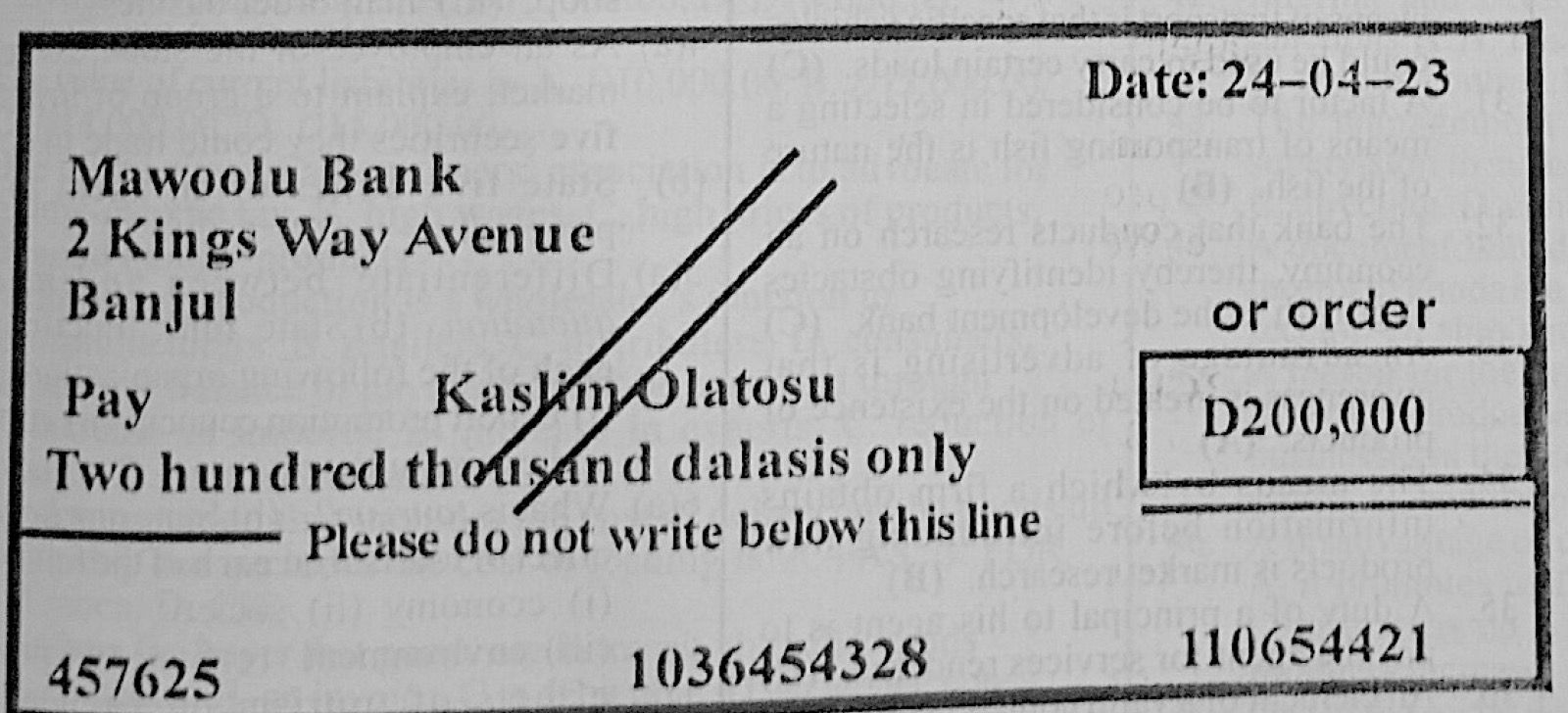
Use the diagram below to answer questions 20 to 22.
[Figure: a crossed cheque on Mawoolu Bank, Banjul, dated 24-04-23, Pay Kaslim Olatosu or order, D200,000, Two hundred thousand dalasis only]
The instrument in the diagram is a

Diagram for this question
  1. A.warrant
  2. B.money order
  3. C.cheque
  4. D.deposit slip.
Show the answer and explanation

Answer: C (cheque)

Explanation

It is an order to a bank (Mawoolu Bank) to pay a named person a sum of money: a cheque.

Open this question

Question 21

Banking

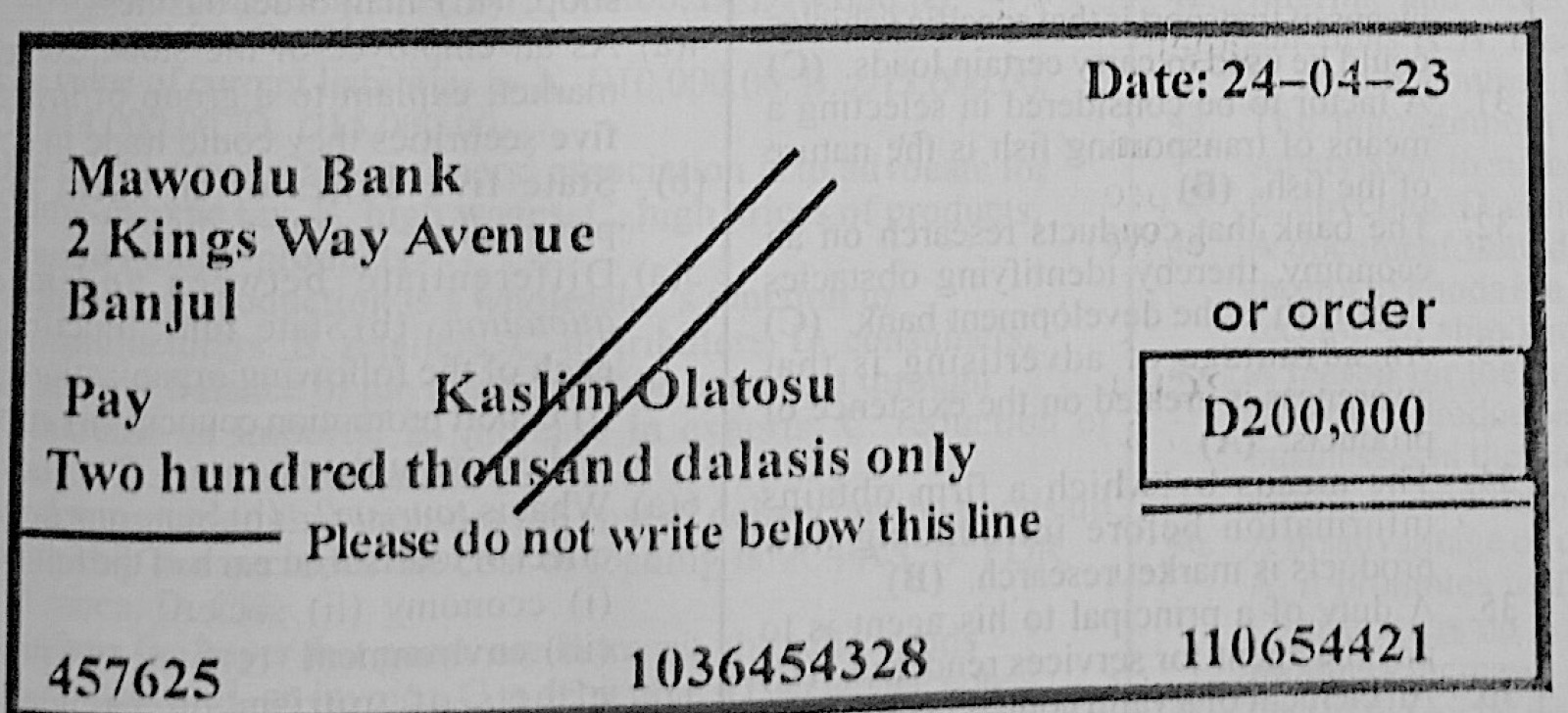
Use the diagram below to answer questions 20 to 22.
[Figure: a crossed cheque on Mawoolu Bank, Banjul, dated 24-04-23, Pay Kaslim Olatosu or order, D200,000, Two hundred thousand dalasis only]
The two lines on the instrument shows that it is

Diagram for this question
  1. A.paid
  2. B.crossed
  3. C.cancelled.
  4. D.altered.
Show the answer and explanation

Answer: B (crossed)

Explanation

Two parallel lines drawn across a cheque make it a crossed cheque, which must be paid into a bank account.

Open this question

Question 22

Banking

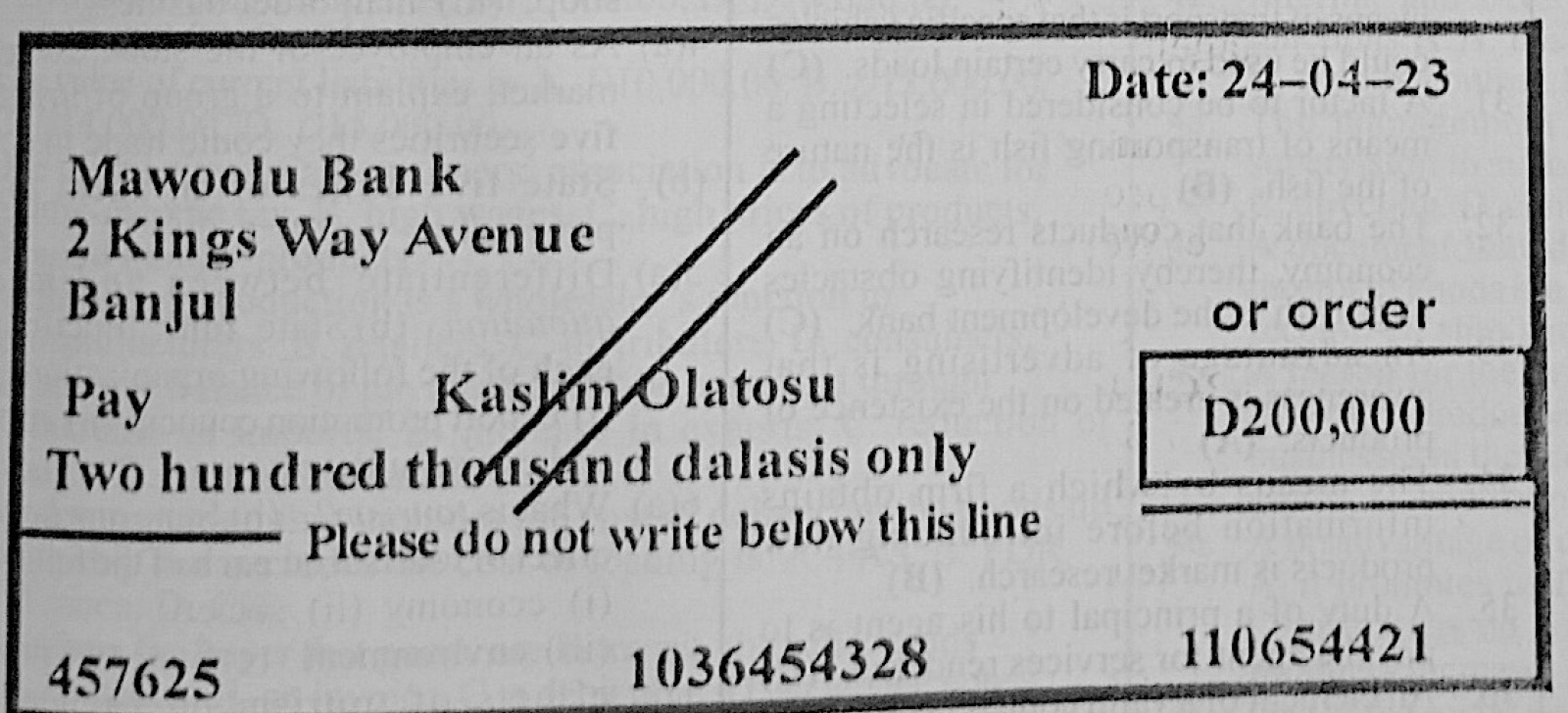
Use the diagram below to answer questions 20 to 22.
[Figure: a crossed cheque on Mawoolu Bank, Banjul, dated 24-04-23, Pay Kaslim Olatosu or order, D200,000, Two hundred thousand dalasis only]
The instrument will not be valid on

Diagram for this question
  1. A.October 25, 2023
  2. B.September 25, 2023.
  3. C.July 25, 2023.
  4. D.June 25, 2023
Show the answer and explanation

Answer: A (October 25, 2023)

Explanation

A cheque becomes stale six months after its date. Dated 24 April 2023, it is valid until 24 October 2023, so on 25 October 2023 it is no longer valid.

Open this question

Question 24

Purchase and Sale of Goods

When a seller wishes to be paid before supplying goods, he would send the buyer a

  1. A.consular invoice.
  2. B.consignment note.
  3. C.credit note.
  4. D.proforma invoice.
Show the answer and explanation

Answer: D (proforma invoice.)

Explanation

A proforma invoice looks like an invoice but is sent before delivery, e.g. to ask for payment in advance (cash with order).

Open this question

Question 25

Foreign Trade Documents

A bill of lading that is tagged clean means that the goods being delivered are

  1. A.paid for.
  2. B.on credit.
  3. C.not damaged.
  4. D.duty free.
Show the answer and explanation

Answer: C (not damaged.)

Explanation

A clean bill of lading has no remarks about damage or shortage: the goods were loaded in good order. A 'dirty' (claused) bill notes damage.

Open this question

Question 26

Business Calculations

If opening and closing inventories of a business are D500 and D300 respectively and cost of sales is D1,200, rate of turnover will be

  1. A.4.0 times.
  2. B.3.0 times
  3. C.2.4 times
  4. D.1.5 times.
Show the answer and explanation

Answer: B (3.0 times)

Explanation

Average inventory = (500 + 300) ÷ 2 = D400. Rate of turnover = cost of sales ÷ average inventory = 1,200 ÷ 400 = 3 times.

Open this question

Question 27

Money

The function of money that makes it generally acceptable is

  1. A.medium of exchange.
  2. B.standard of deferred payment.
  3. C.store of value.
  4. D.unit of account.
Show the answer and explanation

Answer: A (medium of exchange.)

Explanation

Because everyone accepts money in exchange for goods and services, it serves as a medium of exchange.

Open this question

Question 28

Foreign Trade

A reduction in the value of a country's currency in relation to that of other countries is

  1. A.inflation
  2. B.deflation
  3. C.devaluation.
  4. D.revaluation.
Show the answer and explanation

Answer: C (devaluation.)

Explanation

Devaluation is an official lowering of a currency's value against other currencies.

Open this question

Question 29

Transport

The penalty paid for not off-loading goods at a port within the stipulated time is

  1. A.charge.
  2. B.demurrage.
  3. C.dock due.
  4. D.freight.
Show the answer and explanation

Answer: B (demurrage.)

Explanation

Demurrage is the penalty paid when a ship, wagon or goods are held beyond the agreed time for loading or unloading.

Open this question

Question 30

Transport

An advantage of road transport over other means of transport is that

  1. A.canteen services are provided during the cost of transportion.
  2. B.packing and loading is easy as activities are handled by experts.
  3. C.specific vehicles could be used to carry certain loads.
  4. D.terminal handling is eliminated by door-to-door delivery.
Show the answer and explanation

Answer: D (terminal handling is eliminated by door-to-door delivery.)

Explanation

Only road transport can pick goods up at the seller's door and drop them at the buyer's door, avoiding extra loading and unloading at stations, ports or airports.

Open this question

Question 31

Transport

A factor to be considered in selecting a means of transporting fish is the

  1. A.supply of fish
  2. B.nature of the fish.
  3. C.demand for fish
  4. D.cost of the fish.
Show the answer and explanation

Answer: B (nature of the fish.)

Explanation

Fish is perishable, so its nature (it spoils fast) decides the need for fast or refrigerated transport.

Open this question

Question 32

Banking

The bank that conducts research on an economy, thereby identifying obtacles to growth is the

  1. A.central bank.
  2. B.commercial bank.
  3. C.development bank
  4. D.mortgage bank.
Show the answer and explanation

Answer: A (central bank.)

Explanation

The central bank studies the whole economy, publishes reports and advises government on problems and policies.

Open this question

Question 33

Advertising

An advantage of advertising is that

  1. A.awareness is created on the existence of products.
  2. B.distribution channels for products are improved.
  3. C.prices of products are reduced.
  4. D.quality of products is improved.
Show the answer and explanation

Answer: A (awareness is created on the existence of products.)

Explanation

Advertising tells people that a product exists and what it does.

Open this question

Question 34

Marketing

The means by which a firm obtains information before introducing new products is

  1. A.advertising
  2. B.market research
  3. C.market segmentation.
  4. D.promotion.
Show the answer and explanation

Answer: B (market research)

Explanation

Market research collects information about consumers' needs and the market before a product is launched.

Open this question

Question 35

Law of Agency

A duty of the principal to his agent is to

  1. A.stop the sale of good in transit
  2. B.renegotiate agreements made by the agent
  3. C.pay the agent for services rendered.
  4. D.disclose confidential information.
Show the answer and explanation

Answer: C (pay the agent for services rendered.)

Explanation

A principal must pay the agent the agreed commission or remuneration and reimburse his expenses.

Open this question

Question 36

Law of Contract

An element of a valid contract is

  1. A.operation of law
  2. B.performance
  3. C.capacity to contract.
  4. D.breach.
Show the answer and explanation

Answer: C (capacity to contract.)

Explanation

The parties must have legal capacity to contract; performance and breach are ways a contract ends.

Open this question

Question 37

Marketing

An example of after-sales service is

  1. A.sorting and grading of goods.
  2. B.provision of price list and terms.
  3. C.granting of discount.
  4. D.free replacement of parts.
Show the answer and explanation

Answer: D (free replacement of parts.)

Explanation

After-sales service is support given after a sale, e.g. free repairs, delivery, installation or replacement of faulty parts.

Open this question

Question 38

Transport

Which of the following modes of transport could be used to convey both liquid and gas?

  1. A.Tramp
  2. B.Tanker
  3. C.Ferry
  4. D.Aeroplane.
Show the answer and explanation

Answer: B (Tanker)

Explanation

Tankers (ships or vehicles) are built to carry liquids and gases such as oil and gas.

Open this question

Question 39

Advertising

Advertising designed to sell more of a company's products than other brands is

  1. A.competitive.
  2. B.indirect.
  3. C.informative.
  4. D.persuasive.
Show the answer and explanation

Answer: A (competitive.)

Explanation

Competitive advertising tries to win sales from rival brands.

Open this question

Question 40

Law of Contract

In a contract of sale, the amount deposited with the seller for a particular product by a buyer is

  1. A.acceptance
  2. B.counter offer
  3. C.consideration.
  4. D.warranty.
Show the answer and explanation

Answer: C (consideration.)

Explanation

Consideration is the price or value one party gives in return for the other's promise; a deposit is part of it.

Open this question

Question 41

Marketing

The use of brand names and trademarks is to

  1. A.control the supply of goods.
  2. B.make after-sales service possible.
  3. C.prevent imitation by competitors.
  4. D.stabilize the prices of goods.
Show the answer and explanation

Answer: C (prevent imitation by competitors.)

Explanation

A registered brand name or trademark distinguishes a firm's product and stops competitors from copying it.

Open this question

Question 42

Government and Business

A disadvantage of privatization is that

  1. A.there is decline in the supply of goods.
  2. B.there is less efficiency in the production of goods.
  3. C.public interest outweighs the profit motive.
  4. D.income is unevenly distributed.
Show the answer and explanation

Answer: D (income is unevenly distributed.)

Explanation

Privatization puts public assets in the hands of a few rich buyers, widening the gap between rich and poor.

Open this question

Question 43

Government and Business

Operating a state owned enterprise with the intention of making more profit is

  1. A.commercialization.
  2. B.deregulation
  3. C.nationalization.
  4. D.privatization.
Show the answer and explanation

Answer: A (commercialization.)

Explanation

Commercialization keeps government ownership but runs the enterprise to make profit.

Open this question

Question 44

Marketing

The department that ensures that products are made available to consumers is

  1. A.finance
  2. B.marketing
  3. C.production
  4. D.purchases.
Show the answer and explanation

Answer: B (marketing)

Explanation

The marketing department handles pricing, promotion and distribution so that products reach consumers.

Open this question

Question 45

Advertising

Which of the following is not a form of sales promotion?

  1. A.Free samples
  2. B.Demonstrations
  3. C.Cash on delivery
  4. D.Buy one get one free
Show the answer and explanation

Answer: C (Cash on delivery)

Explanation

Free samples, demonstrations and 'buy one get one free' are used to boost sales. Cash on delivery is only a way of paying.

Open this question

Question 46

Government and Business

Divesting government interest in a business to the public is

  1. A.privatization
  2. B.nationalization.
  3. C.deregulation.
  4. D.commercialization.
Show the answer and explanation

Answer: A (privatization)

Explanation

Privatization is government selling its shares in a business to private individuals and firms.

Open this question

Question 47

Business Management

The management function that is concerned with coordinating business resources efficiently is

  1. A.controlling.
  2. B.motivation.
  3. C.planning.
  4. D.organizing.
Show the answer and explanation

Answer: D (organizing.)

Explanation

Organizing arranges people, money and materials and fits them together so the plan can be carried out efficiently.

Open this question

Question 48

Business Management

An organisational chart is used to

  1. A.determine the departmental objectives and targets.
  2. B.implement policies on staff welfare.
  3. C.measure variation on staff performance.
  4. D.show the hierachy of staff.
Show the answer and explanation

Answer: D (show the hierachy of staff.)

Explanation

An organisational chart shows positions and lines of authority, i.e. the hierarchy of staff.

Open this question

Question 49

Economic Integration

Which of the following countries is not a member of the European Union?

  1. A.Bolivia
  2. B.Denmark
  3. C.France
  4. D.Greece
Show the answer and explanation

Answer: A (Bolivia)

Explanation

Bolivia is in South America; Denmark, France and Greece are EU members.

Open this question

Question 50

Economic Integration

One of the aims of ECOWAS is to

  1. A.encourage foreign investments.
  2. B.ensure production of quality goods.
  3. C.improve transportation and communication.
  4. D.promote privatization policies.
Show the answer and explanation

Answer: C (improve transportation and communication.)

Explanation

The ECOWAS treaty aims at economic integration, including joint development of transport and communication links (roads, telecommunications) among member states.

Open this question

Theory question 101

Introduction to Commerce

(a) Explain five factors that delayed the growth of commerce in West Africa.
(b) Using appropriate headings, classify the following workers: (i) oil driller (ii) potter; (iii) policeman; (iv) brewer; (v) stock broker; (vi) mason; (vii) farmer.

Show the model answer
Model answer

(a) Any five, explained: poor transport network (bad roads, few railways); poor communication facilities; shortage of capital/low savings; few banks and other financial institutions; lack of insurance cover; inadequate warehousing (goods spoil); low income and low demand; illiteracy and lack of business skills; political instability; poor technology; barter and absence of a common currency in early times.
(b) Industrial occupation:
- Extractive: oil driller, farmer
- Manufacturing: potter, brewer
- Construction: mason
Commercial occupation: stock broker
Services (direct): policeman

Explanation

Classify under industrial, commercial and services, with subheadings for industry.

Open this question

Theory question 102

Business Units

Victor and Samba have been partners for two years. They have had disagreements throughout the period and Samba requested for a dissolution of the partnership so that he could start a sole proprietorship.
(a) State five problems Samba could face as a sole trader.
(b) State five benefits Samba could enjoy if he remained in the partnership.

Show the model answer
Model answer

(a) Any five: limited capital; unlimited liability; bears all losses and risks alone; heavy workload; lack of continuity (business may end with his illness or death); limited skills and ideas; difficulty getting large loans; no one to share decisions with.
(b) Any five: more capital from two partners; losses and risks are shared; division of labour and specialisation; combined skills, ideas and experience; better decisions through consultation; easier access to credit; business continues if one partner is absent; continued use of goodwill already built.

Explanation

Contrast one-owner business with two-owner business.

Open this question

Theory question 103

Warehousing

(a) State four functions of warehousing.
(b) State two features of each of the following retail outlets: (i) chain store (ii) mobile shop; (iii) mail order business.

Show the model answer
Model answer

(a) Any four: safe storage of goods until needed; protects goods from damage, theft and weather; ensures a steady supply all year (seasonal goods); helps stabilise prices; allows packing, blending, grading and branding; bonded warehouses keep imported goods until duty is paid; goods in store can be used as security for loans; creates time utility.
(b)(i) Chain store (any two): many branches in different towns; same type of goods and similar shop fronts; central buying and control from head office; uniform prices.
(ii) Mobile shop (any two): sells from a van/vehicle; moves from place to place to meet customers; serves rural and new areas; carries a limited range of goods; attracts customers with music or horns.
(iii) Mail order (any two): advertises with catalogues, newspapers or online; orders received by post/phone/internet; goods delivered by post or courier; payment by cash with order or cash on delivery; no physical shop needed.

Explanation

Two features for each of the three outlets.

Open this question

Theory question 104

Stock Exchange

(a) As an employee of the stock exchange market, explain to a group of investors five securities they could trade in.
(b) State five duties of an agent to his principal.

Show the model answer
Model answer

(a) Any five, explained: ordinary shares (part ownership, variable dividend, voting rights); preference shares (fixed dividend paid first); debentures (long-term loans to a company at fixed interest); stocks (shares converted into a fund that can be traded in any amount); government bonds/gilt-edged securities (loans to government at fixed interest); treasury bills; convertible loan stock; municipal (local government) bonds.
(b) Any five: obey the principal's lawful instructions; act with reasonable care and skill; act in good faith and not make secret profit; not delegate duties without permission; keep proper accounts and render them; avoid conflict of interest; keep the principal's information confidential; pass on all money received for the principal.

Explanation

Duties of an agent, not of the principal.

Open this question

Theory question 105

Foreign Trade Documents

(a) Differentiate between indent and quotation.
(b) State four functions of each of the following organizations: (i) export promotion council; (ii) customs and excise authority.

Show the model answer
Model answer

(a) An indent is an order for goods sent by an importer to an agent/supplier abroad (used in foreign trade); a quotation is a seller's reply to an enquiry stating the prices and terms on which goods can be supplied (from seller to buyer).
(b)(i) Export promotion council (any four): finds foreign markets for local products; organises and sponsors participation in trade fairs abroad; gives information and advice to exporters; trains exporters in export procedures and standards; gives incentives and help with export finance; promotes non-oil/non-traditional exports.
(ii) Customs and excise authority (any four): collects import, export and excise duties; prevents smuggling and arrests smugglers; stops the import of banned and harmful goods; manages bonded warehouses; checks documents and values goods; collects trade statistics for government.

Explanation

Indent goes from buyer; quotation comes from seller.

Open this question

Theory question 106

Tourism

(a) What is tourism?
(b) State one negative effect of tourism on each of the following: (i) economy (ii) society; (iii) environment
(c) State two positive effects of tourism on each of the following: (i) economy; (ii) society; (iii) environment

Show the model answer
Model answer

(a) Tourism is the travel of people away from their usual home to other places, for a short time, for leisure, business or other purposes, together with the services provided for them.
(b) Negative (one each): (i) Economy: prices of goods and land rise in tourist areas / income is seasonal. (ii) Society: spread of foreign cultures, crime, drug use or prostitution. (iii) Environment: pollution, litter, damage to natural sites and wildlife.
(c) Positive (two each): (i) Economy: earns foreign exchange; creates jobs; government revenue; growth of hotels, transport and other businesses. (ii) Society: promotes cultural exchange and understanding; improved social amenities; preservation of culture and festivals. (iii) Environment: conservation of parks and wildlife; beautification and cleaner surroundings; better infrastructure.

Explanation

Answer each heading separately.

Open this question

Theory question 107

Marketing

(a) State two differences between marketing and selling.
(b) List four main elements of marketing mix.
(c) Country Z had decided to leave the Economic Community of West African States (ECOWAS). As the adviser on the regional group, explain four benefits the country could derive from remaining in the group.

Show the model answer
Model answer

(a) Any two: marketing starts before production (finding needs), selling starts after goods are made; marketing focuses on the customer's needs, selling on the seller's need to turn goods into cash; marketing is long-term and wide (research, product, price, place, promotion), selling is short-term and only one part of marketing.
(b) Product, price, place (distribution), promotion.
(c) Any four, explained: a wider market for its goods; free movement of people, goods and services; lower or no tariffs on trade with members; attracts investment and joint projects; access to ECOWAS development funds; improved transport and communication links; regional peace and security support; stronger bargaining power in world trade.

Explanation

Marketing mix = the 4 Ps.

Open this question

Theory question 108

Business Calculations

The following information was extracted from the books of Lompat Ventures as at December 31, 2022.
₦
Stock as at 01/01/22 37,500
Stock as at 31/12/22 15,000
Goods bought 30,000
Sales 70,000
Wages and Salaries 2,500
Rent and rates 3,500
Transportation 2,600
Debtors 100,000
Creditors 50,000
Bank overdraft 60,000
Cash at bank 25,000
Calculate (i) net profit; (ii) working capital; (iii) rate of stock turnover.

Show the model answer
Model answer

Cost of sales = 37,500 + 30,000 − 15,000 = ₦52,500
Gross profit = 70,000 − 52,500 = ₦17,500
(i) Expenses = 2,500 + 3,500 + 2,600 = ₦8,600
Net profit = 17,500 − 8,600 = ₦8,900
(ii) Current assets = debtors 100,000 + cash at bank 25,000 + closing stock 15,000 = ₦140,000
Current liabilities = creditors 50,000 + overdraft 60,000 = ₦110,000
Working capital = 140,000 − 110,000 = ₦30,000
(iii) Average stock = (37,500 + 15,000) ÷ 2 = ₦26,250
Rate of stock turnover = 52,500 ÷ 26,250 = 2 times
Explanation

Find gross profit first, then subtract expenses.

Open this question