WAEC Commerce 2011 past questions and answers

57 questions. Try each one, then open the answer to check yourself and read the explanation.

Question 1

Government and Business

When the government gives up its ownership and control of a business to individuals, this is known as

  1. A.nationalization.
  2. B.commercialization.
  3. C.privatization.
  4. D.indigenization.
Show the answer and explanation

Answer: C (privatization.)

Explanation

Transferring government businesses to private owners is privatisation.

Open this question

Question 2

Law of Contract

The reward received by a party in a contract agreement is known as

  1. A.consideration.
  2. B.acceptance
  3. C.offer.
  4. D.warranty.
Show the answer and explanation

Answer: A (consideration.)

Explanation

Consideration is what each party gets in return for his promise.

Open this question

Question 3

Transport

Payment to a ship owner for carrying one's cargo is

  1. A.demurrage.
  2. B.fare.
  3. C.dock due.
  4. D.freight.
Show the answer and explanation

Answer: D (freight.)

Explanation

Freight is the charge for carrying goods by ship.

Open this question

Question 4

Marketing

Which of the following is not pre-sale service?

  1. A.Repair and maintenance work
  2. B.Providing detailed information about the goods to be purchased
  3. C.Demonstrating the use and performance of the products to be sold
  4. D.Setting up facilities for storing the product to be bought.
Show the answer and explanation

Answer: A (Repair and maintenance work)

Explanation

Repair and maintenance are given after the sale (after-sales service).

Open this question

Question 6

Co-operative Societies

The cooperative society that performs a combination of the functions of other types of cooperatives is called

  1. A.consumer cooperative.
  2. B.multipurpose cooperative.
  3. C.producer cooperative.
  4. D.thrift and credit cooperative.
Show the answer and explanation

Answer: B (multipurpose cooperative.)

Explanation

A multipurpose co-operative combines several functions, e.g. buying, selling and lending.

Open this question

Question 7

Business Finance

That portion of the share capital which the company has asked the shareholders to pay for is known as

  1. A.authorized capital.
  2. B.paid-up capital.
  3. C.issued capital.
  4. D.called-up capital.
Show the answer and explanation

Answer: D (called-up capital.)

Explanation

Called-up capital is the amount the company has asked shareholders to pay.

Open this question

Question 8

Transport

One of the advantages of air transport over other forms of transport is

  1. A.safety.
  2. B.flexibility.
  3. C.cost.
  4. D.speed.
Show the answer and explanation

Answer: D (speed.)

Explanation

Air transport is the fastest means of transport.

Open this question

Question 9

Law of Contract

Which of the following are elements of a valid contract?

  1. A.Discharge and performance
  2. B.Offer and acceptance
  3. C.Age and maturity
  4. D.Promise and capacity.
Show the answer and explanation

Answer: B (Offer and acceptance)

Explanation

Offer and acceptance are basic elements of a valid contract.

Open this question

Question 10

Wholesale Trade

The last link in the channel of distribution is the

  1. A.retailer.
  2. B.consumer.
  3. C.wholesaler.
  4. D.producer.
Show the answer and explanation

Answer: B (consumer.)

Explanation

The consumer is the final link in the chain of distribution.

Open this question

Question 11

Foreign Trade

Taxes on imported foreign goods are also known as

  1. A.excise duties.
  2. B.tariffs.
  3. C.ad valorem taxes.
  4. D.dock dues.
Show the answer and explanation

Answer: B (tariffs.)

Explanation

Taxes on imports are called tariffs.

Open this question

Question 12

Foreign Trade

If Karamo who lives in The Gambia imports goods from Senegal and later sells them in Guinea Bissau, Karamo is engaged in

  1. A.multi-lateral trade.
  2. B.counter trade.
  3. C.barter trade.
  4. D.entrepôt trade.
Show the answer and explanation

Answer: D (entrepôt trade.)

Explanation

Importing goods to re-export them is entrepôt trade.

Open this question

Question 13

Wholesale Trade

Manufacturers may sell goods directly to consumers where goods are
I. made to customers' specification
II. advertised by the manufacturer.
III. perishable.
IV. highly technical.
V. widely demanded.

  1. A.I, III and IV only
  2. B.I and III only
  3. C.III, IV and V only
  4. D.III, IV only
Show the answer and explanation

Answer: A (I, III and IV only)

Explanation

Goods made to order, perishable goods and highly technical goods are best sold direct; widely demanded goods usually go through middlemen.

Open this question

Question 14

Money

Which of the following is a means of payment?

  1. A.I.O.U.
  2. B.Postal order
  3. C.Promissory note
  4. D.C.I.F
Show the answer and explanation

Answer: B (Postal order)

Explanation

A postal order is bought at the post office and used to make payments.

Open this question

Question 15

Foreign Trade

Shipping services rendered by Nigeria to The Gambia would be classified by The Gambia as

  1. A.invisible imports.
  2. B.invisible exports.
  3. C.visible imports.
  4. D.visible exports.
Show the answer and explanation

Answer: A (invisible imports.)

Explanation

The Gambia pays for a service from abroad, so it is an invisible import for The Gambia.

Open this question

Question 16

Occupation

The main divisions of production are

  1. A.industry, direct and indirect services.
  2. B.extraction, manufacturing and construction.
  3. C.industry, commerce and direct services.
  4. D.industry, commerce and trading.
Show the answer and explanation

Answer: C (industry, commerce and direct services.)

Explanation

Production is divided into industry, commerce and direct services; extraction, manufacturing and construction are divisions of industry only.

Open this question

Question 17

Business Calculations

Use the following information: A trader's turnover was D36,000. Purchases was D28,000. The opening stock was D2,000 and the closing stock D3,000.
What is the cost of goods sold?

  1. A.D28,000
  2. B.D27,000
  3. C.D8,000
  4. D.D5,000
Show the answer and explanation

Answer: B (D27,000)

Explanation

Cost of goods sold = 2,000 + 28,000 − 3,000 = D27,000.

Open this question

Question 18

Business Calculations

Use the following information: A trader's turnover was D36,000. Purchases was D28,000. The opening stock was D2,000 and the closing stock D3,000.
The average stock is

  1. A.D5,000
  2. B.D3,000
  3. C.D2,500
  4. D.D2,000
Show the answer and explanation

Answer: C (D2,500)

Explanation

Average stock = (2,000 + 3,000) ÷ 2 = D2,500.

Open this question

Question 19

Business Calculations

Use the following information: A trader's turnover was D36,000. Purchases was D28,000. The opening stock was D2,000 and the closing stock D3,000.
What is the rate of turnover?

  1. A.13.5 times
  2. B.10.8 times
  3. C.9 times
  4. D.5.4 times
Show the answer and explanation

Answer: B (10.8 times)

Explanation

Rate of turnover = 27,000 ÷ 2,500 = 10.8 times.

Open this question

Question 20

Insurance

In marine insurance when a particular cargo is thrown into the sea in order to prevent the ship from sinking, the type of marine loss is

  1. A.particular average loss.
  2. B.general average loss.
  3. C.total average loss.
  4. D.constructive average loss.
Show the answer and explanation

Answer: B (general average loss.)

Explanation

Cargo sacrificed to save the ship is a general average loss, shared by all parties to the voyage.

Open this question

Question 21

Business Calculations

The turnover of a trade is the

  1. A.number of times the stock is sold.
  2. B.total sales made during a period.
  3. C.profit made during the period.
  4. D.total purchases made during the period.
Show the answer and explanation

Answer: B (total sales made during a period.)

Explanation

Turnover is the total value of sales in a period.

Open this question

Question 22

Business Finance

The total assets of a business less its total liability is known as

  1. A.capital owned
  2. B.share capital
  3. C.issued capital.
  4. D.working capital.
Show the answer and explanation

Answer: A (capital owned)

Explanation

Assets minus liabilities equals the owner's capital (capital owned).

Open this question

Question 23

Stock Exchange

A document issued to the public by a company to advertise its share is known as

  1. A.prospectus.
  2. B.tender.
  3. C.share certificate.
  4. D.trading certificate.
Show the answer and explanation

Answer: A (prospectus.)

Explanation

A prospectus invites the public to buy a company's shares.

Open this question

Question 24

Banking

An overdraft is the

  1. A.amount permitted to be withdrawn in excess of one's deposit.
  2. B.excessive cash withdrawn by commercial banks from the Central bank.
  3. C.credit balance standing in the name of a customer
  4. D.special deposit made by commercial banks.
Show the answer and explanation

Answer: A (amount permitted to be withdrawn in excess of one's deposit.)

Explanation

An overdraft lets a current account holder draw more than his balance.

Open this question

Question 25

Insurance

Which of the following is not a principle of insurance?

  1. A.Insurable interest
  2. B.Subrogation
  3. C.Surrender value
  4. D.Proximate cause.
Show the answer and explanation

Answer: C (Surrender value)

Explanation

Surrender value is a term in life assurance, not a principle of insurance.

Open this question

Question 26

Stock Exchange

The par value of a share is also known as its

  1. A.premium price.
  2. B.market price.
  3. C.discount price.
  4. D.nominal price.
Show the answer and explanation

Answer: D (nominal price.)

Explanation

Par value is the nominal (face) value of a share.

Open this question

Question 27

Banking

A cheque dated 15th March, 2012 will become stale on

  1. A.16th June, 2012
  2. B.16th July, 2012.
  3. C.16th August, 2012.
  4. D.16th September, 2012.
Show the answer and explanation

Answer: D (16th September, 2012.)

Explanation

A cheque is valid for six months, up to 15th September 2012, so it is stale from 16th September 2012.

Open this question

Question 28

Banking

Banks settle their indebtedness in the

  1. A.discount house.
  2. B.stock exchange market.
  3. C.commercial bank.
  4. D.clearing house.
Show the answer and explanation

Answer: D (clearing house.)

Explanation

Banks settle what they owe one another at the clearing house.

Open this question

Question 29

Foreign Trade

Which of the following distinguishes home trade from foreign trade?

  1. A.Payments are easily arranged
  2. B.Taxes are levied
  3. C.Goods have to be warehoused
  4. D.Middlemen are not required.
Show the answer and explanation

Answer: A (Payments are easily arranged)

Explanation

In home trade one currency is used, so payment is easy; foreign trade needs foreign exchange.

Open this question

Question 30

Money

Before the advent of legal tender and credit instrument, which of the following was used as a medium of exchange?

  1. A.Currency notes
  2. B.Cowries
  3. C.Cheques
  4. D.Bankdrafts
Show the answer and explanation

Answer: B (Cowries)

Explanation

Cowries were used as money before modern currency.

Open this question

Question 31

Foreign Trade Documents

When C.I.F. is quoted on an invoice, it means that the price includes the

  1. A.cost of the goods only.
  2. B.cost of insurance only.
  3. C.cost of carriage only.
  4. D.cost, insurance and carriage.
Show the answer and explanation

Answer: D (cost, insurance and carriage.)

Explanation

CIF means cost, insurance and freight (carriage).

Open this question

Question 32

Trade Associations

Encouraging a high quality of members' products through the circulation of research information is a function of

  1. A.Manufacturers Association.
  2. B.Trade Union.
  3. C.Employers' Association.
  4. D.Consumers' Association.
Show the answer and explanation

Answer: A (Manufacturers Association.)

Explanation

A manufacturers' association shares research information to raise its members' standards.

Open this question

Question 33

Trade Associations

A voluntary association of business executives within a locality is known as

  1. A.Trade Union.
  2. B.Consumers' Association.
  3. C.Chamber of Commerce.
  4. D.Trade Association.
Show the answer and explanation

Answer: C (Chamber of Commerce.)

Explanation

A chamber of commerce brings together businesspeople in a locality.

Open this question

Question 34

Transport

Which of the following is not a function of the Ports Authority?

  1. A.Providing facilities for loading of vessels
  2. B.Collecting dock dues
  3. C.Providing enough ships for the country
  4. D.Dredging of harbours
Show the answer and explanation

Answer: C (Providing enough ships for the country)

Explanation

Ports authorities run the ports; providing ships is the work of shipping lines.

Open this question

Question 35

Marketing

Using symbols, letters, name or combination of these by a company to distinguish its products is

  1. A.product cycle.
  2. B.marketing mix.
  3. C.trade mark.
  4. D.market segmentation.
Show the answer and explanation

Answer: C (trade mark.)

Explanation

A trade mark is a symbol, name or design that identifies a firm's products.

Open this question

Question 36

Introduction to Commerce

Trade as a division of commerce is usually classified into

  1. A.retail and wholesale.
  2. B.import and export.
  3. C.home and foreign.
  4. D.visible and invisible.
Show the answer and explanation

Answer: C (home and foreign.)

Explanation

Trade is divided into home trade and foreign trade.

Open this question

Question 37

Introduction to Commerce

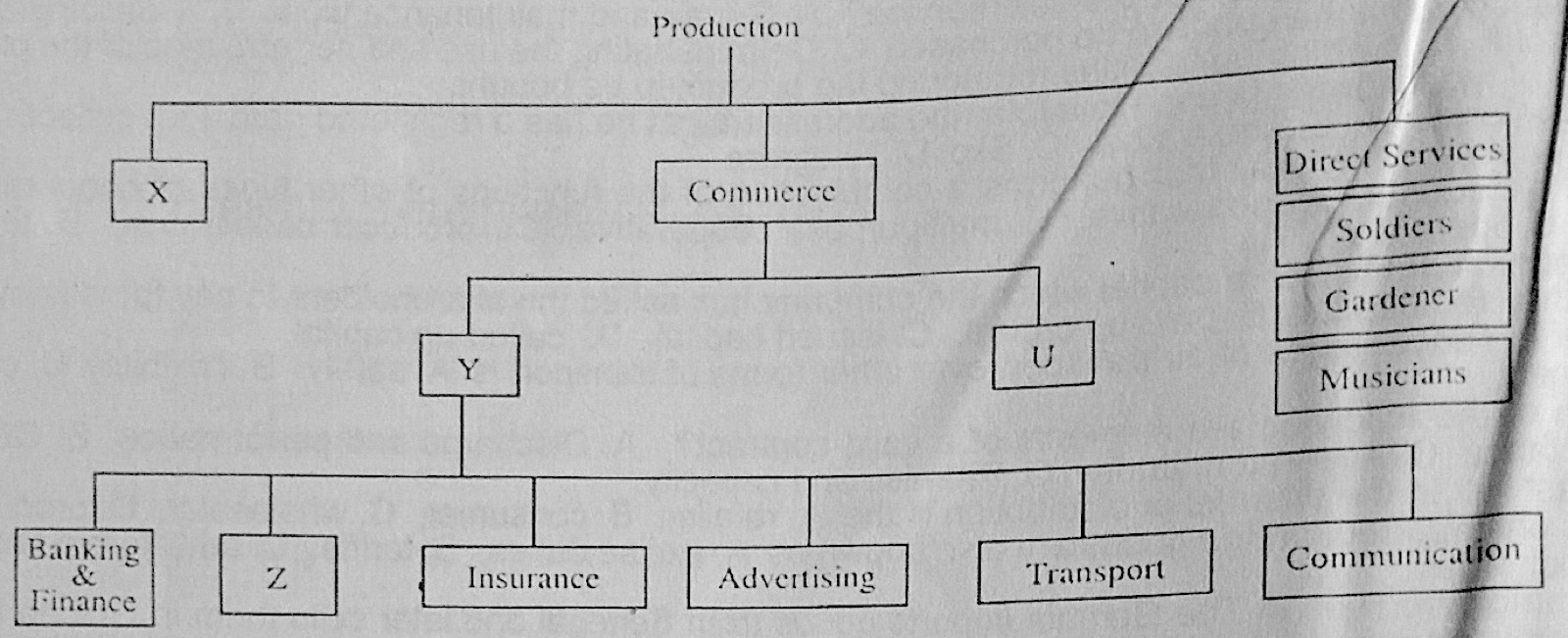
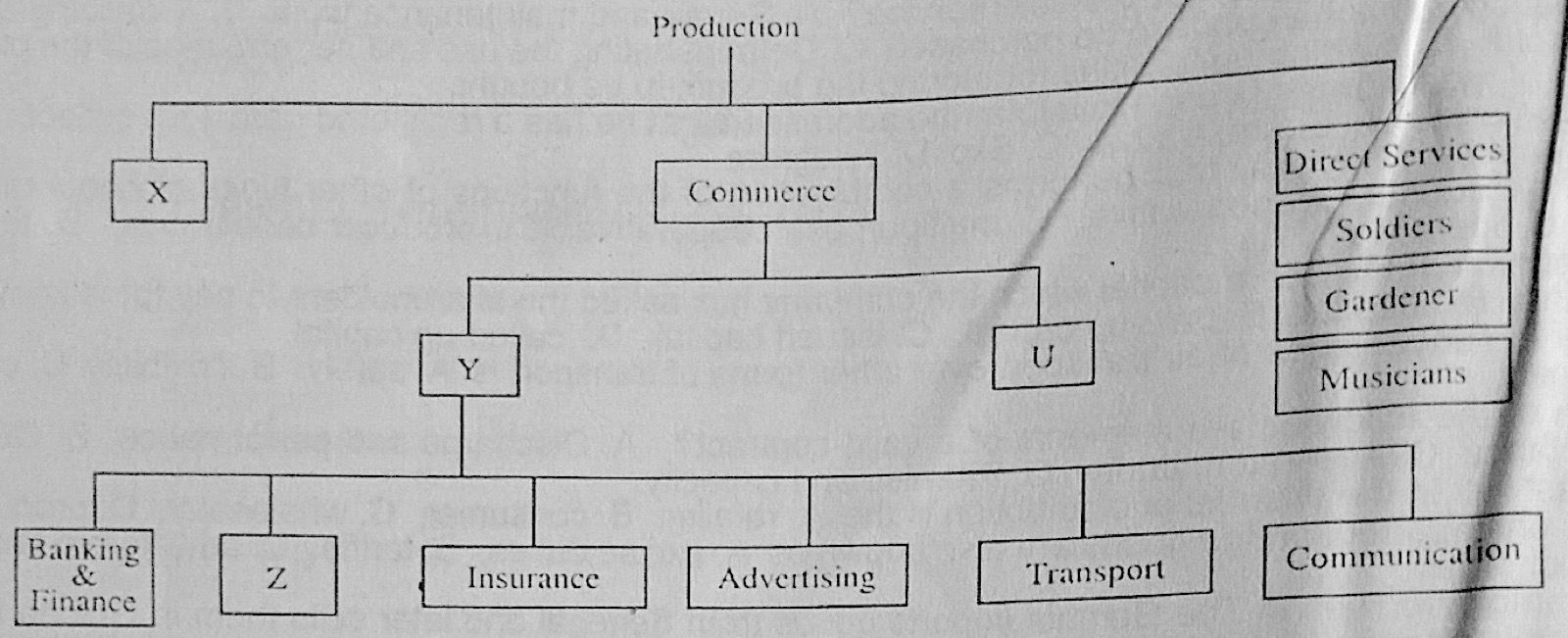
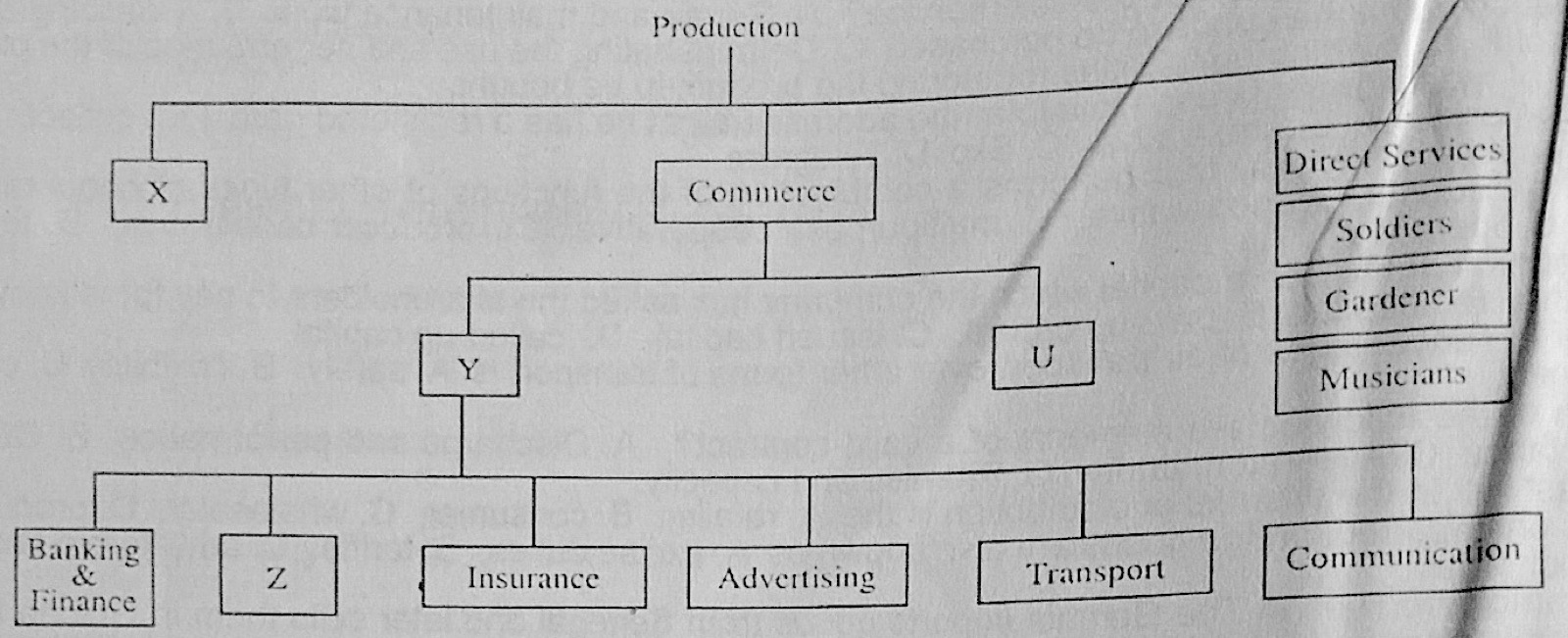
Use the diagram (Production divided into X, Commerce and Direct Services; Commerce divided into Y and U; Y divided into Banking & Finance, Z, Insurance, Advertising, Transport and Communication) to answer the question. The box marked 'X' stands for

Diagram for this question
  1. A.Indirect services.
  2. B.Industry.
  3. C.Occupation.
  4. D.Aids to trade.
Show the answer and explanation

Answer: B (Industry.)

Explanation

Production is divided into industry, commerce and direct services, so X is industry.

Open this question

Question 38

Introduction to Commerce

Use the diagram (Production divided into X, Commerce and Direct Services; Commerce divided into Y and U; Y divided into Banking & Finance, Z, Insurance, Advertising, Transport and Communication) to answer the question. The box marked 'Y' stands for

Diagram for this question
  1. A.Wholesale.
  2. B.Indirect services.
  3. C.Aids to trade.
  4. D.Foreign trade.
Show the answer and explanation

Answer: C (Aids to trade.)

Explanation

Banking, insurance, advertising, transport and communication are aids to trade, so Y is aids to trade.

Open this question

Question 39

Introduction to Commerce

Use the diagram (Production divided into X, Commerce and Direct Services; Commerce divided into Y and U; Y divided into Banking & Finance, Z, Insurance, Advertising, Transport and Communication) to answer the question. The box marked 'Z' stands for

Diagram for this question
  1. A.Warehousing.
  2. B.Home trade.
  3. C.Foreign trade.
  4. D.Marketing.
Show the answer and explanation

Answer: A (Warehousing.)

Explanation

The missing aid to trade among banking, insurance, advertising, transport and communication is warehousing.

Open this question

Question 40

Business Finance

Liquid capital in a business means the

  1. A.movable assets of the business.
  2. B.authorised capital.
  3. C.issued capital.
  4. D.assets easily convertible to cash.
Show the answer and explanation

Answer: D (assets easily convertible to cash.)

Explanation

Liquid capital is cash and assets easily turned into cash.

Open this question

Question 41

Business Units

The "relationship which subsists between two or more persons carrying on a business with a view to profit" is

  1. A.cooperative society.
  2. B.partnership.
  3. C.public limited company.
  4. D.credit union.
Show the answer and explanation

Answer: B (partnership.)

Explanation

This is the legal definition of a partnership.

Open this question

Question 42

Stock Exchange

'Rights issue' is the

  1. A.individual's right to be issued shares on subscription.
  2. B.right of shareholders to vote on issues.
  3. C.preferential right to returns on shares.
  4. D.shares offered to existing shareholders at a cheaper price.
Show the answer and explanation

Answer: D (shares offered to existing shareholders at a cheaper price.)

Explanation

A rights issue offers new shares to existing shareholders below the market price.

Open this question

Question 43

Business Units

In limited partnership the partners'

  1. A.capital is limited.
  2. B.liability is limited.
  3. C.participation is unlimited.
  4. D.ownership is unlimited.
Show the answer and explanation

Answer: B (liability is limited.)

Explanation

Limited partners' liability is limited to the capital they put in.

Open this question

Question 44

Purchase and Sale of Goods

Which of the following pieces of information would be found in a typical debit note?

  1. A.Customer code
  2. B.Date of invoice
  3. C.Brief reason for the debit
  4. D.E & O.E
Show the answer and explanation

Answer: C (Brief reason for the debit)

Explanation

A debit note states why the buyer's account is being increased, e.g. an undercharge.

Open this question

Question 45

Wholesale Trade

The completion of the production process by grading and branding of goods is a function of the

  1. A.transporter.
  2. B.wholesaler.
  3. C.retailer.
  4. D.consumer.
Show the answer and explanation

Answer: B (wholesaler.)

Explanation

Wholesalers grade, blend, pack and brand goods before passing them to retailers.

Open this question

Question 48

Law of Contract

A false statement made by one party with an intention of inducing the other party to enter into a contract with him is known as

  1. A.misrepresentation.
  2. B.legal capacity.
  3. C.consensus ad idem.
  4. D.consideration.
Show the answer and explanation

Answer: A (misrepresentation.)

Explanation

A false statement that leads someone into a contract is misrepresentation.

Open this question

Question 49

Marketing

The essence of adopting the marketing concept by a firm is the recognition that goods and services have no value unless they are

  1. A.desirable to customers.
  2. B.company oriented.
  3. C.beautifully packaged.
  4. D.profit oriented.
Show the answer and explanation

Answer: A (desirable to customers.)

Explanation

The marketing concept holds that products are valuable only if customers want them.

Open this question

Question 50

Consumer Protection

When consumers engage in actions that express dissatisfaction with the quantity, price and quality of goods available, such action is termed

  1. A.Consumer behaviour.
  2. B.Consumerism.
  3. C.Consumer education.
  4. D.Consumer orientation.
Show the answer and explanation

Answer: B (Consumerism.)

Explanation

Consumerism is organised action by consumers to protect their interests.

Open this question

Theory question 101

Occupation

Commerce 2 (essay)
(a) Explain industrial occupation. Give three examples.
(b) State three uses of capital as a factor of production.
(c) State four uses of land as a factor of production.

Show the model answer
Model answer

(a) Industrial occupation is the physical production of goods: extracting raw materials or changing them into finished or semi-finished goods and structures. Examples: extractive (mining, farming, fishing), manufacturing (textiles, car assembly), construction (building, road making).
(b) Any three: to start the business; to buy machines, buildings and equipment; to buy raw materials; to pay wages and running expenses (working capital); as security for credit; to expand the business.
(c) Any four: for farming; for building factories, offices and houses; for mining and quarrying; for roads, railways and airports; for forestry; for sinking wells/boreholes; for grazing livestock.

Explanation

Give real examples for each class in (a).

Open this question

Theory question 102

Business Units

Commerce 2 (essay)
(a) State five features of a partnership business.
(b) Explain five reasons why governments participate in business.

Show the model answer
Model answer

(a) Any five: 2 to 20 members (banking partnership up to 10); formed by agreement/deed; capital from partners; unlimited liability (except limited partners); profits shared as agreed or equally; each partner can bind the firm; not a separate legal entity; ends on death, bankruptcy or insanity of a partner; shares not transferable without consent.
(b) Any five, explained: to provide essential services at affordable prices; to provide large capital needed for some industries; to provide infrastructure; to ensure even development; to prevent exploitation by private monopolies; to control strategic industries/national security; to create jobs; to earn revenue.

Explanation

In (b) explain each reason in a sentence.

Open this question

Theory question 103

Business Units

Commerce 2 (essay)
(a) State any four advantages of a public limited company.
(b) Explain the following:
(i) Ordinary shares;
(ii) Cumulative preference shares;
(iii) Debenture.

Show the model answer
Model answer

(a) Any four: can raise large capital from the public; limited liability; continuity (separate legal entity); shares easily transferable on the stock exchange; can employ specialists; economies of large-scale operation; investors protected by regulation; employees can become shareholders.
(b)(i) Ordinary shares (equities) – shares owned by the real owners of the company; holders vote, bear the greatest risk and receive variable dividends after preference shareholders.
(ii) Cumulative preference shares – earn a fixed dividend before ordinary shares; if the dividend is not paid in a bad year, the arrears are carried forward and paid later.
(iii) Debenture – a long-term loan to a company, usually secured on its assets, earning fixed interest whether or not profit is made; holders are creditors, not owners.

Explanation

Show the difference between owners (shares) and creditors (debentures).

Open this question

Theory question 104

Purchase and Sale of Goods

Commerce 2 (essay)
(a) List four means of payment in business.
(b) Explain the following:
(i) Quotation;
(ii) Hire purchase;
(iii) Deferred payment;
(iv) Quantity discount.

Show the model answer
Model answer

(a) Any four: cash; cheques; bank drafts; postal orders/money orders; bills of exchange; credit transfer; credit/debit cards; standing orders; electronic transfer/POS; vouchers.
(b)(i) Quotation – a seller's reply to an enquiry, stating prices, terms of payment and delivery of goods.
(ii) Hire purchase – the buyer pays a deposit, takes the goods and pays the rest in instalments; ownership passes after the last instalment.
(iii) Deferred payment – the buyer takes the goods now and pays the whole amount or instalments at a later date; ownership usually passes at once (credit sale).
(iv) Quantity discount – a reduction in price given to buyers who buy in large quantities.

Explanation

Keep each explanation to one or two sentences.

Open this question

Theory question 105

Communication

Commerce 2 (essay)
(a) State two advantages of courier services.
(b) List and explain six communication services rendered by the post office.

Show the model answer
Model answer

(a) Any two: fast delivery; door-to-door collection and delivery; items can be tracked; safe for valuable documents and parcels; proof of delivery.
(b) Any six, explained: ordinary letter post; registered post (for valuables, with compensation); express/speed post; parcel post; post office boxes and private bags; poste restante (mail kept for travellers to collect); recorded delivery; business reply service; franking machines; postal and money orders; EMS courier.

Explanation

Each service in (b) needs a one-line explanation.

Open this question

Theory question 106

Wholesale Trade

Commerce 2 (essay)
Explain the following:
(a) Insurance Underwriter;
(b) Promoters;
(c) Auctioneer;
(d) Factor;
(e) Broker.

Show the model answer
Model answer

(a) Insurance underwriter – a person or company that accepts insurance risks in return for a premium, and signs the policy.
(b) Promoters – people who take the steps to form a new company (draft documents, register it, raise capital).
(c) Auctioneer – an agent who sells goods publicly to the highest bidder for a commission.
(d) Factor – an agent given possession of goods to sell in his own name, who may give credit and fix prices; earns a commission (factorage).
(e) Broker – an agent who brings buyers and sellers together without holding the goods, earning brokerage.

Explanation

Define each person by what he does.

Open this question

Theory question 107

Advertising

Commerce 2 (essay)
(a) Outline six functions of advertising.
(b) Explain seven factors to be considered in choosing an advertising medium.

Show the model answer
Model answer

(a) Any six: informs consumers about products; persuades people to buy; introduces new products; increases sales; meets competition; builds brand image/loyalty; educates on uses; reminds consumers; supports mass production.
(b) Any seven, explained: cost of the medium; coverage/area reached; type of audience (age, income, literacy); nature of the product; frequency of exposure; medium used by competitors; flexibility/time available; availability of the medium; purpose of the advert; need for demonstration (TV) or permanence (print).

Explanation

Explain each factor in a sentence.

Open this question

Theory question 108

Banking

Commerce 2 (essay)
(a) State four differences between a loan and an overdraft.
(b) Explain six factors to be considered by a Bank Manager before granting a loan.

Show the model answer
Model answer

(a) Any four: a loan is a fixed sum credited to a separate loan account, an overdraft lets a current account go into debit; a loan is open to customers with any account, an overdraft only to current account holders; interest on a loan is on the whole sum, on an overdraft only on the amount used; loans are usually longer-term, overdrafts short-term; loans are repaid in fixed instalments, overdrafts fluctuate; loans usually need collateral, overdrafts may not.
(b) Any six, explained: character/integrity of the borrower; capacity to repay (income, cash flow); collateral/security offered; purpose of the loan; amount and duration; past record with the bank; capital the borrower has in the business; government/central bank credit policy; economic conditions; guarantors.

Explanation

The '5 Cs' (character, capacity, capital, collateral, conditions) cover most of (b).

Open this question

Theory question 109

Consumer Protection

Commerce 2 (essay)
(a) Give five reasons for the protection of consumers.
(b) State five measures taken to protect consumers.

Show the model answer
Model answer

(a) Any five: to prevent sale of fake/adulterated goods; to stop exploitative prices and hoarding; to stop false or misleading adverts; to ensure correct weights and measures; to protect health and safety; to protect against harmful/expired drugs and foods; to ensure fair terms in credit/hire purchase; ignorance of consumers about their rights.
(b) Any five: laws such as the Sale of Goods Act, Hire Purchase Act, Food and Drugs Act, Weights and Measures Act, Trade Descriptions Act; agencies such as the standards organisation, NAFDAC and Consumer Protection Council; consumer associations; price control boards; consumer education; self-regulation by trade associations; courts.

Explanation

In (b) name actual laws or bodies.

Open this question

Theory question 110

Business Calculations

Commerce 2 (essay)
Deslie Cobola, a businessman has the following assets and liabilities as at 01/01/07 (Le):
Stock – 120,000
Fixtures – 335,000
Debtors – 111,000
Overdraft – 27,000
Machinery – 348,000
Motor vehicles – 232,000
Cash – 82,000
Creditors – 101,000
From the above information calculate the following:
(a) Total fixed assets;
(b) Total current assets;
(c) Total current liabilities;
(d) The working capital;
(e) The capital employed.

Show the model answer
Model answer

(a) Fixed assets = fixtures 335,000 + machinery 348,000 + motor vehicles 232,000 = Le 915,000.
(b) Current assets = stock 120,000 + debtors 111,000 + cash 82,000 = Le 313,000.
(c) Current liabilities = overdraft 27,000 + creditors 101,000 = Le 128,000.
(d) Working capital = 313,000 − 128,000 = Le 185,000.
(e) Capital employed = fixed assets + working capital = 915,000 + 185,000 = Le 1,100,000 (equal to total assets 1,228,000 − current liabilities 128,000).
Explanation

Bank overdraft is a current liability.

Open this question