JAMB Physics 2005 past questions and answers

48 questions. Try each one, then open the answer to check yourself and read the explanation.

Question 1

Electromagnetic Induction

A transformer is rated 240 V. If the primary coil is 4000 turns and the secondary voltage 12 V, determine the number of turns in the secondary coil.

  1. A.250.
  2. B.100.
  3. C.150.
  4. D.200
Show the answer and explanation

Answer: D (200)

Explanation

Ns/Np = Vs/Vp, so Ns = 4000 × 12/240 = 200.

Open this question

Question 2

Electrostatics

Which of the following materials is a conductor?

  1. A.Plastic
  2. B.Sodium
  3. C.Wax
  4. D.Glass
Show the answer and explanation

Answer: B (Sodium)

Explanation

Sodium is a metal with free electrons, so it conducts; plastic, wax and glass are insulators.

Open this question

Question 3

Conduction through Liquids and Gases

The charge carriers in gases are

  1. A.ions only.
  2. B.electrons and holes.
  3. C.electrons only.
  4. D.electrons and ions.
Show the answer and explanation

Answer: D (electrons and ions.)

Explanation

When a gas conducts, its atoms are ionised into positive ions and free electrons, and both carry the current.

Open this question

Question 4

Electronics

When impurities are added to semi-conductors, the conductivity of the semi-conductor

  1. A.remains constant.
  2. B.increases then decreases.
  3. C.increases.
  4. D.decreases.
Show the answer and explanation

Answer: C (increases.)

Explanation

Doping adds extra free electrons or holes, so the semiconductor conducts better.

Open this question

Question 5

Conduction through Liquids and Gases

The ray which causes gas molecules to glow is known as

  1. A.molecular ray.
  2. B.gamma ray.
  3. C.anode ray.
  4. D.cathode ray.
Show the answer and explanation

Answer: D (cathode ray.)

Explanation

Cathode rays (fast electrons) strike gas molecules in a discharge tube and make them glow.

Open this question

Question 6

Magnetism

A proton moving with a speed of 1.0 × 10⁶ms−1 through a magnetic field of 1.0 T experiences a magnetic force of magnitude 8.0 × 10⁻¹⁴ N. The angle between the proton's velocity and the field is [Proton charge = 1.6 × 10⁻¹⁹C]

  1. A.45°.
  2. B.30°.
  3. C.60°.
  4. D.90°.
Show the answer and explanation

Answer: B (30°.)

Explanation

F = qvB sin θ: sin θ = 8.0 × 10⁻¹⁴ ÷ (1.6 × 10−19 × 106 × 1.0) = 0.5, so θ = 30°.

Open this question

Question 7

Radioactivity and Nuclear Physics

23592U + 10n → 14456Ba + 9036Kr + 2X
In the reaction above, X is

  1. A.neutron.
  2. B.electron.
  3. C.neutrino
  4. D.proton.
Show the answer and explanation

Answer: A (neutron.)

Explanation

Mass numbers: 236 = 144 + 90 + 2A gives A = 1. Atomic numbers: 92 = 56 + 36 + 2Z gives Z = 0. So X is a neutron.

Open this question

Question 8

Electronics

A silicon material is dopped with an element of a certain group and an n-type semi-conductor is formed. The most likely group of the element is

  1. A.II.
  2. B.I.
  3. C.V.
  4. D.III.
Show the answer and explanation

Answer: C (V.)

Explanation

n-type silicon is made by adding a group V (pentavalent) element, whose fifth electron becomes a free carrier.

Open this question

Question 9

Radioactivity and Nuclear Physics

The time it will take a certain radioactive material with a half-life of 50 days to reduce to 1/32 of its original number is

  1. A.300 days.
  2. B.150 days.
  3. C.200 days.
  4. D.250 days.
Show the answer and explanation

Answer: D (250 days.)

Explanation

1/32 = (½)5, so 5 half-lives are needed: 5 × 50 = 250 days.

Open this question

Question 10

Alternating Current Circuits

In an a.c. circuit that contains only a capacitor, the voltage lags behind the current by

  1. A.90°
  2. B.180°
  3. C.60°
  4. D.30°
Show the answer and explanation

Answer: A (90°)

Explanation

In a purely capacitive circuit the current leads the voltage by a quarter cycle, so the voltage lags by 90°.

Open this question

Question 11

Electronics

In the circuit diagram of a transistor above, the terminals P, Q and R represent.

Diagram for this question
  1. A.COLLECTOR, EMITTER and BASE.
  2. B.EMITTER, BASE and COLLECTOR.
  3. C.BASE, EMITTER and COLLECTOR.
  4. D.BASE, COLLECTOR and EMITTER.
Show the answer and explanation

Answer: B (EMITTER, BASE and COLLECTOR.)

Explanation

The lead with the arrow (P) is the emitter, the lead entering from the side (Q) is the base, and the other lead (R) is the collector.

Open this question

Question 12

Radioactivity and Nuclear Physics

The amount of energy released when 0.5 kg of uranium is burnt completely is [c = 3 × 10⁸ ms−1]

  1. A.4.5 × 1016J.
  2. B.1.5 × 1016J.
  3. C.1.5 × 108 J.
  4. D.4.5 × 108J.
Show the answer and explanation

Answer: A (4.5 × 10¹⁶J.)

Explanation

If all the mass becomes energy, E = mc2 = 0.5 × (3 × 108)2 = 4.5 × 10¹⁶ J.

Open this question

Question 13

Electronics

The current in a reverse-biased junction is due to

  1. A.electrons.
  2. B.majority carriers.
  3. C.holes.
  4. D.minority carriers.
Show the answer and explanation

Answer: D (minority carriers.)

Explanation

Reverse bias stops the majority carriers; the small leakage current is carried by minority carriers.

Open this question

Question 14

Modern Physics

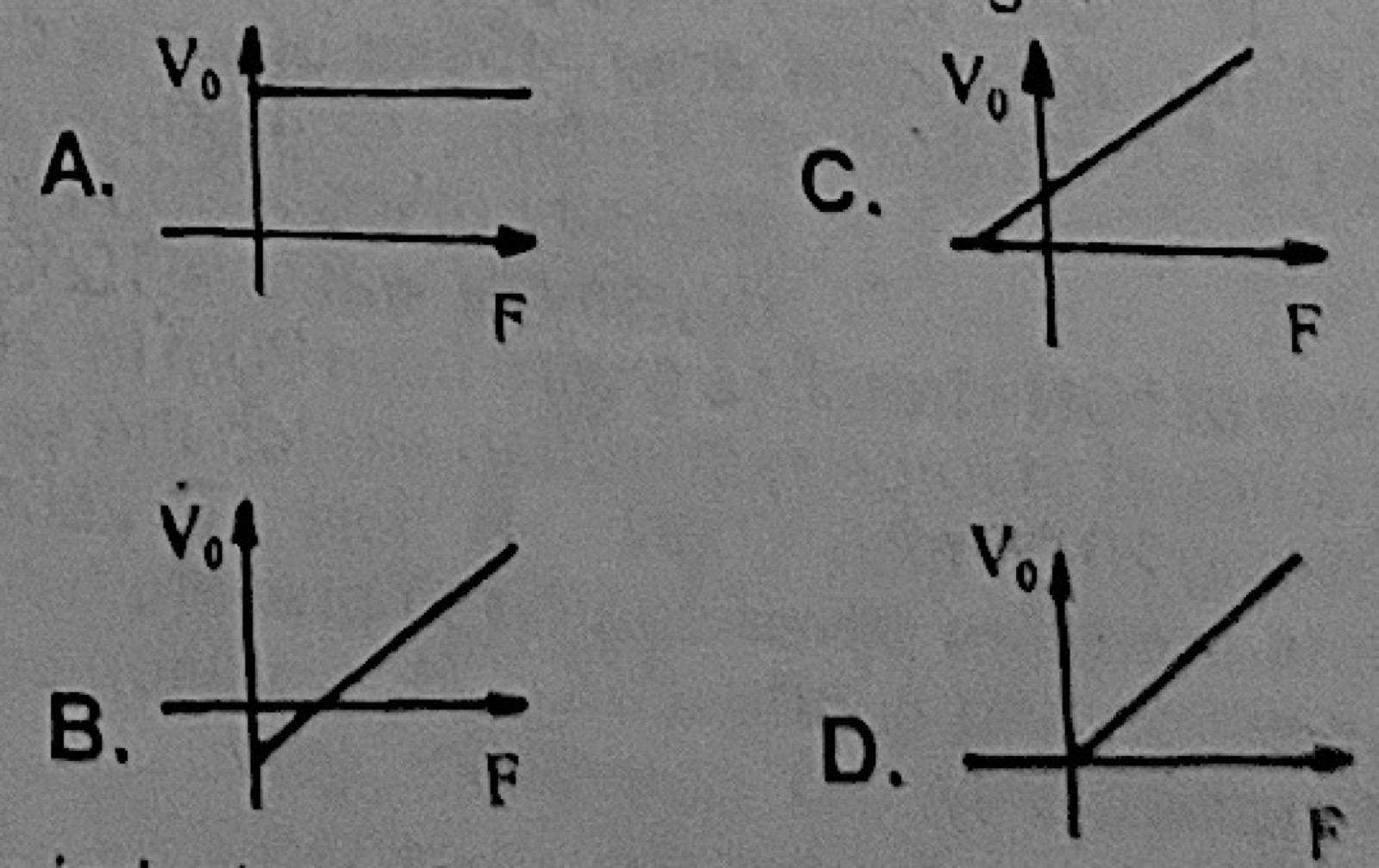
In photoelectric effect, which of the following graphs correctly represents the graph of stopping potential V0 against frequency f of incident light?

Diagram for this question
  1. A.Graph A
  2. B.Graph B
  3. C.Graph C
  4. D.Graph D
Show the answer and explanation

Answer: B (Graph B)

Explanation

eV0 = hf − W, so V0 against f is a straight line of positive slope that cuts the f-axis at the threshold frequency and, extended, has a negative intercept on the V0 axis (graph B).

Open this question

Question 15

Electromagnetic Induction

If two inductors of inductances 3H and 6H are arranged in series, the total inductance is

  1. A.18.0 H.
  2. B.9.0 H.
  3. C.2.0 H
  4. D.0.5 H
Show the answer and explanation

Answer: B (9.0 H.)

Explanation

Inductors in series add (like resistors): 3 + 6 = 9 H.

Open this question

Question 16

Electromagnetic Spectrum

Satellite communication network makes use of

  1. A.infra-red rays.
  2. B.sound wave.
  3. C.visible light.
  4. D.radio wave.
Show the answer and explanation

Answer: D (radio wave.)

Explanation

Satellites relay signals as radio (microwave) waves, which pass through the atmosphere and travel through space.

Open this question

Question 17

Electrostatics

The electric field intensity in a place where a charge of 10−10 C experiences a force of 0.4N is

  1. A.8.0 × 10−12NC−1.
  2. B.8.0 × 109 NC−1.
  3. C.4.0 × 109 NC−1.
  4. D.4.0 × 10−11 NC−1.
Show the answer and explanation

Answer: C (4.0 × 10⁹ NC−1.)

Explanation

E = F/q = 0.4 ÷ 10−10 = 4.0 × 10⁹ N C−1.

Open this question

Question 18

Current Electricity

The resistance of a piece of wire of length 20m and cross-sectional area 8 × 10⁻⁶m2 is [Resistivity of the wire = 4 × 10⁻⁷Ωm]

  1. A.1.0Ω.
  2. B.10.0Ω.
  3. C.0.5Ω.
  4. D.5.0Ω.
Show the answer and explanation

Answer: A (1.0Ω.)

Explanation

R = ρL/A = 4 × 10−7 × 20 ÷ 8 × 10−6 = 1.0 Ω.

Open this question

Question 19

Capacitors

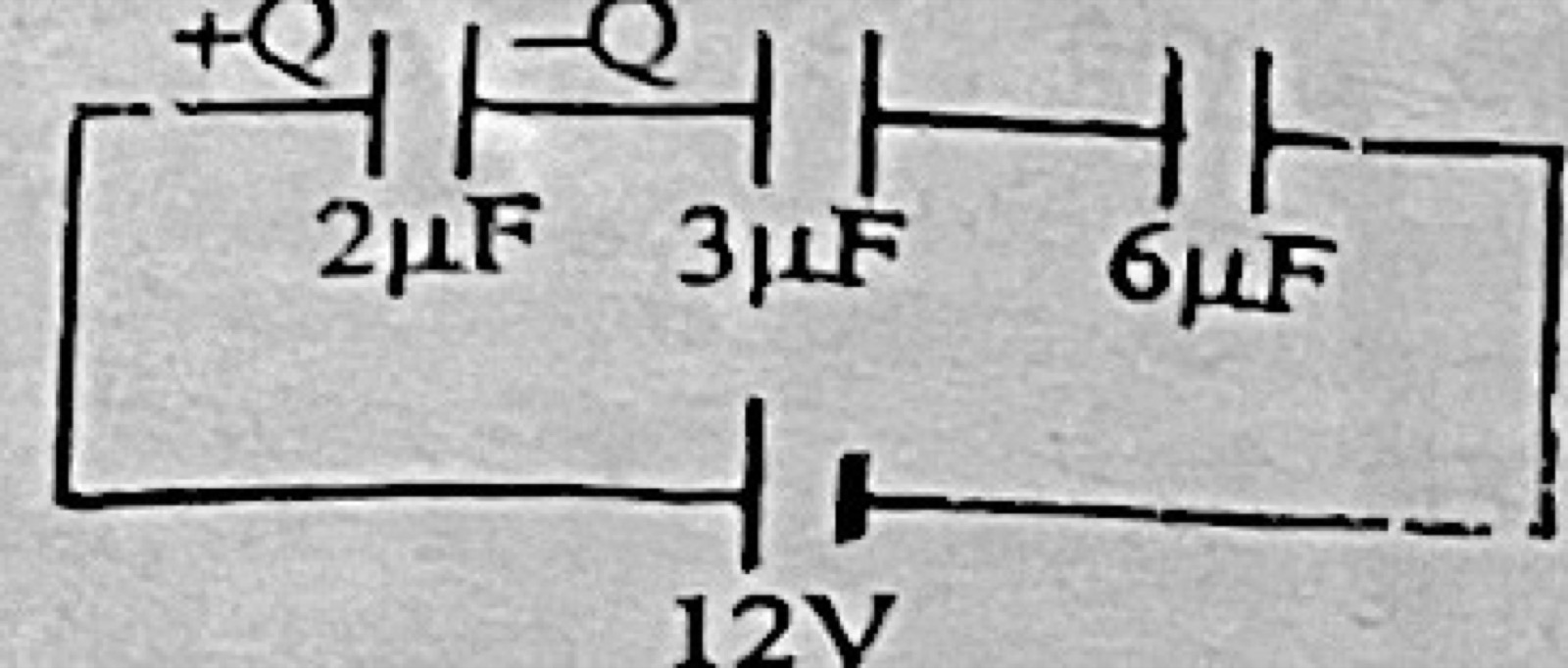
The figure above shows three capacitors, 2μF, 3μF and 6μF connected in series. If the p.d. across the system is 12V, the p.d. across the 6μF capacitor is

Diagram for this question
  1. A.4V.
  2. B.6V.
  3. C.12 V.
  4. D.2V.
Show the answer and explanation

Answer: D (2V.)

Explanation

1/C = 1/2 + 1/3 + 1/6 = 1, so C = 1 μF and Q = 12 μC. V across 6 μF = 12 μC ÷ 6 μF = 2 V.

Open this question

Question 20

Magnetism

The north pole of a magnet can never be separated from the south pole because of a property known as

  1. A.magnetic dipole.
  2. B.magnetic octopole.
  3. C.magnetic monopole.
  4. D.magnetic quadrupole.
Show the answer and explanation

Answer: A (magnetic dipole.)

Explanation

Every magnet is a dipole: cutting it always gives smaller magnets, each with both a north and a south pole.

Open this question

Question 21

Electrical Energy and Power

An electric device is rated 2000 W, 250 V. The correct fuse rating of the device is

  1. A.8A.
  2. B.9A.
  3. C.7A.
  4. D.6A.
Show the answer and explanation

Answer: A (8A.)

Explanation

I = P/V = 2000 ÷ 250 = 8 A.

Open this question

Question 22

Current Electricity

A car battery rated 45 AH is charged with a charger whose rating is 2.5 A. How long will it take to charge the battery fully?

  1. A.20 hrs
  2. B.10 hrs
  3. C.25 hrs
  4. D.18 hrs
Show the answer and explanation

Answer: D (18 hrs)

Explanation

Time = capacity ÷ current = 45 A h ÷ 2.5 A = 18 h.

Open this question

Question 23

Electrostatics

If the distance between two point charges is increased by a factor of four, the magnitude of the electrostatic force between them will be

  1. A.½ of its former value.
  2. B.1/16 of its former value.
  3. C.1/4 of its former value.
  4. D.4 times its former value.
Show the answer and explanation

Answer: B (1/16 of its former value.)

Explanation

Coulomb's law: F ∝ 1/r2, so making r four times bigger makes F (1/4)2 = 1/16 of its former value.

Open this question

Question 24

Magnetism

Two charged particles are projected into a region where there is a magnetic field perpendicular to their velocities. If the charges are deflected in opposite directions, which of the following statements is true of the charges?

  1. A.The charges are of the same sign
  2. B.Positive charges are more in number
  3. C.The charges must be of opposite sign
  4. D.The charges are electrically neutral.
Show the answer and explanation

Answer: C (The charges must be of opposite sign)

Explanation

The magnetic force direction depends on the sign of the charge; opposite deflections in the same field mean opposite charges.

Open this question

Question 25

Equilibrium of Forces

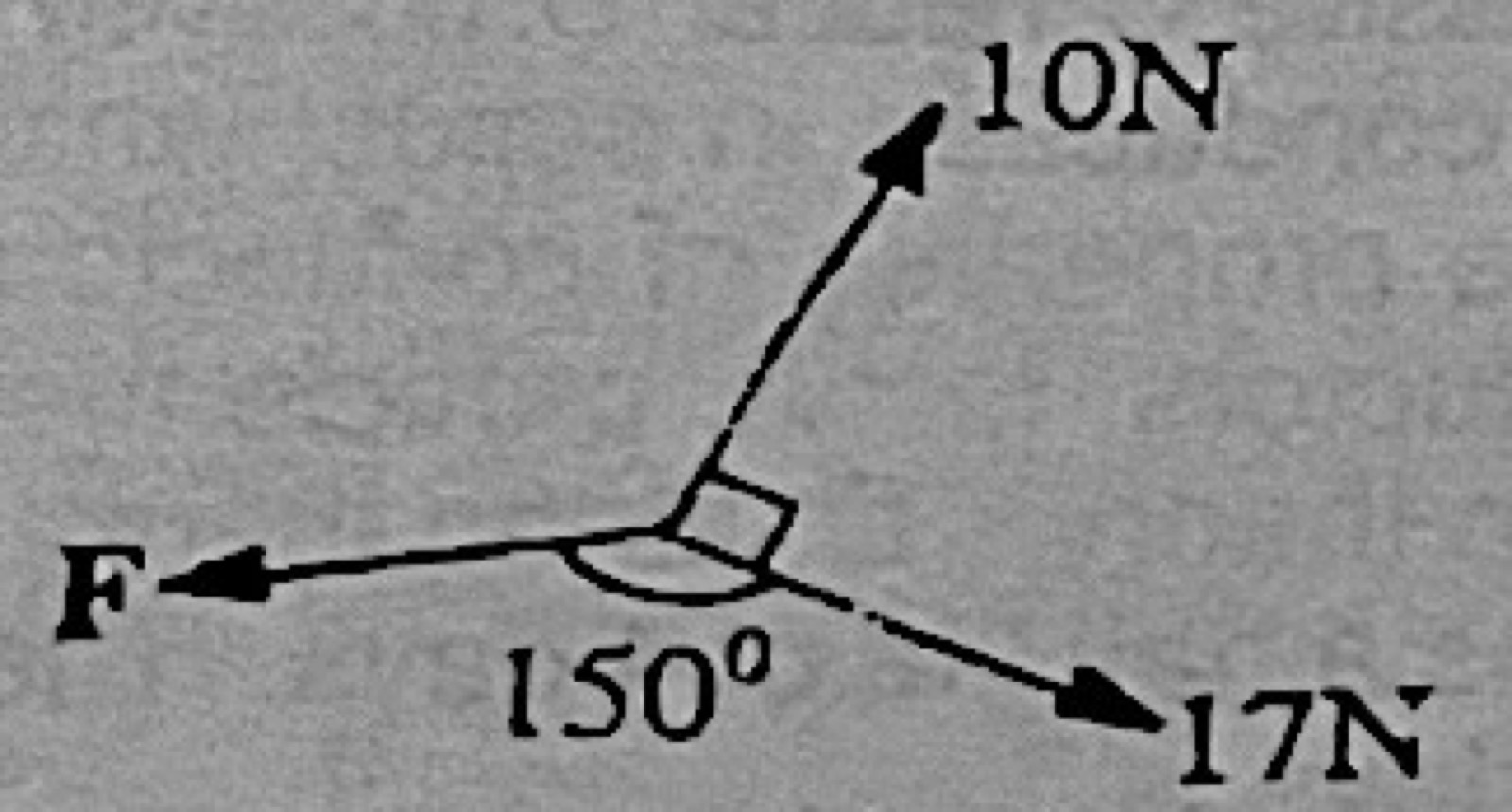
The value of F in the figure above when in equilibrium is

Diagram for this question
  1. A.10 N.
  2. B.12 N.
  3. C.27 N.
  4. D.20 N.
Show the answer and explanation

Answer: D (20 N.)

Explanation

10 N and 17 N are at right angles, so their resultant is √(102 + 172) ≈ 20 N. F must be equal and opposite to this resultant: about 20 N.

Open this question

Question 26

Friction

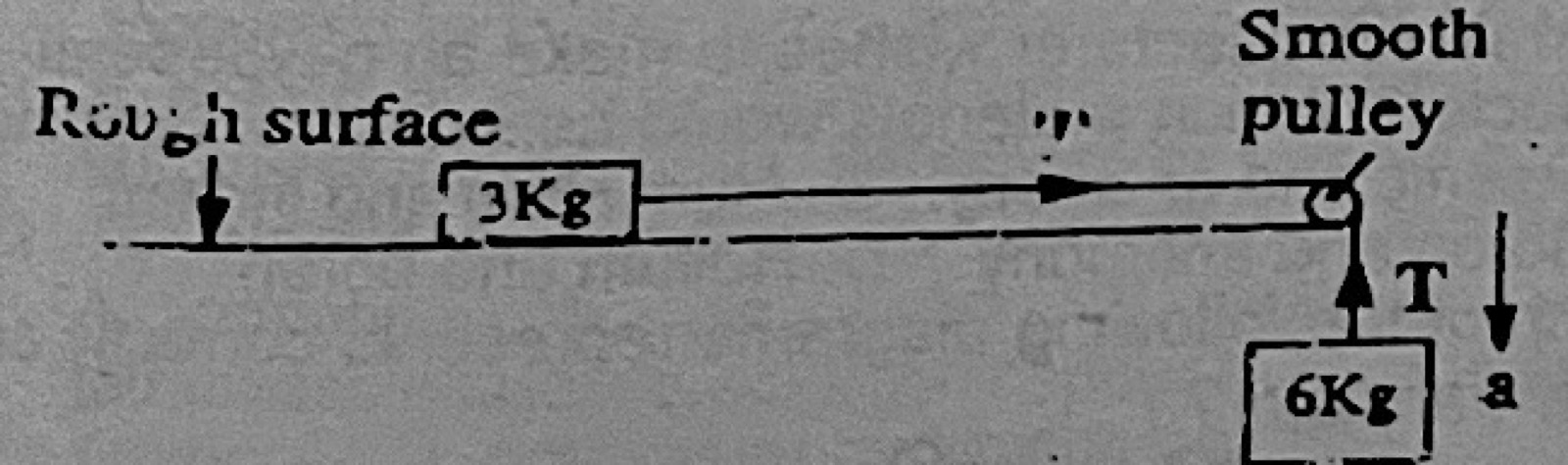
In the figure above, the coefficient of static friction is 0.5. If the tension in the string is T, the acceleration of the system in motion is [g = 10 ms−2]

Diagram for this question
  1. A.15 ms−2.
  2. B.3 ms−2.
  3. C.5 ms−2.
  4. D.9 ms−2.
Show the answer and explanation

Answer: C (5 ms−2.)

Explanation

Friction on the 3 kg block = 0.5 × 30 = 15 N. Net force = 60 − 15 = 45 N on a total mass of 9 kg, so a = 5 m s−2.

Open this question

Question 27

Simple Machines

In an ideal wheel and axle system, R stands for the radius of the wheel and r is the radius of the axle. The mechanical advantage is

  1. A.R/r.
  2. B.(r/R)2.
  3. C.r/R.
  4. D.(R/r)2.
Show the answer and explanation

Answer: A (R/r.)

Explanation

For an ideal machine MA = VR, and the velocity ratio of a wheel and axle is R/r.

Open this question

Question 28

Motion

A motorcyclist travelling at 30 ms−1 starts to apply his brakes when he is 50 m from the traffic light that has just turned red. If he just reached the traffic light, his deceleration is

  1. A.5 ms−2
  2. B.9 ms−2.
  3. C.10 ms−2.
  4. D.18 ms−2.
Show the answer and explanation

Answer: B (9 ms−2.)

Explanation

v2 = u2 − 2as: 0 = 900 − 100a, so a = 9 m s−2.

Open this question

Question 29

Equilibrium of Forces

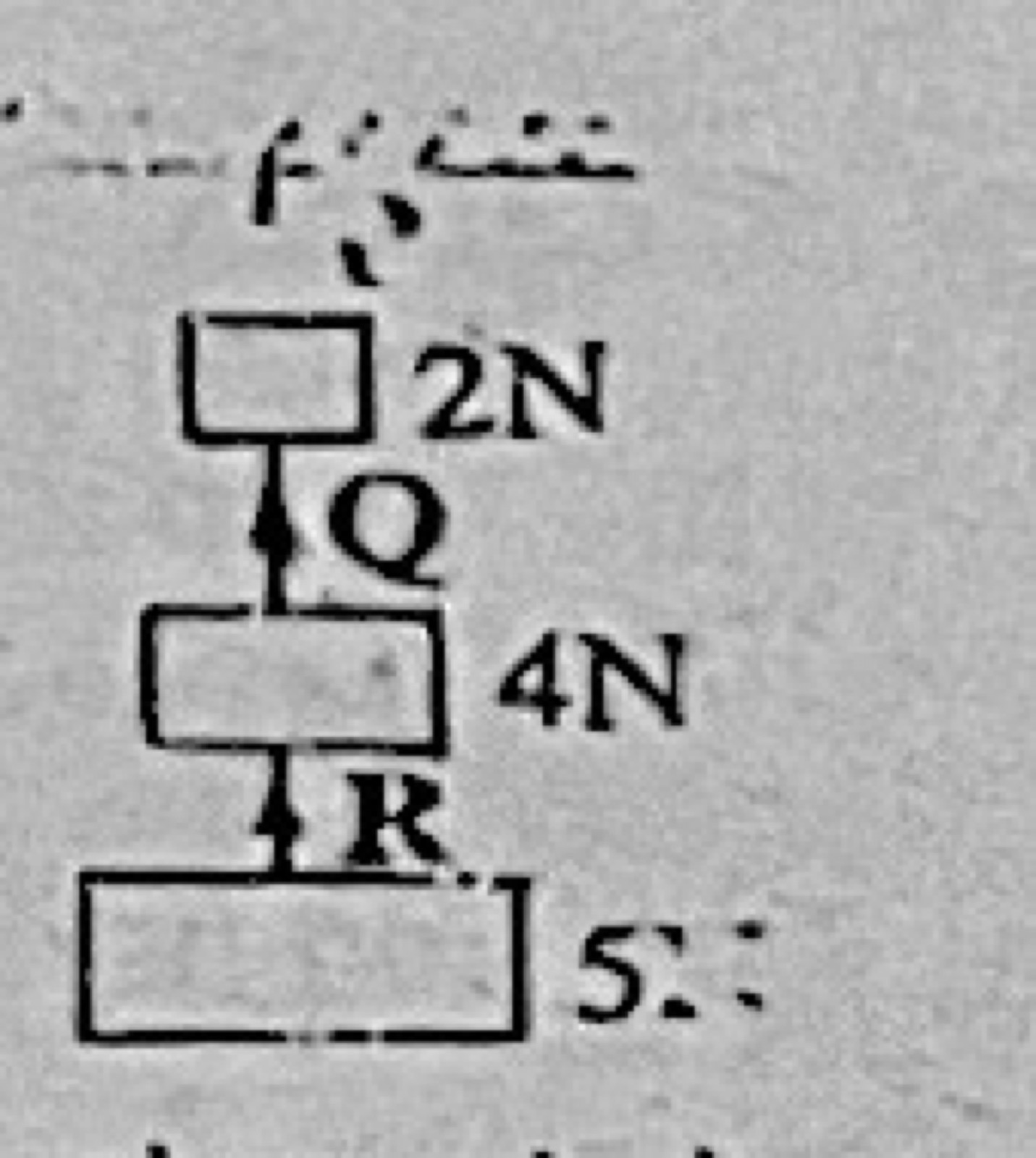
If the system above is in equilibrium, the tension in the string Q is

Diagram for this question
  1. A.6 N.
  2. B.4 N.
  3. C.11 N.
  4. D.9 N.
Show the answer and explanation

Answer: D (9 N.)

Explanation

String Q holds up everything below it: the 4 N block and the 5 N block, so the tension is 9 N.

Open this question

Question 30

Work, Energy and Power

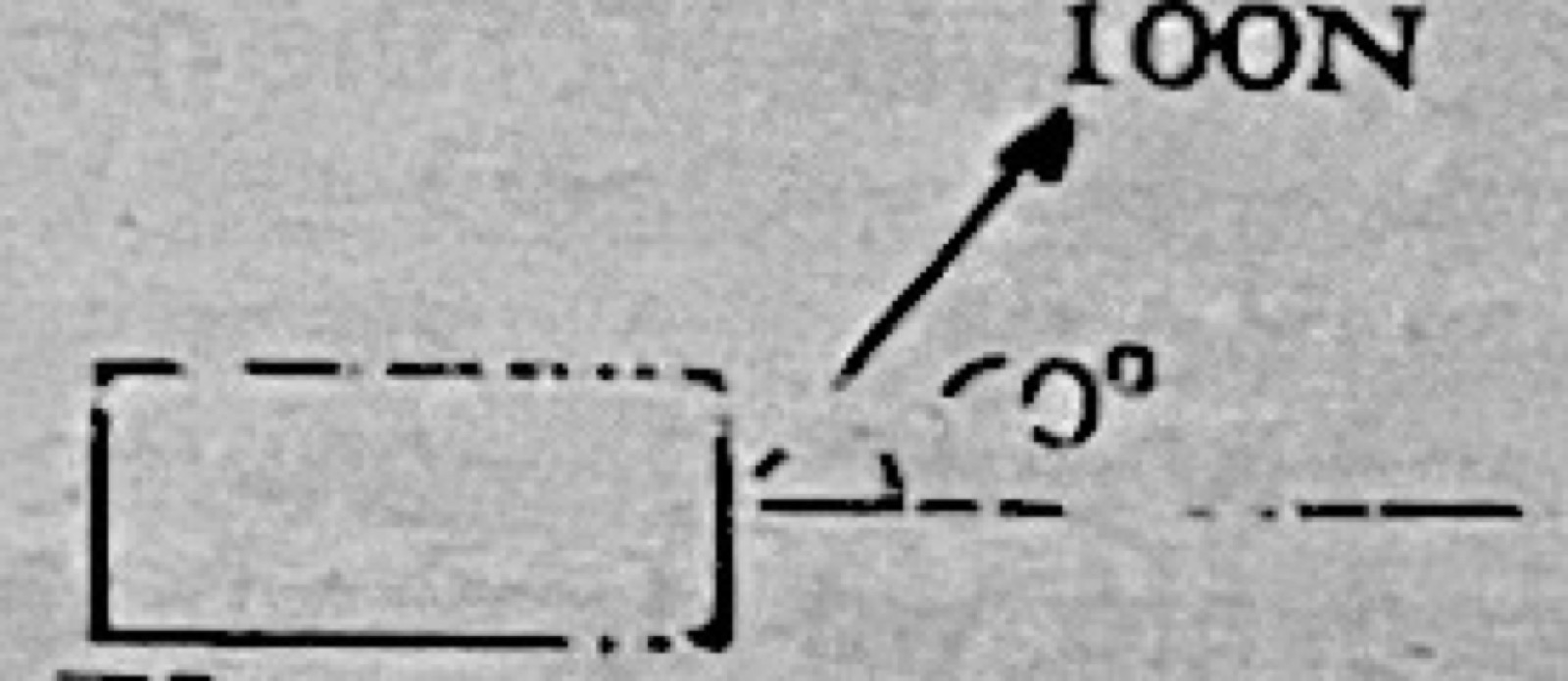
In the figure above, the work done by the force of 100 N inclined at an angle of 60° to the object dragged horizontally to a distance of 8 m is [Neglect frictional effect]

Diagram for this question
  1. A.800 J.
  2. B.800 J.
  3. C.400 J.
  4. D.100 J.
Show the answer and explanation

Answer: C (400 J.)

Explanation

Only the horizontal part does work: W = F cos 60° × s = 100 × 0.5 × 8 = 400 J.

Open this question

Question 32

Electrostatics

A force of 200 N acts between two objects at a certain distance apart. The value of the force when the distance is halved is

  1. A.100 N.
  2. B.200 N.
  3. C.800 N.
  4. D.400 N.
Show the answer and explanation

Answer: C (800 N.)

Explanation

The force follows the inverse-square law: halving the distance makes it 22 = 4 times bigger, 800 N.

Open this question

Question 33

Scalars and Vectors

The pair of physical quantities consisting of vectors only are

  1. A.acceleration and speed.
  2. B.displacement and torque.
  3. C.velocity and distance.
  4. D.momentum and power.
Show the answer and explanation

Answer: B (displacement and torque.)

Explanation

Displacement and torque both have direction; speed, distance and power are scalars.

Open this question

Question 34

Light and Reflection

A real image three times the size of an object is formed 24 cm from a converging mirror. What is the focal length of the mirror?

  1. A.8 cm
  2. B.16cm
  3. C.6 cm
  4. D.12 cm
Show the answer and explanation

Answer: C (6 cm)

Explanation

m = v/u = 3 with v = 24 cm gives u = 8 cm. 1/f = 1/8 + 1/24 = 4/24, so f = 6 cm.

Open this question

Question 35

Simple Harmonic Motion

Marching soldiers crossing a suspension bridge are usually advised to break their steps to avoid damaging the bridge owing to

  1. A.swinging.
  2. B.vibration.
  3. C.oscillation.
  4. D.resonance.
Show the answer and explanation

Answer: D (resonance.)

Explanation

If the marching rhythm matched the bridge's natural frequency, resonance could build up large, damaging oscillations.

Open this question

Question 36

Lenses and Optical Instruments

A thin converging lens has a power of 4.0 diopters. Determine its focal length.

  1. A.0.25 m.
  2. B.0.03 m.
  3. C.5.00 m.
  4. D.2.50 m.
Show the answer and explanation

Answer: A (0.25 m.)

Explanation

f = 1/P = 1/4 = 0.25 m.

Open this question

Question 38

Sound

The velocity of sound in air will be doubled if its absolute temperature is

  1. A.doubled.
  2. B.halved.
  3. C.constant.
  4. D.quadrupled.
Show the answer and explanation

Answer: D (quadrupled.)

Explanation

v ∝ √T, so to double v the absolute temperature must be multiplied by 4.

Open this question

Question 39

Refraction of Light

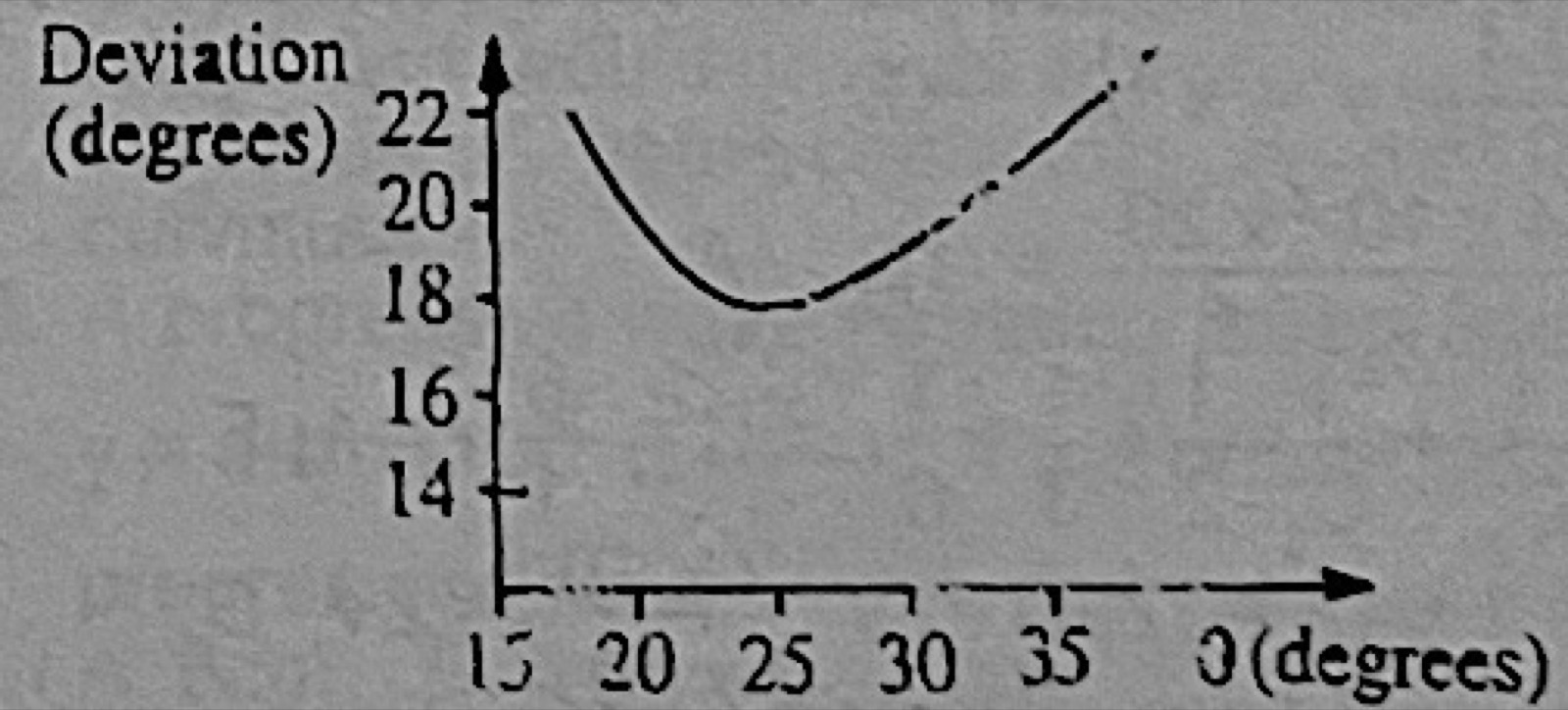
The figure above shows a plot of angles of deviation through a glass prism when light is incident at θ degrees on the prism. The incident angle that produces the minimum deviation is

Diagram for this question
  1. A.25°.
  2. B.18°.
  3. C.35°.
  4. D.20°.
Show the answer and explanation

Answer: A (25°.)

Explanation

Minimum deviation is the lowest point of the curve, which is at an incident angle of about 25°.

Open this question

Question 40

Pressure

Two liquids L1 and L2 are contained in a U-tube. The height and the density of L1 are 8 cm and 103 kgm−3 respectively. If the density of L2 is 800 kgm−3, its height measured from the same level is

  1. A.8 cm.
  2. B.16 cm.
  3. C.12 cm.
  4. D.10 cm.
Show the answer and explanation

Answer: D (10 cm.)

Explanation

Pressures balance: h1ρ1 = h2ρ2, so h2 = 8 × 1000/800 = 10 cm.

Open this question

Question 41

Change of State and Vapours

When the temperature difference between the wet and dry bulbs of a hygrometer is high, this indicates that

  1. A.it is about to rain.
  2. B.there is plenty of sunshine.
  3. C.the relative humidity is low.
  4. D.the relative humidity is high.
Show the answer and explanation

Answer: C (the relative humidity is low.)

Explanation

Water evaporates fast from the wet bulb in dry air, cooling it a lot; a big difference means low relative humidity.

Open this question

Question 42

Elasticity

An elastic material has a length of 36cm when a load of 40 N is hung on it and a length of 45 cm when a load of 60 N is hung on it. The original length of the string is

  1. A.18cm.
  2. B.12cm.
  3. C.20cm.
  4. D.15cm.
Show the answer and explanation

Answer: A (18cm.)

Explanation

An extra 20 N gives 9 cm more, so 40 N gives 18 cm extension. Original length = 36 − 18 = 18 cm.

Open this question

Question 43

Temperature and Thermometers

I. Reproducibility II. Sensitivity III. High thermal capacity IV. High accuracy
The qualities of a good thermometer include

  1. A.I, III and IV only.
  2. B.I, II and IV only.
  3. C.II, III and IV only.
  4. D.I, II and III only.
Show the answer and explanation

Answer: B (I, II and IV only.)

Explanation

A good thermometer gives repeatable, sensitive and accurate readings; a high thermal capacity is a drawback because it takes heat from what it measures and responds slowly.

Open this question

Question 44

Structure of Matter and Kinetic Theory

The process whereby the molecules of different substances move randomly is called

  1. A.surface tension.
  2. B.diffusion.
  3. C.capillarity.
  4. D.osmosis.
Show the answer and explanation

Answer: B (diffusion.)

Explanation

Diffusion is the random movement of molecules that makes different substances spread into each other.

Open this question

Question 45

Change of State and Vapours

106J of heat is required to boil off completely 2 kg of a certain liquid. Neglecting heat lost to the surroundings, the latent heat of vaporization of the liquid is

  1. A.5.0 × 105J kg−1.
  2. B.2.0 × 105J kg−1.
  3. C.5.0 × 106J kg−1.
  4. D.2.0 × 106J kg−1.
Show the answer and explanation

Answer: A (5.0 × 10⁵J kg−1.)

Explanation

L = Q/m = 106 ÷ 2 = 5.0 × 10⁵ J kg−1.

Open this question

Question 46

Density and Upthrust

A 3 m3 volume of liquid W of density 200 kgm−3 is mixed with another liquid L of volume 7 m3 and density 150 kgm−3. The density of the mixture is

  1. A.265 kgm−3.
  2. B.165 kgm−3.
  3. C.100 kgm−3.
  4. D.350 kgm−3.
Show the answer and explanation

Answer: B (165 kgm−3.)

Explanation

Total mass = 3 × 200 + 7 × 150 = 1650 kg; total volume = 10 m3; density = 165 kg m−3.

Open this question

Question 47

Structure of Matter and Kinetic Theory

I. Melting II. Boiling III. Refraction IV. Conduction
Which combination of the above is evident of the molecular nature of matter?

  1. A.I, II and IV only
  2. B.I, III and IV only
  3. C.I, II and III only
  4. D.II, III and IV only
Show the answer and explanation

Answer: A (I, II and IV only)

Explanation

Melting, boiling and conduction are explained by the behaviour of molecules; refraction is a property of light, not evidence of molecules.

Open this question

Question 48

Thermal Expansion

When very hot water is poured into two identical thin and thick glass tumblers in equal volumes, the thick one cracks because

  1. A.of the even expansion of glass.
  2. B.glass is a good conductor of heat.
  3. C.of the uneven expansion of glass.
  4. D.glass is a crystal.
Show the answer and explanation

Answer: C (of the uneven expansion of glass.)

Explanation

Glass conducts heat poorly, so the inside of the thick glass expands before the outside warms; this uneven expansion cracks it.

Open this question

Question 49

Friction

A body of mass 36 kg falls through a viscous liquid which offers a drag force of 260 N on the body. The upthrust on the body at terminal velocity is [g = 10ms−2]

  1. A.310 N.
  2. B.50 N.
  3. C.620 N.
  4. D.100 N.
Show the answer and explanation

Answer: D (100 N.)

Explanation

At terminal velocity weight = drag + upthrust: 360 = 260 + U, so U = 100 N.

Open this question

Question 50

Change of State and Vapours

The process whereby a liquid turns spontaneously into vapour is called

  1. A.evaporation.
  2. B.regelation.
  3. C.boiling.
  4. D.sublimation.
Show the answer and explanation

Answer: A (evaporation.)

Explanation

Evaporation happens on its own at the surface at any temperature; boiling needs the liquid to reach its boiling point.

Open this question