47 questions. Try each one, then open the answer to check yourself and read the explanation.
Question 1
Measurement and Units
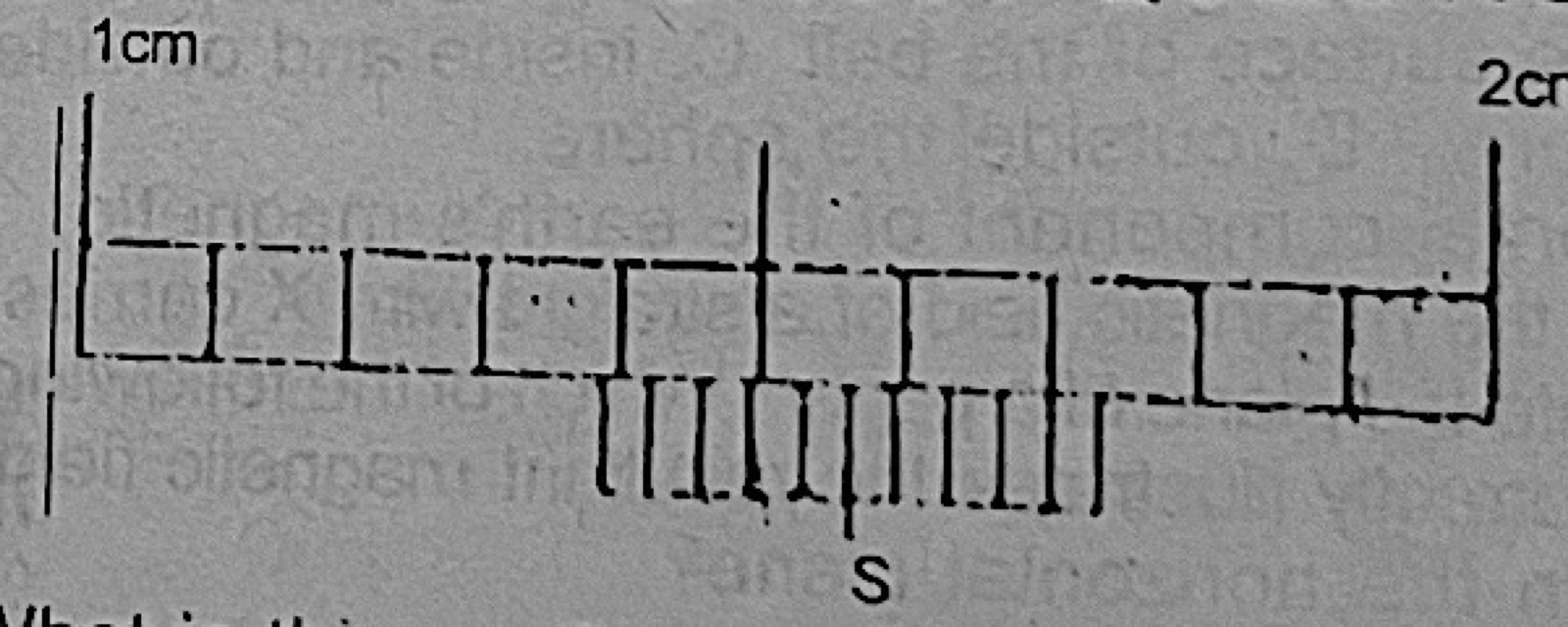
What is the reading of the vernier calipers shown above?
A.1.79cm
B.1.73cm
C.1.39cm
D.1.34cm
Show the answer and explanation
Answer: C (1.39cm)
Explanation
The vernier zero lies just short of the 1.4 cm mark (main scale 1.3 cm), and the 9th vernier line lines up with a main-scale line, so the reading is 1.3 + 0.09 = 1.39 cm.
Which of the following is TRUE of a particle moving in a horizontal circle with constant angular velocity?
A.The energy is constant but the linear momentum varies
B.The linear momentum is constant but the energy varies
C.Both energy and linear momentum are constant
D.The speed and the linear velocity are both constant.
Show the answer and explanation
Answer: A (The energy is constant but the linear momentum varies)
Explanation
The speed is constant, so the kinetic energy is constant, but the direction of motion keeps changing, so the velocity and the momentum (mv) keep changing.
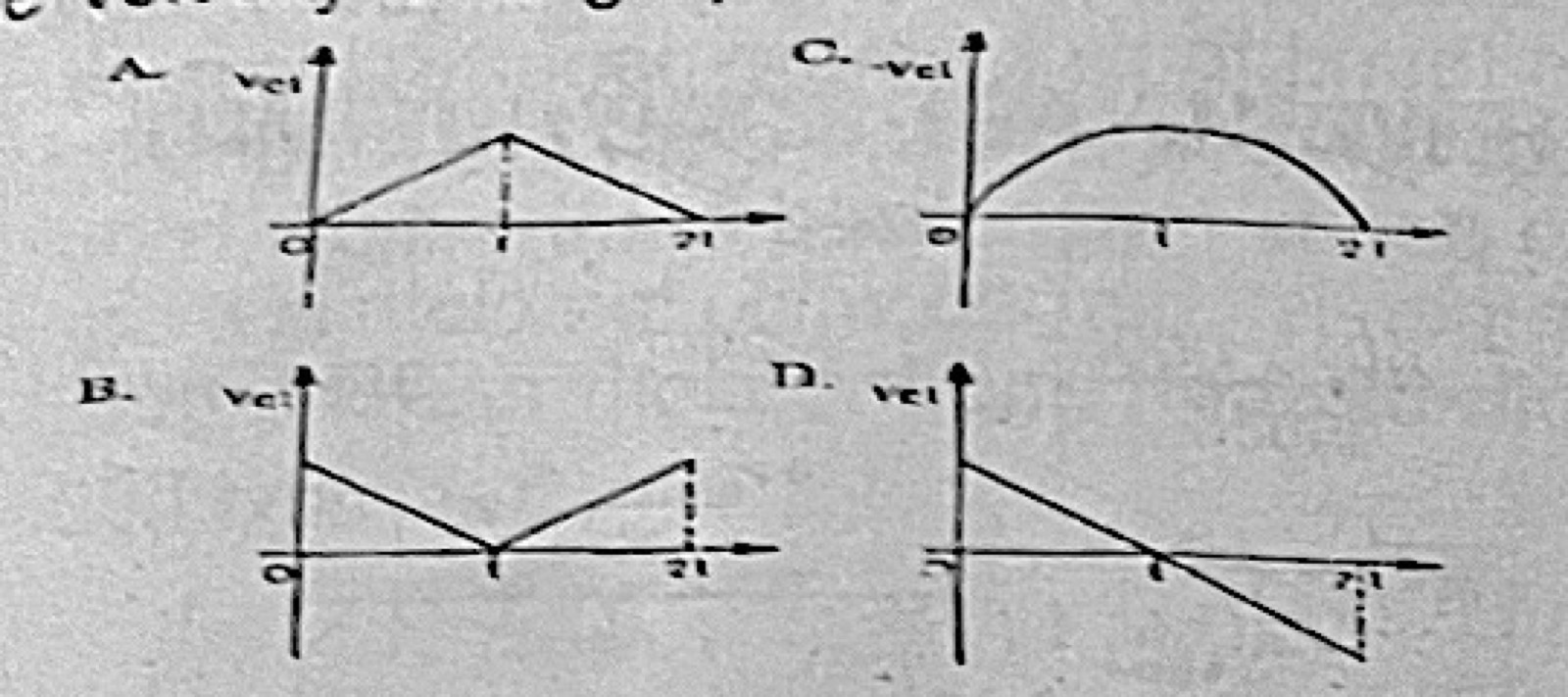
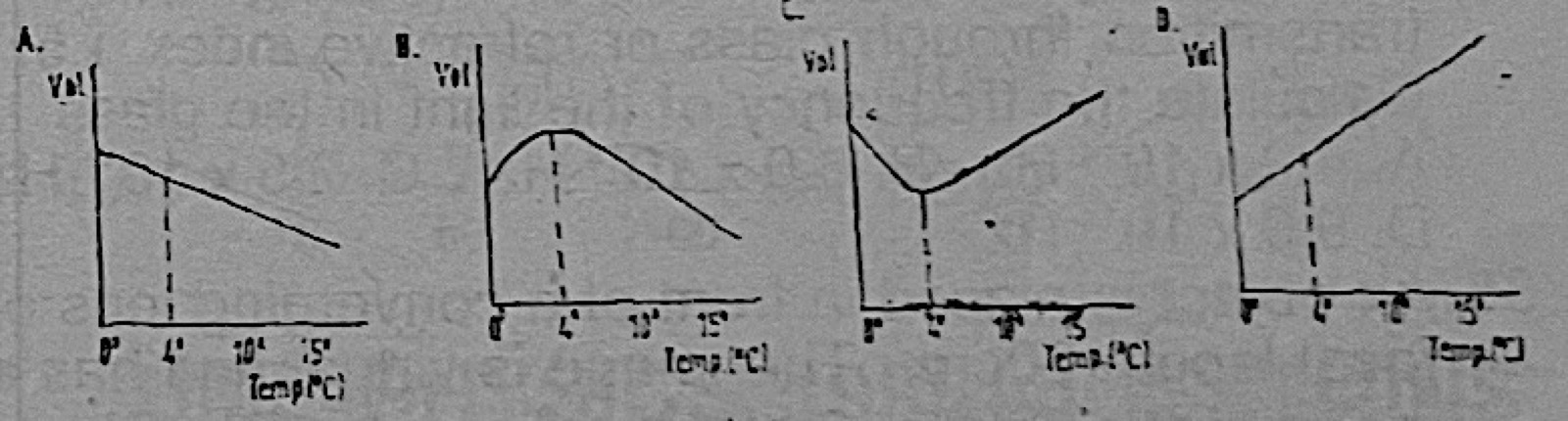
A stone thrown vertically upwards returns to the ground. Which of the following figures represents the velocity-time graph?
A.Figure A
B.Figure B
C.Figure C
D.Figure D
Show the answer and explanation
Answer: D (Figure D)
Explanation
Velocity starts positive (upwards), falls at a steady rate g to zero at the top, then becomes negative (downwards) as the stone falls: one straight line crossing the time axis, as in D.
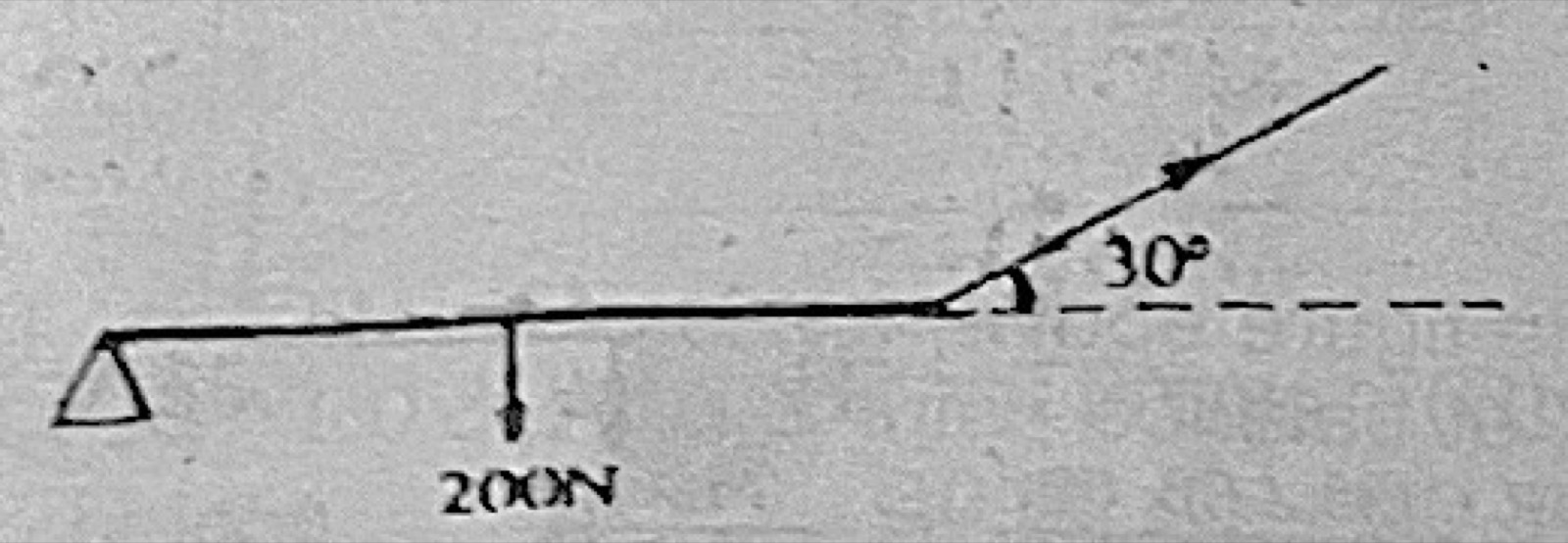
The diagram above shows a uniform wood of weight 200 N and length 50m. It is pivoted at one end and suspended by a cord at the other end at an angle of 30° to the wood. Calculate the tension in the cord if the wood is horizontal.
A.10 N
B.20 N
C.100 N
D.200 N
Show the answer and explanation
Answer: D (200 N)
Explanation
Moments about the pivot: 200 × 25 = T sin 30° × 50, so 5000 = 25T and T = 200 N.
A cone in an unstable equilibrium has its potential energy
A.decreased
B.increased
C.unchanged
D.oscillating
Show the answer and explanation
Answer: A (decreased)
Explanation
A cone balanced on its tip is in unstable equilibrium: any small tilt lowers its centre of gravity, so its potential energy decreases and it falls over.
Calculate the magnitude of the force required to just move a 20kg object along a horizontal surface if the coefficient of friction is 0.2 (g = 10 m s−2)
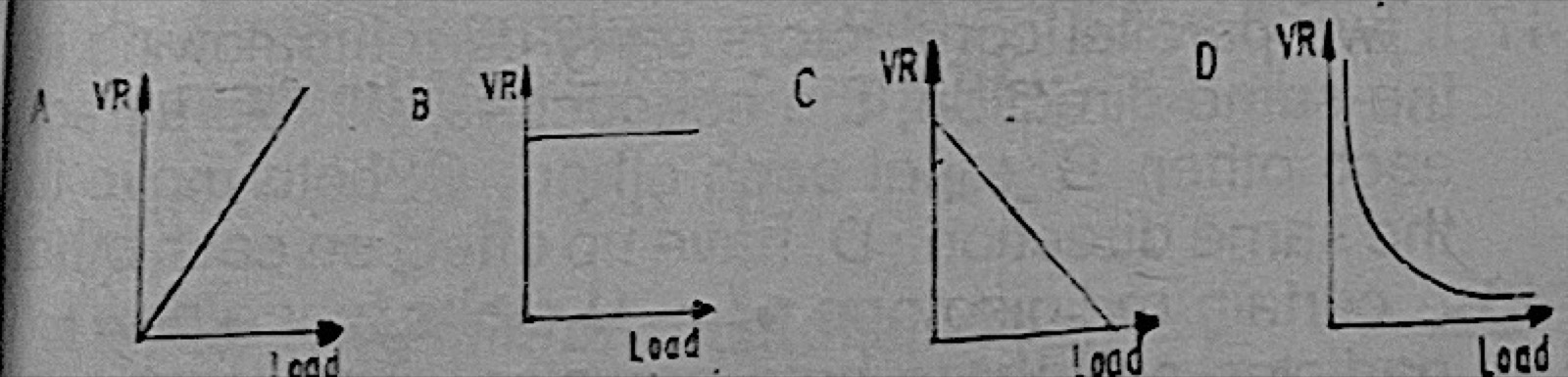
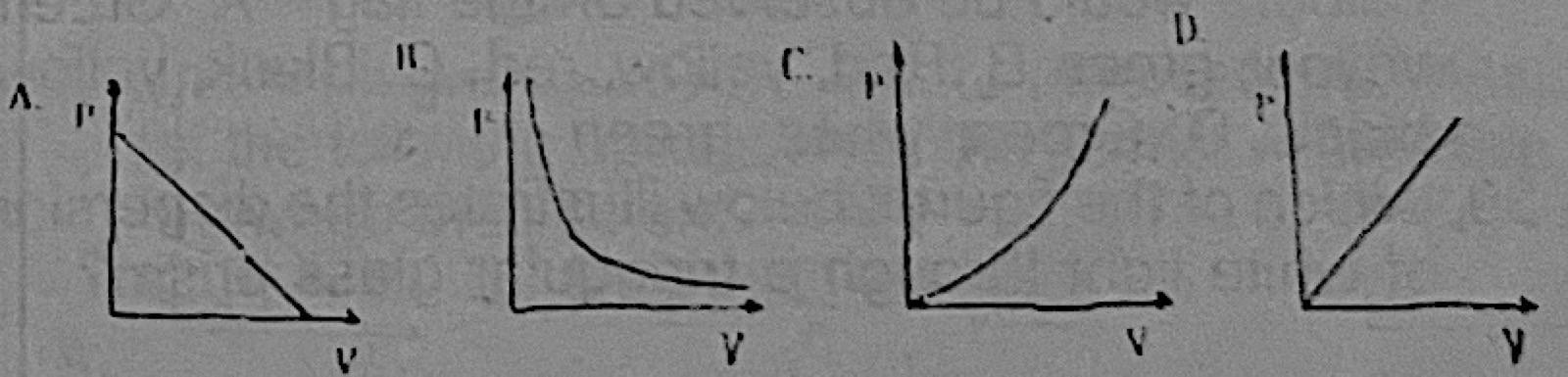
Which of the following graphs correctly represents the relationship between the load and the velocity ratio of a machine?
A.Graph A
B.Graph B
C.Graph C
D.Graph D
Show the answer and explanation
Answer: B (Graph B)
Explanation
Velocity ratio depends only on the design of the machine (distance moved by effort ÷ distance moved by load), so it stays the same whatever the load: a horizontal line, graph B.
A force of 15 N stretches a spring to a total length of 30cm. An additional force of 10 N stretches the spring 5cm further. Find the natural length of the spring
A.25.0cm
B.22.5cm
C.20.0cm
D.15.0cm
Show the answer and explanation
Answer: B (22.5cm)
Explanation
10 N gives 5 cm, so 15 N gives 7.5 cm extension. Natural length = 30 − 7.5 = 22.5 cm.
Which of these statements are TRUE of pressure in liquids? I. Pressure acts equally in all directions II. Pressure decreases with depth III. Pressure at the same level of a liquid is the same IV. Pressure is dependent on the cross-sectional area of the barometer tube.
A.I and III only
B.I, II and III only
C.I, III and IV only
D.I, II, III and IV.
Show the answer and explanation
Answer: A (I and III only)
Explanation
Pressure at a point acts equally in all directions and is the same at the same level. It increases (not decreases) with depth, and does not depend on the tube's area.
The mass of a specific gravity bottle is 15.2g when it is empty. It is 24.8g when filled with kerosene and 27.2g when filled with distilled water. Calculate the relative density of kerosene
A.1.25
B.1.10
C.0.90
D.0.80
Show the answer and explanation
Answer: D (0.80)
Explanation
Mass of kerosene = 24.8 − 15.2 = 9.6 g; mass of the same volume of water = 27.2 − 15.2 = 12.0 g. R.D. = 9.6/12.0 = 0.80.
If a solid X floats in liquid P of relative density 2.0 and in liquid Q of relative density 1.5, it can be inferred that the
A.weight of P displaced is greater than that of Q
B.weight of p displaced is less than that of Q
C.volume of P displaced is greater than that of Q
D.volume of P displaced is less than that of Q.
Show the answer and explanation
Answer: D (volume of P displaced is less than that of Q.)
Explanation
A floating body displaces its own weight in any liquid, so the weights displaced are equal. The denser liquid P needs a smaller volume to give that weight.
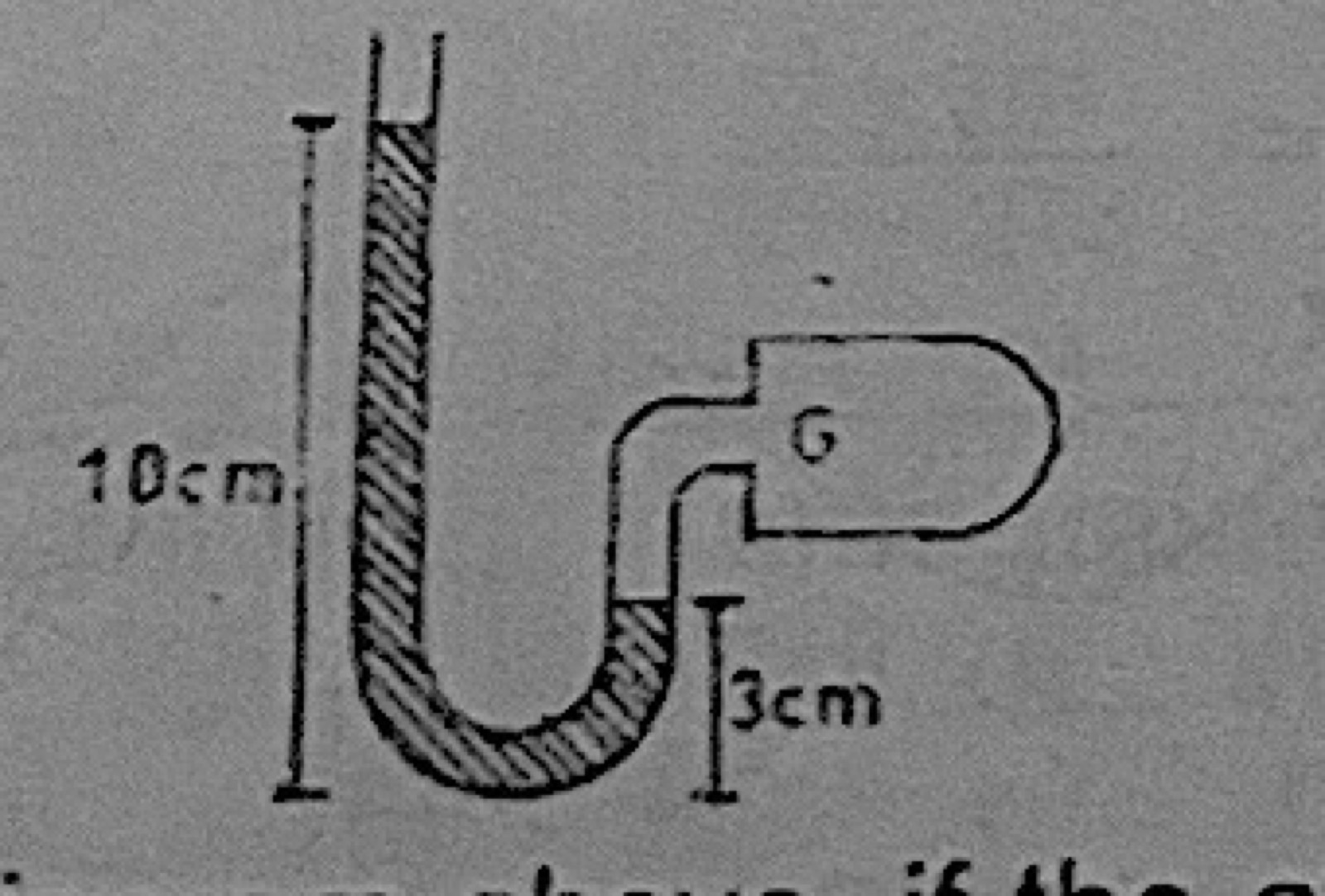
A motor tyre is inflated to pressure of 2.0 × 10⁵ N m−2 when the temperature of air is 27°C. What will be the pressure in it at 87°C assuming that the volume of the tyre does not change?
A.2.6 × 105 N m−2
B.2.4 × 105 N m−2
C.2.2 × 105 N m−2
D.1.3 × 105 N m−2
Show the answer and explanation
Answer: B (2.4 × 10⁵ N m−2)
Explanation
At constant volume p/T is constant: p = 2.0 × 105 × 360/300 = 2.4 × 10⁵ N m−2 (temperatures in kelvin).
Heat is supplied to a test tube containing 100g of ice at its melting point. The ice melts completely in 1 min. What is the power rating of the source of heat? (Latent heat of fusion of ice = 336 J g−1)
A.336 W
B.450 W
C.560 W
D.600 W
Show the answer and explanation
Answer: C (560 W)
Explanation
Heat needed = 100 × 336 = 33 600 J in 60 s. Power = 33 600 ÷ 60 = 560 W.
Two similar kettles containing equal masses of boiling water are placed on a table. If the surface of one is highly polished and the surface of the other is covered with soot, which of the following observations is correct?
A.The two kettles will cool down at the same rate
B.The polished kettle cools down more quickly by conduction
C.The kettle covered with soot cools down more quickly because it is a good radiator of heat
D.The kettle covered with soot cools down more quickly by the process of heat convection.
Show the answer and explanation
Answer: C (The kettle covered with soot cools down more quickly because it is a good radiator of heat)
Explanation
Dull black surfaces are good radiators of heat; shiny polished surfaces are poor radiators, so the sooty kettle loses heat faster.
The equation of tranverse wave travelling along a string is given by y = 0.3 sin (0.5x − 50t) where y and x are in cm and t is in seconds. Find the maximum displacement of the particles from the equilibrium position.
A.50.0cm
B.2.5cm
C.0.5cm
D.0.3cm
Show the answer and explanation
Answer: D (0.3cm)
Explanation
Compare with y = A sin(kx − ωt): the amplitude (maximum displacement) is A = 0.3 cm.
The sound from a source travelled to the bottom of the sea and the echo was heard 4s later. If the speed of sound in sea water is 1500 m s−1, the depth of the sea is
A.6000m
B.3000m
C.1500m
D.375m
Show the answer and explanation
Answer: B (3000m)
Explanation
The sound goes down and back in 4 s, so 2d = 1500 × 4 = 6000 m and d = 3000 m.
A pipe of length 45cm is closed at one end. Calculate the fundamental frequency of the sound wave generated in the pipe if the velocity of sound in air is 360 m s−1. (Neglect end corrections).
A.5.5 Hz
B.148.5 Hz
C.200.0 Hz
D.550.0 Hz
Show the answer and explanation
Answer: C (200.0 Hz)
Explanation
For a closed pipe, L = λ/4, so λ = 4 × 0.45 = 1.8 m and f = 360 ÷ 1.8 = 200.0 Hz.
The note produced by a stretched string has a fundamental frequency of 400 Hz. If the length of the string is doubled while the tension in the string is increased by a factor of 4, the frequency is
A.200 Hz
B.400 Hz
C.800 Hz
D.1600 Hz
Show the answer and explanation
Answer: B (400 Hz)
Explanation
f ∝ √T/L. Multiplying T by 4 doubles f, and doubling L halves it, so f stays 400 Hz.
Light of frequency 6.0 × 10¹⁴ Hz travelling in air is transmitted through glass or refractive index 1.5. Calculate the frequency of the light in the glass.
A.4.0 × 1014 Hz
B.6.0 × 1014 Hz
C.7.5 × 1014 Hz
D.9.0 × 1014 Hz
Show the answer and explanation
Answer: B (6.0 × 10¹⁴ Hz)
Explanation
Frequency is set by the source and does not change on refraction; only the speed and wavelength fall by the factor 1.5. So it stays 6.0 × 10¹⁴ Hz.
An object is placed in front of a converging lens of focal length 20cm. The image is virtual and has a magnification of 2. What is the distance of the object from the lens?
A.5cm
B.10cm
C.30cm
D.40cm
Show the answer and explanation
Answer: B (10cm)
Explanation
Virtual image with m = 2: v = −2u. Using 1/u + 1/v = 1/f: 1/u − 1/(2u) = 1/20, so 1/(2u) = 1/20 and u = 10 cm.
An object is placed directly below a glass block of thickness 3.0cm. Calculate the lateral displacement of the object if the refractive index of the glass is 1.5.
A.1.0cm
B.1.5cm
C.2.0cm
D.2.5cm
Show the answer and explanation
Answer: A (1.0cm)
Explanation
Apparent depth = 3.0 ÷ 1.5 = 2.0 cm, so the object appears raised by 3.0 − 2.0 = 1.0 cm.
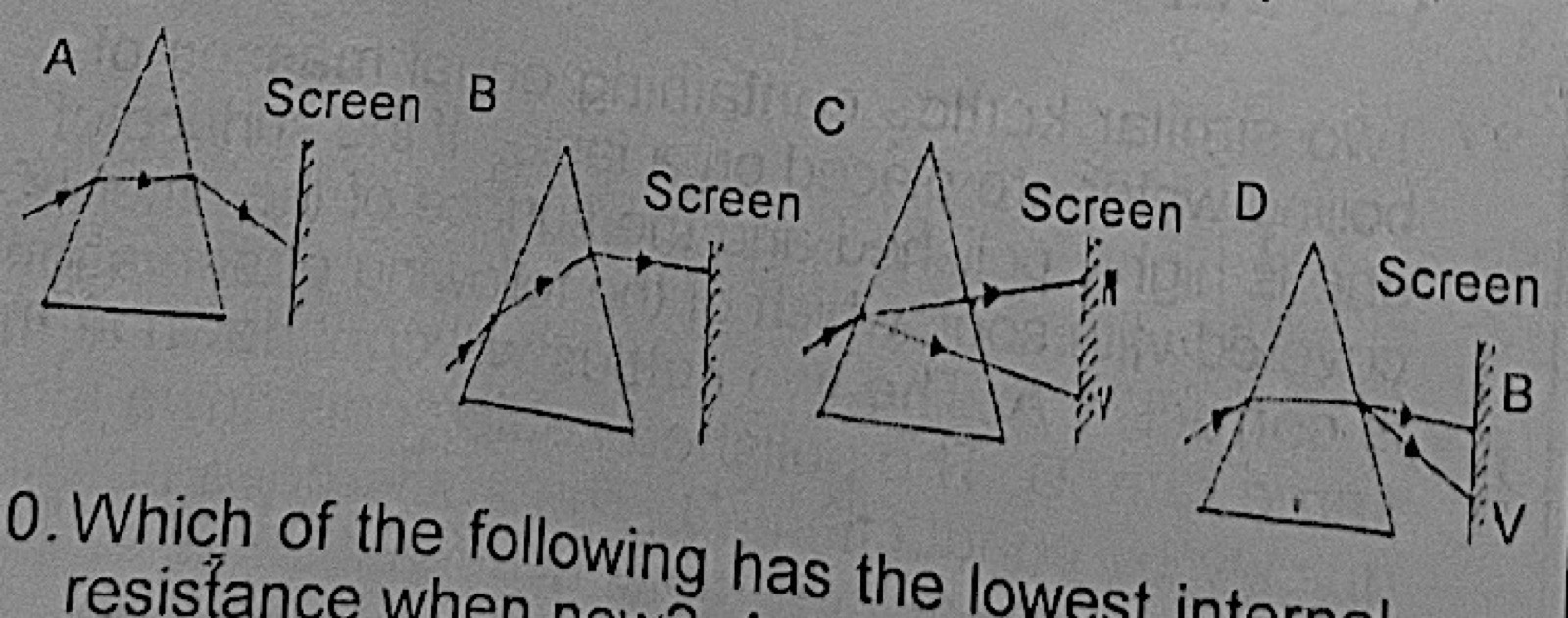
Which of the figures below illustrates the dispersion of white light through a triangular glass prism?
A.Figure A
B.Figure B
C.Figure C
D.Figure D
Show the answer and explanation
Answer: C (Figure C)
Explanation
Each colour has a different refractive index, so white light starts to split into colours as soon as it enters the glass and spreads further on leaving, as in figure C.
When a biro pen rubbed on a dry silk cloth is moved very close to a piece of paper on a dry table, the pen is found to pick up the paper. This is because
A.both the pen and the cloth are magnetized
B.the pen is magnetized but the cloth is not
C.the pen is charged while the cloth is magnetized
D.both the pen and the cloth are charged.
Show the answer and explanation
Answer: D (both the pen and the cloth are charged.)
Explanation
Rubbing transfers electrons, so the pen and the cloth gain equal and opposite charges; the charged pen attracts the light paper.
Two resistors, R1 = 4Ω and R2 = 5Ω, are connected in parallel across a potential difference. If P1 and P2 represent the power dissipated in R1 and R2 respectively, then the ratio P1 : P2 is
A.4 : 5
B.5 : 4
C.16 : 25
D.25 : 16
Show the answer and explanation
Answer: B (5 : 4)
Explanation
In parallel both have the same voltage, so P = V2/R and P1 : P2 = 1/4 : 1/5 = 5 : 4.
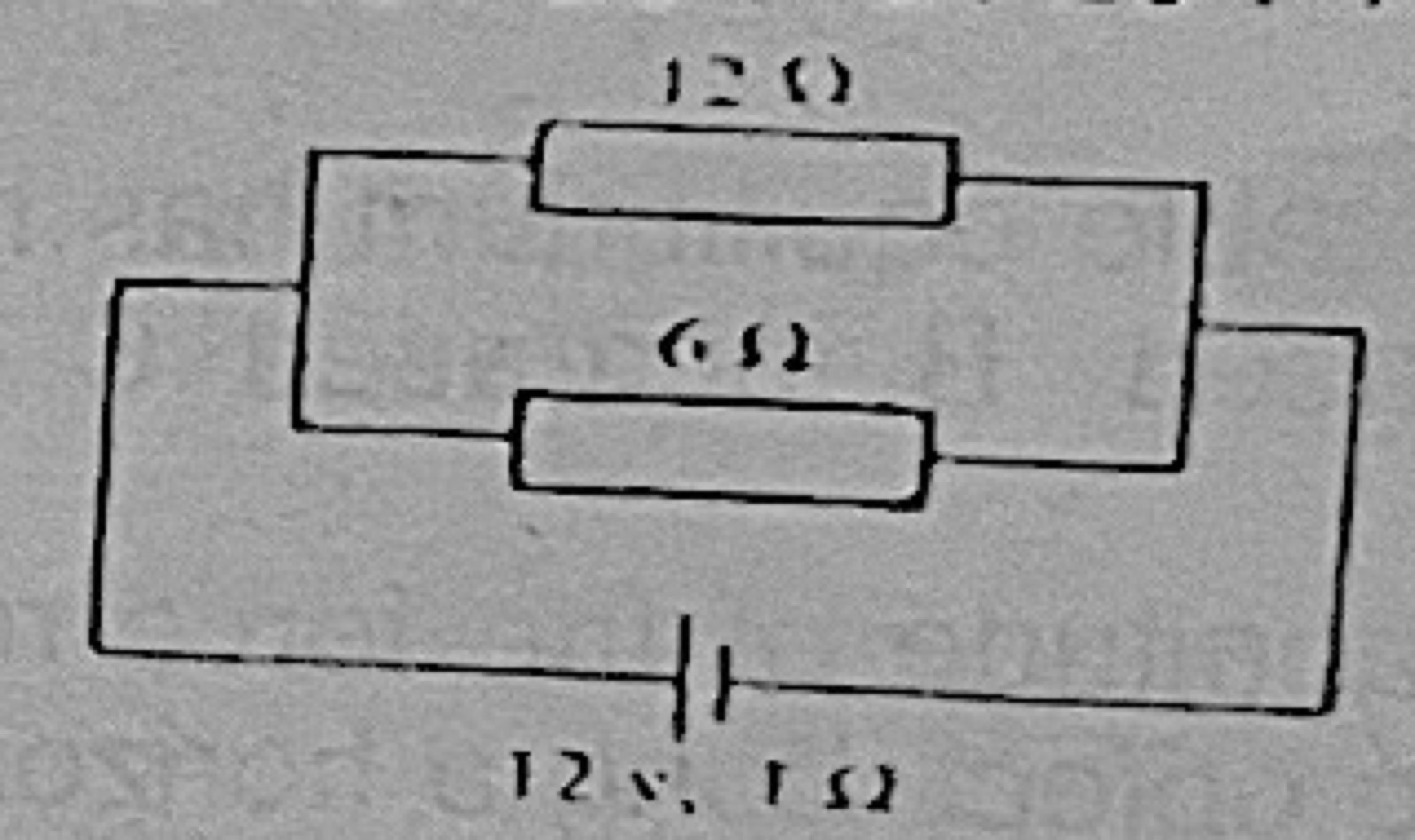
In the circuit diagram above, calculate the current in the 12 Ω resistor if the cell has an e.m.f. of 12V and an internal resistance of 1Ω.
A.0.8A
B.1.0A
C.1.6A
D.2.4 A
Show the answer and explanation
Answer: A (0.8A)
Explanation
12 Ω and 6 Ω in parallel give 4 Ω; with the 1 Ω internal resistance the total is 5 Ω, so the cell gives 12/5 = 2.4 A. The 12 Ω branch takes 6/(12 + 6) of this: 0.8 A.
Which of the following are found in the receiver but not in the microphone of a telephone handset? I. Diaphragm II. Soft iron pole pieces III. Permanent magnet IV. Carbon blocks
A.I and II
B.I and IV
C.II and III
D.III and IV.
Show the answer and explanation
Answer: C (II and III)
Explanation
Both parts have a diaphragm. The earpiece (receiver) has a permanent magnet with soft-iron pole pieces and coils; the carbon granules are in the microphone.