Which of the following affects the period of a simple pendulum? I. Mass of the pendulum bob II. Length of the pendulum III. Acceleration due to gravity
A.I, II and III
B.II and III only
C.I and III only
D.I and II only
Show the answer and explanation
Answer: B (II and III only)
Explanation
T = 2π√(l/g), so the period depends on the length l and on g, but not on the mass of the bob.
A boy sits in a train moving with uniform speed on a straight track. If from his outstretched palm he gently tosses a coin vertically upwards, the coin will fall
A.in front of his palm
B.behind his palm
C.beside his palm
D.into his palm
Show the answer and explanation
Answer: D (into his palm)
Explanation
The coin already shares the train's horizontal velocity, and nothing changes it while it is in the air, so it keeps pace with the boy and lands back in his palm.
A stone, Q is thrown with velocity u at an angle of 75° to the horizontal. Another stone R is thrown with the same velocity u but at an angle of 15° to the horizontal. The ranges covered by the stones will be
A.greater for Q
B.greater for R
C.the same for Q and R
D.greater for the heavier of the two stones
Show the answer and explanation
Answer: C (the same for Q and R)
Explanation
Range = u² sin 2θ / g. sin 150° = sin 30°, so angles of 75° and 15° (which add up to 90°) give the same range.
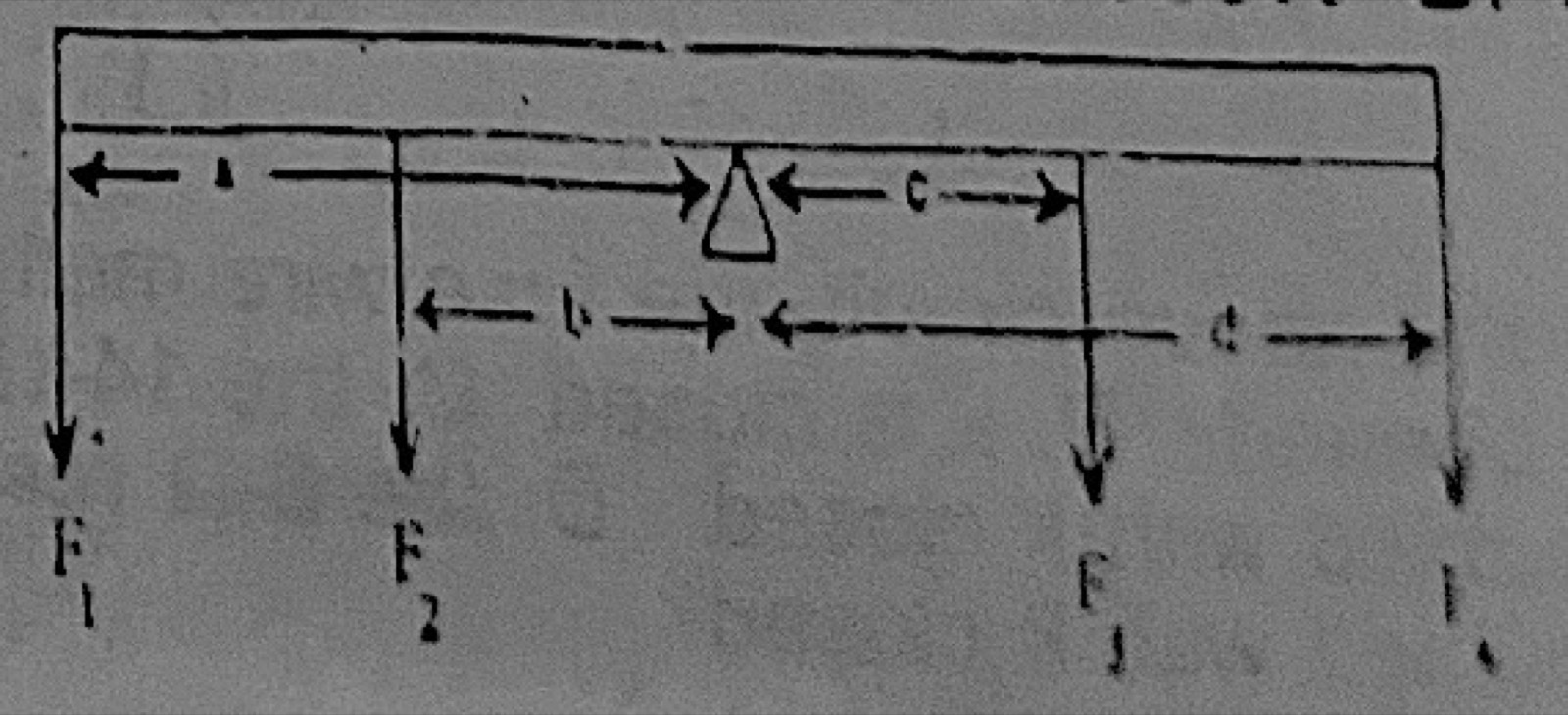
A uniform light rod is kept in horizontal equilibrium under the influence of four forces as shown above. Which of the following equations correctly represents the condition of equilibrium for the rod?
A.F1 + F2 = F3 + F4
B.F1 + F2 − F3 + F4 = 0
C.(F1 + F2)ab = (F3 + F4)cd
D.F1a + F2b − F3c − F4d = 0
Show the answer and explanation
Answer: D (F1a + F2b − F3c − F4d = 0)
Explanation
Take moments about the pivot: F1 and F2 turn the rod one way, F3 and F4 the other way. Balance means F1a + F2b = F3c + F4d.
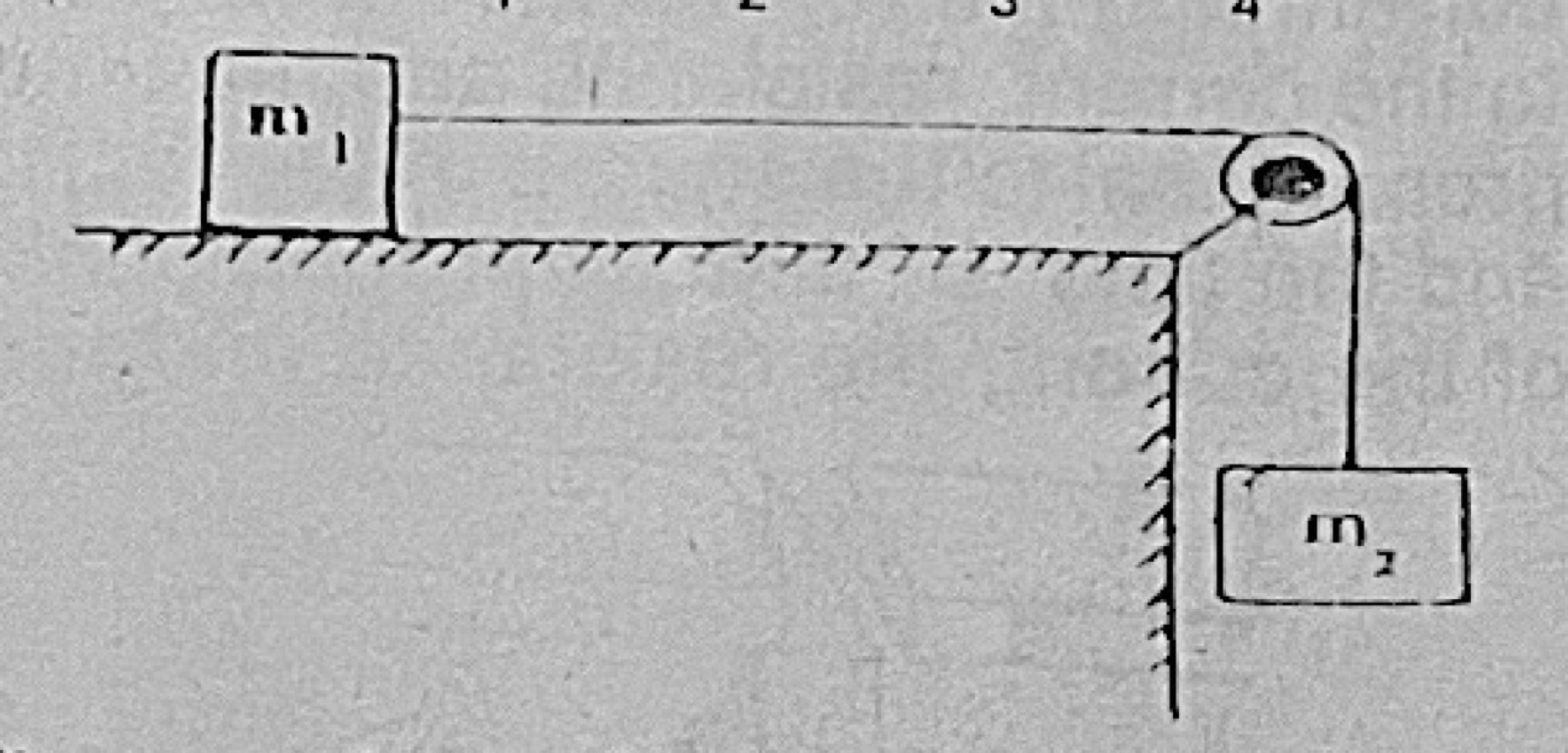
In the diagram above, the hanging mass m2 is adjusted until m1 is on the verge of sliding. The coefficient of static friction between the mass m1 and the table is
A.m1/m2
B.m1g/m2
C.m2/m1
D.m2g/m1
Show the answer and explanation
Answer: C (m2/m1)
Explanation
At the point of sliding, the pull m2g equals the limiting friction μm1g, so μ = m2/m1.
In an experiment to determine Young's Modulus for a wire, several loads are attached to the wire and the corresponding extensions measured. The tensile stress in each case depends on the
A.load and the extension
B.load and the radius of the wire
C.radius of the wire and the extension
D.extension and the original length of the wire
Show the answer and explanation
Answer: B (load and the radius of the wire)
Explanation
Tensile stress = force ÷ cross-sectional area = load ÷ πr², so it depends on the load and the radius of the wire.
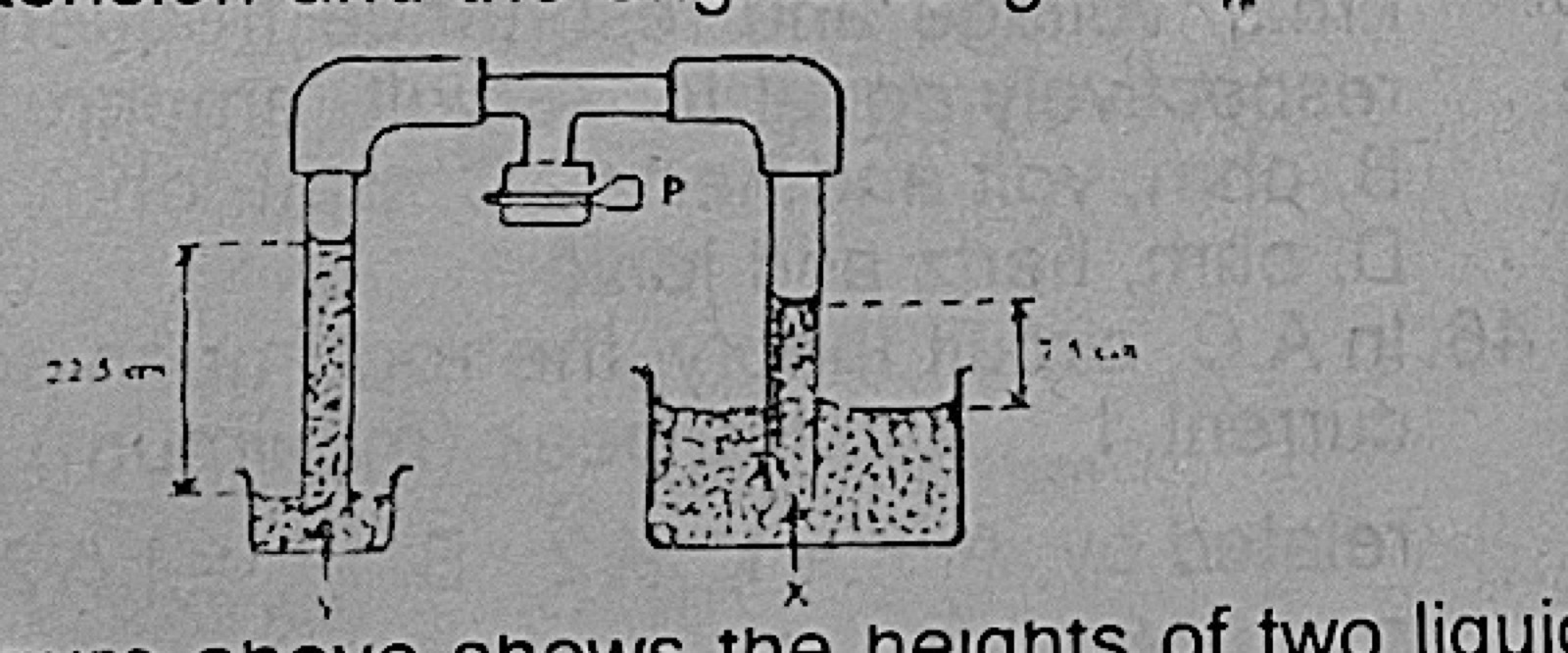
The figure above shows the heights of two liquids X and Y when some air is sucked out of the apparatus through the pump P. The diameter of the table in X is twice that of the tube in Y. What is the relative density of liquid X with respect to liquid Y?
A.1/3
B.2/3
C.3
D.6
Show the answer and explanation
Answer: C (3)
Explanation
Both columns are held up by the same pressure difference, so ρX × 7.5 = ρY × 22.5, giving ρX/ρY = 3. The tube diameter does not matter.
If a plastic sphere floats in water (density = 1000 kg m−3) with 0.5 of its volume submerged and floats on oil with 0.4 of its volume submerged, the density of the oil is
A.800 kg m−3
B.1200 kg m−3
C.1250 kg m−3
D.2000 kg m−3
Show the answer and explanation
Answer: C (1250 kg m−3)
Explanation
A floating body displaces its own weight in both liquids: 0.5V × 1000 = 0.4V × ρ, so ρ = 500/0.4 = 1250 kg m−3.
A platinum resistance thermometer wire has a resistance of 5 ohms at 0°C and 5.5 ohms at 100°C. Calculate the temperature of the wire when the resistance is 5.2 ohms.
A bridge made of steel is 600m long. What is the daily variation in its length if the night-time and day-time temperatures are 10°C and 35°C respectively. The linear expansivity of steel is 0.000012 C−1
A.0.18cm
B.1.80cm
C.18.00cm
D.1800cm
Show the answer and explanation
Answer: C (18.00cm)
Explanation
Change in length = 600 × 0.000012 × (35 − 10) = 0.18 m, which is 18.00 cm.
A block of ice floats on water inside a container. If the block of ice gets completely melted, the level of water in the container will
A.increase
B.remain the same
C.decrease
D.first decrease and then increase
Show the answer and explanation
Answer: B (remain the same)
Explanation
Floating ice displaces its own weight of water. When it melts it becomes exactly that much water, which fills the space it displaced, so the level does not change.
The space between the double glass walls of a thermos flask is evacuated and the two surfaces facing the evacuated space are silvered. The residual source of heat loss takes place by
A.convection
B.radiation from the surfaces
C.conduction through the stopper and the glass
D.conduction across the walls.
Show the answer and explanation
Answer: C (conduction through the stopper and the glass)
Explanation
The vacuum stops conduction and convection across the walls and the silvering cuts radiation, so the heat that still escapes leaks by conduction through the stopper and along the glass.
Which of the following properties make the convex mirror useful as a driving mirror? I. The image is real II. The image is erect III. It has a wide field of view IV. The image is magnified.
A.I, II and IV
B.I, II and III
C.II and III
D.I and III.
Show the answer and explanation
Answer: C (II and III)
Explanation
A convex mirror always gives an upright (erect), diminished, virtual image and covers a wide field of view, which is what a driver needs.
A concave mirror has a radius of curvature of 36cm. At what distance from the mirror should an object be placed to give a real image three times the size of the object?
A.12cm
B.24cm
C.48cm
D.108cm
Show the answer and explanation
Answer: B (24cm)
Explanation
f = 36/2 = 18 cm and v = 3u. 1/u + 1/(3u) = 1/18 gives 4/(3u) = 1/18, so u = 24 cm.
Which of the following statements is CORRECT about a long-sighted boy who does not put on glasses?
A.He cannot see distant objects clearly
B.Rays of light from a close object are focused in front of his retina
C.His eyeball is too long
D.Parallel rays of light are focused behind his retina.
Show the answer and explanation
Answer: D (Parallel rays of light are focused behind his retina.)
Explanation
A long-sighted eye is too short (or its lens too weak), so with the eye relaxed even parallel rays would meet behind the retina; near objects are the ones he cannot see clearly.
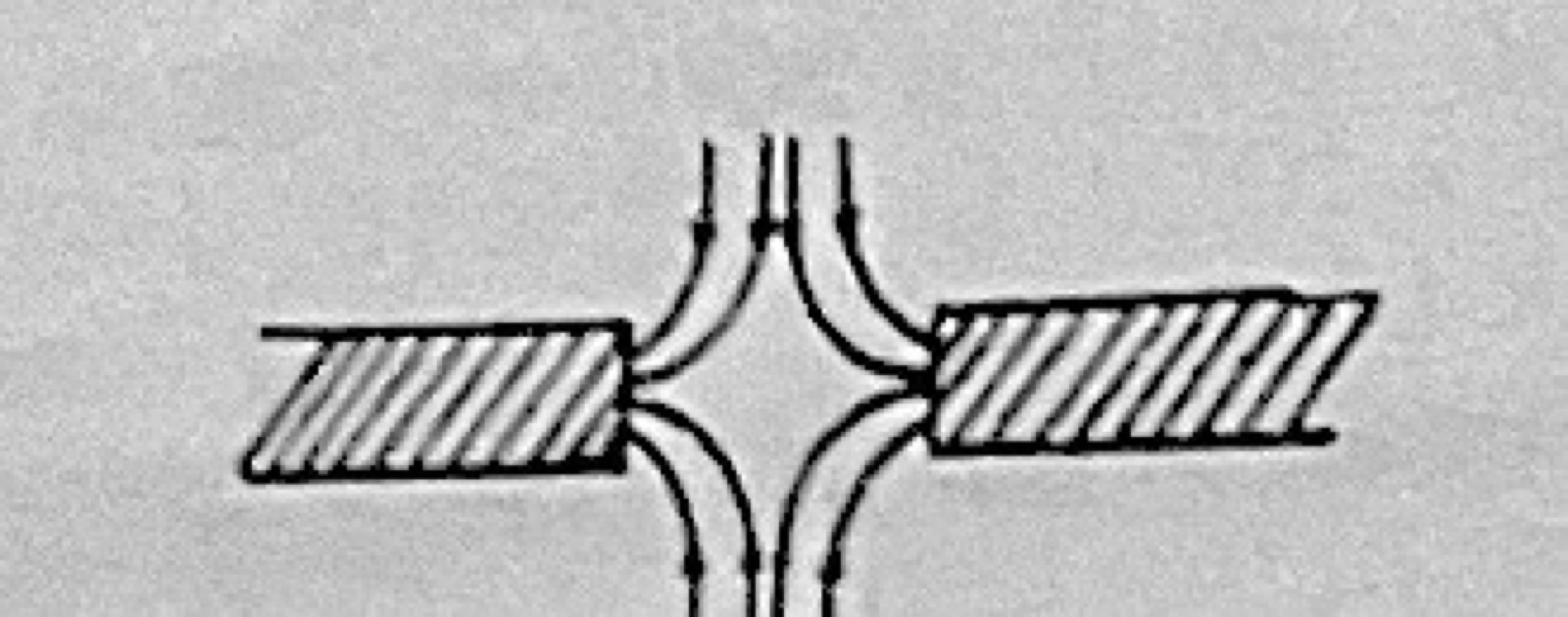
The diagram above represents the field pattern obtained by bringing the poles of two magnets near each other. The poles must be
A.N-N poles
B.S-S poles
C.S-N poles
D.N-S poles
Show the answer and explanation
Answer: B (S-S poles)
Explanation
The lines push away from each other and leave a neutral point between the poles, so the poles are alike; the arrows point into both poles, and field lines enter at south poles.
The angle between the direction of the earth's magnetic field and the horizontal is called the
A.angle of deviation
B.magnetic declination
C.magnetic meridian
D.angle of dip.
Show the answer and explanation
Answer: D (angle of dip.)
Explanation
The angle the earth's field makes with the horizontal is the angle of dip (inclination); declination is the angle between magnetic and geographic north.
The diagram above shows a meter bridge in which two of the arms contain resistances R and 2Ω. A balance point is obtained at 60cm from the left end. Calculate the value of R.
The maximum permissible current through a galvanometer G of internal resistance 10Ω is 0.05A. A resistance R is used to convert G into a voltmeter with a maximum reading of 100V. Find the value of R and how it is connected to G.
A.20,000 ohms in parallel
B.19,990 ohms in series
C.1990 ohms in series
D.100 ohms in series.
Show the answer and explanation
Answer: C (1990 ohms in series)
Explanation
A voltmeter needs a large resistance in series. Total resistance = 100/0.05 = 2000 Ω, so R = 2000 − 10 = 1990 Ω in series.
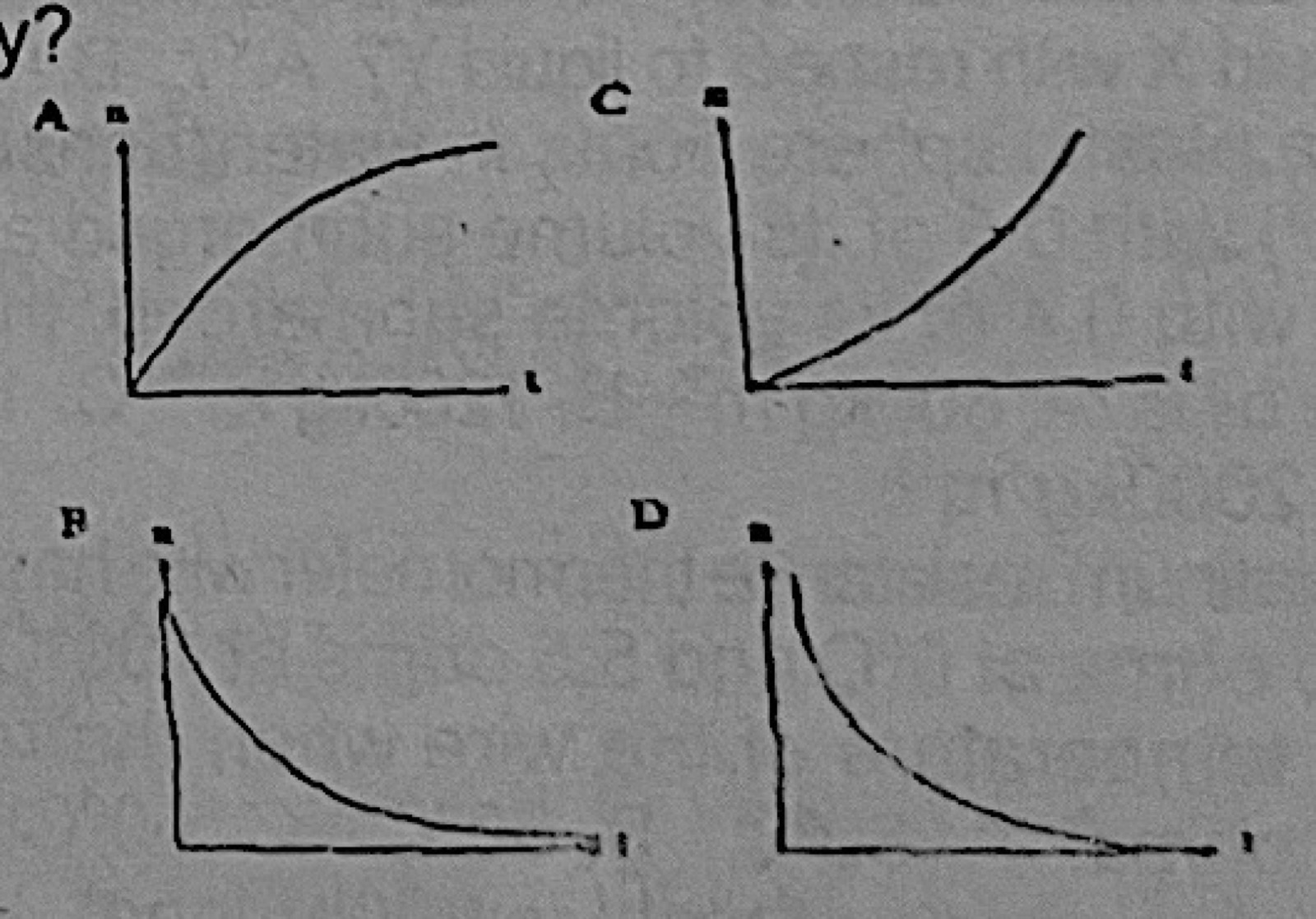
Which of the following graphs correctly illustrates the number of remaining atoms during a radioactive decay?
A.Graph A
B.Graph B
C.Graph C
D.Graph D
Show the answer and explanation
Answer: B (Graph B)
Explanation
The number of undecayed atoms starts at its largest value and falls exponentially, halving every half-life and approaching zero; graph B shows this curve starting from the initial number.