49 questions. Try each one, then open the answer to check yourself and read the explanation.
Question 1
Sound
In a resonance tube experiment, a tube of fixed length is closed at one end and several tuning forks of increasing frequency used to obtain resonance at the open end. If the tuning fork with the lowest frequency which gave resonance had a frequency f1 and the next tuning fork to give resonance had a frequency f2, find the ratio f2/f1.
A.8
B.3
C.2
D.½
E.⅓
Show the answer and explanation
Answer: B (3)
Explanation
A tube closed at one end resonates at L = λ/4, 3λ/4, 5λ/4…, so its resonant frequencies are f, 3f, 5f… The next one after the lowest is 3 times it.
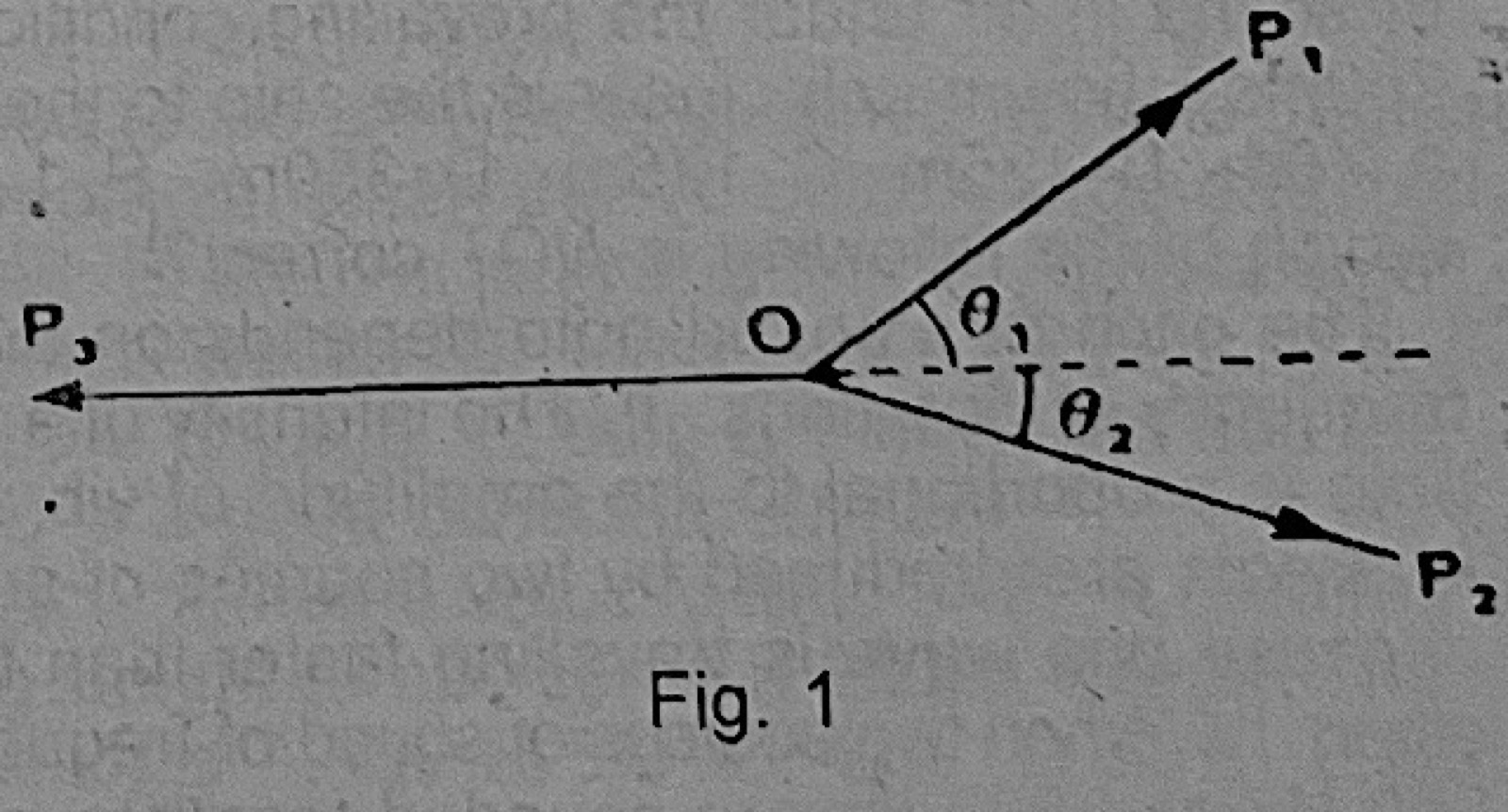
Consider the three forces acting at O and in equilibrium as shown in Fig. 1. Which of the following equations is/are CORRECT? I. P1 cos θ1 = P2 cos θ2 II. P3 = P1 cos θ1 + P2 cos θ2 III. P1 sin θ1 = P2 sin θ2
A.I only
B.II only
C.III only
D.II and III only
E.I and III only.
Show the answer and explanation
Answer: D (II and III only)
Explanation
Resolve horizontally: the components of P1 and P2 to the right together balance P3, so II is true. Resolve vertically: the upward part of P1 balances the downward part of P2, so III is true. I is not generally true.
Which of the following statements about friction is NOT correct?
A.The force of kinetic friction is less than the force of static friction
B.The force of kinetic friction between two surfaces is independent of the areas in contact provided the normal reaction is unchanged.
C.The force of rolling friction between two surfaces is less than the force of sliding friction
D.The angle of friction is the angle between the normal reaction and the force of friction.
E.Friction may be reduced by lubrication.
Show the answer and explanation
Answer: D (The angle of friction is the angle between the normal reaction and the force of friction.)
Explanation
The normal reaction and friction are always at 90°. The angle of friction is the angle between the normal reaction and the resultant of the normal reaction and friction.
If the relative density of a metal is 19, what will be the mass of 20 cm3 of the metal when immersed in water?
A.380 g
B.400 g
C.360 g
D.39 g
E.180 g
Show the answer and explanation
Answer: A (380 g)
Explanation
Mass does not change when a body is put in water. Mass = relative density × volume (g/cm³) = 19 × 20 = 380 g; immersion only reduces its apparent weight.
A ship travelling towards a cliff receives the echo of its whistle after 3.5 seconds. A short while later, it receives the echo after 2.5 seconds. If the speed of sound in air under the prevailing conditions is 250 m s−1, how much closer is the ship to the cliff?
A.10 m
B.125 m
C.175 m
D.350 m
E.1,000 m.
Show the answer and explanation
Answer: B (125 m)
Explanation
Distance = speed × (echo time ÷ 2). First 250 × 1.75 = 437.5 m, then 250 × 1.25 = 312.5 m. The ship is 125 m closer.
Which of the following is NOT correct? I. The pitch of a sound note depends on the frequency of vibrations. II. The intensity of a sound note is proportional to the amplitude of vibrations. III. Beats are produced by two sources of sound because one wave is travelling faster than the other. IV. When two sources of sound of frequencies 500 Hz and 502 Hz are sounded together, a beat frequency of 2 Hz is observed. V. The first harmonic of a note has double the frequency of the fundamental note.
A.I and II
B.II and III
C.I and III
D.III and IV
E.IV and V.
Show the answer and explanation
Answer: B (II and III)
Explanation
Intensity is proportional to the square of the amplitude, not the amplitude (II wrong), and beats come from two slightly different frequencies, not different speeds (III wrong). I and IV are correct.
Which of the following statements about defects of vision is/are CORRECT? I. For a long sighted person, close objects appear blurred. II. For a short sighted person, distant objects appear blurred III. Short sight is corrected by using a pair of converging lenses.
A.I only
B.II only
C.I and II only
D.II and III only
E.I, II and III.
Show the answer and explanation
Answer: C (I and II only)
Explanation
A long-sighted person cannot see near objects clearly and a short-sighted person cannot see distant ones. Short sight is corrected with diverging (concave) lenses, so III is wrong.
Which of the following conditions are necessary and sufficient for total internal reflection to take place at the boundary between two optical media? I. Light is passing from optically denser medium to optically less dense medium II. Light is passing from optically less dense medium to optically denser medium III. Angle of incidence is greater IV. Angle of incidence is lesser
A.I and II only
B.II and III only
C.III and IV only
D.I and III only
E.II and IV only.
Show the answer and explanation
Answer: D (I and III only)
Explanation
Total internal reflection needs light going from a denser to a less dense medium, with an angle of incidence greater than the critical angle.
Answer: A (Source, slit, converging lens, prism, converging lens, screen)
Explanation
A narrow slit, a converging lens to make the light parallel, the prism, and a second converging lens to focus each colour sharply on the screen give a pure spectrum.
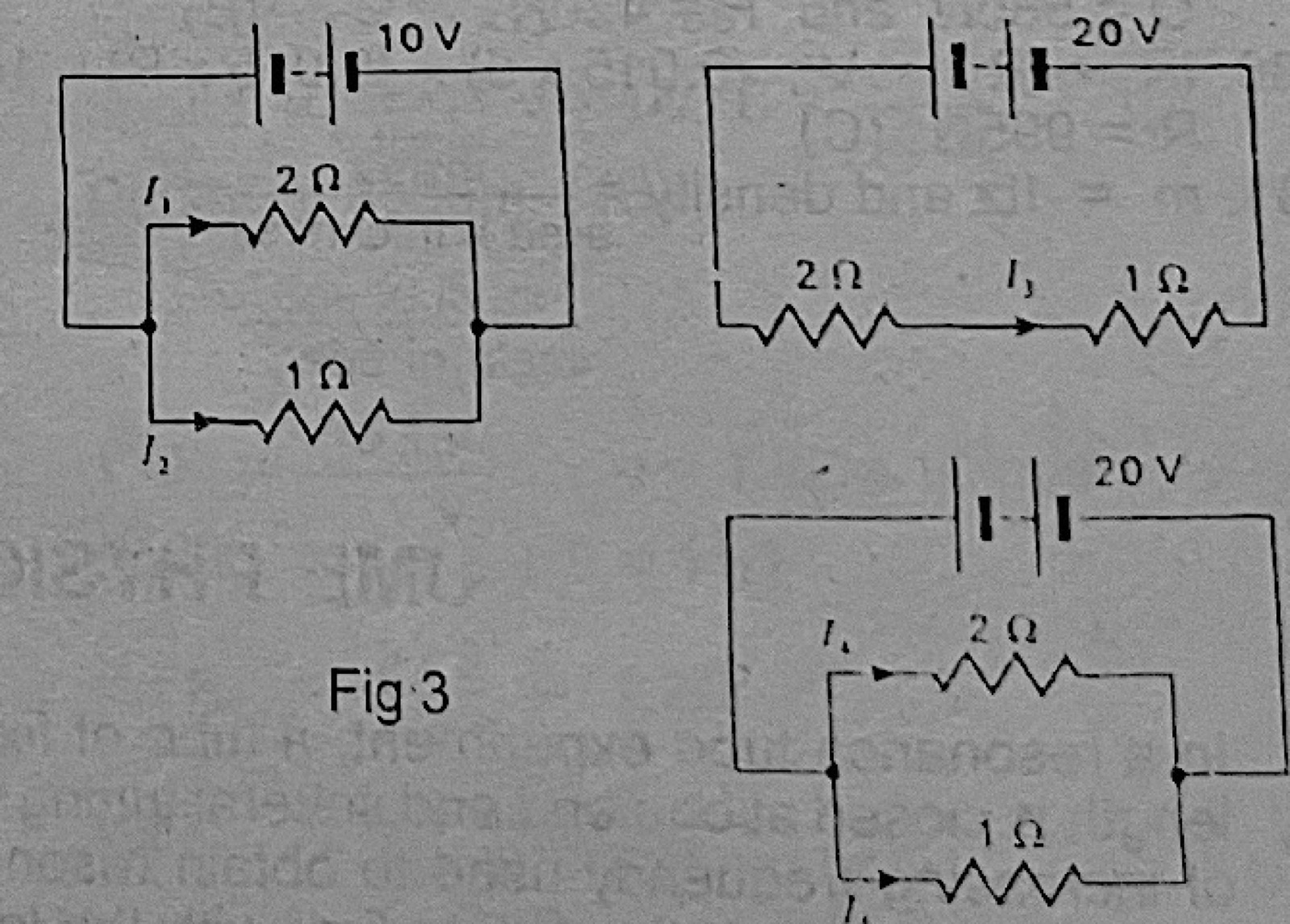
A milliameter with full scale deflection of 10 mA has an internal resistance of 5 ohms. It would be converted to an ammeter with a full scale deflection of 1 A by connecting a resistance of
A.5/99 ohm in series with it
B.5/99 ohm in parallel with it
C.99/5 ohm in parallel with it
D.99/5 ohm in series with it
E.2 ohms in series with it.
Show the answer and explanation
Answer: B (5/99 ohm in parallel with it)
Explanation
A shunt goes in parallel and carries 1 − 0.01 = 0.99 A while the meter carries 0.01 A at the same p.d.: 0.99R = 0.01 × 5, so R = 5/99 Ω.
It is usual to transmit electric power at high voltage and low current. Which of the following are possible advantages of the method? I. Heat losses are reduced because the currents are small II. Thin wires can be used because small currents are flowing III. The power can flow faster because the voltage is high
A.I only
B.I and II only
C.II and III only
D.I and III only
E.I, II and III.
Show the answer and explanation
Answer: B (I and II only)
Explanation
Small currents mean small I²R heat losses and allow thinner, cheaper cables. Power does not 'flow faster' at high voltage.
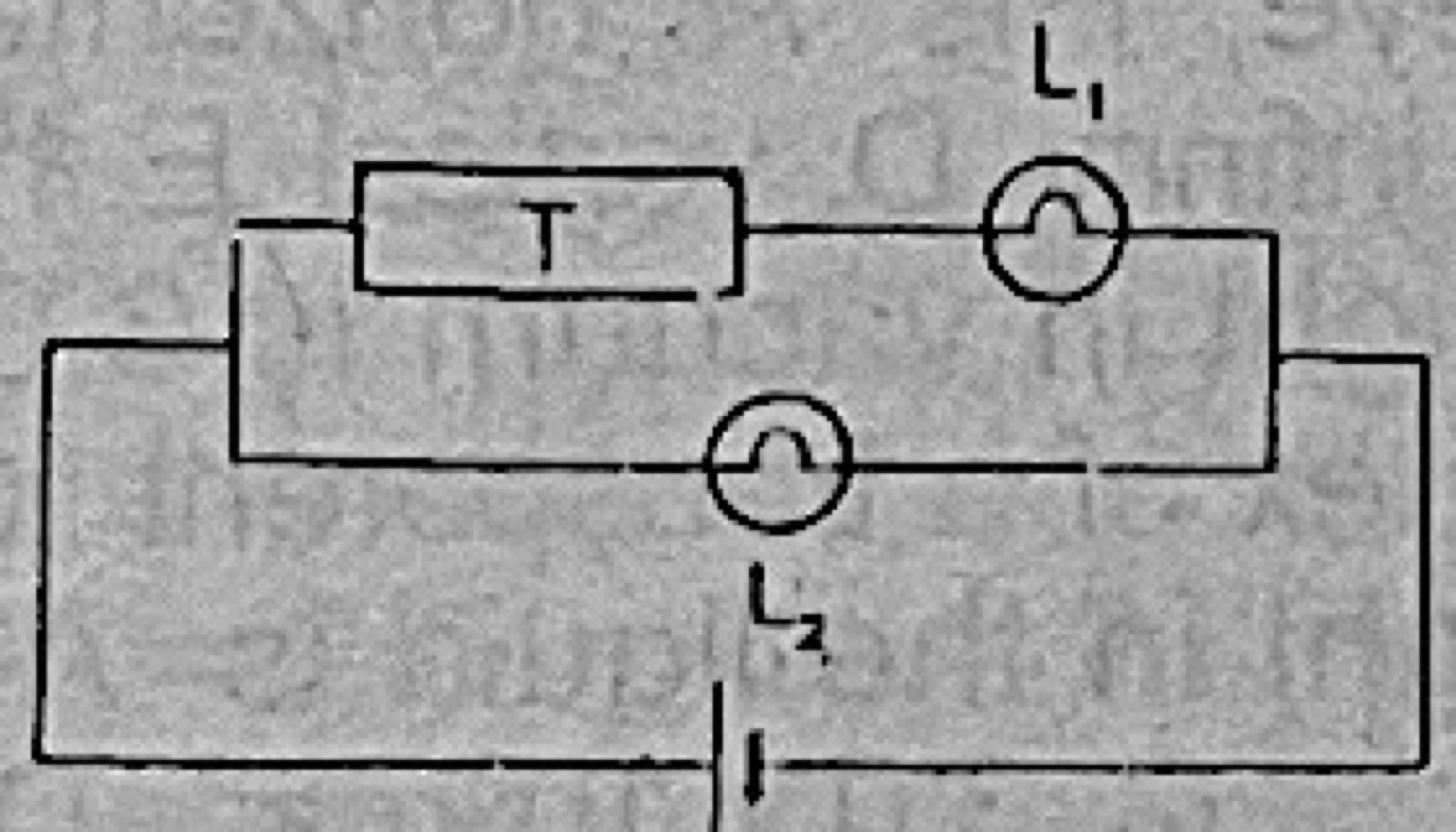
In the circuit shown in Fig. 4, T is a resistor whose resistance falls as temperature increases. L1 and L2 are lamps. Assuming the cell has negligible internal resistance, as the temperature of T increases.
A.L1 becomes brighter, L2 becomes dimmer
B.L1 and L2 becomes brighter
C.L1 becomes dimmer, L2 becomes brighter
D.L1 becomes brighter, L2 does not change
E.L2 becomes dimmer, L1 does not change.
Show the answer and explanation
Answer: D (L1 becomes brighter, L2 does not change)
Explanation
T is in series with L1, so as T's resistance falls more current flows and L1 brightens. L2 is directly across the cell, whose voltage is fixed, so it is unchanged.
The electrochemical equivalent of a metal is 0.126 × 10⁻⁶ kg/C. The mass of the metal that a current of 5 A will deposit from a suitable bath in 1 hour is
A.0.0378 × 10−3 kg
B.0.227 × 10−3 kg
C.0.378 × 10−3 kg
D.0.595 × 10−3 kg
E.2.268 × 10−3 kg.
Show the answer and explanation
Answer: E (2.268 × 10⁻³ kg.)
Explanation
m = zIt = 0.126 × 10−6 × 5 × 3600 = 2.268 × 10⁻³ kg.
1,000 identical drops of oil of density 500 kg/m3 have a total mass of 5 × 10⁻⁴ kg. One of the drops forms a thin film of area 0.5 m2 on water. The thickness of the film is
A.2 × 10−8 m
B.2 × 10−9 m
C.2 × 10−7 m
D.3 × 10−9 m
E.2.8 × 10−8 m.
Show the answer and explanation
Answer: B (2 × 10⁻⁹ m)
Explanation
One drop has mass 5 × 10⁻⁷ kg, so its volume is 5 × 10⁻⁷/500 = 10−9 m3. Thickness = volume/area = 10−9/0.5 = 2 × 10⁻⁹ m.
The total length of a spring when a mass of 20 g is hung from its end is 14 cm, while its total length is 16 cm when a mass of 30 g is hung from the same end. Calculate the unstretched length of the spring assuming Hooke's law is obeyed.
A.9.33 cm
B.10.00 cm
C.10.66 cm
D.12.00 cm
E.15.00 cm
Show the answer and explanation
Answer: B (10.00 cm)
Explanation
The extra 10 g stretches it 2 cm, so 20 g stretches it 4 cm. Unstretched length = 14 − 4 = 10 cm.
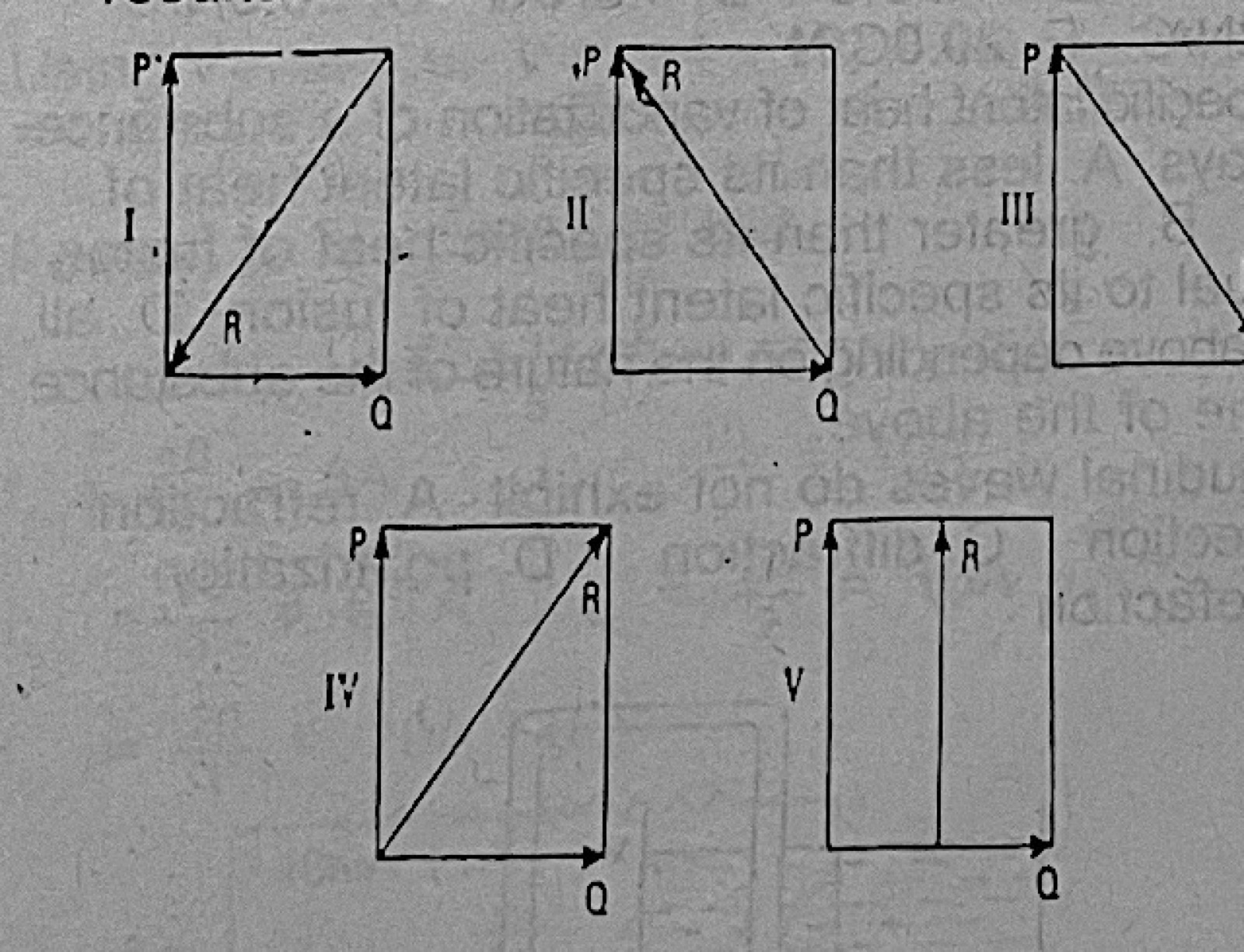
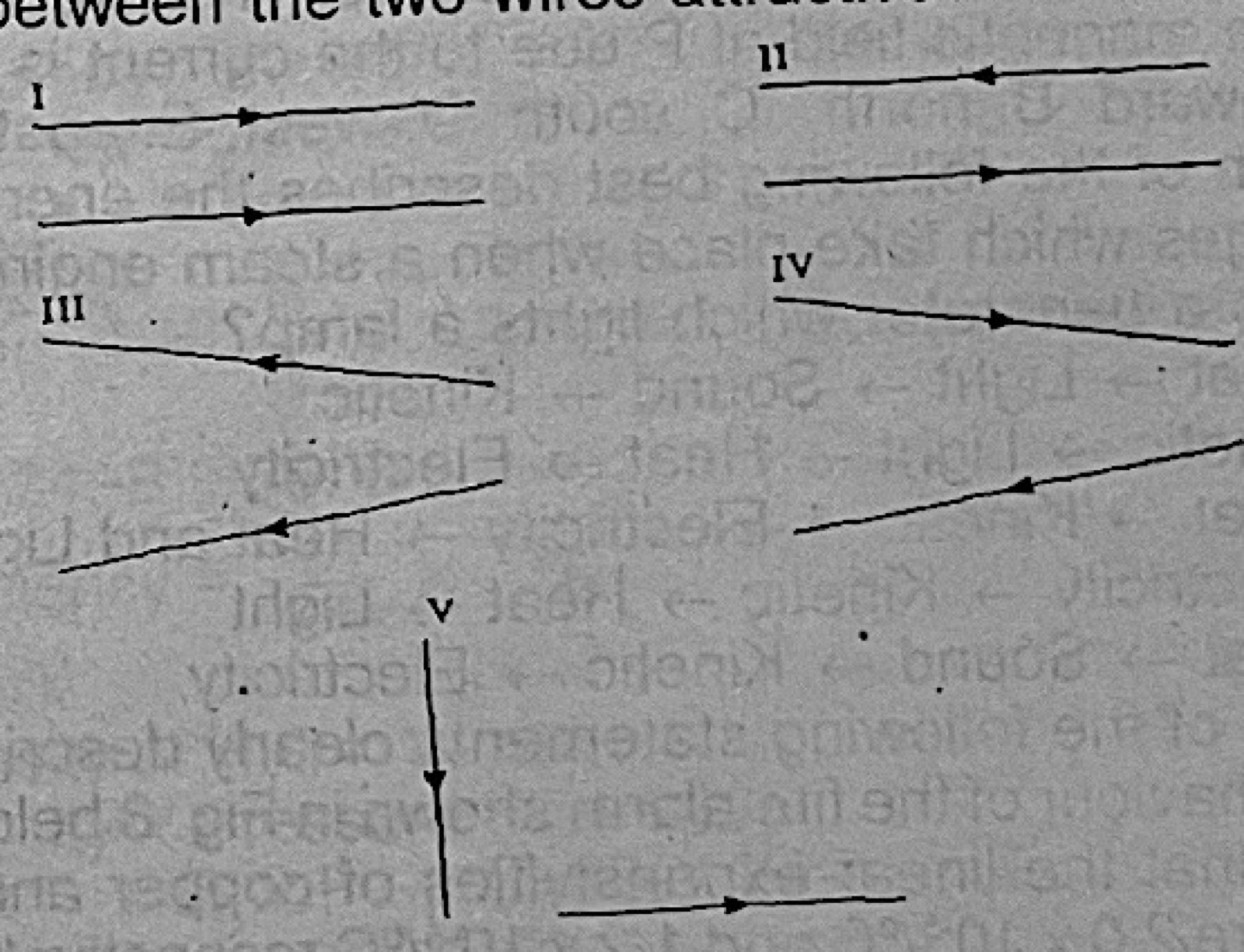
Each of the diagrams in Fig. 6 represents two current carrying conductors situated close to each other. In which two diagrams are the forces between the two wires attractive?
A.I and V
B.I and III
C.II and IV
D.II and V
E.III and IV.
Show the answer and explanation
Answer: B (I and III)
Explanation
Parallel wires attract when their currents flow in the same direction. In I both currents go to the right and in III both go to the left; in II and IV they are opposite (repel), and in V the wires are at right angles.
Which of the following statements is CORRECT? I. The mass number is equal to the total number of protons and electrons in an atom II. The atomic number is equal to the number of protons in an atom III. The number of electrons in an atom is equal to the total number of protons and neutrons in the nucleus.
A.I only
B.II only
C.III only
D.I and II only
E.II and III only.
Show the answer and explanation
Answer: B (II only)
Explanation
The atomic number is the number of protons. The mass number counts protons and neutrons (not electrons), and a neutral atom has as many electrons as protons.
A short response time is obtained in liquid-in-glass thermometer when the
A.bulb is large and thick-walled
B.stem is long and thin
C.bulb is small and thick-walled
D.liquid is of high density and the bore is large
E.bulb is thin-walled and the liquid is a good conductor of heat.
Show the answer and explanation
Answer: E (bulb is thin-walled and the liquid is a good conductor of heat.)
Explanation
Heat passes quickly through a thin glass wall, and a liquid that conducts well soon reaches the temperature being measured, so the reading responds fast.
If the normal atmospheric pressure in a laboratory supports a column of mercury 0.76 m high and the relative density of mercury is 13.8, then the height of water column which atmospheric pressure will support in the same laboratory at the same time is
A.0 m
B.10 m
C.13 m
D.14 m
E.18 m.
Show the answer and explanation
Answer: B (10 m)
Explanation
Equal pressures: hwater = 0.76 × 13.8 ≈ 10.5 m, so about 10 m.
An electric current of 3 A flowing through an electric heating element of resistance 20 Ω embedded in 1,000 g of an oil raises the temperature of the oil by 10°C in 10 seconds, then the specific heat capacity of the oil is
A.1.8 J/g
B.0.6 J/g
C.0.18 J/g°C
D.1.8 J/g°C
E.0.06 J/g°C
Show the answer and explanation
Answer: C (0.18 J/g°C)
Explanation
Heat = I²Rt = 9 × 20 × 10 = 1800 J. c = 1800/(1000 × 10) = 0.18 J/g°C.
The difference of potential between the terminals of a cell is 2.2 volts. When a 4 ohm resistor is connected across the terminals of this cell, the potential difference is 2 volts. What is the internal resistance of the cell?
A.0.10 ohms
B.0.25 ohms
C.0.40 ohms
D.2.50 ohms
E.4.00 ohms
Show the answer and explanation
Answer: C (0.40 ohms)
Explanation
Current I = 2/4 = 0.5 A. Lost volts = 2.2 − 2 = 0.2 V, so r = 0.2/0.5 = 0.4 Ω.
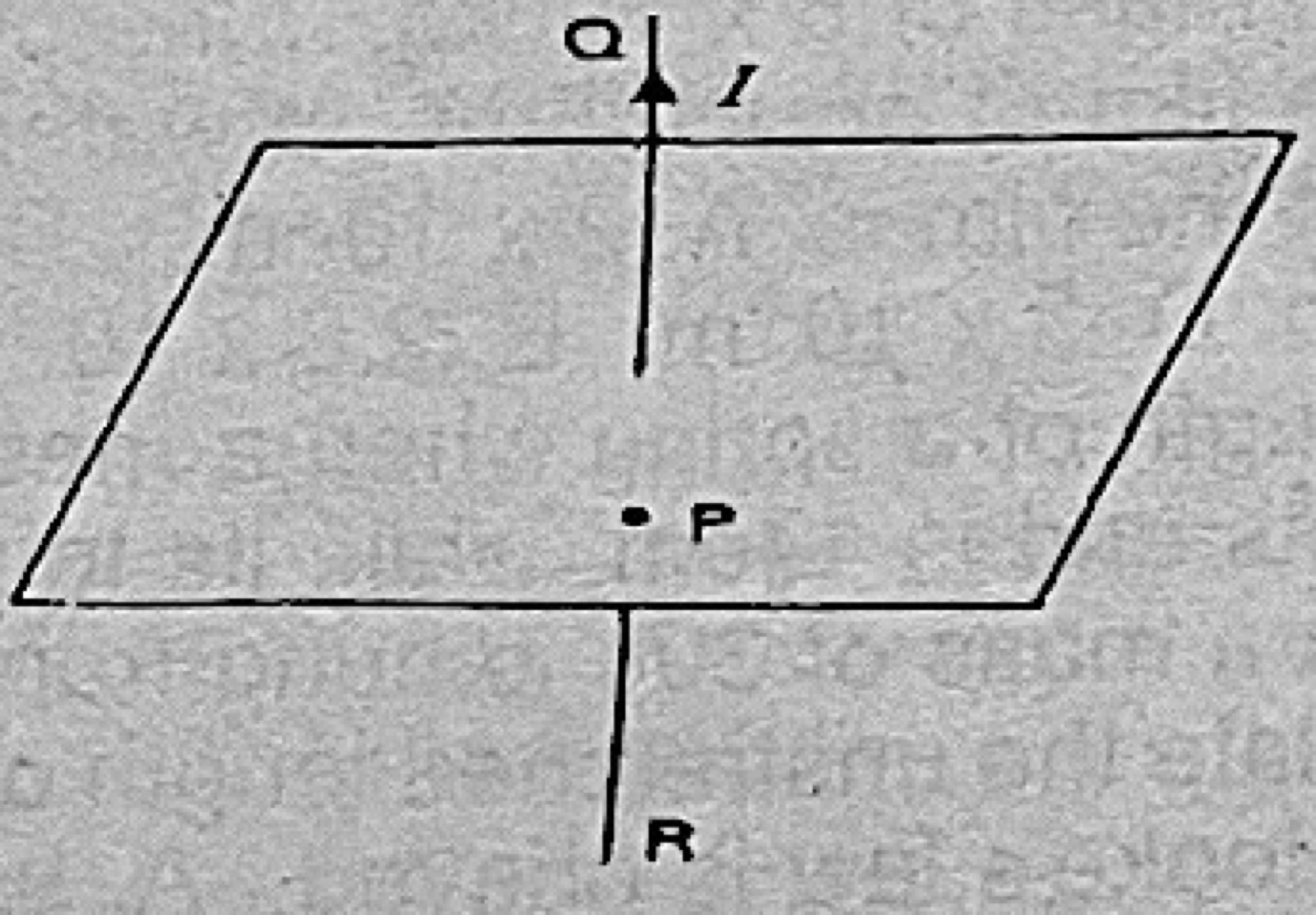
In Fig. 7 above, QR is a vertical conductor and the current I flows from R to Q. P is a point on the horizontal plane and is to the South of the wire. The direction of the magnetic field at P due to the current is
A.upward
B.north
C.south
D.west
E.east
Show the answer and explanation
Answer: E (east)
Explanation
The current flows upwards. By the right-hand grip rule the field lines circle anticlockwise when seen from above, so at a point due south of the wire the field points east.
Which of the following best describes the energy changes which take place when a steam engine drives a generator which lights a lamp?
A.Heat → Light → Sound → Kinetic
B.Kinetic → Light → Heat → Electricity
C.Heat → Kinetic → Electricity → Heat and Light
D.Electricity → Kinetic → Heat → Light
E.Heat → Sound → Kinetic → Electricity
Show the answer and explanation
Answer: C (Heat → Kinetic → Electricity → Heat and Light)
Explanation
The steam engine turns heat into kinetic energy, the generator turns kinetic energy into electricity, and the lamp turns electricity into heat and light.
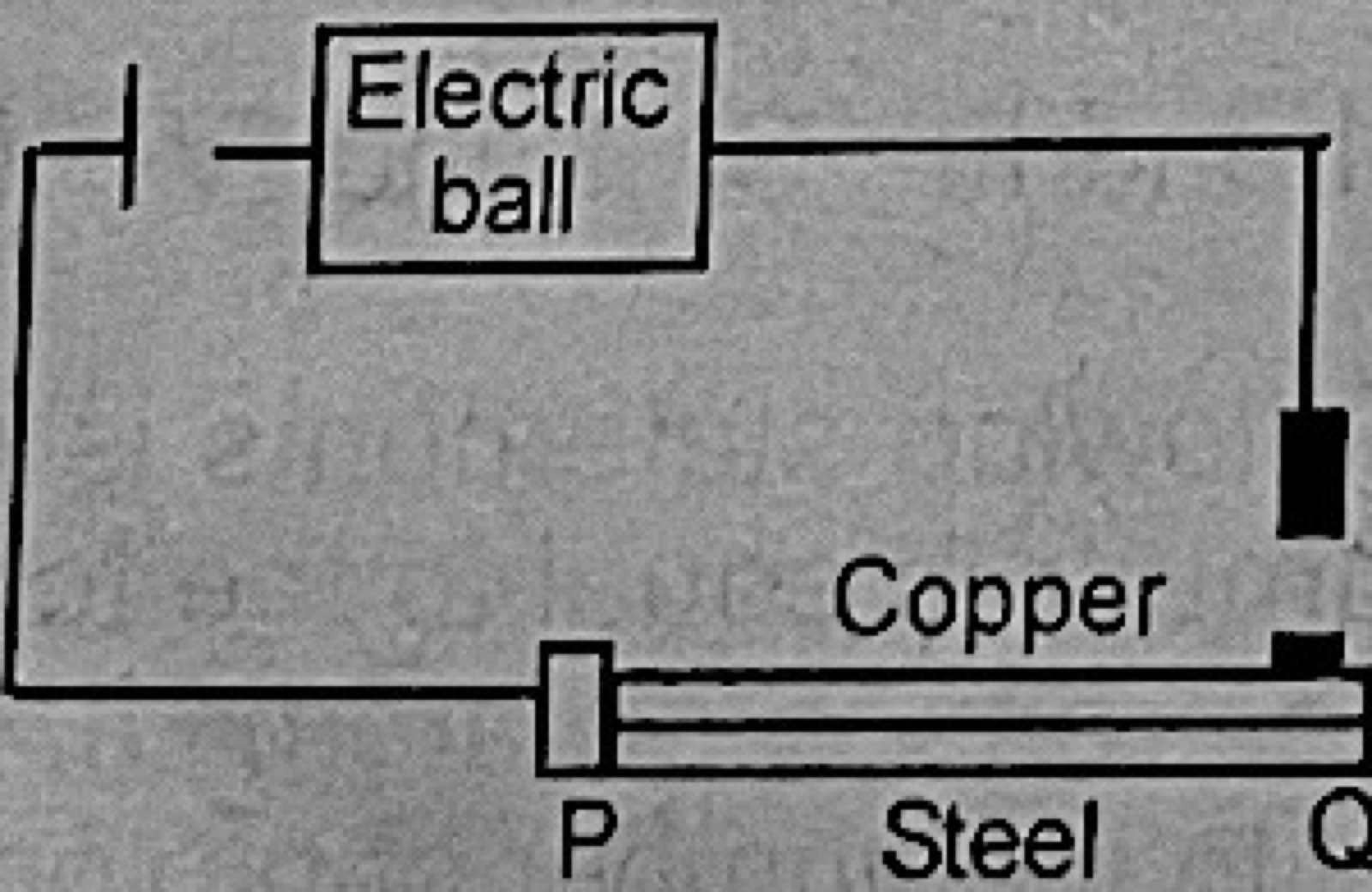
Which of the following statements clearly describe the behaviour of the fire alarm shown in Fig. 8 below given that the linear expansivities of copper and steel are 2.0 × 10⁻⁵/°C and 1.2 × 10⁻⁵/°C respectively? I. The bimetallic strip will not be able to close the circuit when there is fire II. The bimetallic strip will close the circuit when there is fire III. If the copper and steel are interchanged, the circuit will close when there is fire.
A.I only
B.II only
C.III only
D.I and III
E.II and III.
Show the answer and explanation
Answer: D (I and III)
Explanation
Copper expands more, so when heated the strip bends towards the steel side, away from the contact above it; the circuit stays open (I). With the metals swapped it bends up to the contact and rings the bell (III).
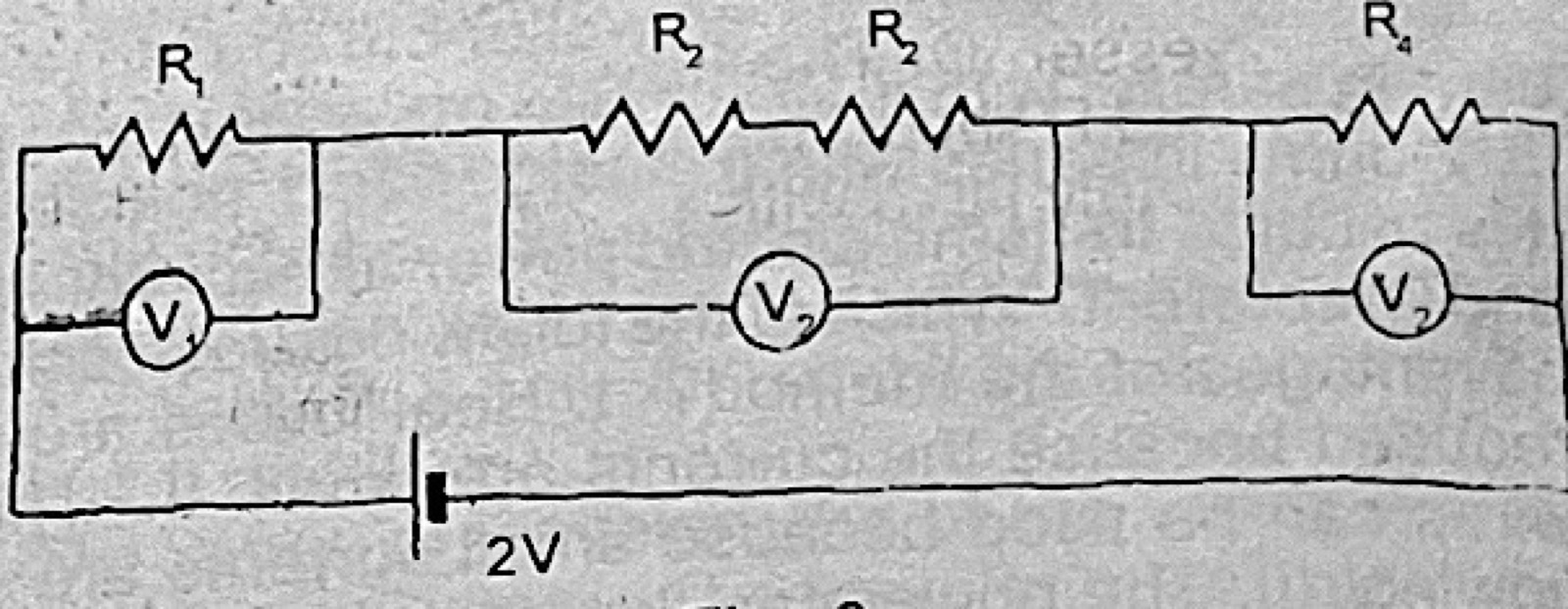
Four equal resistors R1, R2, R3 and R4 are connected in series as shown in Fig. 9 below. V1, V2 and V3 are voltmeters connected as indicated. Which of the following relations is CORRECT?
A.V1 = V3 = V2/2
B.V1 = 2V2 = V3
C.V1 = ½V3 = V2
D.V1 − V3 = V2
E.V2 − V1 = V3/2
Show the answer and explanation
Answer: A (V1 = V3 = V2/2)
Explanation
The same current flows through four equal resistors, so each has the same p.d. V1 and V3 each read across one resistor, while V2 reads across two, so V1 = V3 = V2/2.
Which of the following may be used to determine the relative humidity in a physics laboratory? I. Manometer II. Wet-and-dry bulb hygrometer III. Hair hygrometer IV. A hydrometer.
A.I only
B.II and III only
C.II only
D.III only
E.II, III and IV only
Show the answer and explanation
Answer: B (II and III only)
Explanation
Hygrometers measure humidity. A manometer measures gas pressure and a hydrometer measures the relative density of liquids.
PQ is a thin rod on a horizontal table, RS is a plane mirror inclined at 45° to the horizontal as shown in Fig. 10 above. The image of PQ as seen in the mirror by the eye, T is
A.horizontal
B.parallel to the mirror
C.at infinity
D.vertical
E.highly magnified
Show the answer and explanation
Answer: D (vertical)
Explanation
A plane mirror forms the image as far behind the mirror as the object is in front. A mirror at 45° turns the horizontal rod's image through 90°, so the image is vertical.
The specific latent heat of vaporization of a substance is always
A.less than its specific latent heat of fusion
B.greater than its specific latent heat of fusion
C.equal to its specific latent heat of fusion
D.all of the above depending on the nature of the substance
E.none of the above.
Show the answer and explanation
Answer: B (greater than its specific latent heat of fusion)
Explanation
Separating molecules completely to form a gas needs much more energy than loosening them to form a liquid, so latent heat of vaporisation is larger than that of fusion.
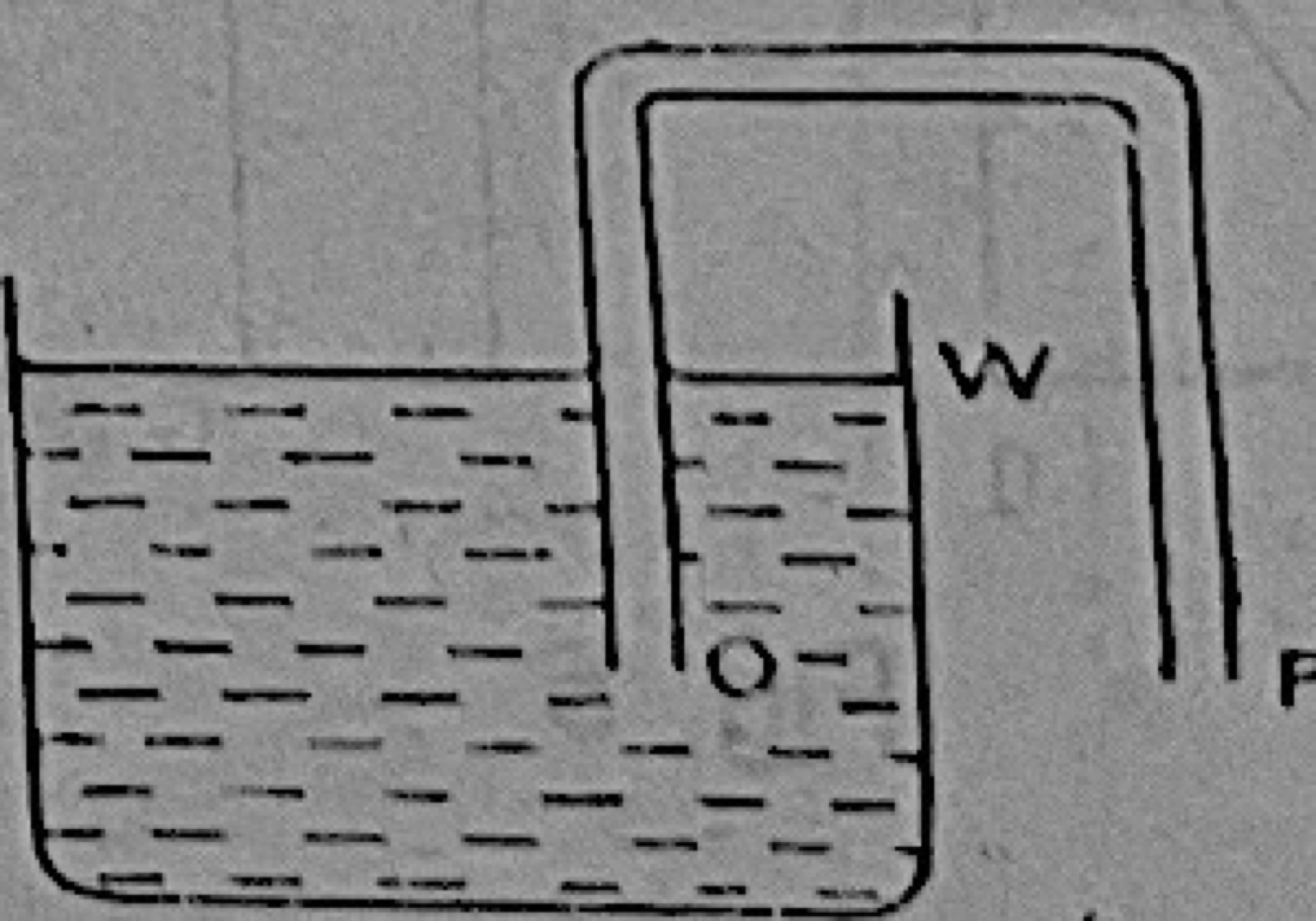
Fig. 11 above shows an inverted U-tube with the open end, O of one limb below the level, W, of water in a tank. In order that water should begin to flow from the tank it is necessary that
A.the U-tube is completely filled with water and P should be higher than W.
B.P should be lower than O and W
C.P should be lower than W and O should reach to the bottom of the vessel
D.The U-tube is completely filled with water and P should be lower than W
E.the U-tube is completely filled with water and O should reach the bottom of the vessel.
Show the answer and explanation
Answer: D (The U-tube is completely filled with water and P should be lower than W)
Explanation
This is a siphon: it works only when the tube is full of water and its outlet P is below the water surface W in the tank.