Home › Past questions › JAMB › Mathematics › 2001 45 questions. Try each one, then open the answer to check yourself and read the explanation.
Sign up free to answer these questions on a CBT screen with a timer, then see your score and every answer explained.
Start practising free
Question 1 Commercial Arithmetic Find the principal which amounts to N5,500 at simple interest in 5 years at 2% per annum
A. N5,000 B. N4,900 C. N4,800 D. N4,700 Show the answer and explanation Answer: A (N5,000 )
Explanation In 5 years at 2% the interest is 10% of the principal, so the amount is 1.1P. Then 1.1P = 5500, giving P = N5,000.
Open this question
Question 2 Commercial Arithmetic A car dealer bought a second-hand car for N250,000.00 and spent N70,000.00 refurbishing it. He then sold the car for N400,000.00. What is the percentage gain?
A. 20% B. 25% C. 32% D. 60% Show the answer and explanation Answer: B (25% )
Explanation Total cost = 250 000 + 70 000 = N320 000, so the gain is N80 000. As a percentage of cost: 80 000/320 000 × 100 = 25%.
Open this question
Question 3 Fractions, Decimals and Approximation Evaluate 21.05347 − 1.6324 × 0.43, to 3 decimal places.
A. 20.351 B. 20.352 C. 20.980 D. 20.981 Show the answer and explanation Answer: B (20.352 )
Explanation Multiply first: 1.6324 × 0.43 = 0.701932. Then 21.05347 − 0.701932 = 20.351538, which is 20.352 to 3 decimal places.
Open this question
Question 5 Surds Given that p = 1 + √2 and q = 1 − √2, evaluate (p2 − q2 )/2pq
A. −2(2 + √2) B. 2(2 + √2) C. −2√2 D. 2√2 Show the answer and explanation Answer: C (−2√2 )
Explanation p2 − q2 = (p + q)(p − q) = 2 × 2√2 = 4√2, and pq = 1 − 2 = −1, so 2pq = −2. The value is 4√2 ÷ (−2) = −2√2.
Open this question
Question 7 Indices Simplify (∛(64a3 ))−1
A. 8a B. 4a C. 1/(4a) D. 1/(8a) Show the answer and explanation Answer: C (1/(4a) )
Explanation The cube root of 64a3 is 4a. Raising to the power −1 gives 1/(4a).
Open this question
Question 8 Algebraic Expressions Factorize 4x2 − 9y2 + 20x + 25
A. (2x − 3y)(2x + 3y) B. (2x + 5)(2x − 9y + 5) C. (2x − 3y + 5)(2x − 3y − 5) D. (2x − 3y + 5)(2x + 3y + 5) Show the answer and explanation Answer: D ((2x − 3y + 5)(2x + 3y + 5) )
Explanation Group as (4x2 + 20x + 25) − 9y2 = (2x + 5)2 − (3y)2 . As a difference of two squares this is (2x + 5 − 3y)(2x + 5 + 3y).
Open this question
Question 9 Graphs of Functions If two graphs y = px2 + q and y = 2x2 − 1 intersect at x = 2, find the value of p in terms of q.
A. (7 + q)/8 B. (8 − q)/2 C. (9 − 8)/7 D. (7 − q)/4 Show the answer and explanation Answer: D ((7 − q)/4 )
Explanation At x = 2 the second graph gives y = 2(4) − 1 = 7. The first must give the same: 4p + q = 7, so p = (7 − q)/4.
Open this question
Question 10 Linear and Simultaneous Equations Solve the equations; m2 + n2 = 29, m + n = 7
A. (5,2) and (5,3) B. (5,3) and (3,5) C. (2,3) and (3,5) D. (2,5) and (5,2) Show the answer and explanation Answer: D ((2,5) and (5,2) )
Explanation Substitute m = 7 − n: (7 − n)2 + n2 = 29 gives n2 − 7n + 10 = 0, so n = 2 or 5. The pairs are (5, 2) and (2, 5).
Open this question
Question 11 Polynomials Divide a3x − 26a2x + 156ax − 216 by a2x − 24ax + 108
A. ax − 18 B. ax − 6 C. ax − 2 D. ax + 2 Show the answer and explanation Answer: C (ax − 2 )
Explanation Let u = ax . Then (u − 2)(u2 − 24u + 108) = u3 − 26u2 + 156u − 216, so the quotient is ax − 2.
Open this question
Question 12 Inequalities Find the integral values of x and y satisfying the inequality 3y + 5x ≤ 15, given that y > 0, y < 3 and x > 0.
A. (1,1), (2,1), (1,3) B. (1,1), (1,2), (1,3) C. (1,1), (1,2), (2,1) D. (1,1), (3,1), (2,2) Show the answer and explanation Answer: C ((1,1), (1,2), (2,1) )
Explanation y can only be 1 or 2. For x = 1, 3y ≤ 10 allows y = 1, 2; for x = 2, 3y ≤ 5 allows y = 1; for x = 3, no positive y works. So the points are (1,1), (1,2), (2,1).
Open this question
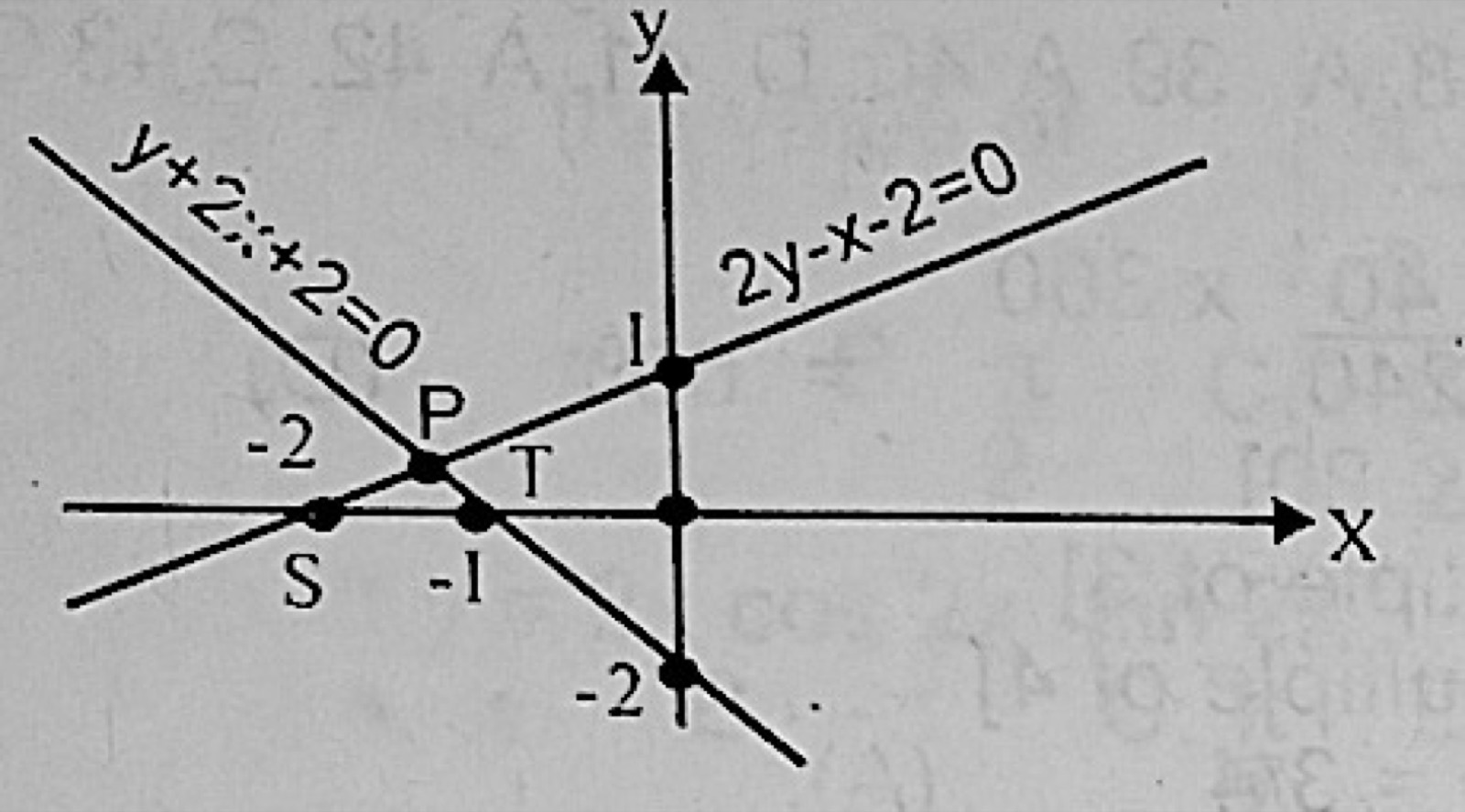
Question 13 Inequalities Triangle SPT is the solution of the linear inequalities
A. 2y − x − 2 ≤ 0, y + 2x + 2 ≤ 0, y ≥ 0, x ≤ 0 B. 2y − x − 2 ≥ 0, y + 2x + 2 ≤ 0, x ≤ 0 C. 2y − x − 2 ≤ 0, y + 2x + 2 ≥ 0, −2 ≤ x ≤ −1 D. −2 ≤ x ≤ 2, y ≥ 0, y + 2x + 2 ≤ 0, x ≤ 0 Show the answer and explanation Answer: A (2y − x − 2 ≤ 0, y + 2x + 2 ≤ 0, y ≥ 0, x ≤ 0 )
Explanation The triangle lies above the x-axis (y ≥ 0), below the line 2y − x − 2 = 0 and to the left of y + 2x + 2 = 0. Testing the point (−1.4, 0.1) confirms both line expressions are negative there, matching option A.
Open this question
Question 14 Progressions The sixth term of an arithmetical progression is half of its twelfth term. The first term is equal to
A. half of the common difference B. double the common difference C. the common difference D. zero Show the answer and explanation Answer: C (the common difference )
Explanation a + 5d = ½(a + 11d), so 2a + 10d = a + 11d, giving a = d.
Open this question
Question 15 Progressions A man saves N100.00 in his first year of work and each year saves N20.00 more than in the preceeding year. In how many years will he save N5,800.00?
A. 20 years B. 29 years C. 58 years D. 100 years Show the answer and explanation Answer: A (20 years )
Explanation This is an A.P. with a = 100, d = 20. Setting n/2[200 + 20(n − 1)] = 5800 gives n2 + 9n − 580 = 0, so n = 20.
Open this question
Question 16 Binary Operations An operation is defined on the set of real numbers by a * b = a + b + 1. If the identity element is −1, find the inverse of the element 2 under *.
A. −4 B. −2 C. 0 D. 4 Show the answer and explanation Answer: A (−4 )
Explanation The inverse b satisfies 2 * b = −1 (the identity). So 2 + b + 1 = −1, giving b = −4.
Open this question
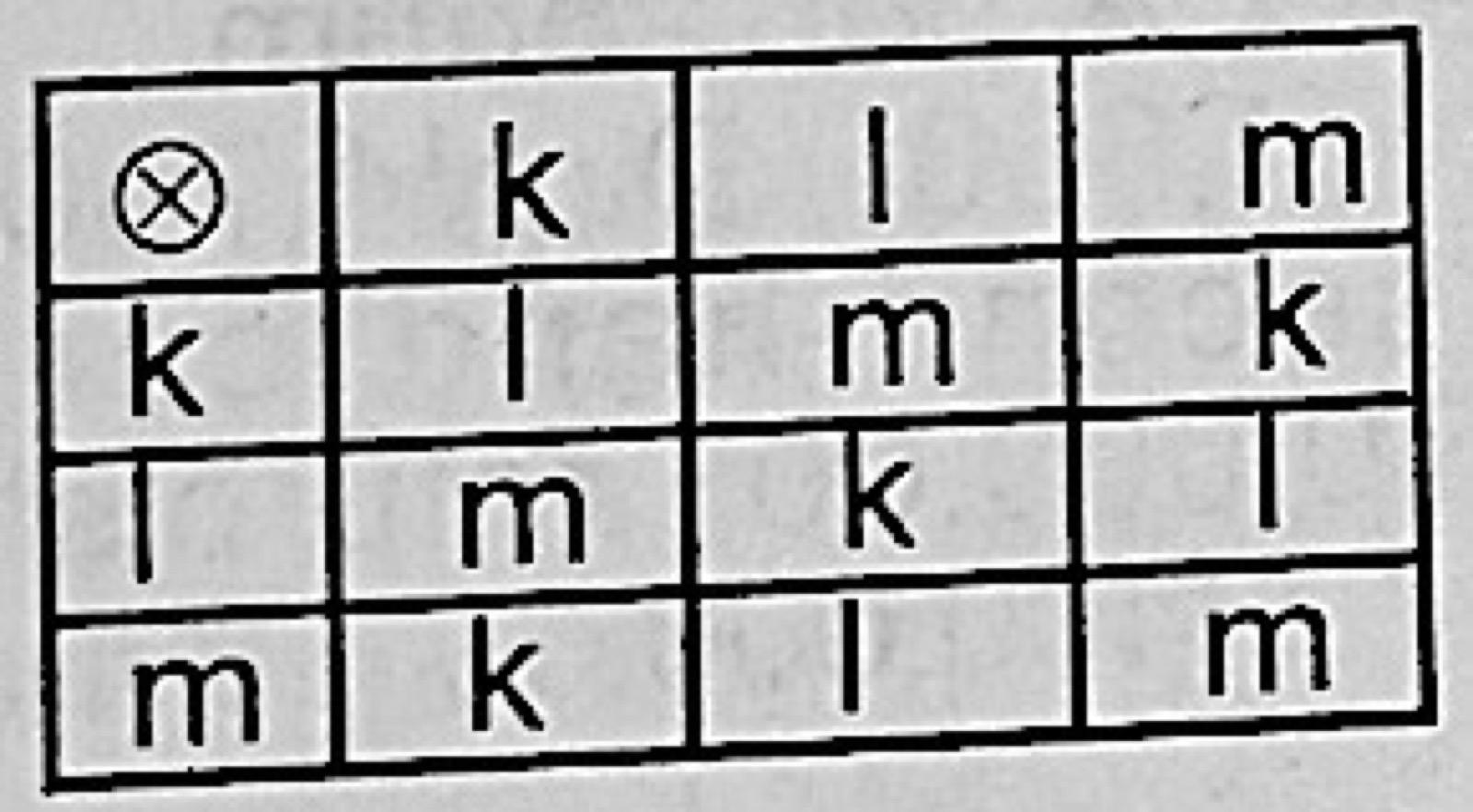
Question 17 Binary Operations ⊗ | k | l | m
A. k B. l C. m D. o Show the answer and explanation Answer: C (m )
Explanation The row for m reads k, l, m, the same as the column headings, so combining m with any element leaves it unchanged. m is the identity.
Open this question
Question 18 Matrices and Determinants Given the matrix K = [2, 1; 3, 4], the matrix K2 + K + 1, where I is the 2 × 2 identity matrix, is
A. [9, 8; 22, 23] B. [10, 7; 21, 24] C. [7, 2; 12, 21] D. [6, 3; 13, 20] Show the answer and explanation Answer: B ([10, 7; 21, 24] )
Explanation K2 = [7, 6; 18, 19]. Adding K = [2, 1; 3, 4] and I = [1, 0; 0, 1] gives [10, 7; 21, 24].
Open this question
Question 19 Matrices and Determinants Evaluate the determinant |−1, −1, −1; 3, 1, −1; 1, 2, 1|
A. 4 B. −2 C. −4 D. −12 Show the answer and explanation Answer: C (−4 )
Explanation Expanding along the first row: −1(1 + 2) − (−1)(3 + 1) + (−1)(6 − 1) = −3 + 4 − 5 = −4.
Open this question
Question 20 Matrices and Determinants If P = [3, −2, 4; 5, 0, 6; 7, 5, −1], then −2p is
A. [−6, 4, −8; 5, 0, 6; 7, 5, −1] B. [−6, 4, −8; −10, 0, 6; −14, 5, −1] C. [−6, −4, 2; −10, −2, −12; −14, −10, 2] D. [−6, 4, −8; −10, 0, −12; −14, −10, 2] Show the answer and explanation Answer: D ([−6, 4, −8; −10, 0, −12; −14, −10, 2] )
Explanation Multiply every entry of P by −2: the rows become (−6, 4, −8), (−10, 0, −12) and (−14, −10, 2).
Open this question
Question 21 Angles and Polygons Find the number of sides of a regular polygon whose interior angle is twice the exterior angle.
A. 2 B. 3 C. 6 D. 8 Show the answer and explanation Answer: C (6 )
Explanation Interior + exterior = 180° and interior = 2 × exterior, so the exterior angle is 60°. The polygon has 360 ÷ 60 = 6 sides.
Open this question
Question 23 Mensuration of Solids A cylindrical tank has a capacity of 3080m3 . What is the depth of the tank if the diameter of its base is 14m?
A. 20m B. 22m C. 23m D. 25m Show the answer and explanation Answer: A (20m )
Explanation The radius is 7 m, so the base area is 22/7 × 49 = 154 m2 . Depth = 3080 ÷ 154 = 20 m.
Open this question
Question 24 Mensuration of Solids A sector of a circle of radius 7.2cm which subtends an angle of 300° at the centre is used to form a cone. What is the radius of the base of the cone?
A. 6cm B. 7cm C. 8cm D. 9cm Show the answer and explanation Answer: A (6cm )
Explanation The arc length becomes the base circumference: (300/360) × 2π × 7.2 = 2πr. So r = 7.2 × 300/360 = 6 cm.
Open this question
Question 25 Mensuration of Plane Shapes The chord ST of a circle is equal to the radius, r, of the circle. Find the length of arc ST.
A. πr/2 B. πr/3 C. πr/6 D. πr/12 Show the answer and explanation Answer: B (πr/3 )
Explanation A chord equal to the radius forms an equilateral triangle with the centre, so it subtends 60°. Arc length = (60/360) × 2πr = πr/3.
Open this question
Question 26 Loci A point P moves such that it is equidistant from points Q and R. Find QR when PR = 8cm and ∠PRQ = 30°.
A. 4cm B. 4√3cm C. 8cm D. 8√3cm Show the answer and explanation Answer: D (8√3cm )
Explanation PQ = PR = 8 cm, so triangle PQR is isosceles with base angles 30°. Half of QR is 8 cos 30° = 4√3, so QR = 8√3 cm.
Open this question
Question 27 Loci Find the locus of a point which moves such that its distance from the line y = 4 is a constant, k.
A. y = 4 + k B. y = k − 4 C. y = k ± 4 D. y = 4 ± k Show the answer and explanation Answer: D (y = 4 ± k )
Explanation Points at distance k from y = 4 lie on two parallel lines, one k above and one k below: y = 4 ± k.
Open this question
Question 28 Coordinate Geometry A straight line makes an angle of 30° with the positive x-axis and cuts the y-axis at y = 5. Find the equation of the straight line.
A. √3y = x + 5√3 B. √3y = −x + 5√3 C. y = x + 5 D. y = (1/10)x + 5 Show the answer and explanation Answer: A (√3y = x + 5√3 )
Explanation The gradient is tan 30° = 1/√3 and the intercept is 5, so y = x/√3 + 5. Multiplying by √3 gives √3y = x + 5√3.
Open this question
Question 29 Coordinate Geometry P(−6, 1) and Q(6, 6) are the two ends of the diameter of a given circle. Calculate the radius.
A. 3.5 units B. 6.5 units C. 7.0 units D. 13.0 units Show the answer and explanation Answer: B (6.5 units )
Explanation PQ = √(122 + 52 ) = √169 = 13, which is the diameter. The radius is 6.5 units.
Open this question
Question 30 Coordinate Geometry Find the value of p if the line joining (p, 4) and (6, −2) is perpendicular to the line joining (2, p) and (−1, 3).
A. 0 B. 3 C. 4 D. 6 Show the answer and explanation Answer: C (4 )
Explanation The gradients are −6/(6 − p) and (p − 3)/3. Their product must be −1: 6(p − 3) = 3(6 − p), so 9p = 36 and p = 4.
Open this question
Question 31 Bearings The bearings of P and Q from a common point N are 020° and 300° respectively. If P and Q are also equidistant from N, find the bearing of P from Q.
A. 320° B. 280° C. 070° D. 040° Show the answer and explanation Answer: C (070° )
Explanation ∠PNQ = 80° and NP = NQ, so the base angles are 50°. The bearing of N from Q is 120°; turning 50° towards P gives 120° − 50° = 070°.
Open this question
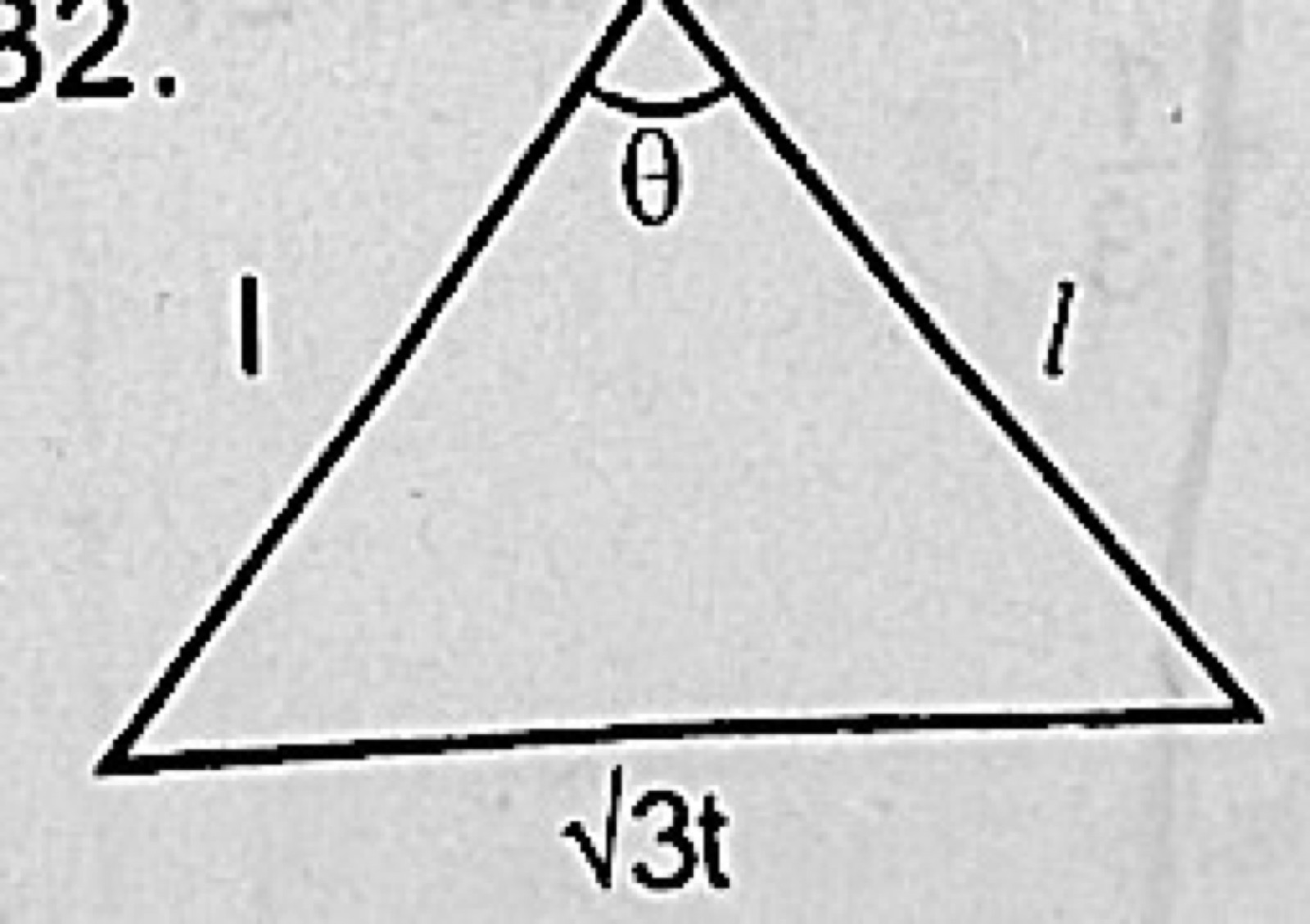
Question 32 Trigonometry Find the value of θ in the diagram above.
A. 30° B. 60° C. 100° D. 120° Show the answer and explanation Answer: D (120° )
Explanation The triangle has two sides l and base √3 l. Half the base is (√3/2)l, so each base angle has cosine √3/2 and is 30°. Then θ = 180° − 60° = 120°.
Open this question
Question 33 Differentiation Differentiate (2x + 5)2 (x − 4) with respect to x.
A. (2x + 5)(6x − 11) B. (2x + 5)(2x − 13) C. 4(2x + 5)(x − 4) D. 4(2x + 5)(4x − 3) Show the answer and explanation Answer: A ((2x + 5)(6x − 11) )
Explanation By the product rule: (2x + 5)2 + (x − 4) × 4(2x + 5) = (2x + 5)(2x + 5 + 4x − 16) = (2x + 5)(6x − 11).
Open this question
Question 34 Differentiation If y = x sin x, find dy/dx when x = π/2.
A. π/2 B. 1 C. −1 D. π/−2 Show the answer and explanation Answer: B (1 )
Explanation dy/dx = sin x + x cos x. At x = π/2 this is 1 + (π/2)(0) = 1.
Open this question
Question 35 Differentiation If the gradient of the curve y = 2kx2 + x + 1 at x = 1 is 9, find k.
A. 1 B. 2 C. 3 D. 4 Show the answer and explanation Answer: B (2 )
Explanation dy/dx = 4kx + 1. At x = 1, 4k + 1 = 9, so k = 2.
Open this question
Question 36 Differentiation Find the rate of change of the volume v of a sphere with respect to its radius r when r = 1.
A. 4π B. 8π C. 12π D. 24π Show the answer and explanation Answer: A (4π )
Explanation v = (4/3)πr3 , so dv/dr = 4πr2 . At r = 1 this is 4π.
Open this question
Question 37 Differentiation Find the dimensions of the rectangle of greatest area which has a fixed perimeter p.
A. Square of sides p/4 B. Square of sides p/2 C. Square of sides p D. Square of sides 2p Show the answer and explanation Answer: A (Square of sides p/4 )
Explanation With sides x and p/2 − x, the area x(p/2 − x) is greatest when x = p/4. Both sides are then p/4, a square.
Open this question
Question 38 Integration Evaluate ∫2(2x − 3)2/3 dx.
A. 2x − 3 + k B. 2(2x − 3) + k C. (6/5)(2x − 3)5/3 + k D. (3/5)(2x − 3)5/3 + k Show the answer and explanation Answer: D ((3/5)(2x − 3)5/3 + k )
Explanation Raise the power by one to 5/3 and divide by 5/3 and by the inner derivative 2: 2 × (2x − 3)5/3 ÷ (5/3 × 2) = (3/5)(2x − 3)5/3 + k.
Open this question
Question 39 Integration Find the area bounded by the curves y = 4 − x2 and y = 2x + 1.
A. 10⅓ sq. units B. 10⅔ sq. units C. 20⅓ sq. units D. 20⅔ sq. units Show the answer and explanation Answer: B (10⅔ sq. units )
Explanation The curves meet where x2 + 2x − 3 = 0, i.e. x = −3 and 1. The area is ∫(3 − 2x − x2 )dx from −3 to 1 = 5/3 − (−9) = 32/3 = 10⅔.
Open this question
Question 42 Measures of Central Tendency Score: 4, 7, 8, 11, 13, 8
A. 25 B. 49 C. 64 D. 121 Show the answer and explanation Answer: D (121 )
Explanation The score with the highest frequency (7) is 11, so the mode is 11. Its square is 121.
Open this question
Question 43 Measures of Central Tendency Score: 4, 7, 8, 11, 13, 8
A. 11.0 B. 9.5 C. 8.7 D. 7.0 Show the answer and explanation Answer: C (8.7 )
Explanation Σfx = 12 + 35 + 16 + 77 + 26 + 8 = 174 and Σf = 20. The mean is 174 ÷ 20 = 8.7.
Open this question
Question 44 Measures of Dispersion Find the range of 1/6, 1/3, 3/2, 2/3, 8/9 and 4/3.
A. 4/3 B. 7/6 C. 5/6 D. 3/4 Show the answer and explanation Answer: A (4/3 )
Explanation Range = largest − smallest. The largest is 3/2 and the smallest is 1/6, so the range is 9/6 − 1/6 = 8/6 = 4/3.
Open this question
Question 45 Measures of Dispersion Find the variance of 2, 6, 8, 6, 2 and 6.
A. √5 B. √6 C. 5 D. 6 Show the answer and explanation Answer: C (5 )
Explanation The mean is 30 ÷ 6 = 5. The squared deviations are 9, 1, 9, 1, 9, 1, which add to 30. Variance = 30 ÷ 6 = 5.
Open this question
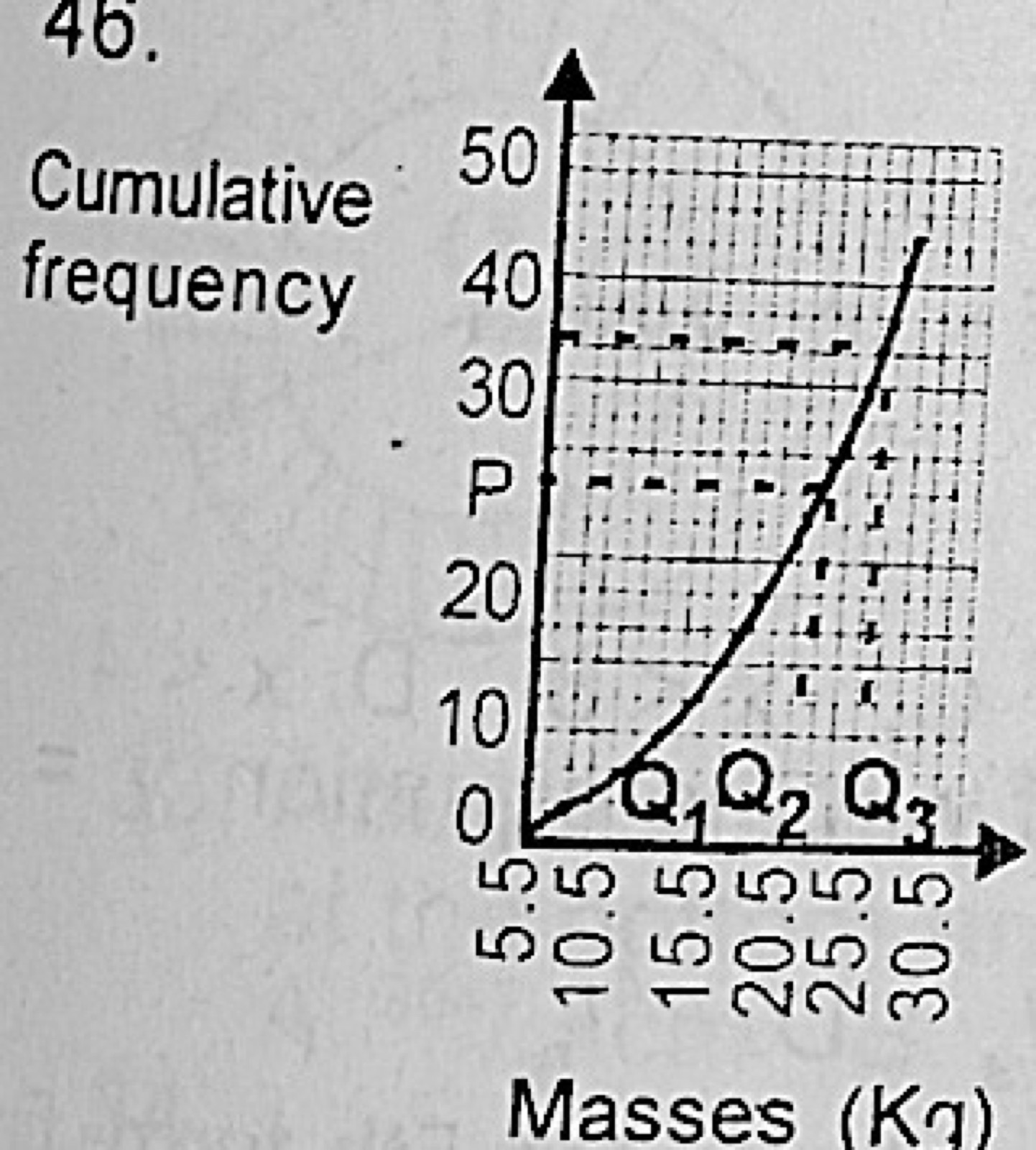
Question 46 Measures of Dispersion The graph above shows the cumulative frequency of the distribution of masses of fertilizer for 48 workers in one institution. Which of the following gives the interquartile range?
A. Q3 − Q1 B. Q3 − Q2 C. Q2 − Q1 D. ½(Q3 − Q1 ) Show the answer and explanation Answer: A (Q3 − Q1 )
Explanation The interquartile range is the upper quartile minus the lower quartile, Q3 − Q1 . Half of it would be the semi-interquartile range.
Open this question
Question 47 Permutation and Combination Find the number of ways of selecting 8 subjects from 12 subjects for an examination.
A. 498 B. 496 C. 495 D. 490 Show the answer and explanation Answer: C (495 )
Explanation This is a selection, so use combinations: 12 C8 = 12 C4 = (12 × 11 × 10 × 9)/24 = 495.
Open this question
Question 48 Permutation and Combination If 6 Pr = 6, find the value of 6 Pr + 1 .
A. 15 B. 30 C. 33 D. 35 Show the answer and explanation Answer: B (30 )
Explanation 6 P1 = 6, so r = 1. Then 6 P2 = 6 × 5 = 30.
Open this question
Question 49 Probability Colour: Blue, Black, Yellow, White, Brown
A. 1/15 B. 1/3 C. 2/5 D. 7/15 Show the answer and explanation Answer: C (2/5 )
Explanation There are 15 beads, of which 1 + 5 = 6 are blue or white. The probability is 6/15 = 2/5.
Open this question
Question 50 Probability Teams P and Q are involved in a game of football. What is the probability that the game ends in a draw?
A. ¼ B. ⅓ C. ½ D. ⅔ Show the answer and explanation Answer: B (⅓ )
Explanation There are three possible results: P wins, Q wins, or a draw. Taking them as equally likely, the chance of a draw is 1/3.
Open this question Sign up free for every JAMB Mathematics year, practice by topic and timed mocks.
Start practising free