Home › Past questions › JAMB › Mathematics › 2000 45 questions. Try each one, then open the answer to check yourself and read the explanation.
Sign up free to answer these questions on a CBT screen with a timer, then see your score and every answer explained.
Start practising free
Question 1 Sets Let P = {1, 2, u, v, w, x}, Q = {2, 3, u, v, w, 5, 6, y} and R = {2, 3, 4, v, x, y}. Determine (P − Q) ∩ R.
A. {1, x} B. {x, y} C. {x} D. ∅ Show the answer and explanation Answer: C ({x} )
Explanation P − Q keeps the elements of P that are not in Q: {1, x}. Of these, only x is in R, so (P − Q) ∩ R = {x}.
Open this question
Question 2 Ratio, Percentages and Rates If the population of a town was 240 000 in January 1998 and it increased by 2% each year, what would be the population of the town in January 2000?
A. 480 000 B. 149 696 C. 249 600 D. 244 800 Show the answer and explanation Answer: C (249 600 )
Explanation After one year: 240 000 × 1.02 = 244 800. After two years: 244 800 × 1.02 = 249 696, which is closest to option C (249 600).
Open this question
Question 3 Surds If (2√3 − √2)/(√3 + 2√2) = m + n√6, find the values of m and n respectively.
A. 1, −2 B. −2, 1 C. −2/5, 1 D. 2, 3/5 Show the answer and explanation Answer: B (−2, 1 )
Explanation Multiply top and bottom by (√3 − 2√2): the top becomes 6 − 4√6 − √6 + 4 = 10 − 5√6 and the bottom 3 − 8 = −5. So the value is −2 + √6, giving m = −2 and n = 1.
Open this question
Question 4 Sets In a youth club of 94 members, 60 like modern music and 50 like traditional music. The number of members who like both traditional and modern music is three times those who do not like any type of music. How many members like only one type of music?
A. 8 B. 24 C. 62 D. 86 Show the answer and explanation Answer: C (62 )
Explanation Let x like neither, so 3x like both. Then 60 + 50 − 3x + x = 94, so x = 8 and 24 like both. Only one type: (60 − 24) + (50 − 24) = 36 + 26 = 62.
Open this question
Question 5 Fractions, Decimals and Approximation Evaluate (2.813 × 10−3 × 1.063)/(5.637 × 10−2 ) reducing each number to two sig. fig. and leaving your answer in two significant figures.
A. 0.056 B. 0.055 C. 0.054 D. 0.54 Show the answer and explanation Answer: B (0.055 )
Explanation To 2 s.f. the numbers are 2.8 × 10⁻³ , 1.1 and 5.6 × 10⁻² . (0.0028 × 1.1)/0.056 = 0.00308/0.056 = 0.055.
Open this question
Question 6 Commercial Arithmetic A man wishes to keep some money in savings deposit at 25% compound interest so that after 3 years he can buy a car for N150000. How much does he need to deposit now?
A. N112 000.50 B. N96 000.00 C. N85 714.28 D. N76 800.00 Show the answer and explanation Answer: D (N76 800.00 )
Explanation The deposit P must satisfy P × 1.253 = 150 000. Since 1.253 = 1.953125, P = 150 000 ÷ 1.953125 = N76 800.
Open this question
Question 7 Number Bases If 31410 − 2567 = 340x , find x
A. 7 B. 8 C. 9 D. 10 Show the answer and explanation Answer: A (7 )
Explanation 2567 = 2×49 + 5×7 + 6 = 139, so the left side is 314 − 139 = 175. Then 3x2 + 4x = 175, i.e. (x − 7)(3x + 25) = 0, so x = 7.
Open this question
Question 8 Commercial Arithmetic Audu bought an article for N50 000 and sold it to Femi at a loss of x%. Femi later sold the article to Oche at a profit of 40%. If Femi made a profit of N10000, find the value of x.
A. 60 B. 50 C. 40 D. 20 Show the answer and explanation Answer: B (50 )
Explanation Femi's 40% profit was N10 000, so he paid 10 000 ÷ 0.4 = N25 000. Audu lost 50 000 − 25 000 = N25 000, which is 50% of N50 000.
Open this question
Question 9 Indices Simplify (3(2n + 1 ) − 4(2n − 1 ))/(2n + 1 − 2n )
A. 2n + 1 B. 2n − 1 C. 4 D. ¼ Show the answer and explanation Answer: C (4 )
Explanation Write everything in terms of 2n : the top is 6(2n ) − 2(2n ) = 4(2n ) and the bottom is 2(2n ) − 2n = 2n . The quotient is 4.
Open this question
Question 10 Number Bases If P3446 − 23P26 = 2PP26 , find the value of digit P.
A. 2 B. 3 C. 4 D. 5 Show the answer and explanation Answer: D (5 )
Explanation In base ten: (216P + 136) − (542 + 6P) = 434 + 42P. This gives 168P = 840, so P = 5.
Open this question
Question 11 Logarithms Evaluate 5−3log5 2 × 22log2 3
A. 8 B. 1⅛ C. 2/5 D. 1/8 Show the answer and explanation Answer: B (1⅛ )
Explanation 5−3log5 2 = 5log5 (2−3 ) = 1/8 and 22log2 3 = 32 = 9. The product is 9/8 = 1⅛.
Open this question
Question 12 Binary Operations A binary operation * is defined by a*b = ab . If a*2 = 2 − a, find the possible value of a.
A. 1, −1 B. 1, 2 C. 2, −2 D. 1, −2 Show the answer and explanation Answer: D (1, −2 )
Explanation a*2 = a2 , so a2 = 2 − a, i.e. a2 + a − 2 = 0. Factorising, (a − 1)(a + 2) = 0, so a = 1 or −2.
Open this question
Question 13 Progressions The 3rd term of an A.P. is 4x − 2y and the 9th term is 10x − 8y. Find the common difference.
A. 19x − 17y B. 8x − 4y C. x − y D. 2x Show the answer and explanation Answer: C (x − y )
Explanation The 9th term minus the 3rd term is 6d. So 6d = (10x − 8y) − (4x − 2y) = 6x − 6y, giving d = x − y.
Open this question
Question 14 Binary Operations Find the inverse of p under the binary operation * defined by p*q = p + q − pq, where p and q are real numbers and zero is the identity.
A. p B. p − 1 C. p/(p − 1) D. p/(p + 1) Show the answer and explanation Answer: C (p/(p − 1) )
Explanation The inverse q satisfies p*q = 0, so p + q − pq = 0. Then q(1 − p) = −p, so q = p/(p − 1).
Open this question
Question 15 Matrices and Determinants A matrix P = [a, b; c, d] is such that PT = −P, where PT is the transpose of P. If b = 1, then P is
A. [0, 1; 1, 0] B. [0, 1; −1, 0] C. [0, 1; −1, 1] D. [1, 1; −1, 0] Show the answer and explanation Answer: B ([0, 1; −1, 0] )
Explanation PT = [a, c; b, d] must equal [−a, −b; −c, −d]. So a = −a and d = −d give a = d = 0, and c = −b = −1. Hence P = [0, 1; −1, 0].
Open this question
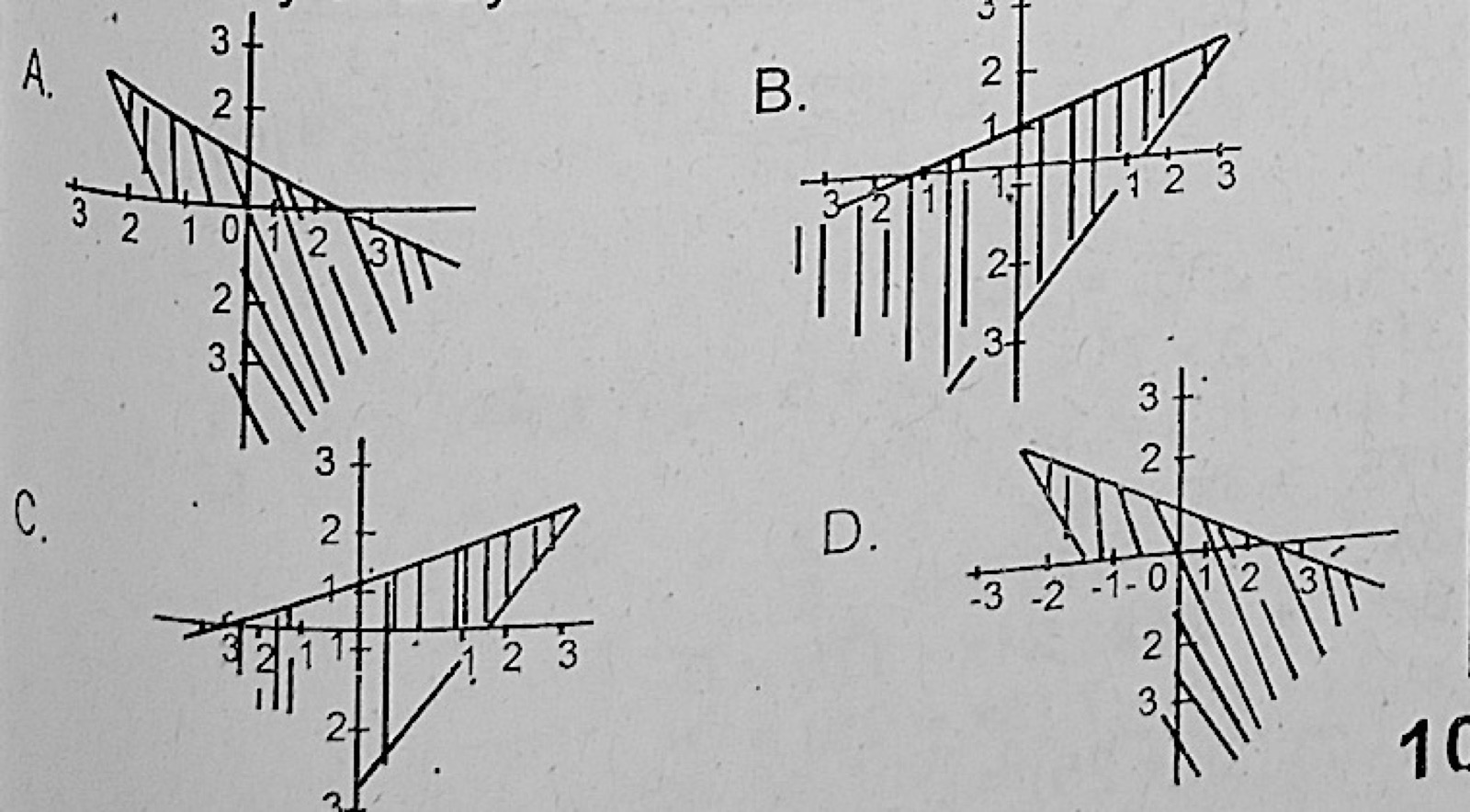
Question 17 Inequalities The solution of the simultaneous inequalities 2x − 2 ≤ y and 2y − 2 ≤ x is represented by
A. Graph A B. Graph B C. Graph C D. Graph D Show the answer and explanation Answer: B (Graph B )
Explanation The boundary lines y = 2x − 2 and y = ½x + 1 both slope upwards and meet at (2, 2). The region lies above the steeper line and below the gentler one, the wedge opening to the left, which is graph B.
Open this question
Question 18 Matrices and Determinants Find the values of t, for which the determinant of the matrix [t − 4, 0, 0; −1, t + 1, 1; 3, 4, t − 2] is zero
A. 0, 2, 3 B. −4, 2, 3 C. −4, −2, 3−3 D. 4, −2, 3 Show the answer and explanation Answer: D (4, −2, 3 )
Explanation Expanding along the first row: (t − 4)[(t + 1)(t − 2) − 4] = (t − 4)(t2 − t − 6) = (t − 4)(t − 3)(t + 2). It is zero when t = 4, −2 or 3.
Open this question
Question 19 Polynomials If (x − 1), (x + 1) and (x − 2) are factors of the polynomial ax3 + bx2 + cx − 1, find a, b, c respectively.
A. −½, 1, ½ B. ½, 1, ½ C. ½, 1, −½ D. ½, −1, ½ Show the answer and explanation Answer: A (−½, 1, ½ )
Explanation The polynomial equals a(x − 1)(x + 1)(x − 2) = a(x3 − 2x2 − x + 2). Matching the constant term, 2a = −1, so a = −½, b = −2a = 1 and c = −a = ½.
Open this question
Question 20 Differentiation A trader realises 10x − x2 naira profit from the sale of x bags of corn. How many bags will give him the maximum profit?
A. 4 B. 5 C. 6 D. 7 Show the answer and explanation Answer: B (5 )
Explanation The profit is greatest where its derivative 10 − 2x is zero, i.e. at x = 5 bags.
Open this question
Question 21 Inequalities Solve the inequality 2 − x > x2 .
A. x < −2 or x > 1 B. x > 2 or x < −1 C. −1 < x < 2 D. −2 < x < 1 Show the answer and explanation Answer: D (−2 < x < 1 )
Explanation Rearrange to x2 + x − 2 < 0, i.e. (x + 2)(x − 1) < 0. The product is negative between the roots, so −2 < x < 1.
Open this question
Question 22 Quadratic Equations If α and β are the roots of the equation 3x2 + 5x − 2 = 0, find the value of 1/α + 1/β.
A. −5/2 B. −2/3 C. ½ D. 5/2 Show the answer and explanation Answer: D (5/2 )
Explanation 1/α + 1/β = (α + β)/(αβ). Here α + β = −5/3 and αβ = −2/3, so the value is (−5/3) ÷ (−2/3) = 5/2.
Open this question
Question 23 Trigonometry Find the minimum value of the function f(θ) = 2/(3 − cosθ) for 0 ≤ θ ≤ 2π
A. ½ B. ⅔ C. 1 D. 2 Show the answer and explanation Answer: A (½ )
Explanation cosθ lies between −1 and 1, so 3 − cosθ lies between 2 and 4. The fraction 2/(3 − cosθ) is smallest when the denominator is 4, giving 2/4 = ½.
Open this question
Question 24 Mensuration of Solids A frustum of pyramid with square base has its upper and lower sections as square of sizes 2cm and 5cm respectively and the distance between them 6cm. Find the height of the pyramid from which the frustum was obtained.
A. 8.0m B. 8.4m C. 9.0m D. 10.0m Show the answer and explanation Answer: D (10.0m )
Explanation By similar shapes, height/5 = (height − 6)/2. So 2H = 5H − 30, giving H = 10.
Open this question
Question 26 Bearings A ship sails a distance of 50km in the direction S50°E and then sails the distance of 50km in the direction N40°E. Find the bearing of the ship from its original position.
A. S90°E B. N40°E C. S95°E D. N85°E Show the answer and explanation Answer: D (N85°E )
Explanation The two legs (bearings 130° and 040°) are at right angles and equal, so the direct line makes 45° with the first leg. Its bearing is 130° − 45° = 085°, i.e. N85°E.
Open this question
Question 28 Coordinate Geometry 3y = 4x − 1 and Ky = x + 3 are equations of two straight lines. If the two lines are perpendicular to each other, find K.
A. −4/3 B. −3/4 C. 3/4 D. 4/3 Show the answer and explanation Answer: A (−4/3 )
Explanation The gradients are 4/3 and 1/K. For perpendicular lines their product is −1, so 4/(3K) = −1 and K = −4/3.
Open this question
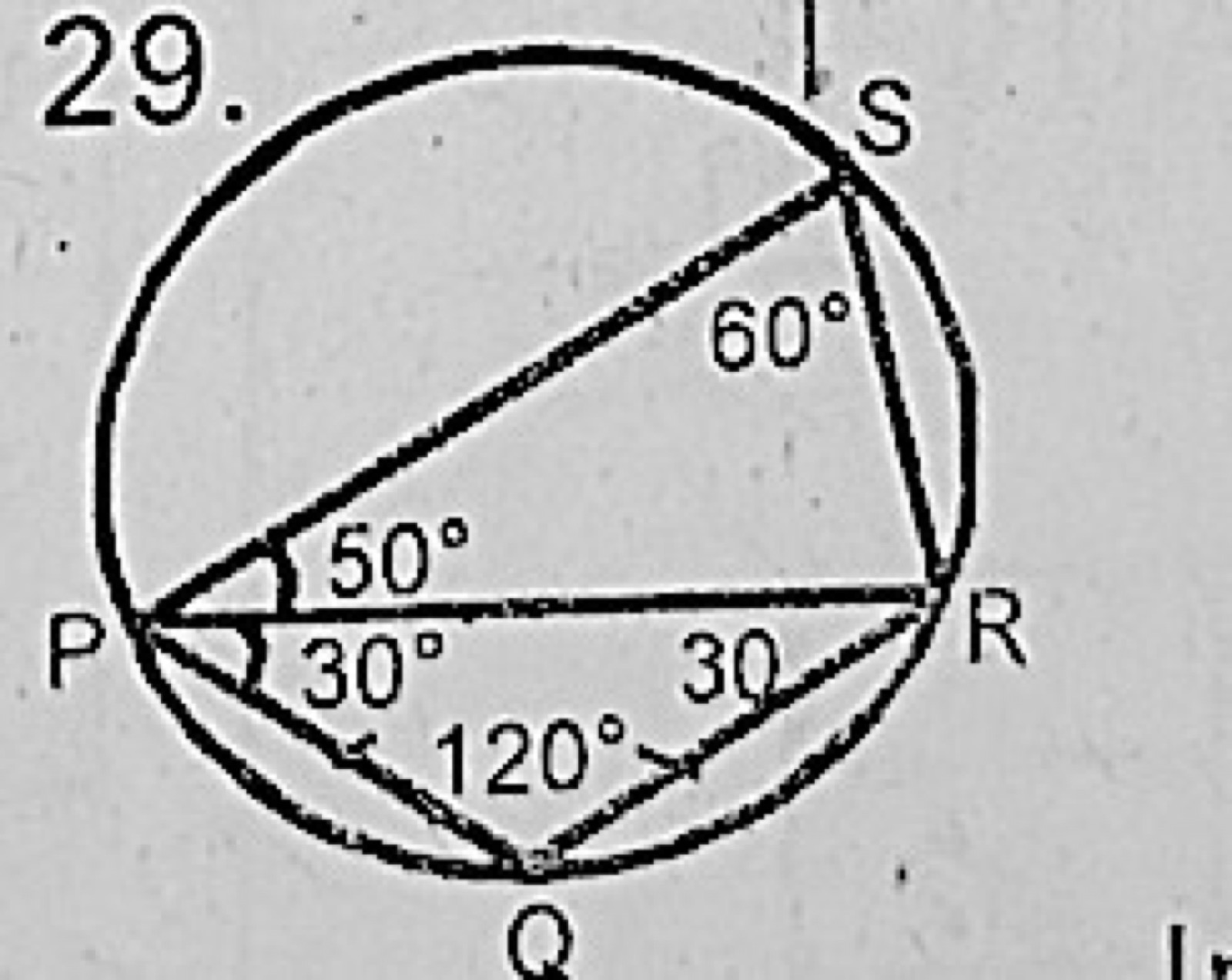
Question 29 Triangles and Quadrilaterals In the diagram above, if ∠RPS = 50°, ∠RPQ = 30° and PQ = QR, find the value of ∠PRS.
A. 80° B. 70° C. 60° D. 50° Show the answer and explanation Answer: B (70° )
Explanation Since PQ = QR, ∠QRP = 30° and ∠PQR = 120°. Opposite angles of a cyclic quadrilateral add to 180°, so ∠PSR = 60°. In triangle PRS, ∠PRS = 180° − 50° − 60° = 70°.
Open this question
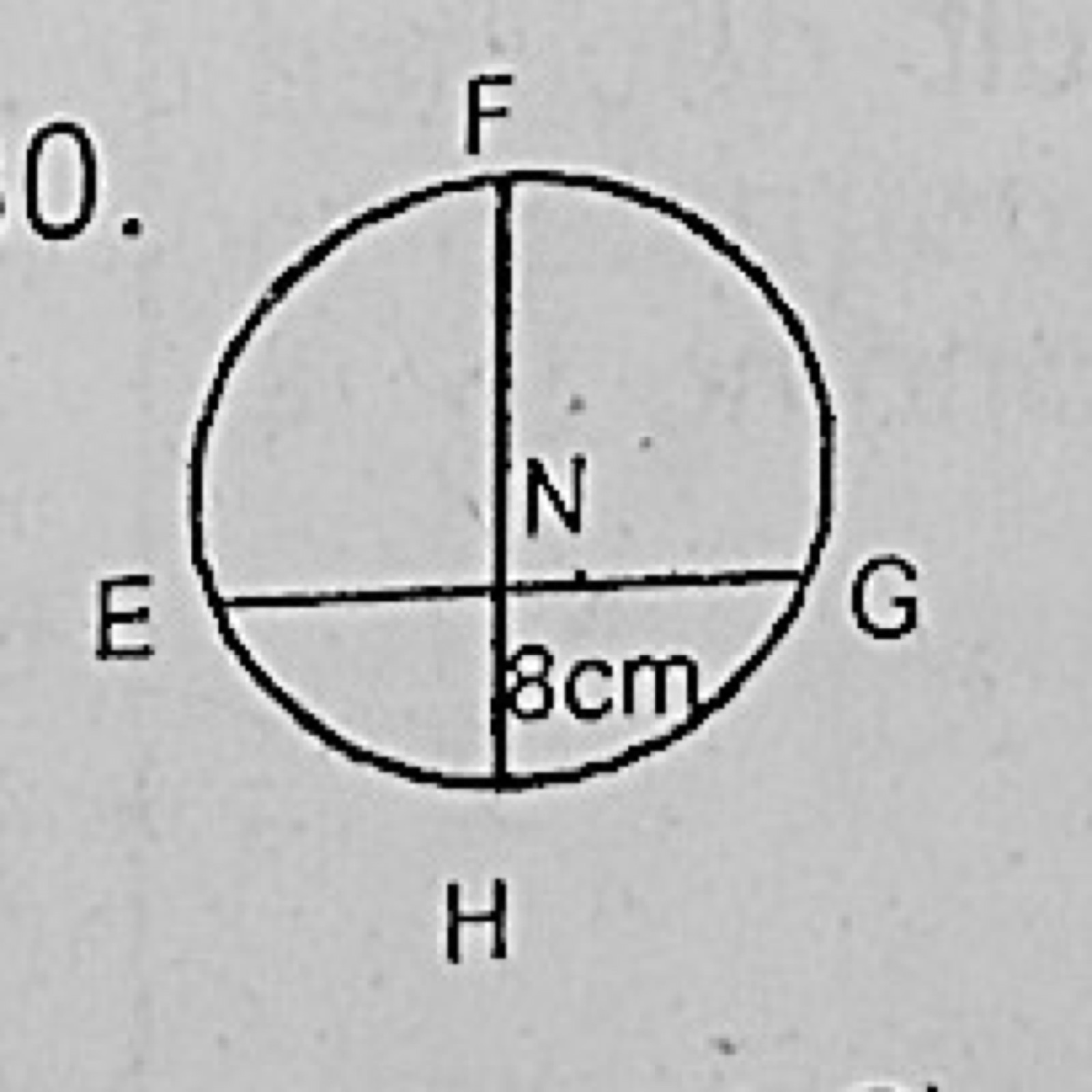
Question 30 Circle Theorems In the diagram above EFGH is a circle centre of O. FH is a diameter and GE is a chord which meets FH at right angle at the point N. If NH = 8cm and EG = 24cm, calculate FH.
A. 16cm B. 20cm C. 26cm D. 32cm Show the answer and explanation Answer: C (26cm )
Explanation The diameter bisects the chord, so EN = NG = 12 cm. By intersecting chords, FN × NH = EN × NG, so FN × 8 = 144 and FN = 18. FH = 18 + 8 = 26 cm.
Open this question
Question 31 Loci If P and Q are fixed points and X is a point which moves so that XP = XQ, the locus of X is
A. a straight line B. a circle C. the bisector of ∠PXQ D. the perpendicular bisector of PQ Show the answer and explanation Answer: D (the perpendicular bisector of PQ )
Explanation Points that are the same distance from two fixed points lie on the perpendicular bisector of the line joining them.
Open this question
Question 32 Angles and Polygons In a regular polygon, each interior angle doubles its corresponding exterior angle. Find the number of sides of the polygon.
A. 8 B. 6 C. 4 D. 3 Show the answer and explanation Answer: B (6 )
Explanation Interior + exterior = 180° and interior = 2 × exterior, so the exterior angle is 60°. Number of sides = 360° ÷ 60° = 6.
Open this question
Question 33 Coordinate Geometry A predator moves in a circle of radius √2 centre (0, 0), while a prey moves along the line y = x. If 0 ≤ x ≤ 2, at which point(s) will they meet?
A. (1, 1) only B. (1, ) and (1, 2) C. (0, 0) and (1, 1) D. (√2, √2) only Show the answer and explanation Answer: A ((1, 1) only )
Explanation The circle is x2 + y2 = 2. Putting y = x gives 2x2 = 2, so x = ±1. Only x = 1 is in the range, so they meet at (1, 1) only.
Open this question
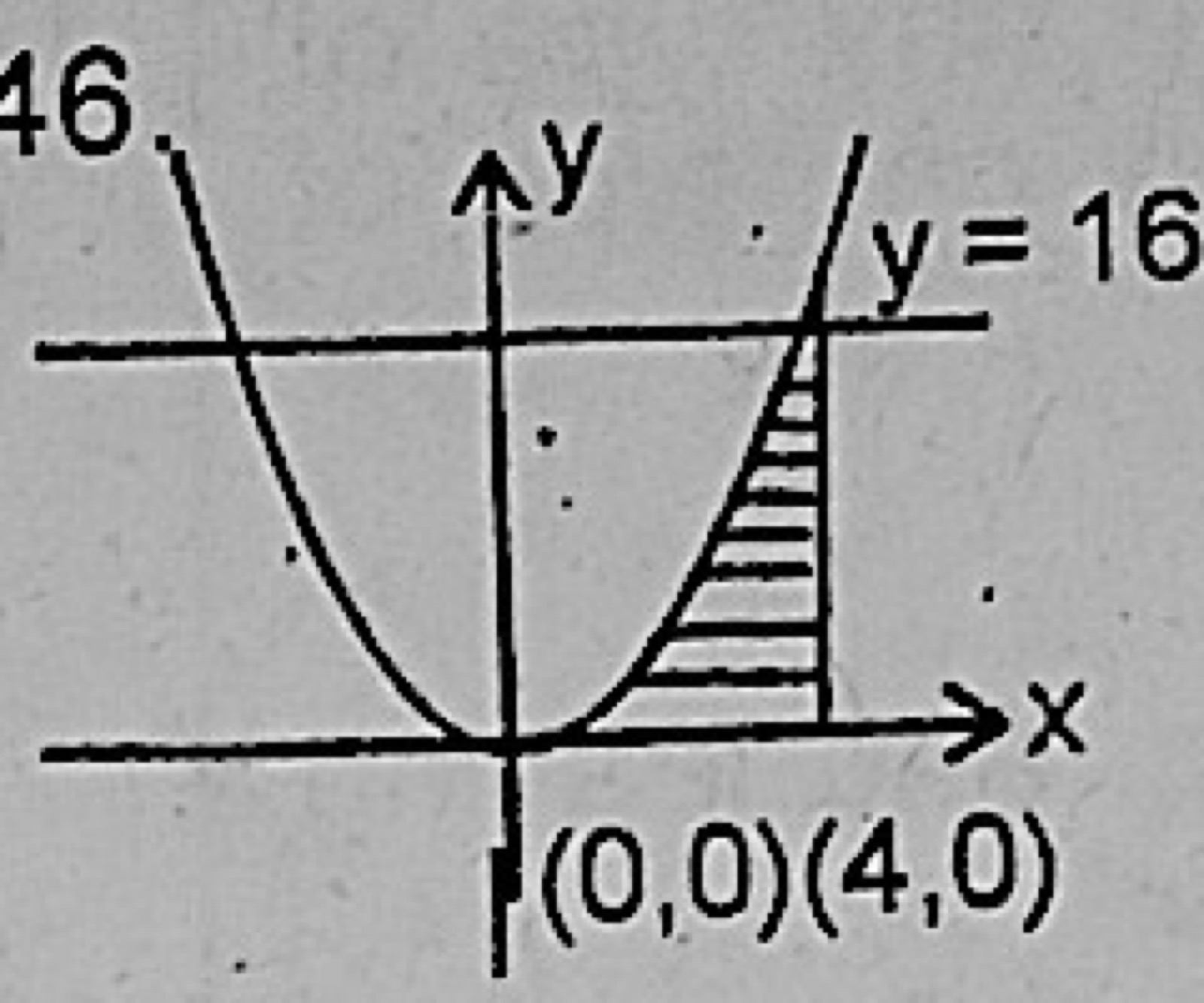
Question 34 Integration If the diagram above is the graph y = x2 , the shaded area is
A. 64 square units B. 128/3 square units C. 64/3 square units D. 32 square units Show the answer and explanation Answer: C (64/3 square units )
Explanation The shaded region lies under y = x2 from x = 0 to x = 4. Its area is ∫x2 dx from 0 to 4 = 43 /3 = 64/3 square units.
Open this question
Question 35 Integration Find the value of ∫0 π (cos2 θ − 1)/sin2 θ dθ
A. π B. π/2 C. −π/2 D. −π Show the answer and explanation Answer: D (−π )
Explanation cos2 θ − 1 = −sin2 θ, so the integrand is −1. Integrating −1 from 0 to π gives −π.
Open this question
Question 36 Differentiation If y = 2x cos 2x − sin 2x, find dy/dx when x = π/4
A. π B. −π C. π/2 D. −π/2 Show the answer and explanation Answer: B (−π )
Explanation dy/dx = 2cos 2x − 4x sin 2x − 2cos 2x = −4x sin 2x. At x = π/4, sin(π/2) = 1, so dy/dx = −π.
Open this question
Question 37 Integration A bowl is designed by revolving completely the area enclosed by y = x2 − 1, y = 0, y = 3 and x ≥ 0 around the y-axis. What is the volume of this bowl?
A. 7π cubic units B. 15π/2 cubic units C. 8π cubic units D. 17π/2 cubic units Show the answer and explanation Answer: B (15π/2 cubic units )
Explanation Around the y-axis, V = π∫x2 dy with x2 = y + 1. From y = 0 to 3 this is π[y2 /2 + y] = π(4.5 + 3) = 15π/2.
Open this question
Question 38 Differentiation If the volume of a hemisphere is increasing at a steady rate of 18πm3 s−1 , at what rate is its radius changing when it is 6m?
A. 2.50ms−1 B. 2.00ms−1 C. 0.25ms−1 D. 0.20ms−1 Show the answer and explanation Answer: C (0.25ms−1 )
Explanation V = (2/3)πr3 , so dV/dt = 2πr2 × dr/dt. With r = 6: 18π = 72π × dr/dt, so dr/dt = 0.25 m/s.
Open this question
Question 39 Integration A function f(x) passes through the origin and its first derivative is 3x + 2. What is f(x)?
A. y = (3/2)x2 + 2x B. y = (3/2)x2 + x C. y = 3x2 + x/2 D. y = 3x2 + 2x Show the answer and explanation Answer: A (y = (3/2)x2 + 2x )
Explanation Integrating 3x + 2 gives (3/2)x2 + 2x + c. Passing through the origin makes c = 0.
Open this question
Question 40 Differentiation The expression ax2 + bx + c equals 5 at x = 1, if its derivative is 2x + 1, what are the values of a, b, c, respectively?
A. 1, 3, 1 B. 1, 2, 1 C. 2, 1, 1 D. 1, 1, 3 Show the answer and explanation Answer: D (1, 1, 3 )
Explanation The derivative 2ax + b equals 2x + 1, so a = 1 and b = 1. At x = 1, a + b + c = 5, so c = 3.
Open this question
Question 41 Probability X and Y are two events. The probability of X or Y is 0.7 and the probability of X is 0.4. If X and Y are independent, find the probability of Y.
A. 0.30 B. 0.50 C. 0.57 D. 1.80 Show the answer and explanation Answer: B (0.50 )
Explanation For independent events, P(X or Y) = P(X) + P(Y) − P(X)P(Y). So 0.7 = 0.4 + y − 0.4y, giving 0.6y = 0.3 and y = 0.5.
Open this question
Question 42 Measures of Dispersion If the mean of the numbers 0, x + 2, 3x + 6 and 4x + 8 is 4, find their mean deviation.
A. 0 B. 2 C. 3 D. 4 Show the answer and explanation Answer: C (3 )
Explanation The mean is (8x + 16)/4 = 2x + 4 = 4, so x = 0 and the numbers are 0, 2, 6, 8. Their distances from 4 are 4, 2, 2, 4, whose average is 3.
Open this question
Question 43 Permutation and Combination In how many ways can the word MATHEMATICS be arranged?
A. 11!/(9!2!) B. 11!/(9!2!2!) C. 11!/(2!2!2!) D. 11!/(2!2!) Show the answer and explanation Answer: C (11!/(2!2!2!) )
Explanation MATHEMATICS has 11 letters with M, A and T each appearing twice. The number of arrangements is 11!/(2!2!2!).
Open this question
Question 44 Data Presentation No.: 1, 2, 3, 4, 5, 6
A. 10° B. 16° C. 40° D. 60° Show the answer and explanation Answer: D (60° )
Explanation The score 4 came up 40 times out of 240. Its angle is 40/240 × 360° = 60°.
Open this question
Question 45 Probability If U = {x : x is an integer and 1 ≤ x ≤ 20}, E1 = {x : x is a multiple of 3}, E2 = {x : x is a multiple of 4} and an integer is picked at random from U, find the probability that it is not in E2 .
A. 3/4 B. 3/10 C. 1/4 D. 1/20 Show the answer and explanation Answer: A (3/4 )
Explanation The multiples of 4 from 1 to 20 are 4, 8, 12, 16, 20: five numbers. So 15 of the 20 are not in E2 , a probability of 15/20 = 3/4.
Open this question
Question 47 Measures of Dispersion The variance of x, 2x, 3x, 4x and 5x is
A. x√2 B. 2x2 C. x2 D. 3x Show the answer and explanation Answer: B (2x2 )
Explanation The mean is 3x. The squared deviations are 4x2 , x2 , 0, x2 , 4x2 , which add to 10x2 . Dividing by 5 gives a variance of 2x2 .
Open this question
Question 48 Measures of Dispersion Find the sum of the range and the mode of the set of numbers 10, 5, 10, 9, 8, 7, 7, 10, 8, 10, 8, 4, 6, 9, 10, 9, 10, 9, 7, 10, 6, 5.
A. 16 B. 14 C. 12 D. 10 Show the answer and explanation Answer: A (16 )
Explanation The range is 10 − 4 = 6 and the mode is 10 (it appears 7 times). Their sum is 16.
Open this question
Question 49 Permutation and Combination In how many ways can a delegation of 3 be chosen from among 5 men and 3 women, if at least one man and at least one woman must be included?
A. 15 B. 28 C. 30 D. 45 Show the answer and explanation Answer: D (45 )
Explanation All choices of 3 from 8: 8 C3 = 56. Remove the all-men choices (5 C3 = 10) and the all-women choice (1): 56 − 10 − 1 = 45.
Open this question Sign up free for every JAMB Mathematics year, practice by topic and timed mocks.
Start practising free