Question 1
Number BasesIf (1P03)4 = 11510, find P.
- A.0
- B.1
- C.2
- D.3
Show the answer and explanation
Answer: D (3)
Explanation
In base 4, 1P03 = 1×64 + P×16 + 0×4 + 3 = 67 + 16P. Setting 67 + 16P = 115 gives 16P = 48, so P = 3.
47 questions. Try each one, then open the answer to check yourself and read the explanation.
If (1P03)4 = 11510, find P.
Answer: D (3)
In base 4, 1P03 = 1×64 + P×16 + 0×4 + 3 = 67 + 16P. Setting 67 + 16P = 115 gives 16P = 48, so P = 3.
Evaluate 64.7642 − 35.2362 correct to 3 significant figures.
Answer: B (2950)
Use the difference of two squares: (64.764 − 35.236)(64.764 + 35.236) = 29.528 × 100 = 2952.8, which is 2950 to 3 significant figures.
Find the value of (0.006)3 + (0.004)3 in standard form.
Answer: C (2.8 × 10⁻⁷)
0.006³ = 2.16 × 10⁻⁷ and 0.004³ = 0.64 × 10⁻⁷. Adding gives 2.8 × 10⁻⁷.
Given that loga2 = 0.693 and loga3 = 1.097, find loga13.5.
Answer: C (2.598)
13.5 = 27/2 = 3³/2, so log 13.5 = 3 log 3 − log 2 = 3(1.097) − 0.693 = 2.598.
Simplify log296 − 2log26
Answer: B (3 − log23)
2log₂6 = log₂36, so the expression is log₂(96/36) = log₂(8/3) = log₂8 − log₂3 = 3 − log₂3.
If 8x/2 = (23/8)(43/4), find x.
Answer: D (5/4)
Write everything as powers of 2: 8^(x/2) = 2^(3x/2) and 2^(3/8) × 2^(3/2) = 2^(15/8). So 3x/2 = 15/8, giving x = 5/4.
Simplify (2√3 + 3√5)/(3√5 − 2√3)
Answer: A ((19 + 4√15)/11)
Multiply top and bottom by (3√5 + 2√3). The top becomes (2√3 + 3√5)² = 57 + 12√15 and the bottom 45 − 12 = 33. Dividing by 3 gives (19 + 4√15)/11.
Find the simple interest rate per cent per annum at which N1000 accumulates to N1240 in 3 years.
Answer: B (8%)
The interest is N240. R = 100I/(PT) = (100 × 240)/(1000 × 3) = 8%.
A survey of 100 students in an institution shows that 80 students speak Hausa and 20 students speak Igbo, while only 9 students speak both languages. How many students speak neither Hausa nor Igbo?
Answer: B (9)
Students speaking at least one language = 80 + 20 − 9 = 91. So 100 − 91 = 9 speak neither.
If the function f(x) = x3 + 2x2 + qx − 6 is divisible by x + 1, find q
Answer: A (−5)
By the factor theorem f(−1) = 0: −1 + 2 − q − 6 = 0, so −5 − q = 0 and q = −5.
Solve the simultaneous equations 2/x − 3/y = 2, 4/x + 3/y = 10
Answer: B (x = 1/2, y = 3/2)
Adding the equations gives 6/x = 12, so x = 1/2. Then 4/x = 8, so 3/y = 2 and y = 3/2.
Find the minimum value of x2 − 3x + 2 for all real values of x.
Answer: A (−1/4)
x² − 3x + 2 = (x − 3/2)² − 1/4, which is smallest when x = 3/2, giving −1/4.
Make f the subject of the formula t = √(v/(1/f + 1/g))
Answer: B (gt2/(gv − t2))
Square: t² = vfg/(f + g). Then t²f + t²g = vfg, so f(vg − t²) = gt² and f = gt²/(gv − t²).
What value of g will make the expression 4x2 − 18xy + g a perfect square?
Answer: D (81y2/4)
(2x − 9y/2)² = 4x² − 18xy + 81y²/4, so g = 81y²/4.
Find the value of K if (5 + 2r)/((r + 1)(r − 2)) expressed in partial fraction is K/(r − 2) + L/(r + 1) where K and L are constants.
Answer: A (3)
5 + 2r = K(r + 1) + L(r − 2). Putting r = 2 gives 9 = 3K, so K = 3.
Let f(x) = 2x + 4 and g(x) = 6x + 7 where g(x) > 0. Solve the inequality f(x)/g(x) < 1
Answer: C (x > −3/4)
Since g(x) > 0 we can multiply through: 2x + 4 < 6x + 7, so −3 < 4x and x > −3/4.
Find the range of value of x which satisfies the inequality 12x2 < x + 1.
Answer: A (−1/4 < x < 1/3)
12x² − x − 1 < 0 factorises as (4x + 1)(3x − 1) < 0, which holds between the roots: −1/4 < x < 1/3.
Sn is the sum of the first n terms of a series given by Sn = n2 − 1. Find the nth term.
Answer: D (2n − 1)
Tn = Sn − Sn−1 = (n² − 1) − ((n − 1)² − 1) = 2n − 1.
The nth term of a sequence is given by 31−n. Find the sum of the first three terms of the sequence.
Answer: A (13/9)
The terms are 3⁰ = 1, 3⁻¹ = 1/3 and 3⁻² = 1/9. Their sum is 13/9.
Two binary operations ∗ and ⊗ are defined as m∗n = mn − n − 1 and m ⊗ n = mn + n − 2 for all real numbers m, n. Find the value of 3 ⊗ (4 ∗ 5)
Answer: C (54)
4 ∗ 5 = 20 − 5 − 1 = 14. Then 3 ⊗ 14 = 42 + 14 − 2 = 54.
If x∗y = x + y − xy, find x, when (x∗2) + (x∗3) = 68
Answer: D (−21)
x∗2 = x + 2 − 2x = 2 − x and x∗3 = 3 − 2x. So 5 − 3x = 68, giving x = −21.
Determine x + y if (2 −3 / −1 4)(x / y) = (−1 / 8)
(The 2 × 2 matrix has rows 2, −3 and −1, 4; the column vectors are (x, y) and (−1, 8).)
Answer: C (7)
The equations are 2x − 3y = −1 and −x + 4y = 8. Solving gives y = 3 and x = 4, so x + y = 7.
Find the non-zero positive value of x which satisfies the equation
| x 1 0 |
| 1 x 1 | = 0
| 0 1 x |
Answer: C (√2)
Expanding along the first row: x(x² − 1) − 1(x − 0) = x³ − 2x = 0. So x(x² − 2) = 0 and the positive non-zero root is √2.
Each of the base angles of an isosceles triangle is 58° and all the vertices of the triangles lie on a circle. Determine the angles which the base of the triangle subtends at the centre of the circle.
Answer: A (128°)
The apex angle is 180° − 2(58°) = 64°. The angle at the centre is twice the angle at the circumference, so 128°.
From the figure above, FK//GR and FH = GH, ∠RFK = 34° and ∠FGH = 47°. Calculate the angle marked x
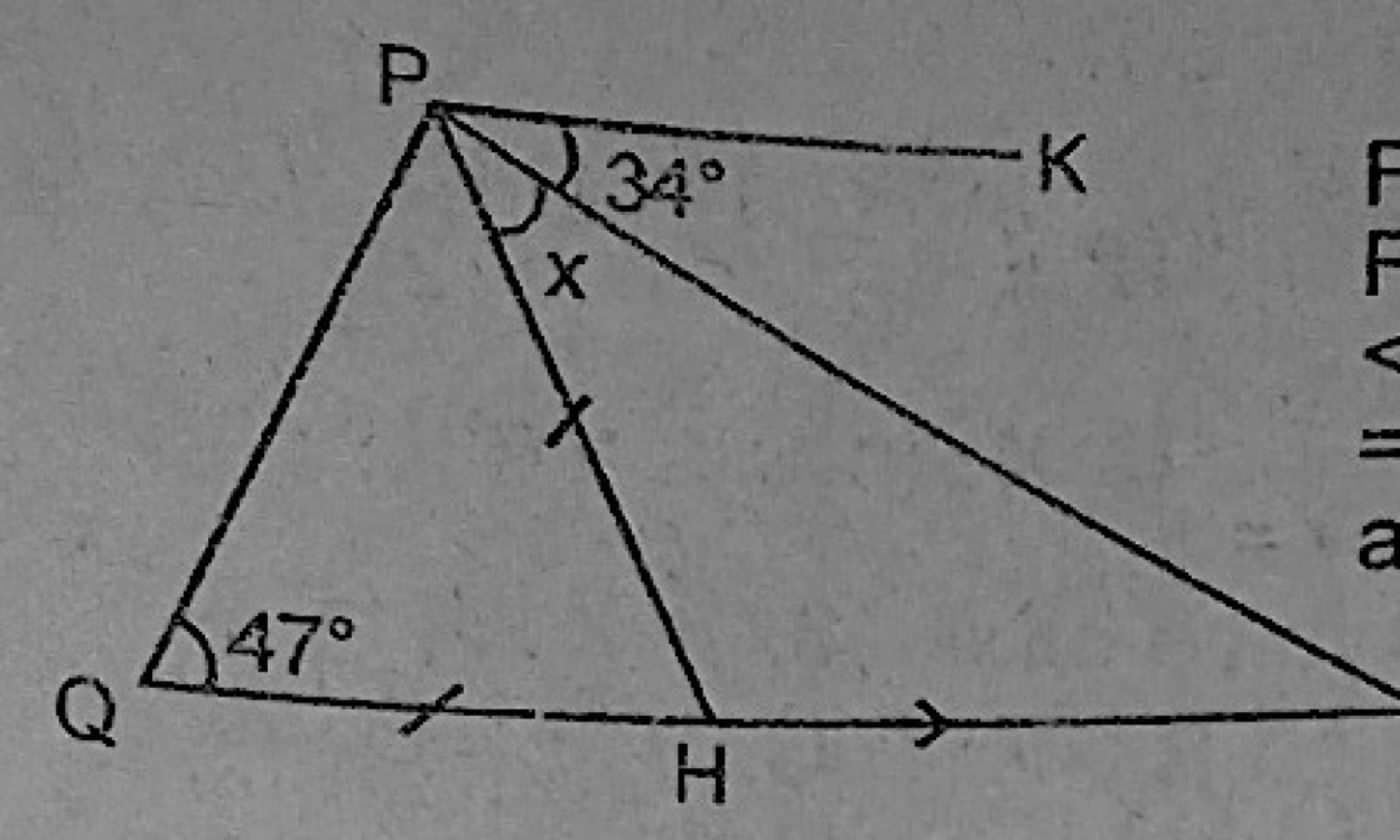
Answer: B (52°)
In the figure F, G are P, Q. Since PK ∥ QR, ∠PRQ = ∠KPR = 34°. PH = QH makes ∠QPH = 47°. In triangle PQR, ∠QPR = 180° − 47° − 34° = 99°, so x = 99° − 47° = 52°.
The figure above shows circles of radii 3cm and 2cm with centre at X and Y respectively. The circles have a transverse common tangent of length 25cm. Calculate XY.
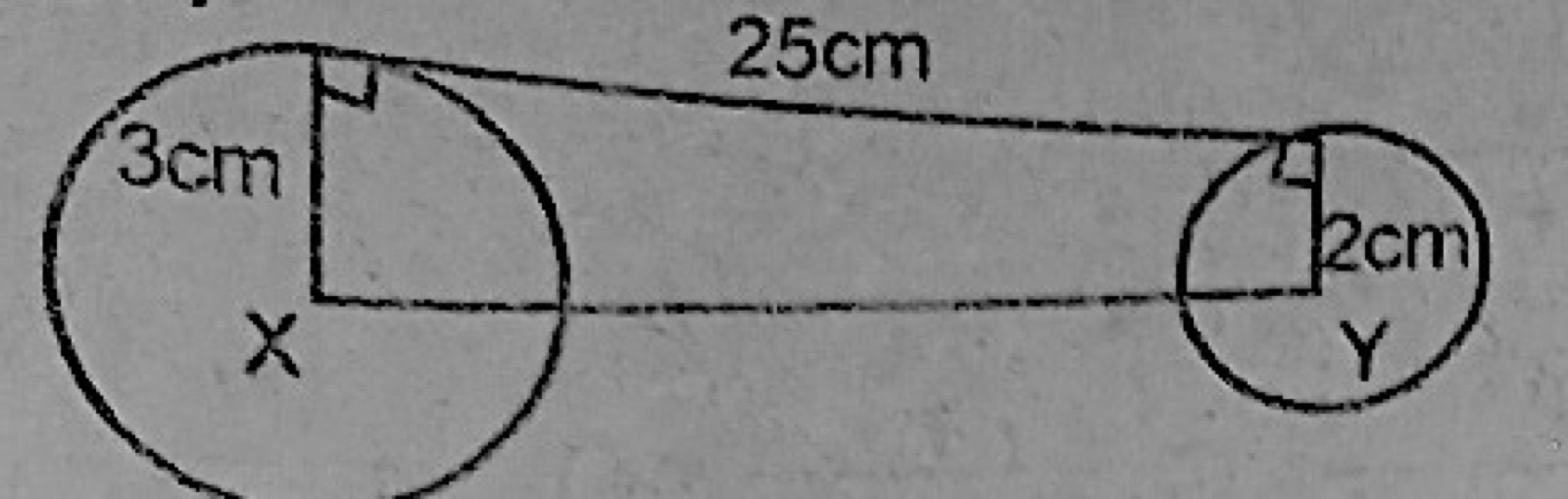
Answer: B (√626cm)
Drawn as in the figure, the tangent, the difference of the radii and XY form a right-angled triangle: XY² = 25² + (3 − 2)² = 626, so XY = √626 cm.
A chord of a circle of diameter 42cm subtends an angle of 60° at the centre of the circle. Find the length of the minor arc.
Answer: A (22cm)
Arc length = (60/360) × 2πr = (1/6) × 2 × (22/7) × 21 = 22 cm.
An arc of a circle subtends an angle 70° at the centre. If the radius of the circle is 6cm, calculate the area of the sector subtended by the given angle.
Answer: A (22cm2)
Area = (70/360) × (22/7) × 6² = 22 cm².
Find the volume of the prism above.
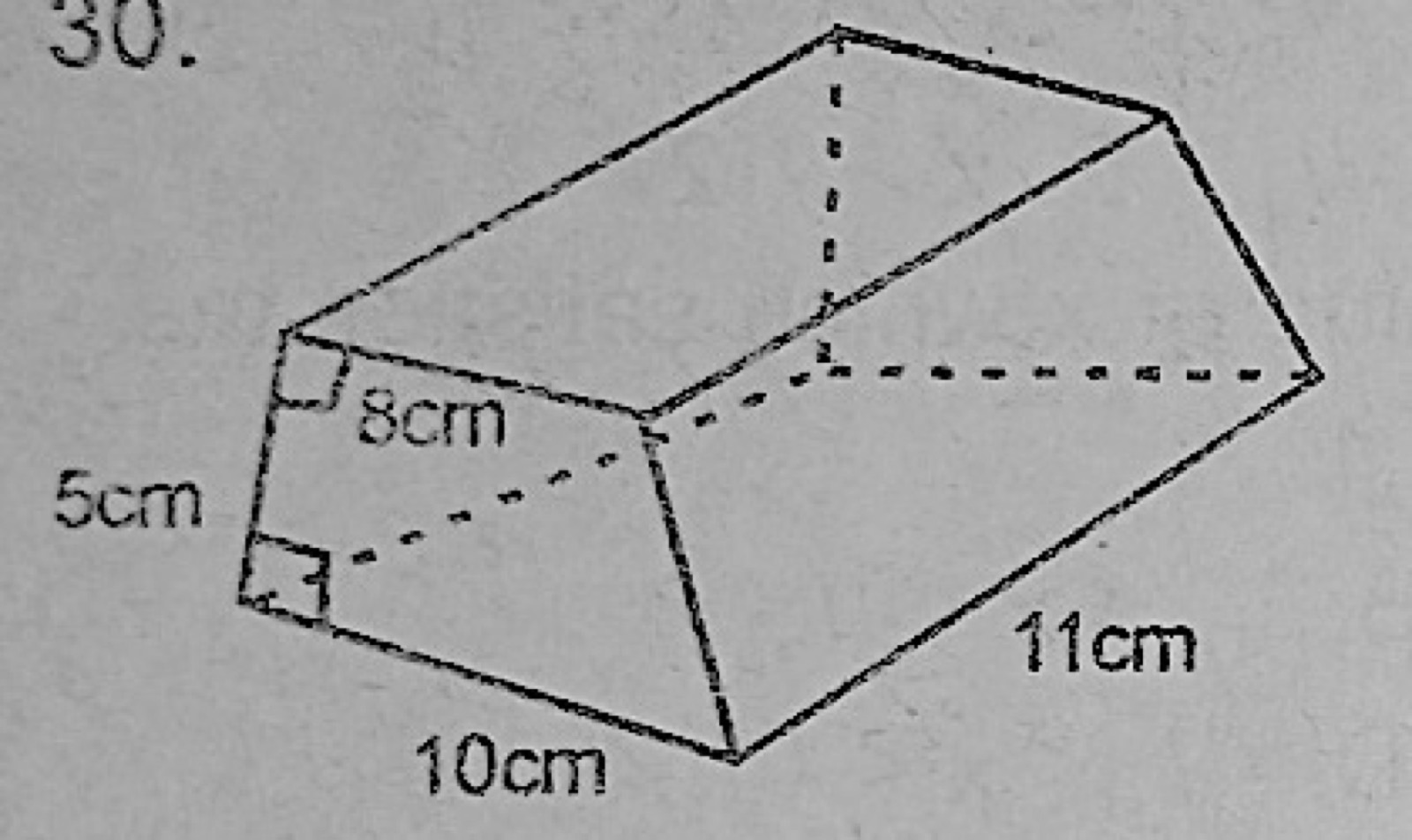
Answer: D (495cm3)
The cross-section is a trapezium with parallel sides 8 cm and 10 cm and height 5 cm: area = ½(8 + 10) × 5 = 45 cm². Volume = 45 × 11 = 495 cm³.
A cone with the sector angle of 45° is cut out of a circle of radius r cm. Find the base radius of the cone.
Answer: B (r/8cm)
The arc of the sector becomes the base circumference: (45/360) × 2πr = 2πR, so R = r/8.
A point P moves so that it is equidistant from point L and M. If LM is 16cm, find the distance of P from LM when P is 10cm from L.
Answer: D (6cm)
P lies on the perpendicular bisector of LM, 8 cm from L along LM. By Pythagoras the distance is √(10² − 8²) = 6 cm.
The angle between the positive horizontal axis and a given line is 135°. Find the equation of the line if it passes through the point (2, 3)
Answer: C (x + y = 5)
Gradient = tan 135° = −1. So y − 3 = −(x − 2), which gives x + y = 5.
Find the distance between the point Q(4, 3) and the point common to the lines 2x − y = 4 and x + y = 2.
Answer: D (√13)
Adding the equations gives 3x = 6, so x = 2 and y = 0. Distance from (4, 3) to (2, 0) = √(2² + 3²) = √13.
The angle of elevation of a building from a measuring instrument placed on the ground is 30°. If the building is 40m high, how far is the instrument from the foot of the building?
Answer: D (40√3m)
tan 30° = height/distance, so distance = 40 ÷ (1/√3) = 40√3 m.
In a triangle XYZ, if ∠XYZ is 60°, XY = 3cm and YZ = 4cm. Calculate the length of the side XZ.
Answer: B (√13cm)
By the cosine rule, XZ² = 3² + 4² − 2(3)(4)cos 60° = 25 − 12 = 13, so XZ = √13 cm.
In the figure above, XYZ is a triangle with XY = 5cm, XZ = 2cm and XZ is produced to E marking the angle YZE = 150°. If the angle XYZ = θ calculate the value of sin θ.
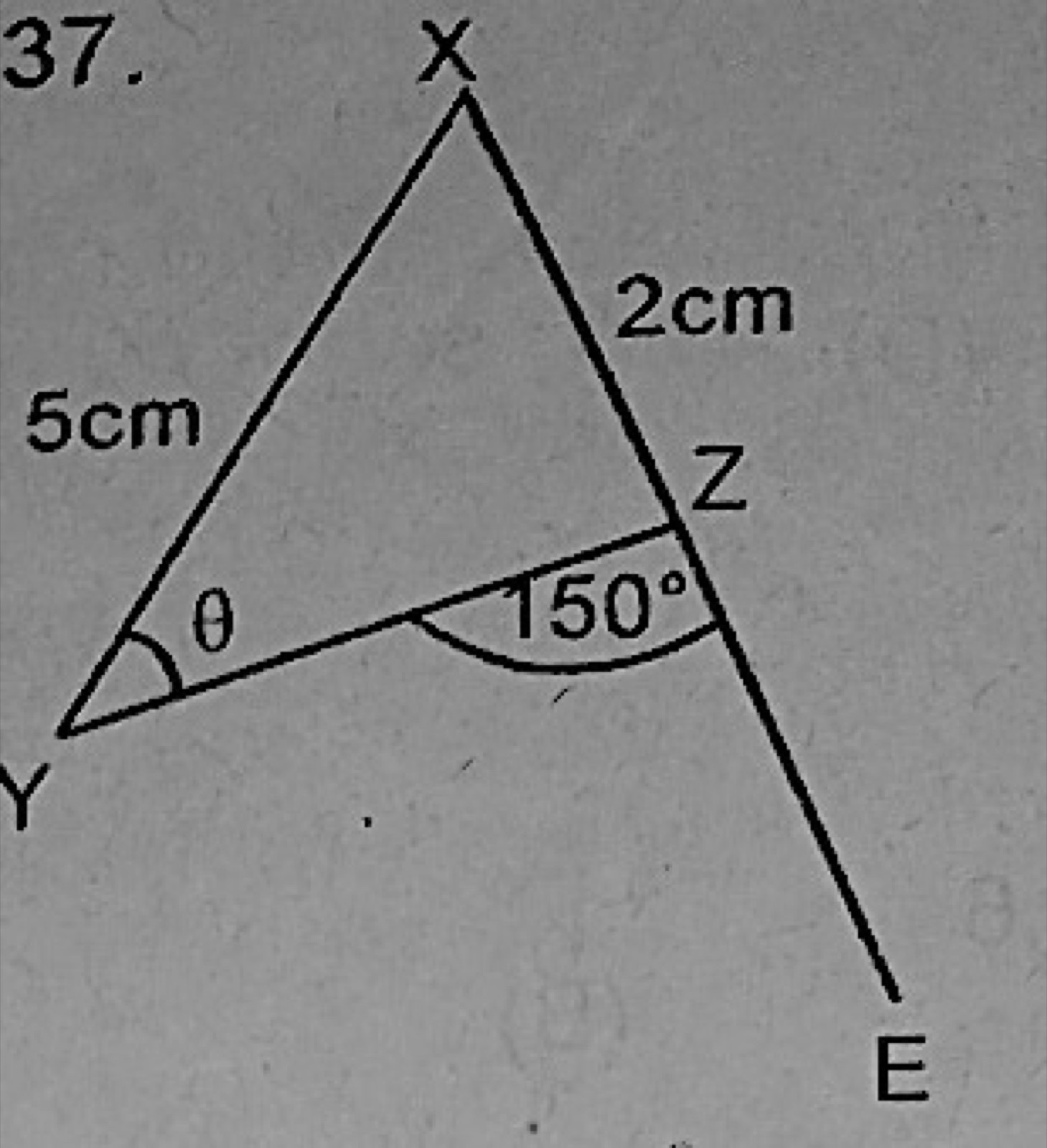
Answer: D (1/5)
∠XZY = 180° − 150° = 30°. By the sine rule, sin θ/XZ = sin 30°/XY, so sin θ = 2 × ½ ÷ 5 = 1/5.
Differentiate (6x3 − 5x2 + 1)/3x2 with respect to x
Answer: C (2 − 2/(3x3))
Divide first: 2x − 5/3 + (1/3)x⁻². Differentiating gives 2 − (2/3)x⁻³ = 2 − 2/(3x³).
d/dx cos (3x2 − 2x) is equal to
Answer: D (−(6x − 2)sin(3x2 − 2x))
By the chain rule, the derivative of cos u is −sin u × du/dx, with du/dx = 6x − 2.
Find the gradient of the curve y = 2√x − 1/x at the point x = 1
Answer: C (2)
dy/dx = 1/√x + 1/x². At x = 1 this is 1 + 1 = 2.
Integrate 1/x + cos x with respect to x
Answer: B (ln x + sin x + k)
∫(1/x)dx = ln x and ∫cos x dx = sin x, so the result is ln x + sin x + k.
The pie chart above shows the income of a civil servant in a month. If his monthly income is N6 000, find his monthly basic salary.
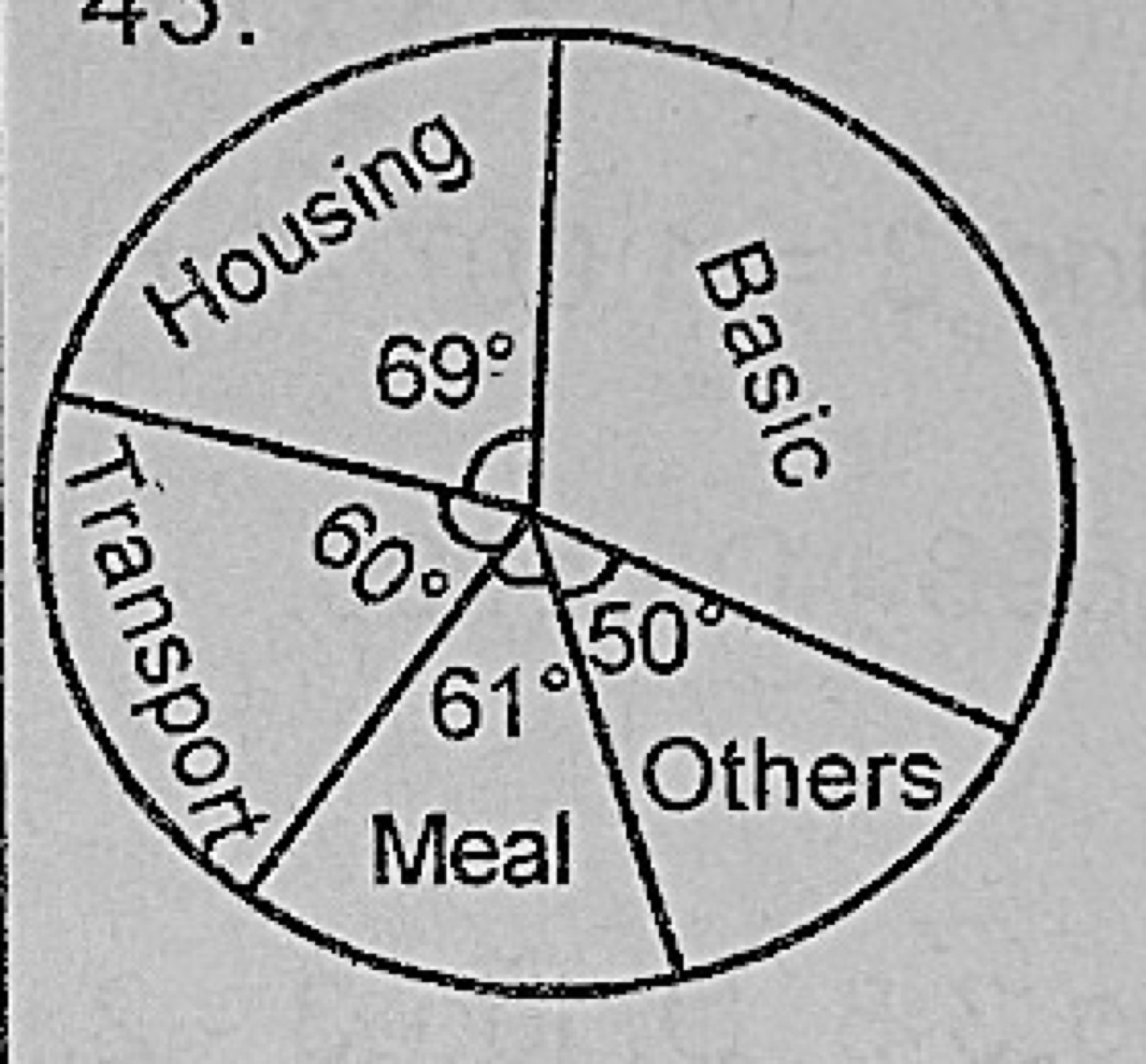
Answer: A (N2 000)
Basic salary angle = 360° − (69° + 60° + 61° + 50°) = 120°. So basic = (120/360) × 6000 = N2 000.
In an examination, the result of a certain school is as shown in the histogram above. How many candidates did the school present?
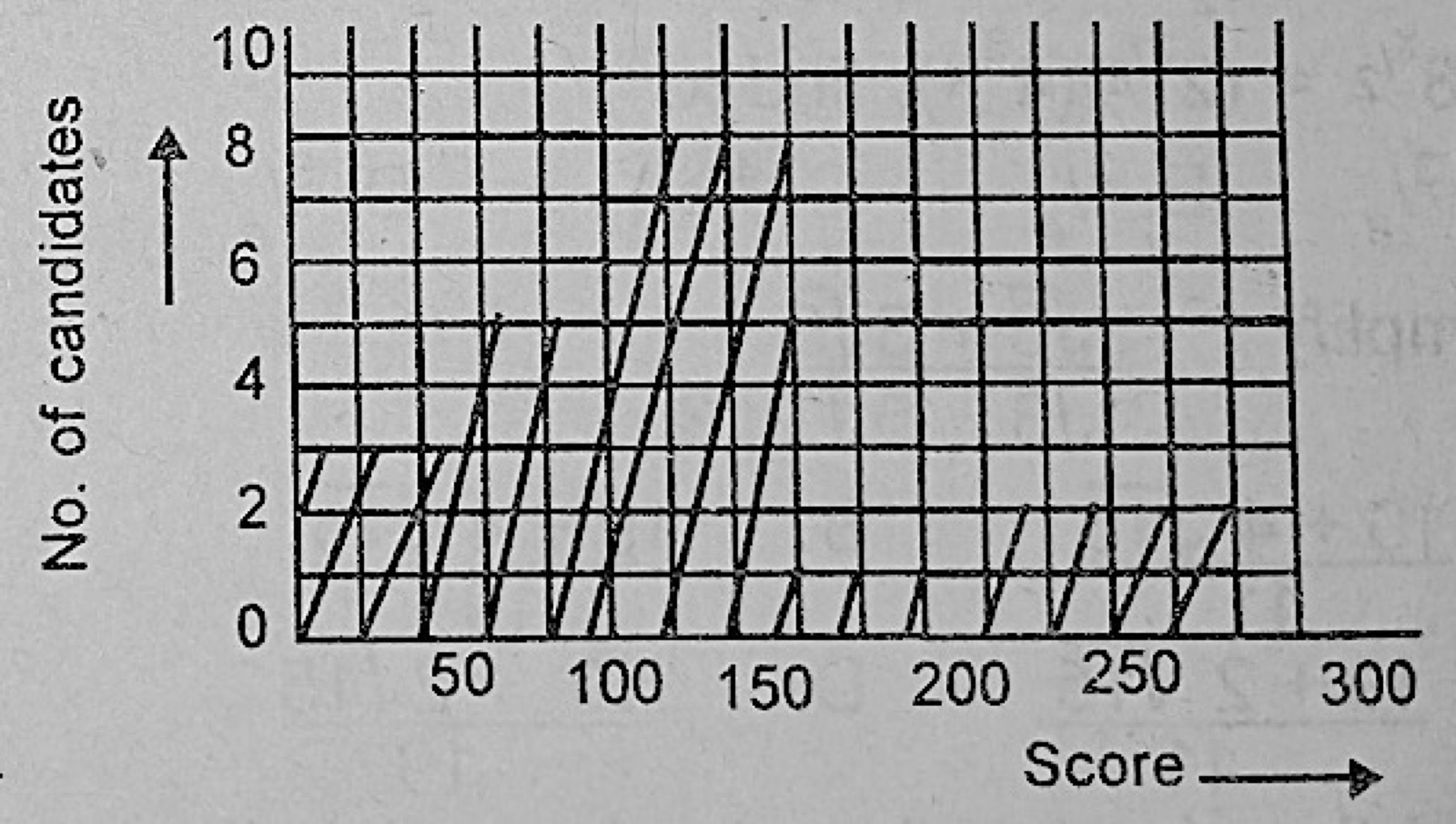
Answer: D (19)
Add the frequencies (heights) of the bars: 3 + 5 + 8 + 1 + 2 = 19.
Age: 20, 25, 30, 35, 40, 45
No. of people: 3, 5, 1, 1, 2, 3
Find the median age of the frequency distribution in the table above.
Answer: B (25)
There are 15 people, so the median is the 8th. The cumulative frequencies are 3, 8, …, so the 8th person is aged 25.
The following are the scores of ten students in a test of 20 marks: 15, 16, 17, 13, 16, 8, 5, 16, 19, 17. What is the modal score?
Answer: C (16)
16 appears three times, more than any other score.
Find the standard deviation of the following data −5, −4, −3, −2, −1, 0, 1, 2, 3, 4, 5.
Answer: C (√10)
The mean is 0. The sum of squares is 2(1 + 4 + 9 + 16 + 25) = 110, so the variance is 110/11 = 10 and the standard deviation is √10.
Find the difference between the range and the variance of the following set of numbers 4, 9, 6, 3, 2, 8, 10, 5, 6, 7 where Σd2 = 60.
Answer: A (2)
Range = 10 − 2 = 8. Variance = Σd²/n = 60/10 = 6. The difference is 8 − 6 = 2.
In a basket of fruits, there are 6 grapes, 11 bananas and 13 oranges. If one fruit is chosen at random, what is the probability that the fruit is either a grape or a banana?
Answer: A (17/30)
There are 30 fruits and 6 + 11 = 17 are grapes or bananas, so the probability is 17/30.