JAMB Mathematics 1991 past questions and answers

47 questions. Try each one, then open the answer to check yourself and read the explanation.

Question 1

Fractions, Decimals and Approximation

Simplify 3⅓ − 1¼ × ⅔ + 1⅖

  1. A.2 17/30
  2. B.3 9/10
  3. C.4 1/10
  4. D.4 11/36
Show the answer and explanation

Answer: B (3 9/10)

Explanation

Multiply first: 1¼ × ⅔ = 5/6. Then 10/3 − 5/6 + 7/5 = (100 − 25 + 42)/30 = 117/30 = 3 9/10.

Open this question

Question 2

Number Bases

If 2257 is the result of subtracting 4577 from 7056 in base n find n

  1. A.8
  2. B.9
  3. C.10
  4. D.11
Show the answer and explanation

Answer: A (8)

Explanation

The digit 7 rules out bases below 8. In base 8, 7056 = 3630 and 4577 = 2431 in base ten; 3630 − 2431 = 1199, and 2257 in base 8 is also 1199. So n = 8.

Open this question

Question 3

Fractions, Decimals and Approximation

Find correct to 3 decimal places [1/0.05] ÷ [1/5.005] − [0.05 × 20.5]

  1. A.99.998
  2. B.98.999
  3. C.89.899
  4. D.9.998
Show the answer and explanation

Answer: A (99.998)

Explanation

1/0.05 ÷ 1/5.005 = 20 × 5.005 = 100.1. Taking the second bracket as 0.05 × 2.05 = 0.1025 (as in the book's working), 100.1 − 0.1025 = 99.9975 = 99.998.

Open this question

Question 4

Fractions, Decimals and Approximation

Express 62 ÷ 3 as a decimal correct to 3 significants figures.

  1. A.20.6
  2. B.20.667
  3. C.20.67
  4. D.20.7
Show the answer and explanation

Answer: D (20.7)

Explanation

62 ÷ 3 = 20.666…, and to 3 significant figures that is 20.7.

Open this question

Question 5

Commercial Arithmetic

Factory P produces 20,000 bags of cement per day while Q factory produces 15,000 bags per day. If P reduces production by 5% and Q increases production by 5%, determine the effective loss in the number of bags produced per day by the two factories.

  1. A.250
  2. B.750
  3. C.1000
  4. D.1250
Show the answer and explanation

Answer: A (250)

Explanation

P loses 5% of 20,000 = 1,000 bags and Q gains 5% of 15,000 = 750 bags. The overall loss is 1,000 − 750 = 250 bags.

Open this question

Question 6

Commercial Arithmetic

Musa borrows N10.00 at 2% per month simple interest and repays N8.00 after four months. How much does he still owes?

  1. A.N10.80
  2. B.N10.67
  3. C.N2.80
  4. D.N2.67
Show the answer and explanation

Answer: C (N2.80)

Explanation

Interest = 10 × 2/100 × 4 = N0.80, so he owes N10.80 in all. After repaying N8.00 he still owes N2.80.

Open this question

Question 7

Ratio, Percentages and Rates

If 3 gallons of spirit containing 20% water are added to 5 gallons of another spirit containing 15% water, what percentage of the mixture is water?

  1. A.2 4/5%
  2. B.16 7/8%
  3. C.18 1/8%
  4. D.18 7/8%
Show the answer and explanation

Answer: B (16 7/8%)

Explanation

Water = 20% of 3 + 15% of 5 = 0.6 + 0.75 = 1.35 gallons out of 8 gallons. 1.35/8 × 100 = 16⅞%.

Open this question

Question 8

Indices

What is the product of 27/5, (3)−3 and (1/5)−1?

  1. A.5
  2. B.3
  3. C.1
  4. D.1/25
Show the answer and explanation

Answer: C (1)

Explanation

(3)−3 = 1/27 and (1/5)−1 = 5, so 27/5 × 1/27 × 5 = 1.

Open this question

Question 9

Logarithms

Simplify 2log 2/5 − log 72/125 + log 9

  1. A.1 − 4 log 3
  2. B.−1 + 2 log 3
  3. C.−1 + 5 log 2
  4. D.1 − 2 log 2
Show the answer and explanation

Answer: D (1 − 2 log 2)

Explanation

Combine: log(4/25 × 125/72 × 9) = log(5/2) = log 10 − log 4 = 1 − 2 log 2.

Open this question

Question 10

Surds

Rationalize (2√3 + 3√2)/(3√2 − 2√3)

  1. A.5 − 2√6
  2. B.5 + 2√6
  3. C.5√3
  4. D.5
Show the answer and explanation

Answer: B (5 + 2√6)

Explanation

Multiply top and bottom by 3√2 + 2√3. The top becomes (2√3 + 3√2)2 = 30 + 12√6 and the bottom 18 − 12 = 6, giving 5 + 2√6.

Open this question

Question 11

Surds

Simplify 1/(3 + √5) − 1/(3 − √5)

  1. A.−½√5
  2. B.½√5
  3. C.−¼√5
  4. D.0
Show the answer and explanation

Answer: A (−½√5)

Explanation

Over the common denominator (3 + √5)(3 − √5) = 4, the top is (3 − √5) − (3 + √5) = −2√5. So the answer is −2√5/4 = −½√5.

Open this question

Question 12

Algebraic Expressions

Multiply (x2 − 3x + 1) by (x − a)

  1. A.x3 − (3 + a) x2 + (1 + 3a) x − a
  2. B.x3 − (3 − a) x2 + 3ax − a
  3. C.x3 − (a − 3) x2 − (1 + 3a) − a
  4. D.x3 + (3 − a) x2 + (1 + 3a) − a
Show the answer and explanation

Answer: A (x3 − (3 + a) x2 + (1 + 3a) x − a)

Explanation

Expanding gives x3 − ax2 − 3x2 + 3ax + x − a. Grouping like terms: x3 − (3 + a)x2 + (1 + 3a)x − a.

Open this question

Question 13

Algebraic Expressions

Evaluate (xy2 − x2y)/(x2 − xy) when x = −2 and y = 3

  1. A.−3
  2. B.−3/2
  3. C.3/5
  4. D.3
Show the answer and explanation

Answer: A (−3)

Explanation

The expression is xy(y − x)/[x(x − y)] = −y. With y = 3, the value is −3.

Open this question

Question 14

Linear and Simultaneous Equations

A car travels from Calabar to Enugu, a distance of p km with an average speed of u km per hour and continues to Benin, a distance of q km, with an average speed of w km per hour. Find its average speed from Calabar to Benin.

  1. A.(p + q)/(up + wq)
  2. B.u + w
  3. C.uw(p + q)/(wp + uq)
  4. D.(wp + uq)/(up + wq)
Show the answer and explanation

Answer: C (uw(p + q)/(wp + uq))

Explanation

Total time = p/u + q/w = (pw + qu)/(uw). Average speed = total distance ÷ total time = uw(p + q)/(wp + uq).

Open this question

Question 15

Variation

If w varies inversely as uv/(u + v) and is equal to 8 when u = 2 and v = 6, find a relationship between u, v, w

  1. A.urw = 16(u + r)
  2. B.16ur = 3w(u + r)
  3. C.urw = 12(u + r)
  4. D.12urw = u + r
Show the answer and explanation

Answer: C (urw = 12(u + r))

Explanation

w = k(u + v)/(uv). With u = 2, v = 6: 8 = k × 8/12, so k = 12 and uvw = 12(u + v). This is option C, where the book prints r in place of v.

Open this question

Question 16

Algebraic Expressions

If g(x) = x2 + 3x + 4 find g(x + 1) − g(x)

  1. A.(x + 2)
  2. B.2(x + 2)
  3. C.(2x + 1)
  4. D.(x2 + 2)
Show the answer and explanation

Answer: B (2(x + 2))

Explanation

g(x + 1) = (x + 1)2 + 3(x + 1) + 4 = x2 + 5x + 8. Subtracting g(x) leaves 2x + 4 = 2(x + 2).

Open this question

Question 17

Algebraic Expressions

Factorize m3 − 2m2 − m + 2

  1. A.(m2 + 1)(m − 2)
  2. B.(m + 1)(m + 1)(m + 2)
  3. C.(m − 2)(m + 1)(m − 1)
  4. D.(m2 + 2)(m − 1)
Show the answer and explanation

Answer: C ((m − 2)(m + 1)(m − 1))

Explanation

Group: m2(m − 2) − 1(m − 2) = (m2 − 1)(m − 2) = (m − 2)(m + 1)(m − 1).

Open this question

Question 18

Algebraic Expressions

Factorize 1 − (a − b)2

  1. A.(1 − a − b)(1 − a + b)
  2. B.(1 − a + b)(1 + a − b)
  3. C.(1 − a + b)(1 − a + b)
  4. D.(1 − a − b)(1 + a − b)
Show the answer and explanation

Answer: B ((1 − a + b)(1 + a − b))

Explanation

Difference of two squares: [1 − (a − b)][1 + (a − b)] = (1 − a + b)(1 + a − b).

Open this question

Question 19

Algebraic Expressions

Which of the following is a factor of rs + tr − pt − ps?

  1. A.(p − s)
  2. B.(s − p)
  3. C.(r − p)
  4. D.(r + p)
Show the answer and explanation

Answer: C ((r − p))

Explanation

Group: r(s + t) − p(t + s) = (s + t)(r − p). So r − p is a factor.

Open this question

Question 20

Linear and Simultaneous Equations

Find the two values of y which satisfy the simultaneous equation 3x + y = 8, x2 + xy = 6

  1. A.−1 and 5
  2. B.−5 and 1
  3. C.1 and 5
  4. D.1 and 1
Show the answer and explanation

Answer: A (−1 and 5)

Explanation

From the first equation y = 8 − 3x. Substituting: x2 + 8x − 3x2 = 6, so x2 − 4x + 3 = 0 and x = 1 or 3. Then y = 5 or −1.

Open this question

Question 21

Inequalities

Find the range of value of x which satisfy the inequality (x/2 + x/3 + x/4) < 1

  1. A.x < 12/13
  2. B.x < 13
  3. C.x < 9
  4. D.x < 13/12
Show the answer and explanation

Answer: A (x < 12/13)

Explanation

x/2 + x/3 + x/4 = 13x/12. So 13x/12 < 1 gives x < 12/13.

Open this question

Question 22

Quadratic Equations

Find the positive number n, such that thrice its square is equal to twelve times the number.

  1. A.1
  2. B.2
  3. C.3
  4. D.4
Show the answer and explanation

Answer: D (4)

Explanation

3n2 = 12n gives n(n − 4) = 0. The positive answer is n = 4.

Open this question

Question 23

Quadratic Equations

Solve the equation (x − 2)(x − 3) = 12

  1. A.2, 3
  2. B.3, 6
  3. C.−1, 6
  4. D.1, −6
Show the answer and explanation

Answer: C (−1, 6)

Explanation

Expand: x2 − 5x + 6 = 12, so x2 − 5x − 6 = 0, i.e. (x − 6)(x + 1) = 0. So x = −1 or 6.

Open this question

Question 25

Algebraic Expressions

Evaluate x2(x2 − 1)−½ − (x2 − 1)½

  1. A.(x2 − 1)½
  2. B.(x2 − 1)
  3. C.(x2 − 1)−1
  4. D.(x2 − 1)−½
Show the answer and explanation

Answer: D ((x2 − 1)−½)

Explanation

Write both terms over (x2 − 1)½: [x2 − (x2 − 1)]/(x2 − 1)½ = 1/(x2 − 1)½ = (x2 − 1)−½.

Open this question

Question 26

Coordinate Geometry

Find the gradient of the line passing through the points (−2, 0) and (0, −4)

  1. A.2
  2. B.−4
  3. C.−2
  4. D.4
Show the answer and explanation

Answer: C (−2)

Explanation

Gradient = (−4 − 0)/(0 − (−2)) = −4/2 = −2.

Open this question

Question 28

Progressions

What is the nth term of the progression 27, 9, 3,...?

  1. A.27(1/3)n−1
  2. B.3n+2
  3. C.27 + 18(n − 1)
  4. D.27 + 6(n − 1)
Show the answer and explanation

Answer: A (27(1/3)n−1)

Explanation

It is a G.P. with first term 27 and common ratio ⅓, so the nth term is 27(⅓)n−1.

Open this question

Question 29

Progressions

Find the sum of the 20 terms in an arithmetic progression whose first term is 7 and last term is 117

  1. A.2480
  2. B.1240
  3. C.620
  4. D.124
Show the answer and explanation

Answer: B (1240)

Explanation

Sum = n/2 × (first + last) = 20/2 × (7 + 117) = 10 × 124 = 1240.

Open this question

Question 31

Triangles and Quadrilaterals

The angles of a quadrilateral are 5x − 30, 4x + 60, 60 − x and 3x + 61. Find the smallest of these angles.

  1. A.5x − 30
  2. B.4x + 60
  3. C.60 − x
  4. D.3x + 61
Show the answer and explanation

Answer: C (60 − x)

Explanation

The angles add up to 360°: 11x + 151 = 360, so x = 19. The angles are 65°, 136°, 41° and 118°, so the smallest is 60 − x.

Open this question

Question 32

Mensuration of Plane Shapes

The area of a square is 144sq cm. Find the length of its diagonal.

  1. A.11√3cm
  2. B.12cm
  3. C.12√2cm
  4. D.13cm
Show the answer and explanation

Answer: C (12√2cm)

Explanation

The side is √144 = 12cm, so the diagonal is 12√2cm.

Open this question

Question 33

Triangles and Quadrilaterals

One angle of a rhombus is 60°. The shorter of the two diagonals is 8cm long. Find the length of the longer one.

  1. A.8√3
  2. B.16/√3
  3. C.5√3
  4. D.10/√3
Show the answer and explanation

Answer: A (8√3)

Explanation

The shorter diagonal cuts the rhombus into two equilateral triangles, so each side is 8cm. The longer diagonal is twice the height of such a triangle: 2 × 4√3 = 8√3cm.

Open this question

Question 34

Angles and Polygons

If the exterior angles of a pentagon are x°, (x + 5)°, (x + 10)°, (x + 15)° and (x + 20)°, find x.

  1. A.118°
  2. B.72°
  3. C.62°
  4. D.36°
Show the answer and explanation

Answer: C (62°)

Explanation

Exterior angles add up to 360°: 5x + 50 = 360, so x = 62.

Open this question

Question 35

Circle Theorems

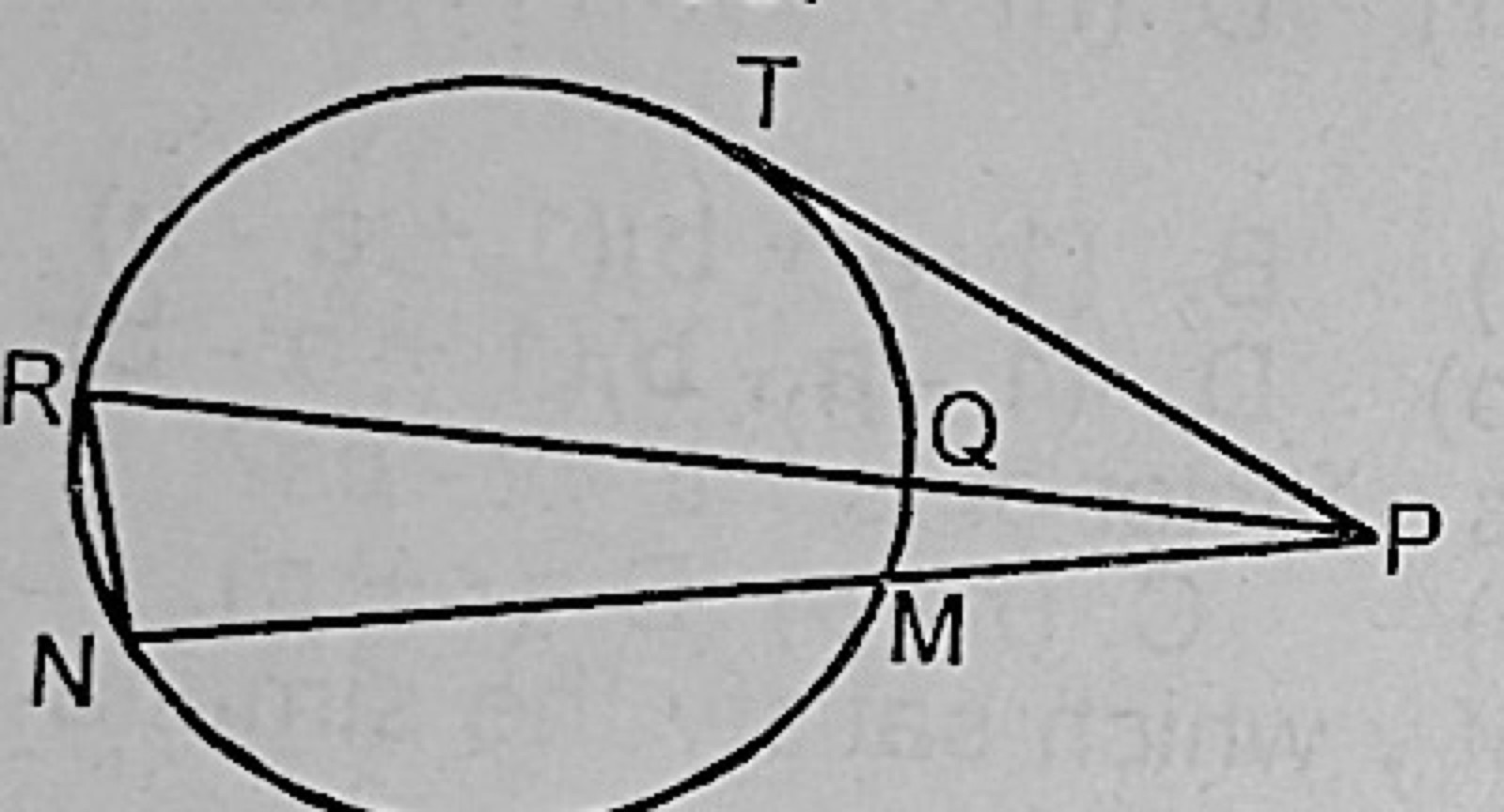
Use the figure below to answer questions 35 and 36. PMN and PQR are two secants of the circle MQTRN and PT is a tangent.
If PM = 5cm, PN = 12cm and PQ = 4.8cm, calculate the respective lengths of PR and PT in centimetres

Diagram for this question
  1. A.7.3, 5.9
  2. B.7.7, 12.5
  3. C.12.5, 7.7
  4. D.5.9, 7.3
Show the answer and explanation

Answer: C (12.5, 7.7)

Explanation

For secants from the same point, PM × PN = PQ × PR, so 60 = 4.8 × PR and PR = 12.5. For the tangent, PT2 = PM × PN = 60, so PT ≈ 7.7.

Open this question

Question 36

Circle Theorems

Use the figure below to answer questions 35 and 36. PMN and PQR are two secants of the circle MQTRN and PT is a tangent.
If PN̂R = 110° and PM̂Q = 55°, find MP̂Q

Diagram for this question
  1. A.40°
  2. B.30°
  3. C.25°
  4. D.15°
Show the answer and explanation

Answer: D (15°)

Explanation

MQRN is cyclic, so the exterior angle PMQ equals the interior opposite angle QRN = 55°. In triangle PNR, angle P = 180° − 110° − 55° = 15°.

Open this question

Question 37

Triangles and Quadrilaterals

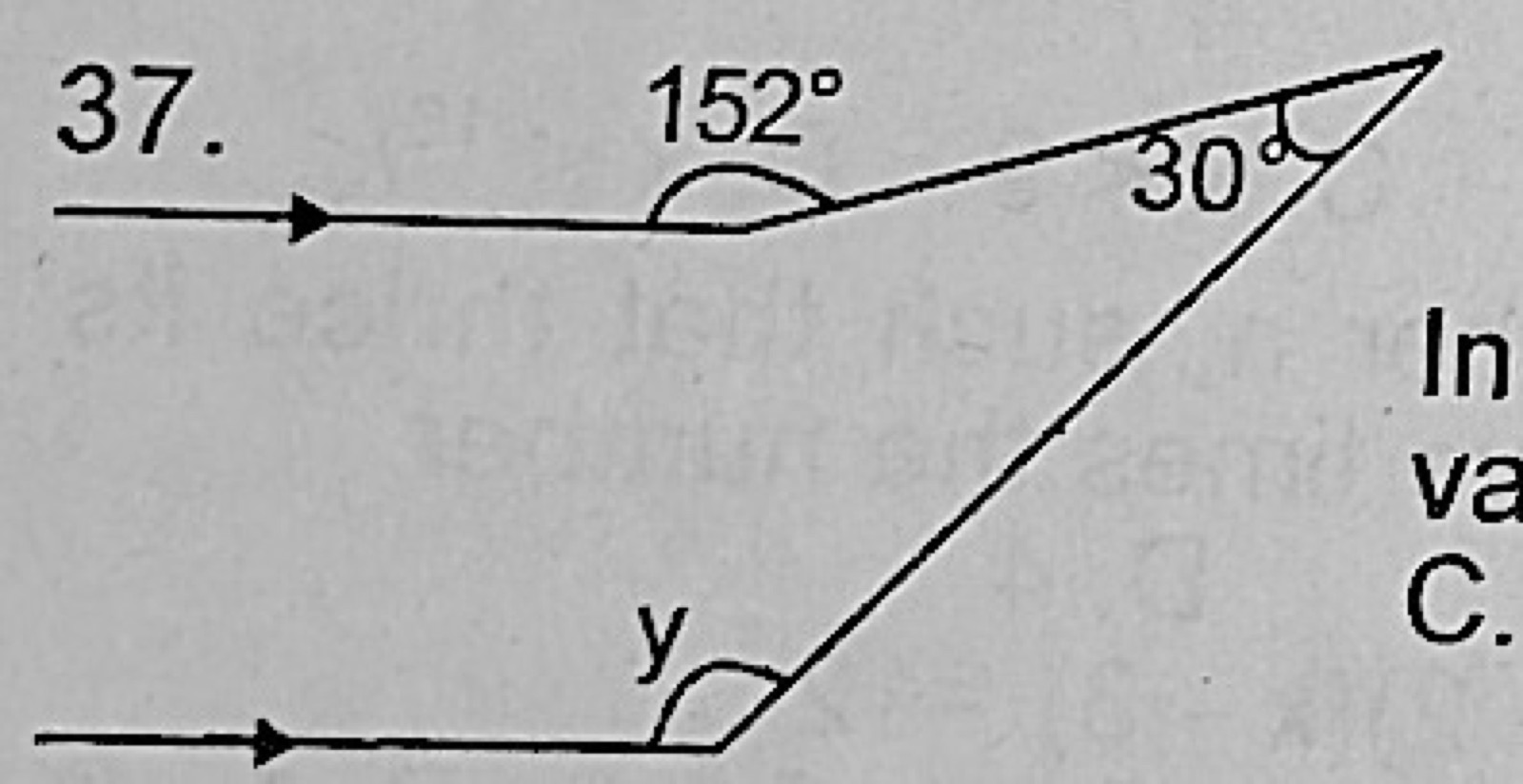
In the figure above, find the value of y.

Diagram for this question
  1. A.28°
  2. B.122°
  3. C.150°
  4. D.152°
Show the answer and explanation

Answer: B (122°)

Explanation

The 152° bend makes the slanting top line rise at 28° to the parallels. The next line turns a further 30°, so it meets the bottom parallel at 28° + 30° = 58°. y is on the other side of that line, so y = 180° − 58° = 122°.

Open this question

Question 38

Triangles and Quadrilaterals

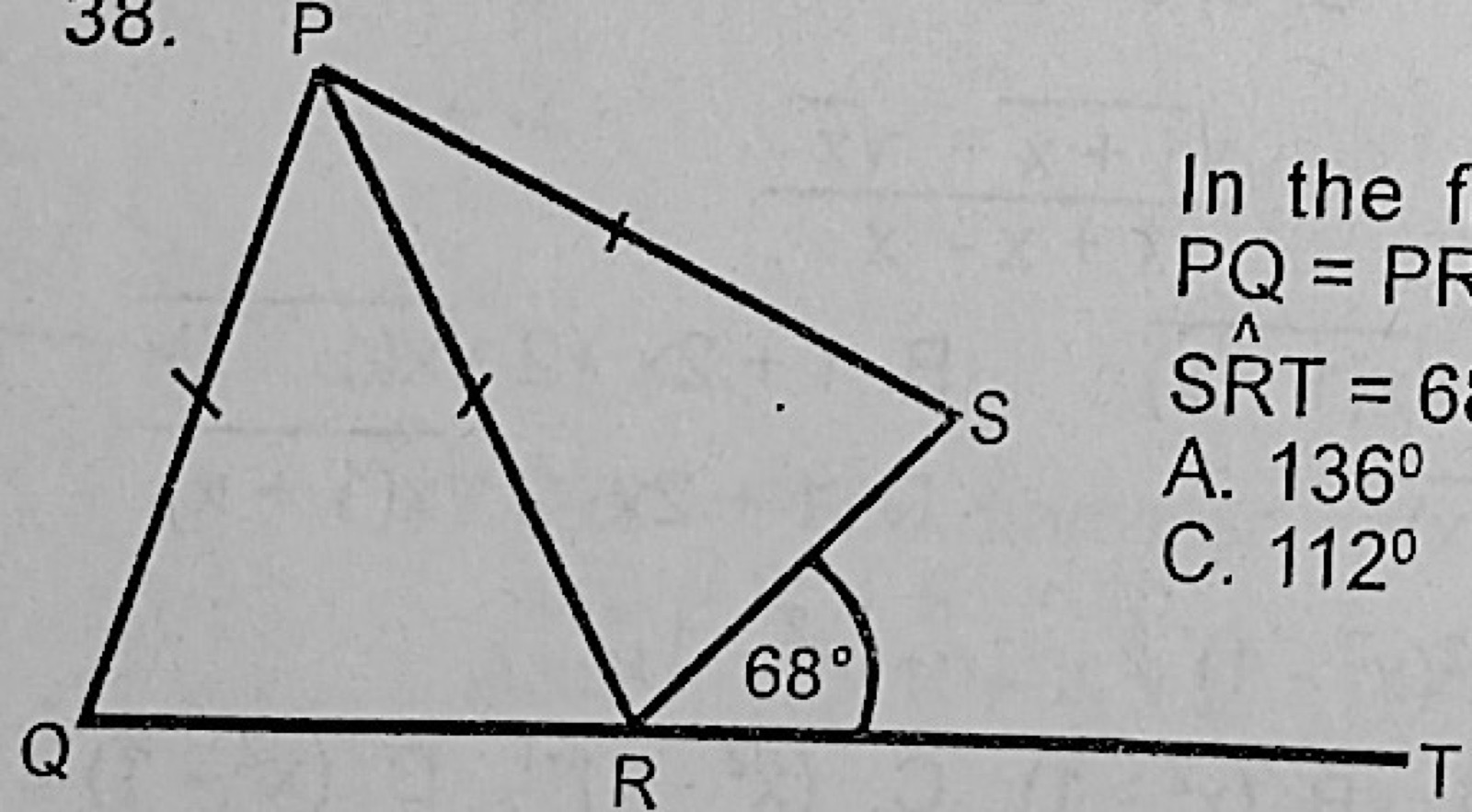
In the figure above, PQ = PR = PS and SR̂T = 68°, Find QP̂S.

Diagram for this question
  1. A.136°
  2. B.124°
  3. C.112°
  4. D.68°
Show the answer and explanation

Answer: A (136°)

Explanation

Angle QRS = 180° − 68° = 112°. Triangles PQR and PRS are isosceles, so angle QPR + angle RPS = (180° − 2 × PRQ) + (180° − 2 × PRS) = 360° − 2 × 112° = 136°.

Open this question

Question 39

Trigonometry

A flagstaff stands on the top of a vertical tower. A man standing 60m away from the tower observes that the angles of elevation of the top and bottom of the flagstaff are 64° and 62° respectively. Find the length of the flagstaff

  1. A.60(tan 62° − tan 64°)
  2. B.60(cot 64° − cot 62°)
  3. C.60(cot 62° − cot 64°)
  4. D.60(tan 64° − tan 62°)
Show the answer and explanation

Answer: D (60(tan 64° − tan 62°))

Explanation

The top of the flagstaff is 60 tan 64° high and its bottom (the top of the tower) is 60 tan 62° high. The flagstaff is the difference: 60(tan 64° − tan 62°).

Open this question

Question 40

Trigonometry

Simplify cos2 x(sec2x + sec2 x tan2x).

  1. A.Tan x
  2. B.Tan x sec x
  3. C.sec2 x
  4. D.Cosec2 x
Show the answer and explanation

Answer: C (sec2 x)

Explanation

cos2x × sec2x = 1, so the expression is 1 + tan2x = sec2x.

Open this question

Question 41

Trigonometry

If cos x = √(a/b), find cosec x.

  1. A.b/√(b − a)
  2. B.√(b/a)
  3. C.√(b/(b − a))
  4. D.√((b − a)/b)
Show the answer and explanation

Answer: C (√(b/(b − a)))

Explanation

sin2x = 1 − a/b = (b − a)/b, so sin x = √((b − a)/b) and cosec x = √(b/(b − a)).

Open this question

Question 42

Bearings

From a point Z, 60m north of X, a man walks 60√3m eastwards to another point Y. Find the bearing of Y from X.

  1. A.030°
  2. B.045°
  3. C.060°
  4. D.090°
Show the answer and explanation

Answer: C (060°)

Explanation

From X, Y is 60m north and 60√3m east. tan θ = 60√3/60 = √3 measured from north, so θ = 60° and the bearing is 060°.

Open this question

Question 43

Trigonometry

A surveyor walks 500m up a hill which slopes at an angle of 30°. Calculate the vertical height through which he rises.

  1. A.250m
  2. B.500√3/3 m
  3. C.250√2m
  4. D.250√3m
Show the answer and explanation

Answer: A (250m)

Explanation

Vertical height = 500 sin 30° = 500 × ½ = 250m.

Open this question

Question 44

Mensuration of Plane Shapes

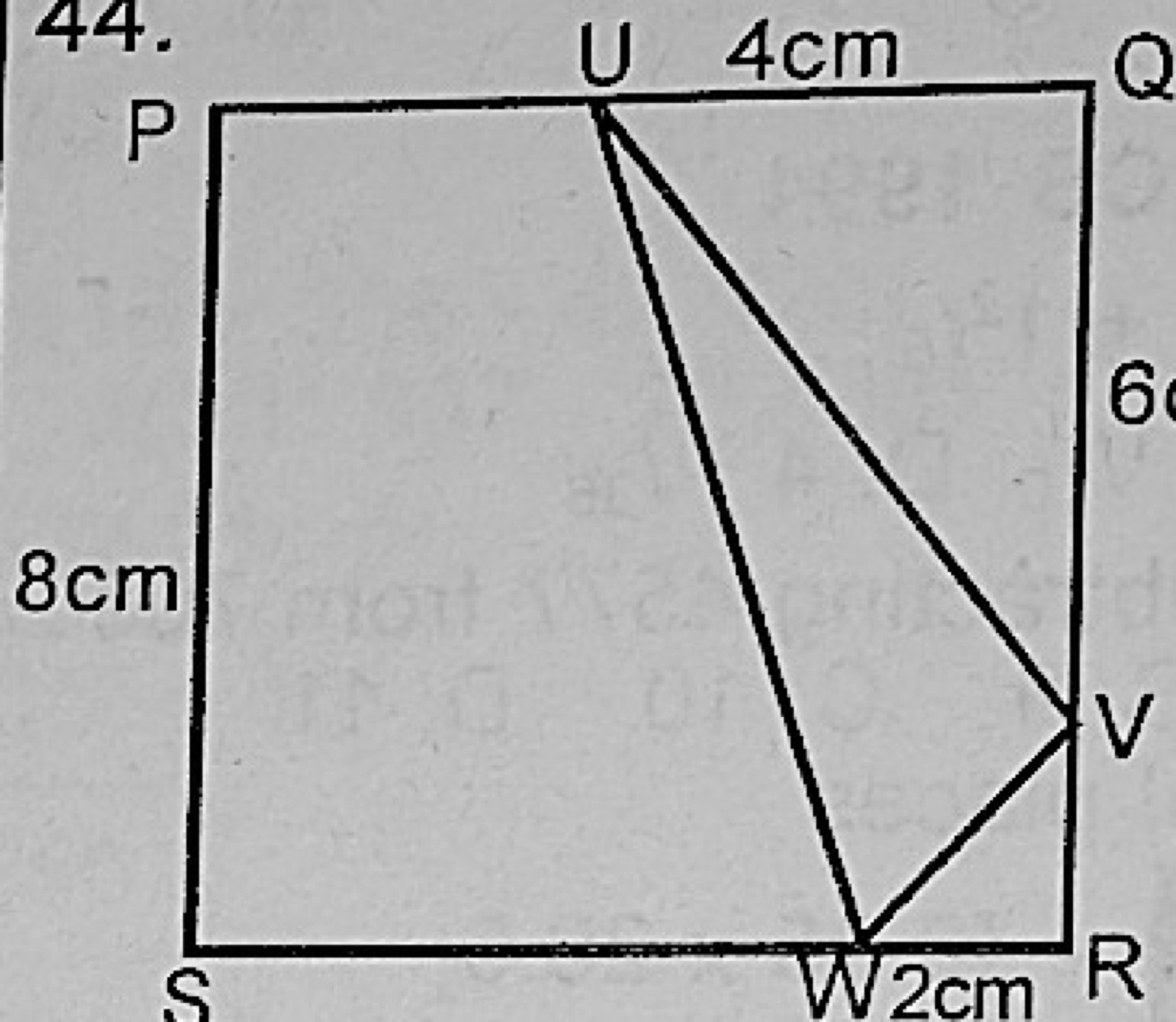
In the figure above, PQRS is a square of side 8cm. What is the area of ΔUVW?

Diagram for this question
  1. A.64sq. cm
  2. B.54sq. cm
  3. C.50sq. cm
  4. D.10sq. cm
Show the answer and explanation

Answer: D (10sq. cm)

Explanation

Take S as (0, 0): then U = (4, 8), V = (8, 2) and W = (6, 0). By the shoelace formula, area = ½|4(2 − 0) + 8(0 − 8) + 6(8 − 2)| = ½ × 20 = 10 sq. cm.

Open this question

Question 45

Mensuration of Solids

Find the total area of the surface of a solid cylinder whose base radius is 4cm and height is 5cm

  1. A.56πcm2
  2. B.72πcm2
  3. C.96πcm2
  4. D.192πcm2
Show the answer and explanation

Answer: B (72πcm2)

Explanation

Total surface = 2πr2 + 2πrh = 2π(16) + 2π(4)(5) = 32π + 40π = 72πcm2.

Open this question

Question 46

Mensuration of Solids

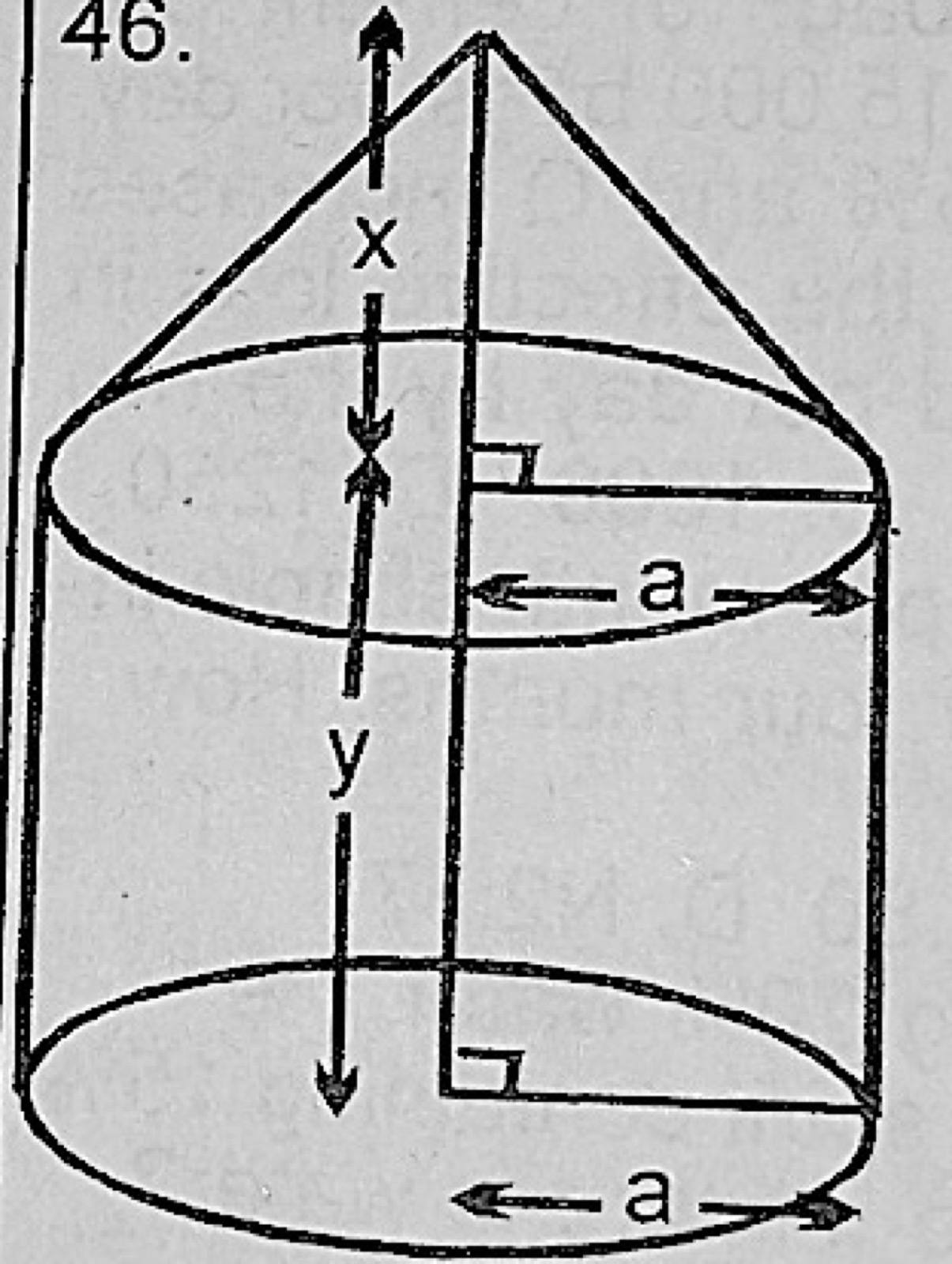
Find the volume of the figure above.

Diagram for this question
  1. A.(πa2/3)(x + 3y)
  2. B.πa2y
  3. C.(πa2/3)(y + x)
  4. D.(½πa2x + y)
Show the answer and explanation

Answer: A ((πa2/3)(x + 3y))

Explanation

The solid is a cylinder (radius a, height y) with a cone (radius a, height x) on top. Volume = πa2y + ⅓πa2x = (πa2/3)(x + 3y).

Open this question

Question 47

Data Presentation

3% of a family's income is spent on electricity, 58% on food, 20% on transport, 11% on education and 7% on extended family. The angles subtended at the centre of the pie chart under education and food are respectively

  1. A.76.8° and 25.2°
  2. B.10.8° and 224.6°
  3. C.112.4° and 72.0°
  4. D.39.6° and 212.4°
Show the answer and explanation

Answer: D (39.6° and 212.4°)

Explanation

Each 1% is 3.6°, so education gets 11 × 3.6° = 39.6°. Only option D has this angle; its 212.4° for food is 59% of 360°.

Open this question

Question 48

Measures of Central Tendency

Use the following information to answer questions 48 and 49.
Fifty boxes each of 50 bolts were inspected for the number which were defective. The following was the result
No. of defective per box: 4, 5, 6, 7, 8, 9
No. of boxes: 2, 7, 17, 10, 8, 6
The mean and the median of the distribution are respectively

  1. A.6.7, 6
  2. B.6.7, 6.5
  3. C.6, 6.7
  4. D.6.5, 6.7
Show the answer and explanation

Answer: A (6.7, 6)

Explanation

Σfx = 8 + 35 + 102 + 70 + 64 + 54 = 333 over 50 boxes, so the mean is 6.66 ≈ 6.7. The 25th and 26th boxes both have 6 defective (cumulative frequencies 2, 9, 26), so the median is 6.

Open this question

Question 49

Measures of Central Tendency

Use the following information to answer questions 48 and 49.
Fifty boxes each of 50 bolts were inspected for the number which were defective. The following was the result
No. of defective per box: 4, 5, 6, 7, 8, 9
No. of boxes: 2, 7, 17, 10, 8, 6
Find the percentage of boxes containing at least 5 defective each.

  1. A.96
  2. B.94
  3. C.92
  4. D.90
Show the answer and explanation

Answer: A (96)

Explanation

Only 2 boxes have fewer than 5 defective, so 48 of the 50 boxes have at least 5. 48/50 × 100 = 96%.

Open this question

Question 50

Probability

A crate of soft drinks contains 10 bottles of Coca-cola, 8 of Fanta and 6 of Sprite, if one bottle is selected at random, what is the probability that it is NOT a Coca-cola bottle?

  1. A.5/12
  2. B.1/3
  3. C.3/4
  4. D.7/12
Show the answer and explanation

Answer: D (7/12)

Explanation

There are 24 bottles and 14 are not Coca-cola, so the probability is 14/24 = 7/12.
Open this question