Home › Past questions › JAMB › Mathematics › 1990 50 questions. Try each one, then open the answer to check yourself and read the explanation.
Sign up free to answer these questions on a CBT screen with a timer, then see your score and every answer explained.
Start practising free
Question 1 Fractions, Decimals and Approximation Simplify (4¾ − 6¼)/(4⅕ of 1¼)
A. −7⅞ B. −2/7 C. −10/21 D. 10/21 Show the answer and explanation Answer: B (−2/7 )
Explanation The top is 4¾ − 6¼ = −3/2 and the bottom is 21/5 × 5/4 = 21/4. So −3/2 ÷ 21/4 = −3/2 × 4/21 = −2/7.
Open this question
Question 2 Algebraic Expressions The H.C.F of a2 bx + ab2 x and a2 b − b3 is
A. b B. a + b C. b(a + b) D. abx(a2 − b2 ) Show the answer and explanation Answer: C (b(a + b) )
Explanation a2 bx + ab2 x = abx(a + b) and a2 b − b3 = b(a − b)(a + b). The factors common to both are b and (a + b), so the H.C.F. is b(a + b).
Open this question
Question 3 Fractions, Decimals and Approximation Correct 241.34 (3 × 10⁻³ )2 to 4 significant figures
A. 0.0014 B. 0.001448 C. 0.0022 D. 0.002172 Show the answer and explanation Answer: D (0.002172 )
Explanation (3 × 10⁻³ )2 = 9 × 10⁻⁶ , and 241.34 × 9 × 10−6 = 0.00217206, which is 0.002172 to 4 significant figures.
Open this question
Question 4 Commercial Arithmetic At what rate would a sum of ₦100.00 deposited for 5 years raise an interest of ₦7.50?
A. 1½% B. 2½% C. 15% D. 25% Show the answer and explanation Answer: A (1½% )
Explanation Simple interest I = PRT/100, so 7.50 = 100 × R × 5/100 = 5R. Hence R = 1.5%.
Open this question
Question 5 Ratio, Percentages and Rates Three children shared a basket of mangoes in such a way that the first child took ¼ of the mangoes and the second ¾ of the remainder. What fraction of the mangoes did the third child take?
A. 3/16 B. 7/16 C. 9/16 D. 13/16 Show the answer and explanation Answer: A (3/16 )
Explanation After the first child, ¾ is left. The second takes ¾ of ¾ = 9/16, so the third gets ¾ − 9/16 = 3/16.
Open this question
Question 6 Fractions, Decimals and Approximation Simplify and express in standard form (0.00275 × 0.0064)/(0.025 × 0.08)
A. 8.8 × 10⁻¹ B. 8.8 × 10⁻² C. 8.8 × 10⁻³ D. 8.8 × 10³ Show the answer and explanation Answer: C (8.8 × 10⁻³ )
Explanation Top: 0.00275 × 0.0064 = 0.0000176. Bottom: 0.025 × 0.08 = 0.002. Dividing gives 0.0088 = 8.8 × 10⁻³ .
Open this question
Question 7 Commercial Arithmetic Three brothers in a business deal shared the profit. The first received ⅓ of the profit and the second ⅔ of the remainder. If the third received the remaining N12,000.00, how much profit did they share?
A. ₦60,000.00 B. ₦54,000.00 C. ₦48,000.00 D. ₦42,000.00 Show the answer and explanation Answer: B (₦54,000.00 )
Explanation After the first takes ⅓, ⅔ is left. The second takes ⅔ of ⅔ = 4/9, so the third gets ⅔ − 4/9 = 2/9 of the profit. 2/9 of the profit = ₦12,000, so the profit is ₦54,000.
Open this question
Question 8 Surds Simplify √(160r2 + √(71r4 + √(100r8 )))
A. 9r2 B. 12√3r C. 13r D. √13r Show the answer and explanation Answer: C (13r )
Explanation Work from the inside: √(100r8 ) = 10r4 , then √(71r4 + 10r4 ) = √(81r4 ) = 9r2 , then √(160r2 + 9r2 ) = √(169r2 ) = 13r.
Open this question
Question 9 Surds Simplify √27 + 3/√3
A. 4√3 B. 4/√3 C. 3√3 D. √3/4 Show the answer and explanation Answer: A (4√3 )
Explanation √27 = 3√3 and 3/√3 = √3, so the sum is 4√3.
Open this question
Question 10 Logarithms Simplify 3log6 9 + log6 12 + log6 64 − log6 72
A. 5 B. 7776 C. log6 31 D. (7776)6 Show the answer and explanation Answer: A (5 )
Explanation Combine the logs: log6 (93 × 12 × 64 ÷ 72) = log6 7776. Since 65 = 7776, the answer is 5.
Open this question
Question 11 Algebraic Expressions Simplify (1/x−1 ÷ 1/y−1 )−1
A. x/y B. xy C. y/x D. (xy)−1 Show the answer and explanation Answer: C (y/x )
Explanation 1/x−1 = x and 1/y−1 = y, so the bracket is x/y. Its reciprocal is y/x.
Open this question
Question 12 Algebraic Expressions If a = 2, b = −2 and c = −½, evaluate (ab2 − bc2 )(a2 c − abc)
A. 0 B. −28 C. −30 D. −34 Show the answer and explanation Answer: D (−34 )
Explanation ab2 − bc2 = 8 − (−½) = 8½ and a2 c − abc = −2 − 2 = −4. The product is 8½ × (−4) = −34.
Open this question
Question 13 Variation Y varies inversely as X2 and X varies directly as Z2 . Find the relationship between Y and Z, if C is a constant.
A. Z2 Y = C B. Y = CZ2 C. Y = CZ4 D. Z4 Y = C Show the answer and explanation Answer: D (Z4 Y = C )
Explanation Y = k/X2 and X = mZ2 , so Y = k/(m2 Z4 ). Hence Z4 Y is a constant: Z4 Y = C.
Open this question
Question 14 Algebraic Expressions Express r in terms of p and q in the following equation: p/√2 = √(r/(r + q))
A. r = p2 q/(2 − p2 ) B. r = pq2 /(2 − q2 ) C. r = p2 q2 /(2 − pq) D. r = p/(q(2 − p)) Show the answer and explanation Answer: A (r = p2 q/(2 − p2 ) )
Explanation Square both sides: p2 /2 = r/(r + q), so p2 r + p2 q = 2r. Then r(2 − p2 ) = p2 q, giving r = p2 q/(2 − p2 ).
Open this question
Question 15 Algebraic Expressions If f(x − 4) = x2 + 2x + 3, find f(2)
A. 6 B. 11 C. 27 D. 51 Show the answer and explanation Answer: D (51 )
Explanation f(2) means x − 4 = 2, so x = 6. Then 62 + 2(6) + 3 = 51.
Open this question
Question 16 Algebraic Expressions Factorize 9(x + y)2 − 4(x − y)2
A. (x + y)(5x + y) B. (x + y)2 C. (x + 5y)(5x + y) D. 5(x + y)2 Show the answer and explanation Answer: C ((x + 5y)(5x + y) )
Explanation It is a difference of two squares: [3(x + y) − 2(x − y)][3(x + y) + 2(x − y)] = (x + 5y)(5x + y).
Open this question
Question 17 Algebraic Expressions If a2 + b2 = 16 and 2ab = 7, find all the possible values of (a − b).
A. 3, −3 B. 2, −2 C. 1, −1 D. 3, −1 Show the answer and explanation Answer: A (3, −3 )
Explanation (a − b)2 = a2 + b2 − 2ab = 16 − 7 = 9. So a − b = 3 or −3.
Open this question
Question 18 Polynomials Divide x3 − 2x2 − 5x + 6 by (x − 1).
A. x2 − x − 6 B. x2 − 5x + 6 C. x2 − 7x + 6 D. x2 − 5x − 6 Show the answer and explanation Answer: A (x2 − x − 6 )
Explanation Long (or synthetic) division by x − 1 leaves no remainder and gives x2 − x − 6. Check: (x − 1)(x2 − x − 6) = x3 − 2x2 − 5x + 6.
Open this question
Question 19 Algebraic Expressions If x + 1/x = 4, find x2 + 1/x2
A. 16 B. 14 C. 12 D. 9 Show the answer and explanation Answer: B (14 )
Explanation Square x + 1/x = 4: x2 + 2 + 1/x2 = 16, so x2 + 1/x2 = 14.
Open this question
Question 20 Quadratic Equations What must be added to 4x2 − 4 to make it a perfect square?
A. −1/x2 B. 1/x2 C. 1 D. −1 Show the answer and explanation Answer: B (1/x2 )
Explanation (2x − 1/x)2 = 4x2 − 4 + 1/x2 . So adding 1/x2 to 4x2 − 4 makes a perfect square.
Open this question
Question 21 Quadratic Equations Find the solution of the equation x − 8√x + 15 = 0
A. 3, 5 B. −3, −5 C. 9, 25 D. −9, 25 Show the answer and explanation Answer: C (9, 25 )
Explanation Let u = √x: u2 − 8u + 15 = 0 gives u = 3 or 5. So x = 9 or 25.
Open this question
Question 22 Triangles and Quadrilaterals The lengths of the sides of a right-angled triangle are x cm, (3x − 1)cm and (3x + 1) cm. Find x.
A. 5 B. 7 C. 8 D. 12 Show the answer and explanation Answer: D (12 )
Explanation The longest side is 3x + 1, so (3x + 1)2 = x2 + (3x − 1)2 . This simplifies to 12x = x2 , so x = 12.
Open this question
Question 23 Quadratic Equations The perimeter of a rectangular lawn is 24m. If the area of the lawn is 35m3 , how wide is the lawn?
A. 5m B. 7m C. 12m D. 14m Show the answer and explanation Answer: A (5m )
Explanation Length + width = 12 and length × width = 35, so the sides are 7m and 5m. The width is the shorter side, 5m.
Open this question
Question 24 Algebraic Expressions A car painter charges N40.00 per day for himself and N10.00 per day for his assistant. If a fleet of cars were painted for N2,000.00 and the painter worked 10 days more than his assistant, how much did the assistant received?
A. N32.00 B. N320.00 C. N420.00 D. N1,680.00 Show the answer and explanation Answer: B (N320.00 )
Explanation If the assistant worked d days, 40(d + 10) + 10d = 2000, so 50d = 1600 and d = 32. The assistant received 32 × N10 = N320.
Open this question
Question 25 Algebraic Expressions Simplify x/(x + y) + y/(x − y) − x2 /(x2 − y2 )
A. x2 /(x2 − y2 ) B. y2 /(x2 − y2 ) C. x/(x2 − y2 ) D. y/(x2 − y2 ) Show the answer and explanation Answer: B (y2 /(x2 − y2 ) )
Explanation Over the common denominator x2 − y2 , the top is x(x − y) + y(x + y) − x2 = y2 . So the answer is y2 /(x2 − y2 ).
Open this question
Question 26 Algebraic Expressions Given that x2 + y2 + z2 = 194, calculate z if x = 7 and √y = 3.
A. √10 B. 8 C. 12.2 D. 13.4 Show the answer and explanation Answer: B (8 )
Explanation √y = 3 means y = 9. Then 49 + 81 + z2 = 194, so z2 = 64 and z = 8.
Open this question
Question 27 Progressions Find the sum of the first twenty terms of the arithmetic progression log a, log a2 , log a3 , .......
A. log a20 B. log a21 C. log a200 D. log a210 Show the answer and explanation Answer: D (log a210 )
Explanation The terms are log a, 2 log a, 3 log a, … so the sum is (1 + 2 + … + 20) log a = 210 log a = log a210 .
Open this question
Question 28 Progressions Find the sum of the first 18 terms of the progression 3, 6, 12,...
A. 3(217 − 1) B. 3(218 ) − 1 C. 3(218 + 1) D. 3(218 − 1) Show the answer and explanation Answer: D (3(218 − 1) )
Explanation This is a G.P. with a = 3 and r = 2, so S18 = 3(218 − 1)/(2 − 1) = 3(218 − 1).
Open this question
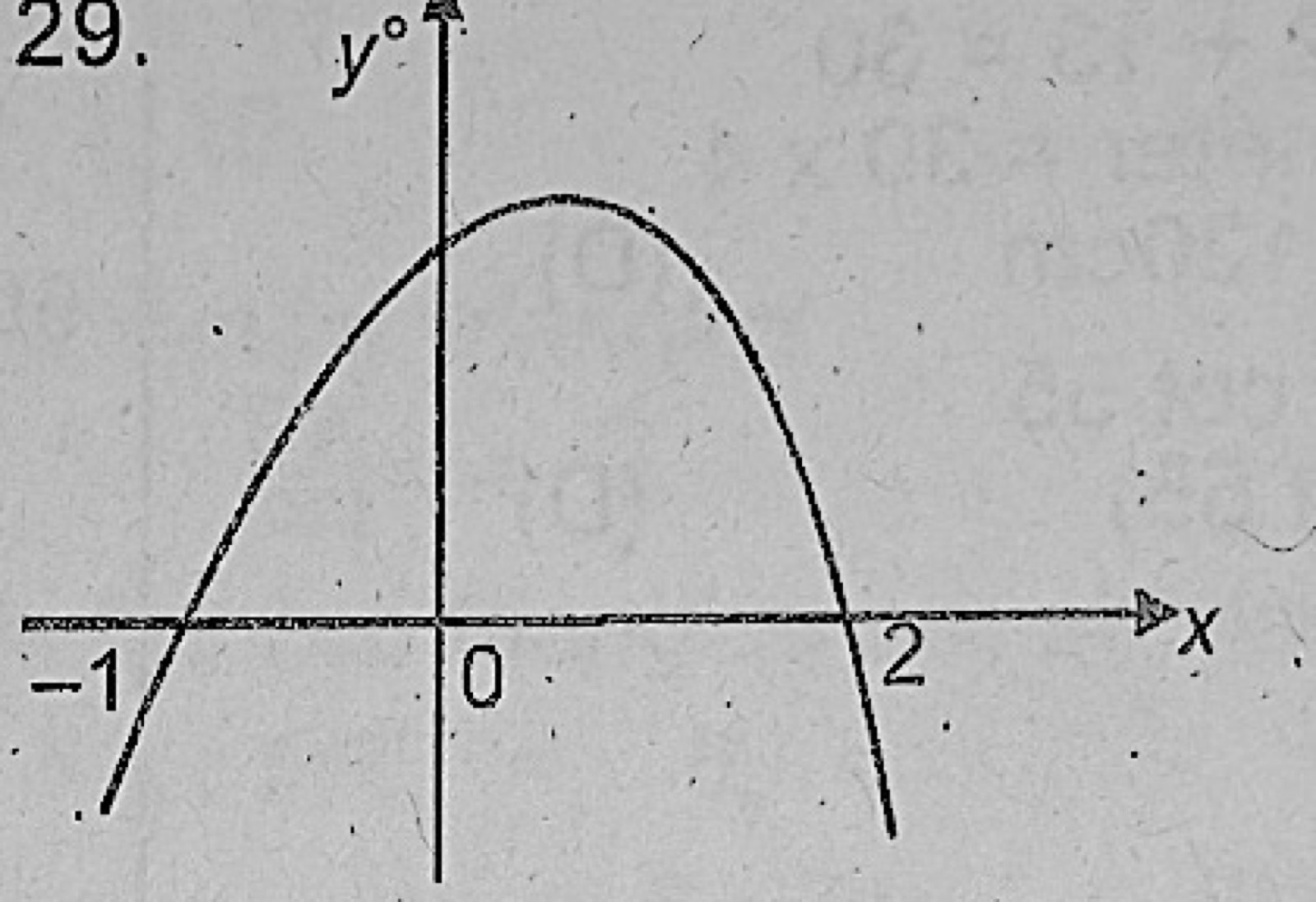
Question 29 Graphs of Functions What is the equation of the quadratic function represented by the graph above?
A. y = x2 + x − 2 B. y = x2 − x − 2 C. y = −x2 − x + 2 D. y = −x2 + x + 2 Show the answer and explanation Answer: D (y = −x2 + x + 2 )
Explanation The curve cuts the x-axis at −1 and 2 and opens downwards, so y = −(x + 1)(x − 2) = −x2 + x + 2.
Open this question
Question 30 Differentiation At what value of x is the function x2 + x + 1 minimum?
A. −1 B. −½ C. ½ D. 1 Show the answer and explanation Answer: B (−½ )
Explanation dy/dx = 2x + 1 = 0 gives x = −½, and the curve opens upwards, so this is the minimum.
Open this question
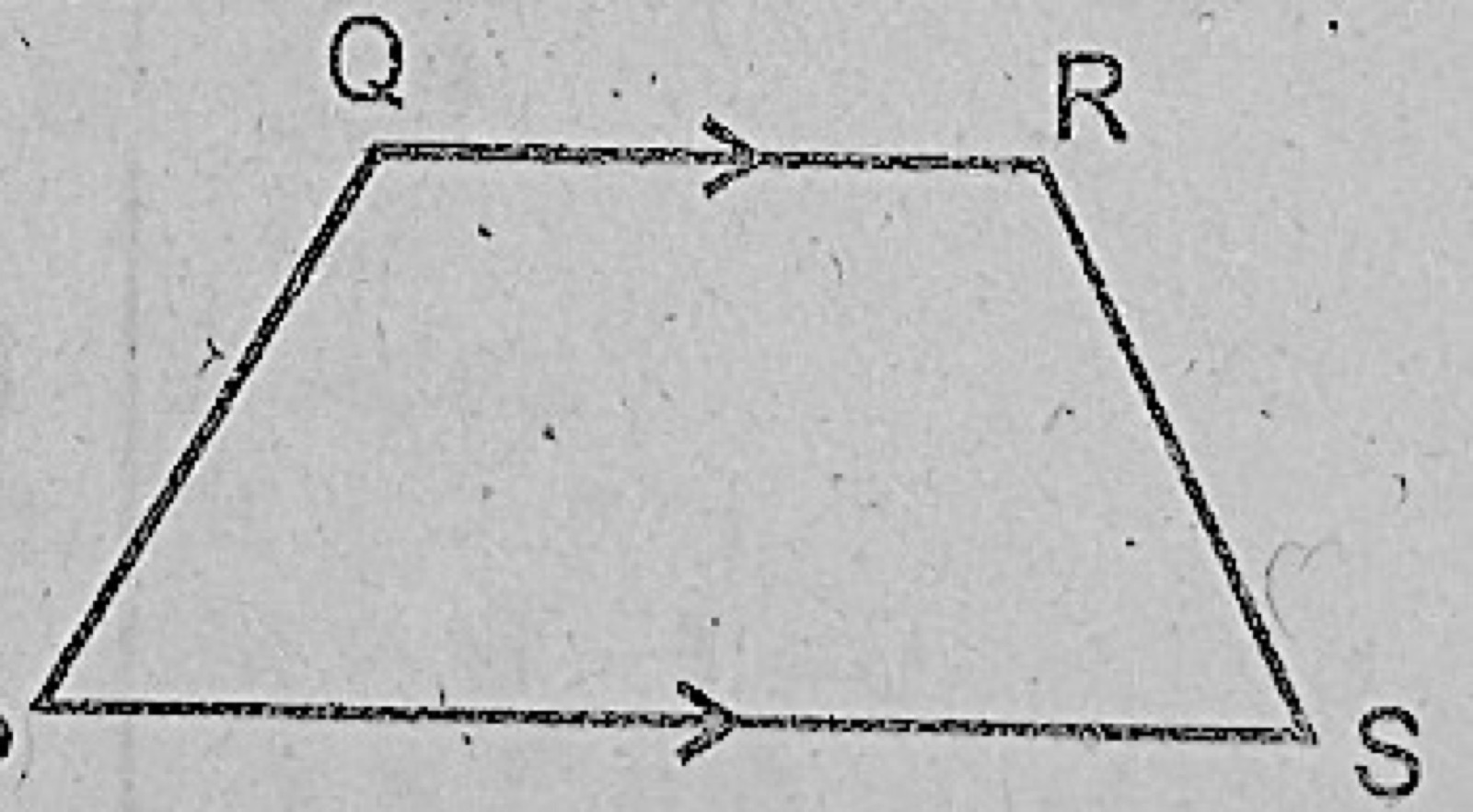
Question 31 Mensuration of Plane Shapes In the diagram above, the area of PQRS is 73.5cm2 and its height is 10.5cm. Find the length of PS if QR is one-third of PS.
A. 21cm B. 17½cm C. 14cm D. 10½cm Show the answer and explanation Answer: D (10½cm )
Explanation Let PS = x, so QR = x/3. Area = ½(x + x/3) × 10.5 = 7x = 73.5, so x = 10.5cm.
Open this question
Question 32 Mensuration of Plane Shapes The angle of a sector of a circle, radius 10.5cm, is 48°. Calculate the perimeter of the sector
A. 8.8cm B. 25.4cm C. 25.6cm D. 29.8cm Show the answer and explanation Answer: D (29.8cm )
Explanation Arc length = 48/360 × 2 × 22/7 × 10.5 = 8.8cm. Perimeter = arc + two radii = 8.8 + 21 = 29.8cm.
Open this question
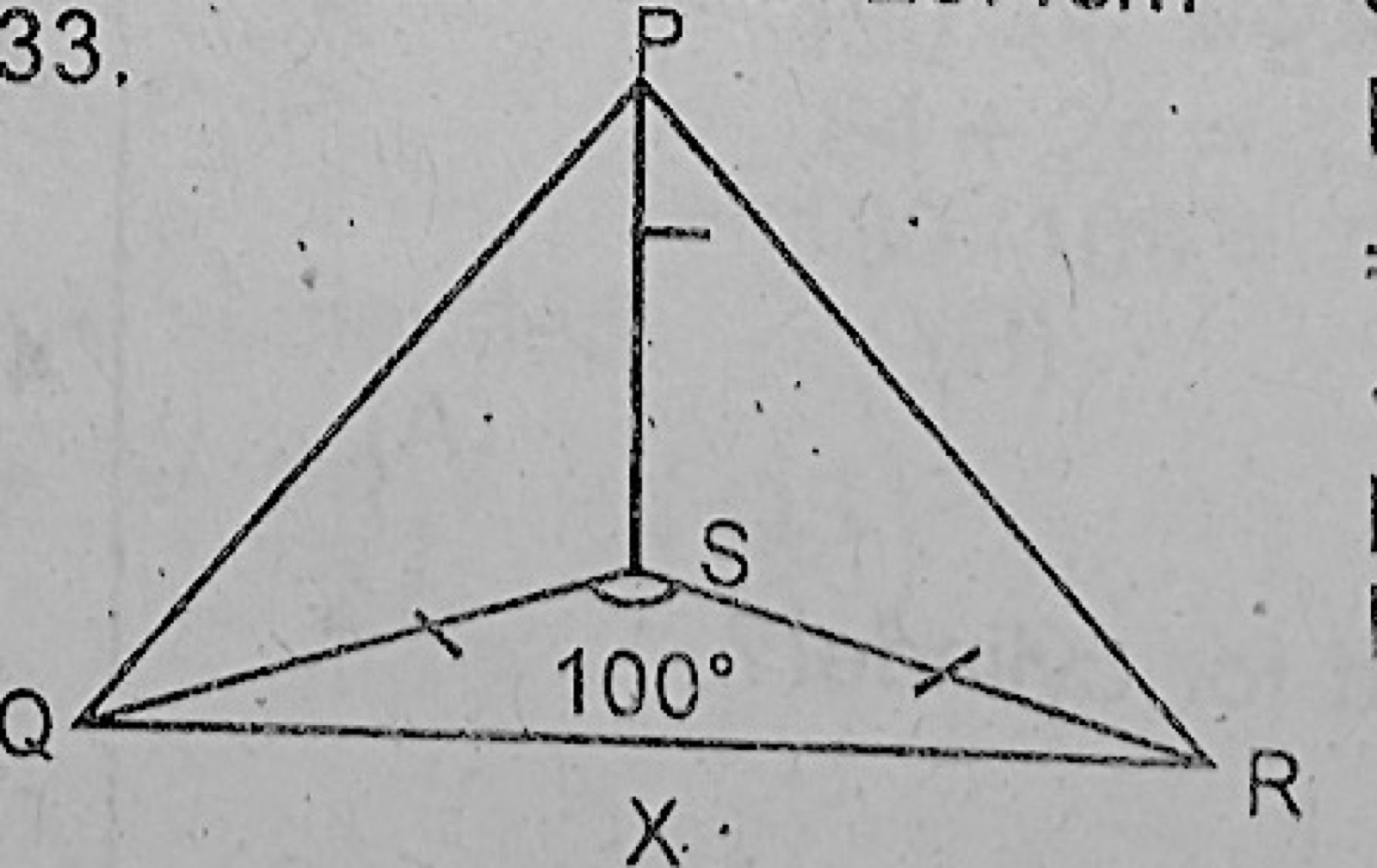
Question 33 Triangles and Quadrilaterals In the figure above, PS = QS = RS and QŜR = 100°, find QP̂R.
A. 40° B. 50° C. 80° D. 100° Show the answer and explanation Answer: B (50° )
Explanation S is the same distance from P, Q and R, so it is the centre of a circle through them. The angle QSR at the centre is twice the angle QPR at the circumference, so QPR = 50°.
Open this question
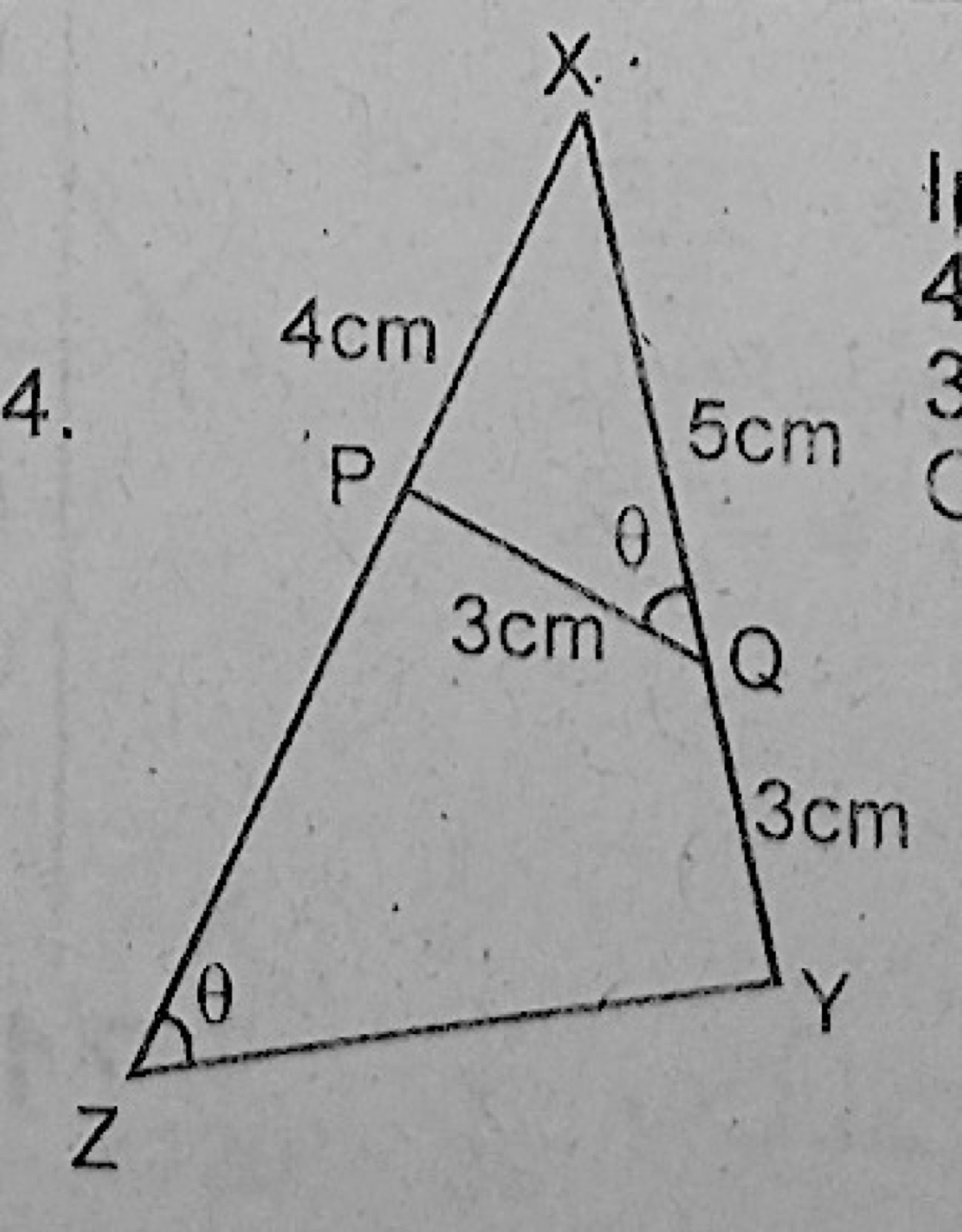
Question 34 Triangles and Quadrilaterals In triangle XYZ and XQP, XP = 4cm, XQ = 5cm and PQ = QY = 3cm. Find ZY
A. 8cm B. 6cm C. 4cm D. 3cm Show the answer and explanation Answer: B (6cm )
Explanation Triangles XPQ and XZY are similar, with XY = 5 + 3 = 8cm matching XP = 4cm. So ZY/PQ = 8/4, giving ZY = 2 × 3 = 6cm.
Open this question
Question 35 Triangles and Quadrilaterals Find the length of a side of a rhombus whose diagonals are 6cm and 8cm.
A. 8cm B. 5cm C. 4cm D. 3cm Show the answer and explanation Answer: B (5cm )
Explanation The diagonals of a rhombus bisect each other at right angles, giving a right triangle with legs 3cm and 4cm. The side is √(32 + 42 ) = 5cm.
Open this question
Question 36 Angles and Polygons Each of the interior angles of a regular polygon is 140°. How many sides has the polygon?
A. 9 B. 8 C. 7 D. 5 Show the answer and explanation Answer: A (9 )
Explanation Each exterior angle is 180° − 140° = 40°. The exterior angles add up to 360°, so there are 360 ÷ 40 = 9 sides.
Open this question
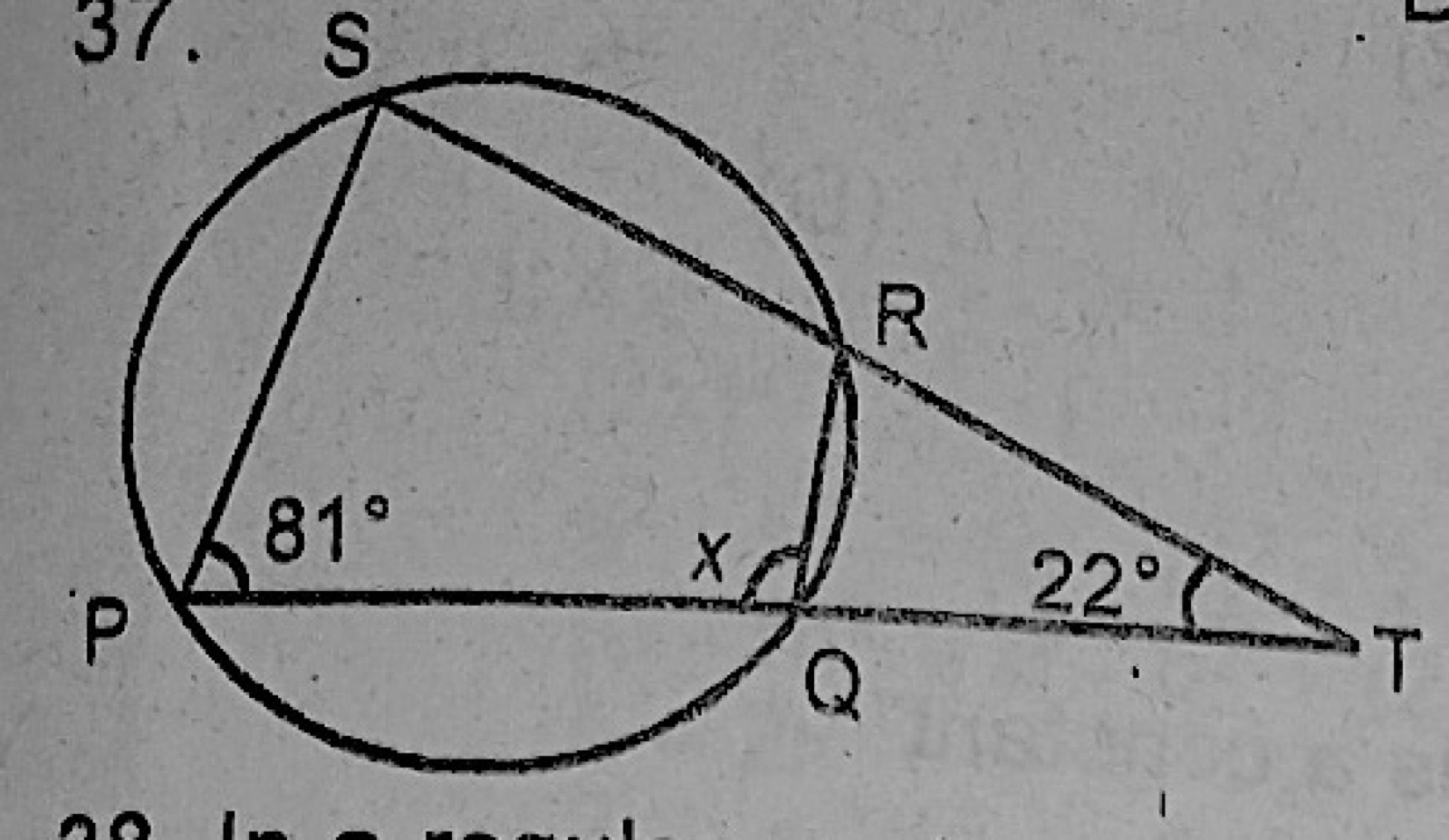
Question 37 Circle Theorems In the figure above, PQRS is a circle. If PQT and SRT are straight lines, find the value of x.
A. 59° B. 77° C. 103° D. 121° Show the answer and explanation Answer: C (103° )
Explanation In triangle PST, angle S = 180° − 81° − 22° = 77°. PQRS is cyclic, so x (angle PQR) = 180° − 77° = 103°.
Open this question
Question 38 Angles and Polygons In a regular pentagon, PQRST, PR intersects QS at O. Calculate RÔS.
A. 36° B. 72° C. 108° D. 144° Show the answer and explanation Answer: B (72° )
Explanation Each interior angle is 108°, and the diagonals make 36° angles with the sides, so in triangle QOR the angles at Q and R are 36° each and angle QOR = 108°. RÔS is on a straight line with QOR, so it is 180° − 108° = 72°.
Open this question
Question 39 Trigonometry If cos θ = 12/13, find 1 + cot2 θ
A. 169/25 B. 25/169 C. 169/144 D. 144/169 Show the answer and explanation Answer: A (169/25 )
Explanation With cos θ = 12/13, the opposite side is 5, so sin θ = 5/13. 1 + cot2 θ = cosec2 θ = (13/5)2 = 169/25.
Open this question
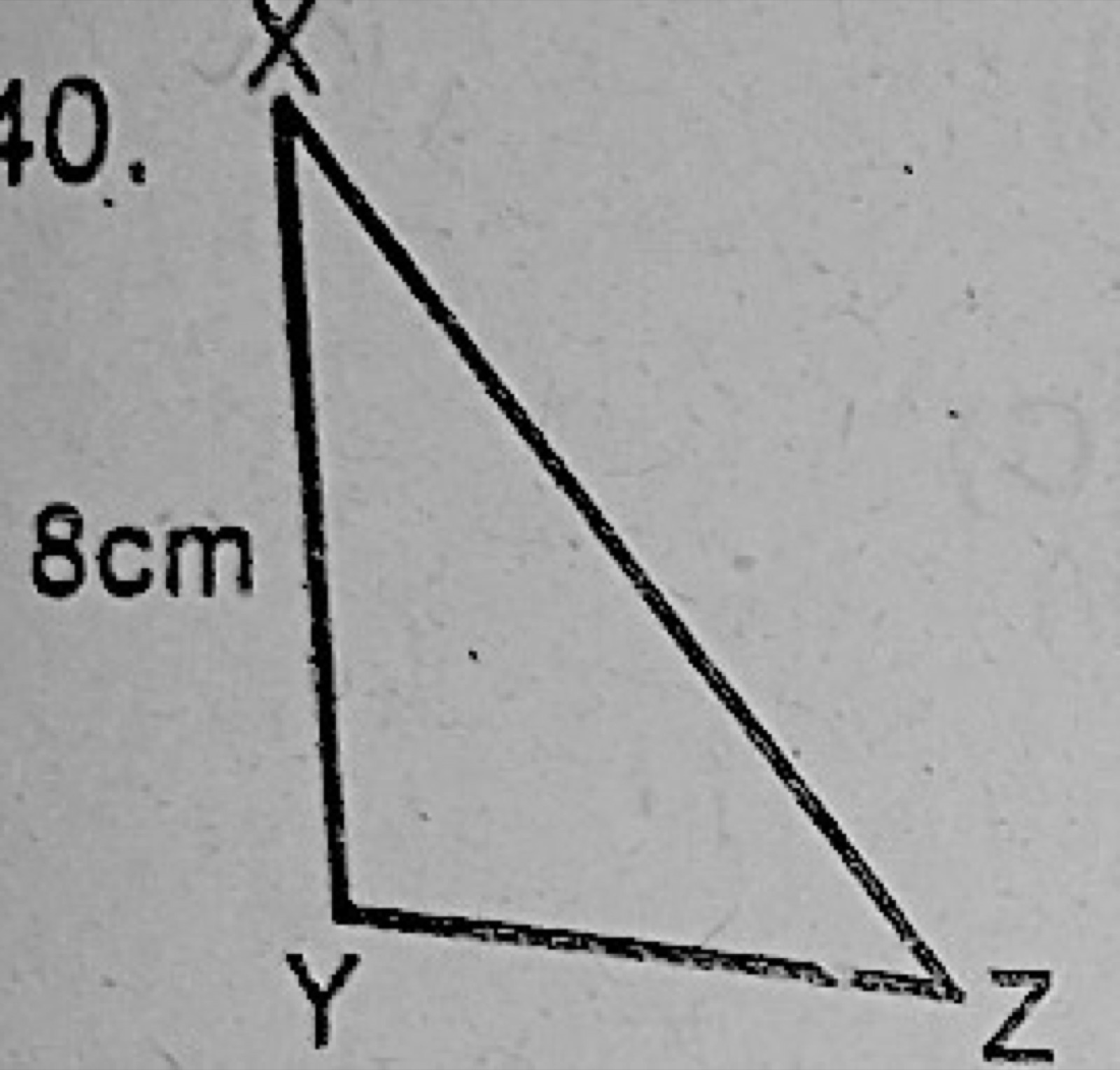
Question 40 Trigonometry In the figure above, YX̂Z = 30°, XŶZ = 105° and XY = 8cm. Calculate YZ.
A. 16√2cm B. 8√2cm C. 4√2cm D. 2√2cm Show the answer and explanation Answer: C (4√2cm )
Explanation Angle Z = 180° − 30° − 105° = 45°. By the sine rule, YZ/sin 30° = 8/sin 45°, so YZ = 8 × ½ ÷ (√2/2) = 4√2cm.
Open this question
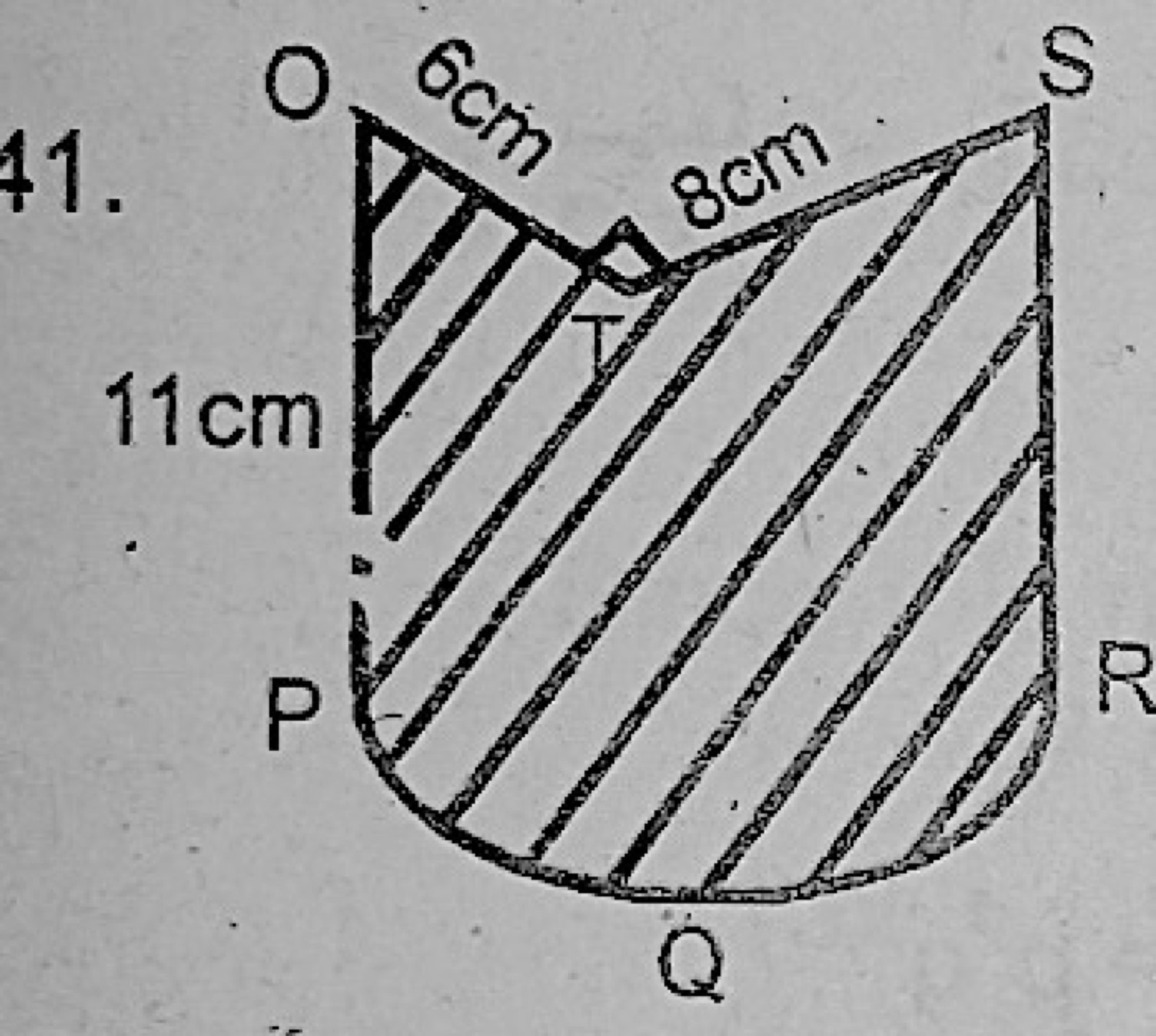
Question 41 Mensuration of Plane Shapes In the figure above, PQR is a semicircle. Calculate the area of the shaded region.
A. 125 2/7cm2 B. 149 2/7cm2 C. 243 1/7cm2 D. 267 1/2cm2 Show the answer and explanation Answer: A (125 2/7cm2 )
Explanation OS = √(62 + 82 ) = 10cm, which is also the diameter PR. Shaded area = rectangle 11 × 10 + semicircle ½ × 22/7 × 52 − triangle ½ × 6 × 8 = 110 + 39 2/7 − 24 = 125 2/7cm2 .
Open this question
Question 42 Mensuration of Solids A cylindrical pipe, made of metal, is 3cm thick, if the internal radius of the pipe is 10cm, find the volume of metal used in making 3m of the pipe.
A. 153πcm3 B. 207πcm3 C. 15,300πcm3 D. 20,700πcm3 Show the answer and explanation Answer: D (20,700πcm3 )
Explanation The outer radius is 13cm and the length is 300cm. Volume of metal = π(132 − 102 ) × 300 = 69 × 300π = 20,700πcm3 .
Open this question
Question 43 Mensuration of Solids If the heights of two circular cylinders are in the ratio 2 : 3 and their base radii are in the ratio 9 : 8, what is the ratio of their volumes?
A. 27 : 32 B. 27 : 23 C. 23 : 32 D. 21 : 27 Show the answer and explanation Answer: A (27 : 32 )
Explanation Volume is πr2 h, so the ratio is (92 × 2) : (82 × 3) = 162 : 192 = 27 : 32.
Open this question
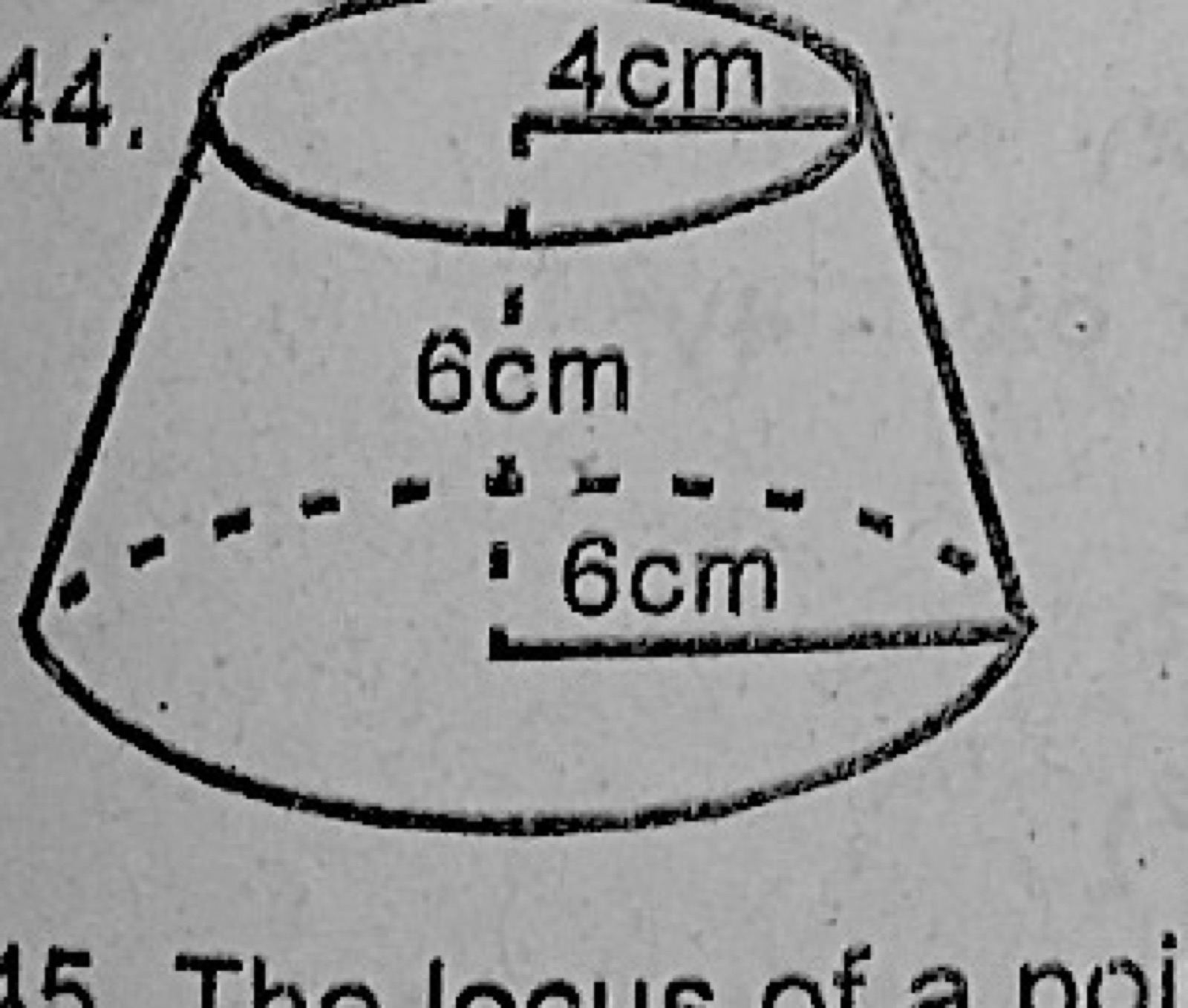
Question 44 Mensuration of Solids Find the curved surface area of the frustrum in the figure above.
A. 16π√10cm2 B. 20π√10cm2 C. 24π√10cm2 D. 36π√10cm2 Show the answer and explanation Answer: B (20π√10cm2 )
Explanation The radii are 4cm and 6cm and the height is 6cm, so the slant height is √(62 + 22 ) = 2√10cm. Curved surface = π(4 + 6) × 2√10 = 20π√10cm2 .
Open this question
Question 45 Loci The locus of a point which moves so that it is equidistant from two intersecting straight lines is the
A. perpendicular bisector of the two lines B. angle bisector of the two lines C. bisector of the two lines D. line parallel to the two lines Show the answer and explanation Answer: B (angle bisector of the two lines )
Explanation Points the same distance from two crossing lines lie on the lines that bisect the angles between them.
Open this question
Question 46 Data Presentation 4, 16, 30, 20, 10, 14 and 26 are represented on a pie chart. Find the sum of the angles of the sectors representing all numbers equal to or greater than 16
A. 48° B. 84° C. 92° D. 276° Show the answer and explanation Answer: D (276° )
Explanation The total is 120. The numbers 16 or more are 16, 30, 20 and 26, which add up to 92. Their angles add up to 92/120 × 360° = 276°.
Open this question
Question 47 Measures of Central Tendency The mean of 10 positive numbers is 16. When another number is added, the mean becomes 18. Find the eleventh number
A. 3 B. 16 C. 18 D. 38 Show the answer and explanation Answer: D (38 )
Explanation The first 10 numbers add up to 160. The 11 numbers add up to 11 × 18 = 198, so the new number is 198 − 160 = 38.
Open this question
Question 48 Measures of Central Tendency Below are the scores of a group of students in a test.
A. 1 B. 2 C. 3 D. 4 Show the answer and explanation Answer: B (2 )
Explanation Total score = 1 + 8 + 15 + 24 + 5x + 12 = 60 + 5x and the number of students is 18 + x. (60 + 5x)/(18 + x) = 3.5 gives 1.5x = 3, so x = 2.
Open this question
Question 49 Probability Two numbers are removed at random from the numbers 1, 2, 3 and 4. What is the probability that the sum of the numbers removed is even?
A. ⅔ B. ½ C. ⅓ D. ¼ Show the answer and explanation Answer: C (⅓ )
Explanation There are 6 possible pairs. Only 1 + 3 and 2 + 4 give even sums, so the probability is 2/6 = ⅓.
Open this question
Question 50 Probability Find the probability that a number selected at random from 41 to 56 is a multiple of 9
A. ⅛ B. 2/15 C. 3/16 D. ⅞ Show the answer and explanation Answer: A (⅛ )
Explanation There are 16 numbers from 41 to 56, and only 45 and 54 are multiples of 9. Probability = 2/16 = ⅛.
Open this question Sign up free for every JAMB Mathematics year, practice by topic and timed mocks.
Start practising free