JAMB Mathematics 1983 past questions and answers

48 questions. Try each one, then open the answer to check yourself and read the explanation.

Question 1

Measures of Central Tendency

If M represents the median and D the mode of the measurements 5,9,3,5,8 then (M, D) is

  1. A.(6,5)
  2. B.(5,8)
  3. C.(5,7)
  4. D.(5,5)
  5. E.(7,5).
Show the answer and explanation

Answer: D ((5,5))

Explanation

In order the numbers are 3, 5, 5, 8, 9. The middle one is 5 (median) and 5 also occurs most often (mode).

Open this question

Question 2

Commercial Arithmetic

A construction company is owned by two partners X and Y and it is agreed that their profit will be divided in the ratio 4:5. At the end of the year, Y received ₦5,000 more than X. What is the total profit of the company for the year?

  1. A.₦20,000
  2. B.₦25,000
  3. C.₦30,000
  4. D.₦15,000
  5. E.₦45,000.
Show the answer and explanation

Answer: E (₦45,000.)

Explanation

Y gets 1 part more than X, so 1 part = ₦5,000. The total is 4 + 5 = 9 parts = ₦45,000.

Open this question

Question 3

Angles and Polygons

Given a regular hexagon, calculate each interior angle of the hexagon.

  1. A.60°
  2. B.30°
  3. C.120°
  4. D.45°
  5. E.135°
Show the answer and explanation

Answer: C (120°)

Explanation

The interior angles of a hexagon add up to (6 − 2) × 180° = 720°, so each is 720° ÷ 6 = 120°.

Open this question

Question 4

Linear and Simultaneous Equations

Solve the following equations
4x − 3 = 3x + y = 2y + 5x − 12

  1. A.x = 5, y = 2
  2. B.x = 2, y = 5
  3. C.x = −2, y = −5
  4. D.x = 5, y = −2
  5. E.x = −5, y = −2.
Show the answer and explanation

Answer: A (x = 5, y = 2)

Explanation

4x − 3 = 3x + y gives x − y = 3. 3x + y = 2y + 5x − 12 gives 2x + y = 12. Adding: 3x = 15, so x = 5 and y = 2.

Open this question

Question 5

Polynomials

If x = 1 is a root of the equation x3 − 2x2 − 5x + 6, find the other roots.

  1. A.−3 and 2
  2. B.−2 and 2
  3. C.3 and −2
  4. D.1 and 3
  5. E.−3 and 1.
Show the answer and explanation

Answer: C (3 and −2)

Explanation

Dividing by x − 1 gives x² − x − 6 = (x − 3)(x + 2), so the other roots are 3 and −2.

Open this question

Question 6

Variation

If x is jointly proportional to the cube of y and the fourth power of z. In what ratio is x increased or decreased when y is halved and z is doubled?

  1. A.4:1 increase
  2. B.2:1 increase
  3. C.1:4 decrease
  4. D.1:1 no change
  5. E.3:4 decrease.
Show the answer and explanation

Answer: B (2:1 increase)

Explanation

x = ky³z⁴. Halving y multiplies x by (½)³ = 1/8 and doubling z multiplies it by 2⁴ = 16, so x is multiplied by 2: an increase in the ratio 2:1.

Open this question

Question 7

Trigonometry

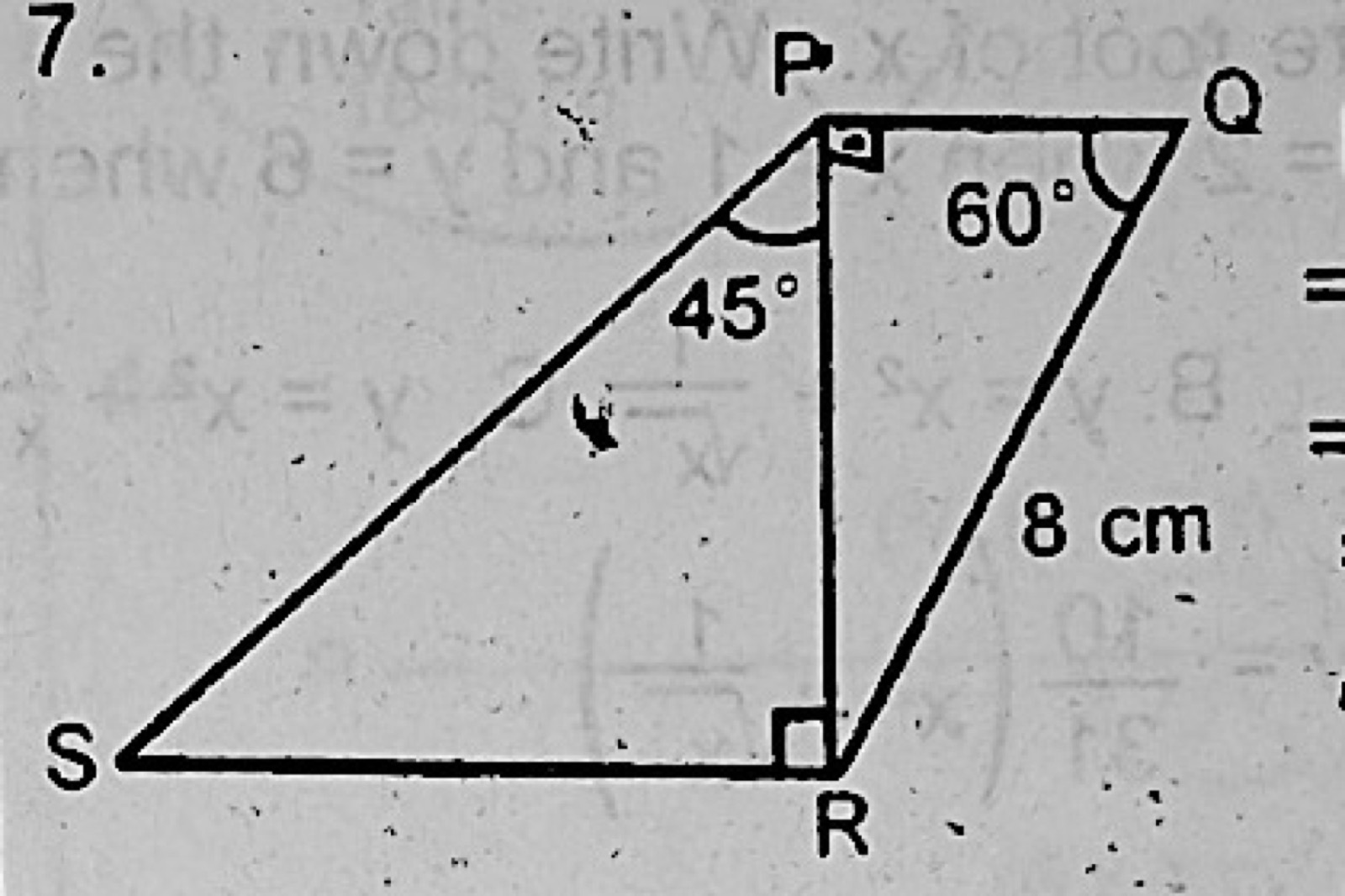
In the above figure PQR = 60°, QPR = 90°, PRS = 90°, RPS = 45°, QR = 8cm. Determine PS.

Diagram for this question
  1. A.2√3cm
  2. B.4√6cm
  3. C.2√6cm
  4. D.8√6cm
  5. E.8cm.
Show the answer and explanation

Answer: B (4√6cm)

Explanation

In triangle PQR, PR = 8 sin 60° = 4√3cm. In triangle PRS, cos 45° = PR/PS, so PS = 4√3 × √2 = 4√6cm.

Open this question

Question 8

Trigonometry

Given that cos z = L, where z is an acute angle, find an expression for (cot z − cosec z)/(sec z + tan z)

  1. A.(1 − L)/(1 + L)
  2. B.(L2 − √(1 − L2))/(L2 + L − 1)
  3. C.−L√(1 − L)/(√(1 + L)(1 + √(1 − L2)))
  4. D.√(L − 1)/(√(1 − L2) + 1 − L2)
  5. E.L(L − 1)/(1 + √(1 − L2) − L2)
Show the answer and explanation

Answer: E (L(L − 1)/(1 + √(1 − L2) − L2))

Explanation

With sin z = √(1 − L²): cot z − cosec z = (L − 1)/sin z and sec z + tan z = (1 + sin z)/L. Dividing gives L(L − 1)/(sin z + sin²z) = L(L − 1)/(√(1 − L²) + 1 − L²).

Open this question

Question 9

Fractions, Decimals and Approximation

If 0.0000152 × 0.00042 = A × 10B, where 1 ≤ A < 10, find A and B.

  1. A.A = 9, B = 6.38
  2. B.A = 6.38, B = −9
  3. C.A = 6.38, B = 9
  4. D.A = 6.38, B = −1
  5. E.A = 6.38, B = 1.
Show the answer and explanation

Answer: B (A = 6.38, B = −9)

Explanation

1.52 × 10⁻⁵ × 4.2 × 10⁻⁴ = 6.384 × 10⁻⁹, so A ≈ 6.38 and B = −9.

Open this question

Question 10

Polynomials

If x + 2 and x − 1 are factors of the expressions lx3 + 2kx2 + 24, find the values of l and k.

  1. A.l = −6, k = −9
  2. B.l = −2, k = 1
  3. C.l = −2, k = −1
  4. D.l = 0, k = 1
  5. E.l = 6, k = 0.
Show the answer and explanation

Answer: A (l = −6, k = −9)

Explanation

Putting x = −2 gives −8l + 8k + 24 = 0, i.e. k − l = −3. Putting x = 1 gives l + 2k + 24 = 0. Solving: k = −9 and l = −6.

Open this question

Question 12

Data Presentation

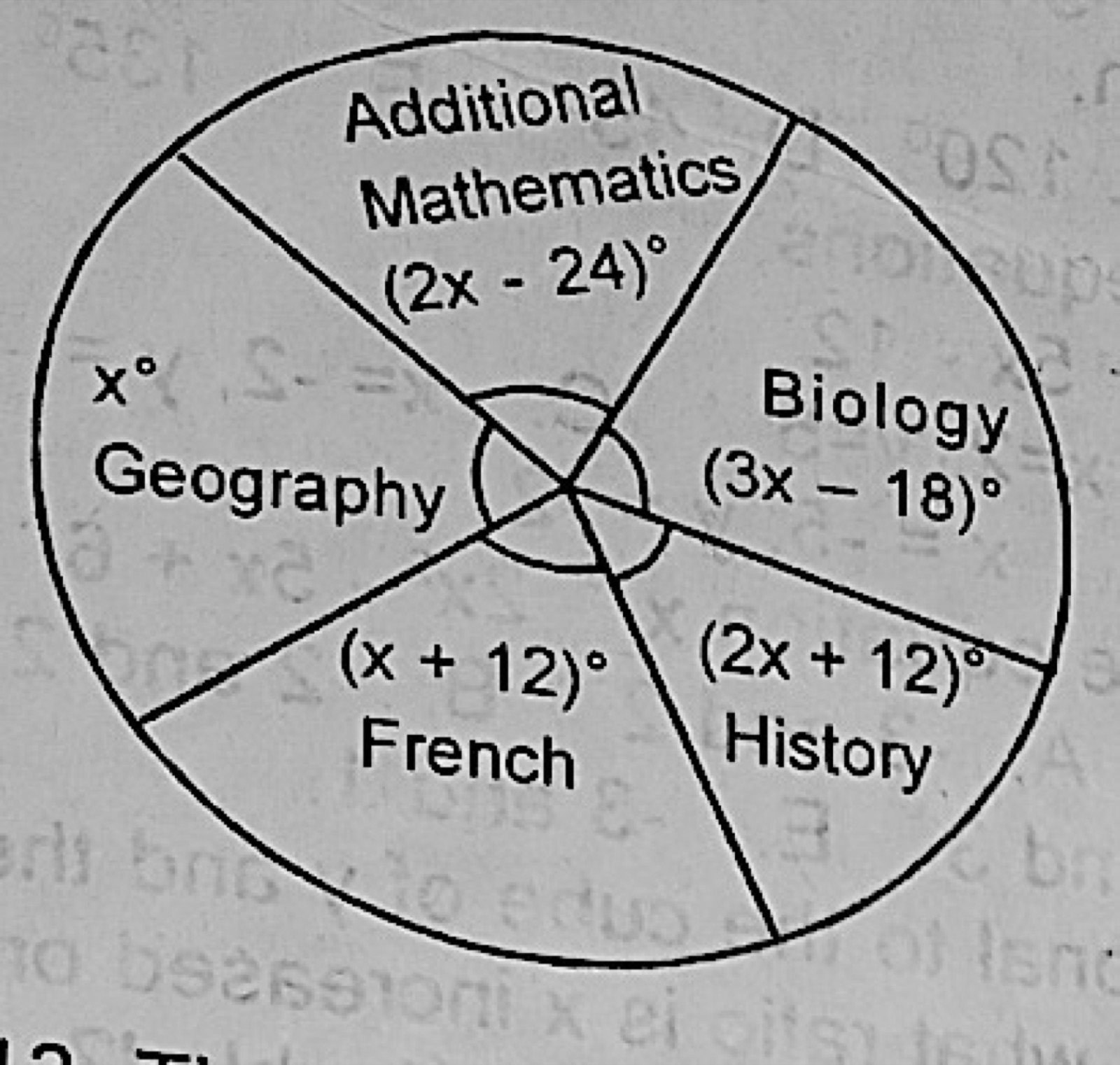
In a class of 60 pupils, the statistical distribution of the number of pupils offering Biology, History, French, Geography and Additional Mathematics is as shown in the pie chart above. How many pupils offer Additional Mathematics?

Diagram for this question
  1. A.15
  2. B.10
  3. C.18
  4. D.12
  5. E.28.
Show the answer and explanation

Answer: B (10)

Explanation

The angles add to 360°: (2x − 24) + (3x − 18) + (2x + 12) + (x + 12) + x = 9x − 18 = 360, so x = 42. Additional Mathematics has 60°, i.e. 60/360 × 60 = 10 pupils.

Open this question

Question 13

Fractions, Decimals and Approximation

The value of (0.03)3 − (0.02)3 is

  1. A.0.019
  2. B.0.0019
  3. C.0.00019
  4. D.0.000019
  5. E.0.000035.
Show the answer and explanation

Answer: D (0.000019)

Explanation

0.03³ = 0.000027 and 0.02³ = 0.000008, so the difference is 0.000019.

Open this question

Question 14

Variation

y varies partly as the square of x and partly as the inverse of the square root of x. Write down the expression for y if y = 2 when x = 1 and y = 6 when x = 4.

  1. A.y = 10x2/31 + 52/(31√x)
  2. B.y = x2 + 1/√x
  3. C.y = x2 + 1/x
  4. D.y = x2/31 + 1/(31√x)
  5. E.y = 10/31 (x2 + 1/√x)
Show the answer and explanation

Answer: A (y = 10x2/31 + 52/(31√x))

Explanation

y = ax² + b/√x. x = 1 gives a + b = 2; x = 4 gives 16a + b/2 = 6, i.e. 32a + b = 12. Subtracting: 31a = 10, so a = 10/31 and b = 52/31.

Open this question

Question 15

Algebraic Expressions

Simplify (x − 7)/(x2 − 9) × (x2 − 3x)/(x2 − 49)

  1. A.x/((x − 3)(x + 7))
  2. B.(x + 3)(x + 7)/x
  3. C.x/((x − 3)(x − 7))
  4. D.x/((x + 3)(x + 7))
  5. E.x/((x + 4)(x − 7))
Show the answer and explanation

Answer: D (x/((x + 3)(x + 7)))

Explanation

Factorise: (x − 7)/((x − 3)(x + 3)) × x(x − 3)/((x − 7)(x + 7)). Cancelling (x − 7) and (x − 3) leaves x/((x + 3)(x + 7)).

Open this question

Question 16

Triangles and Quadrilaterals

The length of the sides of a right-angled triangle are (3x + 1)cm, (3x − 1)cm and x cm. Find x

  1. A.2
  2. B.6
  3. C.18
  4. D.12
  5. E.0.
Show the answer and explanation

Answer: D (12)

Explanation

The hypotenuse is 3x + 1, so x² = (3x + 1)² − (3x − 1)² = 12x. Hence x = 12.

Open this question

Question 17

Measures of Central Tendency

The scores of a set of final year students in the first semester examination in a paper are 41, 29, 55, 21, 47, 70, 70, 40, 43, 56, 73, 23, 50, 50. Find the median of the scores.

  1. A.47
  2. B.48½
  3. C.50
  4. D.48
  5. E.49.
Show the answer and explanation

Answer: B (48½)

Explanation

In order: 21, 23, 29, 40, 41, 43, 47, 50, 50, 55, 56, 70, 70, 73. With 14 scores the median is the average of the 7th and 8th: (47 + 50)/2 = 48½.

Open this question

Question 18

Graphs of Functions

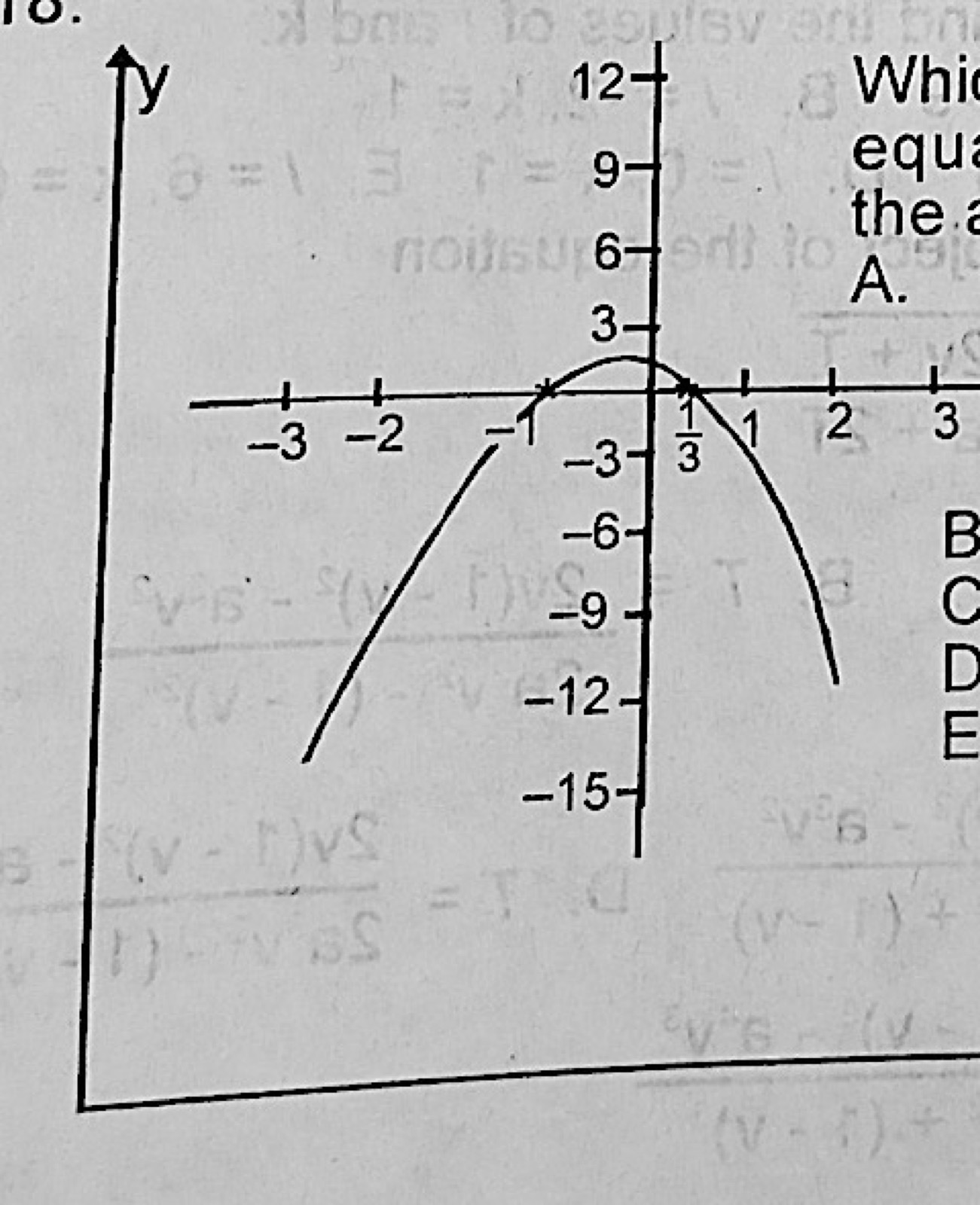
Which of the following equations represents the above graph?

Diagram for this question
  1. A.y = 1 + 2x + 3x2
  2. B.y = 1 + 2x + 3x2
  3. C.y = 1 + 2x − 3x2
  4. D.y = 1 − 2x − 3x2
  5. E.y = 3x2 + 2x − 1.
Show the answer and explanation

Answer: D (y = 1 − 2x − 3x2)

Explanation

Roots −1 and ⅓ give the factors (x + 1)(3x − 1) = 3x² + 2x − 1. The curve is an upside-down parabola through (0, 1), so y = −(3x² + 2x − 1) = 1 − 2x − 3x².

Open this question

Question 19

Triangles and Quadrilaterals

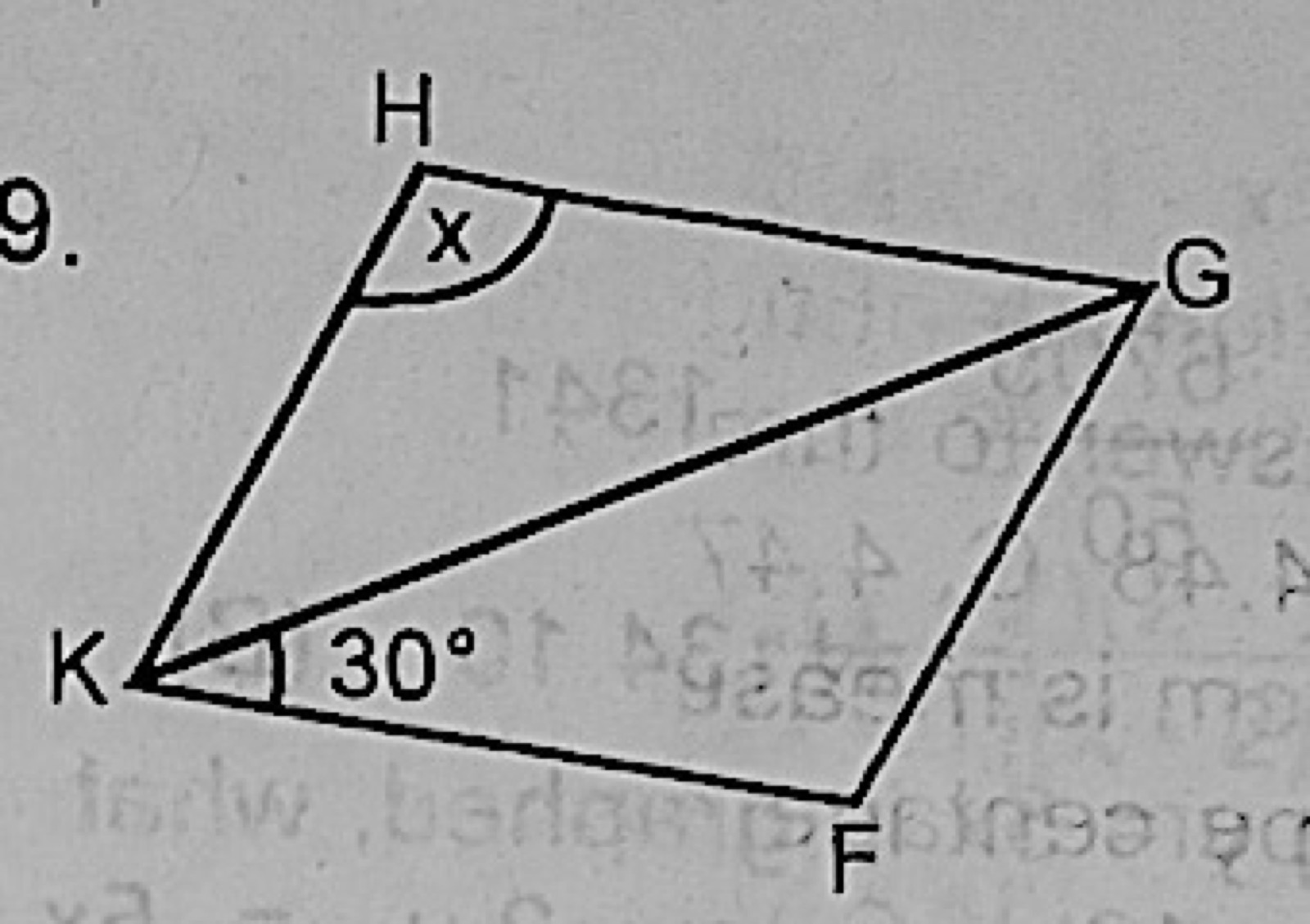
The above figure FGHK is a rhombus. What is the value of angle x?

Diagram for this question
  1. A.90°
  2. B.30°
  3. C.150°
  4. D.120°
  5. E.60°.
Show the answer and explanation

Answer: D (120°)

Explanation

The diagonal KG bisects angle K, so angle K = 2 × 30° = 60°. Adjacent angles of a rhombus add to 180°, so x = 120°.

Open this question

Question 20

Trigonometry

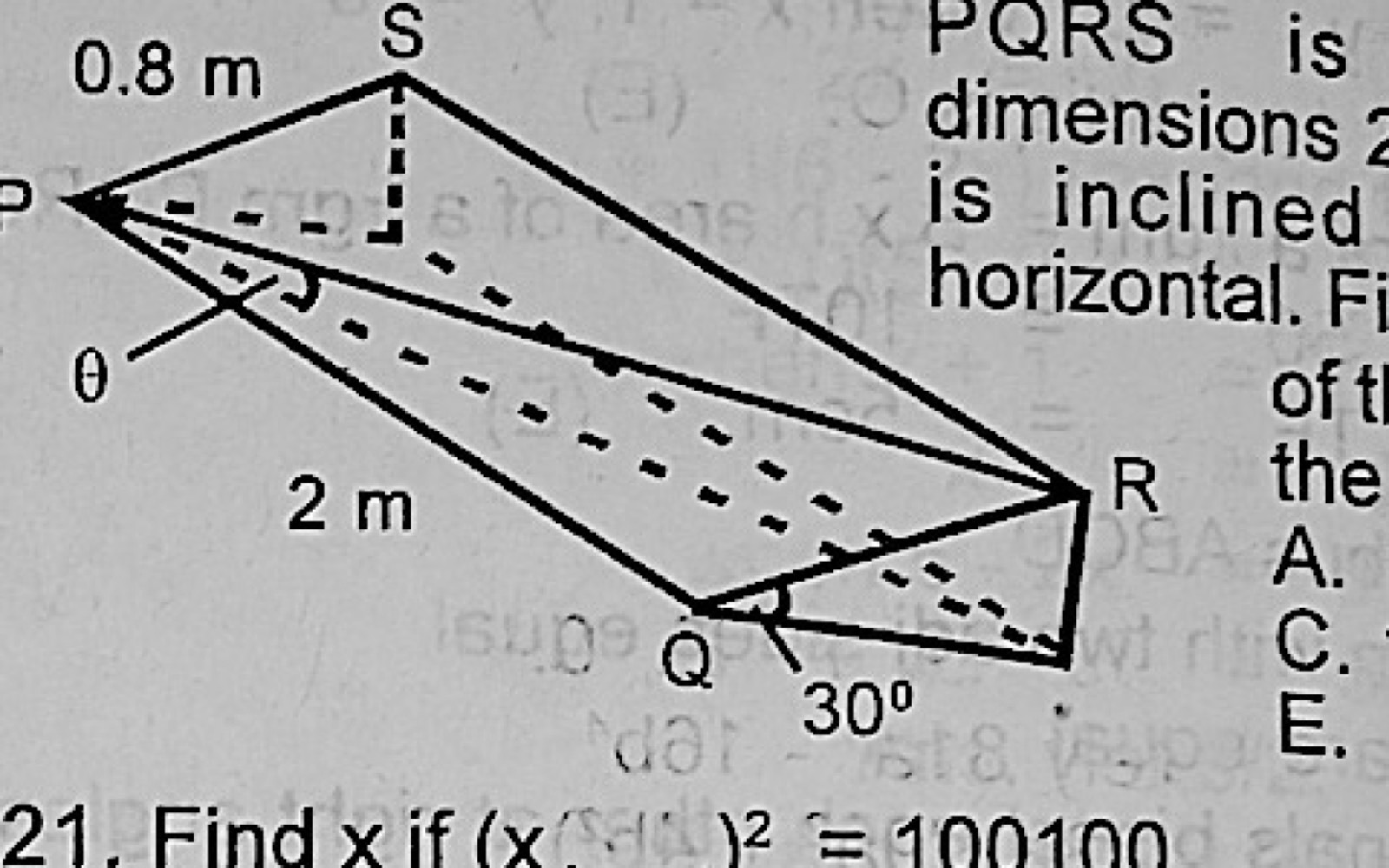
PQRS is a desk of dimensions 2m × 0.8m which is inclined at 30° to the horizontal. Find the inclination of the diagonal PR to the horizontal.

Diagram for this question
  1. A.23°35'
  2. B.30°
  3. C.15°36'
  4. D.10°
  5. E.10°42'.
Show the answer and explanation

Answer: E (10°42'.)

Explanation

The 0.8m edge rises at 30°, so R is 0.8 sin 30° = 0.4m higher than P. The diagonal is √(2² + 0.8²) ≈ 2.154m, so sin θ = 0.4/2.154 ≈ 0.186 and θ ≈ 10°42'.

Open this question

Question 21

Indices

Find x if (xbase 4)2 = 100100base 2

  1. A.6
  2. B.12
  3. C.100
  4. D.210
  5. E.10°42'
Show the answer and explanation

Answer: B (12)

Explanation

100100₂ = 32 + 4 = 36, so x = 6 in base ten. In base 4, 6 = 1 × 4 + 2 = 12.

Open this question

Question 22

Logarithms

Simplify log10 a⅓ + ¼log10a − 1/12log10a7

  1. A.1
  2. B.7/6 log10a
  3. C.0
  4. D.10
  5. E.a.
Show the answer and explanation

Answer: C (0)

Explanation

Write each term as a multiple of log a: (1/3 + 1/4 − 7/12) log a = (4 + 3 − 7)/12 × log a = 0.

Open this question

Question 23

Variation

If w varies inversely as V and u varies directly as w3, find the relationship between u and V given that u = 1 when V = 2.

  1. A.u = 8V3
  2. B.u = 2∛V
  3. C.V = 8/u3
  4. D.V = 8u3
  5. E.u = 8/V3
Show the answer and explanation

Answer: E (u = 8/V3)

Explanation

w ∝ 1/V and u ∝ w³, so u = k/V³. u = 1 at V = 2 gives k = 8, so u = 8/V³.

Open this question

Question 24

Linear and Simultaneous Equations

Solve the simultaneous equations for x
x2 + y − 8 = 0
y + 5x − 2 = 0

  1. A.−28, 7
  2. B.6, −28
  3. C.6, −1
  4. D.−1, 7
  5. E.3, 2.
Show the answer and explanation

Answer: C (6, −1)

Explanation

Subtracting the equations removes y: x² − 5x − 6 = 0, so (x − 6)(x + 1) = 0 and x = 6 or −1.

Open this question

Question 25

Graphs of Functions

Find the missing value in the following table
x: −2, −1, 0, 1, 2, 3
y = x3 − x + 3: ___, 3, 3, 3, 9, 27

  1. A.−3
  2. B.3
  3. C.−9
  4. D.13
  5. E.9
Show the answer and explanation

Answer: A (−3)

Explanation

At x = −2: (−2)³ − (−2) + 3 = −8 + 2 + 3 = −3.

Open this question

Question 26

Circle Theorems

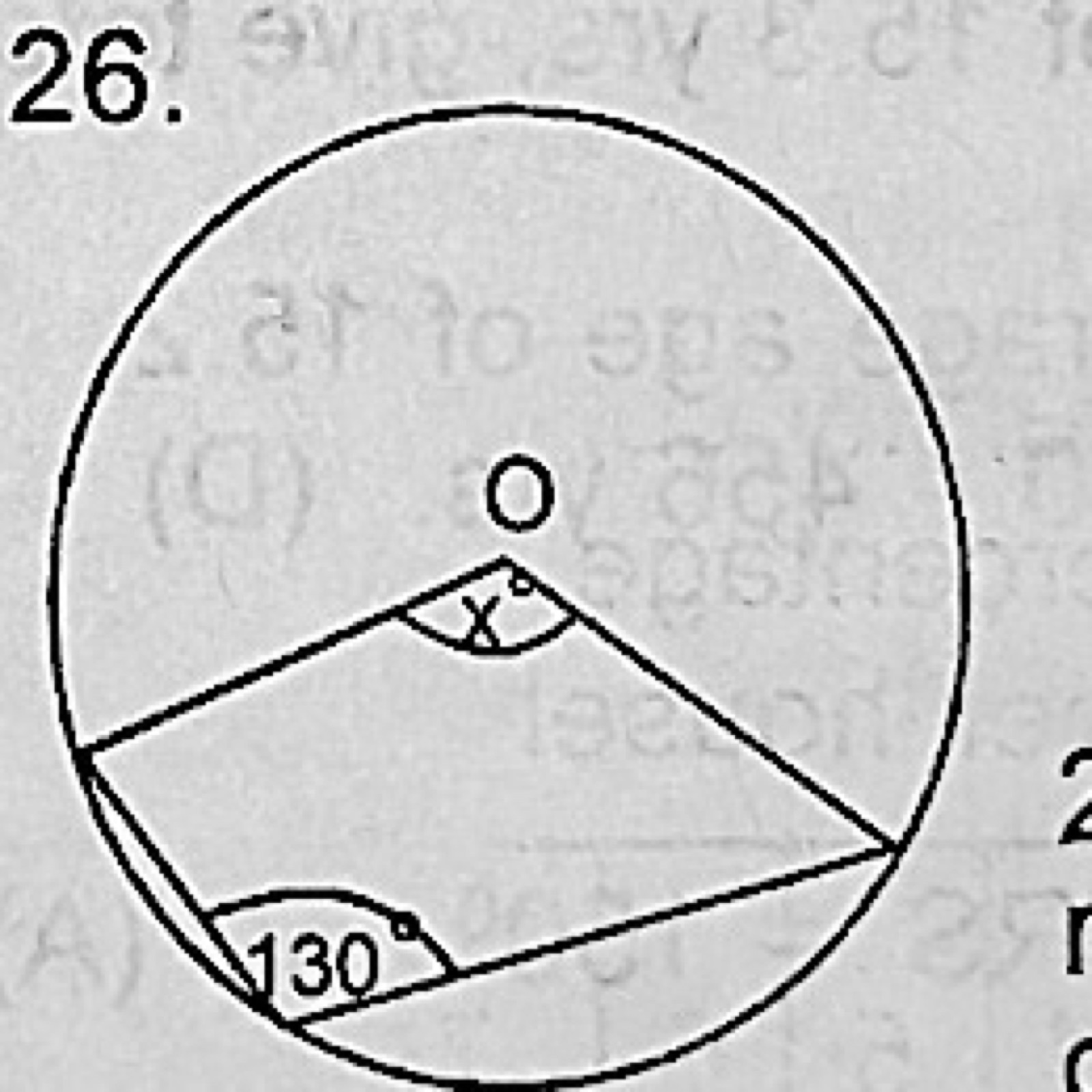
If O is the centre of the circle in the figure above, find the value of x.

Diagram for this question
  1. A.50
  2. B.260
  3. C.100
  4. D.65
  5. E.130.
Show the answer and explanation

Answer: C (100)

Explanation

The 130° angle at the circumference stands on the major arc, so the reflex angle at the centre is 260°. The angle x on the other side is 360° − 260° = 100°.

Open this question

Question 27

Data Presentation

Find the angle of the sectors representing each item in a pie chart of the following data
6, 10, 14, 16, 26

  1. A.15°, 25°, 35°, 40°, 65°
  2. B.60°, 100°, 140°, 160°, 260°
  3. C.6°, 10°, 14°, 16°, 26°
  4. D.30°, 50°, 70°, 80°, 130°
  5. E.None of the above.
Show the answer and explanation

Answer: D (30°, 50°, 70°, 80°, 130°)

Explanation

The total is 72, so each item gets (value/72) × 360° = value × 5°: 30°, 50°, 70°, 80°, 130°.

Open this question

Question 28

Measures of Central Tendency

The score of 16 students in a Mathematics test are 65, 65, 55, 60, 60, 65, 60, 70, 75, 70, 65, 70, 60, 65, 65, 70. What is the sum of the median and modal scores?

  1. A.125
  2. B.130
  3. C.140
  4. D.150
  5. E.137.5.
Show the answer and explanation

Answer: B (130)

Explanation

65 occurs most often (6 times), so the mode is 65. In order, the 8th and 9th scores are both 65, so the median is 65. The sum is 130.

Open this question

Question 29

Probability

The letters of the word 'MATRICULATION' are cut and put into a box. One letter is drawn at random from the box. Find the probability of drawing a vowel.

  1. A.7/13
  2. B.5/13
  3. C.6/13
  4. D.8/13
  5. E.4/13
Show the answer and explanation

Answer: C (6/13)

Explanation

MATRICULATION has 13 letters, of which 6 are vowels (A, I, U, A, I, O). The probability is 6/13.

Open this question

Question 30

Fractions, Decimals and Approximation

Correct each of the numbers 59.81798 and 0.0746829 to three significant figures and multiply them, giving your answer to three significant figures.

  1. A.4.46
  2. B.4.48
  3. C.4.47
  4. D.4.49
  5. E.4.50
Show the answer and explanation

Answer: C (4.47)

Explanation

59.81798 → 59.8 and 0.0746829 → 0.0747. Then 59.8 × 0.0747 = 4.46706, which is 4.47 to three significant figures.

Open this question

Question 31

Ratio, Percentages and Rates

If a rod of length 250cm is measured as 25cm long in error, what is the percentage error in measurement?

  1. A.55
  2. B.10
  3. C.5
  4. D.4
  5. E.2.
Show the answer and explanation

Answer: B (10)

Explanation

An error of 25cm on a true length of 250cm is 25/250 × 100 = 10%.

Open this question

Question 32

Indices

If (2/3)m (3/4)n = 256/729, find the values of m and n.

  1. A.m = 4; n = 2
  2. B.m = −4, n = −2
  3. C.m = −4, n = 2
  4. D.m = 4, n = −2
  5. E.m = −2, n = 4.
Show the answer and explanation

Answer: D (m = 4, n = −2)

Explanation

The left side is 2^(m − 2n) × 3^(n − m) and 256/729 = 2⁸ × 3⁻⁶. So m − 2n = 8 and n − m = −6, giving n = −2 and m = 4.

Open this question

Question 33

Logarithms

Without using tables find the numerical value of log7 49 + log7 (1/7)

  1. A.1
  2. B.2
  3. C.3
  4. D.7
  5. E.0.
Show the answer and explanation

Answer: A (1)

Explanation

log₇ 49 = 2 and log₇ (1/7) = −1, so the sum is 1.

Open this question

Question 34

Algebraic Expressions

Factorize completely 81a4 − 16b4

  1. A.(3a + 2b)(2a − 3b)(9a2 + 4b2)
  2. B.(3a − 2b)(2a − 3b)(4a2 − 9b2)
  3. C.(3a − 2b)(3a + 2b)(9a2 + 4b2)
  4. D.(3a − 2b)(2a − 3b)(9a2 + 4b2)
  5. E.(3a − 2b)(2a − 3b)(9a2 − 4b2).
Show the answer and explanation

Answer: C ((3a − 2b)(3a + 2b)(9a2 + 4b2))

Explanation

81a⁴ − 16b⁴ = (9a² − 4b²)(9a² + 4b²), and 9a² − 4b² = (3a − 2b)(3a + 2b).

Open this question

Question 35

Angles and Polygons

One interior angle of a convex hexagon is 170° and each of the remaining interior angles is equal to x°. Find x.

  1. A.120°
  2. B.110°
  3. C.105°
  4. D.102°
  5. E.100°.
Show the answer and explanation

Answer: B (110°)

Explanation

The angles of a hexagon add to 720°. 5x + 170 = 720, so x = 110°.

Open this question

Question 36

Circle Theorems

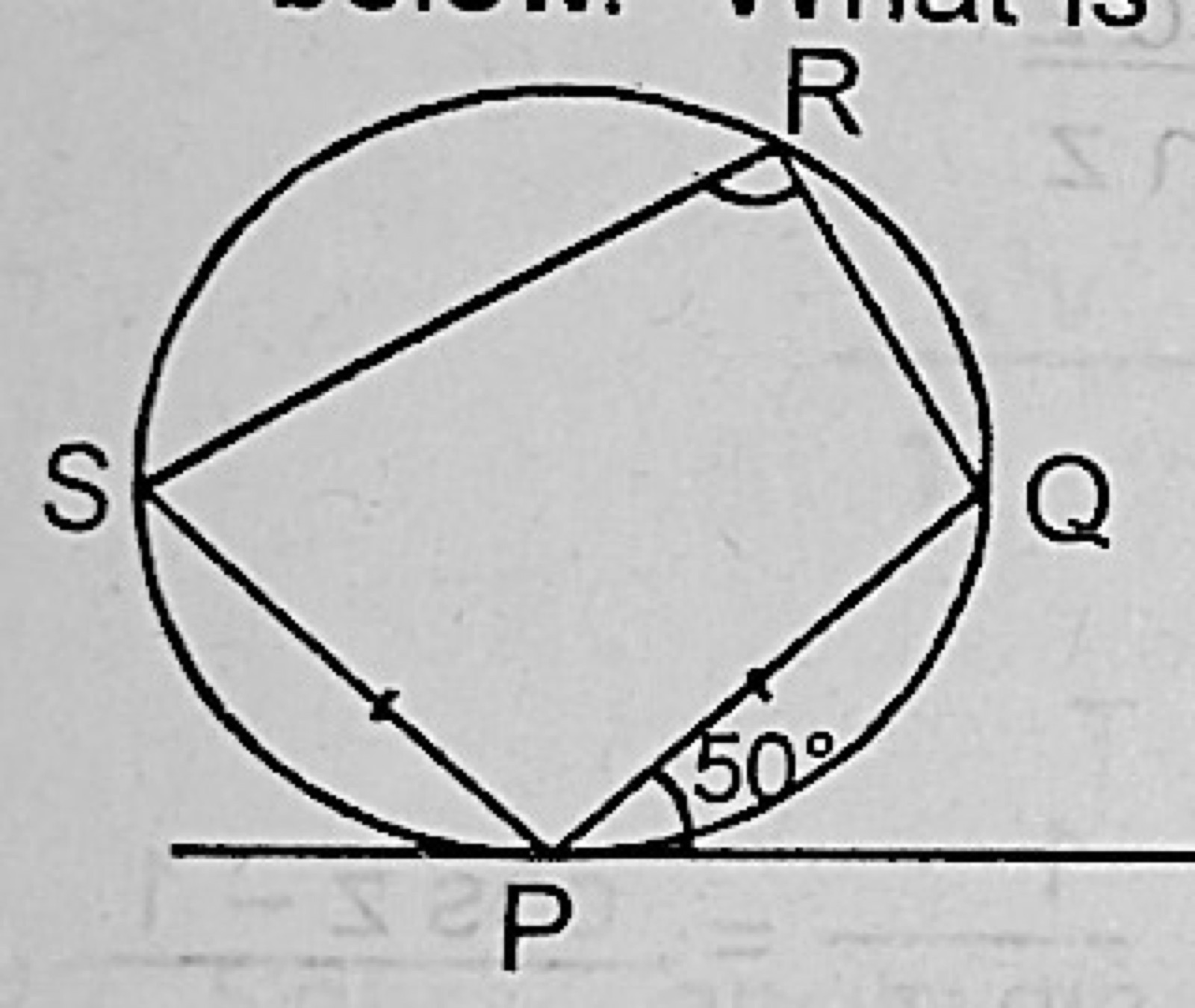
PQRS is a cyclic quadrilateral in which PQ = PS. PT is a tangent to the circle and PQ makes an angle of 50° with the tangent as shown in the figure below. What is the size of QRS?

Diagram for this question
  1. A.50°
  2. B.40°
  3. C.110°
  4. D.80°
  5. E.100°.
Show the answer and explanation

Answer: E (100°.)

Explanation

By the alternate segment theorem <PSQ = 50°, and PQ = PS makes <PQS = 50° too, so <QPS = 80°. Opposite angles of a cyclic quadrilateral add to 180°, so <QRS = 100°.

Open this question

Question 37

Bearings

A ship H leaves a port P and sails 30km due South. Then it sails 60km due West. What is the bearing of H from P?

  1. A.26° 34'
  2. B.243° 26'
  3. C.116° 34'
  4. D.63° 26'
  5. E.240°.
Show the answer and explanation

Answer: B (243° 26')

Explanation

H is 30km south and 60km west of P. The angle west of south is tan⁻¹(60/30) = 63°26', so the bearing is 180° + 63°26' = 243°26'.

Open this question

Question 38

Measures of Central Tendency

In a sample survey of a university community, the following table shows the percentage distribution of the number of members per household.
No. of members per household: 1, 2, 3, 4, 5, 6, 7, 8 (Total)
Number of households: 3, 12, 15, 28, 21, 10, 7, 4 (100)
What is the median?

  1. A.4
  2. B.3
  3. C.5
  4. D.4.5
  5. E.None.
Show the answer and explanation

Answer: A (4)

Explanation

The running totals are 3, 15, 30, 58, … so the 50th and 51st households both have 4 members. The median is 4.

Open this question

Question 39

Mensuration of Plane Shapes

On a square paper of length 2.524375cm is inscribed square diagram of length 0.524375cm. Find the area of the paper not covered by the diagram correct to 3 significant figures.

  1. A.6.00cm2
  2. B.6.10cm2
  3. C.6cm2
  4. D.6.09cm2
  5. E.4.00cm2.
Show the answer and explanation

Answer: B (6.10cm2)

Explanation

Area not covered = 2.524375² − 0.524375² = (2.524375 + 0.524375)(2.524375 − 0.524375) = 3.04875 × 2 = 6.0975 ≈ 6.10cm².

Open this question

Question 40

Algebraic Expressions

If f(x) = 1/(x − 1) + (x − 1)/(x2 − 1), find f(1 − x)

  1. A.1/x + 1/(x − 2)
  2. B.x + 1/(2x − 1)
  3. C.−1/x − 1/(x − 2)
  4. D.−1/x − 1/(2x − 1)
  5. E.1/x + 1/(x2 − 1)
Show the answer and explanation

Answer: C (−1/x − 1/(x − 2))

Explanation

f(x) simplifies to 1/(x − 1) + 1/(x + 1). Replacing x by 1 − x gives 1/(−x) + 1/(2 − x) = −1/x − 1/(x − 2).

Open this question

Question 41

Triangles and Quadrilaterals

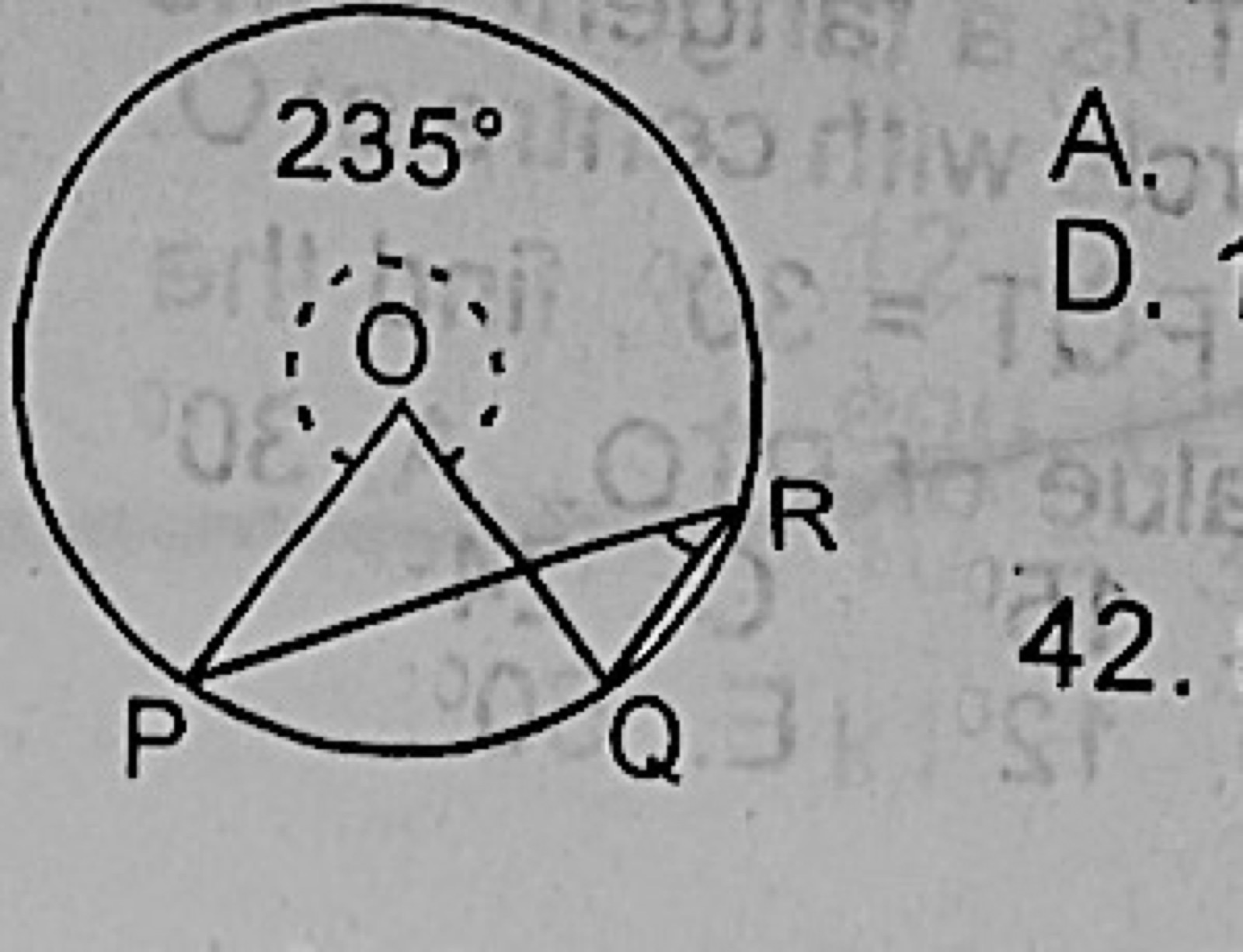
In the figure below find PRQ

Diagram for this question
  1. A.66½°
  2. B.62½°
  3. C.125°
  4. D.105°
  5. E.65°.
Show the answer and explanation

Answer: B (62½°)

Explanation

The reflex angle at O is 235°, so angle POQ = 360° − 235° = 125°. The angle at the circumference is half of it: 62½°.

Open this question

Question 42

Indices

Simplify ∛(27a−9/8)

  1. A.9a−2/2
  2. B.9a−3/2
  3. C.3/(2a3)
  4. D.2/(3a2)
  5. E.3a2/2
Show the answer and explanation

Answer: C (3/(2a3))

Explanation

∛27 = 3, ∛8 = 2 and ∛a⁻⁹ = a⁻³, so the result is 3/(2a³).

Open this question

Question 43

Data Presentation

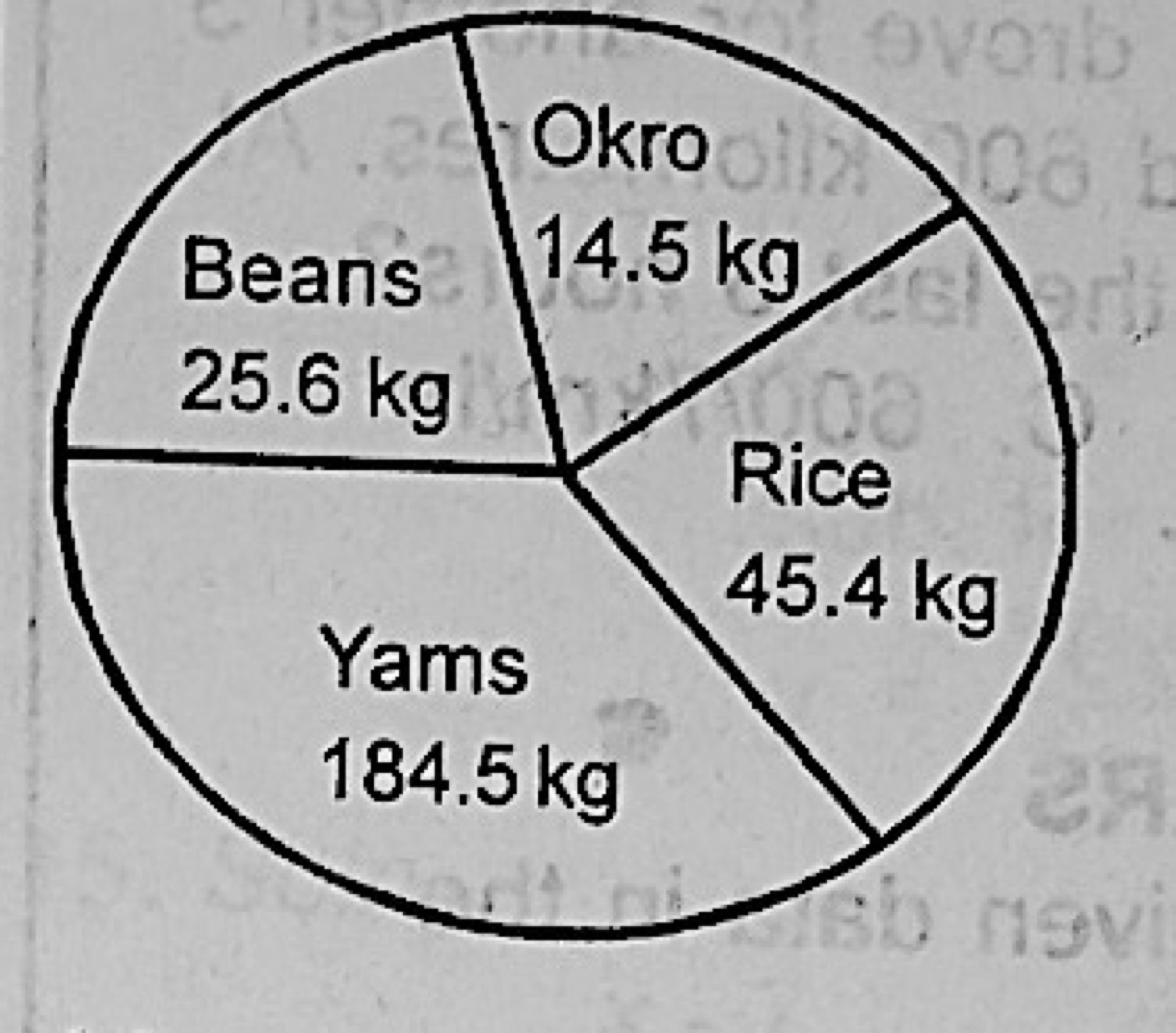
The farm yields of four crops on a piece of land in Ondo are represented on the pie chart above. What is the angle of the sector occupied by Okro in the chart?

Diagram for this question
  1. A.91⅓°
  2. B.19⅓°
  3. C.33⅓°
  4. D.11°
  5. E.91°.
Show the answer and explanation

Answer: B (19⅓°)

Explanation

The total yield is 14.5 + 25.6 + 45.4 + 184.5 = 270kg. Okro's angle = 14.5/270 × 360° ≈ 19⅓°.

Open this question

Question 45

Mensuration of Plane Shapes

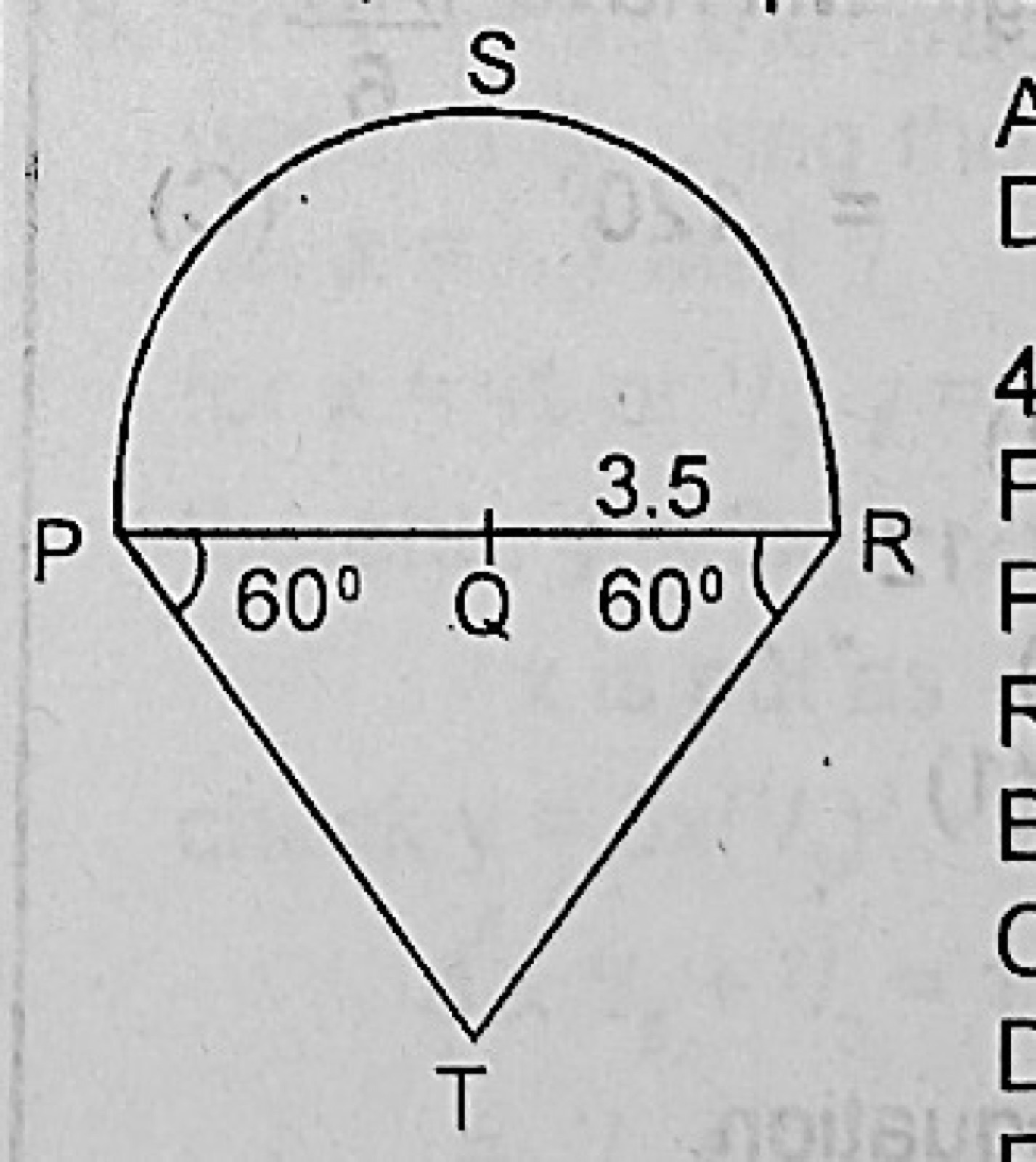
PQR is the diameter of a semicircle RSP with centre at Q and radius of length 3.5cm. If QPT = QRT = 60°, find the perimeter of the figure PTRS (π = 22/7)

Diagram for this question
  1. A.25cm
  2. B.18cm
  3. C.36cm
  4. D.29cm
  5. E.25.5cm.
Show the answer and explanation

Answer: A (25cm)

Explanation

Triangle PTR has two 60° angles, so it is equilateral with side PR = 7cm. The semicircular arc is ½ × 22/7 × 7 = 11cm. Perimeter = 11 + 7 + 7 = 25cm.

Open this question

Question 46

Trigonometry

In triangle PQR, QR = 3cm, PR = √3cm, PQ = 2√3cm and PQR = 30°. Find angles P and R.

  1. A.P = 60° and R = 90°
  2. B.P = 30° and R = 120°
  3. C.P = 90° and R = 60°
  4. D.P = 60° and R = 60°
  5. E.P = 45° and R = 105°.
Show the answer and explanation

Answer: A (P = 60° and R = 90°)

Explanation

PR² + QR² = 3 + 9 = 12 = PQ², so R = 90°. Then P = 180° − 90° − 30° = 60°.

Open this question

Question 47

Angles and Polygons

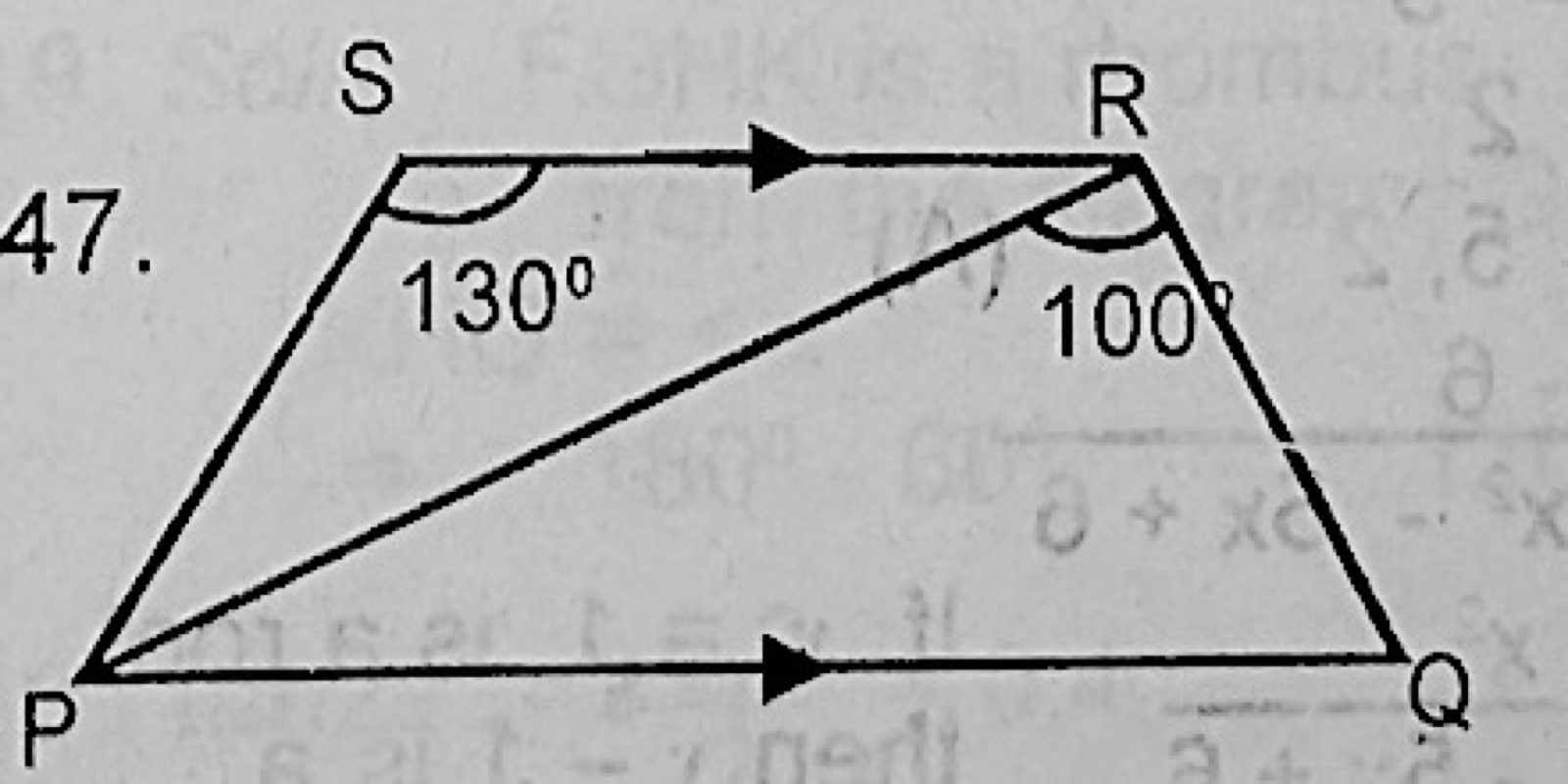
In the above diagram, if PS = SR and PQ∥SR, what is the size of PQR?

Diagram for this question
  1. A.25°
  2. B.50°
  3. C.55°
  4. D.65°
  5. E.75°.
Show the answer and explanation

Answer: C (55°)

Explanation

Triangle PSR is isosceles with <S = 130°, so <SRP = 25°, and <RPQ = 25° (alternate angles, PQ ∥ SR). In triangle PQR with <PRQ = 100°, <PQR = 180° − 100° − 25° = 55°.

Open this question

Question 48

Measures of Central Tendency

Find the mean of the following 24.57, 25.63, 24.32, 26.01, 25.77.

  1. A.25.12
  2. B.25.30
  3. C.25.26
  4. D.25.50
  5. E.25.73.
Show the answer and explanation

Answer: C (25.26)

Explanation

The five numbers add up to 126.30, and 126.30 ÷ 5 = 25.26.

Open this question

Question 49

Circle Theorems

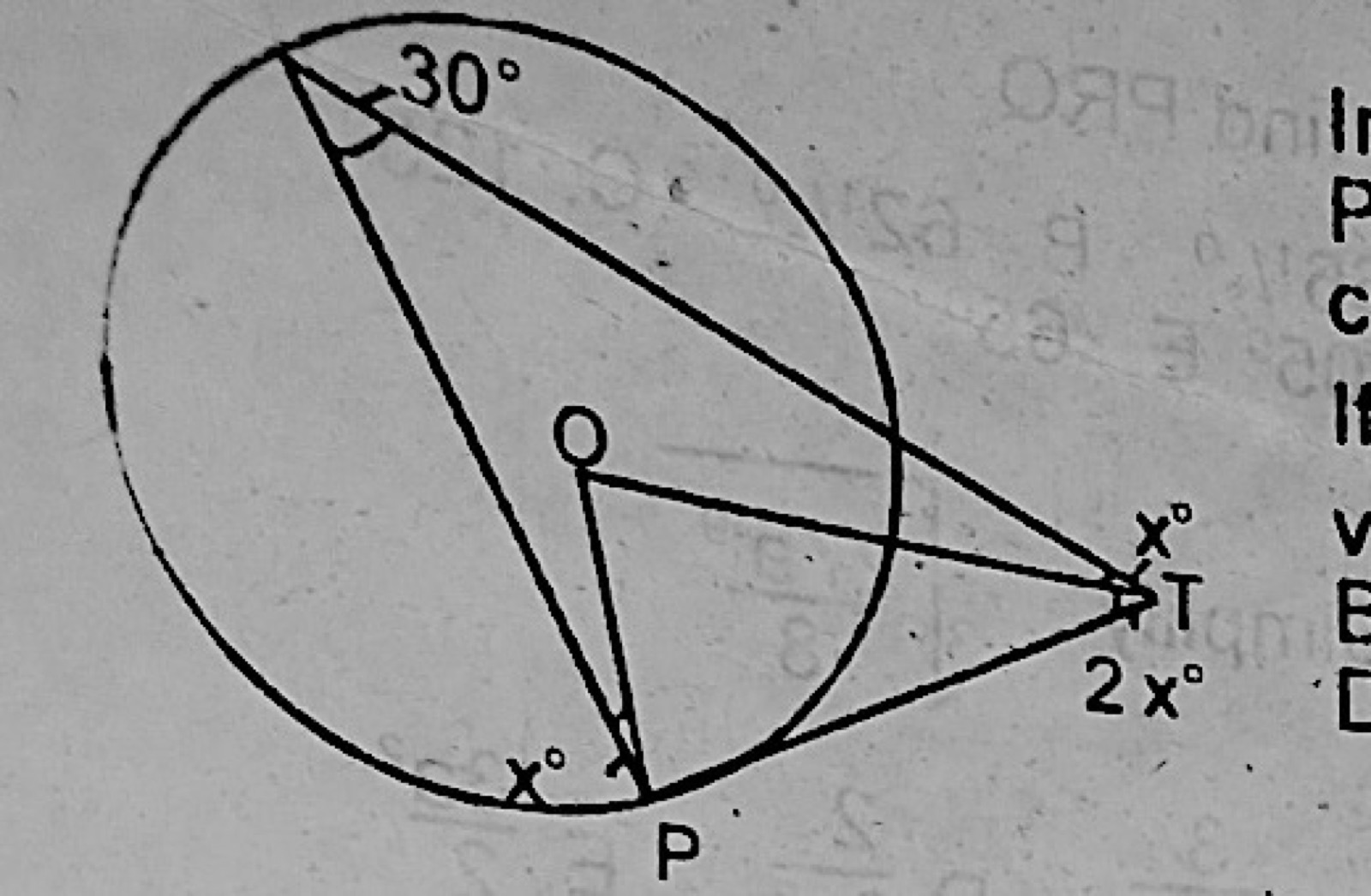
In the figure above, PT is a tangent to the circle with centre at O. If PQT = 30°, find the value of PTO.

Diagram for this question
  1. A.30°
  2. B.15°
  3. C.24°
  4. D.12°
  5. E.60°.
Show the answer and explanation

Answer: A (30°)

Explanation

OP ⊥ PT, and triangle OPQ is isosceles, so <QPT = 90° + x. In triangle PQT: 30° + (90° + x) + 3x = 180°, giving x = 15°. So <PTO = 2x = 30°.

Open this question

Question 50

Linear and Simultaneous Equations

A man drove for 4 hours at a certain speed, he then doubled his speed and drove for another 3 hours. Altogether he covered 600 kilometres. At what speed did he drive for the last 3 hours?

  1. A.120km/hr
  2. B.60km/hr
  3. C.600/7km/hr
  4. D.50km/hr
  5. E.100km/hr.
Show the answer and explanation

Answer: A (120km/hr)

Explanation

With first speed v: 4v + 3(2v) = 10v = 600, so v = 60km/hr. The last 3 hours were at 2v = 120km/hr.
Open this question