Home › Past questions › JAMB › Economics › 2000 48 questions. Try each one, then open the answer to check yourself and read the explanation.
Sign up free to answer these questions on a CBT screen with a timer, then see your score and every answer explained.
Start practising free
Question 1 Basic Concepts Economics can be defined as
A. reduction in spending in the face of competing alternatives B. allocation of resources to alternative uses C. economic behaviour of small units like the household and the firm. D. the study of economic aggregates like inflation and national income. Show the answer and explanation Answer: B (allocation of resources to alternative uses )
Explanation Economics studies how scarce resources are shared among their many alternative uses. C describes only microeconomics and D only macroeconomics.
Open this question
Question 2 Basic Concepts I. What and how much will be produced?
A. I, II and III B. I, II and IV C. I, III and IV D. II, III and IV. Show the answer and explanation Answer: A (I, II and III )
Explanation Every society must decide what to produce, how to produce it and for whom; exports are not one of the basic questions.
Open this question
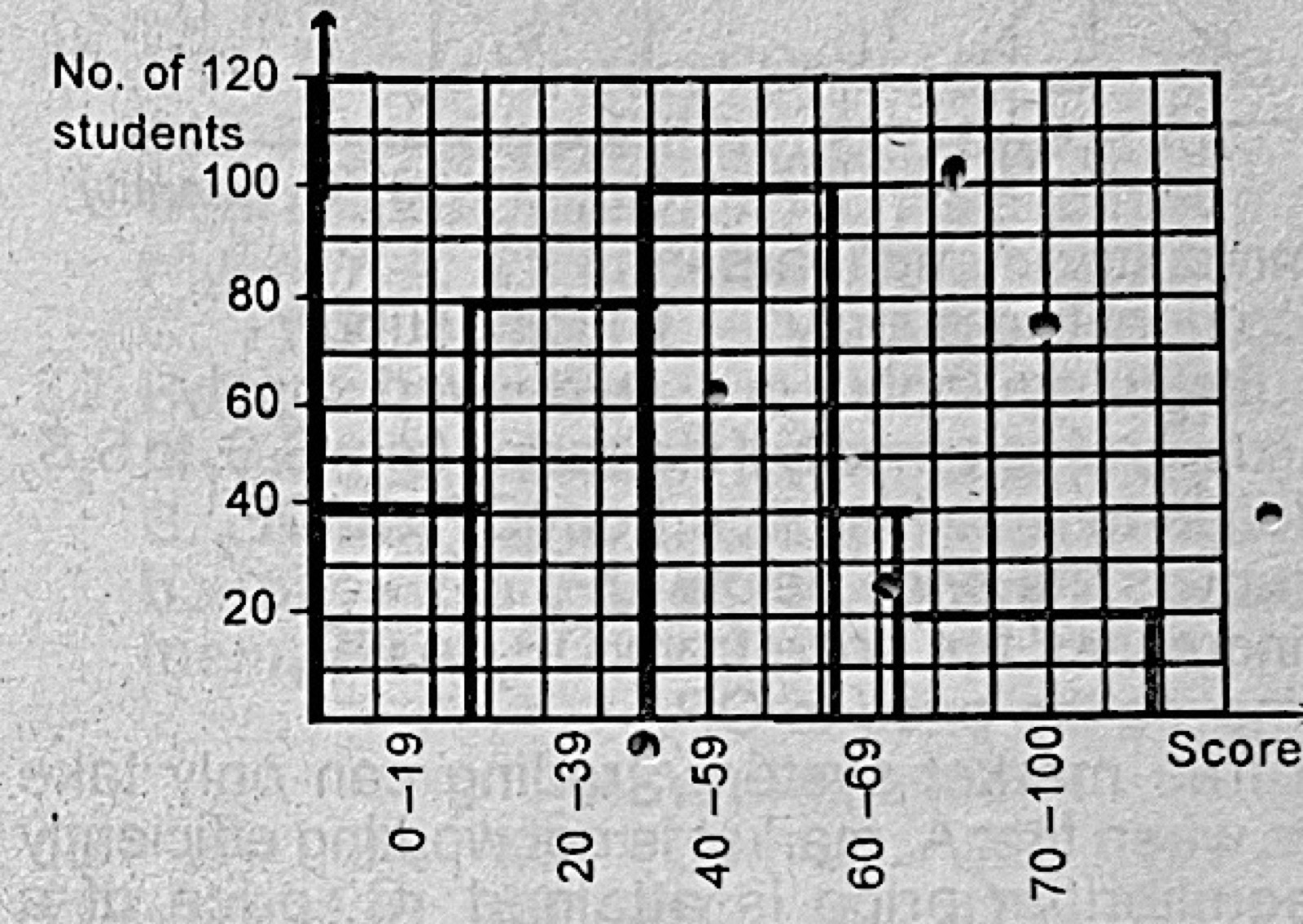
Question 3 Tools of Economic Analysis Use the histogram to answer the question (scores on the horizontal axis, number of students on the vertical axis).
A. 280 B. 240 C. 200 D. 80. Show the answer and explanation Answer: A (280 )
Explanation Add the bar heights: 40 (0–19) + 80 (20–39) + 100 (40–59) + 40 (60–69) + 20 (70–100) = 280.
Open this question
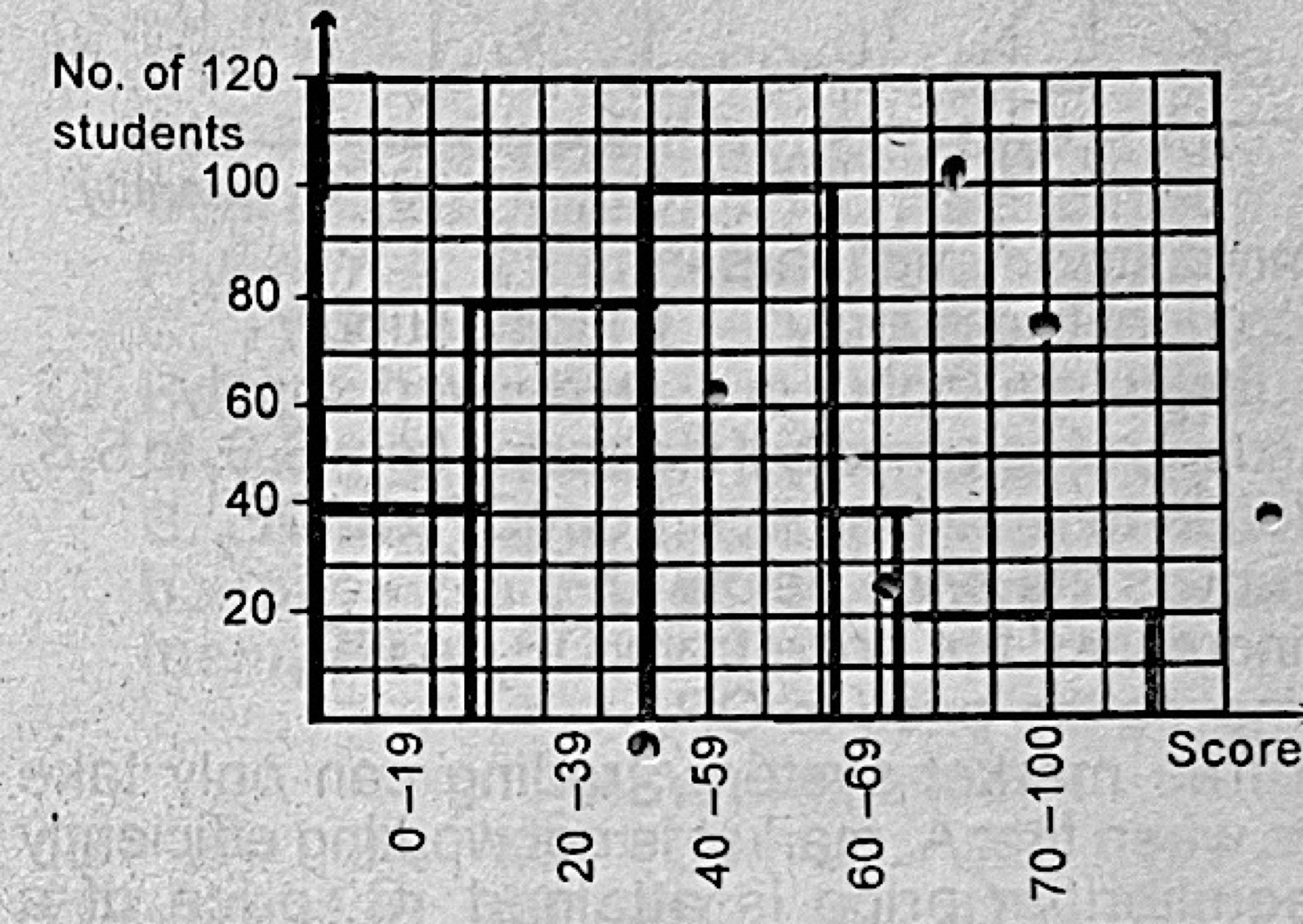
Question 4 Tools of Economic Analysis Use the histogram to answer the question (scores on the horizontal axis, number of students on the vertical axis).
A. 100 B. 120 C. 160 D. 200. Show the answer and explanation Answer: C (160 )
Explanation Students scoring 40 and above: 100 (40–59) + 40 (60–69) + 20 (70–100) = 160.
Open this question
Question 5 Economic Systems In a capitalist economy, the economic problem of what goods to produce is decided mainly by
A. shadow prices B. profit level C. relative prices D. a central planner. Show the answer and explanation Answer: C (relative prices )
Explanation In a capitalist economy there is no central planner: changes in relative prices signal what consumers want, and producers move resources towards the goods whose prices make them most rewarding.
Open this question
Question 6 Theory of Demand Which of the following is an example of derived demand?
A. Tax relief B. Labour C. Wage increase D. Entertainment. Show the answer and explanation Answer: B (Labour )
Explanation Labour is wanted not for itself but for the goods it helps to produce, so its demand is derived from the demand for those goods.
Open this question
Question 7 Elasticity When commodity X sold for ₦25 per unit, 50 units of commodity Y were purchased. With an increase in the price of commodity X to ₦50 per unit, the demand for commodity Y fell to 20 units.
A. 1.7 B. 0.6 C. −0.6 D. −1.7 Show the answer and explanation Answer: C (−0.6 )
Explanation % change in quantity of Y = (20 − 50)/50 × 100 = −60%. % change in price of X = (50 − 25)/25 × 100 = 100%. Cross elasticity = −60 ÷ 100 = −0.6.
Open this question
Question 8 Elasticity When commodity X sold for ₦25 per unit, 50 units of commodity Y were purchased. With an increase in the price of commodity X to ₦50 per unit, the demand for commodity Y fell to 20 units.
A. substitutes B. durable and non-durable C. intermediate and final D. complements. Show the answer and explanation Answer: D (complements. )
Explanation A rise in the price of X reduced the demand for Y, so the cross elasticity is negative: the goods are used together (complements).
Open this question
Question 9 Theory of Consumer Behaviour A central argument of cardinal utility is that utility is
A. measurable B. psychological C. ranked D. intangible. Show the answer and explanation Answer: A (measurable )
Explanation Cardinal utility theory assumes satisfaction can be measured in units (utils); ordinal theory only ranks it.
Open this question
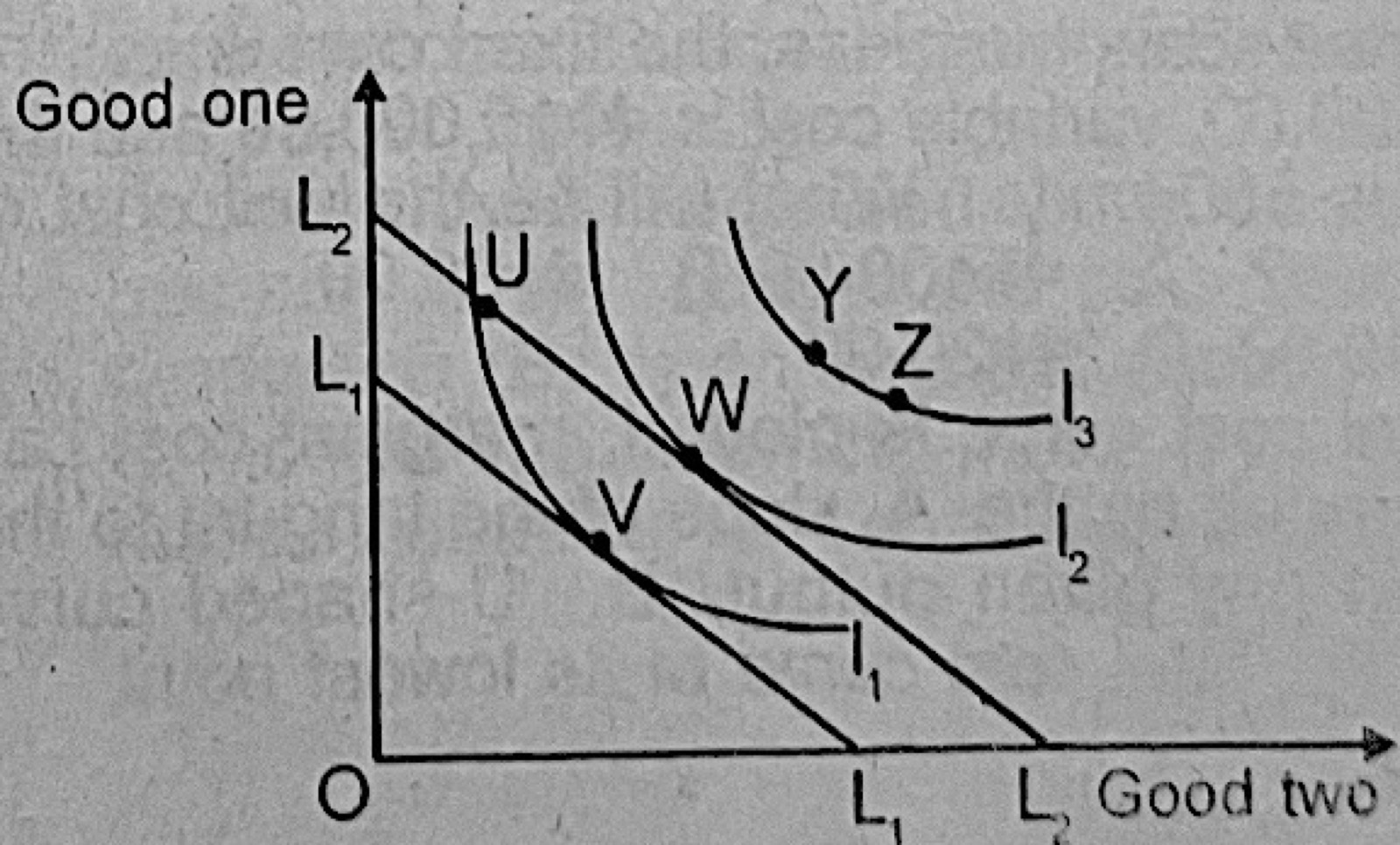
Question 10 Theory of Consumer Behaviour In the diagram above, L1 L1 and L2 L2 are budget lines. I1 , I2 and I3 are indifference curves. Which points are optimal?
A. U and W B. U and Z C. V and W D. Y and Z. Show the answer and explanation Answer: C (V and W )
Explanation The best point on each budget line is where it just touches an indifference curve: V on L1 L1 (touching I1 ) and W on L2 L2 (touching I2 ).
Open this question
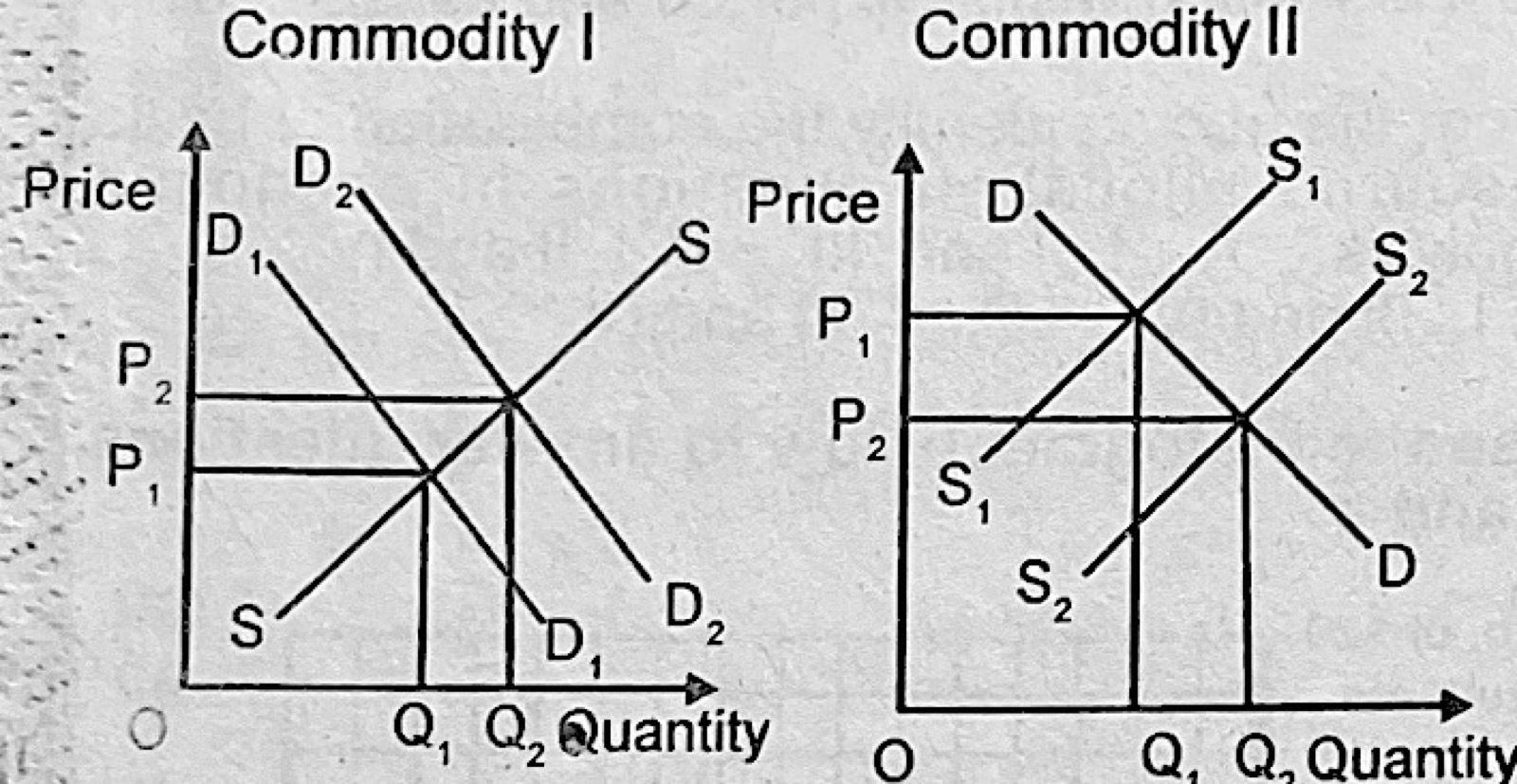
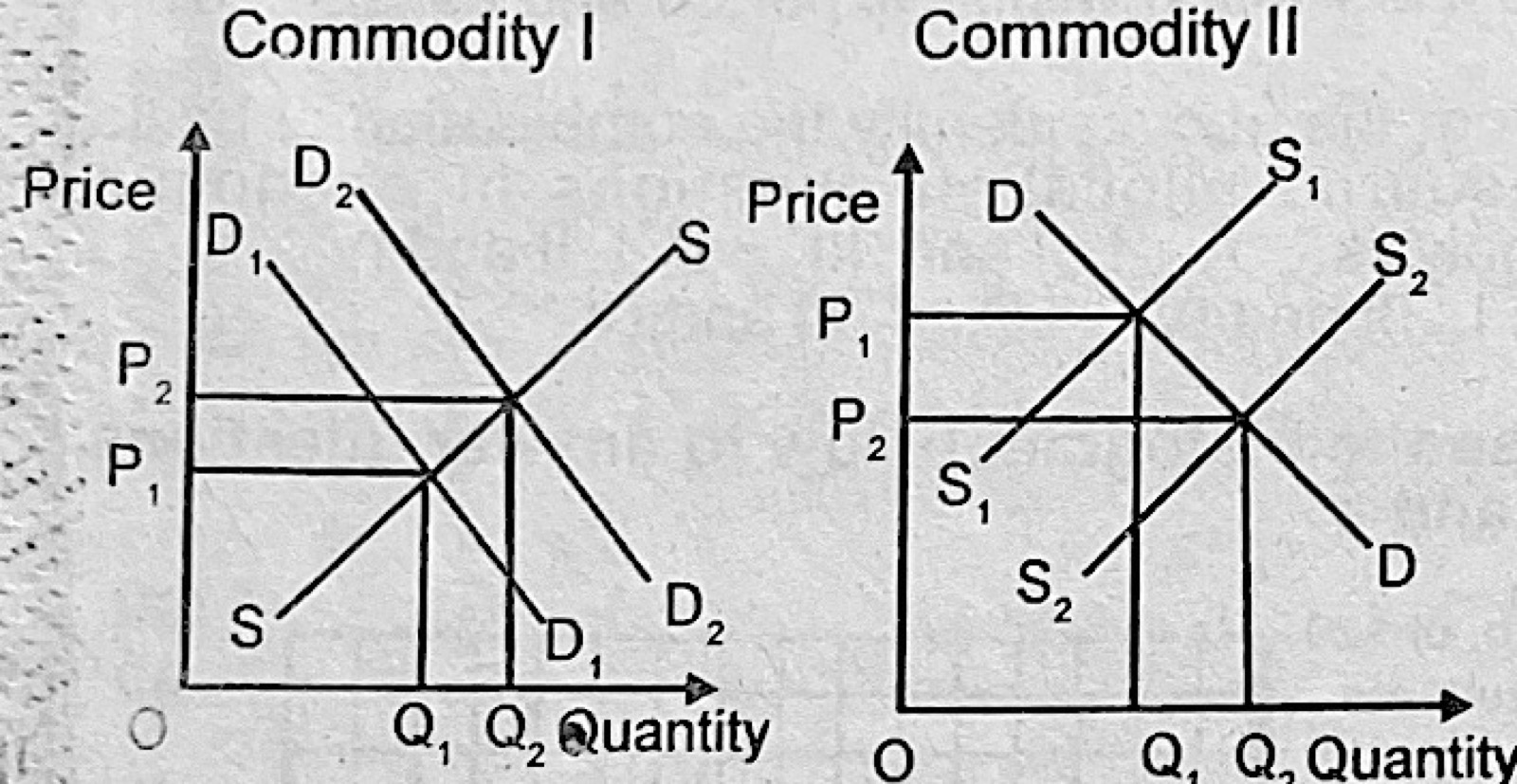
Question 11 Theory of Supply Use the diagrams to answer the question.
A. competitive supply B. joint supply C. substitute supply D. derived supply. Show the answer and explanation Answer: B (joint supply )
Explanation A rise in demand for commodity I raises its output, and at the same time the supply of commodity II increases. Goods produced together like this (e.g. beef and hides) are in joint supply.
Open this question
Question 12 Theory of Supply Use the diagrams to answer the question.1 S1 to S2 S2
A. leads to a fall in price from OP1 to OP2 B. moves the price below OP2 C. increases the price from OP2 to OP1 D. moves the price to OP1 Show the answer and explanation Answer: A (leads to a fall in price from OP1 to OP2 )
Explanation With demand unchanged, a rightward shift of supply from S1 S1 to S2 S2 lowers the equilibrium price from OP1 to OP2 .
Open this question
Question 13 Price Determination In a free market system, trading can only take place when the
A. market is not working efficiently B. equilibrium price is attained C. price of a commodity tends to attract consumers. D. consumer sovereignty is lacking. Show the answer and explanation Answer: B (equilibrium price is attained )
Explanation In a free market, buyers and sellers settle at the equilibrium price, where the quantity they want to buy equals the quantity offered.
Open this question
Question 14 Market Structures The condition for equilibrium price and quantity under perfect competition is
A. MC = AR = TR B. TC = AR = P C. MC = AR = P D. MC = AR = TC Show the answer and explanation Answer: C (MC = AR = P )
Explanation A perfectly competitive firm produces where MC = MR, and for it MR = AR = price, so MC = AR = P.
Open this question
Question 15 Theory of Production External diseconomies of scale result from excessive growth of
A. the whole industry B. some sectors of the industry C. external factors D. internal factors. Show the answer and explanation Answer: A (the whole industry )
Explanation When an industry becomes too large in one area, all its firms face congestion, labour shortages and higher input prices; these are external diseconomies.
Open this question
Question 16 Theory of Production Variable Factor | Total Product | Marginal Product | Average Product
A. 18 B. 20 C. 24 D. 25. Show the answer and explanation Answer: C (24 )
Explanation Marginal product = change in total product = 48 − 24 = 24.
Open this question
Question 17 Theory of Production Variable Factor | Total Product | Marginal Product | Average Product
A. 8.0 B. 12.0 C. 14.6 D. 15.5. Show the answer and explanation Answer: D (15.5. )
Explanation Average product = total product ÷ number of units of the variable factor = 93 ÷ 6 = 15.5.
Open this question
Question 19 Theory of Costs and Revenue If a total cost curve is plotted, marginal cost can be illustrated by the
A. slope of the tangent to the curve at any given output B. U-shaped curve cutting the total cost curve at its lowest point C. straight line from the origin to the mid-point of the curve. D. straight line cutting the curve at its highest point. Show the answer and explanation Answer: A (slope of the tangent to the curve at any given output )
Explanation Marginal cost is the extra cost of one more unit, i.e. how steeply total cost rises at that output: the slope of the tangent to the TC curve.
Open this question
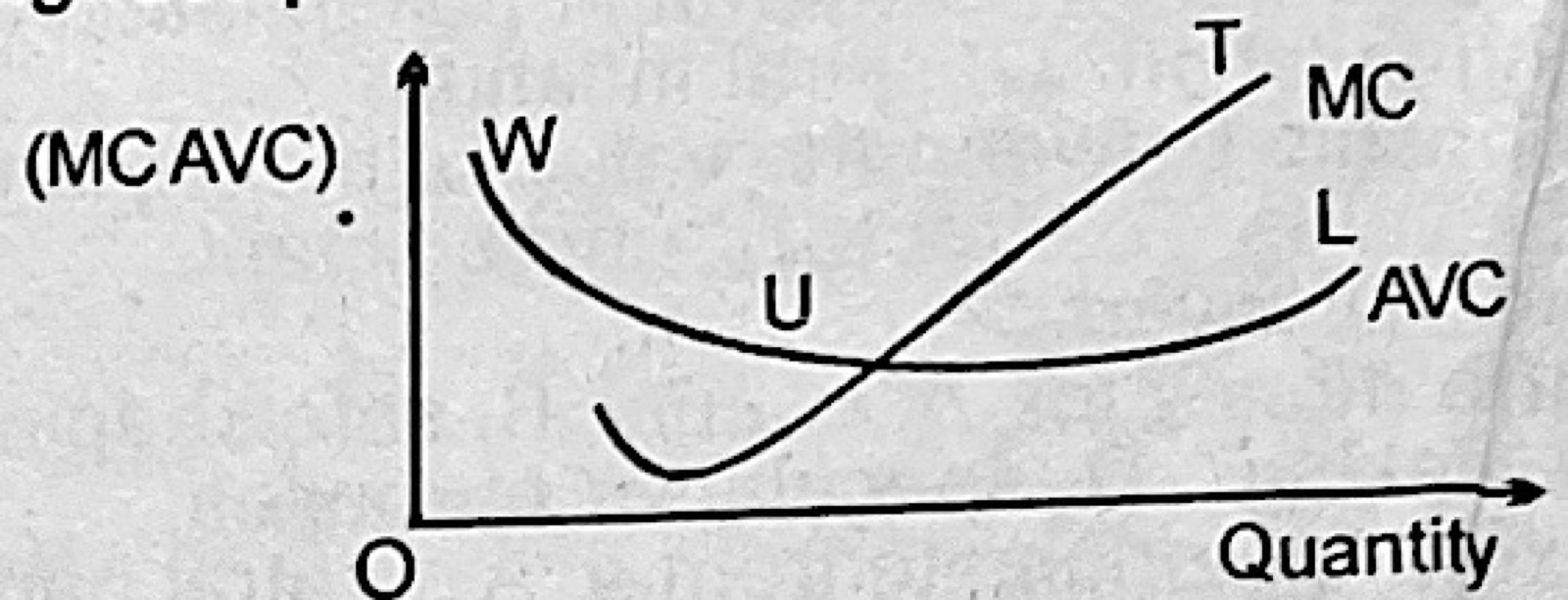
Question 20 Market Structures In a price-taking firm, the portion UT above is the firm's
A. average revenue curve B. supply curve C. demand curve D. long-run average cost curve. Show the answer and explanation Answer: B (supply curve )
Explanation A price-taking firm produces where price = MC, but only if price covers AVC. So the part of MC above the AVC curve (UT) is its short-run supply curve.
Open this question
Question 21 Market Structures The short-run equilibrium in a perfectly competitive market requires that
A. marginal cost be equal to total revenue B. marginal cost and marginal revenue be equal C. costs are mutually determined by buyers and sellers D. the marginal cost curve cuts the total cost curve. Show the answer and explanation Answer: B (marginal cost and marginal revenue be equal )
Explanation Every profit-maximizing firm, including a perfect competitor, is in equilibrium where MC = MR.
Open this question
Question 22 Market Structures Quantity of commodity sold | Total Revenue from sales of commodity
A. a monopolist B. a monopolistic competitor C. a perfect competitor D. an oligopolist. Show the answer and explanation Answer: C (a perfect competitor )
Explanation Each extra unit adds the same ₦5 to total revenue, so marginal revenue is constant, as for a perfect competitor who sells every unit at the same price.
Open this question
Question 23 Market Structures At the point where marginal revenue of a monopolist is equal to zero, its total revenue will be
A. falling B. rising C. equal to zero D. maximum. Show the answer and explanation Answer: D (maximum. )
Explanation While MR is positive, each extra sale adds to TR; once MR becomes negative TR falls. So TR is at its maximum where MR = 0.
Open this question
Question 24 Business Organisations A distinguishing characteristic of cooperative societies is that voting power depends on the
A. number of shares held B. status of the member C. equality of members D. management's decision. Show the answer and explanation Answer: C (equality of members )
Explanation Co-operatives follow 'one member, one vote', whatever the number of shares held, because all members are equal.
Open this question
Question 25 Business Organisations The concept of privatization presupposes
A. efficiency B. market price C. indigenization D. foreign trade. Show the answer and explanation Answer: A (efficiency )
Explanation Privatization rests on the belief that private owners, driven by profit, will run enterprises more efficiently than government.
Open this question
Question 26 Agriculture One problem in the marketing of agricultural products in Nigeria is
A. the seasonal nature of the commodities B. high price of the commodities C. the changing tastes of consumers D. inadequate storage facilities. Show the answer and explanation Answer: D (inadequate storage facilities. )
Explanation Without enough storage, farmers must sell at harvest when prices are low, and much produce rots.
Open this question
Question 27 Elasticity Increased output will cause farmers' revenue to decrease when market demand is
A. elastic B. inelastic C. unitary elastic D. perfectly elastic. Show the answer and explanation Answer: B (inelastic )
Explanation More output lowers the price. When demand is inelastic, the price falls by a bigger percentage than sales rise, so revenue falls.
Open this question
Question 28 Industrialisation A primary industry is concerned with
A. extraction of resources in their raw state B. the operation of small scale enterprises C. the economic activities of primary producers D. clearing and cultivation of land only. Show the answer and explanation Answer: A (extraction of resources in their raw state )
Explanation Primary industries take natural resources from land or sea in their raw state, e.g. farming, fishing, mining.
Open this question
Question 29 Industrialisation The slow pace of industrial growth in Nigeria can be attributed to
A. overdependence on the oil sector B. inadequate number of unskilled labour C. lack of raw materials D. inadequate infrastructural facilities. Show the answer and explanation Answer: A (overdependence on the oil sector )
Explanation Since the oil boom, Nigeria has relied on oil revenue and neglected building up manufacturing.
Open this question
Question 30 Industrialisation Industries contribute to national economic development because they
A. utilize local raw materials B. employ an increasing number of labour C. provide recreational facilities D. use modern machines which replace human labour. Show the answer and explanation Answer: B (employ an increasing number of labour )
Explanation Growing industries create jobs for more and more workers, raising incomes and output.
Open this question
Question 31 Natural Resources and Petroleum The Nigerian economy is monocultural because government revenue is derived mainly from
A. agriculture B. manufacturing C. coal D. crude oil. Show the answer and explanation Answer: D (crude oil. )
Explanation A monocultural economy depends on one product; Nigeria earns most of its revenue from crude oil.
Open this question
Question 32 Natural Resources and Petroleum As a producers' association, the OPEC expects its members to maintain production where marginal cost is
A. greater than price B. less than price C. equal to price D. equal to average cost. Show the answer and explanation Answer: B (less than price )
Explanation OPEC acts like a single monopolist: members limit production so that the price is pushed up. At the restricted output, marginal cost is less than the price.
Open this question
Question 33 Population A well conducted census is important for
A. effective defence B. effective revenue generation C. good economic planning D. optimum population. Show the answer and explanation Answer: C (good economic planning )
Explanation Planners need accurate population figures to provide schools, hospitals, jobs and other services.
Open this question
Question 34 Population The age distribution of a country's population determines the
A. ratio of the dependent to the working group B. total age of all working class adults C. male-female ratio D. percentage of married women. Show the answer and explanation Answer: A (ratio of the dependent to the working group )
Explanation Age distribution shows how many people are children, of working age or old, which gives the dependency ratio.
Open this question
Question 35 Labour Market Firms continue to employ workers until the wage rate equals the
A. average product of labour B. marginal revenue product of labour C. total product of labour D. sum of marginal revenue and average revenue of labour. Show the answer and explanation Answer: B (marginal revenue product of labour )
Explanation An extra worker is worth hiring while the revenue from his extra output (MRP) exceeds his wage, so firms hire until wage = MRP.
Open this question
Question 37 Distributive Trade A major effect of a long distribution chain is
A. high retail prices B. scarcity of commodities C. low retail prices D. low producer earnings. Show the answer and explanation Answer: A (high retail prices )
Explanation Each middleman adds his profit, so the longer the chain, the higher the final price.
Open this question
Question 38 Distributive Trade The major function of the wholesaler to his customers is
A. breaking of bulk B. offering personal services C. stocking a variety of goods D. providing transport facilities. Show the answer and explanation Answer: A (breaking of bulk )
Explanation The wholesaler buys in large quantities from producers and sells in smaller lots to retailers (breaking bulk).
Open this question
Question 39 National Income Which of the following is used for measuring national income?
A. Output, income and wages B. Import, expenditure and output C. Income, output and expenditure D. Export, Import and output. Show the answer and explanation Answer: C (Income, output and expenditure )
Explanation National income is measured by three methods: income, output (product) and expenditure.
Open this question
Question 40 National Income Exclusions that make Gross National Product a poor measure of welfare are
A. government purchases B. government military outlays C. wages and salaries D. housewives' services. Show the answer and explanation Answer: D (housewives' services. )
Explanation Housewives' work is valuable but unpaid, so it is left out of GNP, which therefore understates welfare.
Open this question
Question 41 Money and Inflation An increase in money supply, other things being equal, will
A. lower interest rates B. reduce income C. ensure trade balance D. increase money demand. Show the answer and explanation Answer: A (lower interest rates )
Explanation When more money is available to lend, its price, the interest rate, falls.
Open this question
Question 42 Money and Inflation A persistent rise in the general level of prices implies
A. an increase in some prices B. a one-time rise in prices C. a steady fall in the purchasing power of money D. that the higher the price level, the more the value of money. Show the answer and explanation Answer: C (a steady fall in the purchasing power of money )
Explanation When prices keep rising, each naira buys less and less, so the purchasing power of money falls.
Open this question
Question 43 Financial Institutions Two principal ways by which banks can lend money to their customers are through
A. loans and overdrafts B. loans and discounting bills C. overdrafts and cheques D. overdrafts and treasury bills. Show the answer and explanation Answer: A (loans and overdrafts )
Explanation Banks lend mainly by loans (a fixed sum) and overdrafts (permission to draw beyond the balance).
Open this question
Question 44 Financial Institutions A capital market differs from the money market in that in the former
A. loan sought is short term B. loan repayment is guaranteed C. loan sought is long term D. the percentage of interest charged is more. Show the answer and explanation Answer: C (loan sought is long term )
Explanation The capital market deals in long-term funds; the money market deals in short-term funds.
Open this question
Question 45 Public Finance An aspect of taxation that involves normative economics is the
A. tax rate B. effect on incentive to work C. fairness of the tax D. tax burden. Show the answer and explanation Answer: C (fairness of the tax )
Explanation Whether a tax is fair is a value judgement (what ought to be), which is normative economics.
Open this question
Question 46 Public Finance Public debt is composed of
A. internal debts and World Bank loans B. money owed to local and foreign contractors C. internal and external debts D. loans granted by IMF and ADB. Show the answer and explanation Answer: C (internal and external debts )
Explanation Public debt is all that the government owes, both to lenders at home (internal) and abroad (external).
Open this question
Question 47 Economic Growth and Development A country exporting mainly primary products and with a high percentage of her labour force in agriculture is said to be
A. developing B. developed C. poor D. underdeveloped. Show the answer and explanation Answer: A (developing )
Explanation Reliance on primary exports and on farming for most jobs are typical features of a developing country.
Open this question
Question 48 International Trade A country's import price index by 1995 was 50 and her index of export price was 70. Calculate the terms of trade
A. 20% B. 71% C. 120% D. 140%. Show the answer and explanation Answer: D (140%. )
Explanation Terms of trade = export price index ÷ import price index × 100 = 70 ÷ 50 × 100 = 140%.
Open this question
Question 49 Balance of Payments and Exchange Rates If the United Kingdom buys gold for £60 an ounce and Nigeria buys the same ounce for ₦ 500, what will be the United Kingdom's exchange rate with Nigeria?
A. £0.05 = ₦1.00 B. £0.06 = ₦1.00 C. £0.11 = ₦1.00 D. £0.12 = ₦1.00 Show the answer and explanation Answer: D (£0.12 = ₦1.00 )
Explanation £60 = ₦500, so ₦1 = 60 ÷ 500 = £0.12.
Open this question
Question 50 International Economic Organisations Being a member of the OPEC, Nigeria is in a favourable position to
A. export her crude oil B. control world crude oil prices C. reap the benefit of a cartel D. borrow money from members. Show the answer and explanation Answer: C (reap the benefit of a cartel )
Explanation OPEC is a cartel; as a member Nigeria gains from the higher, more stable prices that joint output control brings.
Open this question Sign up free for every JAMB Economics year, practice by topic and timed mocks.
Start practising free