Home › Past questions › JAMB › Economics › 1981 49 questions. Try each one, then open the answer to check yourself and read the explanation.
Sign up free to answer these questions on a CBT screen with a timer, then see your score and every answer explained.
Start practising free
Question 1 Basic Concepts 'Choice arises because of scarcity of resources'. In discussing this statement, which of the following is NOT correct?
A. Human wants are numerous but the resources needed to satisfy them are limited B. Given numerous wants and limited resources only individuals and business firms make choice C. The process of making a choice involves opportunity cost D. An economist is not interested in the morality or otherwise of any choice so made E. Usually choice is made from a list of wants compiled in the context of a scale of preference. Show the answer and explanation Answer: B (Given numerous wants and limited resources only individuals and business firms make choice )
Explanation Governments and whole societies also face scarcity and must choose, so it is wrong to say only individuals and firms make choices.
Open this question
Question 2 Population Which of the following alternatives will NOT assist in checking the population growth in West African countries?
A. Immigration B. Birth control measures, e.g. use of contraceptives C. Late marriage D. Creating more educational opportunities for women E. Sex education. Show the answer and explanation Answer: A (Immigration )
Explanation Immigration brings more people into the country, so it adds to population instead of checking it.
Open this question
Question 3 Population If P8 and P9 represent the population of West Africa in 1978 and 1979 respectively, and given that in 1979
A. P9 = P8 + D − B + I − E B. P9 = P8 + B − D + I − E C. P9 = P8 + B − D + E − I D. P9 = B − D + I − E E. P9 = P8 + B + D + I + E. Show the answer and explanation Answer: B (P9 = P8 + B − D + I − E )
Explanation Start from last year's population, add births and immigrants, and subtract deaths and emigrants.
Open this question
Question 4 Theory of Demand A movement along a given demand curve for a good is caused by a change in
A. consumer income B. the price of the good C. taste D. the prices of other goods E. population. Show the answer and explanation Answer: B (the price of the good )
Explanation Only a change in the good's own price moves us along the demand curve; the other factors shift the whole curve.
Open this question
Question 5 Theory of Production External economies are
A. the advantages accruing to a firm as a result of its expansion B. the advantages accruing to one firm as a result of the existence of other firms in the same locality C. benefits derived by a firm as a result of its own individual policy D. reaped only by agricultural firms E. bound to increase the costs of production whatever the circumstances. Show the answer and explanation Answer: B (the advantages accruing to one firm as a result of the existence of other firms in the same locality )
Explanation External economies come from outside the firm, e.g. shared services and skilled labour that grow up when many firms of an industry are in one area.
Open this question
Question 6 Theory of Demand Two goods, X and Y , are said to be complementary when
A. a fall in the price of X raises the demand for Y B. a fall in the price of X causes a fall in the demand for Y C. a fall in the price of X does not affect the demand for Y D. a rise in the price of X does not affect the demand for Y E. the two goods are competitive. Show the answer and explanation Answer: A (a fall in the price of X raises the demand for Y )
Explanation Complements are used together, so when X becomes cheaper people buy more X and also more Y.
Open this question
Question 7 Price Determination Market schedules for milk
A. 15k; 13,000 B. 20k; 17,500 C. 13k; 20,000 D. 18k; 18,000 E. 18k; 15,000. Show the answer and explanation Answer: E (18k; 15,000. )
Explanation At 18k, 15,000 tins are demanded and 15,000 tins are supplied, so this is the equilibrium.
Open this question
Question 8 Theory of Production Which of the following is NOT true about specialization or division of labour?
A. Specialization and exchange go hand in hand B. Specialization implies that each person produces a surplus of one or a few items (e.g commodities) in which he is specialized C. Division of labour need not take account of the extent of the market D. Division of labour results in increased productivity E. Division of labour involves the danger of unemployment. Show the answer and explanation Answer: C (Division of labour need not take account of the extent of the market )
Explanation Division of labour is limited by the size of the market, so it must take the market into account.
Open this question
Question 9 Money and Inflation Money becomes a very poor store of value in a period of
A. deflation B. stable prices C. recession D. inflation E. harvest. Show the answer and explanation Answer: D (inflation )
Explanation During inflation prices keep rising, so money saved loses its buying power.
Open this question
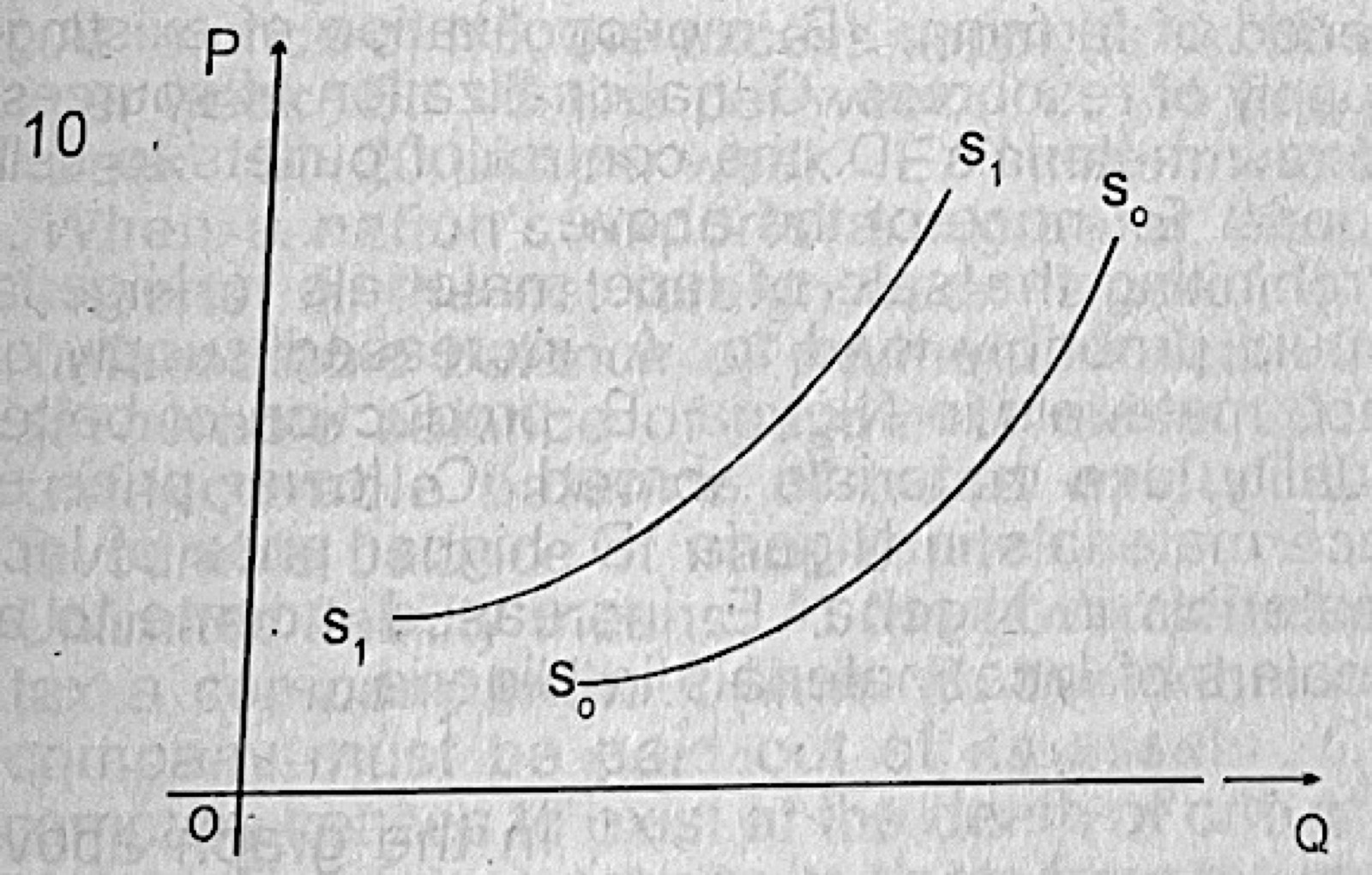
Question 10 Theory of Supply In the above diagram, So So is the original supply curve while S1 S1 is the new curve. Which of the following does S1 S1 represent?
A. A movement along a given supply curve B. An increase in supply C. A decrease in supply D. A perfectly elastic supply curve E. An abnormal supply curve. Show the answer and explanation Answer: C (A decrease in supply )
Explanation S1 S1 lies to the left of (above) So So , so less is supplied at each price: supply has decreased.
Open this question
Question 11 Economic Growth and Development Governments in West African countries engage in running a number of enterprises because
A. large amounts of capital are needed and key industries should not be left in private hands B. private capital would not establish an adequate infrastructure C. it brings about a more even distribution of the country's wealth D. the social costs of some enterprises make the government the most suitable body to set them up E. all of the above Show the answer and explanation Answer: E (all of the above )
Explanation Governments run public enterprises for all these reasons: huge capital needs, strategic industries, infrastructure, fairer distribution and social costs.
Open this question
Question 12 Money and Inflation The function of money as a standard of deferred payments
A. makes it possible for an individual to build up stores of many things for future use B. makes it possible for payments to be postponed from the present to a future date C. facilitates the exchange of goods D. makes easy calculations possible E. none of the above. Show the answer and explanation Answer: B (makes it possible for payments to be postponed from the present to a future date )
Explanation As a standard of deferred payment, money lets debts be settled at a future date, e.g. buying on credit.
Open this question
Question 13 Financial Institutions By open market operations we mean the process by which
A. the Central Bank intervenes in the open market to buy or sell securities B. the commercial banks intervene in the open market to buy or sell treasury bills C. market women buy and sell commodities in the open market D. the money market takes over the functions of the Central Bank E. the bank rate is determined in the open market. Show the answer and explanation Answer: A (the Central Bank intervenes in the open market to buy or sell securities )
Explanation Open market operations are the Central Bank's buying and selling of government securities to change the money supply.
Open this question
Question 14 Financial Institutions Which of the following is NOT a major function of a Central Bank?
A. Serving as Government's bank B. Serving as banker's bank C. Acceptance of deposits from the public D. Responsibility for monetary policy E. Serving as lender of last resort. Show the answer and explanation Answer: C (Acceptance of deposits from the public )
Explanation Taking deposits from the general public is the work of commercial banks, not the Central Bank.
Open this question
Question 15 International Trade Summary of production conditions in countries I and II
A. country I has absolute disadvantage in the production of both cocoa and cloth B. country I has absolute advantage in the production of both cocoa and cloth C. country II has absolute advantage in the production of both cocoa and cloth D. country II has a comparative advantage in the production of cocoa E. country II should leave the production of both cocoa and cloth to country I. Show the answer and explanation Answer: B (country I has absolute advantage in the production of both cocoa and cloth )
Explanation With the same 200 labour days, country I produces more cocoa (600 > 300) and more cloth (900 > 800), so it has an absolute advantage in both.
Open this question
Question 16 International Trade The infant industry argument for protection in developing countries recognizes the need to employ tariffs to protect
A. industries producing baby food and clothing B. industries owned by infants C. newly set-up industries D. industries in which infants will be taken care of E. industries that behave like infants. Show the answer and explanation Answer: C (newly set-up industries )
Explanation 'Infant industries' are new local industries that need temporary protection until they can compete.
Open this question
Question 17 Balance of Payments and Exchange Rates Invisible trade refers to trade in
A. services B. goods and services C. tangible goods D. short-term and long-term capital E. goods that cannot be seen. Show the answer and explanation Answer: A (services )
Explanation Invisible trade is trade in services such as shipping, banking, insurance and tourism.
Open this question
Question 18 Public Finance Indirect taxes are taxes
A. which are levied on the incomes and profits of individuals and firms B. whose incidence always falls on the consumer C. which are based on the progressive principle D. on casinos, airports and capital gains E. which are levied on people and economic units through the goods and services they purchase. Show the answer and explanation Answer: E (which are levied on people and economic units through the goods and services they purchase. )
Explanation Indirect taxes are charged on goods and services, so people pay them when they buy those goods.
Open this question
Question 19 Public Finance The situation whereby in a fiscal year a government's revenue receipts are less than its expenditures is referred to as
A. budget deficit B. balanced budget C. budget surplus D. budget statement E. unfavourable budget. Show the answer and explanation Answer: A (budget deficit )
Explanation When spending is greater than revenue, the budget is in deficit.
Open this question
Question 20 Agriculture Which of the following statements is NOT true about agriculture in West Africa?
A. Agriculture employs over 60 per cent of West Africa's occupied population B. Agricultural production is the basis for excise taxes in West Africa C. Many West African countries depend on agricultural exports for foreign exchange earnings D. Agriculture supplies West African industries with raw materials E. Agriculture provides incomes to West African farmers who engage in it. Show the answer and explanation Answer: B (Agricultural production is the basis for excise taxes in West Africa )
Explanation Excise taxes are charged on locally manufactured goods, not on agricultural production.
Open this question
Question 21 Industrialisation The process by which West African countries attempt to reduce the import of manufactured goods by encouraging firms to produce these goods at home is known as
A. industrialization B. export-promotion C. import-substitution D. export-substitution E. import-expansion. Show the answer and explanation Answer: C (import-substitution )
Explanation Producing at home the goods that used to be imported is called import substitution.
Open this question
Question 22 Basic Concepts Economics may be defined as
A. the study of money and banking B. the study of markets and prices C. the study of production and distribution D. the study of human behaviour in the allocation of scarce resources E. the study of the employment of labour, land, and capital. Show the answer and explanation Answer: D (the study of human behaviour in the allocation of scarce resources )
Explanation Economics studies how people behave when allocating scarce resources among competing wants.
Open this question
Question 23 Elasticity Elasticity of demand is given by
A. the percentage change in quantity demanded divided by the corresponding percentage change in price B. the percentage change in price divided by the corresponding percentage change in quantity demanded C. the percentage change in quantity demanded divided by the corresponding price D. the percentage change in price divided by the corresponding quantity demanded E. none of the above. Show the answer and explanation Answer: A (the percentage change in quantity demanded divided by the corresponding percentage change in price )
Explanation Price elasticity of demand = % change in quantity demanded ÷ % change in price.
Open this question
Question 24 Elasticity If a commodity has many substitutes, it is most likely that
A. the demand curve is fairly inelastic B. the demand curve is fairly elastic C. the demand curve is parallel to the quantity axis D. the demand curve is positively sloped E. the price of the commodity is too high. Show the answer and explanation Answer: B (the demand curve is fairly elastic )
Explanation With many substitutes, a small price rise makes buyers switch, so demand is fairly elastic.
Open this question
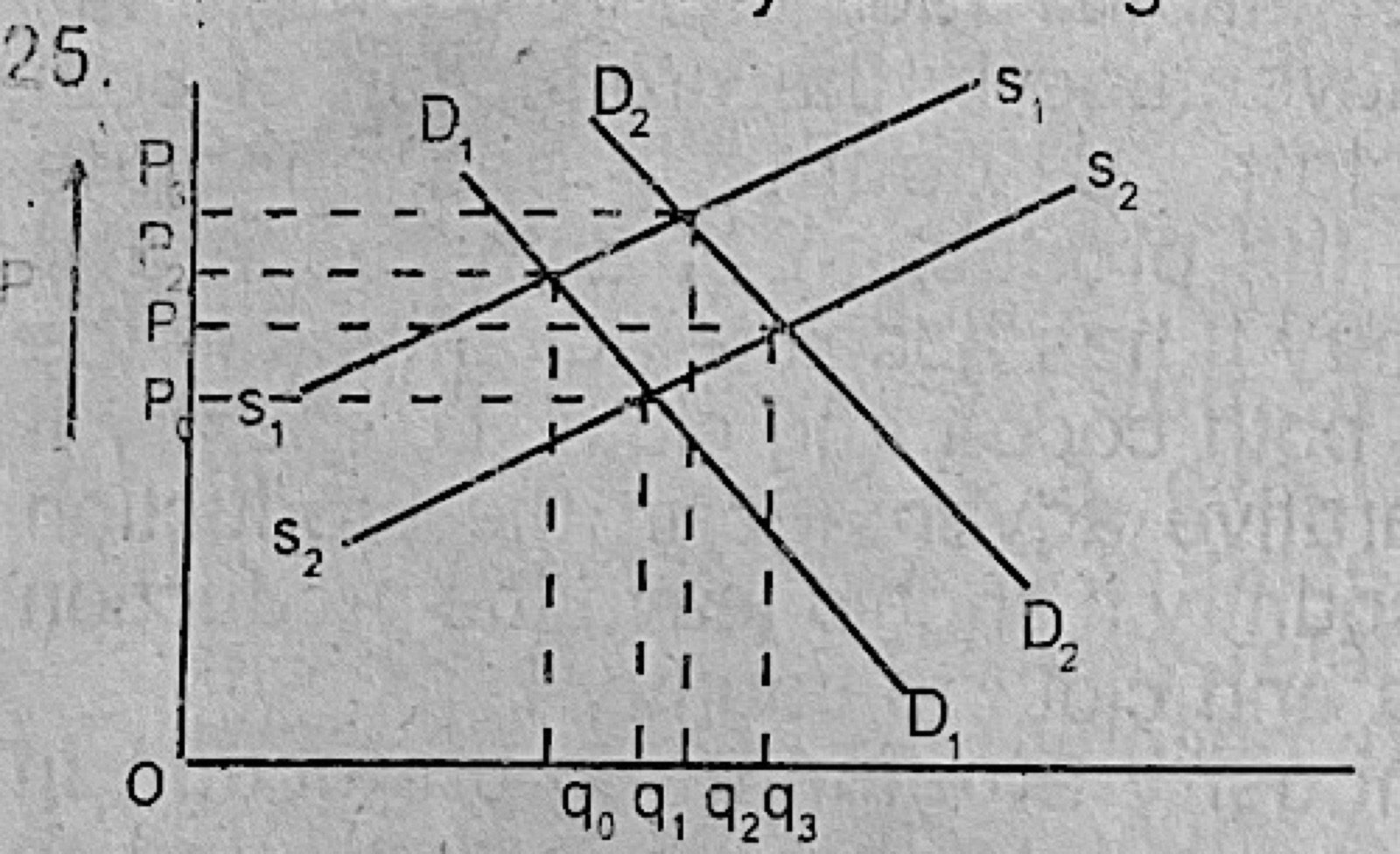
Question 25 Price Determination With reference to the figure above, what is the new equilibrium quantity and price if the Demand Curve shifts forward from D1 to D2 and the Supply Curve shifts downward from S1 to S2 ?
A. (P2 , q3 ) B. (P3 , q2 ) C. (P2 , qo ) D. (Po , q1 ) E. (P2 , q2 ) Show the answer and explanation Answer: A ((P2 , q3 ) )
Explanation The new equilibrium is where D2 crosses S2 ; reading down and across from that point gives quantity q3 and price P2 .
Open this question
Question 26 Market Structures Which of the following statements does NOT describe a situation of perfect competition?
A. The firm faces an infinitely elastic demand curve B. The firm makes no pure profit in the short run C. The price does not change with changes in the output level of the firm D. There is freedom of entry into, and exit out of the industry E. The firm can sell all it produces at the market price. Show the answer and explanation Answer: B (The firm makes no pure profit in the short run )
Explanation A perfectly competitive firm can earn supernormal profit in the short run; it earns only normal profit in the long run.
Open this question
Question 27 Balance of Payments and Exchange Rates Surplus in balance of payments leads to
A. inflation or increasing prices generally B. increase in foreign reserves C. decrease in foreign reserves D. Government budget surplus E. none of the above. Show the answer and explanation Answer: B (increase in foreign reserves )
Explanation When more foreign currency comes in than goes out, the extra is added to the country's foreign reserves.
Open this question
Question 28 Money and Inflation Which of the following does NOT belong in respect of the quantity of money?
A. Durability B. Divisible into the smallest units of value C. Portable D. Identifiable by all E. Measure of value. Show the answer and explanation Answer: E (Measure of value. )
Explanation Durability, divisibility, portability and recognisability are qualities of good money; measure of value is a function of money, not a quality.
Open this question
Question 29 Public Finance Government budget can be described as the sum of
A. indirect tax, direct tax, and loans expected within a financial year B. planned recurrent expenditure and planned investment expenditure C. planned capital expenditure for a development plan within a plan period D. planned expenditure and expected revenue within a financial year E. planned expenses of all ministries within a financial year. Show the answer and explanation Answer: D (planned expenditure and expected revenue within a financial year )
Explanation A budget is the government's plan of expected revenue and planned spending for one financial year.
Open this question
Question 30 Economic Systems An economy in which both the public and the private sectors contribute substantially to the growth of output is
A. a socialist economy B. a capitalist economy C. a mixed economy D. an industrial economy E. a peasant economy. Show the answer and explanation Answer: C (a mixed economy )
Explanation A mixed economy combines government enterprises and private enterprise.
Open this question
Question 31 National Income Sector 1 (Agriculture): share in National Output 25%, share in total Employment 60%, growth rate of Sectoral Output 2%growth rate of Total National Output or GDP is
A. 6.45% i.e. (25x2+10x5+50x10+15x3)/100% B. 20.0%, i.e. (2+5+10+3)% C. 2.95%, i.e. (60x2+10x5+5x10+25x3)/100% D. 5.0%, i.e. (2+5+10+3)/4% E. not obtainable. Show the answer and explanation Answer: A (6.45% i.e. (25x2+10x5+50x10+15x3)/100% )
Explanation Each sector's growth counts according to its share of national output: (25×2 + 10×5 + 50×10 + 15×3) ÷ 100 = 645 ÷ 100 = 6.45%. A simple average ignores that petroleum is half of output.
Open this question
Question 32 Population Which is NOT an important factor responsible for high concentration of population in some parts of Nigeria?
A. Climatic influences B. Development of trade and markets C. Soil fertility D. Processing of petroleum oil E. Concentration of educational facilities. Show the answer and explanation Answer: D (Processing of petroleum oil )
Explanation Petroleum processing employs few people, so it has not drawn large populations the way climate, fertile soil, trade and schools have.
Open this question
Question 33 Basic Concepts Scarcity in economics generally refers to
A. a period of farming B. monopolization of existing supply of resources C. nationalization of sources of raw materials D. the control of outlets to sell goods E. none of the above. Show the answer and explanation Answer: E (none of the above. )
Explanation Scarcity means resources are limited compared with human wants, which none of A to D says.
Open this question
Question 34 International Trade Prohibiting the sale of lace materials in Nigeria would probably lead to
A. increased supply of lace materials in Nigeria B. production of better quality lace materials abroad C. lower price of lace materials in Nigeria D. higher price of lace materials in Nigeria E. increased income to all dealers of lace materials in Nigeria. Show the answer and explanation Answer: D (higher price of lace materials in Nigeria )
Explanation A ban cuts the legal supply while people still want lace, so the price (often on the black market) goes up.
Open this question
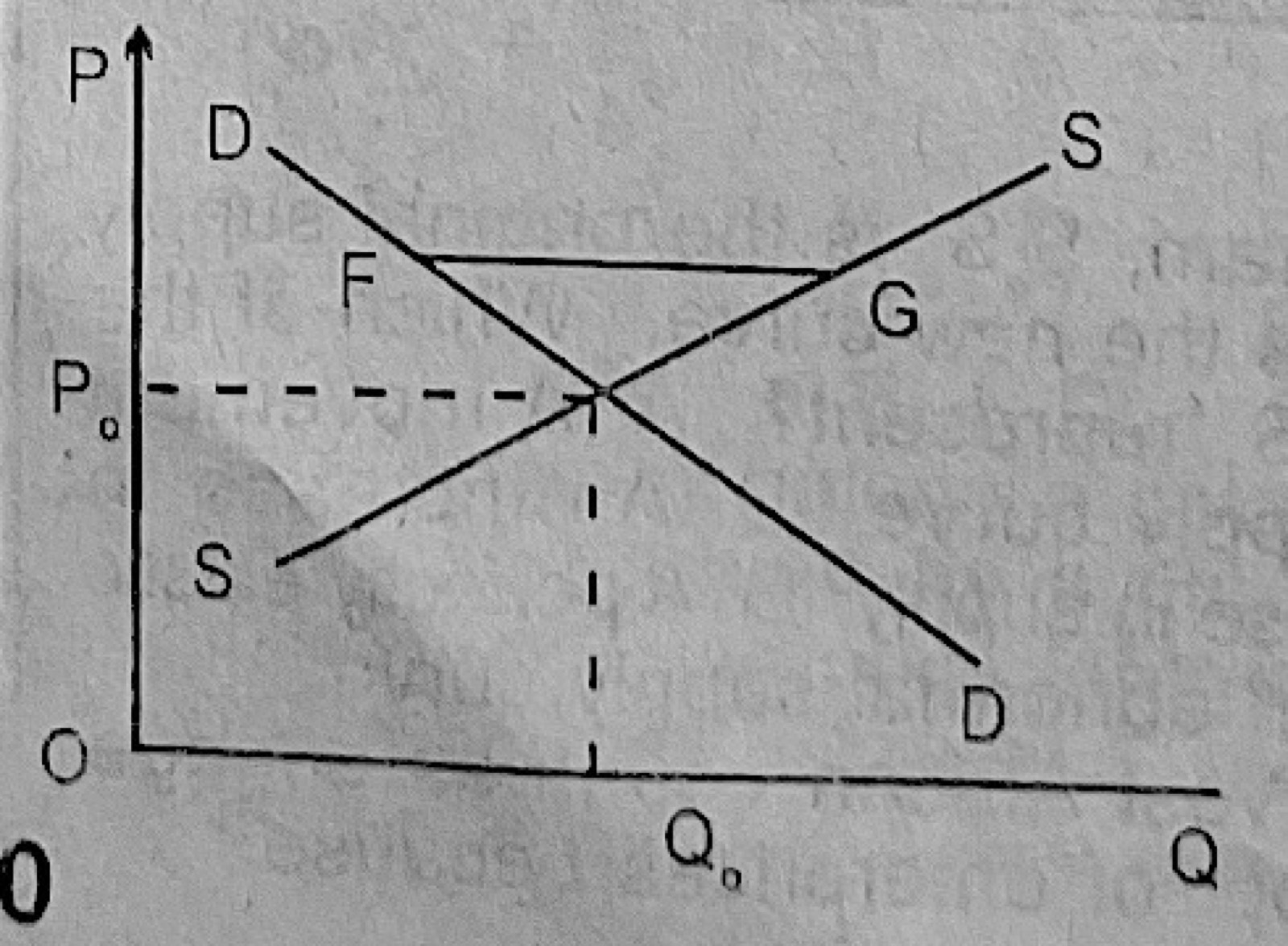
Question 35 Price Determination In the graph above, FG indicates
A. excess demand B. excess supply C. equilibrium quantity supplied D. equilibrium quantity demanded E. equilibrium price. Show the answer and explanation Answer: B (excess supply )
Explanation FG is drawn at a price above Po ; there quantity supplied (G) is greater than quantity demanded (F), so FG is excess supply.
Open this question
Question 36 Balance of Payments and Exchange Rates Which of the following is NOT a visible item on international trade payments?
A. Payments for imported cars B. Receipts from cocoa exports C. Payments to foreign shipping companies D. Payments for steel imports E. Payments for petroleum imports. Show the answer and explanation Answer: C (Payments to foreign shipping companies )
Explanation Shipping is a service, so payments to foreign shipping companies are invisible items.
Open this question
Question 37 International Trade Given the international trade statistics of Nigeria for the past 6 years, which of these statements would you consider to be correct?
A. The value of industrial exports is declining B. The value of industrial imports is constant C. The share of agricultural exports is increasing D. The share of agricultural exports is decreasing E. The value of mineral exports is declining Show the answer and explanation Answer: D (The share of agricultural exports is decreasing )
Explanation Since the oil boom, petroleum has dominated Nigeria's exports, so the share of agricultural exports has been falling.
Open this question
Question 38 Basic Concepts The most basic concern of economists is to
A. create human wants B. satisfy all human wants C. redistribute income so that it is used correctly D. create perfect competition E. study ways of allocating scarce resources in order to satisfy human wants. Show the answer and explanation Answer: E (study ways of allocating scarce resources in order to satisfy human wants. )
Explanation Economics is about how scarce resources are allocated to satisfy as many wants as possible.
Open this question
Question 40 Theory of Demand An increase in the price of butter causes an increase in the demand for margarine. This indicates that butter and margarine are
A. substitute goods B. complementary goods C. elastic goods D. inelastic goods E. inferior goods. Show the answer and explanation Answer: A (substitute goods )
Explanation When butter becomes dearer people switch to margarine, which shows the two are substitutes.
Open this question
Question 41 Price Determination An equilibrium price
A. keeps excess demand within limits B. keeps excess supply within limits C. generates the greatest possible demand and supply D. generates the greatest possible profits E. equates the quantity supplied to be equal to the quantity demanded. Show the answer and explanation Answer: E (equates the quantity supplied to be equal to the quantity demanded. )
Explanation At the equilibrium price, quantity supplied equals quantity demanded.
Open this question
Question 42 Price Determination Market for GARRI
A. 30 tins per week B. 45 tins per week C. 15 tins per week D. 20 tins per week E. indeterminate. Show the answer and explanation Answer: D (20 tins per week )
Explanation Excess supply = quantity supplied − quantity demanded = 25 − 5 = 20 tins per week.
Open this question
Question 43 Balance of Payments and Exchange Rates When a nation's exports are greater than its imports
A. the net foreign trade is zero B. an unfavourable balance of payments exists C. a favourable balance of payments exists D. an unfavourable balance of trade exists E. a favourable balance of trade exists. Show the answer and explanation Answer: E (a favourable balance of trade exists. )
Explanation When exports of goods are worth more than imports, the balance of trade is favourable (a surplus).
Open this question
Question 44 Business Organisations Unlimited liability means
A. the government can tax a company without limit B. the debts of a company must be paid out of its assets C. a company ceases to exist at the death of one of its owners D. a firm must pay its debts from business as well as private funds E. none of the above. Show the answer and explanation Answer: D (a firm must pay its debts from business as well as private funds )
Explanation With unlimited liability the owners' personal property can be taken to pay the business's debts.
Open this question
Question 45 Labour Market One of the probable effects of an increased minimum wage in Nigeria is
A. to create voluntary unemployment B. to decrease the wage rate C. to increase the level of employment D. to create involuntary unemployment E. to increase the demand for labour. Show the answer and explanation Answer: D (to create involuntary unemployment )
Explanation A minimum wage above the market wage makes employers hire fewer workers, so some who want jobs cannot find them.
Open this question
Question 46 Theory of Demand If the income of a consumer rises and his demand for good X falls, good X can be described as
A. a normal good B. an abnormal good C. a good with inelastic demand D. a good with unitary elastic demand E. none of the above. Show the answer and explanation Answer: E (none of the above. )
Explanation A good whose demand falls as income rises is an inferior good, which is not one of the options.
Open this question
Question 47 Money and Inflation Inflation is likely to benefit
A. persons with bank savings B. persons employed in financial houses C. debtors D. persons who live on fixed pension funds E. creditors. Show the answer and explanation Answer: C (debtors )
Explanation Debtors repay loans with money that has lost value, so inflation helps them.
Open this question
Question 48 Market Structures Which of the following is NOT a characteristic of perfect competition?
A. Many sellers and buyers in the markets B. There is perfect knowledge C. Supply and demand are equal D. There is no advertising E. Products are identical. Show the answer and explanation Answer: C (Supply and demand are equal )
Explanation Many buyers and sellers, perfect knowledge, no advertising and identical products are features of perfect competition; equal supply and demand is just equilibrium, found in any market.
Open this question
Question 49 Basic Concepts Opportunity cost is best defined as
A. the penalty for not seizing golden opportunities B. sacrificed alternative (output, income, etc.) C. the cost of creating job opportunities D. payment made to an industrial worker E. the difference between fixed and variable costs. Show the answer and explanation Answer: B (sacrificed alternative (output, income, etc.) )
Explanation Opportunity cost is the alternative given up when a choice is made.
Open this question
Question 50 Public Finance Progressive income tax can be expressed as
A. tax that falls as income rises B. tax that rises as income falls C. tax that is independent of income D. tax that rises as income rises E. tax that is neutral to income. Show the answer and explanation Answer: D (tax that rises as income rises )
Explanation A progressive tax takes a bigger share of income as income rises.
Open this question Sign up free for every JAMB Economics year, practice by topic and timed mocks.
Start practising free