Home › Past questions › JAMB › Chemistry › 2006 44 questions. Try each one, then open the answer to check yourself and read the explanation.
Sign up free to answer these questions on a CBT screen with a timer, then see your score and every answer explained.
Start practising free
Question 1 Metals and their Compounds The raw material used for the smelting of iron ore in a furnace is
A. CaSO4 B. CaCO3 C. CuSO4 D. Zn(NO3 )2 Show the answer and explanation Answer: B (CaCO3 )
Explanation Limestone (CaCO3 ) is charged into the blast furnace with the ore and coke; it decomposes to CaO, which removes silica impurities as slag.
Open this question
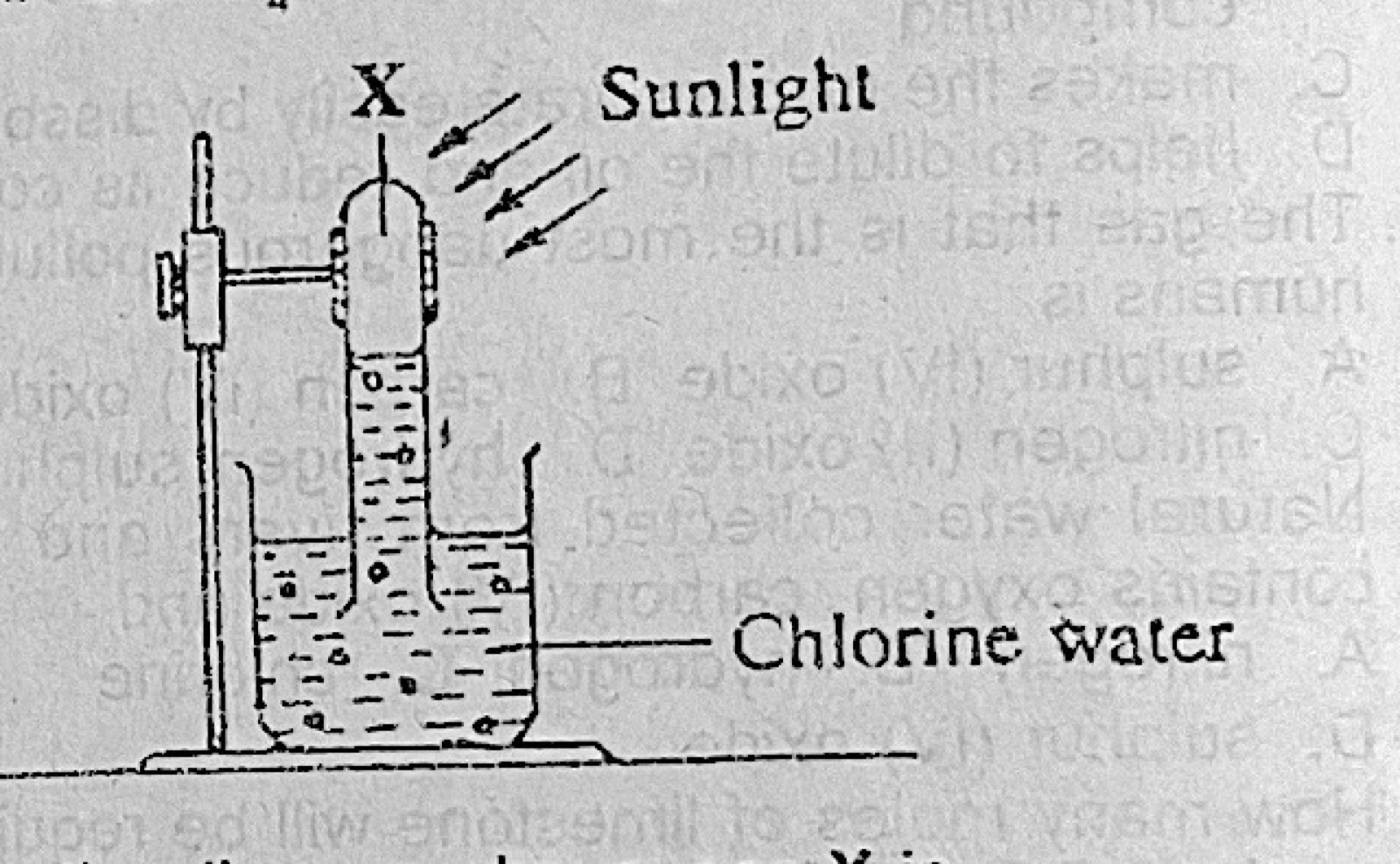
Question 2 Halogens In the diagram above, gas X is
A. hydrogen B. chlorine C. oxygen D. hydrogen chloride Show the answer and explanation Answer: C (oxygen )
Explanation In sunlight chlorine water decomposes: 2HOCl → 2HCl + O2 , so the gas collected is oxygen.
Open this question
Question 3 Nitrogen and its Compounds On heating, which of the following compounds will decompose to the free metal, nitrogen (IV) oxide and oxygen?
A. Ca(NO3 )2 B. Cu(NO3 )2 C. AgNO3 D. NaNO3 Show the answer and explanation Answer: C (AgNO3 )
Explanation Nitrates of metals low in the activity series, like silver, decompose right down to the metal: 2AgNO3 → 2Ag + 2NO2 + O2 .
Open this question
Question 4 Periodic Table Group IA metals are not found free in nature because they
A. are very reactive and unstable B. are malleable and ductile C. have high melting and boiling points D. conduct heat and electricity Show the answer and explanation Answer: A (are very reactive and unstable )
Explanation Alkali metals lose their single outer electron very easily, so they react quickly with air and water and are always found combined in compounds.
Open this question
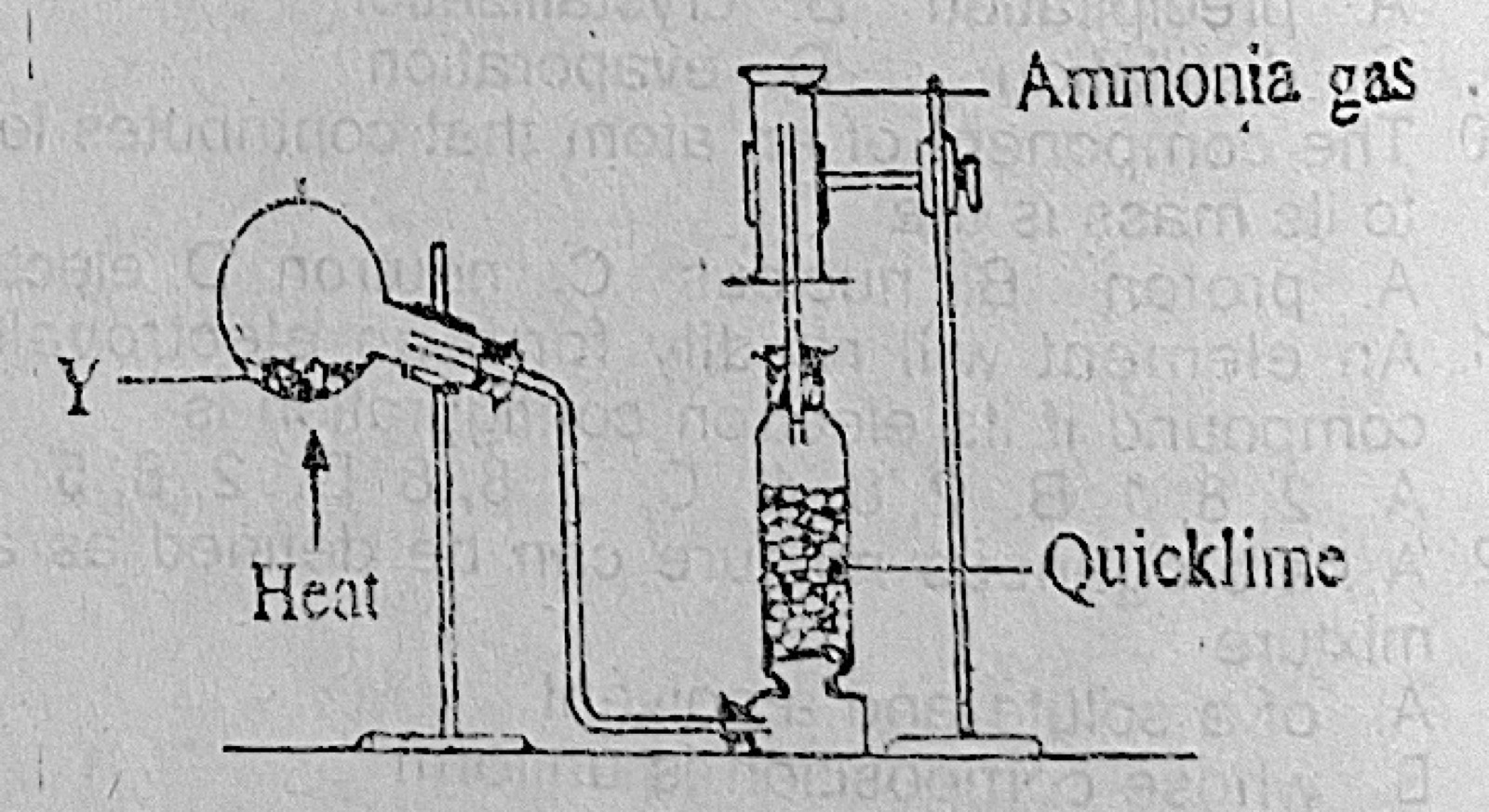
Question 5 Nitrogen and its Compounds In the diagram above, mixture Y is
A. NH4 NO3(s) + CaSO4(s) B. NH4 Cl(s) + NaNO2(aq) C. NH4 NO2(s) + Na2 SO4(s) D. NH4 Cl(s) + Ca(OH)2(s) Show the answer and explanation Answer: D (NH4 Cl(s) + Ca(OH)2(s) )
Explanation Ammonia is prepared in the laboratory by heating an ammonium salt with a base: 2NH4 Cl + Ca(OH)2 → CaCl2 + 2H2 O + 2NH3 , and dried with quicklime.
Open this question
Question 6 Carbon and its Compounds Carbon exists naturally in the combined state as
A. graphite B. coal C. diamond D. wood Show the answer and explanation Answer: D (wood )
Explanation Graphite and diamond are free (uncombined) carbon and coal is largely impure free carbon, while in wood carbon is combined with hydrogen and oxygen in compounds such as cellulose.
Open this question
Question 7 Rates of Reaction The efficiency of a solid catalyst to increase reaction rates depends on its
A. surface area B. solubility C. concentration D. quantity Show the answer and explanation Answer: A (surface area )
Explanation Reactions on a solid catalyst happen at its surface, so the larger the surface area (e.g. powder or fine mesh), the better it works.
Open this question
Question 8 Chemical Equilibrium Dynamic equilibrium describes a situation where
A. a reaction gives back the reactants B. the concentration of reactants and products is equal C. both forward and reverse reactions proceed at the same rate D. reactants are converted to products. Show the answer and explanation Answer: C (both forward and reverse reactions proceed at the same rate )
Explanation At dynamic equilibrium both reactions are still going on, but at equal rates, so concentrations stay constant (not necessarily equal).
Open this question
Question 11 Qualitative Analysis The characteristic colour of the flame shown when a copper salt moistened with concentrated hydrochloric acid on a platinum wire is put on bunsen burner is
A. lilac B. green C. yellow D. brick-red Show the answer and explanation Answer: B (green )
Explanation Copper compounds give a green (bluish-green) flame. Lilac is potassium, yellow is sodium and brick-red is calcium.
Open this question
Question 13 Qualitative Analysis The sulphide which is insoluble in dilute hydrochloric acid is
A. FeS B. CuS C. ZnS D. Na2 S Show the answer and explanation Answer: B (CuS )
Explanation CuS is extremely insoluble, so it does not dissolve in dilute HCl. FeS and ZnS dissolve in dilute acid giving H2 S, and Na2 S is soluble even in water.
Open this question
Question 14 Rates of Reaction Which of the following typically represents a photochemical reaction?
A. Formation of water from hydrogen and oxygen molecules. B. Conversion of dinitrogen(IV) oxide to nitrogen(IV) oxide. C. Decomposition of calcium hydroxide to its oxide. D. Conversion of silver halides to grey metallic silver. Show the answer and explanation Answer: D (Conversion of silver halides to grey metallic silver. )
Explanation A photochemical reaction is started by light. Silver halides decompose in light to silver (the basis of photography).
Open this question
Question 15 Hydrocarbons The gas obtained as a product of anaerobic action on organic matter buried in the earth is
A. ethene B. methane C. Carbon (IV) oxide D. nitrogen(IV) oxide Show the answer and explanation Answer: B (methane )
Explanation Bacteria decaying organic matter without air produce methane (marsh gas or natural gas).
Open this question
Question 16 Introduction to Organic Chemistry 2-methylbut-2-ene has the structure
A. C2 H5 CH(CH3 ) — CH = CH2 B. CH3 — CH2 — C(CH3 ) = CH2 C. CH3 — CH(CH3 ) — CH = CH2 D. CH3 — CH = C(CH3 ) — CH3 Show the answer and explanation Answer: D (CH3 — CH = C(CH3 ) — CH3 )
Explanation But-2-ene has a 4-carbon chain with C=C between C2 and C3; a methyl group on C2 gives CH3 −C(CH3 )=CH−CH3 , which is option D read from the other end.
Open this question
Question 17 Alkanols CH3 — CH2 — C(CH3 )(OH) — H
A. 2 – butanone B. 2 – butanal C. 3 – butanal D. 3 – butanone Show the answer and explanation Answer: A (2 – butanone )
Explanation The compound is butan-2-ol, a secondary alkanol. Secondary alkanols are oxidised to ketones, here butan-2-one (2-butanone).
Open this question
Question 18 Petroleum and Coal Nigerian crude oil is described as light crude because of its
A. low sulphur content B. high natural gas content C. high octane number D. low aliphatic-hydrocarbon content Show the answer and explanation Answer: A (low sulphur content )
Explanation Nigerian crude is a light, sweet crude: it contains very little sulphur, which is the property the question's key relies on.
Open this question
Question 19 Hydrocarbons An example of aliphatic unsaturated hydrocarbon is
A. pentane B. butanol C. propene D. benzene Show the answer and explanation Answer: C (propene )
Explanation Propene is an open-chain (aliphatic) hydrocarbon with a C=C double bond. Pentane is saturated, butanol is not a hydrocarbon, and benzene is aromatic.
Open this question
Question 20 Alkanoic Acids and Esters Which of the following functional groups will give gas bubbles when treated with a saturated solution of sodium hydrogen trioxocarbonate(IV)?
A. —NH2 B. —COOH (—C(=O)—OH) C. — OH D. >C=O Show the answer and explanation Answer: B (—COOH (—C(=O)—OH) )
Explanation Carboxylic acids are strong enough to react with NaHCO3 , releasing bubbles of CO2 . Amines, alcohols and carbonyl compounds do not.
Open this question
Question 22 Chemical Bonding CH3 — CH2 — C ≡ CH
A. sp2 B. sp C. sp3 and sp2 D. sp3 and sp Show the answer and explanation Answer: D (sp3 and sp )
Explanation The two saturated carbons (CH3 and CH2 ) are sp3 ; the two triple-bonded carbons are sp.
Open this question
Question 23 Mole Concept and Stoichiometry One mole of a hydrocarbon contains 36g of carbon and its vapour density is 20. The structure of the hydrocarbon is
A. CH3 C≡CH B. CH3 CH=CH2 C. CH3 CH2 C≡CH D. CH3 CH2 CH3 Show the answer and explanation Answer: A (CH3 C≡CH )
Explanation Molar mass = 2 × 20 = 40 g. 36 g C = 3 mol C, leaving 4 g = 4 H, so the formula is C3 H4 , propyne CH3 C≡CH.
Open this question
Question 24 Solubility and Solutions An emulsion may be produced by shaking a detergent solution with
A. palm wine B. ethanoic acid C. palm oil D. water Show the answer and explanation Answer: C (palm oil )
Explanation An emulsion is a liquid dispersed in another liquid it does not mix with. The detergent breaks palm oil into tiny droplets spread through the water.
Open this question
Question 25 Hydrocarbons The products of the combustion of candle wax are
A. hydrogen and water B. oxygen and water C. carbon (IV) oxide and water D. carbon(II) oxide and water Show the answer and explanation Answer: C (carbon (IV) oxide and water )
Explanation Candle wax is a hydrocarbon; burning it completely in air gives carbon(IV) oxide and water.
Open this question
Question 27 Environmental Pollution Which of the following results in the fall of acid rain?
A. Oxides of lead B. Particulate matter C. Oxides of sulphur D. Gaseous hydrocarbons Show the answer and explanation Answer: C (Oxides of sulphur )
Explanation Sulphur oxides dissolve in rain water to form sulphurous and sulphuric acids, causing acid rain.
Open this question
Question 28 Water Water has the ability to dissolve almost all substances because its molecule has a structure with
A. one positive end and one neutral end B. one positive end and one negative end C. two negative ends D. two positive ends Show the answer and explanation Answer: B (one positive end and one negative end )
Explanation Water is a polar molecule: the oxygen end is partly negative and the hydrogen end partly positive, so it attracts and surrounds ions and polar molecules.
Open this question
Question 29 Solubility and Solutions When a crystal was added to the clear solution of its salt, the crystal did not dissolve and the solution remained unchanged. This showed that the solution was
A. supersaturated B. concentrated C. unsaturated D. saturated Show the answer and explanation Answer: D (saturated )
Explanation A saturated solution can hold no more solute at that temperature, so an added crystal neither dissolves nor grows. (In a supersaturated solution more crystals would form.)
Open this question
Question 30 Atomic Structure A particle that contains 11 protons, 12 neutrons and 10 electrons is probably a
A. neutral non-metal B. metallic ion C. non-metallic ion D. neutral metal Show the answer and explanation Answer: B (metallic ion )
Explanation 11 protons is sodium; having one electron fewer than protons means it is the positive ion Na+ , a metallic ion.
Open this question
Question 31 Separation of Mixtures A difference between chemical and physical change is that in a chemical change
A. oxygen is consumed B. heat is supplied C. a reversible process occurs D. a new substance is formed Show the answer and explanation Answer: D (a new substance is formed )
Explanation A chemical change always produces a new substance; a physical change only alters the state or form.
Open this question
Question 32 Mole Concept and Stoichiometry The volume of 2.5 moles of oxygen at s.t.p. is [Molar volume of a gas at s.t.p. = 22.4 dm3 ]
A. 50.0 dm3 B. 84.0 dm3 C. 28.0 dm3 D. 56.0 dm3 Show the answer and explanation Answer: D (56.0 dm3 )
Explanation Volume = moles × molar volume = 2.5 × 22.4 = 56.0 dm3 .
Open this question
Question 33 Radioactivity Nuclear fission involves the splitting of a heavy element into two nuclei of
A. nearly equal masses with a release of energy and radiation. B. equal masses with a release of energy C. equal masses with a release of energy and radiation. D. unequal masses without any release of energy. Show the answer and explanation Answer: A (nearly equal masses with a release of energy and radiation. )
Explanation In fission a heavy nucleus such as U-235 splits into two lighter nuclei of roughly similar size, releasing a lot of energy, neutrons and radiation.
Open this question
Question 34 Mole Concept and Stoichiometry What is the molar mass of a substance, if 0.4 mole of the substance has a mass of 25.0 g?
A. 62.5 g B. 40.0 g C. 6.3 g D. 2.5 g Show the answer and explanation Answer: A (62.5 g )
Explanation Molar mass = mass ÷ moles = 25.0 ÷ 0.4 = 62.5 g.
Open this question
Question 35 Atomic Structure The element with the electron configuration 1s2 2s2 2p3 is
A. calcium B. chlorine C. oxygen D. nitrogen Show the answer and explanation Answer: D (nitrogen )
Explanation Adding up the electrons gives 2 + 2 + 3 = 7, the atomic number of nitrogen.
Open this question
Question 36 Periodic Table A decrease in atomic size and an increase in nuclear charge across a period lead to
A. an increase in the tendency to lose electrons B. an increase in chemical reactivity C. a decrease in electropositivity D. a decrease in covalency in bond formation. Show the answer and explanation Answer: C (a decrease in electropositivity )
Explanation Across a period the outer electrons are pulled more strongly by the nucleus, so atoms lose electrons less easily: elements become less electropositive (less metallic).
Open this question
Question 37 Separation of Mixtures The order in which a mixture of sand, ammonium chloride and sodium chloride can be separated is
A. dissolution → dryness → filtration → evaporation B. filtration → sublimation → evaporation → dryness C. sublimation → dissolution → filtration → evaporation D. dissolution → filtration → sublimation → evaporation Show the answer and explanation Answer: C (sublimation → dissolution → filtration → evaporation )
Explanation Heat first to sublime off NH4 Cl; dissolve the rest in water; filter off the sand; then evaporate the filtrate to get NaCl.
Open this question
Question 38 Atomic Structure The idea of planetary electrons was that of
A. Rutherford B. Thompson C. Bohr D. Dalton Show the answer and explanation Answer: A (Rutherford )
Explanation Rutherford's nuclear (planetary) model pictured electrons moving round a small dense nucleus like planets round the sun.
Open this question
Question 39 Gas Laws If 30 cm3 of a gas at 50°C is warmed to 80°C at a fixed pressure, the fractional increase in volume is
A. 0.009 B. 0.093 C. 0.910 D. 1.090 Show the answer and explanation Answer: B (0.093 )
Explanation Charles' law: V2 = 30 × 353/323 = 32.8 cm3 . The increase 2.8 cm3 divided by 30 is about 0.093.
Open this question
Question 40 Mole Concept and Stoichiometry 2C2 H2(g) + 5O2(g) → 4CO2(g) + 2H2 O(g)
A. 264 g B. 39 g C. 352 g D. 156 g Show the answer and explanation Answer: A (264 g )
Explanation 78 g ÷ 26 g/mol = 3 mol of ethyne. Each mole gives 2 mol CO2 , so 6 mol × 44 g = 264 g.
Open this question
Question 41 Redox Reactions The ion that can be used as an oxidizing agent is
A. Au3+ B. Fe3+ C. F− D. Ca2+ Show the answer and explanation Answer: B (Fe3+ )
Explanation An oxidising agent gains electrons. Fe3+ readily accepts an electron to become Fe2+ . F− cannot gain more electrons, and Ca2+ is very hard to reduce.
Open this question
Question 42 Hydrogen, Oxygen and Oxides Trioxonitrate(V) acid is not used for preparing hydrogen gas from metals because it
A. is strongly oxidizing B. is volatile C. renders the metal passive D. forms a layer of oxide on the metal. Show the answer and explanation Answer: A (is strongly oxidizing )
Explanation HNO3 is a strong oxidising agent: any hydrogen formed is oxidised to water, and oxides of nitrogen are given off instead.
Open this question
Question 43 Energy Changes H2(g) + Br2(g) → 2HBr(g) −1 and ΔS is − 106 J mol−1 K−1 , the reaction will
A. not proceed spontaneously at the given temperature B. proceed spontaneously at the given temperature C. proceed in the reverse direction at the given temperature D. proceed spontaneously at lower temperatures. Show the answer and explanation Answer: B (proceed spontaneously at the given temperature )
Explanation ΔG = ΔH − TΔS = −72 − (298 × −0.106) = −72 + 31.6 = −40.4 kJ mol−1 . A negative ΔG means it proceeds spontaneously at 25°C.
Open this question
Question 44 Electrolysis Zinc and carbon rods are used as anode and cathode respectively in a
A. Leclanche cell B. lead accumulator C. Daniell cell D. voltaic cell Show the answer and explanation Answer: A (Leclanche cell )
Explanation The Leclanché (dry) cell has a zinc case as the negative electrode and a central carbon rod as the positive electrode.
Open this question
Question 45 Electrolysis The solution that will conduct the highest amount of electricity is
A. 0.5 mol dm−3 of hydrochloric acid B. 2.0 mol dm−3 of hydrochloric acid C. 0.5 mol dm−3 of ethanoic acid D. 2.0 mol dm−3 of ethanoic acid Show the answer and explanation Answer: B (2.0 mol dm−3 of hydrochloric acid )
Explanation HCl is a strong acid (fully ionised) and the 2.0 mol dm−3 solution has the most ions, so it conducts best.
Open this question
Question 46 Redox Reactions In which of the following is the oxidation number of sulphur equal to −2?
A. SO3 B. S8 C. H2 S D. SO2 Show the answer and explanation Answer: C (H2 S )
Explanation In H2 S each H is +1, so S is −2. In SO3 it is +6, in SO2 +4 and in S8 0.
Open this question
Question 47 Electrolysis In the electrolysis of CuSO4(aq) using platinum electrodes, the reaction at the anode is
A. 4H+ + 4e− → 2H2 B. 4OH− − 4e− → 2H2 O + O2 C. 2OH− − 2e− → 2OH D. 2OH− + 2OH− → 2H2 O + O2 Show the answer and explanation Answer: B (4OH− − 4e− → 2H2 O + O2 )
Explanation With inert electrodes, OH− ions are discharged in preference to SO4 2− at the anode, losing electrons to form water and oxygen gas.
Open this question
Question 49 Energy Changes If the heat of combustion of hydrogen is −285.8kJ, what is the heat of formation of water?
A. +571.6 kJ B. −571.6 kJ C. −285.8 kJ D. +285.8 kJ Show the answer and explanation Answer: C (−285.8 kJ )
Explanation Burning one mole of hydrogen (H2 + ½O2 → H2 O) is the same reaction as forming one mole of water from its elements, so both are −285.8 kJ.
Open this question
Question 50 Redox Reactions 5SO2(g) + 2KMnO4(aq) + 2H2 O(l) → K2 SO4(aq) + 2MnSO4(aq) + 2H2 SO4(aq)
A. purple solution B. purple precipitate C. colourless precipitate D. colourless solution Show the answer and explanation Answer: D (colourless solution )
Explanation SO2 reduces purple MnO4 − to almost colourless Mn2+ ; all the products are soluble, so a colourless solution forms.
Open this question Sign up free for every JAMB Chemistry year, practice by topic and timed mocks.
Start practising free