Home › Past questions › JAMB › Chemistry › 2004 43 questions. Try each one, then open the answer to check yourself and read the explanation.
Sign up free to answer these questions on a CBT screen with a timer, then see your score and every answer explained.
Start practising free
Question 1 Separation of Mixtures When a solid substance disappears completely as a gas on heating, the substance is said to have undergone
A. evaporation B. distillation C. crystallization D. sublimation Show the answer and explanation Answer: D (sublimation )
Explanation Sublimation is a change straight from solid to gas without melting, as with iodine or ammonium chloride.
Open this question
Question 2 Separation of Mixtures A chemical reaction is always associated with
A. an increase in the composition of one of the substances. B. a change in the volume of the reactants C. a change in the nature of the reactants D. the formation of new substances Show the answer and explanation Answer: D (the formation of new substances )
Explanation The defining feature of a chemical change is that new substances are formed.
Open this question
Question 3 Mole Concept and Stoichiometry If a solution contains 4.9g of tetraoxosulphate(VI) acid, calculate the amount of copper (II) oxide that will react with it. [Cu = 64, O = 16, S = 32, H = 1]
A. 0.8g B. 4.0g C. 40.0g D. 80.0g Show the answer and explanation Answer: B (4.0g )
Explanation H2 SO4 + CuO → CuSO4 + H2 O (1 : 1). 4.9 g ÷ 98 = 0.05 mol, so CuO needed = 0.05 × 80 = 4.0 g.
Open this question
Question 4 Mole Concept and Stoichiometry What volume of gas is evolved at s.t.p. if 2g of calcium trioxocarbonate (IV) is added to a solution of hydrochloric acid? [Ca = 40, C = 12, O = 16, Cl = 35.5, H = 1, Molar volume of a gas at s.t.p. = 22.4dm3 ]
A. 112cm3 B. 224cm3 C. 448cm3 D. 2240cm3 Show the answer and explanation Answer: C (448cm3 )
Explanation CaCO3 (100 g/mol) gives one mole of CO2 per mole. 2 g = 0.02 mol, so CO2 = 0.02 × 22 400 = 448 cm3 .
Open this question
Question 5 Gas Laws According to Charles' law, the volume of a gas becomes zero at
A. 0°C B. –100°C C. –273°C D. –373°C Show the answer and explanation Answer: C (–273°C )
Explanation Extending Charles' law (V ∝ T) to zero volume gives absolute zero, 0 K = –273°C.
Open this question
Question 6 Kinetic Theory and States of Matter It is difficult to achieve an orderly arrangement of the molecules of a gas because they
A. have no definite shape B. have little force of attraction between them C. can collide with one another in the container D. are too small in size. Show the answer and explanation Answer: B (have little force of attraction between them )
Explanation Gas molecules attract each other only very weakly, so nothing holds them in fixed, orderly positions; they move freely and randomly.
Open this question
Question 7 Gas Laws A given volume of methane diffuses in 20s. How long will it take the same volume of sulphur (IV) oxide to diffuse under the same conditions? [C = 12, H = 1, S = 32, O = 16]
A. 5s B. 20s C. 40s D. 60s Show the answer and explanation Answer: C (40s )
Explanation By Graham's law, time ∝ √(molar mass). t = 20 × √(64/16) = 20 × 2 = 40 s.
Open this question
Question 8 Atomic Structure An electron can be added to a halogen atom to form a halide ion with
A. 2 valence electrons B. 3 valence electrons C. 7 valence electrons D. 8 valence electrons Show the answer and explanation Answer: D (8 valence electrons )
Explanation A halogen atom has 7 valence electrons; gaining one electron gives the halide ion a full octet of 8.
Open this question
Question 9 Atomic Structure The shape of the s-orbital is
A. spherical B. elliptical C. spiral D. circular Show the answer and explanation Answer: A (spherical )
Explanation An s-orbital is spherically symmetrical around the nucleus.
Open this question
Question 10 Radioactivity 226 88 Ra → x 86 Rn + α – particle
A. 220 B. 222 C. 226 D. 227 Show the answer and explanation Answer: B (222 )
Explanation An alpha particle is 4 2 He, so the mass number falls by 4: 226 – 4 = 222.
Open this question
Question 11 Chemical Bonding The property of chlorine which causes hydrogen chloride to be more ionic than the chlorine molecule is its
A. electrovalency B. electron affinity C. electropositivity D. electronegativity Show the answer and explanation Answer: D (electronegativity )
Explanation Chlorine is much more electronegative than hydrogen, so it pulls the shared electrons towards itself, making H–Cl polar. In Cl2 both atoms pull equally.
Open this question
Question 13 Air Which of the following mixtures of gases is likely to burn in flame?
A. neon and hydrogen B. nitrogen and helium C. helium and neon D. neon and nitrogen Show the answer and explanation Answer: A (neon and hydrogen )
Explanation Hydrogen is flammable, so the mixture containing hydrogen can burn; the other gases are inert or do not burn.
Open this question
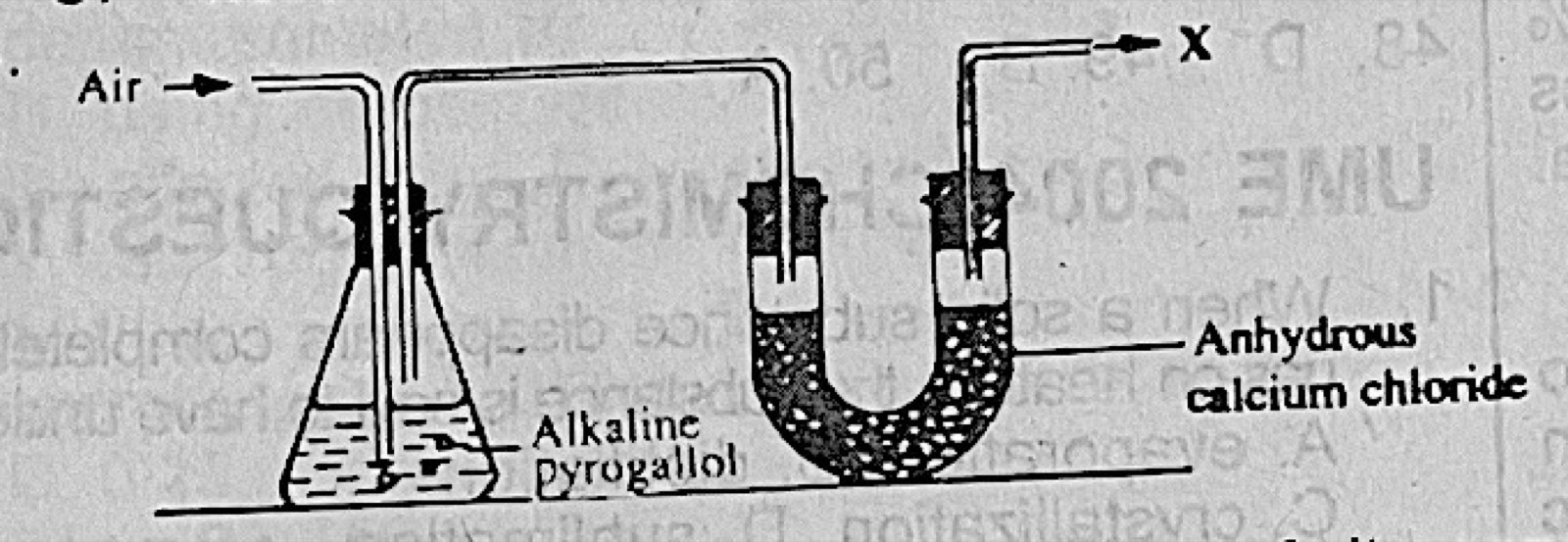
Question 14 Air In the experiment above, X is a mixture of nitrogen, carbon (IV) oxide and
A. water B. impurities C. inert gas D. oxygen Show the answer and explanation Answer: C (inert gas )
Explanation Alkaline pyrogallol absorbs oxygen and anhydrous calcium chloride absorbs water vapour, so the gas leaving at X is mainly nitrogen with the inert (noble) gases.
Open this question
Question 15 Water Hardness of water is caused by the presence of the ions of
A. magnesium and silver B. calcium and magnesium C. sodium and potassium D. calcium and sodium Show the answer and explanation Answer: B (calcium and magnesium )
Explanation Dissolved Ca2+ and Mg2+ ions react with soap to form scum, which is what makes water hard.
Open this question
Question 16 Environmental Pollution Pollution of underground water by metal ions is very likely in a soil that has high
A. acidity B. alkalinity C. chloride content D. nitrate content Show the answer and explanation Answer: A (acidity )
Explanation Acid dissolves metal compounds in the soil, releasing metal ions that seep into groundwater. In alkaline soil metals stay as insoluble hydroxides.
Open this question
Question 17 Environmental Pollution A carcinogenic substance is
A. asbestos dust B. sawdust C. nitrogen (II) oxide D. carbon (II) oxide Show the answer and explanation Answer: A (asbestos dust )
Explanation Breathing in asbestos fibres is known to cause lung cancer, so asbestos dust is carcinogenic.
Open this question
Question 18 Solubility and Solutions The solubility in mol dm-3 of 20g of CuSO4 dissolved in 100g of water at 180°C is [Cu = 64, S = 32, O = 16]
A. 0.13 B. 0.25 C. 1.25 D. 2.00 Show the answer and explanation Answer: C (1.25 )
Explanation CuSO4 = 160 g/mol, so 20 g = 0.125 mol in 100 g (about 100 cm3 ) of water. Per 1000 cm3 : 0.125 × 10 = 1.25 mol dm-3 .
Open this question
Question 20 Acids, Bases and Salts Which of these compounds is a normal salt?
A. NaHS B. NaHSO4 C. NaHCO3 D. Na2 CO3 Show the answer and explanation Answer: D (Na2 CO3 )
Explanation A normal salt has all the replaceable hydrogen of the acid replaced by a metal. Na2 CO3 has none left; the others are acid salts.
Open this question
Question 22 Redox Reactions The oxidation state of chlorine in HClO4 is
A. –5 B. –1 C. +1 D. +7 Show the answer and explanation Answer: D (+7 )
Explanation +1 (H) + x + 4(–2) = 0, so x = +7.
Open this question
Question 23 Redox Reactions ZnO(s) + CO(g) → Zn(s) + CO2(g) (heat)
A. decomposed B. displaced C. oxidized D. reduced Show the answer and explanation Answer: D (reduced )
Explanation Zinc goes from +2 in ZnO to 0 in Zn; it loses oxygen and gains electrons, so it is reduced.
Open this question
Question 25 Electrolysis In the electrolysis of brine, the anode is
A. platinum B. copper C. zinc D. carbon Show the answer and explanation Answer: D (carbon )
Explanation Chlorine attacks most metals, so an inert carbon (graphite) anode is used in the industrial electrolysis of brine.
Open this question
Question 26 Electrolysis The mass of silver deposited when a current of 10A is passed through a solution of silver salt for 4830s is [Ag = 108, F = 96500 C mol-1 ]
A. 108.0g B. 54.0g C. 27.0g D. 13.5g Show the answer and explanation Answer: B (54.0g )
Explanation Q = 10 × 4830 = 48 300 C = 0.5 F. Ag+ + e- → Ag, so 0.5 mol Ag = 0.5 × 108 = 54 g.
Open this question
Question 28 Energy Changes Which of the following hydrogen halides has the highest entropy value?
A. HF B. HCl C. HBr D. HI Show the answer and explanation Answer: D (HI )
Explanation Standard entropy rises with molar mass and number of electrons down the group (HF ≈ 174, HI ≈ 207 J K-1 mol-1 ), so HI has the highest.
Open this question
Question 29 Chemical Equilibrium N2 O4(g) ⇌ 2NO2(g)
A. a constant volume B. an increase in pressure C. a decrease in pressure D. a decrease in volume Show the answer and explanation Answer: C (a decrease in pressure )
Explanation One gas molecule gives two, so lowering the pressure shifts the equilibrium towards the side with more molecules, NO2 .
Open this question
Question 31 Carbon and its Compounds The allotrope of carbon used in the decolourization of sugar is
A. graphite B. soot C. charcoal D. lampblack Show the answer and explanation Answer: C (charcoal )
Explanation Animal (bone) charcoal has a huge surface area and adsorbs the coloured impurities from sugar solution.
Open this question
Question 32 Halogens Which of the following gases can be collected by the method of downward delivery?
A. chlorine B. oxygen C. ammonia D. hydrogen Show the answer and explanation Answer: A (chlorine )
Explanation Downward delivery suits gases denser than air. Chlorine is about 2.5 times as dense as air; ammonia and hydrogen are lighter, and oxygen is collected over water.
Open this question
Question 33 Carbon and its Compounds When steam is passed over red-hot carbon, the substances produced are
A. hydrogen and trioxocarbonate (IV) acid B. hydrogen, oxygen and carbon (IV) oxide C. hydrogen and carbon (II) oxide D. hydrogen and carbon (IV) oxide Show the answer and explanation Answer: C (hydrogen and carbon (II) oxide )
Explanation C + H2 O → CO + H2 ; this mixture of carbon(II) oxide and hydrogen is water gas.
Open this question
Question 34 Sulphur and its Compounds Sulphur (IV) oxide bleaches by
A. reduction B. oxidation C. hydration D. adsorption Show the answer and explanation Answer: A (reduction )
Explanation In water SO2 removes oxygen from (reduces) the dye to a colourless product; that is why its bleaching can wear off as air re-oxidises the dye.
Open this question
Question 35 Atomic Structure Carbon is tetravalent because
A. the electrons in both the 2s and 2p orbitals are equivalent B. the electrons in all the orbitals of carbon are equivalent C. the 2s and 2p atomic orbitals hybridize D. all the atomic orbitals of carbon hybridize Show the answer and explanation Answer: C (the 2s and 2p atomic orbitals hybridize )
Explanation One 2s electron is promoted and the 2s and three 2p orbitals mix (sp3 hybridisation), giving four equivalent half-filled orbitals that form four bonds.
Open this question
Question 36 Metals and their Compounds Aluminium hydroxide is used in the dyeing industry as a
A. salt B. dye C. mordant D. dispersant Show the answer and explanation Answer: C (mordant )
Explanation Aluminium hydroxide is a mordant: it sticks to the fibre and binds the dye to it so the colour does not wash out.
Open this question
Question 37 Metals and their Compounds Alloys are best prepared by
A. electroplating B. arc-welding C. reducing a mixture of their metallic oxides D. cooling a molten mixture of the metals. Show the answer and explanation Answer: D (cooling a molten mixture of the metals. )
Explanation Alloys are made by melting the metals together, mixing them and allowing the mixture to cool and solidify.
Open this question
Question 38 Metals and their Compounds Transition metals possess variable oxidation states because they have
A. electrons in the d orbitals B. electrons in the s orbitals C. a variable number of electrons in the p orbitals D. partially filled p orbitals Show the answer and explanation Answer: A (electrons in the d orbitals )
Explanation The 3d and 4s electrons are close in energy, so different numbers of d electrons can be used in bonding, giving several oxidation states.
Open this question
Question 39 Metals and their Compounds Sodium metal is always kept under oil because it
A. readily reacts with water B. is reduced by atmospheric nitrogen C. reacts vigorously on exposure to air D. reacts with oxygen and carbon(IV)oxide Show the answer and explanation Answer: C (reacts vigorously on exposure to air )
Explanation Sodium reacts rapidly with oxygen and moisture in air, so it is stored under paraffin oil to keep air away.
Open this question
Question 40 Hydrocarbons Oxyacetylene flame is used for iron-welding because it
A. makes the iron metal solidify very quickly B. combines with oxygen to give a pop sound C. evolves a lot of heat when burnt D. dissociates to produce carbon (IV) oxide and oxygen Show the answer and explanation Answer: C (evolves a lot of heat when burnt )
Explanation Ethyne burning in oxygen gives a very hot flame (about 3000°C), hot enough to melt iron.
Open this question
Question 41 Introduction to Organic Chemistry The alkyl group can be represented by the general formula
A. Cn H2n+1 B. Cn H2n C. Cn H2n+2 D. Cn H2n–2 Show the answer and explanation Answer: A (Cn H2n+1 )
Explanation An alkyl group is an alkane (Cn H2n+2 ) with one hydrogen removed: Cn H2n+1 , e.g. CH3 –.
Open this question
Question 42 Introduction to Organic Chemistry An isomer of C5 H12 is
A. butane B. 2 – methylbutane C. 2 – methylpropane D. 2 – ethylbutane Show the answer and explanation Answer: B (2 – methylbutane )
Explanation 2-methylbutane has 5 carbons and 12 hydrogens. Butane and 2-methylpropane are C4 H10 ; 2-ethylbutane is really a C6 compound (3-methylpentane).
Open this question
Question 43 Hydrocarbons A characteristic of the alkane family is
A. addition reaction B. elimination reaction C. substitution reaction D. neutralization reaction Show the answer and explanation Answer: C (substitution reaction )
Explanation Alkanes are saturated, so they react by substitution, e.g. methane with chlorine in sunlight.
Open this question
Question 44 Hydrocarbons Which of these reagents can confirm the presence of a triple bond?
A. Bromine water B. Acidified KMnO4 C. Copper (I) chloride D. Bromine gas Show the answer and explanation Answer: C (Copper (I) chloride )
Explanation Bromine water and KMnO4 are decolourised by both double and triple bonds. Ammoniacal copper(I) chloride gives a red precipitate only with alkynes having a terminal triple bond.
Open this question
Question 45 Polymers Vulcanization involves the removal of
A. a monomer B. the single bond C. the double bond D. a polymer Show the answer and explanation Answer: C (the double bond )
Explanation In vulcanization, sulphur reacts at the C=C double bonds of rubber, forming cross-links, so the double bonds are used up.
Open this question
Question 47 Alkanoic Acids and Esters CH3 COOH(g) → CH4(g) + CO2(g)
A. carboxylation B. decarboxylation C. acidification D. esterification Show the answer and explanation Answer: B (decarboxylation )
Explanation The –COOH group is removed as CO2 , leaving methane: that is decarboxylation.
Open this question
Question 48 Alkanols C2 H5 OH(aq) → Y (conc. H2 SO4 , 180°C)
A. CH4 B. C2 H5 COOH C. C2 H4 D. CH3 OCH3 Show the answer and explanation Answer: C (C2 H4 )
Explanation Excess concentrated sulphuric acid at about 180°C removes water from ethanol (dehydration), giving ethene, C2 H4 .
Open this question
Question 49 Alkanoic Acids and Esters Alkanol + Alkanoic acid ⇌ Ester + Water
A. hydrolysis B. saponification C. hydration D. fermentation Show the answer and explanation Answer: A (hydrolysis )
Explanation The reverse of esterification is the breaking of an ester by water into the acid and alkanol, which is hydrolysis.
Open this question
Question 50 Fats, Oils and Soaps In the production of soap, concentrated sodium chloride solution is added to
A. increase the solubility of the soap B. decrease the solubility of the soap C. saponify the soap D. emulsify the soap Show the answer and explanation Answer: B (decrease the solubility of the soap )
Explanation Adding brine lowers the solubility of soap so it separates out as a solid on top (salting out).
Open this question Sign up free for every JAMB Chemistry year, practice by topic and timed mocks.
Start practising free