Home › Past questions › JAMB › Chemistry › 2000 48 questions. Try each one, then open the answer to check yourself and read the explanation.
Sign up free to answer these questions on a CBT screen with a timer, then see your score and every answer explained.
Start practising free
Question 2 Separation of Mixtures Sieving is a technique used to separate mixtures containing solid particles of
A. small sizes B. large sizes C. different sizes D. the same size Show the answer and explanation Answer: C (different sizes )
Explanation A sieve lets small particles through and holds back bigger ones, so it can only separate solids whose particle sizes are different.
Open this question
Question 3 Chemistry and Industry Which of the following compounds is composed of Al, Si, O and H?
A. Epsom salt B. Limestone C. Clay D. Urea Show the answer and explanation Answer: C (Clay )
Explanation Clay is hydrated aluminium silicate, e.g. Al2 Si2 O5 (OH)4 , which contains Al, Si, O and H. Epsom salt is MgSO4 ·7H2 O, limestone is CaCO3 and urea is CO(NH2 )2 .
Open this question
Question 4 Gas Laws 50 cm3 of carbon (II) oxide was exploded with 150 cm3 of air containing 20% oxygen by volume. Which of the reactants was in excess?
A. Carbon (II) oxide B. Carbon (IV) oxide C. Oxygen D. Nitrogen Show the answer and explanation Answer: C (Oxygen )
Explanation 2CO + O2 → 2CO2 , so 50 cm3 of CO needs only 25 cm3 of O2 . The air holds 20% × 150 = 30 cm3 of O2 , so oxygen is in excess.
Open this question
Question 5 Mole Concept and Stoichiometry How many moles of HCl will be required to react with potassium heptaoxodichromate (VI) to produce 3 moles of chlorine?
A. 14 B. 12 C. 11 D. 10 Show the answer and explanation Answer: A (14 )
Explanation K2 Cr2 O7 + 14HCl → 2KCl + 2CrCl3 + 7H2 O + 3Cl2 , so 14 moles of HCl give 3 moles of chlorine.
Open this question
Question 6 Gas Laws The ratio of the initial to the final pressure of a given mass of gas is 1:1.5. Calculate the final volume of the gas if the initial volume was 300 cm3 at the same temperature.
A. 120 cm3 B. 200 cm3 C. 450 cm3 D. 750 cm3 Show the answer and explanation Answer: B (200 cm3 )
Explanation Boyle's law: P1 V1 = P2 V2 , so 1 × 300 = 1.5 × V2 and V2 = 200 cm3 .
Open this question
Question 7 Gas Laws The partial pressure of oxygen in a sample of air is 452 mm Hg and the total pressure is 780 mm Hg. What is the mole fraction of oxygen?
A. 0.203 B. 0.579 C. 2.030 D. 5.790 Show the answer and explanation Answer: B (0.579 )
Explanation Mole fraction = partial pressure ÷ total pressure = 452 ÷ 780 = 0.579.
Open this question
Question 8 Kinetic Theory and States of Matter The fundamental difference between the three states of matter is the
A. shape of their particles B. number of particles in each state C. shape of the container they occupy D. degree of movement of their particles Show the answer and explanation Answer: D (degree of movement of their particles )
Explanation Solids, liquids and gases are made of the same kind of particles; they differ in how freely the particles move (and how strongly they are held).
Open this question
Question 9 Atomic Structure Which of the following statements is correct about the periodic table?
A. Elements in the same period have the same number of valence electrons B. The valence electrons of the elements in the same period increase progressively across the period C. Elements in the same group have the same number of electron shells D. The non-metallic properties of the elements tend to decrease across each period Show the answer and explanation Answer: B (The valence electrons of the elements in the same period increase progressively across the period )
Explanation Across a period one electron is added to the outer shell at each step, so the number of valence electrons rises. Non-metallic character increases, not decreases, across a period.
Open this question
Question 10 Atomic Structure The electron configuration of 22 X2+ ion is
A. 1s2 2s2 2p6 3s2 3p6 4s2 3d2 B. 1s2 2s2 2p6 3s2 3p6 4s2 3d1 C. 1s2 2s2 2p6 3s2 3p6 D. 1s2 2s2 2p6 3s2 3p6 4s2 Show the answer and explanation Answer: D (1s2 2s2 2p6 3s2 3p6 4s2 )
Explanation The ion X2+ has 22 − 2 = 20 electrons, and D is the only option with 20 electrons. (Strictly, a transition metal loses its 4s electrons first, giving 1s2 2s2 2p6 3s2 3p6 3d2 , but that is not offered.)
Open this question
Question 11 Chemical Bonding Which of the following types of bonding does not involve the formation of new substance?
A. Metallic B. Covalent C. Co-ordinate D. Electrovalent Show the answer and explanation Answer: A (Metallic )
Explanation Metallic bonding holds atoms of the same metal together; no new compound is formed. Covalent, co-ordinate and electrovalent bonds join atoms into new substances.
Open this question
Question 12 Radioactivity The knowledge of half-life can be used to
A. create an element B. detect an element C. split an element D. irradiate an element Show the answer and explanation Answer: B (detect an element )
Explanation Each radioactive isotope has its own fixed half-life, so measuring the half-life helps to identify (detect) the element.
Open this question
Question 13 Chemical Bonding The shapes of CO2 , H2 O and CH4 respectively are
A. bent, linear and tetrahedral B. bent, tetrahedral and linear C. linear, bent and tetrahedral D. tetrahedral, linear and bent Show the answer and explanation Answer: C (linear, bent and tetrahedral )
Explanation CO2 has no lone pairs on carbon, so it is linear; the two lone pairs on oxygen make H2 O bent; CH4 has four bond pairs, so it is tetrahedral.
Open this question
Question 14 Periodic Table The distance between the nuclei of chlorine atoms in a chlorine molecule is 0.194 mm. The atomic radius of chlorine atom is
A. 0.097 mm B. 0.194 mm C. 0.388 mm D. 2.388 mm Show the answer and explanation Answer: A (0.097 mm )
Explanation The atomic (covalent) radius is half the distance between the two nuclei: 0.194 ÷ 2 = 0.097.
Open this question
Question 15 Periodic Table The noble gas, argon, is used for
A. electric arc welding B. welding brass C. underwater welding D. steel welding Show the answer and explanation Answer: A (electric arc welding )
Explanation Argon is unreactive, so it is blown around the electric arc during welding to keep air away from the hot metal and stop it being oxidised.
Open this question
Question 16 Water A side effect of soft water is that
A. it gives offensive taste B. excess calcium is precipitated C. it attacks lead contained in pipes D. it encourages the growth of bacteria Show the answer and explanation Answer: C (it attacks lead contained in pipes )
Explanation Soft water lacks the dissolved calcium salts that coat pipes, so it can dissolve poisonous lead from lead pipes (plumbosolvency).
Open this question
Question 17 Metals and their Compounds Water molecules can be ligands especially when they are bonded to
A. alkaline earth metals B. alkali metals C. transition metals D. group VII elements Show the answer and explanation Answer: C (transition metals )
Explanation Transition metal ions have empty d-orbitals that accept lone pairs from water molecules, forming complex ions such as [Cu(H2 O)6 ]2+ .
Open this question
Question 18 Environmental Pollution The air pollutant unknown in nature is
A. NO B. CO C. HCHO D. DDT Show the answer and explanation Answer: D (DDT )
Explanation NO, CO and methanal (HCHO) are all produced by natural processes, but DDT is a synthetic insecticide made only by man.
Open this question
Question 19 Solubility and Solutions 1.0 dm3 of distilled water was used to wash 2.0 g of a precipitate of AgCl. If the solubility product of AgCl is 2.0 × 10⁻¹⁰ mol2 dm−6 , what quantity of silver was lost in the process?
A. 2.029 × 10⁻³ mol dm−3 B. 1.414 × 10⁻³ mol dm−3 C. 2.029 × 10⁻⁵ mol dm−3 D. 1.414 × 10⁻⁵ mol dm−3 Show the answer and explanation Answer: D (1.414 × 10⁻⁵ mol dm−3 )
Explanation Solubility = √Ksp = √(2.0 × 10⁻¹⁰ ) = 1.414 × 10⁻⁵ mol dm−3 , so that much silver dissolves in the wash water.
Open this question
Question 20 Energy Changes Hydration of ions in solution is associated with
A. absorption of heat B. reduction of heat C. conduction of heat D. liberation of heat Show the answer and explanation Answer: D (liberation of heat )
Explanation When water molecules surround and attract ions, energy is given out, so hydration is exothermic (heat is liberated).
Open this question
Question 21 Solubility and Solutions The diagram above is the solubility curve of a solute, X. Find the amount of X deposited when 500cm3 of a solution of X is cooled from 60°C to 20°C.
A. 0.750 mole B. 0.950 mole C. 2.375 moles D. 4.750 moles Show the answer and explanation Answer: A (0.750 mole )
Explanation From the curve the solubility falls by about 1.5 mol dm−3 between 60°C and 20°C. In 500 cm3 (0.5 dm3 ), 1.5 × 0.5 = 0.75 mole is deposited.
Open this question
Question 22 Acids, Bases and Salts HCl(aq) + H2 O(l) ⇌ H3 O+ (aq) + Cl− (aq) − (aq) is the
A. conjugate acid B. acid C. conjugate base D. base Show the answer and explanation Answer: C (conjugate base )
Explanation HCl gives away a proton and becomes Cl− , so Cl− is the conjugate base of the acid HCl.
Open this question
Question 24 Acids, Bases and Salts The pOH of a solution of 0.25 mol dm−3 of hydrochloric acid is
A. 12.40 B. 13.40 C. 14.40 D. 14.60 Show the answer and explanation Answer: B (13.40 )
Explanation pH = −log 0.25 = 0.60, so pOH = 14 − 0.60 = 13.40.
Open this question
Question 25 Redox Reactions MnO4 − (aq) + 8H+ (aq) + Y → Mn2+ (aq) + 4H2 O(l)
A. 2e− B. 3e− C. 5e− D. 7e− Show the answer and explanation Answer: C (5e− )
Explanation Manganese goes from +7 in MnO4 − to +2, so it gains 5 electrons. (Charge check: −1 + 8 − 5 = +2.)
Open this question
Question 26 Electrolysis ½Zn2+ (aq) + e− → ½Zn(s) −1 ]
A. 0.965 × 10⁴ C B. 4.820 × 10⁴ C C. 9.650 × 10⁴ C D. 48.200 × 10⁴ C Show the answer and explanation Answer: C (9.650 × 10⁴ C )
Explanation The equation as written uses one mole of electrons, which is 1 faraday = 96 500 C = 9.650 × 10⁴ C.
Open this question
Question 27 Electrolysis Given that M is the mass of substance deposited in an electrolysis and Q the quantity of electricity consumed, then Faraday's law can be written as
A. M = Z/Q B. M = Q/Z C. M = Z/2Q D. M = QZ Show the answer and explanation Answer: D (M = QZ )
Explanation Faraday's first law says the mass deposited is proportional to the charge passed: M = ZQ, where Z is the electrochemical equivalent.
Open this question
Question 28 Energy Changes 0.46g of ethanol when burned raised the temperature of 50 g of water by 14.3 K. Calculate the heat of combustion of ethanol.−1 K−1 ]
A. +3000 kJ mol−1 B. +300 kJ mol−1 C. −300 kJ mol−1 D. −3000 kJ mol−1 Show the answer and explanation Answer: C (−300 kJ mol−1 )
Explanation Heat = 50 × 4.2 × 14.3 ≈ 3003 J. 0.46 g of ethanol (M = 46) is 0.01 mol, so 3003 ÷ 0.01 ≈ 300 kJ mol−1 ; combustion gives out heat, so ΔH = −300 kJ mol−1 .
Open this question
Question 29 Rates of Reaction Powdered marble reacts faster with hydrochloric acid solution than the granular form because the powdered form has
A. more molecules B. more atoms C. larger surface area D. relatively large mass Show the answer and explanation Answer: C (larger surface area )
Explanation Powder exposes much more surface to the acid, so more particles collide per second and the reaction is faster.
Open this question
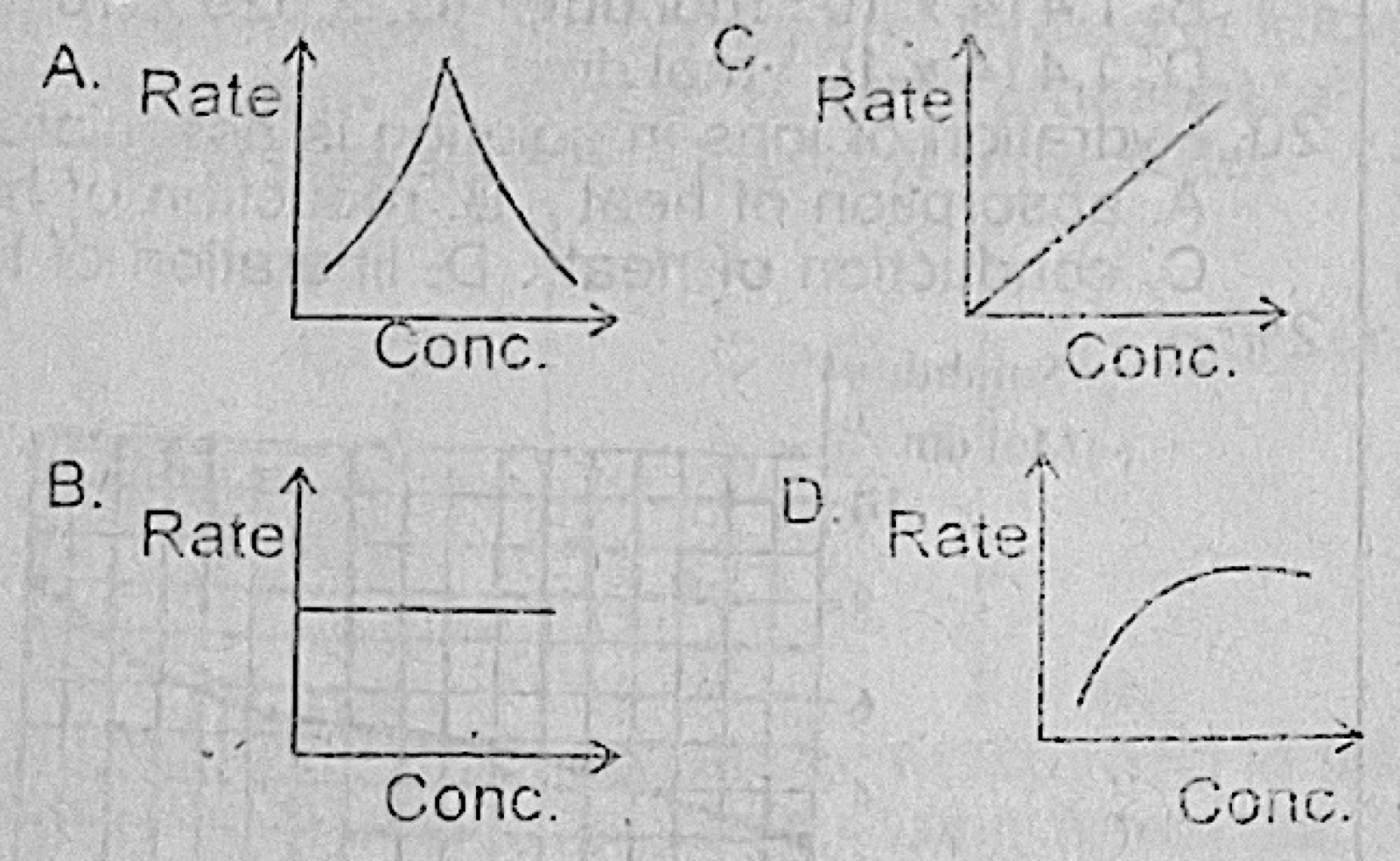
Question 30 Rates of Reaction The graph that describes a zero order reaction is
A. A B. B C. C D. D Show the answer and explanation Answer: B (B )
Explanation In a zero order reaction the rate does not depend on concentration, so the graph of rate against concentration is a horizontal line (graph B).
Open this question
Question 31 Chemical Equilibrium N2(g) + O2(g) ⇌ 2NO(g) ; ΔH = + 180.6kJ mol−1
A. increase the quantity of N2 B. increase the yield of NO C. decrease the yield of NO D. decrease the quantity of O2 Show the answer and explanation Answer: B (increase the yield of NO )
Explanation The forward reaction is endothermic (ΔH positive), so raising the temperature shifts the equilibrium to the right and more NO is formed.
Open this question
Question 32 Chemical Equilibrium For a reaction in equilibrium, the species involved in the equilibrium constant expression are
A. gaseous and solid species B. liquid and solid species C. solid and dissolved species D. gaseous and dissolved species Show the answer and explanation Answer: D (gaseous and dissolved species )
Explanation Pure solids and pure liquids have constant concentrations, so only gases and dissolved species appear in the equilibrium constant expression.
Open this question
Question 33 Carbon and its Compounds A phenomenon where an element exists in different forms in the same physical state is known as
A. isomerism B. amorphism C. allotropy D. isotopy Show the answer and explanation Answer: C (allotropy )
Explanation Allotropy is the existence of an element in two or more forms in the same physical state, e.g. diamond and graphite.
Open this question
Question 34 Polymers The substance often use for vulcanization of rubber is
A. chlorine B. hydrogen peroxide C. sulphur D. tetraoxosulphate (VI) acid. Show the answer and explanation Answer: C (sulphur )
Explanation Vulcanization is heating rubber with sulphur, which forms cross-links and makes the rubber harder and more elastic.
Open this question
Question 35 Environmental Pollution A gas that is not associated with global warming is
A. CO2 B. SO3 C. CH4 D. H2 Show the answer and explanation Answer: D (H2 )
Explanation CO2 and CH4 are greenhouse gases and sulphur oxides are atmospheric pollutants; hydrogen does not trap heat in the atmosphere.
Open this question
Question 36 Carbon and its Compounds The refreshing and characteristic taste of soda water and other soft drinks is as a result of the presence in them of
A. carbon (IV) oxide B. carbon (II) oxide C. soda D. glucose Show the answer and explanation Answer: A (carbon (IV) oxide )
Explanation Soft drinks are carbonated: carbon (IV) oxide is dissolved in them under pressure, giving the fizz and slightly sharp taste.
Open this question
Question 37 Carbon and its Compounds A form of carbon used for absorbing poisonous gases and purification of noble gases is
A. wood charcoal B. animal charcoal C. carbon fibres D. carbon black Show the answer and explanation Answer: A (wood charcoal )
Explanation Wood charcoal (activated) has a huge porous surface that adsorbs gases, so it is used in gas masks and to purify gases.
Open this question
Question 38 Petroleum and Coal Synthesis gas is a mixture of
A. CH4 and H2 O B. CH4 and H2 C. CO2 and H2 D. CO and H2 Show the answer and explanation Answer: D (CO and H2 )
Explanation Synthesis gas (syngas) is a mixture of carbon (II) oxide and hydrogen, made by passing steam over hot methane or coke.
Open this question
Question 39 Qualitative Analysis Potassium vapour burns with a
A. blue flame B. brick-red flame C. violet flame D. golden-yellow flame Show the answer and explanation Answer: C (violet flame )
Explanation Potassium compounds and vapour give a lilac (violet) flame; sodium gives golden-yellow and calcium brick-red.
Open this question
Question 40 Metals and their Compounds A common characteristics of copper and silver in their usage as coinage metals is that they
A. have high metallic lustre B. are not easily oxidized C. are easily oxidized D. are not easily reduced. Show the answer and explanation Answer: B (are not easily oxidized )
Explanation Coins must last a long time, and copper and silver are low in the activity series, so they do not corrode (get oxidized) easily.
Open this question
Question 41 Metals and their Compounds Haematite is an ore of
A. zinc B. lead C. iron D. copper Show the answer and explanation Answer: C (iron )
Explanation Haematite is Fe2 O3 , the main ore of iron.
Open this question
Question 42 Metals and their Compounds The least easily oxidized of the metals below is
A. Ca B. Na C. Zn D. Al Show the answer and explanation Answer: C (Zn )
Explanation Of these metals zinc is lowest in the activity series, so it loses electrons least readily.
Open this question
Question 43 Polymers The repeating unit in natural rubber is
A. alkyne B. isoprene C. n-propene D. neoprene Show the answer and explanation Answer: B (isoprene )
Explanation Natural rubber is a polymer of isoprene (2-methylbuta-1,3-diene). Neoprene is a synthetic rubber.
Open this question
Question 44 Hydrocarbons Unsaturated organic compounds are identified by decolourization of
A. silver bromine and potassium tetraoxomanganate (VII) solutions B. bromine water and acidified potassium tetraoxomanganate (VII) solution C. silver bromide solution and bromine water D. bromine water and alkaline potassium tetraoxomanganate (VII) solution. Show the answer and explanation Answer: B (bromine water and acidified potassium tetraoxomanganate (VII) solution )
Explanation A C=C or C≡C bond decolourises reddish-brown bromine water and purple acidified potassium tetraoxomanganate (VII) solution.
Open this question
Question 45 Alkanols The conditions necessary for the extraction of a water molecule from two molecules of ethanol are
A. less acid and a lower temperature B. excess acid and a lower temperature C. excess acid and a higher temperature D. less acid and a higher temperature Show the answer and explanation Answer: A (less acid and a lower temperature )
Explanation Removing one water molecule from two ethanol molecules gives ethoxyethane (ether); this needs excess ethanol (less acid) at a lower temperature (about 140°C). Excess acid at 170°C gives ethene.
Open this question
Question 46 Hydrocarbons The chlorinated alkane often used industrially to remove grease is
A. tetrachloromethane B. chloromethane C. trichloromethane D. dichloromethane Show the answer and explanation Answer: A (tetrachloromethane )
Explanation Tetrachloromethane (CCl4 ) is a good non-polar solvent for oils and grease and was widely used in dry cleaning.
Open this question
Question 47 Hydrocarbons The reaction of carbide with water gives
A. ethyne B. ethene C. ethane D. ethanal Show the answer and explanation Answer: A (ethyne )
Explanation Calcium carbide reacts with water: CaC2 + 2H2 O → Ca(OH)2 + C2 H2 (ethyne).
Open this question
Question 48 Alkanoic Acids and Esters CH3 —CH2 —C(=O)—OCH2 CH3
A. ether B. ester C. alkanal D. alkanol Show the answer and explanation Answer: B (ester )
Explanation The —COO— group joining two alkyl groups is the ester linkage; this is ethyl propanoate.
Open this question
Question 49 Alkanals and Alkanones Alkanones are generally obtained by the oxidation of
A. primary alkanols B. secondary alkanols C. tertiary alkanols D. alkanoic acid. Show the answer and explanation Answer: B (secondary alkanols )
Explanation Oxidising a secondary alkanol gives an alkanone (ketone); primary alkanols give alkanals and acids, and tertiary alkanols resist oxidation.
Open this question
Question 50 Carbohydrates, Proteins and Amines Sucrose is made up of
A. glucose and glucose B. glucose and fructose C. fructose and fructose D. galactose and glucose. Show the answer and explanation Answer: B (glucose and fructose )
Explanation Sucrose is a disaccharide; hydrolysis splits it into one glucose and one fructose unit.
Open this question Sign up free for every JAMB Chemistry year, practice by topic and timed mocks.
Start practising free