JAMB Chemistry 1998 past questions and answers

47 questions. Try each one, then open the answer to check yourself and read the explanation.

Question 1

Separation of Mixtures

The addition of water to calcium oxide leads to

  1. A.a physical change
  2. B.a chemical change
  3. C.the formation of a mixture
  4. D.an endothermic change.
Show the answer and explanation

Answer: B (a chemical change)

Explanation

Water reacts with calcium oxide to form a new substance, calcium hydroxide (slaked lime), with a lot of heat given out. A new substance means a chemical change.

Open this question

Question 2

Separation of Mixtures

A mixture of iron and sulphur can be separated by dissolving the mixture in

  1. A.steam
  2. B.dilute hydrochloric acid
  3. C.dilute sodium hydroxide
  4. D.benzene
Show the answer and explanation

Answer: D (benzene)

Explanation

Sulphur dissolves in organic solvents such as benzene (or carbon disulphide) but iron does not, so the sulphur can be dissolved away and the iron filtered off. Dilute HCl would react with the iron instead of separating it.

Open this question

Question 3

Mole Concept and Stoichiometry

8.0 g of an element X reacted with an excess of copper (II) tetraoxosulphate (VI) solution to deposit 21.3g of copper. The correct equation for the reaction is [Cu = 64].

  1. A.X(s) + CuSO4(aq) → Cu(s) + XSO4(aq)
  2. B.X(s) + 2CuSO4(aq) → 2Cu(s) + X(SO4)2(aq)
  3. C.2X(s) + CuSO4(aq) → Cu(s) + X2SO4(aq)
  4. D.2X(s) + 3CuSO4(aq) → 3Cu(s) + X2(SO4)3(aq)
Show the answer and explanation

Answer: A (X(s) + CuSO4(aq) → Cu(s) + XSO4(aq))

Explanation

21.3 g of Cu is 21.3/64 ≈ 0.333 mol. With a 1 : 1 ratio, 8.0 g of X is also 0.333 mol, so X has relative atomic mass 24, which is magnesium, a real divalent metal that displaces copper. The other ratios give masses that match no suitable metal.

Open this question

Question 4

Gas Laws

C3H8(g) + 5O2(g) → 4H2O(g) + 3CO2(g). From the equation above, the volume of oxygen at s.t.p. required to burn 50cm3 of propane is

  1. A.250cm3
  2. B.150cm3
  3. C.100cm3
  4. D.50cm3
Show the answer and explanation

Answer: A (250cm3)

Explanation

By Gay-Lussac's law, gas volumes react in the ratio of the coefficients: 1 volume of propane needs 5 volumes of oxygen, so 50 × 5 = 250 cm3.

Open this question

Question 5

Gas Laws

30cm3 of hydrogen was collected over water at 27°C and 780 mm Hg. If the vapour pressure of water at the temperature of the experiment was 10 mm Hg, calculate the volume of the gas at 760 mm Hg and 7°C.

  1. A.40.0 cm3
  2. B.35.7 cm3
  3. C.28.4 cm3
  4. D.25.2 cm3
Show the answer and explanation

Answer: C (28.4 cm3)

Explanation

Pressure of dry hydrogen = 780 − 10 = 770 mmHg at 300 K. V2 = 770 × 30 × 280/(300 × 760) ≈ 28.4 cm3.

Open this question

Question 6

Mole Concept and Stoichiometry

A given amount of gas occupies 10.0 dm3 at 4 atm, and 273°C. The number of moles of the gas present is [Molar volume of a gas at s.t.p. = 22.4 dm3]

  1. A.0.89 mol
  2. B.1.90 mol
  3. C.3.80 mol
  4. D.5.70 mol
Show the answer and explanation

Answer: A (0.89 mol)

Explanation

Convert to s.t.p.: V = 10.0 × 4 × 273/546 = 20 dm3. Moles = 20/22.4 ≈ 0.89 mol.

Open this question

Question 7

Gas Laws

If sulphur (IV) oxide and methane are released simultaneously at the opposite ends of a narrow tube, the rates of diffusion RSO2 and RCH4 will be in the ratio [S = 32, O = 16, C = 12, H = 1]

  1. A.4:1
  2. B.2:1
  3. C.1:2
  4. D.1:4
Show the answer and explanation

Answer: C (1:2)

Explanation

Rate is inversely proportional to √(molar mass). R(SO2)/R(CH4) = √(16/64) = 1/2, so the ratio is 1 : 2.

Open this question

Question 8

Kinetic Theory and States of Matter

A solid begins to melt when

  1. A.constituent particles acquire a greater kinetic energy
  2. B.energy of vibration of particles of the solid is less than the intermolecular forces
  3. C.constituent particles acquire energy above the average kinetic energy
  4. D.energy of vibration of particles of the solid equals the intermolecular forces.
Show the answer and explanation

Answer: D (energy of vibration of particles of the solid equals the intermolecular forces.)

Explanation

As a solid is heated, its particles vibrate more and more. Melting begins when this vibrational energy is equal to the forces holding the particles in their fixed positions, so they can start to move past one another.

Open this question

Question 9

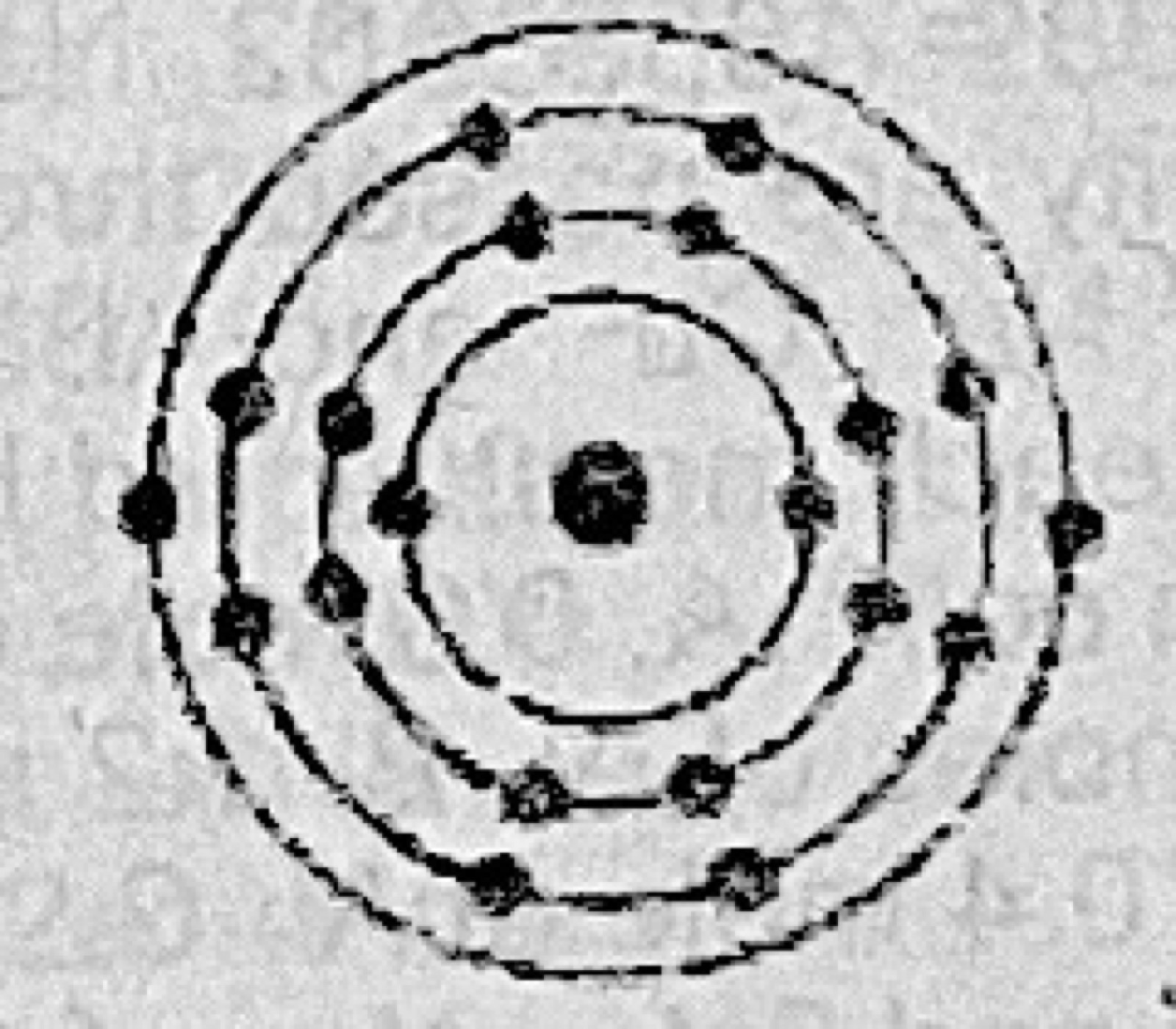
Chemical Bonding

The diagram above represents an atom that can combine with chlorine to form

Diagram for this question
  1. A.a covalent bond
  2. B.an electrovalent bond
  3. C.a hydrogen bond
  4. D.a co-ordinate bond.
Show the answer and explanation

Answer: B (an electrovalent bond)

Explanation

The atom shown has only two electrons in its outermost shell, so it is a metal that easily loses them. A metal losing electrons to chlorine forms ions, which is an electrovalent (ionic) bond.

Open this question

Question 10

Atomic Structure

Which of the following electron configurations indicates an atom with the highest ionization energy?

  1. A.2, 8, 7
  2. B.2, 8, 8, 1
  3. C.2, 8, 8, 2
  4. D.2,8,8,7
Show the answer and explanation

Answer: A (2, 8, 7)

Explanation

Ionization energy is highest for a small atom with a nearly full outer shell. 2, 8, 7 (chlorine) has fewer shells than 2, 8, 8, 7, so its outer electrons are held most tightly; the 1- and 2-electron metals lose electrons easily.

Open this question

Question 11

Atomic Structure

The line observed in the simple hydrogen spectrum are due to emission of

  1. A.electrons from the atom
  2. B.energy by proton transition
  3. C.energy by electron transition
  4. D.neutrons from the atom.
Show the answer and explanation

Answer: C (energy by electron transition)

Explanation

Each line comes from light given out when an electron falls from a higher energy level to a lower one, releasing a fixed amount of energy.

Open this question

Question 12

Radioactivity

If an element X of atomic number Z and mass number Y is irradiated by an intense concentration of neutrons, the relevant nuclear equation is

  1. A.YZX + 10n → Y−1Z+1X
  2. B.YZX + 10n → Y+1ZX
  3. C.YZX + 10n → YZ+1X
  4. D.YZX + 10n → Y+1Z−1X
Show the answer and explanation

Answer: B (YZX + 10n → Y+1ZX)

Explanation

Capturing a neutron adds 1 to the mass number but leaves the number of protons (atomic number) unchanged, giving a heavier isotope of the same element.

Open this question

Question 13

Air

The property used in obtaining oxygen and nitrogen industrially from air is the

  1. A.boiling point
  2. B.density
  3. C.rate of diffusion
  4. D.solubility
Show the answer and explanation

Answer: A (boiling point)

Explanation

Air is liquefied and then fractionally distilled; nitrogen and oxygen separate because they have different boiling points.

Open this question

Question 15

Water

Potassium tetraoxomanganate (VII) is often added to impure water to

  1. A.reduce organic impurities
  2. B.reduce inorganic impurities
  3. C.destroy bacteria and algae
  4. D.remove permanent hardness.
Show the answer and explanation

Answer: C (destroy bacteria and algae)

Explanation

KMnO4 is a strong oxidizing agent and acts as a disinfectant, killing bacteria and algae in the water.

Open this question

Question 16

Environmental Pollution

The soil around a battery manufacturing factory is likely to contain a high concentration of

  1. A.Ca2+ salts
  2. B.Pb2+ salts
  3. C.Mg2+ salts
  4. D.Al3+ salts.
Show the answer and explanation

Answer: B (Pb2+ salts)

Explanation

Car batteries (lead-acid accumulators) are made from lead and lead compounds, so waste from such a factory pollutes the soil with lead salts.

Open this question

Question 17

Solubility and Solutions

90.0g of MgCl2 was placed in 50.0cm3 of water to give a saturated solution at 298K. If the solubility of the salt is 8.0 mol dm−3 at the same temperature, what is the mass of the salt left undissolved at the given temperature? [Mg = 24, Cl = 35.5]

  1. A.52.0g
  2. B.58.5g
  3. C.85.5g
  4. D.88.5g
Show the answer and explanation

Answer: A (52.0g)

Explanation

Molar mass of MgCl2 = 95. 50 cm3 dissolves 8.0 × 0.050 = 0.40 mol = 38 g. Undissolved = 90 − 38 = 52 g.

Open this question

Question 18

Solubility and Solutions

Soap lather is an example of a colloid in which

  1. A.liquid is dispersed in gas
  2. B.solid is dispersed in liquid
  3. C.gas is dispersed in liquid
  4. D.liquid is dispersed in liquid.
Show the answer and explanation

Answer: C (gas is dispersed in liquid)

Explanation

Lather (foam) is made of tiny air bubbles trapped in soapy water, so a gas is dispersed in a liquid.

Open this question

Question 19

Acids, Bases and Salts

The pH of a solution obtained by mixing 100cm3 of a 0.1M HCl solution with 100cm3 of a 0.2M solution of NaOH is

  1. A.1.3
  2. B.7.0
  3. C.9.7
  4. D.12.7
Show the answer and explanation

Answer: D (12.7)

Explanation

HCl = 0.01 mol and NaOH = 0.02 mol, so 0.01 mol of OH− is left in 200 cm3: [OH−] = 0.05 M. pOH = −log 0.05 = 1.3, so pH = 14 − 1.3 = 12.7.

Open this question

Question 20

Electrolysis

In the conductance of aqueous potassium tetraoxosulphate (VI) solution, the current carriers are the

  1. A.ions
  2. B.electrons
  3. C.hydrated ions
  4. D.hydrated electrons
Show the answer and explanation

Answer: C (hydrated ions)

Explanation

In a solution, electricity is carried by moving ions, not electrons. In water each K+ and SO42− ion is surrounded by water molecules, so the carriers are hydrated ions.

Open this question

Question 21

Volumetric Analysis

What volume of 0.1 mol dm−3 solution of tetraoxosulphate (VI) acid would be needed to dissolve 2.86g of sodium trioxocarbonate (IV) decahydrate crystals? [H = 1, C = 12, O = 16, S = 32, Na = 23].

  1. A.20cm3
  2. B.40cm3
  3. C.80cm3
  4. D.100cm3
Show the answer and explanation

Answer: D (100cm3)

Explanation

Na2CO3.10H2O has molar mass 286, so 2.86 g = 0.01 mol. It reacts 1 : 1 with H2SO4, so 0.01 mol of acid is needed: 0.01/0.1 = 0.1 dm3 = 100 cm3.

Open this question

Question 22

Electrolysis

1.2F of electricity are passed through electrolytic cells containing Na+, Cu2+ and Al3+ in series. How many moles of each metal would be formed at the cathode of each cell?

  1. A.0.6 mole of Na, 1.2 moles of Cu and 1.2 moles of Al
  2. B.1.2 moles of Na, 0.6 mole of Cu and 0.4 mole of Al
  3. C.1.2 moles of Na, 2.4 moles of Cu and 2.4 moles of Al
  4. D.1.2 moles of Na, 2.4 moles of Cu and 3.6 moles of Al.
Show the answer and explanation

Answer: B (1.2 moles of Na, 0.6 mole of Cu and 0.4 mole of Al)

Explanation

Moles of metal = faradays ÷ charge on the ion: Na 1.2/1 = 1.2, Cu 1.2/2 = 0.6, Al 1.2/3 = 0.4.

Open this question

Question 23

Electrolysis

What mass of gold is deposited during the electrolysis of gold (III) tetraoxosulphate (VI) when a current of 15A is passed for 193 seconds? [Au = 97, F = 96500C mol−1].

  1. A.1.97g
  2. B.3.94g
  3. C.5.91 g
  4. D.19.70 g
Show the answer and explanation

Answer: A (1.97g)

Explanation

Q = 15 × 193 = 2895 C = 0.03 F. Au3+ needs 3 F per mole, so 0.01 mol of gold is deposited. With the true Au = 197 this is 1.97 g.

Open this question

Question 24

Redox Reactions

Fe(s) + Cu2+(aq) → Fe2+(aq) + Cu(s). From the reaction above, it can be inferred that

  1. A.Fe is the oxidising agent
  2. B.Fe is reduced
  3. C.Cu2+ loses electrons
  4. D.Cu2+ is the oxidising agent.
Show the answer and explanation

Answer: D (Cu2+ is the oxidising agent.)

Explanation

Cu2+ gains two electrons from iron and becomes Cu. A species that takes electrons is reduced and is the oxidising agent.

Open this question

Question 25

Redox Reactions

2FeCl2(s) + Cl2(g) → 2FeCl3(s). The reducing agent in the reaction above is

  1. A.FeCl2
  2. B.Cl2
  3. C.FeCl3
  4. D.Fe
Show the answer and explanation

Answer: A (FeCl2)

Explanation

Iron goes from +2 in FeCl2 to +3 in FeCl3, so FeCl2 loses electrons (is oxidized) and is the reducing agent.

Open this question

Question 26

Energy Changes

The reaction that is accompanied by a decrease in entropy when carried out at constant temperature is

  1. A.N2O4(g) ⇌ 2NO2(g)
  2. B.N2(g) + 3H2(g) ⇌ 2NH3(g)
  3. C.CaCO3(s) ⇌ CaO(s) + CO2(g)
  4. D.2N2H4(l) + N2O4(l) ⇌ 3N2(g) + 4H2O(l)
Show the answer and explanation

Answer: B (N2(g) + 3H2(g) ⇌ 2NH3(g))

Explanation

Entropy (disorder) falls when the number of gas molecules falls. In B, 4 moles of gas become 2 moles; the other reactions produce more gas.

Open this question

Question 27

Energy Changes

32g of anhydrous copper (II) tetraoxosulphate (VI) dissolved in 1dm3 of water generated 13.0kJ of heat. The heat of solution is [Cu = 64, S = 32, O = 16]

  1. A.26.0 kJmol−1
  2. B.65.0 k Jmol−1
  3. C.130.0 kJmol−1
  4. D.260.0kJmol−1
Show the answer and explanation

Answer: B (65.0 k Jmol−1)

Explanation

Molar mass of CuSO4 = 160, so 32 g = 0.2 mol. Heat per mole = 13.0/0.2 = 65.0 kJ mol−1 (given out, so ΔH = −65 kJ mol−1).

Open this question

Question 28

Electrolysis

Mg2+(aq) + 2e− → Mg(s) E° = −2.370 volts
Zn2+(aq) + 2e− → Zn(s) E° = −0.763 volts
Cd2+(aq) + 2e− → Cd(s) E° = −0.403 volts
Cu2+(aq) + 2e− → Cu(s) E° = +0.340 volts
In the electrochemical series above, the strongest reducing agent is

  1. A.Cu(s)
  2. B.Cd(s)
  3. C.Zn(s)
  4. D.Mg(s)
Show the answer and explanation

Answer: D (Mg(s))

Explanation

The metal with the most negative electrode potential gives up electrons most easily, so it is the strongest reducing agent. Magnesium (−2.37 V) is strongest; copper (+0.34 V) is the weakest.

Open this question

Question 29

Energy Changes

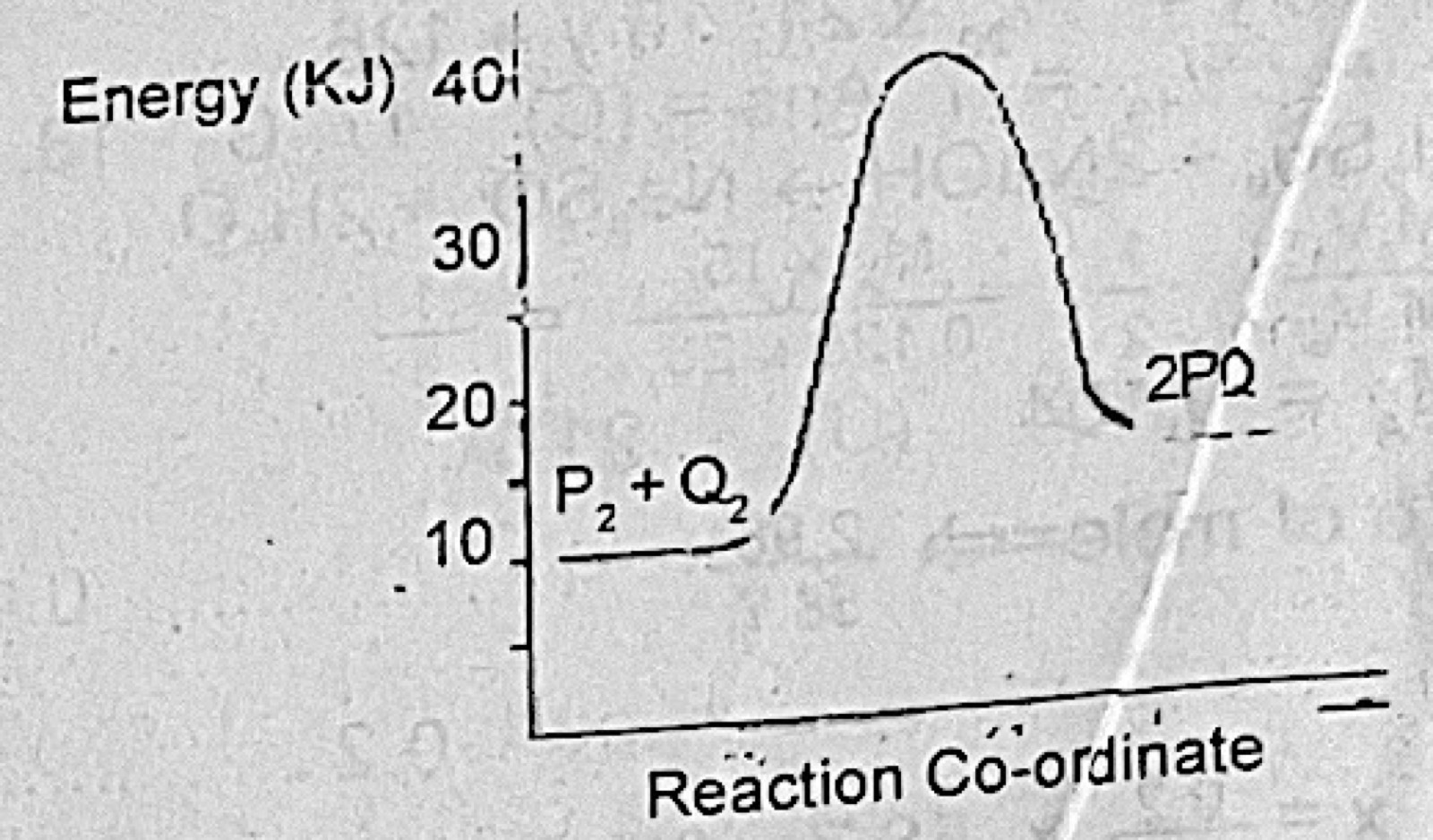
In the diagram above, the activation energy for the backward reaction is

Diagram for this question
  1. A.+5kJ
  2. B.+15kJ
  3. C.+25kJ
  4. D.+30kJ
Show the answer and explanation

Answer: C (+25kJ)

Explanation

The backward reaction starts from the products (2PQ, about 15 kJ on the graph) and must climb to the top of the peak (40 kJ). So its activation energy is about 40 − 15 = 25 kJ.

Open this question

Question 30

Rates of Reaction

2X(g) + Y(g) → Z(g). In the equation above, the rate of formation of Z is found to be independent of the concentration of Y and to quadruple when the concentration of X is doubled. The correct equation for the reaction is

  1. A.R = k [X][Y]
  2. B.R = k[X]2[Y]
  3. C.R = k[X]0[Y]2
  4. D.R = k[X]2[Y]0
Show the answer and explanation

Answer: D (R = k[X]2[Y]0)

Explanation

Doubling [X] makes the rate 4 = 22 times faster, so the order in X is 2. The rate does not depend on Y, so its power is 0.

Open this question

Question 31

Chemical Equilibrium

2Cl2(g) + 2H2O(g) ⇌ 4HCl(g) + O2(g) ΔH° = +115kJ mol−1. In the above equilibrium reaction, a decrease in temperature will

  1. A.favour the reverse reaction
  2. B.favour the forward reaction
  3. C.have no effect on the equilibrium state
  4. D.double the rate of the reverse reaction.
Show the answer and explanation

Answer: A (favour the reverse reaction)

Explanation

The forward reaction is endothermic. Cooling favours the exothermic direction, which here is the reverse reaction.

Open this question

Question 32

Nitrogen and its Compounds

3CuO(s) + 2NH3(g) → 3Cu(s) + 3H2O(l) + N2(g) (i)
2NH3(g) + 3Cl2(g) → 6HCl(g) + N2(g) (ii)
4NH3(g) + 3O2(g) → 6H2O(l) + 2N2(g) (iii)
The reactions represented by the equations above demonstrate the

  1. A.basic properties of ammonia
  2. B.acidic properties of ammonia
  3. C.reducing properties of ammonia
  4. D.oxidising properties of ammonia
Show the answer and explanation

Answer: C (reducing properties of ammonia)

Explanation

In each reaction the nitrogen in NH3 goes from −3 to 0 in N2; ammonia is oxidized, so it acts as a reducing agent.

Open this question

Question 33

Sulphur and its Compounds

A gas that turns a filter paper previously soaked in lead ethanoate solution black is

  1. A.hydrogen chloride
  2. B.hydrogen sulphide
  3. C.sulphur (IV) oxide
  4. D.sulphur (VI) oxide
Show the answer and explanation

Answer: B (hydrogen sulphide)

Explanation

Hydrogen sulphide reacts with lead ethanoate to form black lead(II) sulphide; this is the standard test for H2S.

Open this question

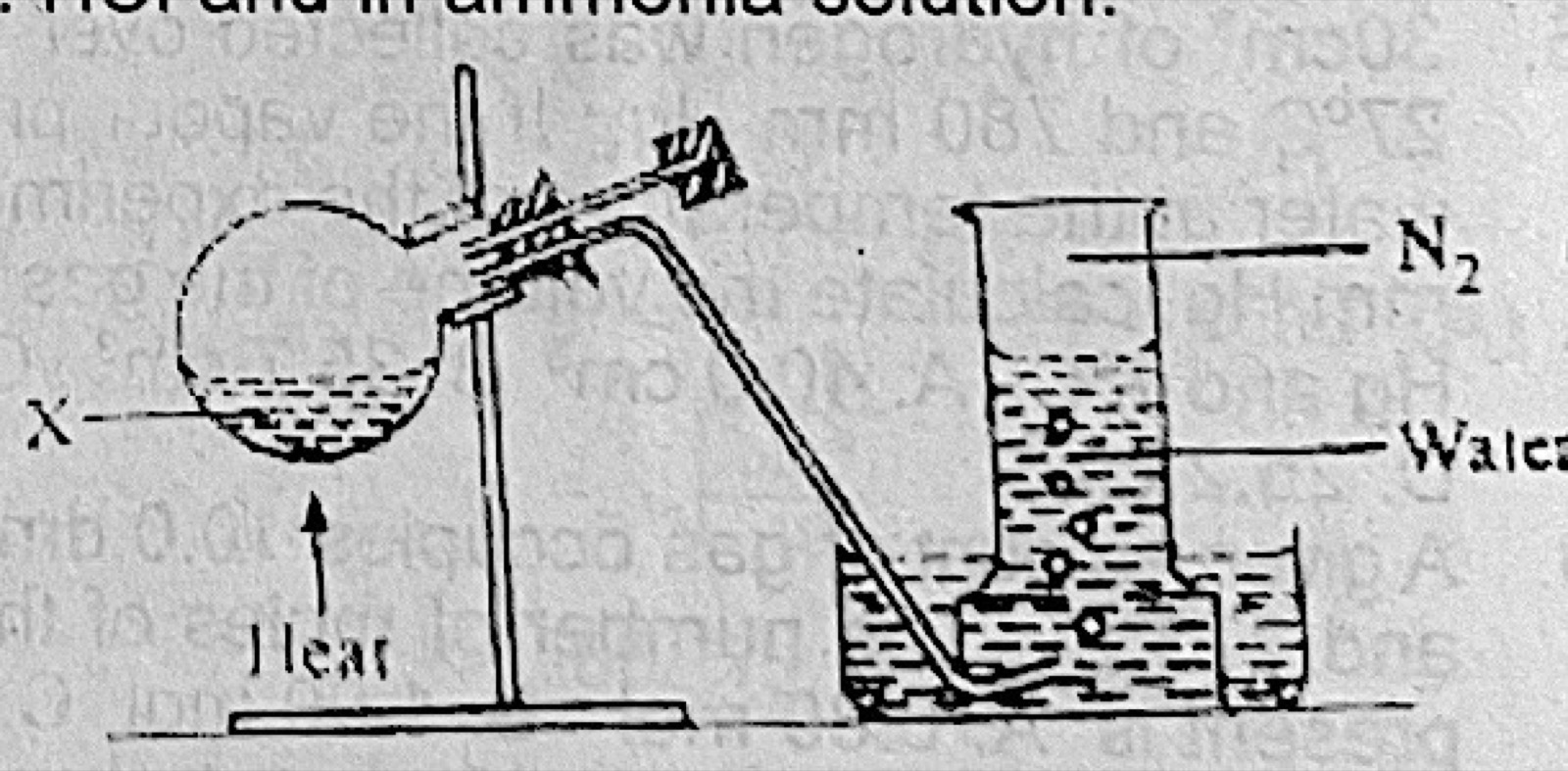
Question 35

Halogens

In the experiment above, X could be a solution of

Diagram for this question
  1. A.sodium trioxonitrate (V) and ammonium chloride
  2. B.sodium trioxonitrate (III) and ammonium chloride
  3. C.lead (II) trioxonitrate (V) and copper turnings
  4. D.potassium trioxonitrate (V) and copper turnings.
Show the answer and explanation

Answer: B (sodium trioxonitrate (III) and ammonium chloride)

Explanation

Nitrogen is prepared in the laboratory by warming a mixture of sodium nitrite (sodium dioxonitrate(III)) and ammonium chloride; the gas is collected over water.

Open this question

Question 36

Metals and their Compounds

The oxide that remains unchanged when heated in hydrogen is

  1. A.CuO
  2. B.Fe2O3
  3. C.PbO2
  4. D.ZnO
Show the answer and explanation

Answer: D (ZnO)

Explanation

Hydrogen can reduce the oxides of less reactive metals such as copper, lead and iron to the metal. Zinc is too high in the activity series, so heating ZnO in hydrogen leaves it unchanged.

Open this question

Question 37

Qualitative Analysis

Which of the following is observed when a solution of iron (III) chloride is mixed with a solution of sodium hydroxide?

  1. A.A gas is evolved
  2. B.A deep blue precipitate is formed
  3. C.The resultant solution turns green
  4. D.A brown precipitate is formed
Show the answer and explanation

Answer: D (A brown precipitate is formed)

Explanation

Fe3+ ions react with OH− to give reddish-brown iron(III) hydroxide precipitate.

Open this question

Question 39

Metals and their Compounds

A common characteristic shared by iron and aluminium is that both

  1. A.are extracted by reduction methods
  2. B.form only basic oxides
  3. C.show oxidation states of +2 and +3
  4. D.form soluble hydroxides.
Show the answer and explanation

Answer: A (are extracted by reduction methods)

Explanation

Both metals are obtained from their ores by reduction: iron by carbon(II) oxide in the blast furnace and aluminium by electrolytic reduction. Aluminium oxide is amphoteric, aluminium shows only +3, and both hydroxides are insoluble.

Open this question

Question 40

Metals and their Compounds

Alloys are often used in preference to pure metals because

  1. A.metals are too hard
  2. B.metals are ductile
  3. C.metallic properties are improved in alloys
  4. D.alloys are a mixture of metals.
Show the answer and explanation

Answer: C (metallic properties are improved in alloys)

Explanation

Alloying improves properties such as hardness, strength and resistance to corrosion, which is why alloys are chosen over pure metals.

Open this question

Question 41

Introduction to Organic Chemistry

CH3CH2CH(OH)CH(CH3)2
The IUPAC nomenclature for the above compound is

  1. A.4-methylpentan-3-ol
  2. B.2-methylpentan-3-ol
  3. C.3-methylpentan-3-ol
  4. D.1, 1-dimethylbutan-2-ol
Show the answer and explanation

Answer: B (2-methylpentan-3-ol)

Explanation

The longest chain has five carbons with OH on C3 from either end. Numbering to give the methyl branch the lower number puts it on C2: 2-methylpentan-3-ol.

Open this question

Question 42

Alkanols

Dehydration of CH3-CH2-CH2-CH2-OH gives

  1. A.CH2 = CH-CH2-CH3
  2. B.CH3CH≡CH-CH3
  3. C.H-C≡C-CH2-CH3
  4. D.CH3C≡C-CH3
Show the answer and explanation

Answer: A (CH2 = CH-CH2-CH3)

Explanation

Removing a water molecule from butan-1-ol (the OH and an H from the next carbon) forms a C=C double bond, giving but-1-ene, CH2=CHCH2CH3. Dehydration gives an alkene, not an alkyne.

Open this question

Question 43

Polymers

nCH2=CH2 → (-CH2-CH2-)n [O2 (initiator), 1,500 atm, 473K]. The above equation represents the manufacture of

  1. A.rubber
  2. B.polythene
  3. C.polystyrene
  4. D.butane
Show the answer and explanation

Answer: B (polythene)

Explanation

Ethene molecules join together by addition polymerization at high pressure to form polythene (poly(ethene)).

Open this question

Question 44

Hydrocarbons

One mole of a hydrocarbon contains 6g of hydrogen. If the molecular weight is 54, the hydrocarbon is an

  1. A.alkanone
  2. B.alkane
  3. C.alkene
  4. D.alkyne
Show the answer and explanation

Answer: D (alkyne)

Explanation

6 g of H means 6 H atoms. 54 − 6 = 48 g of carbon = 4 C atoms, so the formula is C4H6, which fits CnH2n−2, an alkyne (butyne).

Open this question

Question 45

Hydrocarbons

The products obtained when a pure hydrocarbon is burnt in excess oxygen are

  1. A.carbon and hydrogen
  2. B.carbon and water
  3. C.Carbon (II) oxide and hydrogen
  4. D.carbon (IV) oxide and water.
Show the answer and explanation

Answer: D (carbon (IV) oxide and water.)

Explanation

Complete combustion of a hydrocarbon turns all the carbon into carbon(IV) oxide and all the hydrogen into water.

Open this question

Question 46

Alkanols

How many structural isomers can be drawn for the non-cyclic alkanol with molecular formula C4H10O?

  1. A.1
  2. B.2
  3. C.3
  4. D.4
Show the answer and explanation

Answer: D (4)

Explanation

There are four butanols: butan-1-ol, butan-2-ol, 2-methylpropan-1-ol and 2-methylpropan-2-ol.

Open this question

Question 47

Hydrocarbons

On cracking medicinal paraffin, a gas is evolved which gives a pop sound with a lighted splinter and an oily liquid which decolourizes bromine solution is also obtained. The products of the cracking are

  1. A.carbon (IV) oxide and alkyne
  2. B.carbon (II) oxide and alkene
  3. C.hydrogen gas and alkene
  4. D.hydrogen gas and alkane
Show the answer and explanation

Answer: C (hydrogen gas and alkene)

Explanation

A gas that burns with a pop is hydrogen. A liquid that decolourizes bromine is unsaturated, an alkene.

Open this question

Question 48

Introduction to Organic Chemistry

An example of aromatic compound is

  1. A.C6H13OH
  2. B.C6H13Cl
  3. C.C6H5OH
  4. D.C6H14
Show the answer and explanation

Answer: C (C6H5OH)

Explanation

Aromatic compounds contain a benzene ring (C6H5–). C6H5OH is phenol; the others are aliphatic hexane derivatives.

Open this question

Question 49

Polymers

Terylene is synthesized from ethane-1, 2-diol and benzene-1, 4-dicarboxylic acid by

  1. A.addition reaction
  2. B.condensation reaction
  3. C.elimination reaction
  4. D.substitution reaction.
Show the answer and explanation

Answer: B (condensation reaction)

Explanation

The diol and the diacid join through ester links and lose a water molecule at each link, so terylene is a condensation polymer.

Open this question

Question 50

Hydrocarbons

Which of the following is true concerning the properties of benzene and hexane?

  1. A.Both undergo substitution reaction.
  2. B.Both undergo addition reaction
  3. C.Both are solids
  4. D.Both can decolourize bromine water.
Show the answer and explanation

Answer: A (Both undergo substitution reaction.)

Explanation

Hexane is saturated and benzene is very stable, so both mainly undergo substitution reactions (e.g. with chlorine). Both are liquids and neither readily decolourizes bromine water.
Open this question