The molar ratio of carbon to hydrogen of a volatile liquid compound is 1:2. 0.12 g of the liquid on evaporation at s.t.p. gave 32 cm3 of vapour. The molecular formula of the liquid is [G.M.V = 22.4 dm3, C = 12, H = 1]
A.C3H6
B.C4H8
C.C5C10
D.C6H12
Show the answer and explanation
Answer: D (C6H12)
Explanation
Molar mass = 0.12 × 22400/32 = 84 g. The empirical formula CH2 has mass 14, and 84/14 = 6, so the formula is C6H12.
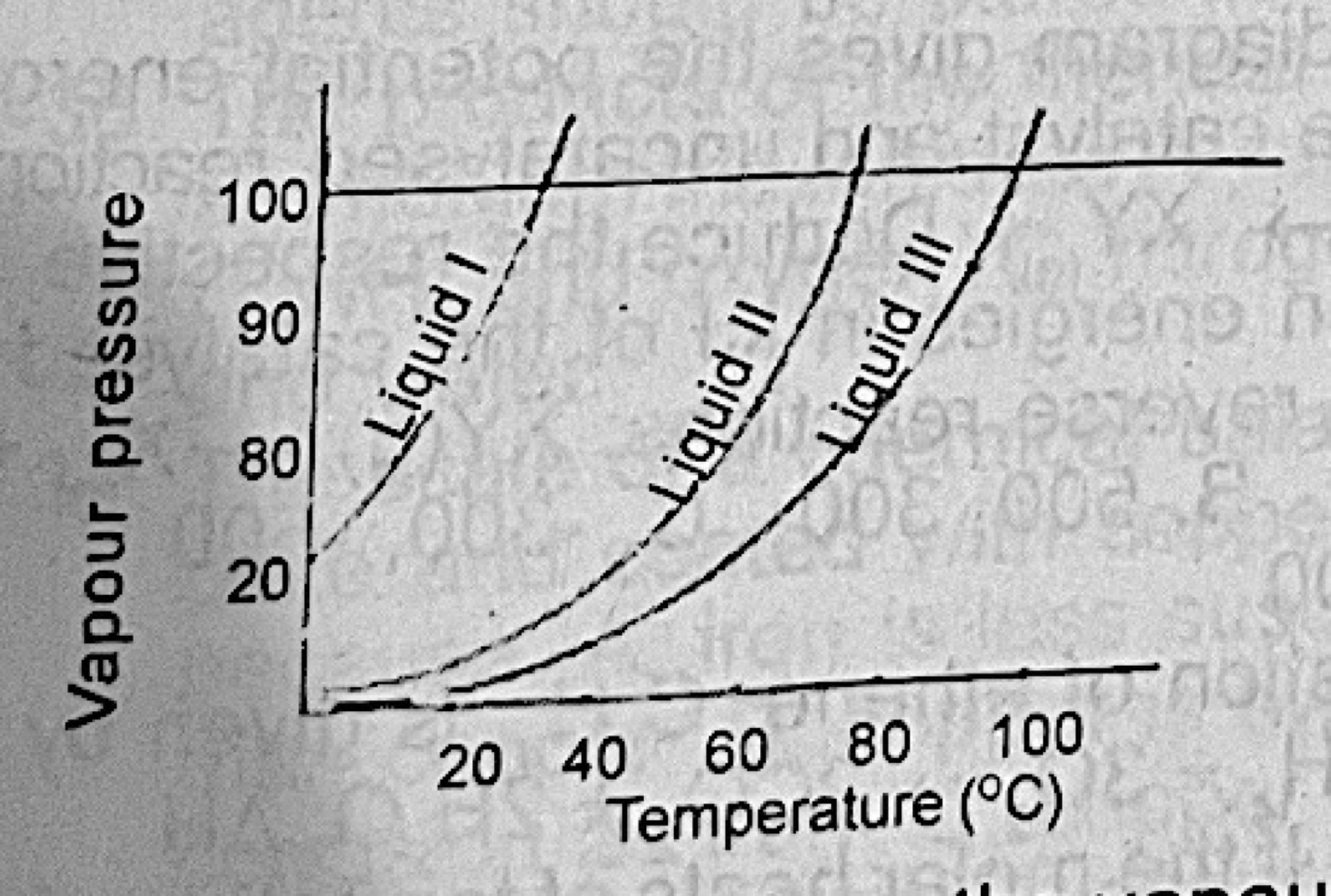
From the vapour pressure curves of liquids I, II and III shown, it can be deduced that
A.liquid I has the highest boiling point
B.liquid II has the highest boiling point
C.liquid III has the highest boiling point
D.liquid III has the lowest boiling point.
Show the answer and explanation
Answer: C (liquid III has the highest boiling point)
Explanation
A liquid boils when its vapour pressure reaches the external pressure (the horizontal line). Liquid III reaches it at the highest temperature, so it has the highest boiling point.
20.00 cm3 of a solution containing 0.53 g of anhydrous Na2CO3 in 100 cm3 requires 25.00 cm3 of H2SO4 for complete neutralisation. The concentration of the acid solution in moles per dm3 is [H = 1, C = 12, O = 16, Na = 23, S = 32]
A.0.02
B.0.04
C.0.06
D.0.08
Show the answer and explanation
Answer: B (0.04)
Explanation
Na2CO3 concentration = 5.3 g dm−3 ÷ 106 = 0.05 M. The reaction is 1 : 1, so MA × 25 = 0.05 × 20, giving MA = 0.04 mol dm−3.
What is the partial pressure of hydrogen gas collected over water at standard atmospheric pressure and 25°C if the saturation vapour pressure of water is 23 mm Hg at that temperature?
A.737 mm Hg
B.763 mm Hg
C.777 mm Hg
D.783 mm Hg.
Show the answer and explanation
Answer: A (737 mm Hg)
Explanation
By Dalton's law the total pressure is the sum of the partial pressures: p(H2) = 760 − 23 = 737 mm Hg.
Using 50 cm3 of 1 M potassium hydroxide and 100 cm3 of 1 M tetraoxosulphate (VI) acid, calculate the respective volumes in cm3 of base and acid that would be required to produce the maximum amount of potassium tetraoxosulphate (IV). [K = 39, S = 32, O = 16, H = 1]
A.50,50
B.25,50
C.50,25
D.25,25
Show the answer and explanation
Answer: C (50,25)
Explanation
2KOH + H2SO4 → K2SO4 + 2H2O. The most salt comes from using all the base: 50 cm3 of 1 M KOH (0.05 mol) needs 0.025 mol acid, which is 25 cm3.
A solution of calcium bromide contains 20 g dm−3. What is the molarity of the solution with respect to calcium bromide and bromide ions? [Ca = 40, Br = 80]
A.0.1, 0.1
B.0.1, 0.2
C.0.1, 0.05
D.0.05, 0.1
Show the answer and explanation
Answer: B (0.1, 0.2)
Explanation
CaBr2 has M = 200, so 20 g dm−3 is 0.1 M. Each formula unit gives 2 Br− ions, so [Br−] = 0.2 M.
The substance ZnO dissolves in sodium hydroxide solution and mineral acid solution to give soluble products in each case. ZnO is therefore referred to as
A.an allotropic oxide
B.an amphoteric oxide
C.a peroxide
D.a dioxide
Show the answer and explanation
Answer: B (an amphoteric oxide)
Explanation
An oxide that reacts with both acids and alkalis to form salts is amphoteric.
The same current is passed for the same time through solutions of AgNO3 and CuSO4 connected in series. How much silver will be deposited if 1.0 g of copper is produced? [Cu = 63.5, S = 32, O = 16, Ag = 108, N = 14]
A.1.7 g
B.3.4 g
C.6.8 g
D.13.6 g
Show the answer and explanation
Answer: B (3.4 g)
Explanation
1.0 g Cu = 1/63.5 mol, which needs 2/63.5 F. The same charge deposits 2/63.5 mol of Ag: 108 × 2/63.5 = 3.4 g.
Which of the reactions below is NOT an example of a redox reaction? I Fe + 2Ag+ → Fe2+ + 2Ag II 2H2S + SO2 → 2H2O + 3S III N2 + O2 ⇌ 2NO IV CaCO3 → CaO + CO2
A.I, II and III
B.II and III
C.III and IV
D.IV only
Show the answer and explanation
Answer: D (IV only)
Explanation
In I, II and III oxidation numbers change. In the decomposition of CaCO3 every element keeps its oxidation number (Ca +2, C +4, O −2), so IV is not redox.
The combustion of ethene, C2H4, is given by the equation C2H4 + 3O2 → 2CO2 + 2H2O; ΔH = −1428 kJ. If the molar heats of formation of water and carbon (IV) oxide are −286 kJ and −396 kJ respectively, calculate the molar heat of formation of ethene in kJ
CO(g) + H2O(g) ⇌ CO2(g) + H2(g), ΔH = −41000 J. Which of the following factors favour the formation of hydrogen in the above reaction? I. high pressure II. low pressure III. High temperature IV. Use of excess steam
A.I, III and IV
B.III only
C.II, III and I
D.IV only
Show the answer and explanation
Answer: D (IV only)
Explanation
There are 2 moles of gas on each side, so pressure has no effect. The forward reaction is exothermic, so high temperature works against it. Excess steam pushes the equilibrium to the right.
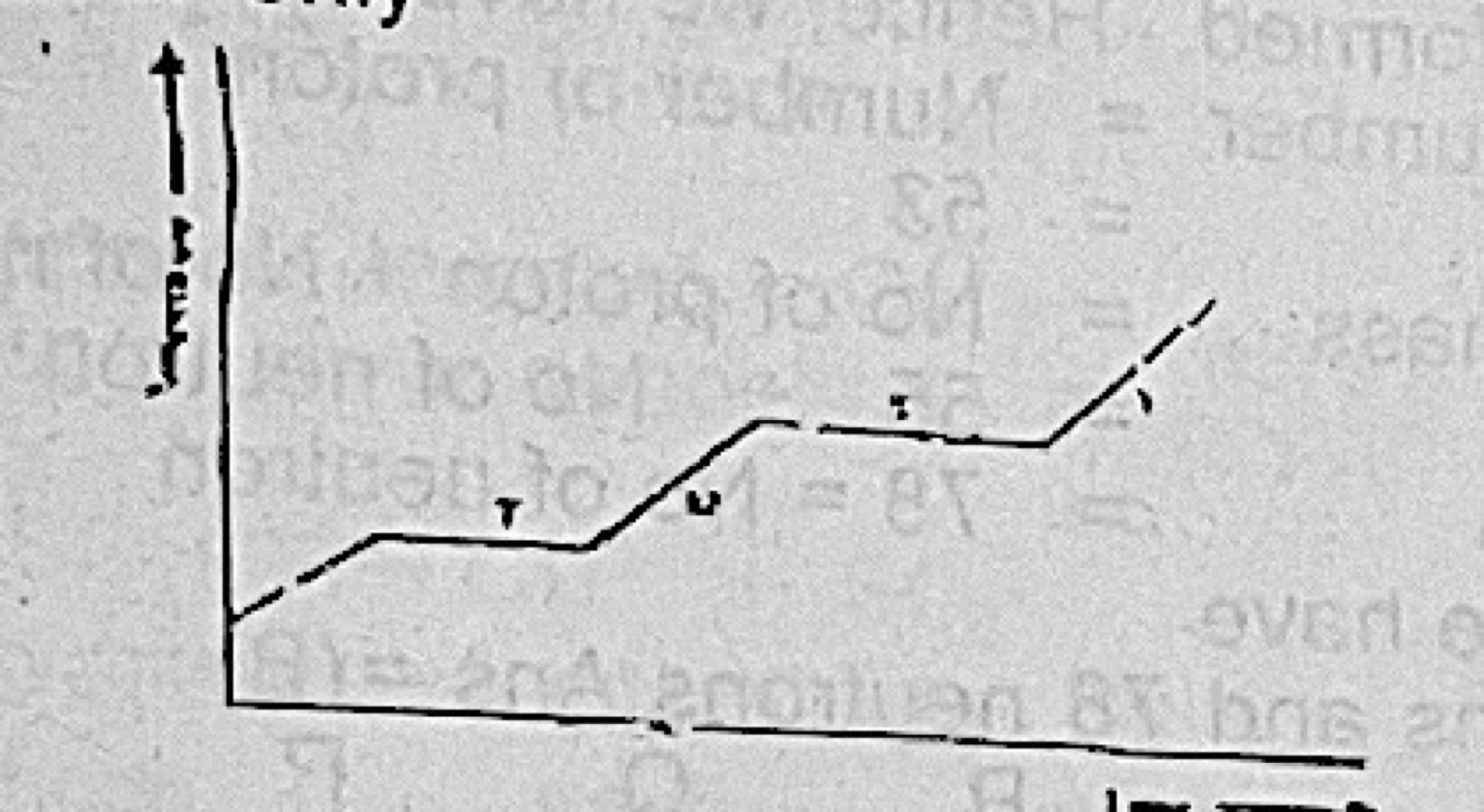
The graph shows a typical heating curve from the solid phase through the liquid phase to the gaseous phase of a substance. Which part of the curve shows solid and liquid in equilibrium?
A.T
B.U
C.X
D.Y
Show the answer and explanation
Answer: A (T)
Explanation
While a solid melts, its temperature stays constant, giving the first flat part of the curve (T). There, solid and liquid exist together.
Which of the following reactions is (are) feasible? I Br2(l) + 2Cl−(aq) → 2Br−(aq) + Cl2(g) II 2I−(aq) + Br2(l) → 2Br−(aq) + I2(s) III 2F−(aq) + Cl2(g) → 2Cl−(aq) + F2(g) IV 2F−(aq) + Br2(l) → 2Br−(aq) + F2(g)
A.I
B.II
C.I and III
D.III and IV
Show the answer and explanation
Answer: B (II)
Explanation
A halogen can only displace a halogen below it in the group. Bromine is more reactive than iodine, so II works; bromine and chlorine cannot displace chlorine or fluorine.
Bleaching powder, CaOCl2.H2O, deteriorates on exposure to air because
A.it loses its water of crystallization
B.atmospheric nitrogen displaces chlorine from it
C.carbon (IV) oxide of the atmosphere displaces chlorine from it
D.bleaching agents should be stored in solution.
Show the answer and explanation
Answer: C (carbon (IV) oxide of the atmosphere displaces chlorine from it)
Explanation
Carbon (IV) oxide in air reacts with bleaching powder to form calcium carbonate and release chlorine, so the powder slowly loses its available chlorine.
A metal is extracted from its ore by the electrolysis of its molten chloride and it displaces lead from lead (II) trioxonitrate (V) solution. The metal is
A.copper
B.aluminium
C.zinc
D.sodium
Show the answer and explanation
Answer: D (sodium)
Explanation
Sodium is extracted by electrolysing molten sodium chloride, and being far above lead in the activity series it can displace lead. Aluminium is extracted from its oxide, and copper and zinc are not made from molten chlorides.
Which of the following compounds is an isomer of the compound CH3–CH2–CH(CH3)–CH2–CH3?
A.CH3–CH2–CH(CH2CH3)–CH2–CH3
B.CH3–CH2–CH(CH2CH3)–CH3
C.CH3–CH2–CH(CH3)–CH3
D.CH3–CH(CH3)–CH2–CH2–CH3
Show the answer and explanation
Answer: D (CH3–CH(CH3)–CH2–CH2–CH3)
Explanation
The compound is 3-methylpentane, C6H14. Option D (2-methylpentane) has the same formula but a different structure. A has 7 carbons, C has 5, and B is the same compound drawn differently.
Three liquids X, Y and Z containing only hydrogen and carbon were burnt on a spoon. X and Y burnt with sooty flames while Z did not. Y is able to discharge the colour of bromine water whereas X and Z cannot. Which of the liquids would be aromatic in nature?
A.X and Z
B.Y
C.X
D.Z
Show the answer and explanation
Answer: C (X)
Explanation
Aromatic hydrocarbons have a high carbon content and burn with a sooty flame, but they do not decolourise bromine water. Y decolourises it, so it is an alkene or alkyne; X is the aromatic one.