JAMB Chemistry 1988 past questions and answers

48 questions. Try each one, then open the answer to check yourself and read the explanation.

Question 1

Separation of Mixtures

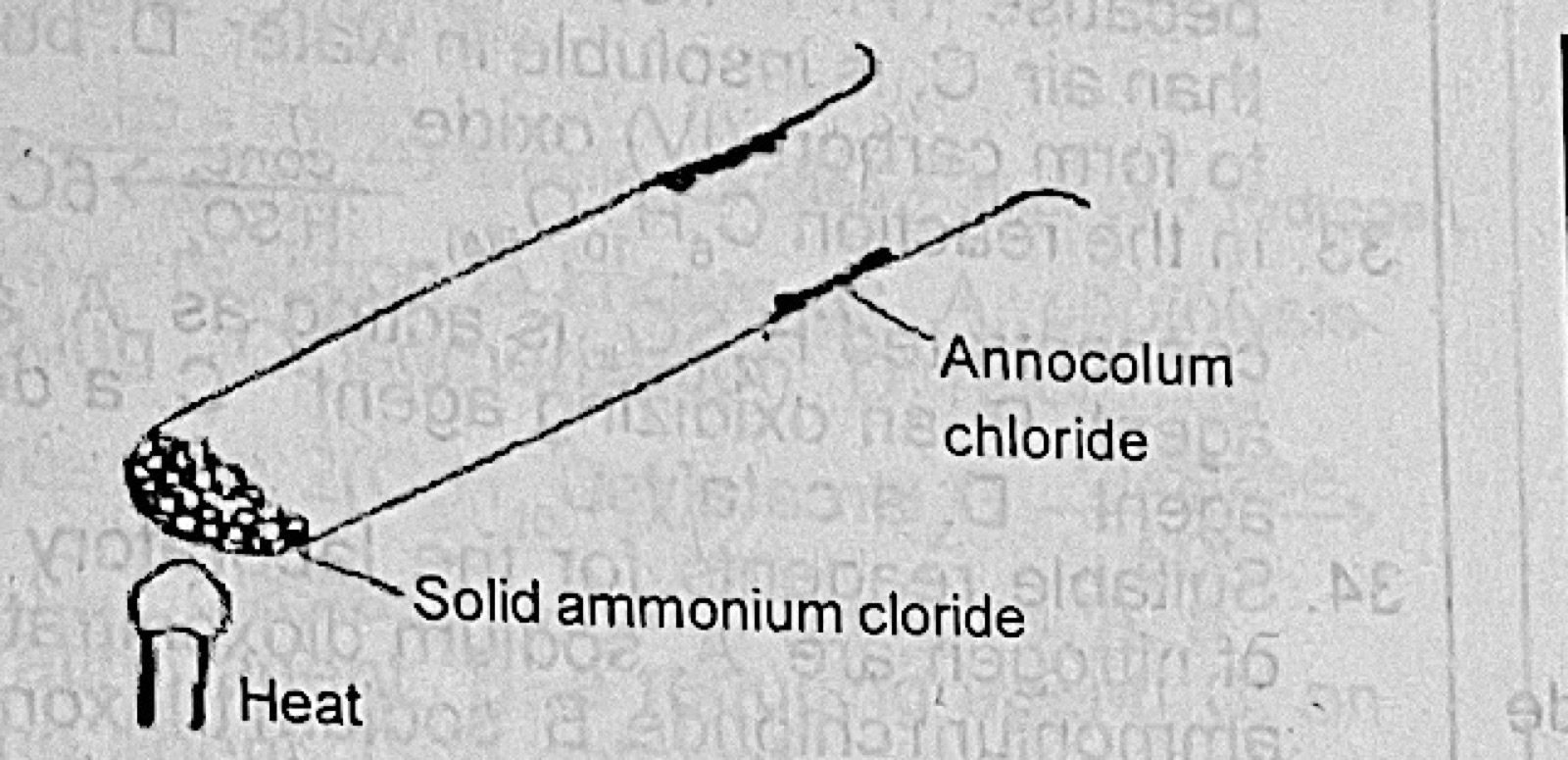
In the experiment shown in the figure, solid ammonium chloride is heated at the closed end of a tube. Ammonium chloride crystals deposit on the walls of the tube as a result of

Diagram for this question
  1. A.evaporation
  2. B.recrystallization
  3. C.sublimation
  4. D.fractional precipitation.
Show the answer and explanation

Answer: C (sublimation)

Explanation

Ammonium chloride changes straight from solid to vapour on heating and back to solid on the cooler part of the tube, without melting. That is sublimation.

Open this question

Question 2

Chemical Formulae and Equations

The formula of the compound formed in a reaction between a trivalent metal M and a tetravalent non-metal X is

  1. A.MX
  2. B.M3X4
  3. C.M4X3
  4. D.M3X2.
Show the answer and explanation

Answer: C (M4X3)

Explanation

Cross the valencies: M has valency 3 and X has valency 4, so 4 atoms of M combine with 3 atoms of X, giving M4X3.

Open this question

Question 3

Chemical Formulae and Equations

2.25 g of a sample of an oxide of copper on reduction gave 2.0 g of copper. 2.50 g of another oxide of copper on reduction also gave 2.0 g of copper. These results are in accordance with the law of

  1. A.constant composition
  2. B.conservation of matter
  3. C.multiple proportions
  4. D.definite proportions.
Show the answer and explanation

Answer: C (multiple proportions)

Explanation

The same 2.0 g of copper combines with 0.25 g and 0.50 g of oxygen in the two oxides. These masses are in the simple ratio 1 : 2, which is the law of multiple proportions.

Open this question

Question 4

Gas Laws

One mole of propane is mixed with five moles of oxygen. The mixture is ignited and the propane burns completely. What is the volume of the products at s.t.p? [G.M.V = 22.4 dm3 mol−1]

  1. A.112.0 dm3
  2. B.67.2 dm3
  3. C.56.0 dm3
  4. D.44.8 dm3.
Show the answer and explanation

Answer: B (67.2 dm3)

Explanation

C3H8 + 5O2 → 3CO2 + 4H2O. At s.t.p. the water is liquid, so only 3 mol of CO2 is gas: 3 × 22.4 = 67.2 dm3.

Open this question

Question 5

Gas Laws

9.0 dm3 of a gas at s.t.p was subjected by means of a movable piston to two times the original pressure with the temperature being now kept at 364 K. What is the volume of the gas in dm3 at this pressure?

  1. A.2.0
  2. B.4.5
  3. C.6.0
  4. D.8.3
Show the answer and explanation

Answer: C (6.0)

Explanation

V2 = V1 × (P1/P2) × (T2/T1) = 9.0 × ½ × 364/273 = 6.0 dm3.

Open this question

Question 6

Gas Laws

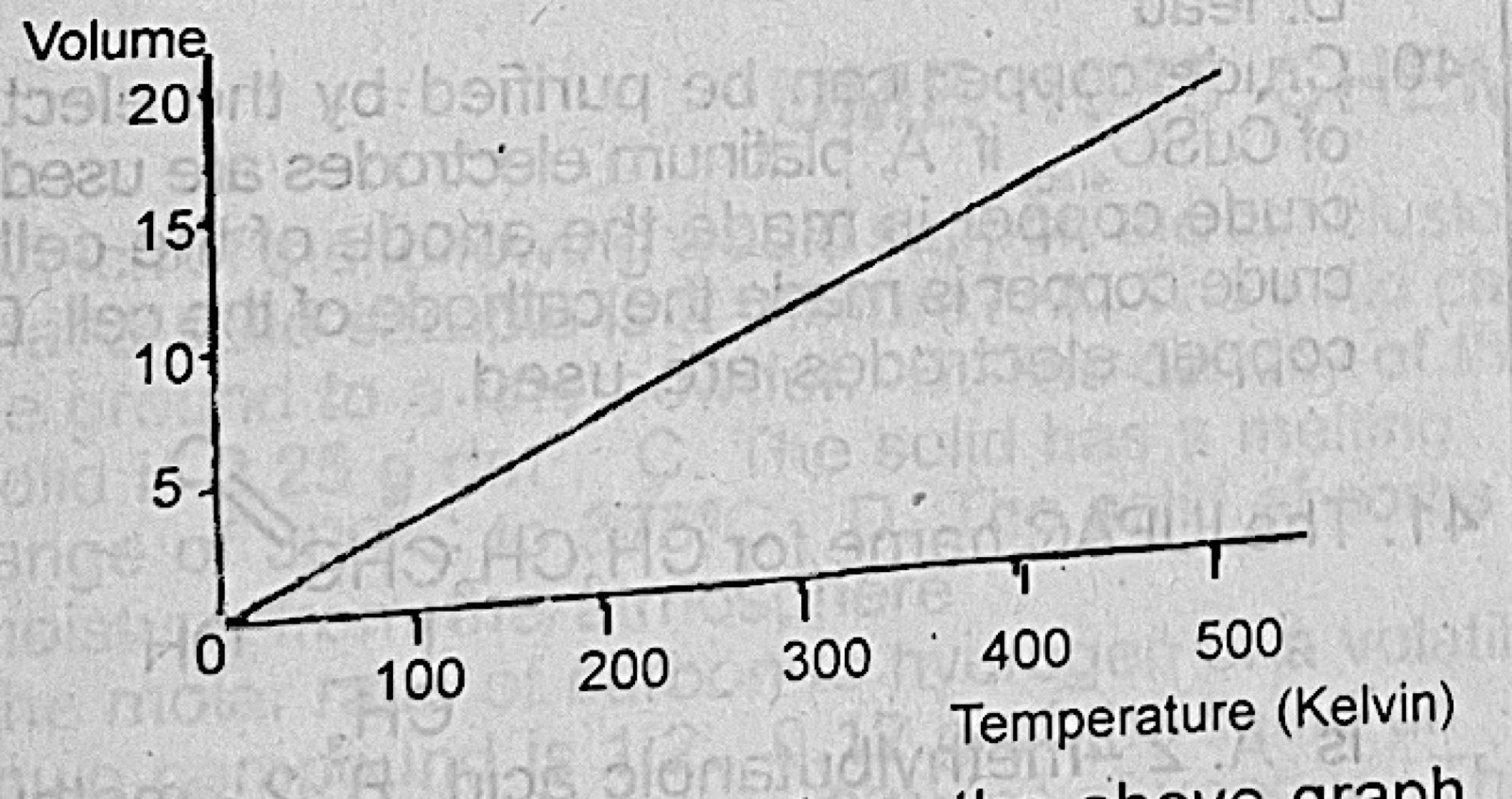
Which of the gas laws does the graph of volume against temperature (Kelvin) shown illustrate?

Diagram for this question
  1. A.Boyle
  2. B.Charles
  3. C.Graham
  4. D.Gay-Lussac.
Show the answer and explanation

Answer: B (Charles)

Explanation

The graph is a straight line through the origin: volume is directly proportional to Kelvin temperature at constant pressure. That is Charles' law.

Open this question

Question 7

Gas Laws

An increase in temperature causes an increase in the pressure of a gas because there is an increase in the

  1. A.average velocity of the molecules
  2. B.number of collisions between the molecules
  3. C.density of the molecules
  4. D.free mean path between each molecule and the other.
Show the answer and explanation

Answer: A (average velocity of the molecules)

Explanation

Heating gives the molecules more kinetic energy, so they move faster. Faster molecules hit the container walls more often and harder, which raises the pressure.

Open this question

Question 8

Chemical Bonding

The forces holding naphthalene crystals together can be overcome when naphthalene is heated to a temperature of 354 K resulting in the crystals melting. These forces are known as

  1. A.coulombic
  2. B.ionic
  3. C.covalent
  4. D.Van der Waals
Show the answer and explanation

Answer: D (Van der Waals)

Explanation

Naphthalene is a molecular solid. Its molecules are held together by weak van der Waals forces, which is why it melts at a low temperature.

Open this question

Question 9

Atomic Structure

A metallic ion X2+ with an inert gas structure contains 18 electrons. How many protons are there in this ion?

  1. A.20
  2. B.18
  3. C.16
  4. D.2
Show the answer and explanation

Answer: A (20)

Explanation

X2+ has lost 2 electrons, so the neutral atom had 20 electrons and therefore 20 protons (calcium).

Open this question

Question 10

Periodic Table

Which of the following physical properties decreases across the Periodic Table?

  1. A.Ionization potential
  2. B.Electron affinity
  3. C.Electronegativity
  4. D.Atomic radius
Show the answer and explanation

Answer: D (Atomic radius)

Explanation

Across a period the nuclear charge increases while electrons go into the same shell, so they are pulled closer and the atomic radius decreases. The other three properties increase.

Open this question

Question 11

Redox Reactions

What are the possible oxidation numbers for an element if its atomic number is 17?

  1. A.−1 and 7
  2. B.−1 and 6
  3. C.−3 and 5
  4. D.−2 and 6
Show the answer and explanation

Answer: A (−1 and 7)

Explanation

Element 17 is chlorine (2, 8, 7). It can gain 1 electron (−1) or use all 7 outer electrons (+7).

Open this question

Question 12

Periodic Table

The energy change accompanying the addition of an electron to a gaseous atom is called

  1. A.first ionization energy
  2. B.second ionization energy
  3. C.electron affinity
  4. D.electronegativity
Show the answer and explanation

Answer: C (electron affinity)

Explanation

Electron affinity is the energy change when a gaseous atom gains an electron. Ionization energy is for removing one.

Open this question

Question 13

Air

The molar ratio of oxygen to nitrogen in dissolved air is 2:1 whereas the ratio is 4:1 in atmospheric air because

  1. A.nitrogen is less soluble than oxygen
  2. B.oxygen is heavier than nitrogen
  3. C.nitrogen has a higher partial pressure in air
  4. D.gases are hydrated in water.
Show the answer and explanation

Answer: A (nitrogen is less soluble than oxygen)

Explanation

Air has much more nitrogen than oxygen, yet dissolved air is richer in oxygen. This is because oxygen is more soluble in water than nitrogen.

Open this question

Question 15

Mole Concept and Stoichiometry

1.34 g of hydrated sodium tetraoxosulphate (VI) was heated to give an anhydrous salt weighing 0.71 g. The formula of the hydrated salt is [Na = 23, S = 32, O = 16, H = 1]

  1. A.Na2SO4.7H2O
  2. B.Na2SO4.3H2O
  3. C.Na2SO4.2H2O
  4. D.Na2SO4.H2O
Show the answer and explanation

Answer: A (Na2SO4.7H2O)

Explanation

Anhydrous Na2SO4: 0.71/142 = 0.005 mol. Water lost: 0.63 g = 0.035 mol. Ratio 0.035/0.005 = 7, so Na2SO4.7H2O.

Open this question

Question 16

Water

The ion that may be assumed to have negligible concentration in a sample of water that lathers readily with soap is

  1. A.Mg2+
  2. B.K+
  3. C.CO32−
  4. D.HCO3−
Show the answer and explanation

Answer: A (Mg2+)

Explanation

Water that lathers readily is soft, so it contains almost no Ca2+ or Mg2+, the ions that cause hardness. K+ does not affect lathering.

Open this question

Question 17

Solubility and Solutions

A substance S is isomorphous with another substance R. When a tiny crystal of S is added into a supersaturated solution of R,

  1. A.S dissolves in the solution
  2. B.crystals of R are precipitated
  3. C.there is no observable change
  4. D.R and S react to generate heat
Show the answer and explanation

Answer: B (crystals of R are precipitated)

Explanation

Isomorphous substances have the same crystal shape, so a crystal of S acts as a seed on which R crystallises out of its supersaturated solution.

Open this question

Question 18

Acids, Bases and Salts

Which of the following dilute solutions has the lowest pH value?

  1. A.Calcium trioxocarbonate (IV)
  2. B.Sodium trioxocarbonate (IV)
  3. C.Hydrochloric acid
  4. D.Ethanoic acid.
Show the answer and explanation

Answer: C (Hydrochloric acid)

Explanation

Hydrochloric acid is a strong acid, fully ionised, so it has the most H+ ions and the lowest pH. The carbonates are alkaline.

Open this question

Question 19

Acids, Bases and Salts

Which of the following in aqueous solution is neutral to litmus?

  1. A.NH4Cl
  2. B.Na2CO3
  3. C.FeCl3
  4. D.NaCl
Show the answer and explanation

Answer: D (NaCl)

Explanation

NaCl is the salt of a strong acid and a strong base, so its solution is neutral. NH4Cl and FeCl3 are acidic; Na2CO3 is alkaline.

Open this question

Question 20

Volumetric Analysis

What volume of a 0.1 M H3PO4 will be required to neutralize 45.0 cm3 of a 0.2 M NaOH?

  1. A.10.0 cm3
  2. B.20.0 cm3
  3. C.27.0 cm3
  4. D.30.0 cm3
Show the answer and explanation

Answer: D (30.0 cm3)

Explanation

H3PO4 + 3NaOH → Na3PO4 + 3H2O. NaOH = 0.2 × 45/1000 = 0.009 mol, so acid = 0.003 mol. Volume = 0.003/0.1 = 0.030 dm3 = 30.0 cm3.

Open this question

Question 21

Acids, Bases and Salts

Which of the following substances is a basic salt?

  1. A.Na2CO3
  2. B.Mg(OH)Cl
  3. C.NaHCO3
  4. D.K2SO4.Al2(SO4)3.24H2O
Show the answer and explanation

Answer: B (Mg(OH)Cl)

Explanation

A basic salt still contains hydroxide ions from the base, as in Mg(OH)Cl. NaHCO3 is an acid salt, Na2CO3 a normal salt and alum a double salt.

Open this question

Question 22

Redox Reactions

Which of the following acts both as a reducing and an oxidizing agent?

  1. A.H2
  2. B.SO2
  3. C.H2S
  4. D.C
Show the answer and explanation

Answer: B (SO2)

Explanation

Sulphur in SO2 is +4, in the middle of its range. It can be oxidised to +6 (acting as a reducing agent) or reduced to 0, for example by H2S (acting as an oxidising agent).

Open this question

Question 23

Electrolysis

Which of the following reactions takes place in the cathode compartment during the electrolysis of copper (II) chloride solution?

  1. A.Cu2+(aq) + 2e− → Cu(s)
  2. B.2Cl− − 2e− → Cl2
  3. C.Cu(s) − 2e− → Cu2+(aq)
  4. D.Cu2+(aq) + 2Cl−(aq) → CuCl2(aq).
Show the answer and explanation

Answer: A (Cu2+(aq) + 2e− → Cu(s))

Explanation

The cathode supplies electrons, so reduction happens there: Cu2+ ions gain electrons and copper is deposited. Chlorine is released at the anode.

Open this question

Question 24

Electrolysis

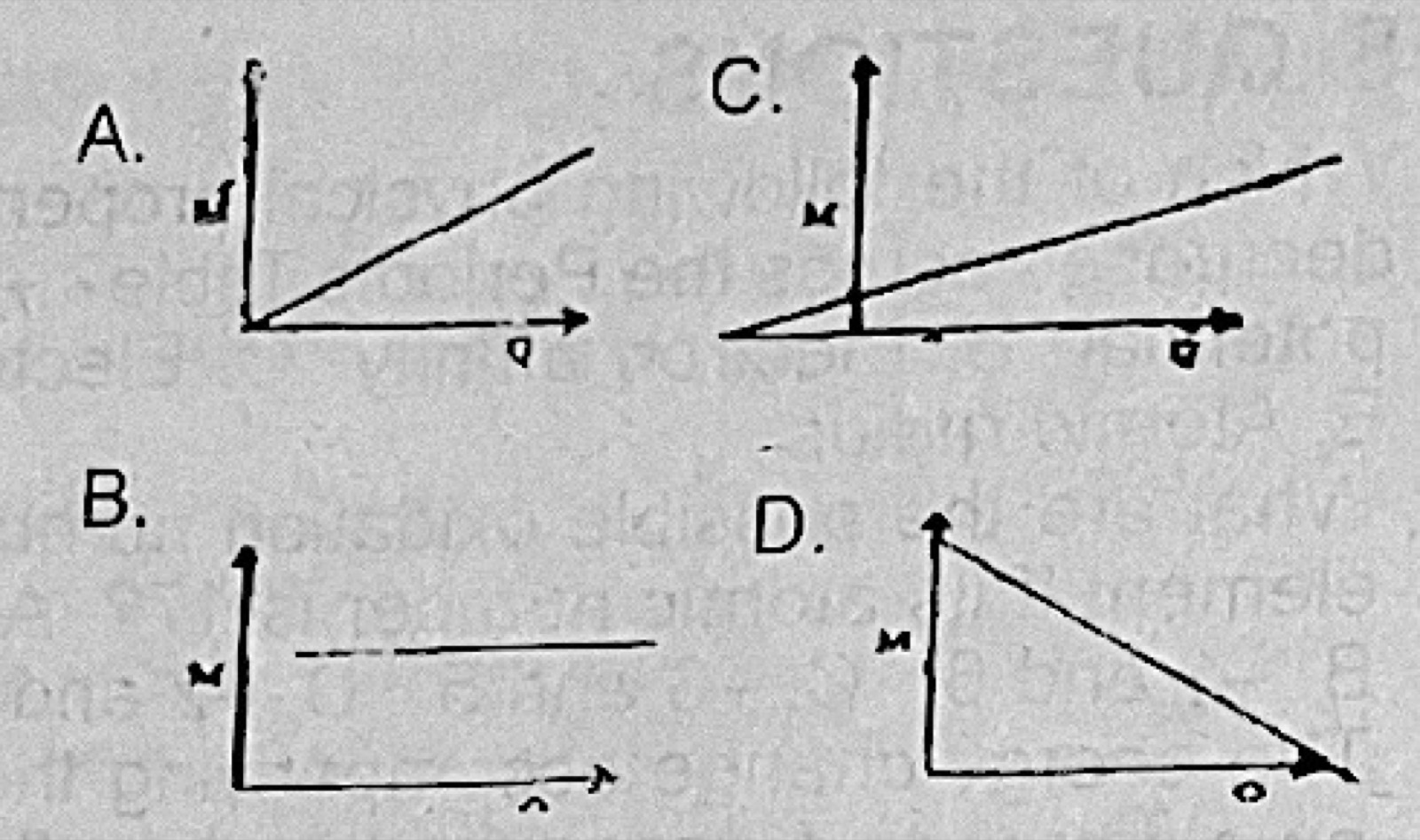
The mass of a substance, M, liberated at an electrode during electrolysis is proportional to the quantity of electricity, Q passing through the electrolyte. This is represented graphically by (see the graphs A–D in the figure)

Diagram for this question
  1. A.Graph A
  2. B.Graph B
  3. C.Graph C
  4. D.Graph D
Show the answer and explanation

Answer: A (Graph A)

Explanation

Direct proportion (Faraday's first law) gives a straight line through the origin: M = 0 when Q = 0. Graph A is the only such line.

Open this question

Question 25

Redox Reactions

A mixture of starch solution and potassium iodide was placed in a test tube. On adding dilute tetraoxosulphate (VI) acid and then K2Cr2O7 solutions, a blue-black colour was produced. In this reaction, the

  1. A.iodide ion is oxidized
  2. B.tetraoxosulphate (VI) acid acts as an oxidizing agent
  3. C.starch has been oxidized
  4. D.K2Cr2O7 is oxidized.
Show the answer and explanation

Answer: A (iodide ion is oxidized)

Explanation

Acidified dichromate oxidises iodide ions to iodine, which turns starch blue-black. The dichromate itself is reduced.

Open this question

Question 26

Energy Changes

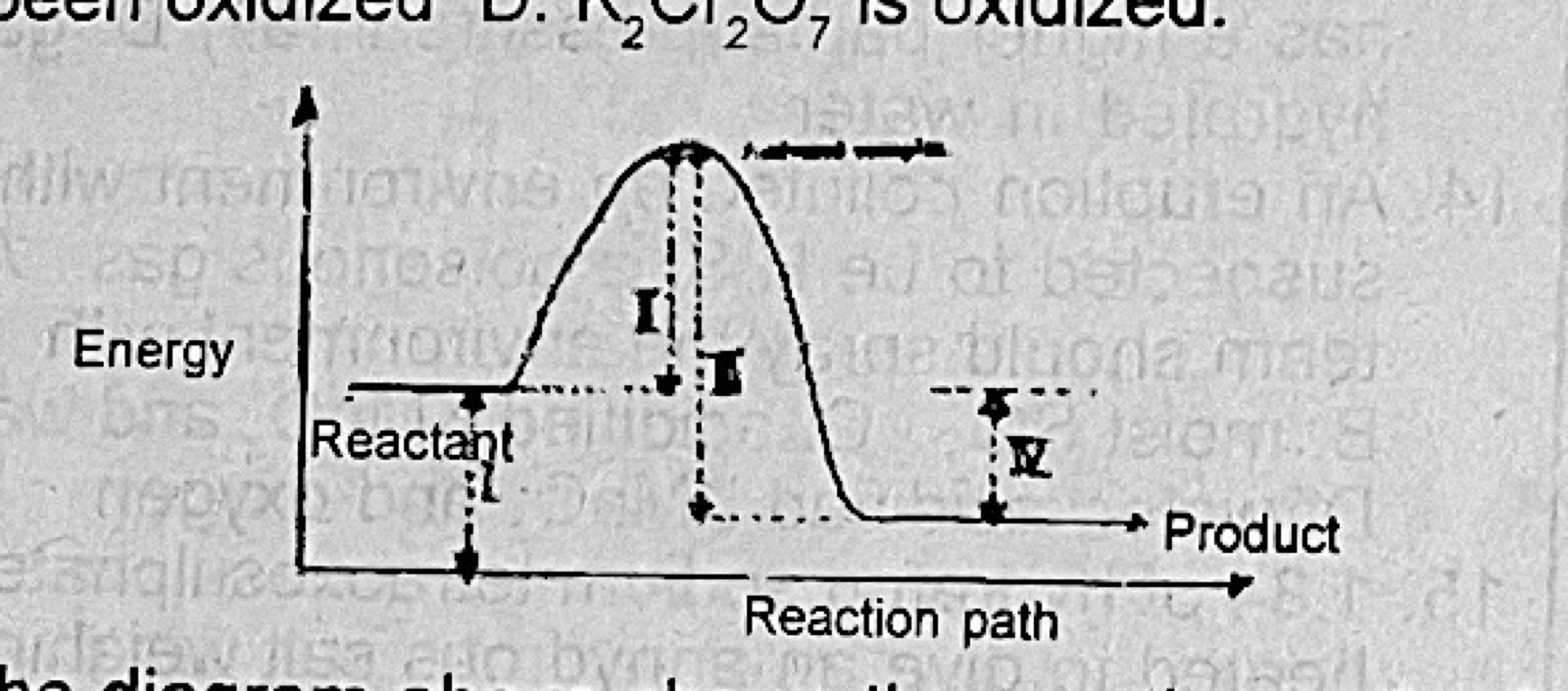
The diagram shows the reaction path of an exothermic reaction. The heat of reaction is represented by

Diagram for this question
  1. A.I
  2. B.II
  3. C.III
  4. D.IV.
Show the answer and explanation

Answer: D (IV.)

Explanation

The heat of reaction is the energy difference between the reactants and the products. On the diagram that gap is labelled IV; the other labels measure from the peak (activation energy) or to the axis.

Open this question

Question 27

Energy Changes

Which of the following statements is TRUE?

  1. A.The dissolution of NaOH(s) in water is endothermic
  2. B.The heat of solution of NaOH(s) is positive
  3. C.The NaOH(s) gains heat from the surroundings
  4. D.The heat of solution of NaOH(s) is negative.
Show the answer and explanation

Answer: D (The heat of solution of NaOH(s) is negative.)

Explanation

Solid NaOH gets hot when it dissolves: it gives out heat, so its heat of solution is negative (exothermic).

Open this question

Question 28

Rates of Reaction

Which of the following will produce the greatest increase in the rate of the chemical reaction represented by the equation Na2S2O3(aq) + 2HCl(aq) → 2NaCl(aq) + H2O(l) + SO2(g) + S(s)?

  1. A.A decrease in temperature and an increase in the concentration of the reactants
  2. B.An increase in the temperature and a decrease in the concentration of the reactants
  3. C.An increase in the temperature and an increase in the concentration of the reactants.
  4. D.A decrease in the temperature and a decrease in the concentration of the reactants.
Show the answer and explanation

Answer: C (An increase in the temperature and an increase in the concentration of the reactants.)

Explanation

Both a higher temperature and a higher concentration speed up the reaction, so raising both gives the greatest increase in rate.

Open this question

Question 29

Rates of Reaction

Which property of a reversible reaction is affected by a catalyst?

  1. A.Heat content (enthalpy).
  2. B.Energy of activation
  3. C.Free energy change
  4. D.Equilibrium position
Show the answer and explanation

Answer: B (Energy of activation)

Explanation

A catalyst provides a pathway with lower activation energy. It does not change ΔH, the free energy change or the equilibrium position.

Open this question

Question 30

Carbon and its Compounds

Which of the following is used in fire extinguishers?

  1. A.Carbon (II) oxide
  2. B.Carbon (IV) oxide
  3. C.Sulphur (IV) oxide
  4. D.Ammonia.
Show the answer and explanation

Answer: B (Carbon (IV) oxide)

Explanation

Carbon (IV) oxide is denser than air and does not burn or support burning, so it blankets the fire and cuts off oxygen.

Open this question

Question 31

Redox Reactions

When H2S gas is passed into a solution of iron (III) chloride, the colour changes from yellow to green. This is because

  1. A.H2S is reduced to S
  2. B.Fe3+ ions are oxidized by H2S
  3. C.Fe3+ ions are oxidized by Fe2+ ions
  4. D.Fe3+ ions are reduced to Fe2+ ions.
Show the answer and explanation

Answer: D (Fe3+ ions are reduced to Fe2+ ions.)

Explanation

H2S is a reducing agent: it reduces yellow Fe3+ to green Fe2+ and is itself oxidised to sulphur.

Open this question

Question 32

Carbon and its Compounds

Carbon (II) oxide may be collected as shown in the figure because it

  1. A.is heavier than air
  2. B.is less dense than air
  3. C.is insoluble in water
  4. D.burns in oxygen to form carbon (IV) oxide.
Show the answer and explanation

Answer: C (is insoluble in water)

Explanation

The gas is collected over water, which only works for a gas that does not dissolve in water. Carbon (II) oxide is insoluble.

Open this question

Question 33

Sulphur and its Compounds

In the reaction C6H10O5(s) → 6C(s) + 5H2O (conc. H2SO4), concentrated H2SO4 is acting as

  1. A.a reducing agent
  2. B.an oxidizing agent
  3. C.a dehydrating agent
  4. D.a catalyst.
Show the answer and explanation

Answer: C (a dehydrating agent)

Explanation

The acid removes the elements of water (H and O in a 2 : 1 ratio) from the carbohydrate, leaving carbon. That is dehydration.

Open this question

Question 34

Nitrogen and its Compounds

Suitable reagents for the laboratory preparation of nitrogen are

  1. A.sodium dioxonitrate (III) and ammonium chloride
  2. B.sodium trioxonitrate (V) and ammonium chloride
  3. C.sodium chloride and ammonium trioxonitrate (V)
  4. D.sodium chloride and ammonium dioxonitrate (III).
Show the answer and explanation

Answer: A (sodium dioxonitrate (III) and ammonium chloride)

Explanation

Warming sodium dioxonitrate (III) (NaNO2) with ammonium chloride forms ammonium dioxonitrate (III), which decomposes to nitrogen and water.

Open this question

Question 35

Nitrogen and its Compounds

The thermal decomposition of copper (II) trioxonitrate (V) yields copper (II) oxide, oxygen and

  1. A.nitrogen (II) oxide
  2. B.nitrogen (I) oxide
  3. C.nitrogen (IV) oxide
  4. D.nitrogen
Show the answer and explanation

Answer: C (nitrogen (IV) oxide)

Explanation

2Cu(NO3)2 → 2CuO + 4NO2 + O2. The brown gas given off is nitrogen (IV) oxide.

Open this question

Question 36

Halogens

Chlorine is produced commercially by

  1. A.electrolysis of dilute hydrochloric acid
  2. B.electrolysis of brine
  3. C.neutralization of hydrogen chloride
  4. D.heating potassium trioxochlorate (V).
Show the answer and explanation

Answer: B (electrolysis of brine)

Explanation

Industrially, chlorine is made by electrolysing brine (concentrated sodium chloride solution), which also gives sodium hydroxide and hydrogen.

Open this question

Question 37

Chemistry and Industry

Which of the following is used in the manufacture of glass?

  1. A.Sodium chloride
  2. B.Sodium trioxocarbonate (IV).
  3. C.Sodium tetraoxosulphate (VI).
  4. D.Sodium trioxonitrate (V).
Show the answer and explanation

Answer: B (Sodium trioxocarbonate (IV).)

Explanation

Glass is made by melting sand with sodium trioxocarbonate (IV) (soda ash) and limestone: Na2CO3 + SiO2 → Na2SiO3 + CO2.

Open this question

Question 38

Metals and their Compounds

Aluminium is extracted commercially from its ore by

  1. A.heating aluminium oxide with coke in a furnace
  2. B.the electrolysis of fused aluminium oxide in cryolite
  3. C.treating cryolite with sodium hydroxide solution under pressure
  4. D.heating sodium aluminium silicate to a high temperature.
Show the answer and explanation

Answer: B (the electrolysis of fused aluminium oxide in cryolite)

Explanation

Aluminium is too reactive to be reduced by carbon, so purified alumina dissolved in molten cryolite is electrolysed.

Open this question

Question 40

Electrolysis

Crude copper can be purified by the electrolysis of CuSO4(aq) if

  1. A.platinum electrodes are used
  2. B.the crude copper is made the anode of the cell
  3. C.the crude copper is made the cathode of the cell
  4. D.crude copper electrodes are used.
Show the answer and explanation

Answer: B (the crude copper is made the anode of the cell)

Explanation

The impure copper anode dissolves as Cu2+ ions, and pure copper is deposited on a pure copper cathode. Impurities fall as anode sludge.

Open this question

Question 41

Introduction to Organic Chemistry

The IUPAC name for CH3CH2CH(CH3)COOH is

  1. A.2 –methylbutanoic acid
  2. B.2 –methyl-1-hydroxyketone
  3. C.2–methyl-1-hydroxy aldehyde
  4. D.2-methylpentanoic acid.
Show the answer and explanation

Answer: A (2 –methylbutanoic acid)

Explanation

The longest chain including the COOH carbon has 4 carbons (butanoic acid), with a methyl group on carbon 2, counting the COOH carbon as 1.

Open this question

Question 42

Carbohydrates, Proteins and Amines

Methylethanoate reacts with ammonia to yield

  1. A.methylamine and ethanol
  2. B.ethylamine and methanol
  3. C.methanamide and ethanol
  4. D.ethanamide and methanol
Show the answer and explanation

Answer: D (ethanamide and methanol)

Explanation

CH3COOCH3 + NH3 → CH3CONH2 + CH3OH. The acid part becomes the amide (ethanamide) and the alkyl part becomes the alkanol (methanol).

Open this question

Question 43

Alkanoic Acids and Esters

Alkanoates are formed by the reaction of alkanoic acids with

  1. A.Alkyl halides
  2. B.alkanols
  3. C.ethers
  4. D.sodium
Show the answer and explanation

Answer: B (alkanols)

Explanation

Alkanoic acids react with alkanols (esterification) to form alkyl alkanoates (esters) and water.

Open this question

Question 44

Hydrocarbons

The acidic hydrogen in the compound H–C≡C–CH=CH–CH3 (carbons numbered 1 to 5 from the left) is the hydrogen attached to carbon number

  1. A.5
  2. B.4
  3. C.3
  4. D.1
Show the answer and explanation

Answer: D (1)

Explanation

A hydrogen on a triple-bonded carbon (≡C–H) is weakly acidic. Only carbon 1 carries such a hydrogen.

Open this question

Question 45

Hydrocarbons

The four classes of hydrocarbons are

  1. A.ethane, ethene, ethyne and benzene
  2. B.alkanes, alkenes, alkynes and aromatics
  3. C.alkanes, alkenes, alkynes and benzene
  4. D.methane, ethane, propane and butane.
Show the answer and explanation

Answer: B (alkanes, alkenes, alkynes and aromatics)

Explanation

Hydrocarbons are grouped into alkanes, alkenes, alkynes and aromatic hydrocarbons. The other options list single compounds, not classes.

Open this question

Question 46

Hydrocarbons

Alkanes → smaller alkanes + alkenes + hydrogen (400 – 700 °C, catalyst). The above reaction is known as

  1. A.photolysis
  2. B.cracking
  3. C.isomerization
  4. D.reforming
Show the answer and explanation

Answer: B (cracking)

Explanation

Breaking large alkane molecules into smaller alkanes, alkenes and hydrogen with heat and a catalyst is cracking.

Open this question

Question 47

Carbohydrates, Proteins and Amines

In the reaction 2(C6H10O5)n + nH2O → nC12H22O11 (diastase, 60 °C), diastase is functioning as

  1. A.a dehydrating agent
  2. B.a reducing agent
  3. C.an oxidizing agent
  4. D.a catalyst
Show the answer and explanation

Answer: D (a catalyst)

Explanation

Diastase is an enzyme, a biological catalyst. It speeds up the hydrolysis of starch to maltose without being used up.

Open this question

Question 48

Introduction to Organic Chemistry

Which of the following compounds has the highest boiling point?

  1. A.CH3CH2CH2CH2OH
  2. B.CH3CH2CH2CHO
  3. C.CH3CH2CH2CH3
  4. D.CH3CH2OCH2CH3.
Show the answer and explanation

Answer: A (CH3CH2CH2CH2OH)

Explanation

Butan-1-ol molecules form hydrogen bonds with each other through their –OH groups, so it boils much higher than the aldehyde, alkane or ether of similar size.
Open this question

Question 49

Fats, Oils and Soaps

Detergents have the general formula

  1. A.R(CH2)nOH
  2. B.RSO3−Na+
  3. C.RCO2−Na+
  4. D.RCO2H.
Show the answer and explanation

Answer: B (RSO3−Na+)

Explanation

Soapless detergents are sodium alkyl (or alkylbenzene) sulphonates, RSO3−Na+. RCO2−Na+ is soap.

Open this question

Question 50

Petroleum and Coal

What process would coal undergo to give coal gas, coal tar, ammoniacal liquor and coke?

  1. A.Steam distillation
  2. B.Destructive distillation
  3. C.Liquefaction
  4. D.Hydrolysis.
Show the answer and explanation

Answer: B (Destructive distillation)

Explanation

Heating coal strongly in the absence of air (destructive distillation) breaks it down into coal gas, coal tar, ammoniacal liquor and coke.

Open this question