JAMB Chemistry 1983 past questions and answers

50 questions. Try each one, then open the answer to check yourself and read the explanation.

Question 1

Acids, Bases and Salts

X is a crystalline salt of sodium. A solution of X in water turns litmus red and produces a gas which turns lime water milky when added to sodium carbonate. With barium chloride solution, X gives a white precipitate which is insoluble in dilute hydrochloric acid. X is

  1. A.Na2CO3
  2. B.NaHCO3
  3. C.NaHSO4
  4. D.Na2SO3
  5. E.Na2SO4.
Show the answer and explanation

Answer: C (NaHSO4)

Explanation

X is acidic (turns litmus red and liberates CO2 from carbonate) and is a sulphate (white precipitate with BaCl2 that does not dissolve in HCl). The acidic sulphate salt is NaHSO4.

Open this question

Question 2

Fats, Oils and Soaps

The alkanol obtained from the production of soap is

  1. A.ethanol
  2. B.glycerol
  3. C.methanol
  4. D.propanol
  5. E.glycol
Show the answer and explanation

Answer: B (glycerol)

Explanation

Boiling a fat or oil with alkali gives soap and glycerol (propane-1,2,3-triol).

Open this question

Question 3

Hydrocarbons

The flame used by welders in cutting metals is

  1. A.butane gas flame
  2. B.acetylene flame
  3. C.kerosene flame
  4. D.oxy-acetylene flame
  5. E.oxygen flame
Show the answer and explanation

Answer: D (oxy-acetylene flame)

Explanation

Ethyne (acetylene) burnt in pure oxygen gives a flame of about 3000°C, hot enough to cut and weld metals.

Open this question

Question 4

Introduction to Organic Chemistry

Consecutive members of an alkane homologous series differ by

  1. A.CH
  2. B.CH2
  3. C.CH3
  4. D.CnHn
  5. E.CnH2n+2.
Show the answer and explanation

Answer: B (CH2)

Explanation

Each member of a homologous series has one more CH2 group than the one before, e.g. CH4, C2H6, C3H8.

Open this question

Question 5

Atomic Structure

If an element has the electronic configuration 1s2 2s2 2p6 3s2 3p4, it is

  1. A.a metal
  2. B.an alkaline earth metal
  3. C.an s-block element
  4. D.a p-block element
  5. E.a transition element
Show the answer and explanation

Answer: D (a p-block element)

Explanation

The last electrons go into a p subshell (3p4), so it is a p-block element (sulphur).

Open this question

Question 6

Mole Concept and Stoichiometry

Some copper (II) sulphate pentahydrate (CuSO4.5H2O), was heated at 120°C with the following results: Wt of crucible = 10.00 g; Wt of crucible + CuSO4.5H2O = 14.98g; Wt of crucible + residue = 13.54 g. How many molecules of water of crystallization were lost? [H = 1, Cu = 63.5, O = 16, S = 32]

  1. A.1
  2. B.2
  3. C.3
  4. D.4
  5. E.5
Show the answer and explanation

Answer: D (4)

Explanation

Hydrate = 4.98 g = 4.98/249.5 ≈ 0.020 mol. Water lost = 14.98 − 13.54 = 1.44 g = 0.080 mol. 0.080/0.020 = 4 molecules of water per formula unit.

Open this question

Question 7

Chemical Bonding

The three-dimensional shape of methane is

  1. A.hexagonal
  2. B.trigonal
  3. C.linear
  4. D.tetrahedral
  5. E.cubical
Show the answer and explanation

Answer: D (tetrahedral)

Explanation

The four C–H bond pairs around carbon repel equally and point to the corners of a tetrahedron (bond angle 109.5°).

Open this question

Question 8

Carbohydrates, Proteins and Amines

An unknown organic compound X has a relative molecular mass of 180. It is a colourless crystalline solid, readily soluble in water. X contains the elements C, H, and O in the atomic ratio 1:2:1. The compound has a sweet taste and melts on heating. In the presence of yeast and in the absence of air, X is converted to compound Y and a colourless gas. Compound Y reacts with sodium metal to produce a gas Z which gives a 'pop' sound with a glowing splint. Y also reacts with ethanoic acid to give a sweet smelling compound W.
Compound W is

  1. A.a soap
  2. B.an oil
  3. C.an alkane
  4. D.an ester
  5. E.sucrose
Show the answer and explanation

Answer: D (an ester)

Explanation

X is glucose and Y is ethanol (made by fermentation). Ethanol reacting with ethanoic acid gives ethyl ethanoate, a sweet-smelling ester.

Open this question

Question 9

Carbohydrates, Proteins and Amines

An unknown organic compound X has a relative molecular mass of 180. It is a colourless crystalline solid, readily soluble in water. X contains the elements C, H, and O in the atomic ratio 1:2:1. The compound has a sweet taste and melts on heating. In the presence of yeast and in the absence of air, X is converted to compound Y and a colourless gas. Compound Y reacts with sodium metal to produce a gas Z which gives a 'pop' sound with a glowing splint. Y also reacts with ethanoic acid to give a sweet smelling compound W.
The molecular formula of X is

  1. A.C12H22O11
  2. B.C6H12O6
  3. C.C3H6O3
  4. D.C7H14O7
  5. E.C4H6O4
Show the answer and explanation

Answer: B (C6H12O6)

Explanation

The empirical formula CH2O has mass 30; 180/30 = 6, so X is C6H12O6.

Open this question

Question 10

Carbohydrates, Proteins and Amines

An unknown organic compound X has a relative molecular mass of 180. It is a colourless crystalline solid, readily soluble in water. X contains the elements C, H, and O in the atomic ratio 1:2:1. The compound has a sweet taste and melts on heating. In the presence of yeast and in the absence of air, X is converted to compound Y and a colourless gas. Compound Y reacts with sodium metal to produce a gas Z which gives a 'pop' sound with a glowing splint. Y also reacts with ethanoic acid to give a sweet smelling compound W.
Reaction of X with yeast forms the basis of the

  1. A.plastic industry
  2. B.textile industry
  3. C.brewing industry
  4. D.soap industry
  5. E.dyeing industry
Show the answer and explanation

Answer: C (brewing industry)

Explanation

Yeast ferments sugar into ethanol and carbon dioxide, which is how beer and other alcoholic drinks are brewed.

Open this question

Question 11

Separation of Mixtures

A mixture of common salt, ammonium chloride and barium sulphate can best be separated by

  1. A.addition of water followed by filtration then sublimation
  2. B.addition of water followed by sublimation then filtration
  3. C.sublimation followed by addition of water then filtration
  4. D.fractional distillation
  5. E.fractional crystallization
Show the answer and explanation

Answer: C (sublimation followed by addition of water then filtration)

Explanation

Heat first to sublime off the ammonium chloride (it would dissolve if water came first). Then add water: salt dissolves and insoluble barium sulphate is filtered off.

Open this question

Question 12

Gas Laws

Which of the following relationships between the pressure P, the volume V and the temperature T, represents an ideal gas behaviour?

  1. A.P α VT
  2. B.P α T/V
  3. C.PT α V
  4. D.PV α 1/T
  5. E.P α V/T
Show the answer and explanation

Answer: B (P α T/V)

Explanation

For an ideal gas PV/T is constant, so P is proportional to T/V.

Open this question

Question 13

Halogens

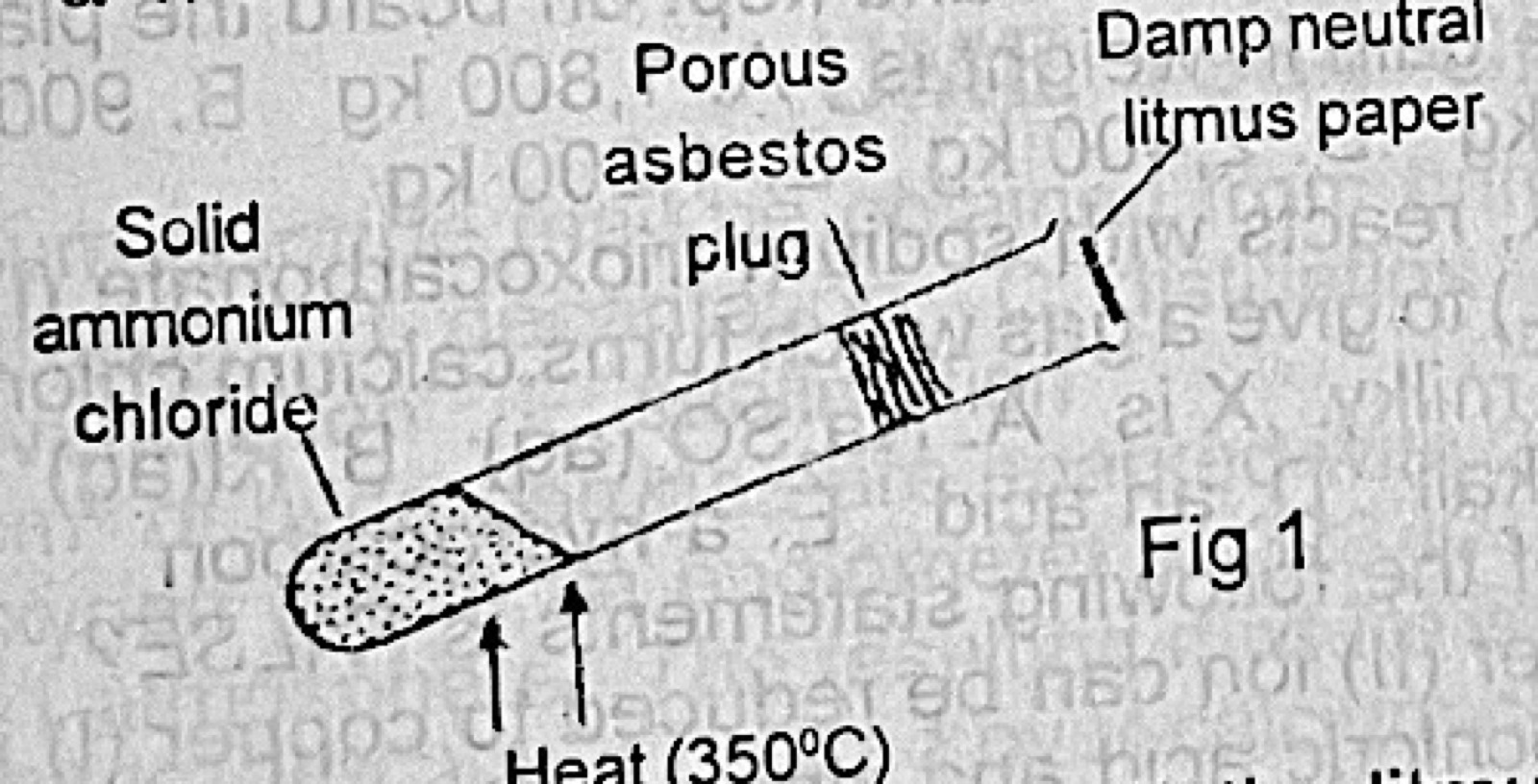
In the above experiment (Fig. 1) the litmus paper will initially

Diagram for this question
  1. A.be bleached
  2. B.turn green
  3. C.turn red
  4. D.turn blue
  5. E.turn black
Show the answer and explanation

Answer: D (turn blue)

Explanation

Heated ammonium chloride splits into ammonia and hydrogen chloride. Ammonia is lighter, so it diffuses through the porous plug faster and turns the damp litmus blue first.

Open this question

Question 14

Qualitative Analysis

The colour imparted to a flame by calcium ion is

  1. A.green
  2. B.blue
  3. C.brick-red
  4. D.yellow
  5. E.lilac
Show the answer and explanation

Answer: C (brick-red)

Explanation

Calcium compounds give a brick-red flame (sodium yellow, potassium lilac).

Open this question

Question 15

Chemical Equilibrium

In the reaction M + N ⇌ P; ΔH = +Q kJ. Which of the following would increase the concentration of the product?

  1. A.Decreasing the concentration of N
  2. B.Increasing the concentration of P
  3. C.Adding a suitable catalyst
  4. D.Decreasing the temperature
  5. E.Increasing the temperature
Show the answer and explanation

Answer: E (Increasing the temperature)

Explanation

ΔH is positive, so the forward reaction is endothermic. Raising the temperature shifts the equilibrium to the right, making more P.

Open this question

Question 16

Redox Reactions

In which of the following processes is iron being oxidized?
1. Fe + H2SO4 → FeSO4 + H2
2. FeSO4 + H2S → FeS + H2SO4
3. 2FeCl2 + Cl2 → 2FeCl3
4. 2FeCl3 + SnCl2 → 2FeCl2 + SnCl4.

  1. A.1 only
  2. B.2 only
  3. C.3 only
  4. D.1 and 3
  5. E.2 and 4
Show the answer and explanation

Answer: D (1 and 3)

Explanation

Iron's oxidation number rises from 0 to +2 in 1 and from +2 to +3 in 3. It stays +2 in 2 and falls from +3 to +2 in 4.

Open this question

Question 17

Electrolysis

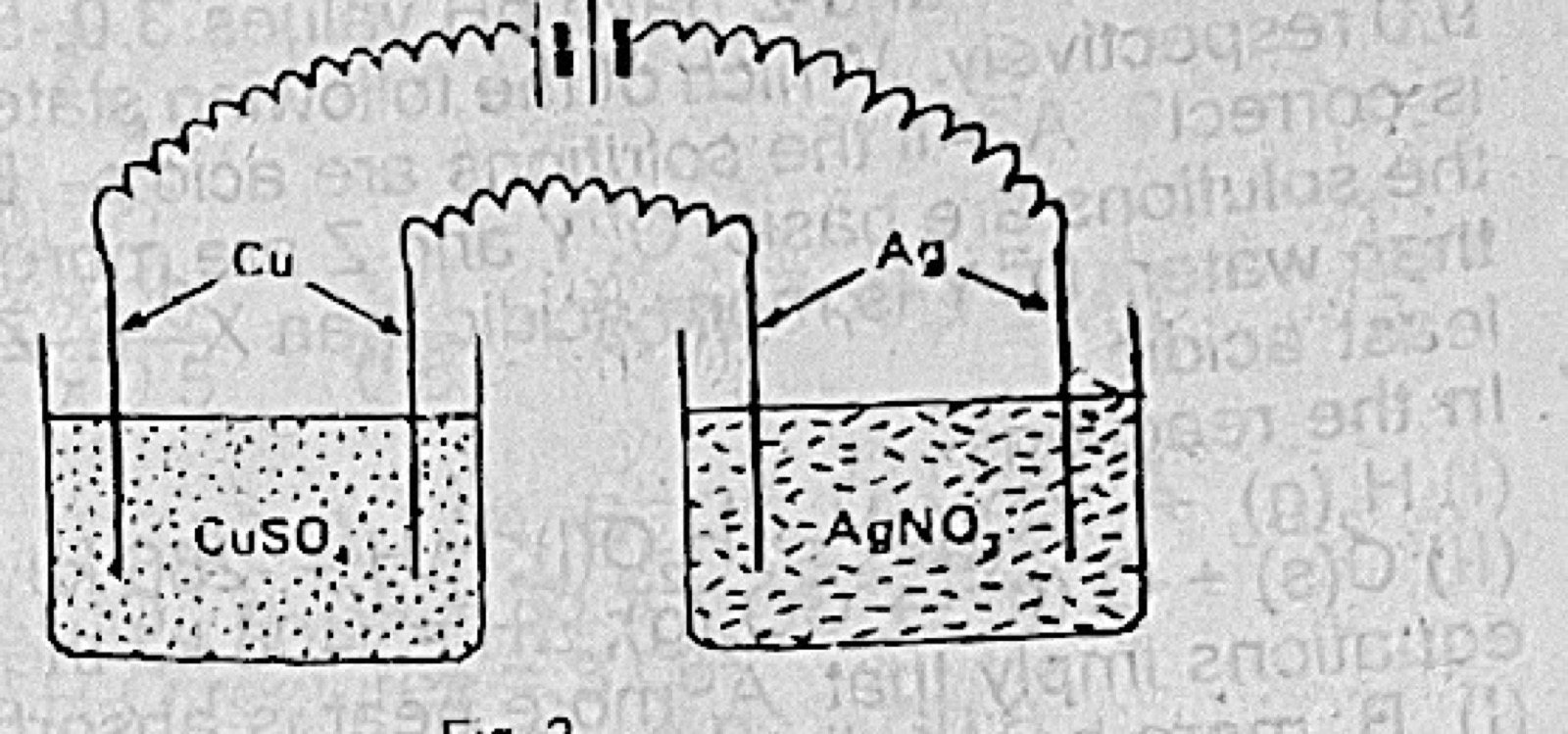
In the above experiment (Fig. 2), a current was passed for 10 minutes and 0.63 g of copper was found to be deposited on the cathode of CuSO4 cells. The weight of silver deposited on the cathode of AgNO3 cell during the same period would be [Cu = 63, Ag = 108]

Diagram for this question
  1. A.0.54 g
  2. B.1.08 g
  3. C.1.62g
  4. D.2.16 g
  5. E.3.24 g.
Show the answer and explanation

Answer: D (2.16 g)

Explanation

0.63 g Cu = 0.01 mol, which needed 0.02 mol of electrons (Cu2+). The same charge deposits 0.02 mol Ag (Ag+) = 0.02 × 108 = 2.16 g.

Open this question

Question 18

Metals and their Compounds

In the reaction Fe + Cu2+ → Fe2+ + Cu, iron displaces copper ions to form copper. This is due to the fact that

  1. A.iron is in the metallic form while the copper is in the ionic form
  2. B.the atomic weight of copper is greater than that of iron
  3. C.copper metal has more electrons than iron metal
  4. D.iron is an inert metal
  5. E.iron is higher in the electrochemical series than copper.
Show the answer and explanation

Answer: E (iron is higher in the electrochemical series than copper.)

Explanation

A metal higher in the electrochemical series gives up electrons more readily, so iron reduces Cu2+ ions to copper.

Open this question

Question 19

Introduction to Organic Chemistry

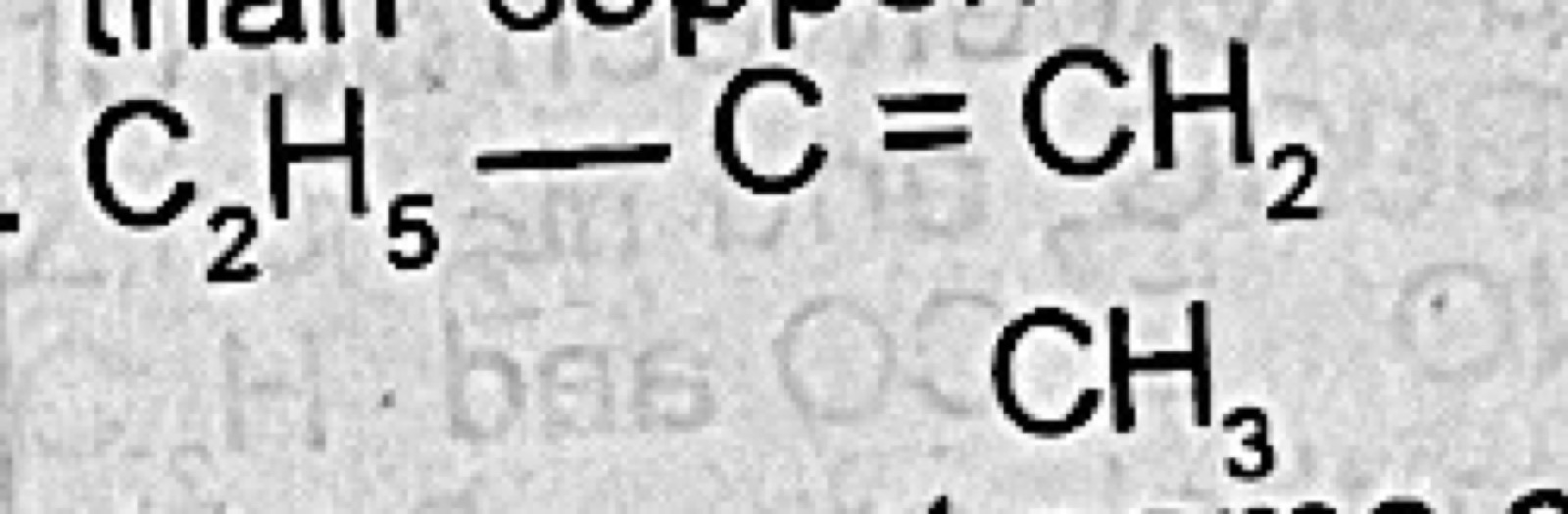
C2H5—C(CH3)=CH2
The correct name of the compound with the above structural formula is

Diagram for this question
  1. A.2-methylbutane
  2. B.2-methylbut-2-ene
  3. C.2-methylbut-1-ene
  4. D.2-ethylprop-1-ene
  5. E.2-ethylprop-2-ene
Show the answer and explanation

Answer: C (2-methylbut-1-ene)

Explanation

The longest chain containing the double bond has four carbons with C=C starting at carbon 1, and a methyl group on carbon 2: 2-methylbut-1-ene.

Open this question

Question 20

Introduction to Organic Chemistry

How many isomeric forms are there for the molecular formula C3H6Br2?

  1. A.1
  2. B.2
  3. C.3
  4. D.4
  5. E.5
Show the answer and explanation

Answer: D (4)

Explanation

The two Br atoms can be placed as 1,1-, 1,2-, 1,3- or 2,2-dibromopropane: four isomers.

Open this question

Question 21

Sulphur and its Compounds

A piece of burning sulphur will continue to burn in a gas jar of oxygen to give misty fumes which readily dissolve in water. The resulting liquid is

  1. A.sulphur (VI) trioxide
  2. B.tetraoxosulphate (VI) acid
  3. C.trioxosulphate (IV) acid
  4. D.dioxosulphate (II) acid
  5. E.hydrogen sulphide
Show the answer and explanation

Answer: C (trioxosulphate (IV) acid)

Explanation

Sulphur burns in oxygen mainly to sulphur(IV) oxide, which dissolves in water to form trioxosulphate(IV) acid (sulphurous acid), H2SO3.

Open this question

Question 22

Water

Sodium sulphate decahydrate (Na2SO4.10 H2O) on exposure to air loses all its water of crystallization. The process of loss is known as

  1. A.efflorescence
  2. B.hygroscopy
  3. C.deliquescence
  4. D.effervescence
  5. E.dehydration
Show the answer and explanation

Answer: A (efflorescence)

Explanation

Losing water of crystallization to the atmosphere on standing is called efflorescence.

Open this question

Question 23

Electrolysis

Which of the following happens during the electrolysis of molten sodium chloride?

  1. A.Sodium ion loses an electron
  2. B.Chlorine atom gains an electron
  3. C.Chlorine ion gains an electron
  4. D.Sodium ion is oxidized
  5. E.Chloride ion is oxidized.
Show the answer and explanation

Answer: E (Chloride ion is oxidized.)

Explanation

At the anode Cl− ions lose electrons to form chlorine gas; losing electrons is oxidation. Na+ gains electrons (is reduced) at the cathode.

Open this question

Question 24

Environmental Pollution

Crude petroleum pollutant usually seen on some Nigerian creeks and waterways can be dispersed or removed by

  1. A.heating the affected parts in order to boil off the petroleum
  2. B.mechanically stirring to dissolve the petroleum in water
  3. C.pouring organic solvents to dissolve the petroleum
  4. D.spraying the water with detergents
  5. E.cooling to freeze out the petroleum.
Show the answer and explanation

Answer: D (spraying the water with detergents)

Explanation

Detergents (dispersants) break the oil slick into tiny droplets that spread through the water and are broken down. Pouring in organic solvents would only add more pollution.

Open this question

Question 25

Periodic Table

An element is electronegative if

  1. A.it has a tendency to exist in the gaseous form
  2. B.its ions dissolve readily in water
  3. C.it has a tendency to lose electrons
  4. D.it has a tendency to gain electrons
  5. E.it readily forms covalent bonds.
Show the answer and explanation

Answer: D (it has a tendency to gain electrons)

Explanation

Electronegative elements (non-metals like chlorine) tend to attract and gain electrons to form negative ions.

Open this question

Question 26

Acids, Bases and Salts

Solutions X, Y, and Z have pH values 3.0, 5.0 and 9.0 respectively. Which of the following statements is correct?

  1. A.All the solutions are acidic.
  2. B.All the solutions are basic
  3. C.Y and Z are more acidic than water
  4. D.Y is more acidic than X.
  5. E.Z is the least acidic
Show the answer and explanation

Answer: E (Z is the least acidic)

Explanation

The higher the pH, the less acidic the solution. Z (pH 9) is actually alkaline, so it is the least acidic of the three.

Open this question

Question 27

Energy Changes

In the reactions
(I) H2(g) + ½O2(g) → H2O(l); ΔH = −286 kJ
(II) C(s) + O2(g) → CO2(g); ΔH = −406 kJ
the equations imply that

  1. A.more heat is absorbed in (I)
  2. B.more heat is absorbed in (II)
  3. C.less heat is evolved in (I)
  4. D.reaction (II) proceeds faster than (I).
  5. E.reaction (I) proceeds faster than (II).
Show the answer and explanation

Answer: C (less heat is evolved in (I))

Explanation

Both ΔH values are negative, so both reactions give out heat; reaction (I) gives out 286 kJ, less than the 406 kJ of (II). ΔH says nothing about speed.

Open this question

Question 28

Metals and their Compounds

Which of these metals, Mg, Fe, Pb and Cu will dissolve in dilute HCl?

  1. A.All the metals.
  2. B.Mg, Fe and Cu.
  3. C.Mg, Fe and Pb
  4. D.Mg and Fe only
  5. E.Mg only.
Show the answer and explanation

Answer: D (Mg and Fe only)

Explanation

Magnesium and iron are well above hydrogen and dissolve readily. Copper is below hydrogen, and lead hardly reacts because insoluble lead(II) chloride coats it.

Open this question

Question 29

Metals and their Compounds

Stainless steel is an alloy of

  1. A.carbon, iron and lead
  2. B.carbon, iron and chromium
  3. C.carbon, iron and copper
  4. D.carbon, iron and silver
  5. E.carbon and iron only.
Show the answer and explanation

Answer: B (carbon, iron and chromium)

Explanation

Stainless steel is iron with a little carbon and chromium (often nickel too); the chromium stops it rusting.

Open this question

Question 30

Volumetric Analysis

What volume of 0.5 M H2SO4 will exactly neutralize 20 cm3 of 0.1 M NaOH solution?

  1. A.2.0 cm3
  2. B.5.0 cm3
  3. C.6.8 cm3
  4. D.8.3 cm3
  5. E.10.4 cm3
Show the answer and explanation

Answer: A (2.0 cm3)

Explanation

NaOH = 0.020 × 0.1 = 0.002 mol, which needs 0.001 mol H2SO4 (1:2 ratio). Volume = 0.001/0.5 = 0.002 dm3 = 2.0 cm3.

Open this question

Question 31

Nitrogen and its Compounds

Which of the following pair of gases will NOT react further with oxygen at a temperature between 30°C and 400°C?

  1. A.SO2 and NH3
  2. B.CO2 and H2
  3. C.NO2 and SO3
  4. D.SO3 and NO
  5. E.CO and H2.
Show the answer and explanation

Answer: C (NO2 and SO3)

Explanation

NO2 and SO3 are already the stable higher oxides and do not take up more oxygen. NO, CO, H2, NH3 and SO2 can all be oxidised further.

Open this question

Question 32

Metals and their Compounds

Some metals are extracted from their ores after some preliminary treatments by electrolysis (L), some by thermal reaction (T) and some by a combination of both processes (TL). Which set-up in the following for the extraction of iron, copper and aluminium is correct?

  1. A.Iron (L), copper (L), aluminium (T).
  2. B.Iron (T), copper (L), aluminium (T).
  3. C.Iron (TL), copper (TL), aluminium (TL).
  4. D.Iron (L), copper (T), aluminium (T)
  5. E.Iron (T), copper (L), aluminium (TL).
Show the answer and explanation

Answer: E (Iron (T), copper (L), aluminium (TL).)

Explanation

Iron is extracted thermally in the blast furnace; copper is purified by electrolysis; aluminium needs bauxite to be purified (heated) to alumina and then electrolysed.

Open this question

Question 33

Acids, Bases and Salts

In the preparation of some pure crystals of Cu(NO3)2 starting with CuO, a student gave the following statements as steps he employed. Which of these shows a flaw in his report?

  1. A.Some CuO was reacted with excess dilute H2SO4.
  2. B.The solution was concentrated
  3. C.When the concentrate was cooled, crystals formed were removed by filtration
  4. D.The crystals were washed with very little cold water
  5. E.The crystals were then allowed to dry.
Show the answer and explanation

Answer: A (Some CuO was reacted with excess dilute H2SO4.)

Explanation

To make copper(II) nitrate, CuO must react with nitric acid. Sulphuric acid would give copper(II) sulphate instead.

Open this question

Question 34

Separation of Mixtures

Which of the following separation processes is most likely to yield high quality ethanol (>95%) from palm wine?

  1. A.Fractional distillation without a dehydrant
  2. B.Simple distillation with a dehydrant
  3. C.Fractional distillation with a dehydrant
  4. D.Column chromatography
  5. E.Evaporation
Show the answer and explanation

Answer: C (Fractional distillation with a dehydrant)

Explanation

Palm wine is mostly water, so fractional distillation is needed to concentrate the ethanol, and it stops at about 95%; a dehydrant (e.g. quicklime) is then needed to remove the remaining water.

Open this question

Question 35

Gas Laws

Increasing the pressure of a gas

  1. A.lowers the average kinetic energy of the molecules
  2. B.decreases the density of the gas
  3. C.decreases the temperature of the gas
  4. D.increases the density of the gas
  5. E.increases the volume of the gas
Show the answer and explanation

Answer: D (increases the density of the gas)

Explanation

Higher pressure squeezes the same mass of gas into a smaller volume, so its density increases.

Open this question

Question 36

Mole Concept and Stoichiometry

2.5 g of a hydrated barium salt gave on heating, 2.13 g of the anhydrous salt. Given that the relative molecular mass of the anhydrous salt is 208, the number of molecules of water of crystallization of the barium salt is

  1. A.10
  2. B.7
  3. C.5
  4. D.2
  5. E.1.
Show the answer and explanation

Answer: D (2)

Explanation

Anhydrous salt = 2.13/208 = 0.0102 mol; water = 0.37 g = 0.0206 mol. 0.0206/0.0102 ≈ 2, so the formula is BaCl2.2H2O.

Open this question

Question 37

Solubility and Solutions

3.06 g of a sample of potassium trioxochlorate (V) (KClO3) was required to make a saturated solution with 10cm3 of water at 25°C. The solubility of the salt at 25°C is [K = 39, Cl = 35.5, O = 16]

  1. A.5.0 moles dm−3
  2. B.3.0 moles dm−3
  3. C.2.5 moles dm−3
  4. D.1.0 moles dm−3
  5. E.0.5 moles dm−3.
Show the answer and explanation

Answer: C (2.5 moles dm−3)

Explanation

3.06 g in 10 cm3 = 306 g per dm3; 306 ÷ 122.5 = 2.5 mol dm−3.

Open this question

Question 38

Petroleum and Coal

The cracking process is very important in the petroleum industry because it

  1. A.gives purer products
  2. B.yields more lubricants
  3. C.yields more engine fuels
  4. D.yields more asphalt
  5. E.yields more candle wax
Show the answer and explanation

Answer: C (yields more engine fuels)

Explanation

Cracking breaks large, less useful molecules into smaller ones, increasing the yield of petrol and other engine fuels.

Open this question

Question 39

Sulphur and its Compounds

A gas that can behave as a reducing agent towards chlorine and as an oxidizing agent toward hydrogen sulphide is

  1. A.O2
  2. B.NO
  3. C.SO2
  4. D.NH3
  5. E.CO2
Show the answer and explanation

Answer: C (SO2)

Explanation

Sulphur in SO2 is +4: chlorine oxidises it to sulphate (+6), but it oxidises H2S to sulphur and is itself reduced to sulphur (0).

Open this question

Question 40

Qualitative Analysis

Which of the following solutions will give a white precipitate with barium chloride solution and a green flame test?

  1. A.Na2SO4
  2. B.CuSO4
  3. C.CaSO4
  4. D.CaCl2
  5. E.(NH4)2SO4.
Show the answer and explanation

Answer: B (CuSO4)

Explanation

The white precipitate with BaCl2 shows a sulphate, and copper compounds give a green (blue-green) flame, so it is CuSO4.

Open this question

Question 41

Atomic Structure

The mass of an atom is determined by

  1. A.its ionization potential
  2. B.its electrochemical potential
  3. C.the number of protons and electrons
  4. D.the number of neutrons and protons
  5. E.the number of neutrons and electrons
Show the answer and explanation

Answer: D (the number of neutrons and protons)

Explanation

Electrons have almost no mass, so an atom's mass comes from the protons and neutrons in its nucleus.

Open this question

Question 42

Acids, Bases and Salts

Which of the following is a neutralization reaction?

  1. A.Addition of sodium chloride solution to potassium chloride solution
  2. B.Addition of trioxonitrate (V) acid (nitric acid) to distilled water.
  3. C.Addition of trioxonitrate (V) acid (nitric acid) to tetraoxosulphate (VI) acid (sulphuric acid).
  4. D.Addition of trioxonitrate (V) acid (nitric acid) to potassium trioxonitrate (V) (potassium nitrate) solution
  5. E.Addition of trioxonitrate (V) acid (nitric acid) to potassium hydroxide solution.
Show the answer and explanation

Answer: E (Addition of trioxonitrate (V) acid (nitric acid) to potassium hydroxide solution.)

Explanation

Only E is an acid reacting with a base: HNO3 + KOH → KNO3 + H2O.

Open this question

Question 43

Mole Concept and Stoichiometry

A jet plane carrying 3,000 kg of ethane burns off all the gas, forming water and carbondioxide. If all the carbondioxide is expelled and all the water formed is condensed and kept on board the plane, then the gain in weight is

  1. A.1,800 kg
  2. B.900 kg
  3. C.600 kg
  4. D.2,400 kg
  5. E.1,200 kg
Show the answer and explanation

Answer: D (2,400 kg)

Explanation

C2H6 → 3H2O: 30 kg of ethane gives 54 kg of water, so 3,000 kg gives 5,400 kg. The plane loses 3,000 kg of fuel and keeps 5,400 kg of water: a gain of 2,400 kg.

Open this question

Question 44

Acids, Bases and Salts

Liquid X, reacts with sodium trioxocarbonate (IV) (Na2CO3) to give a gas which turns calcium chloride solution milky. X is

  1. A.Na2SO4(aq)
  2. B.KI(aq)
  3. C.an alkali
  4. D.an acid
  5. E.a hydrocarbon
Show the answer and explanation

Answer: D (an acid)

Explanation

Acids react with carbonates to release carbon dioxide gas; none of the other substances does this.

Open this question

Question 45

Solubility and Solutions

Which of the following statements is FALSE?

  1. A.Copper (II) ion can be reduced to copper (I) ion by hydrochloric acid and zinc.
  2. B.Sodium metal dissolves in water giving oxygen
  3. C.Nitrogen is insoluble in water
  4. D.Carbondioxide is soluble in water
  5. E.Lead has a higher atomic weight than copper
Show the answer and explanation

Answer: B (Sodium metal dissolves in water giving oxygen)

Explanation

Sodium reacts with water to give sodium hydroxide and hydrogen, not oxygen.

Open this question

Question 46

Energy Changes

When sodium dioxonitrate (III) (NaNO2) dissolves in water, ΔH is positive. The process of dissolution is

  1. A.exothermic
  2. B.endothermic
  3. C.isothermal
  4. D.isomeric
  5. E.hygroscopic
Show the answer and explanation

Answer: B (endothermic)

Explanation

A positive ΔH means heat is absorbed from the surroundings, so dissolving is endothermic.

Open this question

Question 47

Chemical Equilibrium

The equilibrium reaction between copper (I) chloride and chlorine at 25°C and 1 atmosphere is represented by the equation: 2CuCl + Cl2 ⇌ 2CuCl2, ΔH = −166 kJ. Which of the following statements is TRUE for the reaction, pressure remaining constant?

  1. A.more CuCl2 is formed at 40°C.
  2. B.More CuCl2 is formed at 10°C.
  3. C.Less CuCl2 is formed at 10°C.
  4. D.There is no change in the amount of CuCl2 formed at 40°C and 10°C.
  5. E.More CuCl is consumed at 40°C.
Show the answer and explanation

Answer: B (More CuCl2 is formed at 10°C.)

Explanation

The forward reaction is exothermic, so lowering the temperature (to 10°C) shifts the equilibrium to the right and more CuCl2 forms.

Open this question

Question 48

Rates of Reaction

Zn + 2HCl → ZnCl2 + H2
The rate of the above reaction will be greatly increased if

  1. A.the zinc is in the powdered form
  2. B.a greater volume of the acid is used
  3. C.a smaller volume of the acid is used
  4. D.the reaction vessel is immersed in an ice-bath
  5. E.the zinc is in the form of pellets.
Show the answer and explanation

Answer: A (the zinc is in the powdered form)

Explanation

Powdered zinc has a much larger surface area in contact with the acid, so the reaction is much faster.

Open this question

Question 49

Mole Concept and Stoichiometry

Zn + H2SO4 → ZnSO4 + H2.
In the above reaction how much zinc will be left undissolved if 2.00 g of zinc is treated with 10 cm3 of 1.0 M of H2SO4? [Zn = 65, S = 32, O = 16, H = 1]

  1. A.1.35 g
  2. B.1.00 g
  3. C.0.70 g
  4. D.0.65 g
  5. E.0.00 g
Show the answer and explanation

Answer: A (1.35 g)

Explanation

Acid = 0.010 × 1.0 = 0.01 mol, which dissolves 0.01 mol Zn = 0.65 g. Zinc left = 2.00 − 0.65 = 1.35 g.
Open this question

Question 50

Mole Concept and Stoichiometry

30 cm3 of 0.1 M Al(NO3)3 solution is reacted with 100cm3 of 0.15M of NaOH solution. Which reactant is in excess, and by how much?

  1. A.NaOH solution, by 70 cm3
  2. B.NaOH solution, by 60 cm3
  3. C.NaOH solution, by 40 cm3
  4. D.Al(NO3)3 solution, by 20 cm3
  5. E.Al(NO3)3 solution, by 10 cm3.
Show the answer and explanation

Answer: C (NaOH solution, by 40 cm3)

Explanation

Al3+ = 0.003 mol needs 3 × 0.003 = 0.009 mol OH− (= 60 cm3 of 0.15 M). NaOH supplied is 100 cm3, so 40 cm3 is in excess.

Open this question