JAMB Chemistry 1982 past questions and answers

47 questions. Try each one, then open the answer to check yourself and read the explanation.

Question 1

Gas Laws

A mixture contains 20 cm3 of hydrogen, 35 cm3 of oxygen, 15 cm3 of carbon monoxide and 10 cm3 of nitrogen at S.T.P. Which of the following gives the mole fraction of hydrogen in this mixture?

  1. A.0.02
  2. B.0.16
  3. C.0.20
  4. D.0.25
  5. E.20
Show the answer and explanation

Answer: D (0.25)

Explanation

For gases at the same conditions, volume is proportional to moles. Total volume = 80 cm3, so the mole fraction of hydrogen = 20/80 = 0.25.

Open this question

Question 2

Chemical Formulae and Equations

0.07 g of a hydride of carbon occupies 56.0 cm3 at S.T.P. when vaporized and contains 14.29% by mass of hydrogen. The formula of the hydrocarbon is (C = 12, H = 1)

  1. A.CH4
  2. B.C2H2
  3. C.C2H4
  4. D.C2H6
  5. E.C3H8
Show the answer and explanation

Answer: C (C2H4)

Explanation

Molar mass = 0.07 × 22400/56 = 28 g. H : C = 14.29/1 : 85.71/12 = 2 : 1, so the empirical formula is CH2 (14) and the molecule is (CH2)2 = C2H4.

Open this question

Question 3

Gas Laws

The pressure on 100 cm3 of oxygen gas at 35°C is 750 mm of Hg. What would be the volume of the gas if the pressure is increased to 1000 mm of Hg without changing the temperature?

  1. A.133.3 cm3
  2. B.85 cm3
  3. C.75 cm3
  4. D.65 cm3
  5. E.58.3 cm3.
Show the answer and explanation

Answer: C (75 cm3)

Explanation

Boyle's law: P1V1 = P2V2, so V2 = 750 × 100/1000 = 75 cm3.

Open this question

Question 4

Kinetic Theory and States of Matter

When a pressure cooker is half filled with water, and heated to boiling point, then the pressure inside the cooker will

  1. A.decrease, since only a fraction of the water molecules has changed to vapour
  2. B.remain constant, because the total number of water molecules has not changed
  3. C.increase, because the water molecules can now reach every part of the sealed tube
  4. D.decrease, since water boils under reduced pressure
  5. E.increase, because the water vapour molecules now strike the walls of the tube more frequently because of their increased velocity
Show the answer and explanation

Answer: E (increase, because the water vapour molecules now strike the walls of the tube more frequently because of their increased velocity)

Explanation

Heating turns more water into vapour and makes the vapour molecules move faster, so they hit the walls more often and harder: the pressure rises.

Open this question

Question 5

Chemical Bonding

Which of the following bonds exist in crystalline ammonium chloride (NH4Cl)?

  1. A.Ionic and covalent
  2. B.Ionic and co-ordinate
  3. C.Ionic, covalent and co-ordinate
  4. D.Covalent, co-ordinate and metallic
  5. E.Ionic, covalent and metallic
Show the answer and explanation

Answer: C (Ionic, covalent and co-ordinate)

Explanation

NH4+ and Cl− are held by ionic bonds; inside NH4+ three N–H bonds are covalent and one is a co-ordinate (dative) bond.

Open this question

Question 6

Atomic Structure

An element X has two isotopes, 2010X and 2210X, present in the ratio 1:3. The relative atomic mass of X would be

  1. A.20.5
  2. B.21.0
  3. C.21.5
  4. D.22.0
  5. E.22.5
Show the answer and explanation

Answer: C (21.5)

Explanation

Average mass = (1 × 20 + 3 × 22)/4 = 86/4 = 21.5.

Open this question

Question 7

Acids, Bases and Salts

Which of the following is a neutralization reaction? Addition of

  1. A.nitric acid to hydrochloric acid
  2. B.nitric acid to sulphuric acid
  3. C.nitric acid to distilled water
  4. D.nitric acid to sodium hydroxide
  5. E.sodium chloride to distilled water.
Show the answer and explanation

Answer: D (nitric acid to sodium hydroxide)

Explanation

Neutralization is an acid reacting with a base to give salt and water: HNO3 + NaOH → NaNO3 + H2O.

Open this question

Question 8

Electrolysis

A current of 10.0A was passed for 1 hour through a solution of copper (II) sulphate between the copper electrodes. Which of the following observations would be correct? (1 Faraday = 96,500 coulombs)
(i) 0.186 mole of copper is dissolved from the anode
(ii) 0.372 mole of copper is deposited on the cathode
(iii) the original Cu2+ ion concentration of the solution remains unchanged.
(iv) the original Cu2+ ion concentration of the solution decreases

  1. A.(i) and (ii)
  2. B.(i) and (iii)
  3. C.(i) and (iv)
  4. D.(ii) and (iii)
  5. E.(ii) and (iv)
Show the answer and explanation

Answer: B ((i) and (iii))

Explanation

Charge = 10 × 3600 = 36,000 C = 0.373 F, which moves 0.186 mol Cu (2 F per mole). With copper electrodes the anode dissolves as fast as the cathode gains copper, so [Cu2+] stays the same.

Open this question

Question 9

Carbon and its Compounds

In the preparation of carbon monoxide by heating ethanedioic acid with concentrated sulphuric acid, the concentrated sulphuric acid acts as

  1. A.an oxidizing agent
  2. B.a reducing agent
  3. C.a dehydrating agent
  4. D.a reaction medium
  5. E.a catalyst
Show the answer and explanation

Answer: C (a dehydrating agent)

Explanation

The acid removes water from ethanedioic acid: H2C2O4 → CO + CO2 + H2O, so it acts as a dehydrating agent.

Open this question

Question 10

Sulphur and its Compounds

When copper powder is heated with concentrated sulphuric acid, the gas produced is

  1. A.hydrogen sulphide
  2. B.sulphur dioxide
  3. C.sulphur trioxide
  4. D.hydrogen pentasulphide
  5. E.sulphur pentoxide.
Show the answer and explanation

Answer: B (sulphur dioxide)

Explanation

Hot concentrated sulphuric acid oxidises copper and is itself reduced to sulphur dioxide: Cu + 2H2SO4 → CuSO4 + SO2 + 2H2O.

Open this question

Question 11

Metals and their Compounds

Magnesium ribbon was added to each of the following aqueous solutions in turn: H2SO4, AgNO3, HNO3, HCl, NH3. In which case does the magnesium become covered with a dark precipitate?

  1. A.H2SO4
  2. B.AgNO3
  3. C.HNO3
  4. D.NH3
  5. E.HCl.
Show the answer and explanation

Answer: B (AgNO3)

Explanation

Magnesium is above silver in the activity series, so it displaces silver, which coats the ribbon as a dark deposit. The acids just give a gas.

Open this question

Question 12

Hydrocarbons

How many grams of methylacetylene (propyne) CH3—C≡CH will completely discharge the colour of 8 g of bromine? (Br = 80, C = 12, H = 1)

  1. A.0.5
  2. B.1.0
  3. C.2.0
  4. D.3.0
  5. E.4.0
Show the answer and explanation

Answer: B (1.0)

Explanation

8 g Br2 = 8/160 = 0.05 mol. A triple bond adds two Br2, so 0.025 mol propyne is needed: 0.025 × 40 = 1.0 g.

Open this question

Question 13

Redox Reactions

Which of the following is NOT a redox reaction?

  1. A.2HNO2 + 2HI → 2H2O + 2NO + I2
  2. B.Zn + H2SO4 → ZnSO4 + H2
  3. C.Ca(HCO3)2 → CaCO3 + H2O + CO2
  4. D.4FeO + O2 → 2Fe2O3
  5. E.2Na + Cl2 → 2NaCl.
Show the answer and explanation

Answer: C (Ca(HCO3)2 → CaCO3 + H2O + CO2)

Explanation

In the decomposition of calcium hydrogen carbonate no element changes its oxidation number (Ca +2, C +4, O −2, H +1 throughout), so it is not redox.

Open this question

Question 14

Mole Concept and Stoichiometry

What weight of sodium hydroxide is required to make 500 cm3 of 0.2 M solution? (Na = 23, O = 16, H = 1)

  1. A.40 g
  2. B.20 g
  3. C.10 g
  4. D.4 g
  5. E.2 g
Show the answer and explanation

Answer: D (4 g)

Explanation

Moles = 0.5 × 0.2 = 0.1 mol; mass = 0.1 × 40 = 4 g.

Open this question

Question 15

Rates of Reaction

Which of the following combinations of conditions may increase the rate of a chemical reaction?

  1. A.Decrease in temperature, increase in concentration of the reactants
  2. B.Increase in temperature, addition of a catalyst, decrease in the surface area of the reactants
  3. C.Increase in temperature, increase in concentration, addition of a catalyst and increase in the surface area of the reactants
  4. D.Decrease in temperature concentration and surface area of the reactants.
  5. E.Addition of a catalyst and in the absence of light.
Show the answer and explanation

Answer: C (Increase in temperature, increase in concentration, addition of a catalyst and increase in the surface area of the reactants)

Explanation

Higher temperature, higher concentration, a catalyst and a larger surface area all speed up a reaction; option C is the only one with every factor in the helpful direction.

Open this question

Question 16

Chemical Equilibrium

In the manufacture of ammonia by the reaction N2(g) + 3H2(g) ⇌ 2NH3(g) ΔH = −92.37 kJ, the amount of ammonia formed at equilibrium will increase if

  1. A.the pressure decreases
  2. B.the temperature increases
  3. C.the temperature decreases
  4. D.a catalyst is used
  5. E.the physical states of the reactants are changed.
Show the answer and explanation

Answer: C (the temperature decreases)

Explanation

The forward reaction is exothermic, so lowering the temperature shifts the equilibrium to the right (Le Chatelier). A catalyst only speeds up reaching equilibrium.

Open this question

Question 17

Energy Changes

0.16 g of methane when burnt raises the temperature of 100 g of water by 40°C. What is the heat of combustion of methane if the heat capacity of water is 4.2 Jg−1°C−1? (CH4 = 16)

  1. A.1,160 kJ mol−1
  2. B.1,180 kJ mol−1
  3. C.1,560 kJ mol−1
  4. D.1,600 kJ mol−1
  5. E.1,680 kJ mol−1.
Show the answer and explanation

Answer: E (1,680 kJ mol−1.)

Explanation

Heat = 100 × 4.2 × 40 = 16,800 J = 16.8 kJ from 0.16/16 = 0.01 mol, so 16.8/0.01 = 1,680 kJ mol−1.

Open this question

Question 18

Separation of Mixtures

Which of the following processes does NOT lead to a chemical change?

  1. A.Stiring iron in sulphur (IV) acid.
  2. B.Stiring sodium carbonate in water.
  3. C.Stiring glucose in concentrated sulphur (IV) acid
  4. D.Mixing sulphur (VI) acid with potassium carbonate
  5. E.Titrating an acid against base
Show the answer and explanation

Answer: B (Stiring sodium carbonate in water.)

Explanation

Sodium carbonate simply dissolves in water, a physical change. Each of the other processes is a reaction (with an acid, dehydration, or neutralisation).

Open this question

Question 19

Metals and their Compounds

Brass is an alloy containing copper and

  1. A.zinc
  2. B.tin
  3. C.aluminium
  4. D.silver
  5. E.lead
Show the answer and explanation

Answer: A (zinc)

Explanation

Brass is copper with zinc; bronze is copper with tin.

Open this question

Question 20

Mole Concept and Stoichiometry

The number of grammes of potassium hydroxide in 250 cm3 of one molar solution is (K = 39, O = 16, H = 1)

  1. A.40 g
  2. B.52 g
  3. C.100 g
  4. D.26 g
  5. E.14 g
Show the answer and explanation

Answer: E (14 g)

Explanation

Moles = 0.25 × 1 = 0.25 mol; KOH = 56 g/mol, so mass = 0.25 × 56 = 14 g.

Open this question

Question 22

Mole Concept and Stoichiometry

1.00 g of a mixture of calcium carbonate and calcium oxide liberated 0.33 g of carbondioxide on strong heating. The percentage of calcium oxide in the mixture is (Ca = 40, C = 12, O = 16)

  1. A.5
  2. B.15
  3. C.25
  4. D.35
  5. E.50
Show the answer and explanation

Answer: C (25)

Explanation

100 g CaCO3 gives 44 g CO2, so 0.33 g CO2 came from 0.75 g CaCO3. The rest, 0.25 g, is CaO: 25%.

Open this question

Question 23

Gas Laws

If the rate of diffusion of oxygen gas is taken as 1, what will be the rate of diffusion of methane whose relative molar mass is 16?

  1. A.2.0
  2. B.1.8
  3. C.1.4
  4. D.1.0
  5. E.0.5
Show the answer and explanation

Answer: C (1.4)

Explanation

Graham's law: rate ∝ 1/√M. Rate(CH4)/rate(O2) = √(32/16) = √2 ≈ 1.4.

Open this question

Question 24

Gas Laws

If the temperature of a gas is increased

  1. A.the kinetic energy of the molecules will decrease
  2. B.the pressure will decrease if the volume is constant
  3. C.the gas will occupy a greater volume if the pressure is constant
  4. D.the mass of the gas will decrease
  5. E.the pressure and volume will increase.
Show the answer and explanation

Answer: C (the gas will occupy a greater volume if the pressure is constant)

Explanation

By Charles' law, at constant pressure the volume of a gas increases as its temperature rises.

Open this question

Question 25

Qualitative Analysis

When a little brine was added to a metal nitrate a white precipitate was formed which first turned violet and then black on exposure to air. The metal nitrate is therefore

  1. A.sodium nitrate
  2. B.mercuric nitrate
  3. C.lithium nitrate
  4. D.silver nitrate
  5. E.potassium nitrate
Show the answer and explanation

Answer: D (silver nitrate)

Explanation

Chloride ions with silver ions give white silver chloride, which darkens (violet, then black) in light as silver is set free.

Open this question

Question 26

Atomic Structure

If atom X with six electrons in its outermost shell combines with atom Y with only one electron in its outermost shell to form an ionic compound, then

  1. A.six atoms of X will combine with one of Y
  2. B.two atoms of X will combine with six of Y
  3. C.one atom of X will combine with two of Y
  4. D.two atoms of X will combine with one of Y
  5. E.one atom of X will combine with six of Y.
Show the answer and explanation

Answer: C (one atom of X will combine with two of Y)

Explanation

X needs 2 electrons (forming X2−) and each Y gives 1 (forming Y+), so the formula is Y2X: one X to two Y.

Open this question

Question 27

Nitrogen and its Compounds

The nitrogen gas obtained by burning an excess of phosphorus in air has a density higher than the nitrogen from nitrogen compounds because the nitrogen from air is contaminated with

  1. A.some unburnt phosphorus
  2. B.P2O5 vapour
  3. C.some oxygen
  4. D.rare gases
  5. E.carbondioxide.
Show the answer and explanation

Answer: D (rare gases)

Explanation

Removing oxygen from air leaves nitrogen mixed with about 1% of rare gases, mainly argon, which is denser than nitrogen.

Open this question

Question 29

Solubility and Solutions

9.8g of solid potassium chlorate (KClO3) were added to 40 cm3 of water and heated to dissolve all the solid. As the solution cooled, crystals of potassium chlorate started forming at 66°C. The solubility of potassium chlorate at 66°C is therefore

  1. A.24.5 moles per dm3
  2. B.0.2 moles per dm3
  3. C.10.0 moles per dm3
  4. D.20.0 moles per dm3
  5. E.2.0 moles per dm3.
Show the answer and explanation

Answer: E (2.0 moles per dm3.)

Explanation

At 66°C the solution is just saturated: 9.8 g in 40 cm3 = 245 g per dm3. Dividing by KClO3 = 122.5 g/mol gives 2.0 mol dm−3.

Open this question

Question 30

Gas Laws

100 cm3 of oxygen is made to react with 50 cm3 of hydrogen, and the whole reaction mixture was then passed through anhydrous calcium chloride. What is the volume of gas left?

  1. A.5 cm3
  2. B.25 cm3
  3. C.50 cm3
  4. D.75 cm3
  5. E.100 cm3.
Show the answer and explanation

Answer: D (75 cm3)

Explanation

50 cm3 H2 needs only 25 cm3 O2; the water formed is absorbed by the calcium chloride, leaving 100 − 25 = 75 cm3 of oxygen.

Open this question

Question 31

Acids, Bases and Salts

An acid is said to be weak if

  1. A.its ions are so completely dissociated that they easily drift apart
  2. B.the acid is not corrosive
  3. C.the acid has low specific gravity
  4. D.its ions move very slowly when in solution
  5. E.its ions are incompletely dissociated.
Show the answer and explanation

Answer: E (its ions are incompletely dissociated.)

Explanation

A weak acid ionises only partly in water, so most of it stays as molecules.

Open this question

Question 32

Electrolysis

Which of the following statements is correct during the electrolysis of a caustic soda solution using platinum electrodes?

  1. A.Oxygen gas is given off at the cathode
  2. B.Hydrogen gas is given off at the anode
  3. C.Sodium metal is deposited at the anode
  4. D.Sodium metal is deposited at the cathode
  5. E.Alkalinity at the cathode increases.
Show the answer and explanation

Answer: E (Alkalinity at the cathode increases.)

Explanation

At the cathode water is reduced to hydrogen gas and OH− ions, so the solution there becomes more alkaline. Oxygen comes off at the anode and no sodium is deposited.

Open this question

Question 33

Hydrogen, Oxygen and Oxides

An amphoteric oxide is an

  1. A.amorphous oxide of a metal
  2. B.amorphous oxide of a non-metal
  3. C.oxide that is insoluble in water
  4. D.oxide that behaves both as a base as well as an acid
  5. E.oxide that loses its oxygen on sublimation
Show the answer and explanation

Answer: D (oxide that behaves both as a base as well as an acid)

Explanation

Amphoteric oxides such as ZnO and Al2O3 react with both acids and alkalis.

Open this question

Question 34

Solubility and Solutions

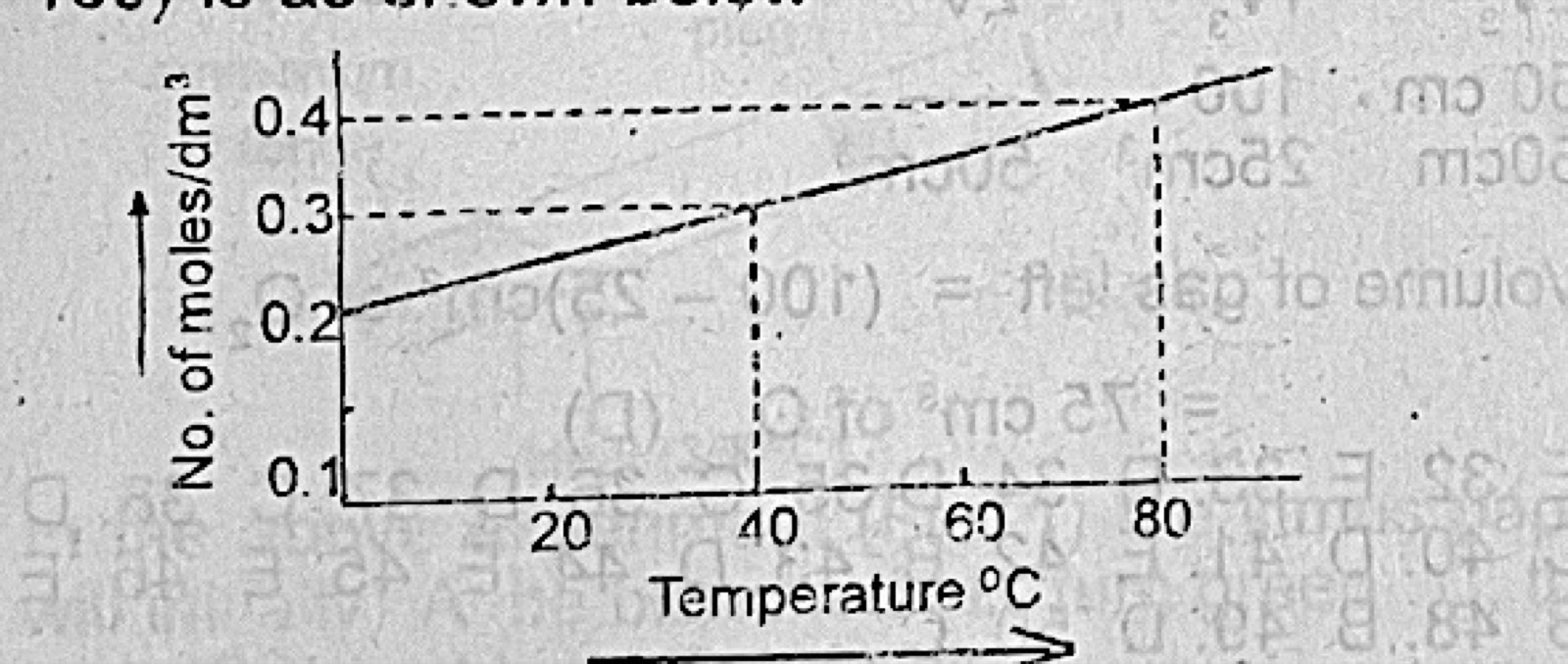
The solubility curve of a solid X (molecular mass = 160) is as shown below. 1,000 cm3 of a saturated solution of X at 80°C is cooled to 40°C. The weight of X crystalized out would be

Diagram for this question
  1. A.10 g
  2. B.12 g
  3. C.14 g
  4. D.16 g
  5. E.18 g
Show the answer and explanation

Answer: D (16 g)

Explanation

From the graph the solubility is 0.4 mol/dm3 at 80°C and 0.3 mol/dm3 at 40°C. The 0.1 mol that comes out of 1 dm3 weighs 0.1 × 160 = 16 g.

Open this question

Question 35

Hydrocarbons

Water is poured over a white solid and a colourless neutral gas is evolved which burns with a sooty flame. The white solid is

  1. A.calcium
  2. B.calcium oxide
  3. C.calcium carbide
  4. D.sodium peroxide
  5. E.sodium sulphate
Show the answer and explanation

Answer: C (calcium carbide)

Explanation

Calcium carbide and water give ethyne (acetylene), a neutral gas with a high carbon content that burns with a sooty flame.

Open this question

Question 36

Carbohydrates, Proteins and Amines

Cotton is almost pure

  1. A.starch
  2. B.protein
  3. C.animal fibre
  4. D.cellulose
  5. E.mineral fibre
Show the answer and explanation

Answer: D (cellulose)

Explanation

Cotton is a plant fibre made almost entirely of cellulose.

Open this question

Question 37

Hydrocarbons

Which of the following types of reactions takes place between C2H4 and the halogens?

  1. A.Substitution
  2. B.Polymerization
  3. C.Addition
  4. D.Saponification
  5. E.Oxidation
Show the answer and explanation

Answer: C (Addition)

Explanation

Ethene is unsaturated, so a halogen adds across the C=C double bond, e.g. C2H4 + Br2 → C2H4Br2.

Open this question

Question 38

Sulphur and its Compounds

Which of the following equations represents an oxidizing action of sulphur dioxide?

  1. A.SO2 + 2HNO3 → H2SO4 + 2NO2 + heat
  2. B.2SO2 + 2H2O + O2 → 2H2SO4
  3. C.SO2 + 2H2O + Cl2 → H2SO4 + 2HCl
  4. D.SO2 + 2H2S → 3S + 2H2O
  5. E.K2Cr2O7 + H2SO4 + 3SO2 → K2SO4 + Cr2(SO4)3 + H2O.
Show the answer and explanation

Answer: D (SO2 + 2H2S → 3S + 2H2O)

Explanation

With H2S, the sulphur in SO2 drops from +4 to 0, so SO2 is reduced and acts as the oxidizing agent. In the other equations SO2 is oxidised to sulphate.

Open this question

Question 39

Electrolysis

The product formed at the cathode during the electrolysis of sodium chloride solution with carbon electrodes is

  1. A.sodium
  2. B.chlorine
  3. C.hydrogen
  4. D.sodium hydroxide
  5. E.oxygen
Show the answer and explanation

Answer: C (hydrogen)

Explanation

H+ (from water) is discharged in preference to Na+, so hydrogen gas forms at the cathode.

Open this question

Question 40

Water

Sodium carbonate crystals on exposure to a dry atmosphere change to a white powder. This phenomenon is known as

  1. A.deliquescence
  2. B.hygroscopy
  3. C.oxidation
  4. D.efflorescence
  5. E.sublimation
Show the answer and explanation

Answer: D (efflorescence)

Explanation

Losing water of crystallization to the air and crumbling to a powder is called efflorescence.

Open this question

Question 41

Metals and their Compounds

Which of the following statements is incorrect?

  1. A.Calcium reacts with water to form calcium hydroxide
  2. B.Magnesium reacts very slowly with cold water but faster with warm water
  3. C.Iron will not react with water in the absence of air.
  4. D.Sodium reacts with water
  5. E.Copper reacts with steam.
Show the answer and explanation

Answer: E (Copper reacts with steam.)

Explanation

Copper is below hydrogen in the activity series, so it does not react with water or steam.

Open this question

Question 42

Chemical Bonding

In the reaction NH3 + H+ → NH4+, the bond formed results from

  1. A.an electron transferred from NH3 to H+
  2. B.an electron pair donated by NH3
  3. C.an electron pair equally shared
  4. D.an electron pair donated by H+
  5. E.an electron transferred from H+ to NH3.
Show the answer and explanation

Answer: B (an electron pair donated by NH3)

Explanation

The lone pair on nitrogen is given to the H+, which has no electrons, forming a dative (co-ordinate) bond.

Open this question

Question 43

Alkanoic Acids and Esters

Which of the following represents ethyl ethanoate?

  1. A.CH3CH2CO2CH3
  2. B.(CH3CO)2O
  3. C.CH3CH2CO2CH2CH3
  4. D.CH3CO2CH2CH3
  5. E.CH3CH2COCH2CH3.
Show the answer and explanation

Answer: D (CH3CO2CH2CH3)

Explanation

Ethyl ethanoate is the ester of ethanoic acid (CH3CO2–) and ethanol (–CH2CH3): CH3CO2CH2CH3.

Open this question

Question 45

Chemical Equilibrium

In the reaction N2(g) + O2(g) ⇌ 2NO(g) an increase in the total pressure will

  1. A.cause less nitrogen to be produced in the equilibrium mixture
  2. B.cause less nitric oxide to be produced in the equilibrium mixture
  3. C.cause more nitric oxide to be produced in the equilibrium mixture
  4. D.cause more oxygen to be produced in the equilibrium mixture
  5. E.have no effect.
Show the answer and explanation

Answer: E (have no effect.)

Explanation

There are 2 moles of gas on each side, so changing the pressure does not shift the equilibrium.

Open this question

Question 46

Chemical Equilibrium

In the chemical reaction A + B ⇌ C + D, more of D is formed

  1. A.if the concentration of A is reduced
  2. B.if the concentration of B is reduced
  3. C.if the concentration of C is increased
  4. D.if the concentration of D is increased
  5. E.if D is continuously removed from the reaction mixture.
Show the answer and explanation

Answer: E (if D is continuously removed from the reaction mixture.)

Explanation

Removing a product makes the equilibrium shift to the right to replace it, so more D keeps forming.

Open this question

Question 47

Chemical Formulae and Equations

1.00 g of the oxide of metal X (atomic mass = 64) gave 0.80 g of the metal when reduced with hydrogen. The formula of the oxide is

  1. A.X2O
  2. B.XO
  3. C.XO2
  4. D.X2O3
  5. E.X3O4.
Show the answer and explanation

Answer: B (XO)

Explanation

Oxygen = 0.20 g = 0.0125 mol; metal = 0.80/64 = 0.0125 mol. The 1 : 1 ratio gives XO.

Open this question

Question 48

Sulphur and its Compounds

When a solution of silver (I) nitrate is saturated with hydrogen sulphide, a black precipitate forms which is

  1. A.H2S
  2. B.Ag2S
  3. C.PbS
  4. D.HNO3
  5. E.S
Show the answer and explanation

Answer: B (Ag2S)

Explanation

Silver ions combine with sulphide ions to form black, insoluble silver sulphide, Ag2S.

Open this question

Question 49

Chemical Equilibrium

The production of ammonia by the Haber process may be represented by the equilibrium equation N2(g) + 3H2(g) ⇌ 2NH3 ΔH = −22kJ. Therefore the production of ammonia will be favoured by

  1. A.only high pressure
  2. B.only high temperature
  3. C.a combination of high temperature and low pressure
  4. D.a combination of low temperature and high pressure
  5. E.low pressure
Show the answer and explanation

Answer: D (a combination of low temperature and high pressure)

Explanation

The forward reaction is exothermic (favoured by low temperature) and reduces 4 moles of gas to 2 (favoured by high pressure).
Open this question

Question 50

Introduction to Organic Chemistry

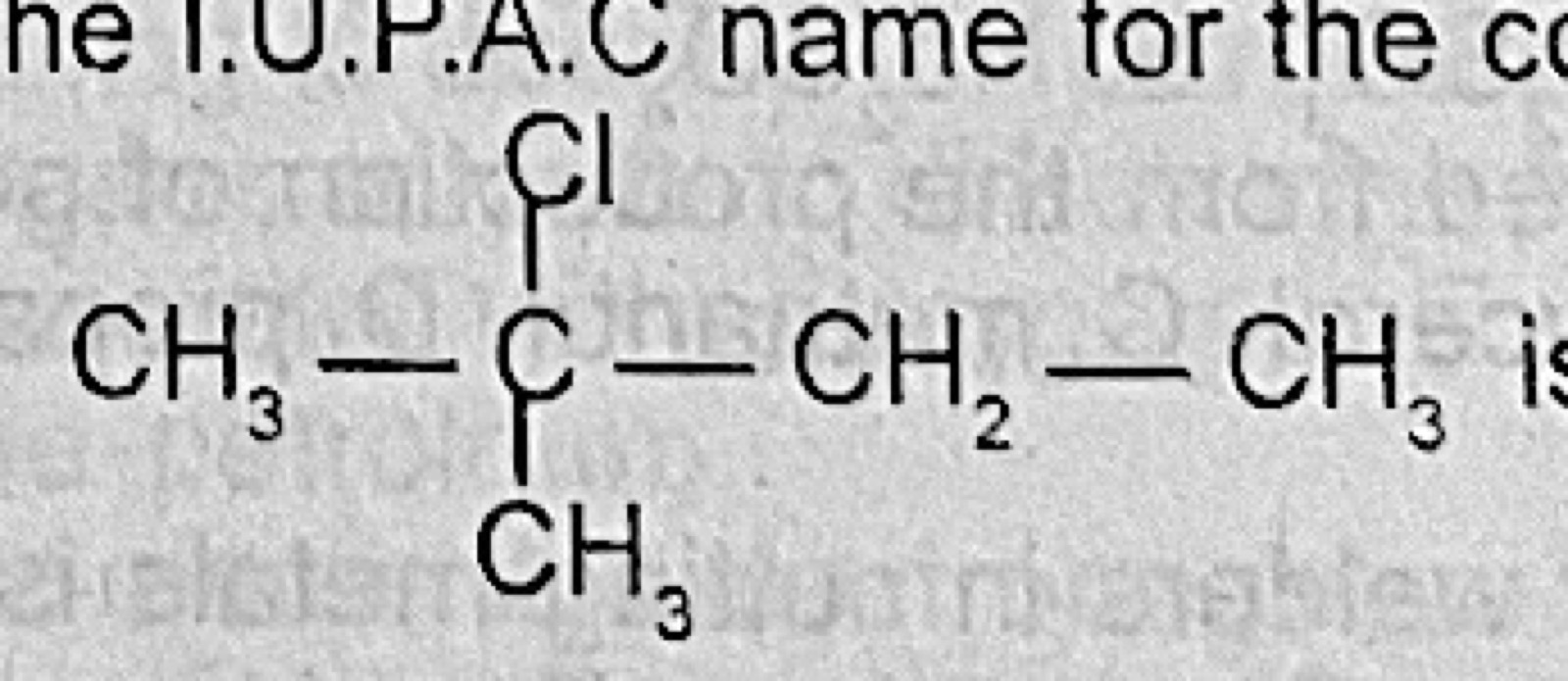
The I.U.P.A.C name for the compound CH3—C(Cl)(CH3)—CH2—CH3 is

Diagram for this question
  1. A.2-chloro-isopentane
  2. B.3-chloro-isopentane
  3. C.2-chloro-2-methylbutane
  4. D.1-chloro-2, 2-dimethylpropane
  5. E.2-chloro-2-ethylpropane
Show the answer and explanation

Answer: C (2-chloro-2-methylbutane)

Explanation

The longest chain has four carbons (butane); carbon 2 carries both the Cl and a CH3 branch, so the name is 2-chloro-2-methylbutane.

Open this question