48 questions. Try each one, then open the answer to check yourself and read the explanation.
Question 1
Separation of Mixtures
In an attempt to remove sugar from a beaker containing a quantity of sand and sugar, 2 M ammonium chloride solution was accidentally added instead of water. Which of the following methods could be used to remove the ammonium chloride from the mixture?
A.Fractional distillation
B.Crystallization
C.Filtration followed by evaporation
D.Evaporation followed by sublimation
E.Filtration followed by sublimation.
Show the answer and explanation
Answer: D (Evaporation followed by sublimation)
Explanation
Evaporating off the water leaves sand, sugar and ammonium chloride; gentle heating then makes the ammonium chloride sublime away, leaving the sand and sugar.
A solution X on mixing with AgNO3 solution, gives a white precipitate soluble in NH3. A solution Y, when added to X, also gives a white precipitate which is soluble on boiling. Solution Y contains
A.Ag+ion
B.Pb2+ion
C.Pb4+ ion
D.Zn2+ ion
E.Al3+ ion.
Show the answer and explanation
Answer: B (Pb2+ion)
Explanation
The first test shows X contains chloride ions. Lead(II) ions form white lead(II) chloride, which dissolves in hot water, so Y contains Pb2+. Silver chloride would not dissolve on boiling.
10cm3 of CO is mixed and sparked with 100 cm3 of air containing 21% O2. If all the volumes are measured at S.T.P, the volume of resulting gases would be
A.90cm3
B.100 cm3
C.105 cm3
D.110 cm3
E.115 cm3.
Show the answer and explanation
Answer: C (105 cm3)
Explanation
2CO + O2 → 2CO2. 10 cm3 CO uses 5 cm3 O2 and forms 10 cm3 CO2, so the total volume falls by 5: 110 − 5 = 105 cm3.
A sample of an oxide of mercury weighed 1.00 g. When this was heated, oxygen was given off, and 1.00 g of mercury metal only was left. What is the formula of the oxide? (Hg = 200, O = 16)
A.Hg2O
B.HgO2
C.HgO4
D.HgO
E.None of the above.
Show the answer and explanation
Answer: E (None of the above.)
Explanation
As printed, the mass does not change, so no oxygen is accounted for and none of the formulae can be worked out from the data. (Any real mercury oxide would leave less than 1.00 g of mercury.)
On heating, under suitable conditions, 1 litre of a monoatomic gas, X, combines with 1½ litres of oxygen to form an oxide. What is the formula of the oxide?
A.XO3
B.X2O3
C.X2O2
D.XO2
E.None of the above
Show the answer and explanation
Answer: A (XO3)
Explanation
By Avogadro's law, 1 mol of X atoms (monoatomic) reacts with 1.5 mol O2 = 3 mol O atoms, so X:O = 1:3 and the oxide is XO3.
If 1 litre of 2.2M sulphuric acid is poured into a bucket containing 10 litres of water, and the resulting solution mixed thoroughly, the resulting sulphuric acid concentration will be
A.2.2 M
B.1.1 M
C.0.22 M
D.0.11 M
E.0.20 M
Show the answer and explanation
Answer: E (0.20 M)
Explanation
The 2.2 mol of acid end up in 1 + 10 = 11 litres, so the concentration is 2.2 ÷ 11 = 0.20 M.
1.0 g of CaCO3 was treated with excess 0.1 M HCl. At the end of the reaction, the acid still left unreacted required 25 cm3 of 0.1 M Na2CO3 to neutralize it. What was the original volume of the acid? (Na = 23, Ca = 40, C = 12, O = 16, Cl = 35.5)
A.220 cm3
B.230cm3
C.240 cm3
D.250cm3
E.260cm3.
Show the answer and explanation
Answer: D (250cm3)
Explanation
1.0 g CaCO3 = 0.01 mol, which uses 0.02 mol HCl (200 cm3). The leftover acid reacted with 0.0025 mol Na2CO3, i.e. 0.005 mol HCl (50 cm3). Total = 250 cm3.
Which one of the following reactions is correct as written?
A.FeCl2 + 3NH4OH → Fe(OH)3 + 3NH4Cl.
B.Pb2O3 + 4HCl → PbCl2 + 2H2O.
C.PbNO3 + H2S → PbS + 2HNO3
D.NaOH + H2SO4 → NaHSO4 + H2O.
E.2NH4NO3 → N2 + 2H2O.
Show the answer and explanation
Answer: D (NaOH + H2SO4 → NaHSO4 + H2O.)
Explanation
Only D has correct formulae and balances (1 Na, 3 H, 1 S, 5 O on each side). The others have wrong formulae or do not balance, e.g. FeCl2 would give Fe(OH)2.
500cm3 oxygen was collected over water at 30°C and 752 mmHg pressure. What is the volume of dry oxygen at S.T.P? (Vapour pressure of water at 30°C = 32 mmHg).
A.Metals conduct electricity while non-metals do not
B.Metals have high density, non-metals have low density
C.Metals form basic oxides, non-metals form acidic oxides
D.In the electro chemical series, metals are above hydrogen while non-metals are below hydrogen
E.Metals lose electrons while non-metals gain electrons during normal reactions.
Show the answer and explanation
Answer: C (Metals form basic oxides, non-metals form acidic oxides)
Explanation
As a general rule metal oxides are basic and non-metal oxides acidic. A fails (graphite conducts), B fails (sodium is less dense than water), D fails (copper is below hydrogen), and non-metals often share electrons rather than gain them.
5.00 g of hydrated salt of barium when heated to a constant weight gave 4.26 g of anhydrous salt with a molecular weight of 208. The number of molecules of water of crystallization in the hydrated salt is
A.10
B.7
C.5
D.2
E.1
Show the answer and explanation
Answer: D (2)
Explanation
Water lost = 5.00 − 4.26 = 0.74 g = 0.041 mol. Anhydrous salt = 4.26/208 = 0.0205 mol. Ratio 0.041/0.0205 = 2 (BaCl2.2H2O).
Chlorine, bromine and iodine resemble each other in that all
A.dissolve in alkalis
B.react violently with hydrogen without heating
C.displace each other from solutions of their salts
D.are gases
E.are liquids.
Show the answer and explanation
Answer: A (dissolve in alkalis)
Explanation
All three halogens react with alkali solutions (e.g. Cl2 + 2NaOH → NaCl + NaOCl + H2O). Iodine cannot displace the others, only chlorine reacts violently with hydrogen, and they are a gas, a liquid and a solid.
The following is an arrangement of elements in order of decreasing number of outer electrons; one of the elements is wrongly placed. Which is it? ALUMINIUM, CHLORINE, SILICON, MAGNESIUM AND SODIUM
A.Chlorine
B.Aluminium
C.Silicon
D.Magnesium
E.Sodium
Show the answer and explanation
Answer: B (Aluminium)
Explanation
Outer electrons: Cl 7, Si 4, Al 3, Mg 2, Na 1. Aluminium (3) is placed first but should come after silicon.
Element X has a total of 19 electrons and can react with oxygen to form an oxide. Which of the following statements is NOT true of the oxide of the element?
A.When exposed to air, it slowly changes to liquid.
B.Its solution in water conducts electricity
C.Its solution in water, on evaporation, gives a white solid
D.Its solution in water liberates hydrogen when in contact with aluminium metal
E.Its oxide, when strongly heated, regenerates the element X.
Show the answer and explanation
Answer: E (Its oxide, when strongly heated, regenerates the element X.)
Explanation
X is potassium. Its oxide is very stable and does not break down to potassium on heating. The others are true: K2O takes up moisture to form deliquescent KOH, whose solution conducts, leaves white KOH on evaporation and reacts with aluminium giving hydrogen.
A.All alkali metal salts dissolve with dissociation in water
B.Most ionic substances are easily vaporized.
C.Ionic substances exist only as liquids.
D.Non-ionic substances are good electrolytes
E.Nitrogen exists in a trivalent state in ammonium salts.
Show the answer and explanation
Answer: A (All alkali metal salts dissolve with dissociation in water)
Explanation
Alkali metal salts are soluble ionic compounds that separate into ions in water. Ionic solids have high boiling points, non-ionic substances are poor electrolytes, and nitrogen forms four bonds in NH4+.
Air is passed through the apparatus shown (alkaline pyrogallol, then a U-tube of CaCl2) and gas X comes out. In the above experiment X is
A.pure nitrogen
B.a mixture of nitrogen and oxygen
C.a mixture of nitrogen and carbondioxide
D.a mixture of oxygen and inert gases
E.a mixture of nitrogen and inert gases
Show the answer and explanation
Answer: E (a mixture of nitrogen and inert gases)
Explanation
Alkaline pyrogallol absorbs oxygen and carbon dioxide, and calcium chloride removes water vapour. What is left is nitrogen together with the noble (inert) gases.
Given the mean atomic mass of chlorine prepared in the laboratory to be 35.5 and assuming that chlorine contains two isotopes of mass number 35 and 37, what is the percentage composition of the isotope of mass number 35?
A.20
B.25
C.50
D.75
E.90
Show the answer and explanation
Answer: D (75)
Explanation
Let x% be Cl-35: 35x + 37(100 − x) = 3550, so 2x = 150 and x = 75%.
Which of the following does NOT happen when a zinc rod is introduced into a solution of copper (II) sulphate?
A.Electrons flow towards the zinc rod
B.The zinc rod dissolves
C.The temperature of the soil changes
D.The blue colour of the solution gradually disappears
E.Copper metal is deposited
Show the answer and explanation
Answer: A (Electrons flow towards the zinc rod)
Explanation
Zinc atoms give up electrons to the Cu2+ ions, so electrons flow away from the zinc, not towards it. The zinc dissolves, copper is deposited, the blue colour fades and heat is given out.
A cold aqueous solution of sodium chloride is electrolysed using a graphite anode and an iron cathode. In the course of the electrolysis the electrolyte is continuously stirred. The liquid left after electrolysis will therefore consist of
A.sodium hydroxide solution
B.chlorine water
C.pure water
D.sodium hypochlorite solution
E.hydrochloric acid solution
Show the answer and explanation
Answer: D (sodium hypochlorite solution)
Explanation
Chlorine forms at the anode and sodium hydroxide at the cathode. Stirring mixes them, and cold chlorine reacts with NaOH to give sodium hypochlorite: Cl2 + 2NaOH → NaCl + NaOCl + H2O.
When copper (II) sulphate solution is treated with excess ammonium hydroxide, a precipitate is first formed, and then this dissolves to give a deep blue solution. This deep blue solution is
A.Cu(OH)2
B.CuSO4.5H2O
C.(NH4)2SO4
D.Cu(NH3)4(OH)2
E.CuSO4.(NH4)2SO4.2H2O.
Show the answer and explanation
Answer: D (Cu(NH3)4(OH)2)
Explanation
The pale blue Cu(OH)2 precipitate dissolves in excess ammonia to form the deep blue tetraamminecopper(II) complex.
The IUPAC name for the compound CH3–CH2–C(CH3) = C(CH3)–CH3 is
A.2, 3-dimethylpent-2, 3-ene
B.2, 3-dimethylpent-2-ene
C.3, 4-dimethylpent-3-ene
D.3, 4-dimethylpentene
E.3, 4-dimethylhept-2-ene.
Show the answer and explanation
Answer: B (2, 3-dimethylpent-2-ene)
Explanation
The main chain has 5 carbons. Numbering from the right gives the double bond the lowest number (C2) and methyl groups on C2 and C3: 2,3-dimethylpent-2-ene.
A mixture of ethanol, sodium dichromate, and water is allowed to drop gradually into a boiling solution containing one part concentrated H2SO4 and three parts water, and the liberated gas is collected by cooling it with ice water to give a liquid. This liquid is
A.ethanoic acid
B.acetaldehyde
C.ethyl acetate
D.methanol
E.ethylene
Show the answer and explanation
Answer: B (acetaldehyde)
Explanation
Acidified dichromate oxidises ethanol first to ethanal (acetaldehyde), which boils at about 21°C. In the boiling mixture it escapes as a vapour before it can be oxidised further, and it condenses to a liquid in ice water.
Chlorine is denser than air and dissolves in water, so it is delivered to the bottom of the jar, pushing the air upwards (upward displacement of air). It also attacks mercury.
If one of the following oxides is heated with hydrogen or carbon using a bunsen burner, it is not reduced to the metal. Which one is it?
A.Lead oxide
B.Magnesium oxide
C.Copper oxide
D.Tin oxide
E.Iron oxide
Show the answer and explanation
Answer: B (Magnesium oxide)
Explanation
Magnesium is very reactive, so its oxide is too stable to be reduced by hydrogen or carbon at bunsen temperatures. The oxides of less reactive metals are reduced.
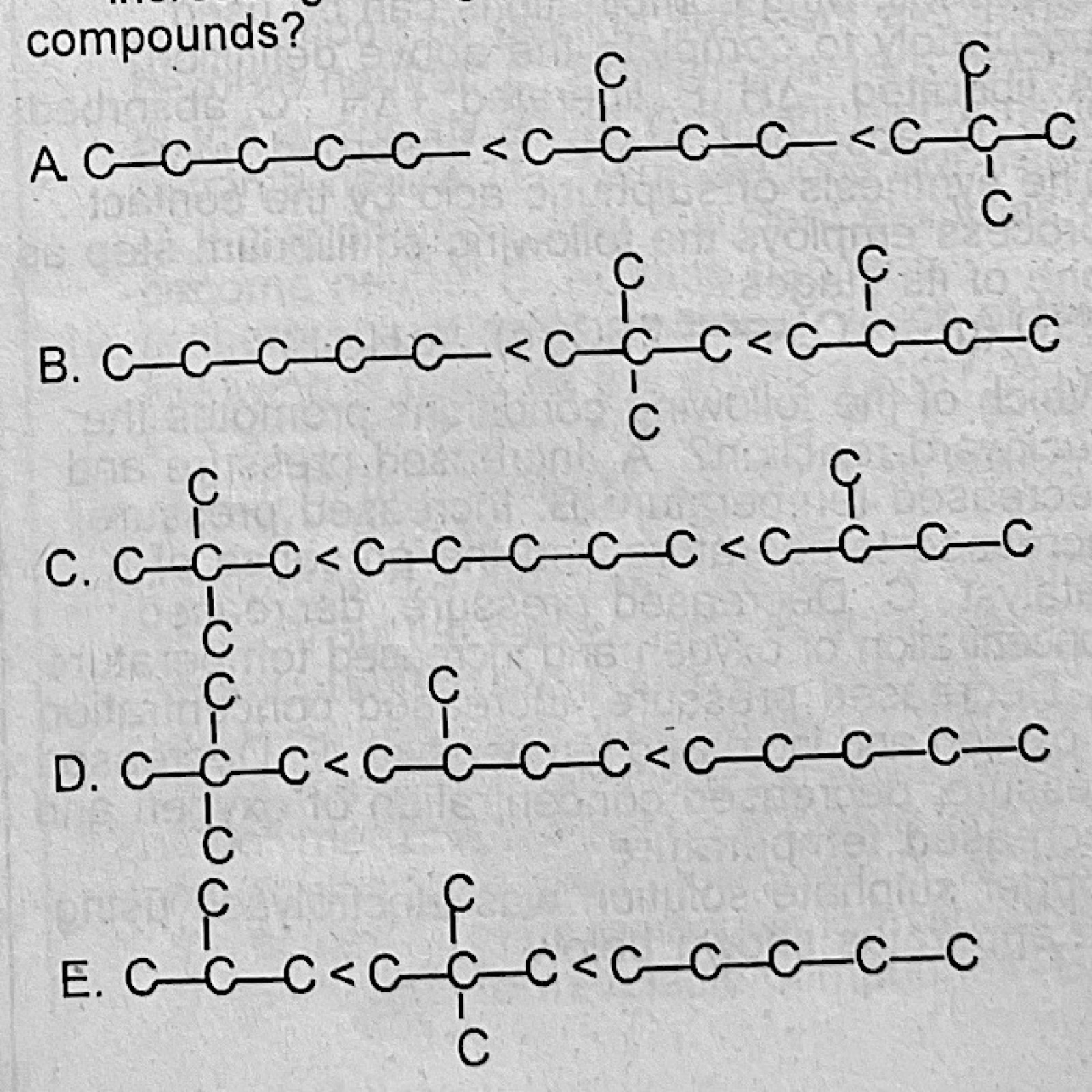
Which of the following is the correct order in increasing boiling point, of the isomeric C5H12 compounds?
A.C–C–C–C–C < C–C(C)–C–C < C–C(C)(C)–C
B.C–C–C–C–C < C–C(C)(C)–C < C–C(C)–C–C
C.C–C(C)(C)–C < C–C–C–C–C < C–C(C)–C–C
D.C–C(C)(C)–C < C–C(C)–C–C < C–C–C–C–C
E.C–C(C)–C < C–C(C)(C)–C < C–C–C–C–C
Show the answer and explanation
Answer: D (C–C(C)(C)–C < C–C(C)–C–C < C–C–C–C–C)
Explanation
More branching makes a molecule more compact, with less surface contact and weaker forces between molecules. So 2,2-dimethylpropane (9°C) < 2-methylbutane (28°C) < pentane (36°C).
Detergents are more advantageous than soaps in hard water districts because
A.on treatment with hard water they either form soluble calcium salts or do not react with calcium ions
B.on treatment with hard water they form soluble calcium salts
C.on treatment with hard water they form sodium salts
D.on treatment with hard water they are converted into soaps
E.on treatment with hard water they form more lather than soap does
Show the answer and explanation
Answer: A (on treatment with hard water they either form soluble calcium salts or do not react with calcium ions)
Explanation
Soap forms an insoluble scum with Ca2+ and Mg2+ ions, wasting it. Soapless detergents give soluble calcium salts (or don't react), so they still lather.
Which of the following classes of organic compounds undergoes rapid oxidation with bromine water?
A.Alcohols
B.Alkenes
C.Carboxylic acids
D.Esters
E.Alkanes
Show the answer and explanation
Answer: B (Alkenes)
Explanation
Alkenes react quickly with bromine water, decolourising it, because bromine adds across the C=C double bond. The other classes are saturated and do not react.
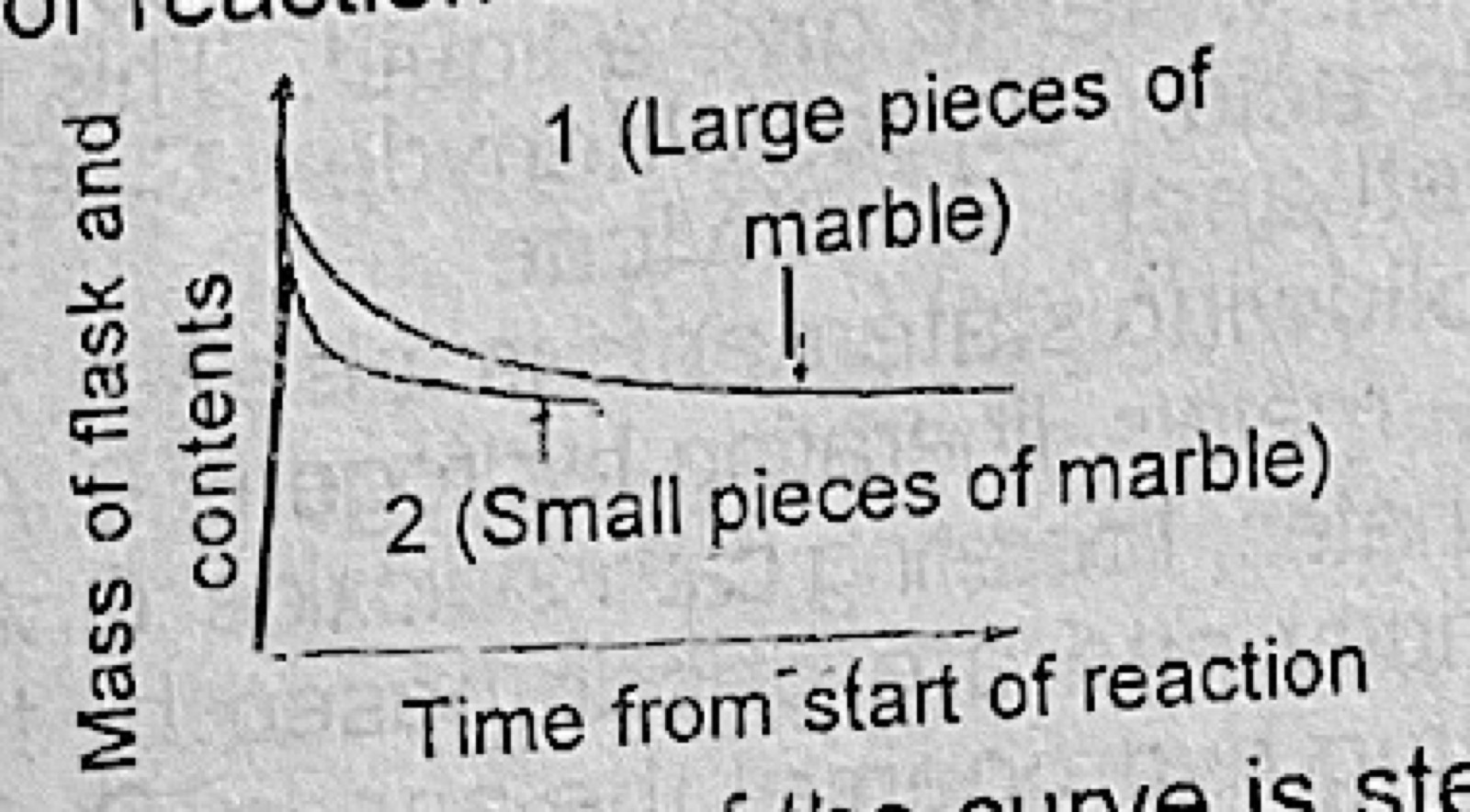
The following graph demonstrates the rate of reaction between calcium carbonate (marble) and dilute hydrochloric acid. The graph shows that the rate of reaction is initially greatest when
A.the initial slope of the curve is steepest and this occur when small pieces of marble are used and is due to a small surface area of reactant
B.the initial slope of the curve is least steep and this occur when large pieces of marble are used and is due to a small surface area of reactant.
C.the initial slope of the curve is steepest and this occurs when small pieces of marble are used and is due to a large surface area of reactant
D.the initial slope of the curve is steepest and this occur when large pieces of marble are used and is due to a large surface area of reactant
E.the initial slope of the curve is least steep and this occur when small pieces of marble are used and is due to the increased surface area of the reactant.
Show the answer and explanation
Answer: C (the initial slope of the curve is steepest and this occurs when small pieces of marble are used and is due to a large surface area of reactant)
Explanation
The mass falls fastest (steepest slope) at the start with small pieces of marble, because many small pieces have a larger total surface area in contact with the acid.
An endothermic reaction is one during which heat is.........and can be represented by the symbol.......Which of the following combinations can be used accurately to complete the above definition?
A.liberated, -ΔH
B.liberated, +ΔH
C.absorbed, -ΔH
D.absorbed, + ΔH
E.absorbed, + ΔG.
Show the answer and explanation
Answer: D (absorbed, + ΔH)
Explanation
An endothermic reaction takes in heat from the surroundings, so its enthalpy change ΔH is positive.
The synthesis of sulphuric acid by the contact process employs the following equilibrium step as one of its stages: 2SO2(g) + O2 ⇌ 2SO3(g) -ΔH. Which of the following conditions promotes the backward reaction?
A.Increased pressure and decreased temperature
B.Increased pressure, increased temperature and the presence of a catalyst
C.Decreased pressure, decreased concentration of oxygen and increased temperature
D.Decreased pressure, increased concentration of oxygen and increased temperature
E.Decreased pressure, decreased concentration of oxygen and decreased temperature.
Show the answer and explanation
Answer: C (Decreased pressure, decreased concentration of oxygen and increased temperature)
Explanation
The forward reaction is exothermic and reduces the moles of gas. The backward reaction is favoured by lower pressure, higher temperature and removing oxygen (a reactant).