Question 1
LogarithmsIf 3 log a + 5 log a − 6 log a = log 64, what is a?
- A.4
- B.6
- C.8
- D.16
- E.32.
Show the answer and explanation
Answer: C (8)
Explanation
The left side is (3 + 5 − 6) log a = 2 log a = log a2. So a2 = 64 and a = 8.
60 questions. Try each one, then open the answer to check yourself and read the explanation.
If 3 log a + 5 log a − 6 log a = log 64, what is a?
Answer: C (8)
The left side is (3 + 5 − 6) log a = 2 log a = log a2. So a2 = 64 and a = 8.
If the second and fourth terms of a G.P. are 8 and 32 respectively, what is the sum of the first four terms?
Answer: D (60)
ar = 8 and ar3 = 32, so r2 = 4, r = 2 and a = 4. The terms are 4, 8, 16, 32, which add up to 60.
In the diagram, TPS is a straight line, PQRS is a parallelogram with base QR and height 8cm. |QR| = 6cm and the area of triangle QST is 52cm2. Find the area of △QPT.
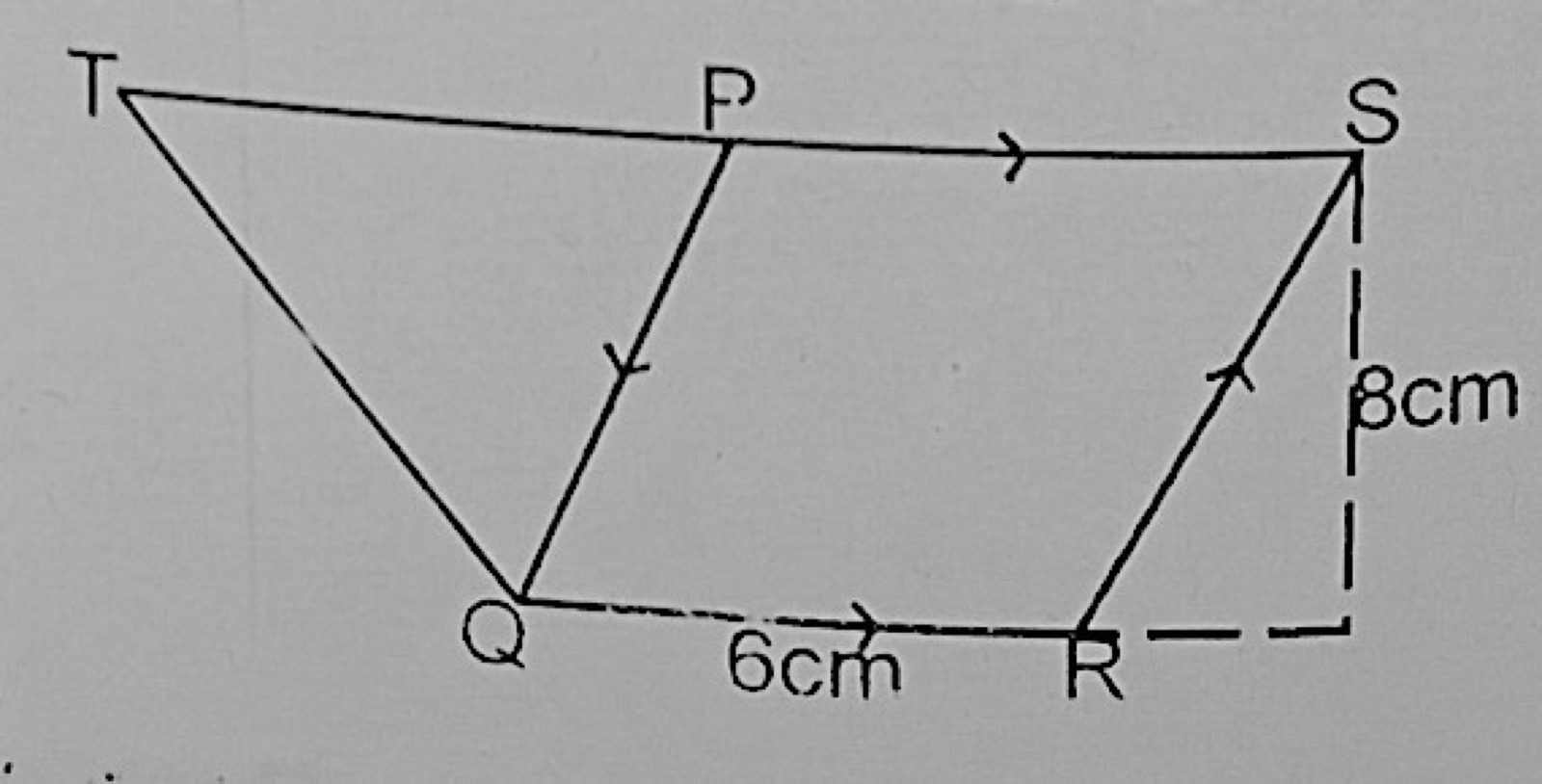
Answer: B (28cm2)
Area QST = ½ × |TS| × 8 = 52, so |TS| = 13 cm. |PS| = |QR| = 6 cm, so |TP| = 7 cm. Area QPT = ½ × 7 × 8 = 28 cm².
In the diagram, O is the centre of the circle, if ∠QRS = 62°, find the value of ∠SQR.
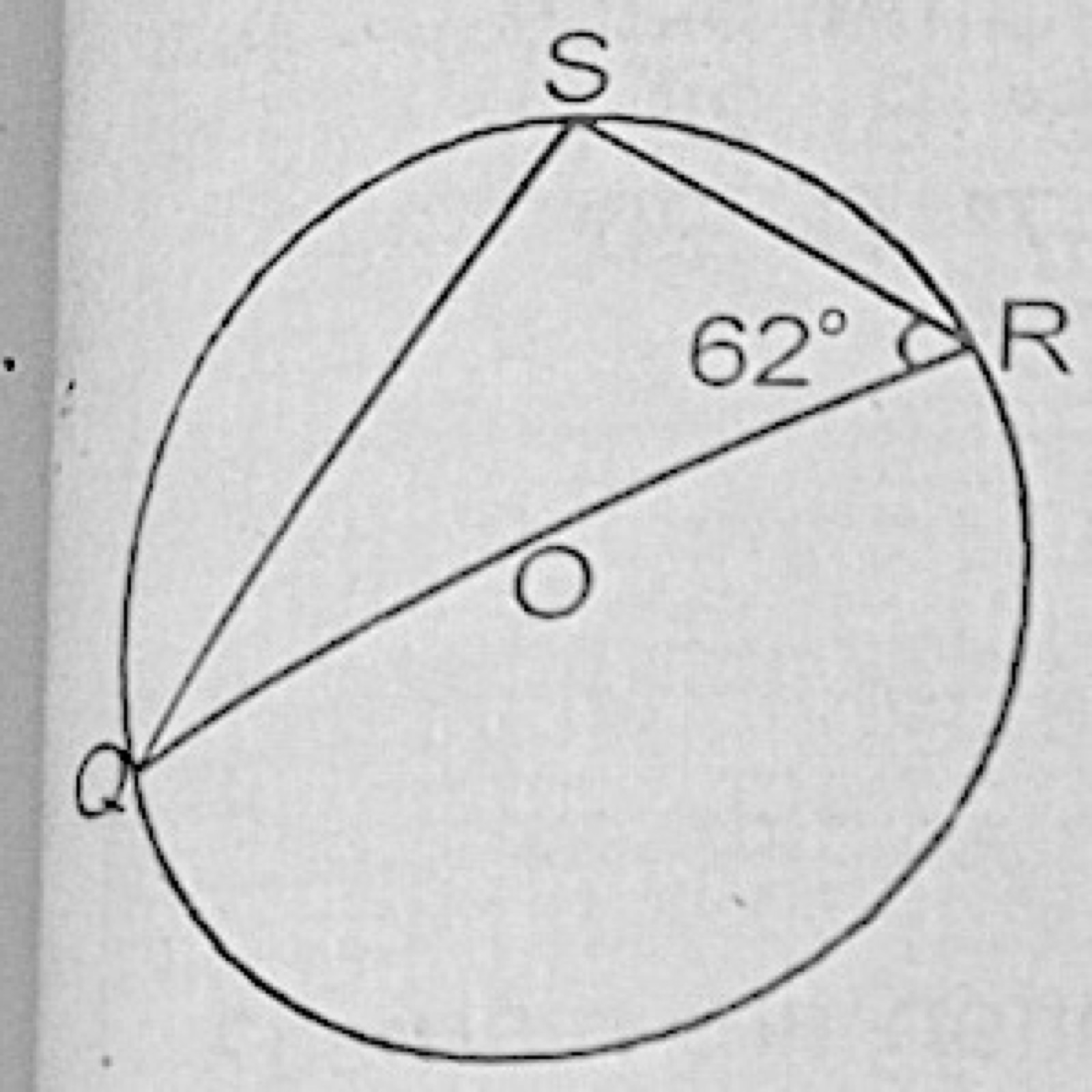
Answer: B (28°)
QR passes through O, so it is a diameter and ∠QSR = 90° (angle in a semicircle). Then ∠SQR = 180° − 90° − 62° = 28°.
Factorize 35 − 2b − b2
Answer: B ((7 + b)(5 − b))
(7 + b)(5 − b) = 35 − 7b + 5b − b2 = 35 − 2b − b2.
The graph below is that of a quadratic function y = 2x2 − x − 6. Use the information provided by the graph. The roots of the equation are
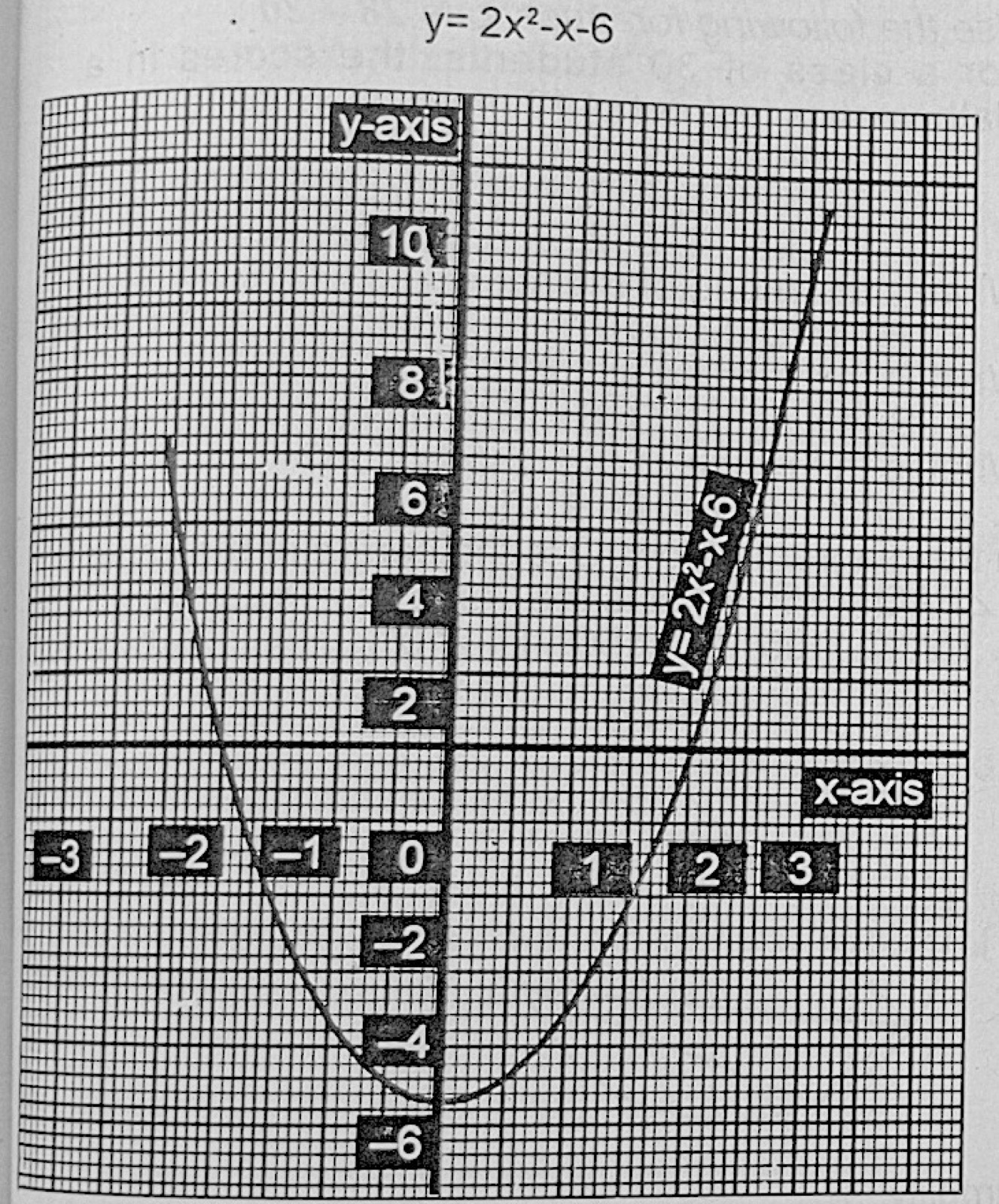
Answer: B (−1.5, 2)
The roots are where the curve crosses the x-axis: x = −1.5 and x = 2. Check: 2x2 − x − 6 = (2x + 3)(x − 2).
The graph below is that of a quadratic function y = 2x2 − x − 6. Use the information provided by the graph. Find the minimum value of y.
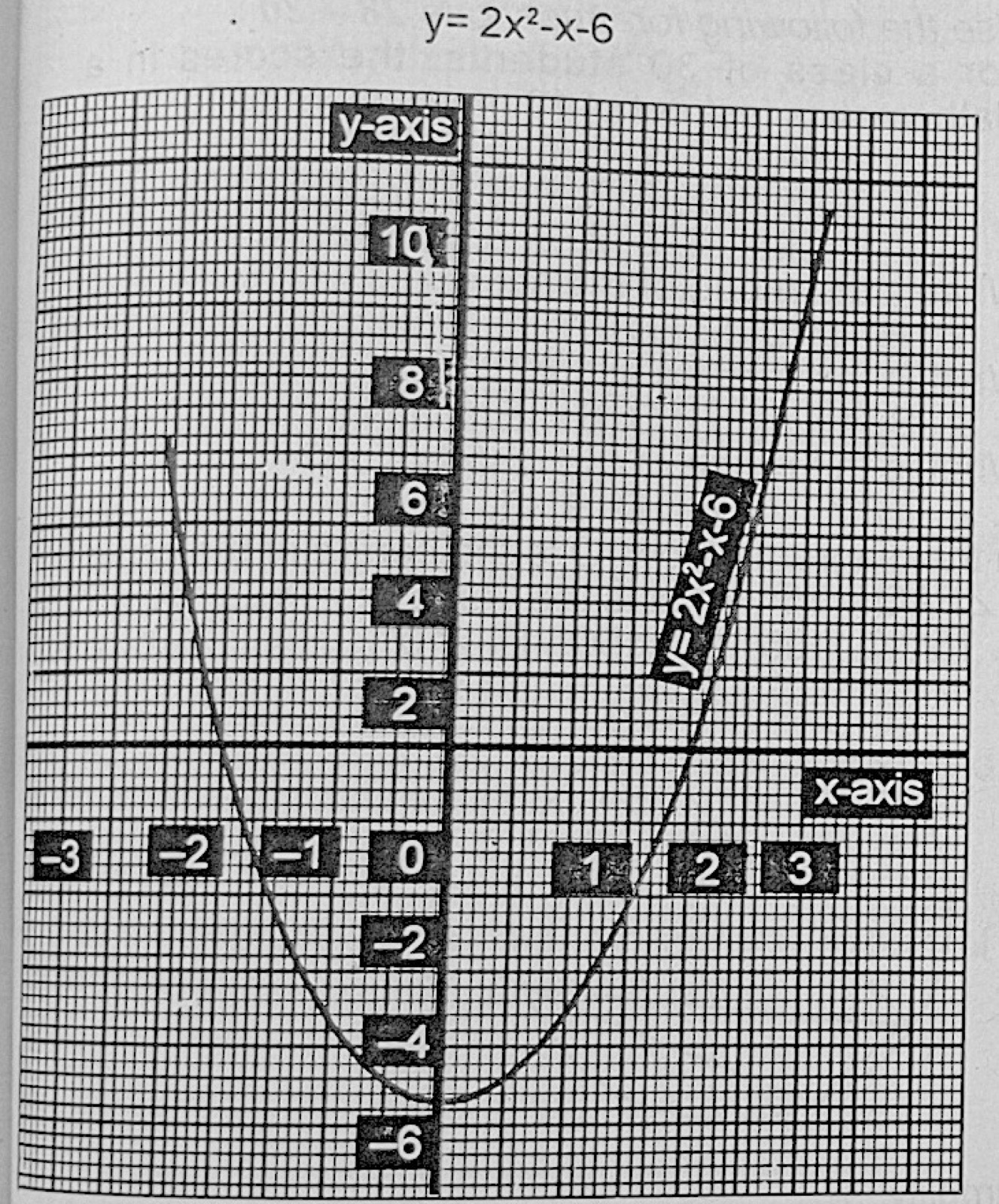
Answer: D (y = −6)
The lowest point of the curve is at about y = −6 (exactly −6.125 at x = ¼), so the nearest option is y = −6.
P and Q are two places on the same circle of latitude 79°S. P is on longitude 68°E while Q is on longitude 22°W. The angular distance between P and Q is
Answer: D (90°)
One longitude is east and the other west, so add them: 68° + 22° = 90°.
Evaluate 0.009 ÷ 0.012, leaving your answer in standard form.
Answer: C (7.5 × 10⁻¹)
0.009 ÷ 0.012 = 9 ÷ 12 = 0.75 = 7.5 × 10⁻¹.
Factorize the following expression; 2x2 + x − 15
Answer: B ((2x − 5)(x + 3))
(2x − 5)(x + 3) = 2x2 + 6x − 5x − 15 = 2x2 + x − 15.
The angle of elevation of X from Y is 30°. If |XY| = 40m, how high is X above the level of Y?
Answer: B (20m)
XY is the line of sight (hypotenuse), so the height = 40 sin 30° = 40 × ½ = 20 m.
Instead of recording the number 1.23cm of the radius of a tube, a student recorded 1.32cm. Find the percentage error, correct to one decimal place.
Answer: B (7.3%)
Error = 1.32 − 1.23 = 0.09. Percentage error = 0.09/1.23 × 100 = 7.3%.
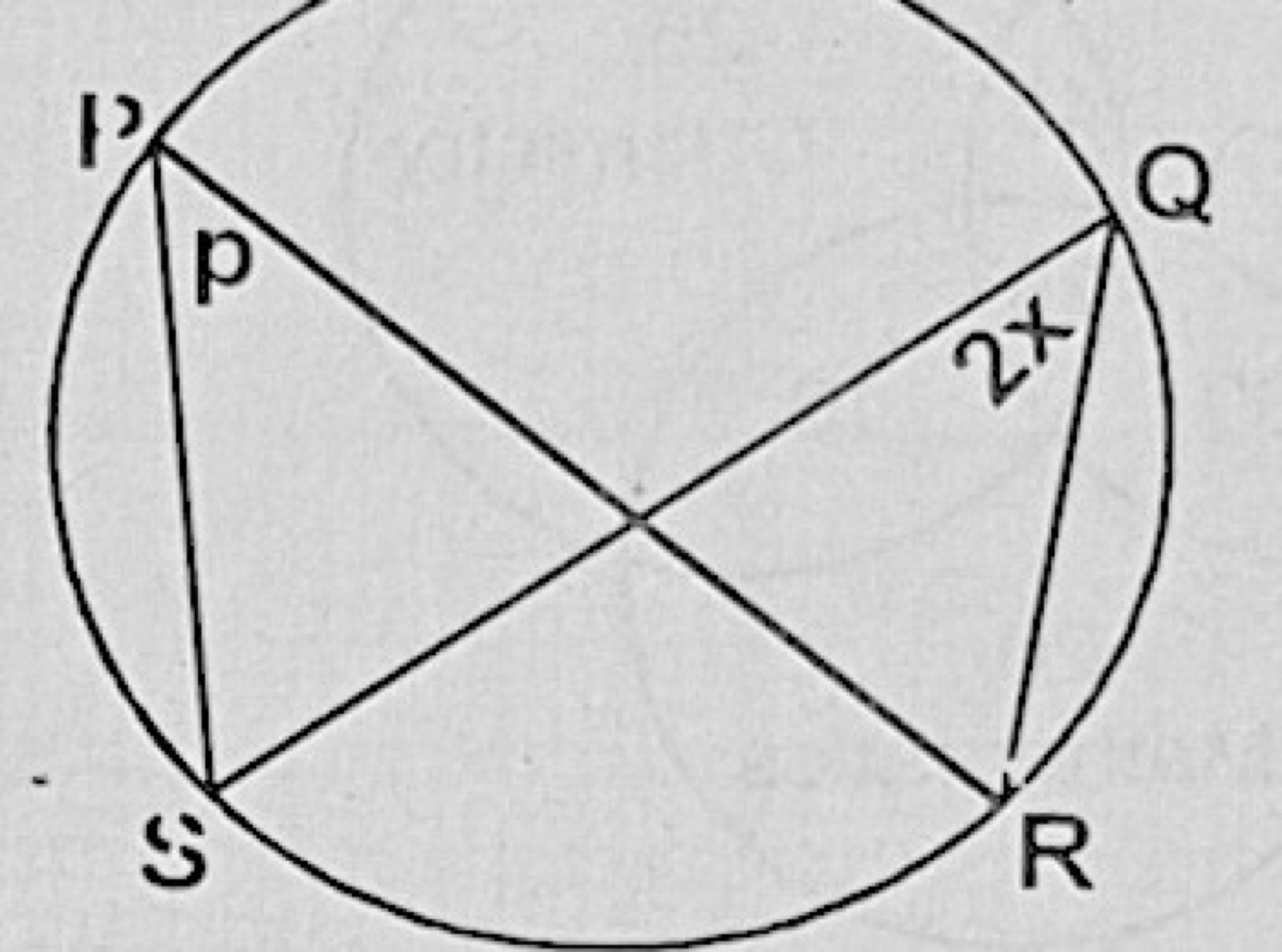
In the diagram below, ∠SPR = p and ∠SQR = 2x. Find x in terms of p.
Answer: D (x = p/2)
∠SPR and ∠SQR stand on the same arc SR, so they are equal: 2x = p, giving x = p/2.
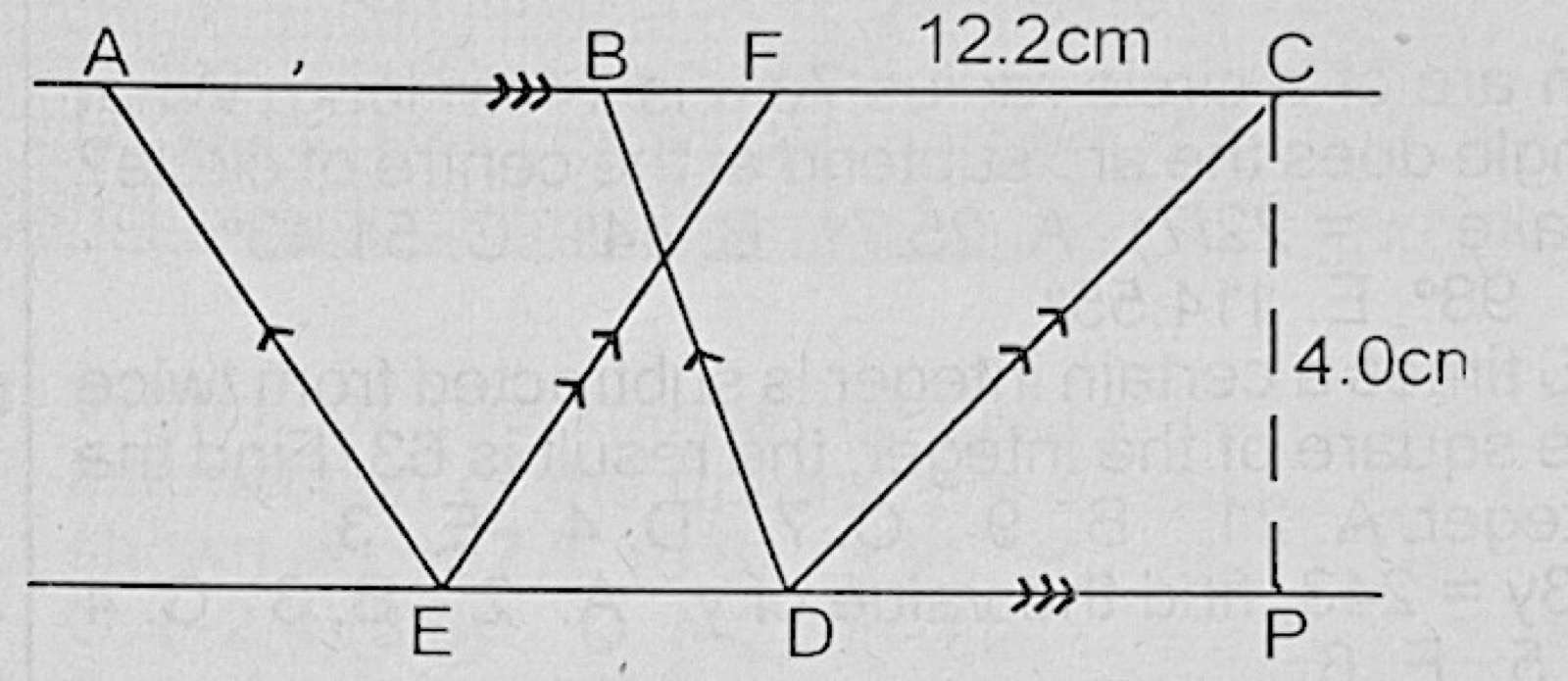
In the diagram above ABDE and FCDE are parallelograms. If |FC| = 12.2cm and the height |PC| = 4.0cm, calculate the area of parallelogram ABDE.
Answer: E (48.80cm2)
|ED| = |FC| = 12.2 cm (opposite sides of FCDE), and both parallelograms have height 4.0 cm. Area of ABDE = 12.2 × 4.0 = 48.80 cm².
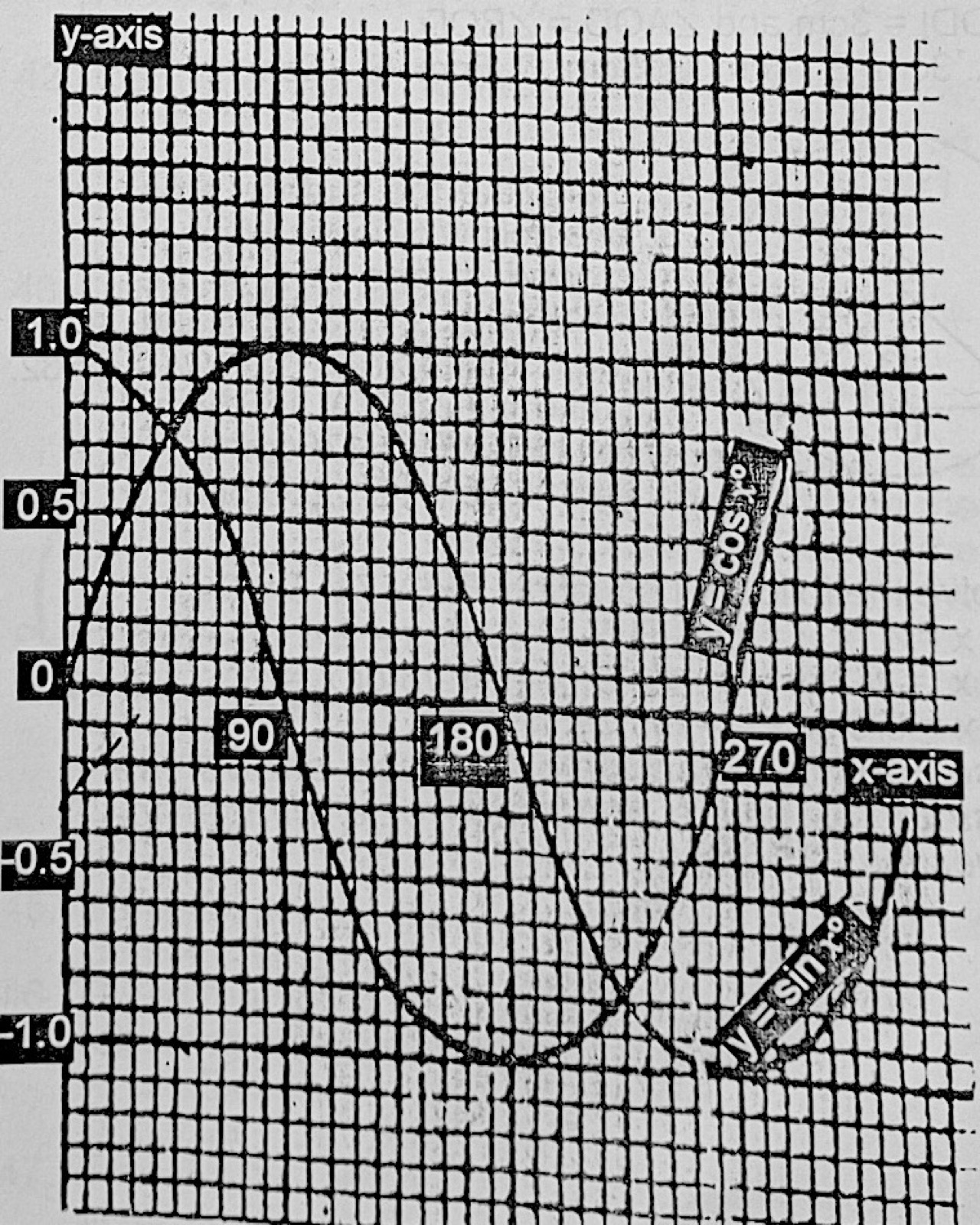
Using the graph above, if 0° < x < 60°, what is the value of x for which sin x = cos x?
Answer: D (45°)
sin x = cos x where the two curves cross; in this range that is at x = 45° (tan 45° = 1).
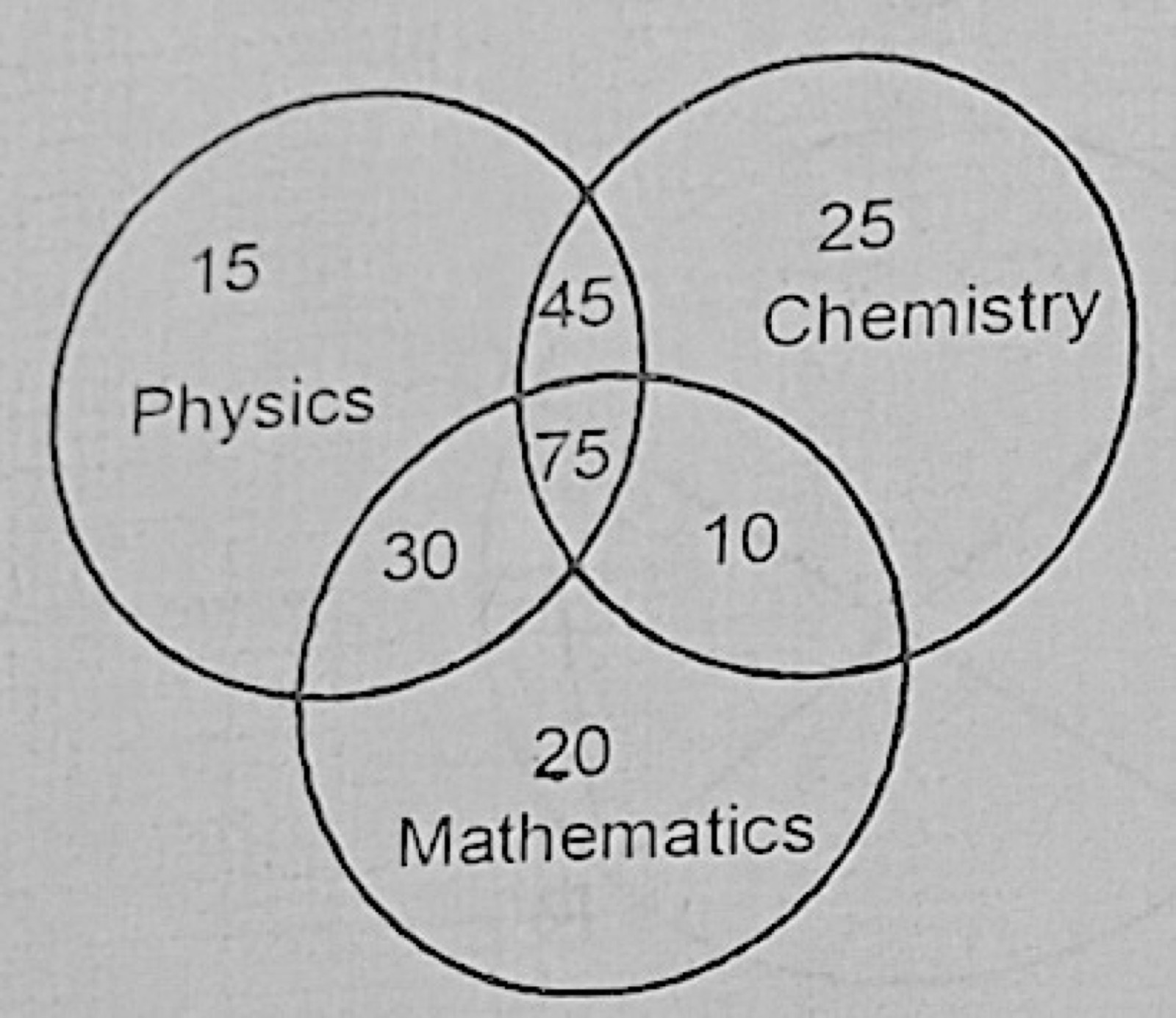
The Venn diagram below shows the number of students who studied Physics, Chemistry, and Mathematics in a certian school. How many students took at least two of the three subjects?
Answer: B (160)
Add the regions that lie in two or more circles: 45 + 75 + 30 + 10 = 160.
An arc of a circle radius 7cm is 14cm long. What angle does the arc subtend at the centre of circle? (Take π = 22/7)
Answer: E (114.55°)
θ/360 × 2 × 22/7 × 7 = 14, so θ/360 × 44 = 14 and θ = 14/44 × 360 = 114.55°.
If 5 times a certain integer is subtracted from twice the square of the integer, the result is 63. Find the integer.
Answer: C (7)
2n2 − 5n = 63 gives 2n2 − 5n − 63 = (2n + 9)(n − 7) = 0. The integer is 7.
If 3y = 243, find the value of y.
Answer: D (5)
243 = 3 × 3 × 3 × 3 × 3 = 35, so y = 5.
Points X and Y are respectively 20km North and 9km East of a point O. What is the bearing of Y from X? Correct to the nearest degree.
Answer: C (156°)
From X, Y is south-east. tan θ = 9/20 gives θ ≈ 24° east of south, so the bearing is 180° − 24° = 156°.
In the diagram below, O is the centre of the circle. Calculate the length of the chord AB if |OA| = 5cm, |OD| = 3cm and ∠AOD = ∠BOD.
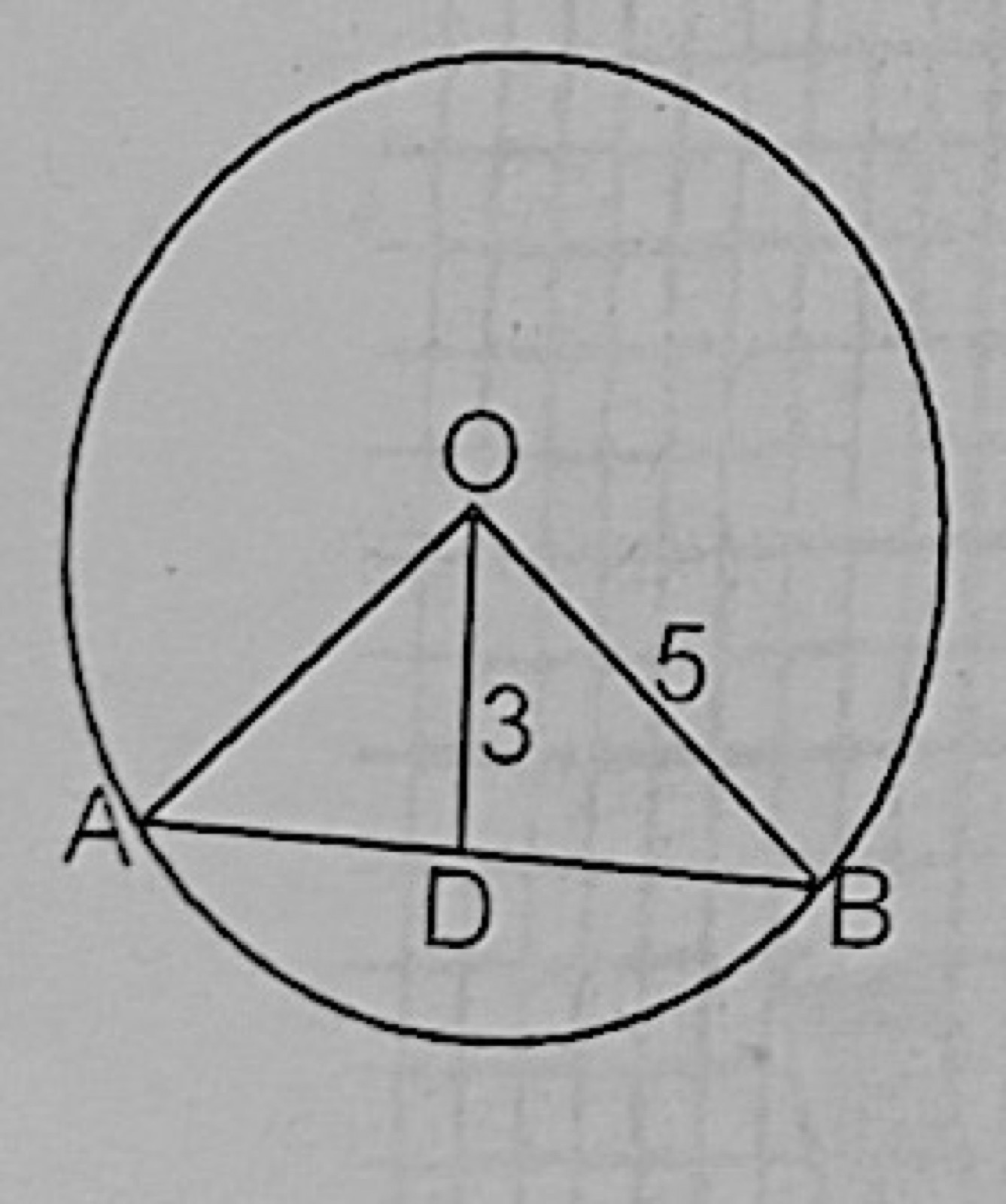
Answer: D (8cm)
OD bisects the chord at right angles, so |AD| = √(5² − 3²) = 4 cm and |AB| = 2 × 4 = 8 cm.
Calculate the surface area of a hollow cylinder which is closed at one end, if the base radius is 3.5cm and the height 8cm. (Take π = 22/7)
Answer: D (214.5cm2)
Curved surface 2πrh = 2 × 22/7 × 3.5 × 8 = 176 cm², plus one end πr2 = 22/7 × 3.52 = 38.5 cm². Total = 214.5 cm².
Solve the following equation: 6x2 − 7x − 5 = 0
Answer: C (x = 5/3 or x = −½)
6x2 − 7x − 5 = (3x − 5)(2x + 1) = 0, so x = 5/3 or x = −½.
Use the pie chart, which shows the distribution of the population of a village. What angle represents grown up girls? Correct to 1 decimal place.
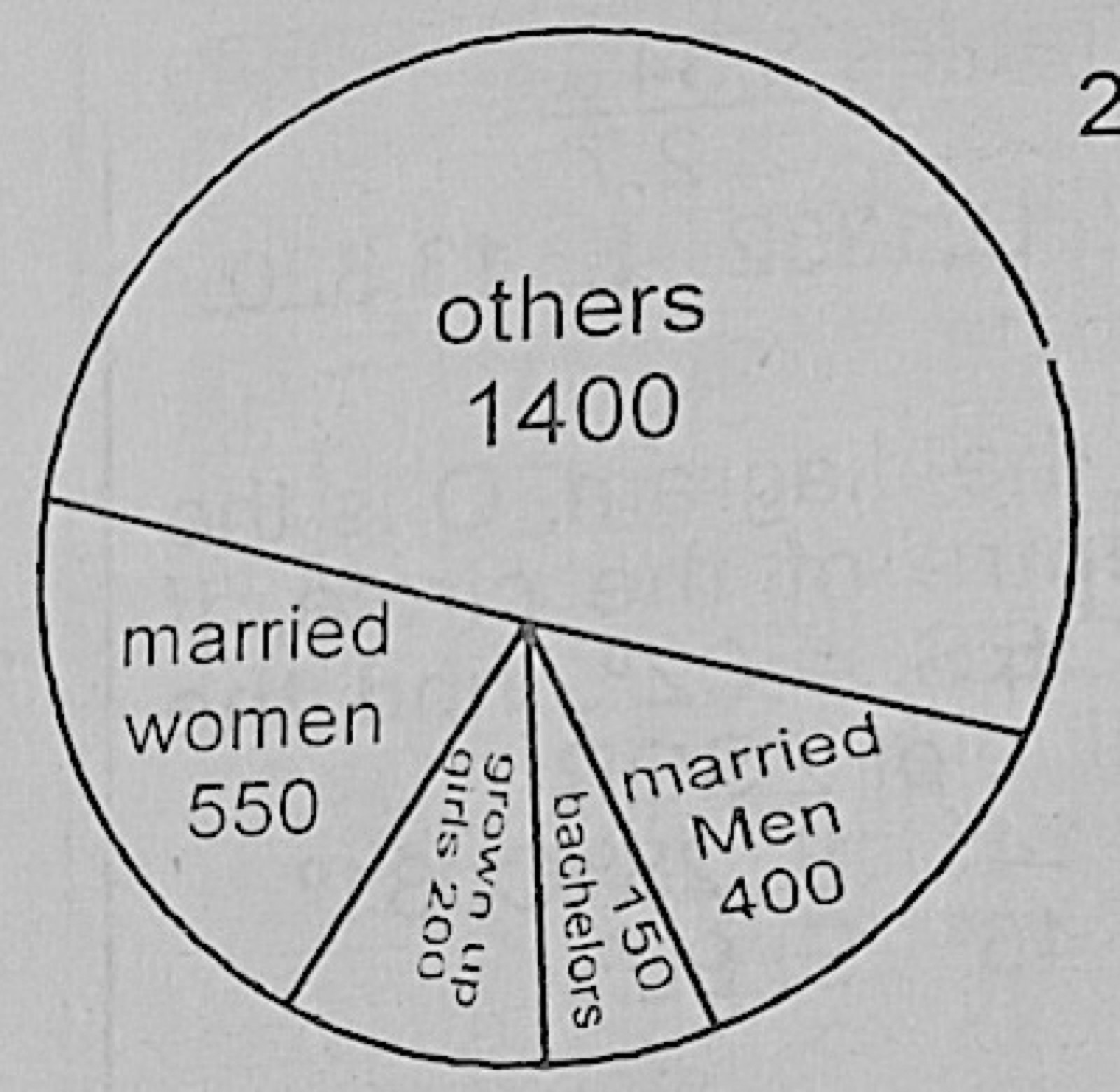
Answer: B (26.7°)
Total population = 1400 + 550 + 200 + 150 + 400 = 2700. Angle = 200/2700 × 360° = 26.7°.
Use the pie chart, which shows the distribution of the population of a village. What percentage of the population are married? Correct to 1 decimal place.
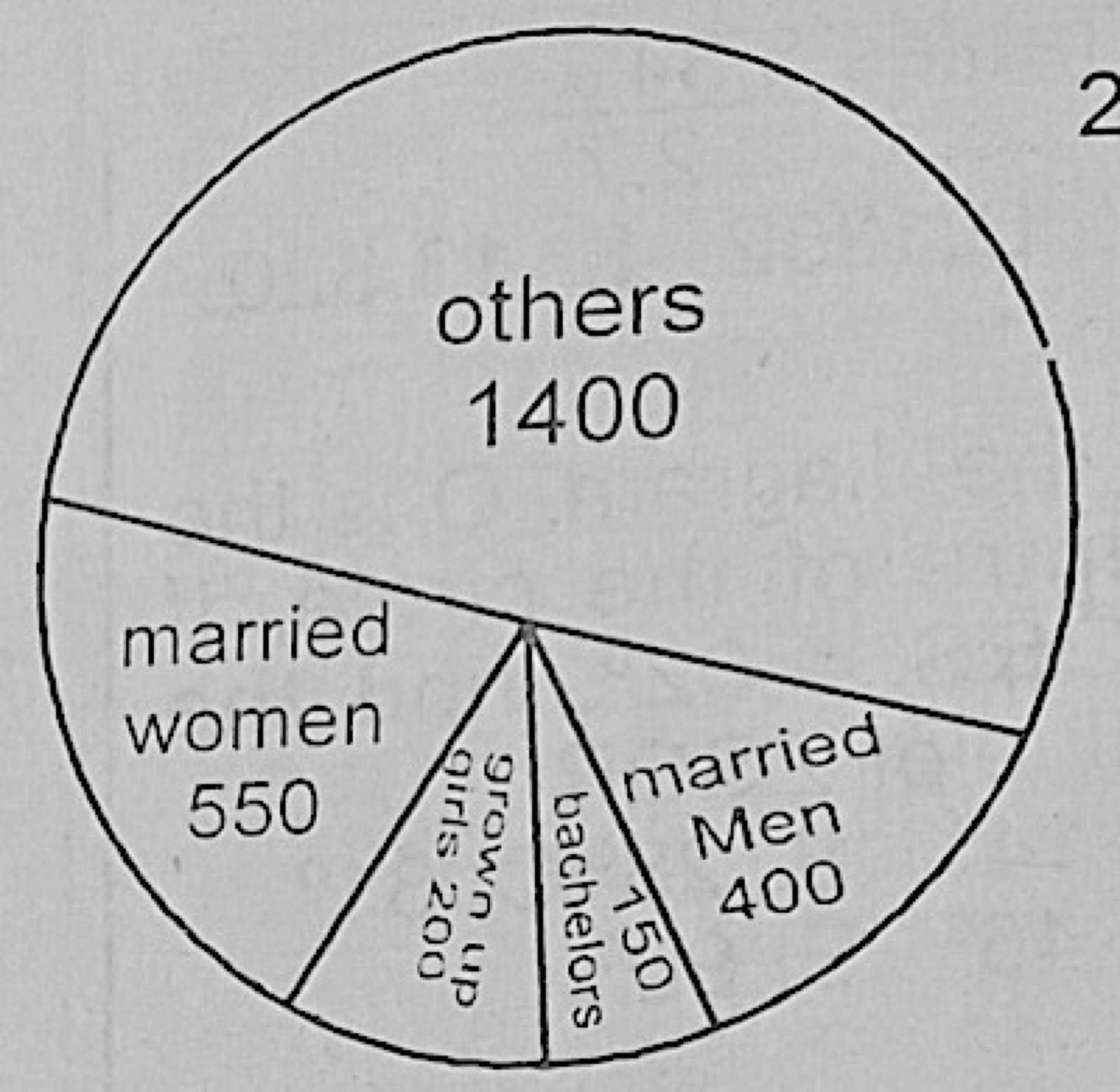
Answer: D (35.2%)
Married = 550 women + 400 men = 950. Percentage = 950/2700 × 100 = 35.2%.
If A = (a,b,c), B = (a,b,c,d,e) and C = (a,b,c,d,e,f). Find (A∪B) ∩ (A∪C).
Answer: B ((a,b,c,d,e))
A is inside both B and C, so A∪B = B and A∪C = C. B ∩ C = {a, b, c, d, e}.
For a class of 30 students, the scores in a Mathematics test out of 10 marks were as follows:
4, 5, 7, 2, 3, 6, 5, 5, 8, 9,
5, 4, 2, 3, 7, 9, 8, 7, 7, 7,
3, 4, 5, 5, 2, 3, 6, 7, 7, 2.
What is the mode of the scores?
Answer: E (7)
The score 7 appears 7 times, more often than any other score (5 appears 6 times).
For a class of 30 students, the scores in a Mathematics test out of 10 marks were as follows:
4, 5, 7, 2, 3, 6, 5, 5, 8, 9,
5, 4, 2, 3, 7, 9, 8, 7, 7, 7,
3, 4, 5, 5, 2, 3, 6, 7, 7, 2.
What is the median score?
Answer: C (5)
In order, the 15th and 16th of the 30 scores are both 5 (there are 11 or 12 scores below 5 and 6 fives), so the median is 5.
For a class of 30 students, the scores in a Mathematics test out of 10 marks were as follows:
4, 5, 7, 2, 3, 6, 5, 5, 8, 9,
5, 4, 2, 3, 7, 9, 8, 7, 7, 7,
3, 4, 5, 5, 2, 3, 6, 7, 7, 2.
What is the range of the distribution?
Answer: B (7)
Range = highest − lowest = 9 − 2 = 7.
In the diagram below, O is the centre of the circle. If ∠PAQ = 75°, what is the value of ∠PBQ?
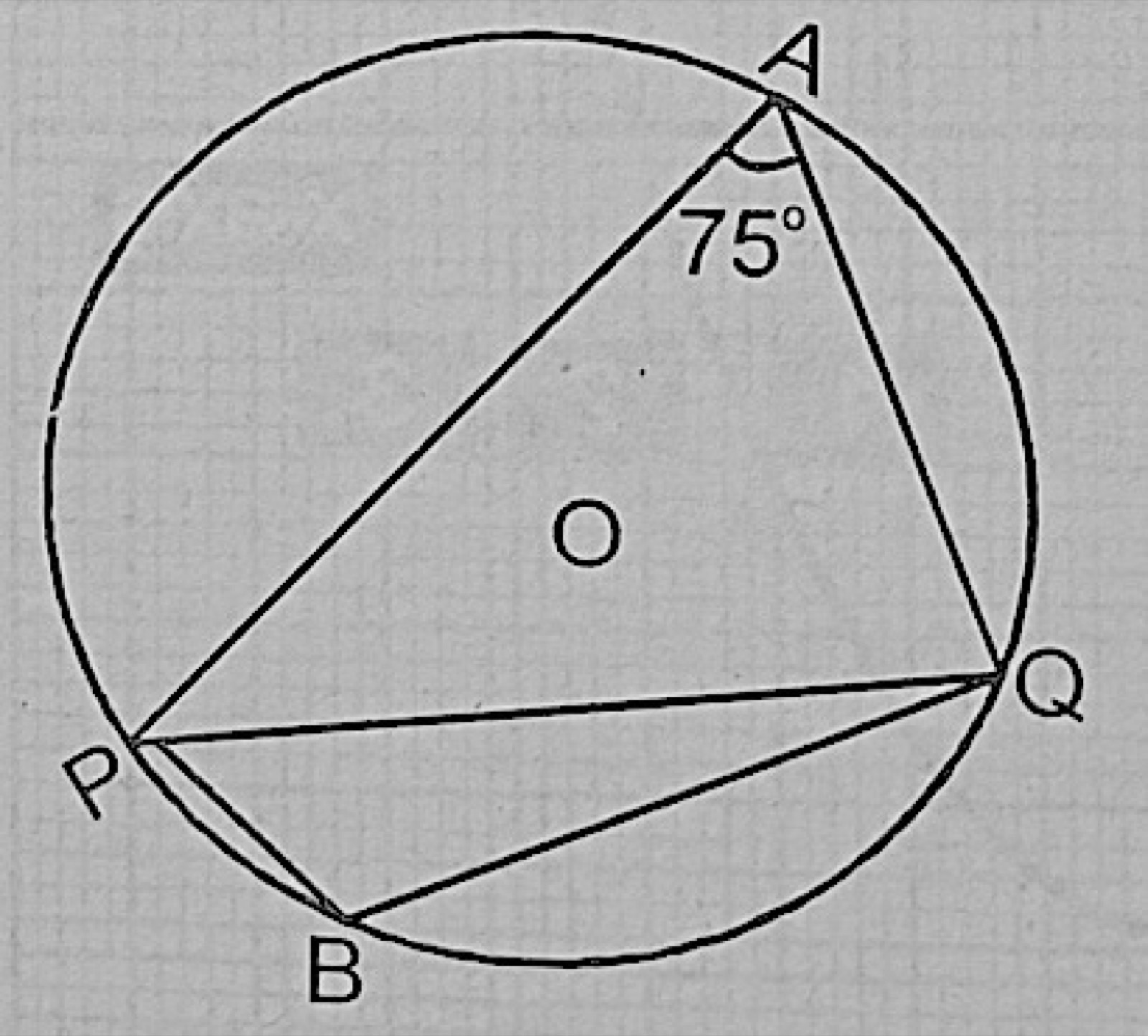
Answer: C (105°)
APBQ is a cyclic quadrilateral, so opposite angles add up to 180°: ∠PBQ = 180° − 75° = 105°.
Simplify: 9−1/2/272/3
Answer: E (1/27)
9−1/2 = 1/3 and 272/3 = 9, so the expression is (1/3) ÷ 9 = 1/27.
In the diagram below, what is the size of angle ACB?
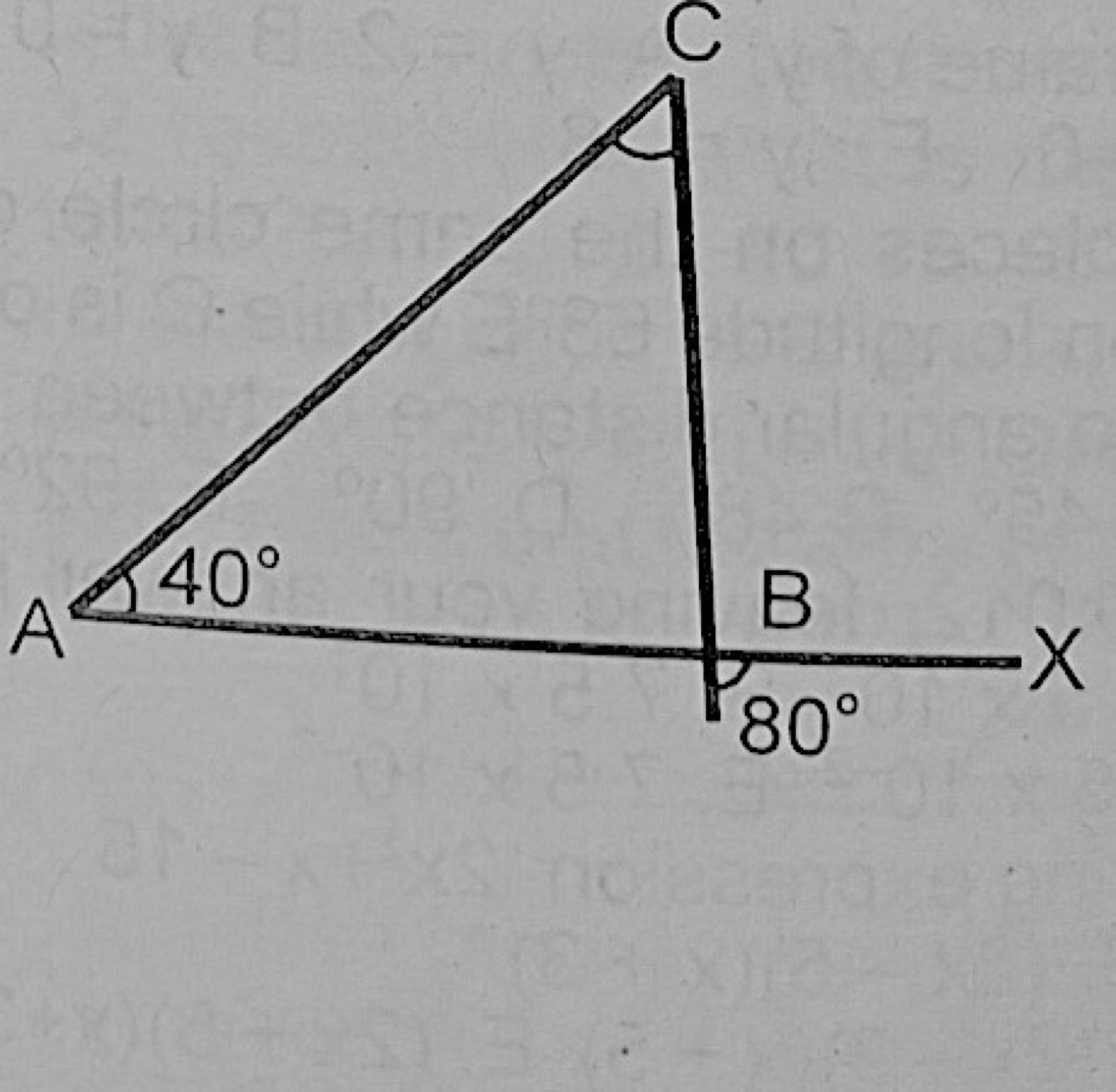
Answer: C (60°)
The 80° angle is vertically opposite ∠ABC, so ∠ABC = 80°. Then ∠ACB = 180° − 40° − 80° = 60°.
With reference to the graph above, which of the following solution sets is represented by △OPQ?
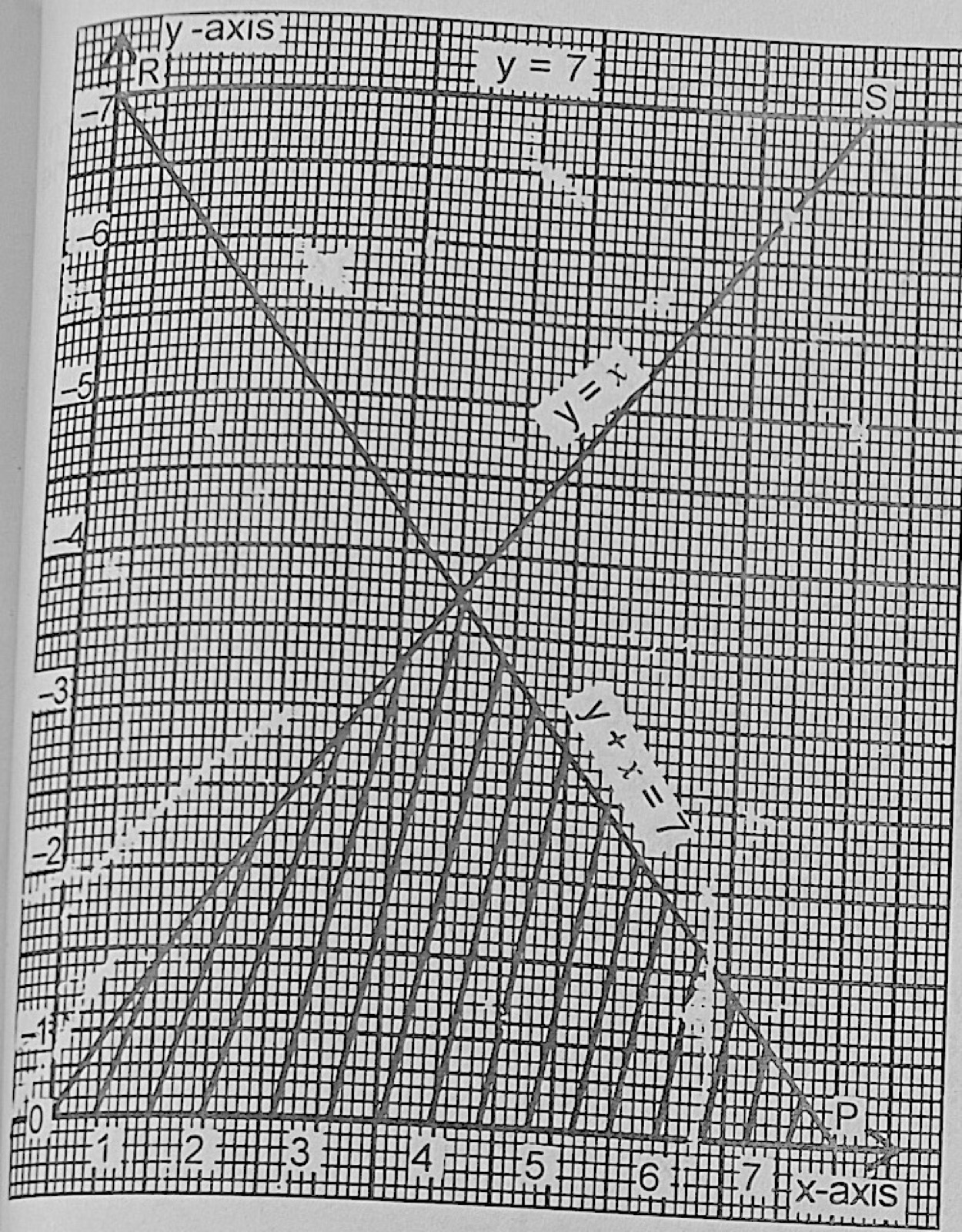
Answer: B (y ≤ x, y ≥ 0, y + x ≤ 7)
The triangle lies above the x-axis (y ≥ 0), below the line y = x (y ≤ x) and below the line y + x = 7 (y + x ≤ 7).
Find the volume of a cone of radius 3.5cm and vertical height 12cm. (Take π = 22/7)
Answer: E (154.0cm3)
V = ⅓πr2h = ⅓ × 22/7 × 3.5 × 3.5 × 12 = 154.0 cm³.
The table below gives the scores of a group of students in an English Language test
Scores: 2, 3, 4, 5, 6, 7
Number of Students: 2, 4, 7, 2, 3, 2
If a student is chosen at random from the group, what is the probability that he scored at least 6 marks?
Answer: C (1/4)
There are 20 students and 3 + 2 = 5 scored 6 or more, so the probability is 5/20 = 1/4.
In the diagram above, O is the centre of the circle QRT and PT is a tangent to the circle at T. Calculate the angle x.
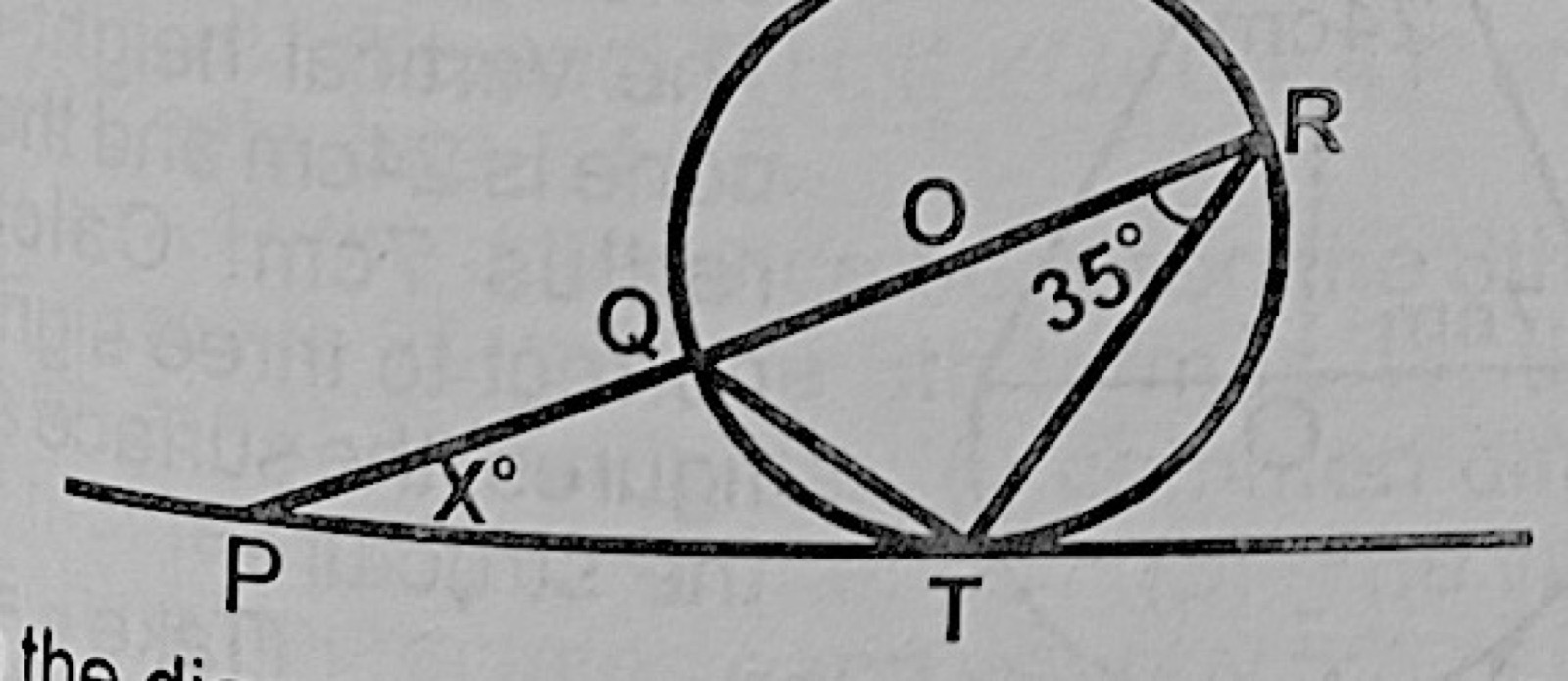
Answer: E (20°)
QR is a diameter, so ∠QTR = 90°. By the tangent–chord angle, ∠PTQ = ∠QRT = 35°. In △PTR: x = 180° − (35° + 90°) − 35° = 20°.
Which of the following gives the point of intersection of the graphs y = x2 and y = x + 6 shown above?
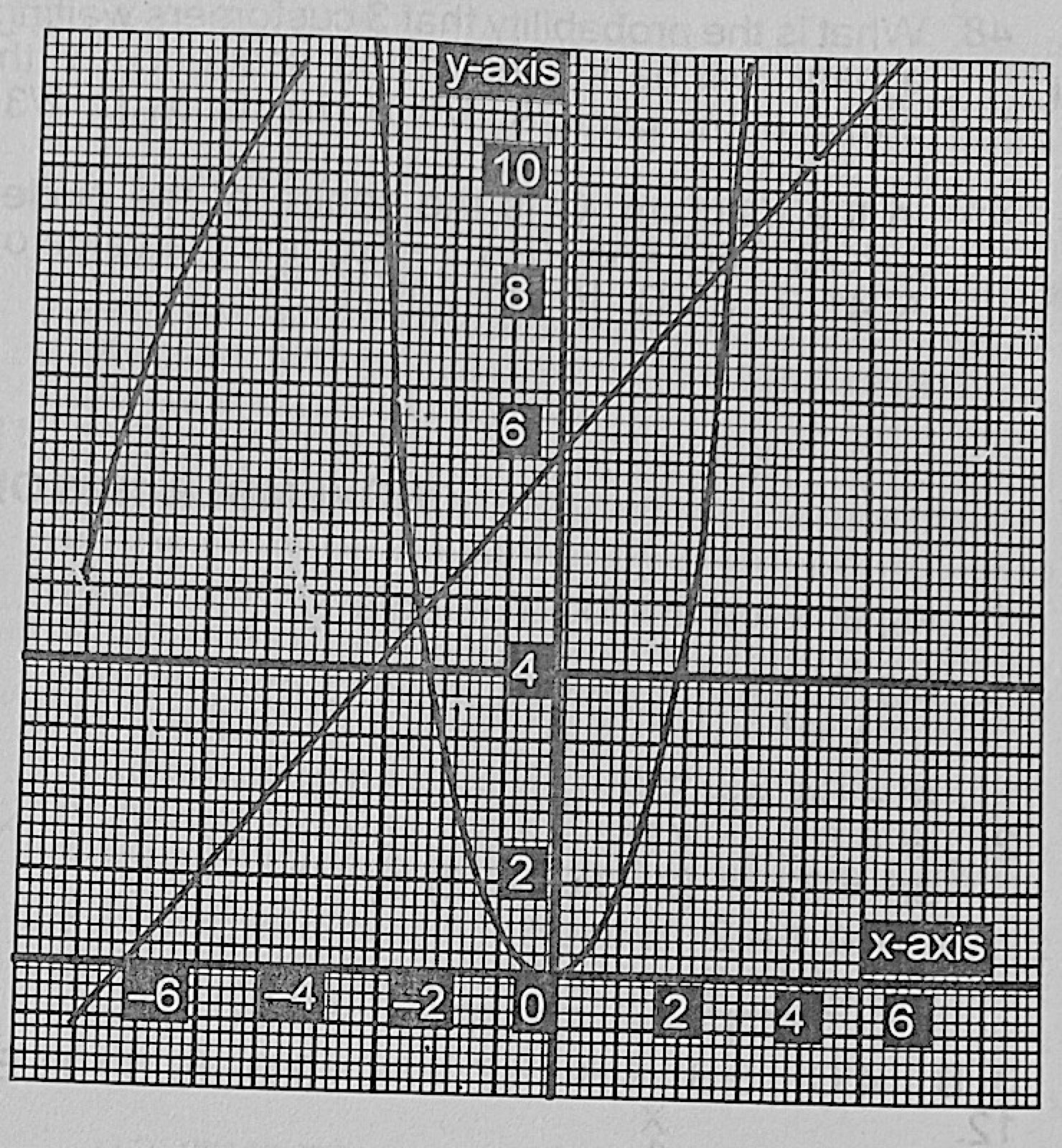
Answer: C ((−2,4)(3,9))
x2 = x + 6 gives x2 − x − 6 = (x − 3)(x + 2) = 0, so x = 3 or −2, and the points are (−2, 4) and (3, 9).
A sector is cut off from a circle radius 8.2cm to form a cone, if the radius of the resulting cone is 3.5cm, calculate the curved surface area of the cone. (Take π = 22/7)
Answer: E (90.2cm2)
The circle's radius becomes the slant height l = 8.2 cm. Curved area = πrl = 22/7 × 3.5 × 8.2 = 90.2 cm².
If logax = p, express x in terms of a and p.
Answer: E (x = ap)
By the definition of a logarithm, logax = p means x = ap.
Calculate, correct to three significant figures, the length of an arc subtends an angle of 70° at the centre of the circle radius 4cm. (Take π = 22/7)
Answer: B (4.89cm)
Arc = 70/360 × 2 × 22/7 × 4 = 4.89 cm.
In the diagram below, O is the centre of the circle. If ∠POR = 114°, calculate ∠PQR.
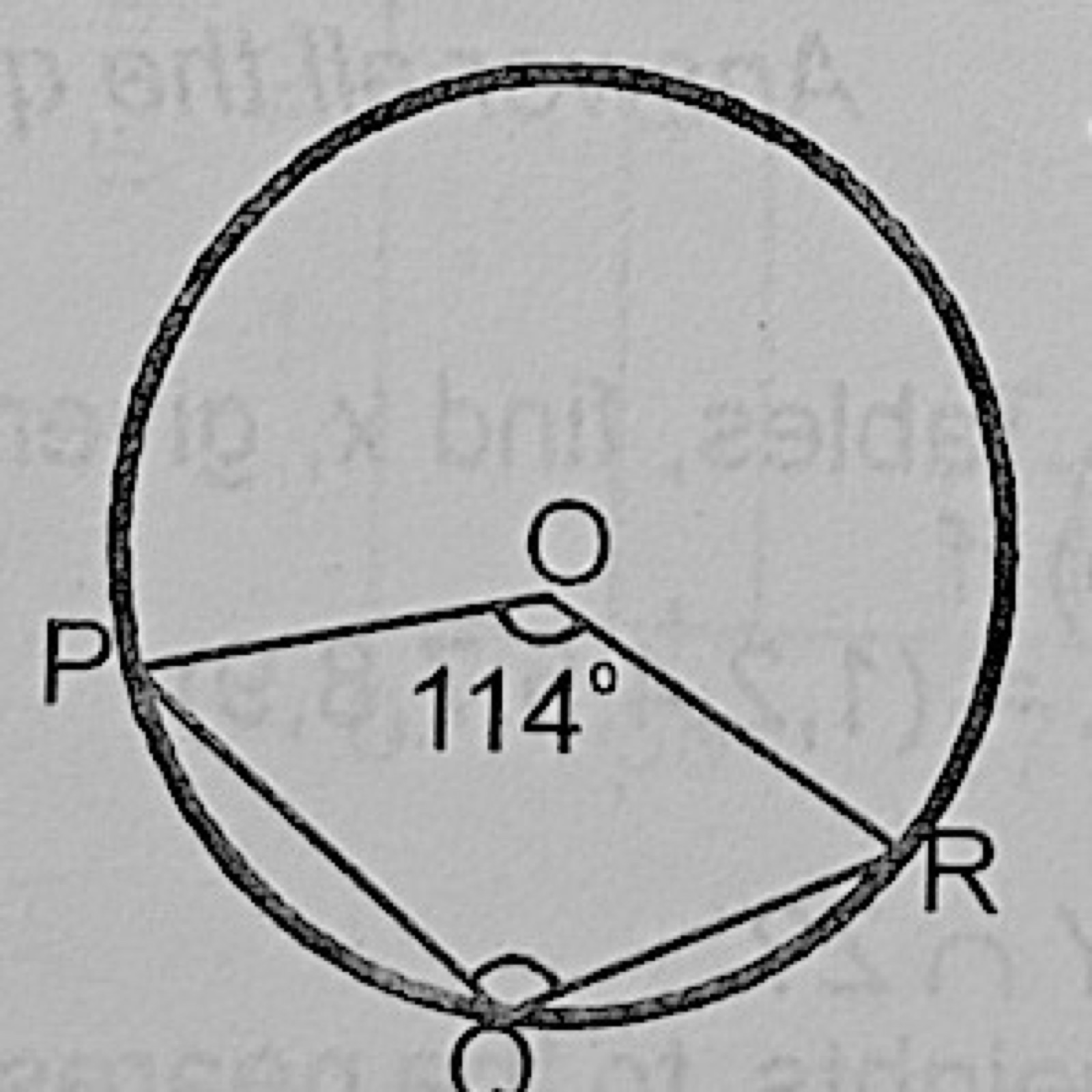
Answer: A (123°)
∠PQR stands on the major arc PR, whose angle at the centre is the reflex angle 360° − 114° = 246°. So ∠PQR = 246° ÷ 2 = 123°.
The angle of depression of a point on the ground from the top of a building is 20.3°. If the distance from the point to the foot of the building is 40m, calculate the height of the building, correct to one decimal place.
Answer: D (14.8m)
The angle of elevation of the top from the point is also 20.3°, so height = 40 tan 20.3° = 40 × 0.3699 = 14.8 m.
Solve for x: (x2 + 2x + 1) = 25
Answer: D (−6, 4)
x2 + 2x + 1 = (x + 1)2 = 25, so x + 1 = ±5, giving x = 4 or x = −6.
Given that log p = 2 log x + 3 log q, which of the following expresses p in terms of x and q?
Answer: E (p = x2q3)
2 log x + 3 log q = log x2 + log q3 = log(x2q3), so p = x2q3.
If sin θ = ½ and cos θ = −√3/2, what is the value of θ?
Answer: E (150°)
Sine positive and cosine negative puts θ in the second quadrant; the reference angle is 30°, so θ = 180° − 30° = 150°.
What is the probability that 3 customers waiting in a bank will be served in the sequence of their arrival at the bank.
Answer: A (1/6)
3 customers can be served in 3! = 6 different orders, and only one is the order of arrival, so the probability is 1/6.
In the diagram, O is the centre of the circle. If ∠POQ = 80° and ∠PRQ = 5x, find the value of x.
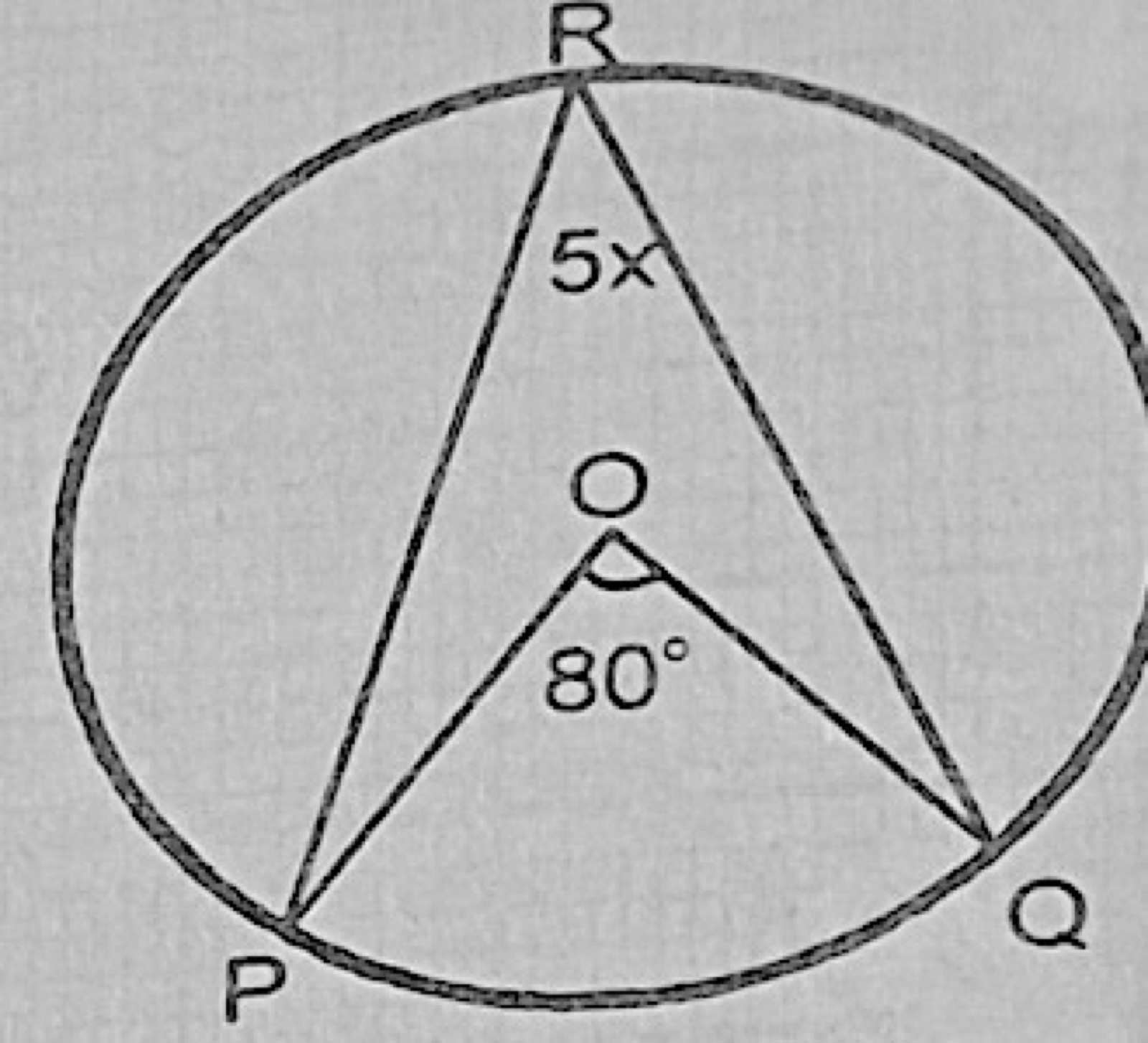
Answer: B (8°)
The angle at the circumference is half the angle at the centre: 5x = 80° ÷ 2 = 40°, so x = 8°.
In an A.P, the first term is 2, and the sum of the 1st and 6th terms is 16½. What is the 4th term?
Answer: B (9½)
2 + (2 + 5d) = 16½ gives 5d = 12½, so d = 2.5. The 4th term = 2 + 3 × 2.5 = 9½.
(a) Without using Mathematics Tables, find x, given that 6log (x + 4) = log 64 (b) if U = (1,2,3,4,5,6,7,8,9,10) X = (1,2,4,5,7,8,9) Y = (1,2,3,4,7,9) and Z = (2,3,4,7,9), what is X∩Y∩Z?
(a) 6 log(x + 4) = log (x + 4)6 and log 64 = log 26.
So (x + 4)6 = 26 ⇒ x + 4 = 2 ⇒ x = −2 (x + 4 must be positive for the log to exist).
(b) X∩Y = {1, 2, 4, 7, 9}
X∩Y∩Z = {2, 4, 7, 9}
(If the question means Z′ = {1, 5, 6, 8, 10}, then X∩Y∩Z′ = {1}.)
Write 64 as a power of 2 so both sides have the same power.
The table below shows the weights, to the nearest kilogram, of twelve students in a Further Mathematics class.
Weight in kg: 55, 57, 59, 61, 63
Number of students: 2, 1, 2, 4, 3
(a) Draw a bar chart to illustrate the above information (b) What is (i) the mode (ii) the median of the distribution? (c) Calculate the mean weight, correct to the nearest kilogram.
(a) Weights on the horizontal axis, number of students on the vertical axis; bars of equal width with heights 2, 1, 2, 4, 3; labelled axes and title.
(b)(i) Mode = 61 kg (highest frequency, 4).
(ii) In order the 12 weights are 55, 55, 57, 59, 59, 61, 61, 61, 61, 63, 63, 63; the 6th and 7th are both 61, so the median = 61 kg.
(c) Σfx = 110 + 57 + 118 + 244 + 189 = 718; Σf = 12.
Mean = 718 ÷ 12 = 59.83 ≈ 60 kg.
For the median of 12 values, average the 6th and 7th.
The diagram shows a wooden structure in the form of a cone, mounted on a hemispherical base. The vertical height of the cone is 24cm and the base radius 7cm. Calculate, correct to three significant figures, the surface area of the structure (Take π = 22/7)
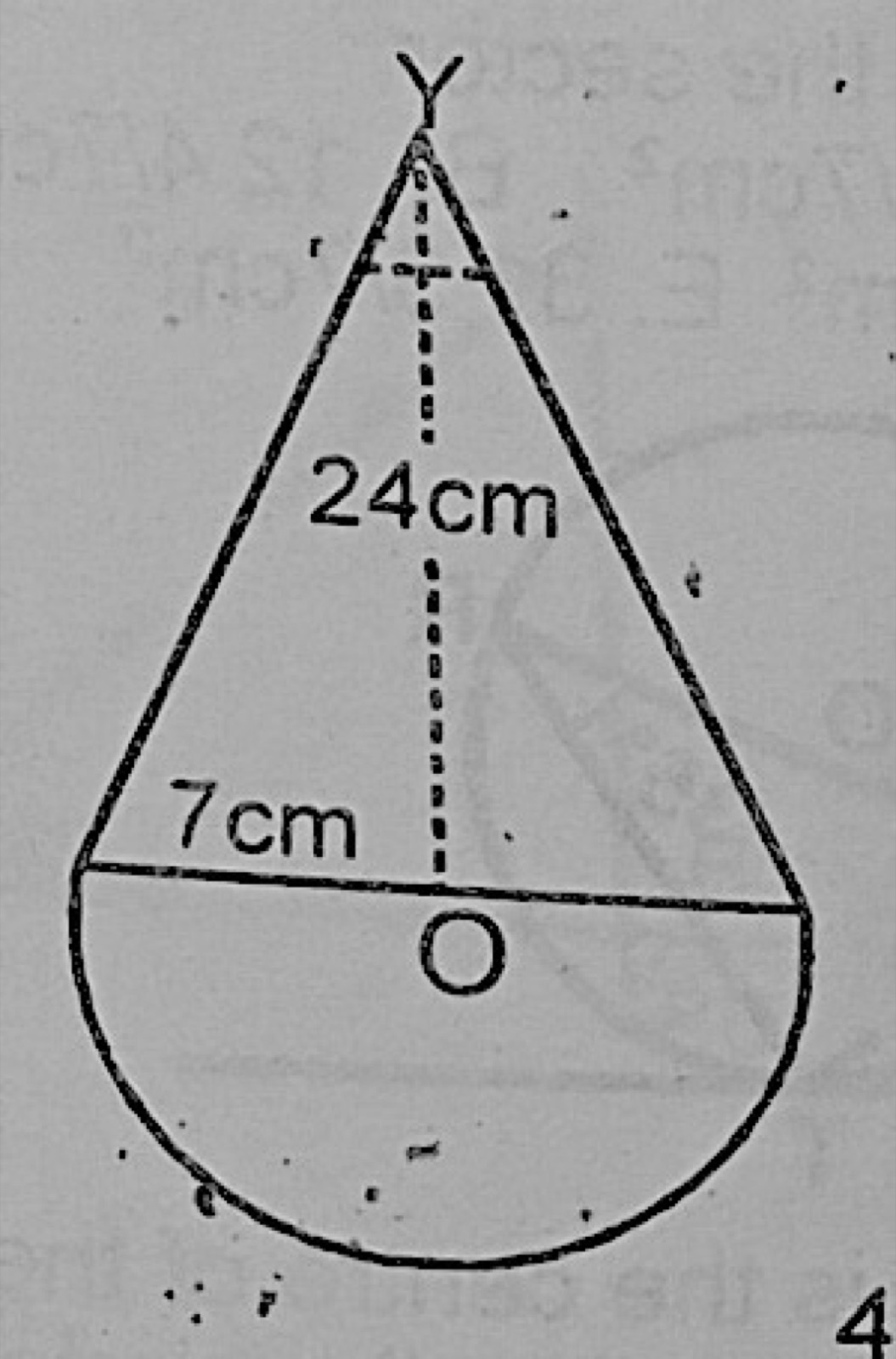
Slant height l = √(242 + 72) = √625 = 25 cm.
Curved surface of cone = πrl = 22/7 × 7 × 25 = 550 cm².
Curved surface of hemisphere = 2πr2 = 2 × 22/7 × 49 = 308 cm².
Total surface area = 550 + 308 = 858 cm² (3 s.f.).
Only the curved surfaces are on the outside; the flat circle is hidden where the cone meets the hemisphere.
Using a ruler and a pair of compasses only, construct a triangle ABC, given that |AB| = 8.4cm, |BC| = 6.5cm and ∠ABC = 30°. Construct the locus: (a) l1 of points equidistant from AB and BC, and within the angle ABC (b) l2 of points equidistant from B and C. Locate the point of intersection P of l1 and l2, measure |AP|.
Draw BC = 6.5 cm. At B construct 60° and bisect it to get 30°; mark A on that arm with BA = 8.4 cm; join AC.
(a) l1 = bisector of ∠ABC (arcs from B, then equal arcs from the cut points).
(b) l2 = perpendicular bisector of BC.
Mark P where l1 and l2 meet.
|AP| ≈ 5.2 cm.
Leave all construction arcs visible.
(a) If cos α = 0.6717, use Mathematical Table to find: (i) α (ii) sin α (b) The angle of depression of a point P on the ground, from the top T of a building is 23.6°. If the distance from P to the foot of the building is 50 cm, calculate the height of the building, correct to the nearest metre.
(a)(i) α = 47.8°
(ii) sin α = sin 47.8° = 0.7408
(b) The angle of elevation of T from P = 23.6° (alternate angles).
Height = 50 tan 23.6° = 50 × 0.4369 = 21.8 ≈ 22 m.
The angle of depression from T equals the angle of elevation from P.
(a) In the diagram below, O is the centre of the circle radius 3.2cm. If ∠PRQ = 42°, calculate, correct to two decimal places, the area of the: (i) minor sector POQ; (ii) shaded part (b) if the sector POQ in (a) is used to form the curved surface of a cone with vertex O, calculate the base radius of the cone, correct to one decimal place.
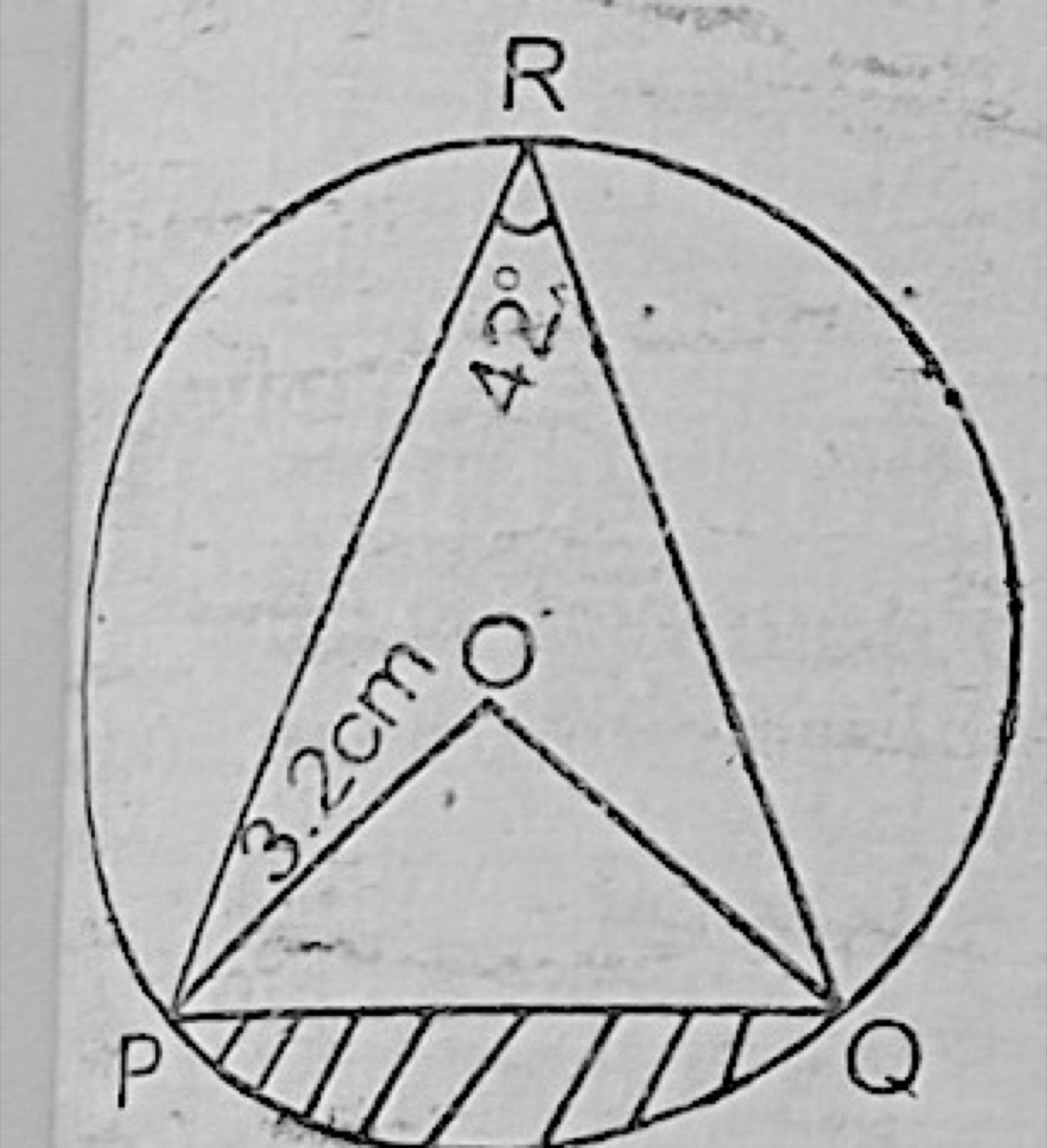
∠POQ = 2 × 42° = 84° (angle at centre = twice angle at circumference).
(a)(i) Sector area = 84/360 × 22/7 × 3.22 = 7.51 cm².
(ii) Area of △POQ = ½ × 3.22 × sin 84° = 5.12 × 0.9945 = 5.09 cm².
Shaded segment = 7.51 − 5.09 = 2.42 cm².
(b) Arc PQ = 84/360 × 2π × 3.2 = 4.69 cm = circumference of the base.
2πr = 4.69 ⇒ r = 84/360 × 3.2 = 0.75 ≈ 0.7 cm (1 d.p.).
The shaded segment is the sector minus the triangle.
When a stone is thrown vertically upwards, its distance d metres after t seconds is given by the formula d = 60t − 10t2. Draw the graph of d = 60t − 10t2 for values of t from 1 to 5 seconds using 2cm to 1 unit on the t axis and 2cm to 20 units on the d axis. (a) Using your graph (i) how long does it take to reach a height of 70 metres? (ii) determine the height of the stone after 5 seconds (iii) after how many seconds does it reach its maximum height? (b) Determine the slope of the graph when t = 4 seconds.
Table: t = 1, 2, 3, 4, 5 gives d = 50, 80, 90, 80, 50. Plot and join with a smooth curve.
(a)(i) d = 70 at t ≈ 1.6 s (on the way up; again at t ≈ 4.4 s on the way down).
(ii) d = 50 m at t = 5 s.
(iii) Maximum height (90 m) at t = 3 s.
(b) Draw the tangent at t = 4; its gradient ≈ −20 (m/s) — the stone is falling.
The slope of a distance–time graph is the velocity; after the top it is negative.
(a)(i) Prove that the angle which an arc of a circle subtends at the centre is twice that which it subtends at any point on the remaining part of the circumference. (ii) In the diagram above, O is the centre of the circle and PT is a diameter. If ∠PTQ = 22° and ∠TOR = 98°, calculate ∠QSR. (b) ABCD is a cyclic quadrilateral and the diagonals AC and BD intersect at H. If ∠DAC = 41° and ∠AHB = 70°, calculate ∠ACB.
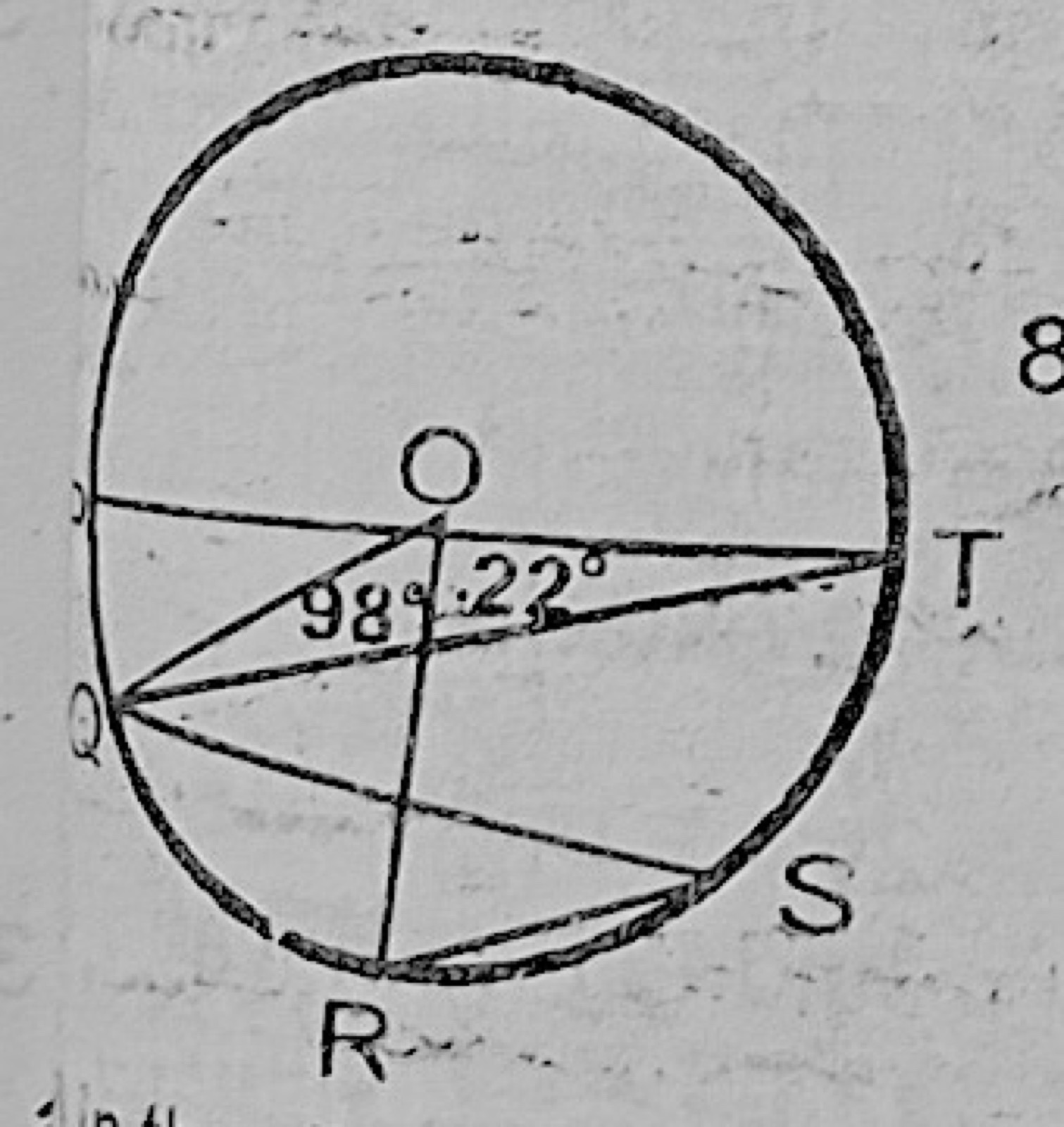
(a)(i) Arc AB, centre O, P on the remaining circumference. Join PO and produce to N.
OA = OP (radii) ⇒ ∠OAP = ∠OPA = x; exterior angle ∠AON = 2x.
Similarly ∠BON = 2y where y = ∠OPB.
∠AOB = 2x + 2y = 2(x + y) = 2∠APB.
(ii) ∠PTQ = 22° ⇒ arc PQ subtends 44° at O.
∠POT = 180° (diameter), so ∠QOR = 180° − 44° − 98° = 38°.
∠QSR = ½ × 38° = 19°.
(b) ∠DBC = ∠DAC = 41° (angles in the same segment).
∠BHC = 180° − 70° = 110° (angles on a straight line).
In △BHC: ∠ACB = 180° − 110° − 41° = 29°.
Use 'angles in the same segment are equal' to move the 41° to B.
(a) In an A.P. the difference between the 8th and the 4th terms is 20 and the 8th term is 1½ times the fourth term. What is the: (i) common difference, (ii) first term of the sequence? (b) The value of a machine depreciates each year by 5% of its value at the beginning of that year. If its value when new on 1st January, 1980 was N10,250.00, what was its value in January, 1989 when it was 9 years old? Give your answer, correct to three significant figures
(a)(i) (a + 7d) − (a + 3d) = 4d = 20 ⇒ d = 5.
(ii) a + 7d = 1½(a + 3d) ⇒ a + 35 = 1.5a + 22.5 ⇒ 0.5a = 12.5 ⇒ a = 25.
(b) Value = 10 250 × (0.95)9 = 10 250 × 0.6302 = N6 460 (3 s.f.).
Depreciation of 5% a year means multiplying by 0.95 each year.
(a) A pair of fair dice each numbered 1 to 6 is tossed. Find the probability of getting a sum of at least 9, (b) If the probability that a civil servant owns a car is 1/6, find the probability that: (i) two civil servants, A and B, selected at random, each owns a car, (ii) of two civil servants, C and D selected at random, only one owns a car, (iii) of three civil servants, X, Y and Z, selected at random, only one owns a car.
(a) Outcomes with sum ≥ 9: (3,6), (4,5), (5,4), (6,3), (4,6), (5,5), (6,4), (5,6), (6,5), (6,6) = 10 of 36.
P = 10/36 = 5/18.
(b)(i) 1/6 × 1/6 = 1/36.
(ii) P(C only) + P(D only) = 2 × 1/6 × 5/6 = 10/36 = 5/18.
(iii) 3 × 1/6 × 5/6 × 5/6 = 75/216 = 25/72.
'Only one' means one owns a car AND the others do not: multiply by 5/6 for each non-owner.
(a) Triangle PQR is right-angled at Q, PQ = 3a cm and QR = 4a cm. Determine PR in terms of a. (b) Ayo travels a distance of 24km from X on a bearing of 60° to Y. He then travels a distance of 18km to a point Z and Z is 30km from X. (i) Draw the diagram to show the positions of X, Y and Z (ii) What is the bearing of Z from Y? (iii) Calculate the bearing of X from Z.
(a) PR2 = (3a)2 + (4a)2 = 25a2 ⇒ PR = 5a cm.
(b)(i) Sketch X, Y on bearing 060° from X (24 km), Z 18 km from Y, XZ = 30 km.
Since 242 + 182 = 900 = 302, ∠XYZ = 90°.
(ii) Bearing of X from Y = 240°; YZ is perpendicular to YX, so the bearing of Z from Y = 240° − 90° = 150°.
(iii) tan ∠YZX = 24/18 ⇒ ∠YZX = 53.1°. Bearing of Y from Z = 330°, so the bearing of X from Z = 330° − 53.1° = 276.9° ≈ 277°.
Check for a 3-4-5 triangle before using the cosine rule.
(a) Derive an equation whose coefficients are integers and which has roots of 1/2 and −7. (b) Three years ago a father was four times as old as his daughter is now. The product of their present ages is 430. Calculate the present ages of the daughter and the father.
(a) (x − ½)(x + 7) = 0 ⇒ (2x − 1)(x + 7) = 0 ⇒ 2x2 + 13x − 7 = 0.
(b) Let the daughter be d and the father f years old now.
f − 3 = 4d and fd = 430.
(4d + 3)d = 430 ⇒ 4d2 + 3d − 430 = 0 ⇒ (d − 10)(4d + 43) = 0 ⇒ d = 10.
Daughter 10 years, father 43 years.
Reject the negative root: an age can't be negative.