GCE Agricultural Science 1989 past questions and answers

67 questions. Try each one, then open the answer to check yourself and read the explanation.

Question 1

Marketing of Agricultural Produce

Peasant farmers sell almost all their produce immediately after harvesting because

  1. A.stored produce would be lost to pests
  2. B.there are inadequate storage facilities
  3. C.stored produce lose their quality
  4. D.the produce are perishable
  5. E.the prices offered for stored produce are low.
Show the answer and explanation

Answer: B (there are inadequate storage facilities)

Explanation

Peasant farmers have no good stores, so they must sell soon after harvest.

Open this question

Question 2

Land Use and Land Tenure

The commonest method of land tenure in Nigeria is

  1. A.lease
  2. B.inheritance
  3. C.outright purchase
  4. D.pledge
  5. E.state allocation.
Show the answer and explanation

Answer: B (inheritance)

Explanation

Most Nigerian farmers got their land by inheriting it from their family.

Open this question

Question 3

Agricultural Finance

Which of the following constitutes a direct monetary cash assistance from government to farmers?

  1. A.Agricultural development programmes
  2. B.Extension service
  3. C.Supply of inputs
  4. D.loans
  5. E.Tractor hiring service.
Show the answer and explanation

Answer: D (loans)

Explanation

A loan is money given directly to the farmer; the others are services or materials.

Open this question

Question 4

Rocks and Soil Formation

The cross-section of a segment of soil showing the horizons or layers is known as the soil

  1. A.structure
  2. B.texture
  3. C.section
  4. D.depth
  5. E.profile.
Show the answer and explanation

Answer: E (profile.)

Explanation

A vertical section through the soil showing its horizons is the soil profile.

Open this question

Question 6

Land Use and Land Tenure

The factor that does not influence land use is

  1. A.topography
  2. B.population pressure
  3. C.population graph
  4. D.forest establishment
  5. E.soil type
Show the answer and explanation

Answer: C (population graph)

Explanation

A population graph is just a way of showing data; it does not affect how land is used.

Open this question

Question 7

Agricultural Ecology

Which of the following environmental factors is likely to have the greatest influence on crop production in Nigeria?

  1. A.Temperature
  2. B.Vegetation
  3. C.Air movement
  4. D.Moisture
  5. E.Pressure.
Show the answer and explanation

Answer: D (Moisture)

Explanation

Temperatures are warm all year in Nigeria, so rainfall (moisture) decides what and when crops can be grown.

Open this question

Question 8

Rocks and Soil Formation

The process whereby rocks are broken down into small particles through both physical and chemical factors is known as

  1. A.rock hydration
  2. B.rock degradation
  3. C.oxidation
  4. D.erosion
  5. E.weathering
Show the answer and explanation

Answer: E (weathering)

Explanation

Breaking down of rocks in place by physical and chemical agents is weathering.

Open this question

Question 9

Rocks and Soil Formation

The parent material of a soil is formed from the disintegration of

  1. A.sand
  2. B.gravel
  3. C.silt
  4. D.rock
  5. E.organic matter.
Show the answer and explanation

Answer: D (rock)

Explanation

Weathered rock forms the parent material from which soil develops.

Open this question

Question 10

Soil Fertility and Plant Nutrition

Nitrogen is made available to plants in the form of nitrates through the process of

  1. A.deamination and nitrification
  2. B.ammonification and denitrification
  3. C.deamination and ammonification
  4. D.nitrification and denitrification
  5. E.nitrification and ammonification.
Show the answer and explanation

Answer: E (nitrification and ammonification.)

Explanation

Organic nitrogen is first changed to ammonium (ammonification), then to nitrites and nitrates (nitrification).

Open this question

Question 11

Soil Fertility and Plant Nutrition

Which of the following is not an effect of burning on the soil?

  1. A.Increasing the organic matter in the soil
  2. B.Increasing the soil nutrients
  3. C.Increasing the acidity of the soil
  4. D.Exposing the soil to erosion
  5. E.Sterilization of the soil.
Show the answer and explanation

Answer: A (Increasing the organic matter in the soil)

Explanation

Burning destroys organic matter rather than adding to it.

Open this question

Question 12

Soil Properties

The functions of soil micro-organisms include the following except

  1. A.decomposition of dead plant and animal remains
  2. B.recycling of nutrient
  3. C.causing plant or animal diseases
  4. D.living as parasites on crop plants
  5. E.filtration of soil water for plant use.
Show the answer and explanation

Answer: E (filtration of soil water for plant use.)

Explanation

Micro-organisms decompose matter, recycle nutrients and some cause disease, but they do not filter soil water.

Open this question

Question 13

Rocks and Soil Formation

Slate is derived from

  1. A.schist
  2. B.sandstone
  3. C.shale
  4. D.gneiss.
  5. E.quartzite
Show the answer and explanation

Answer: C (shale)

Explanation

Slate is a metamorphic rock formed when shale is put under heat and pressure.

Open this question

Question 14

Irrigation and Drainage

The following are advantages of the sprinkler method of irrigation except

  1. A.rate of application of irrigation water can be controlled
  2. B.portable nature of many sprinkler systems make them suitable for use
  3. C.the sprinkler systems can be made automatic
  4. D.method can be used where topography affects harrowing of land
  5. E.method may be difficult for local farmers to use.
Show the answer and explanation

Answer: E (method may be difficult for local farmers to use.)

Explanation

Being difficult for local farmers to use is a disadvantage, not an advantage.

Open this question

Question 15

Soil Fertility and Plant Nutrition

Rhizobium supplies nitrogen to leguminous plants by

  1. A.changing some mineral salts to sulphate of ammonia
  2. B.incorporating urea into its body
  3. C.fixing atmospheric nitrogen
  4. D.decomposing plant remains
  5. E.Increasing the pH value of the soil.
Show the answer and explanation

Answer: C (fixing atmospheric nitrogen)

Explanation

Rhizobium in root nodules fixes nitrogen gas from the air into compounds the legume can use.

Open this question

Question 16

Irrigation and Drainage

The advantage of providing drainage ditches in farms is that it

  1. A.requires periodic clearing
  2. B.is inconvenient for farm mechanization
  3. C.is labour intensive
  4. D.is unsuitable for draining basement of farm buildings
  5. E.is easily adopted by small scale farmers.
Show the answer and explanation

Answer: E (is easily adopted by small scale farmers.)

Explanation

Open ditches are cheap and simple, so small-scale farmers can easily make them; the other options are drawbacks.

Open this question

Question 17

Farm Power

Which of the following sources of farm power cannot be effectively used for processing agricultural products?

  1. A.Animals
  2. B.Electricity
  3. C.Sun
  4. D.Machines
  5. E.Wind.
Show the answer and explanation

Answer: A (Animals)

Explanation

Work animals are used for ploughing and transport; electricity, machines, sun (drying) and wind (winnowing) are used in processing.

Open this question

Question 18

Agricultural Ecology

The instrument used to measure the relative humidity is

  1. A.thermometer
  2. B.anemometer
  3. C.hygrometer
  4. D.hydrometer
  5. E.rain gauge
Show the answer and explanation

Answer: C (hygrometer)

Explanation

A hygrometer measures relative humidity.

Open this question

Question 19

Farm Machinery and Mechanisation

The most important limitation of agricultural mechanization is

  1. A.small holdings
  2. B.lack of technical know-how
  3. C.poor marketing system
  4. D.inadequate storage facilities
  5. E.pest attack.
Show the answer and explanation

Answer: A (small holdings)

Explanation

Small, scattered plots make it hard and uneconomic to use tractors and other machines.

Open this question

Question 20

Farm Surveying and Planning

The best tool(s) a farmer should use to measure out a large farm accurately include(s) the

  1. A.garden line and measuring tape
  2. B.measuring tape and ranging poles
  3. C.measuring tape only
  4. D.garden line only
  5. E.ranging poles and garden line.
Show the answer and explanation

Answer: B (measuring tape and ranging poles)

Explanation

Ranging poles mark straight lines and a measuring tape gives accurate distances.

Open this question

Question 21

Land Preparation and Cultural Practices

The distance between two successive yam mounds should be about

  1. A.0.10 m
  2. B.1.00 m
  3. C.10.00 m
  4. D.100.00 m
  5. E.1000.00 m.
Show the answer and explanation

Answer: B (1.00 m)

Explanation

Yam is spaced about 1 m × 1 m.

Open this question

Question 22

Pasture and Forage Crops

The desirable characteristics of forage crops include the following except

  1. A.palatability
  2. B.dependability
  3. C.high yield
  4. D.resistance to trampling
  5. E.poor reproductive ability.
Show the answer and explanation

Answer: E (poor reproductive ability.)

Explanation

A good forage crop should regrow and spread well; poor reproductive ability is undesirable.

Open this question

Question 23

Forestry and Wildlife

The growing of both forest and agricultural crops on the same piece of land is termed

  1. A.mixed cropping
  2. B.mixed farming
  3. C.forestry
  4. D.taungya system
  5. E.poor reproductive ability.
Show the answer and explanation

Answer: D (taungya system)

Explanation

In the taungya system farmers grow food crops between young forest trees on the same land.

Open this question

Question 24

Crop Diseases

Which of the following is not an effect on man of the various preventive and control measures of diseases and pests of crops?

  1. A.Air pollution
  2. B.Water poisoning
  3. C.Food contamination
  4. D.Poor health
  5. E.Poor utilization.
Show the answer and explanation

Answer: E (Poor utilization.)

Explanation

Pesticides can pollute air and water, contaminate food and harm health; "poor utilization" is not a health or environmental effect.

Open this question

Question 25

Basic Genetics

The units of inheritance which determine the various characteristics of crops are called

  1. A.chromosomes
  2. B.nuclei
  3. C.genes
  4. D.cytoplasm
  5. E.membranes.
Show the answer and explanation

Answer: C (genes)

Explanation

Genes are the units of inheritance carried on chromosomes.

Open this question

Question 26

Crop Husbandry

Which of the following crops is a raw material for the production of chocolate?

  1. A.Kolanut
  2. B.Coffee
  3. C.Banana
  4. D.Cocoa
  5. E.Avocado pear.
Show the answer and explanation

Answer: D (Cocoa)

Explanation

Chocolate is made from cocoa beans.

Open this question

Question 27

Pasture and Forage Crops

In the establishment of pastures, it is best to

  1. A.plant only grasses
  2. B.plant only legumes
  3. C.plant a mixture of grasses and legumes
  4. D.let the natural grasses grow
  5. E.allow weeds to mix with the forage crops.
Show the answer and explanation

Answer: C (plant a mixture of grasses and legumes)

Explanation

A grass–legume mixture gives a balanced feed and the legume adds nitrogen to the soil.

Open this question

Question 28

Forestry and Wildlife

A forest established for watershed management will perform the following functions except

  1. A.reducing water pollution
  2. B.controlling fish population
  3. C.controlling erosion
  4. D.maintaining a steady stream flow
  5. E.reducing evaporation.
Show the answer and explanation

Answer: B (controlling fish population)

Explanation

Watershed forests protect soil and water; they do not control fish numbers.

Open this question

Question 29

Crop Diseases

The disease which most often attacks groundnut is called

  1. A.rosette
  2. B.mosaic
  3. C.soft rot
  4. D.powdery mildew
  5. E.brown rot.
Show the answer and explanation

Answer: A (rosette)

Explanation

Groundnut rosette is the commonest and most damaging groundnut disease.

Open this question

Question 30

Basic Genetics

The process of meiosis in plants ensures the production of reproductive cells with

  1. A.the same number of chromosomes like the parent plant
  2. B.half the number of chromosomes of the parent plant
  3. C.no chromosome unlike the parent plants
  4. D.thrice the number of chromosomes of the parent plant
  5. E.twice the number of chromosomes of the parent plant.
Show the answer and explanation

Answer: B (half the number of chromosomes of the parent plant)

Explanation

Meiosis halves the chromosome number so that fertilisation restores the full number.

Open this question

Question 31

Crop Improvement

Why should a seed-producing farmer spray an insecticide on his crops only when the bees are not around?

  1. A.The bees would sting him and he therefore avoids them
  2. B.The farmer does not want to waste his chemicals
  3. C.Bees are important for pollination of his crops
  4. D.Bees produce honey for him in his farm
  5. E.Bees are harmless insects.
Show the answer and explanation

Answer: C (Bees are important for pollination of his crops)

Explanation

Seed is only formed after pollination, and bees are pollinators the farmer should not kill.

Open this question

Question 32

Land Preparation and Cultural Practices

The average seed rate for maize is 25 kg per hectare. Allowing for a seed wastage of 5 per cent, how many kilogram of seeds would be required in planting 10 hectares of farmland?

  1. A.237.5
  2. B.238.0
  3. C.250.0
  4. D.255.0
  5. E.262.5.
Show the answer and explanation

Answer: E (262.5.)

Explanation

25 × 10 = 250 kg; add 5% (12.5 kg) for wastage = 262.5 kg.

Open this question

Question 33

Crop Pests

Thrips cause serious mechanical damages to crops by their

  1. A.feeding activities on flowers, leaves and fruits
  2. B.laying eggs on plants
  3. C.sucking of the sap of crops
  4. D.burrowing activities causing damping off in crops
  5. E.activities as vectors of bacterial diseases.
Show the answer and explanation

Answer: A (feeding activities on flowers, leaves and fruits)

Explanation

Thrips rasp the surface of flowers, leaves and fruits as they feed, scarring them.

Open this question

Question 34

Basic Genetics

The expression of a gene in the phenotype irrespective of whether the cell is homozygous or heterozygous is known as

  1. A.recessive
  2. B.partial dominance
  3. C.test-cross
  4. D.segregation
  5. E.dominance.
Show the answer and explanation

Answer: E (dominance.)

Explanation

A dominant gene shows in the phenotype whether paired with the same or a different allele.

Open this question

Question 35

Crop Propagation

Vegetative propagation can be carried out through the following processes except

  1. A.seedling
  2. B.cutting
  3. C.layering
  4. D.grafting
  5. E.budding.
Show the answer and explanation

Answer: A (seedling)

Explanation

Seedlings come from seeds (sexual reproduction), not from vegetative parts.

Open this question

Question 36

Crop Pests

Contact insecticides are used to control

  1. A.pod borers of legumes
  2. B.stem borers of cereal
  3. C.leaf beetles of legumes
  4. D.peel worm of legumes
  5. E.bollworms of cotton.
Show the answer and explanation

Answer: C (leaf beetles of legumes)

Explanation

Contact insecticides kill insects they touch, so they work on pests that feed exposed on leaves; borers hide inside plant parts.

Open this question

Question 37

Animal Anatomy and Physiology

The part of the ruminant stomach from which digestive juices are secreted is the

  1. A.rumen
  2. B.reticulum
  3. C.omasum
  4. D.paunch
  5. E.abomasum.
Show the answer and explanation

Answer: E (abomasum.)

Explanation

The abomasum is the true stomach that secretes gastric juice.

Open this question

Question 38

Livestock Management

At which of the following ages are gilts normally mated?

  1. A.8 - 12 months
  2. B.14 - 15 months
  3. C.15 -20 months
  4. D.21 -24 months
  5. E.over 25 months.
Show the answer and explanation

Answer: A (8 - 12 months)

Explanation

Gilts are first served at about 8–12 months old.

Open this question

Question 39

Classification of Farm Animals

Which of the following breeds of cattle is regarded as the best dairy breed in Nigeria?

  1. A.Red Bororo
  2. B.Keteku
  3. C.Sokoto Gudali
  4. D.Muturu
  5. E.White Fulani.
Show the answer and explanation

Answer: E (White Fulani.)

Explanation

White Fulani (Bunaji) is the local breed best known for milk production.

Open this question

Question 40

Animal Nutrition

The symptoms of vitamin deficiency diseases in livestock include the following except

  1. A.scurvy
  2. B.loss of appetite
  3. C.poor blood clotting
  4. D.improved fertility
  5. E.rickets.
Show the answer and explanation

Answer: D (improved fertility)

Explanation

Vitamin deficiency reduces fertility; it does not improve it.

Open this question

Question 41

Animal Health

A protozoan disease of livestock not transmitted by a vector is

  1. A.coccidiosis
  2. B.babesiosis
  3. C.trypanosomiasis
  4. D.redwater
  5. E.anaplasmosis.
Show the answer and explanation

Answer: A (coccidiosis)

Explanation

Coccidiosis spreads when animals eat oocysts in contaminated feed or litter; the others are spread by ticks or tsetse flies.

Open this question

Question 42

Fisheries and Aquaculture

The best method(s) of regulating fish capture is/are

  1. A.gill netting and electro-fishing
  2. B.quota and mesh-size control
  3. C.beach seine method
  4. D.active netting
  5. E.passive netting.
Show the answer and explanation

Answer: B (quota and mesh-size control)

Explanation

Catch quotas and minimum mesh sizes limit how many and how small the fish caught are.

Open this question

Question 43

Animal Improvement

Which of the following is not a factor of improvement in breeding cattle?

  1. A.Fertility
  2. B.Butter-fat percentage
  3. C.Weaning weight
  4. D.Feed efficiency
  5. E.Back-fat thickness.
Show the answer and explanation

Answer: E (Back-fat thickness.)

Explanation

Back-fat thickness is a selection trait in pigs, not cattle.

Open this question

Question 44

Animal Nutrition

Which of the following is not a symptom of malnutrition in livestock?

  1. A.Bloat
  2. B.Night blindness
  3. C.Milk fever
  4. D.Infertility
  5. E.Anaemia.
Show the answer and explanation

Answer: A (Bloat)

Explanation

Bloat is gas trapped in the rumen from eating lush legumes, not a nutrient deficiency.

Open this question

Question 45

Livestock Management

The act of giving birth in rabbits is known as

  1. A.kidding
  2. B.farrowing
  3. C.kindling
  4. D.calving
  5. E.lambing.
Show the answer and explanation

Answer: C (kindling)

Explanation

Rabbits kindle; goats kid, pigs farrow, cows calve and sheep lamb.

Open this question

Question 46

Classification of Farm Animals

The exotic breeds of rabbits found in Nigeria include the following except

  1. A.New Zealand white
  2. B.Chinchila
  3. C.American Albino
  4. D.Flemish Giant
  5. E.Rhode Island Red.
Show the answer and explanation

Answer: E (Rhode Island Red.)

Explanation

Rhode Island Red is a breed of chicken, not rabbit.

Open this question

Question 47

Animal Nutrition

Minerals such as contained in oyster shell help animals to

  1. A.build up their body tissue
  2. B.develop their bones and teeth
  3. C.have balanced diet
  4. D.develop immunity against deficiency diseases
  5. E.increase their blood mineral content.
Show the answer and explanation

Answer: B (develop their bones and teeth)

Explanation

Oyster shell supplies calcium, needed for bones, teeth and eggshells.

Open this question

Question 48

Fisheries and Aquaculture

Some of the by-products of fish include the following except

  1. A.fish meal
  2. B.fish silage
  3. C.glue
  4. D.oil
  5. E.leather.
Show the answer and explanation

Answer: E (leather.)

Explanation

Fish meal, silage, glue and oil are common fish by-products; leather comes from animal hides.

Open this question

Question 49

Animal Health

The commonest ectoparasites of birds are

  1. A.lice
  2. B.fleas
  3. C.ticks
  4. D.mites
  5. E.houseflies
Show the answer and explanation

Answer: A (lice)

Explanation

Lice are the most common external parasites of poultry.

Open this question

Question 50

Animal Improvement

The following factors should be considered when selecting a farm animal irrespective of the use management and cost except

  1. A.heredity
  2. B.age
  3. C.health
  4. D.fecundity
  5. E.colour.
Show the answer and explanation

Answer: E (colour.)

Explanation

Heredity, age, health and fertility affect performance; colour does not.

Open this question

Question 51

Animal Reproduction

Which of the following is not a factor affecting fertility in farm animals?

  1. A.Age
  2. B.Ovulation rate
  3. C.Number of ova fertilized
  4. D.Number of offspring produced
  5. E.Lactation rate.
Show the answer and explanation

Answer: E (Lactation rate.)

Explanation

Age, ovulation rate and number of ova fertilised decide fertility; lactation rate is about milk yield.

Open this question

Question 52

Animal Nutrition

Low fibre and high energy feeds are classified as

  1. A.supplements
  2. B.concentrates
  3. C.roughages
  4. D.additives
  5. E.basal feeds.
Show the answer and explanation

Answer: B (concentrates)

Explanation

Concentrates are low in fibre and rich in energy or protein.

Open this question

Question 53

Livestock Management

Which of the following is not used for identification purpose in livestock?

  1. A.Tattooing
  2. B.Branding
  3. C.Tagging
  4. D.Notching
  5. E.Shearing.
Show the answer and explanation

Answer: E (Shearing.)

Explanation

Shearing removes wool; it does not mark an animal.

Open this question

Question 54

Animal Health

The factors that can predispose animals to diseases include the following except

  1. A.poor housing
  2. B.malnutrition
  3. C.immunity
  4. D.physical injuries
  5. E.unfavourable weather.
Show the answer and explanation

Answer: C (immunity)

Explanation

Immunity protects animals from disease; the others make them more likely to fall ill.

Open this question

Question 55

Basic Agricultural Economics

The following are factors of agricultural production except

  1. A.farmstead
  2. B.land
  3. C.labour
  4. D.capital
  5. E.management.
Show the answer and explanation

Answer: A (farmstead)

Explanation

The factors of production are land, labour, capital and management; a farmstead is not one.

Open this question

Question 57

Basic Agricultural Economics

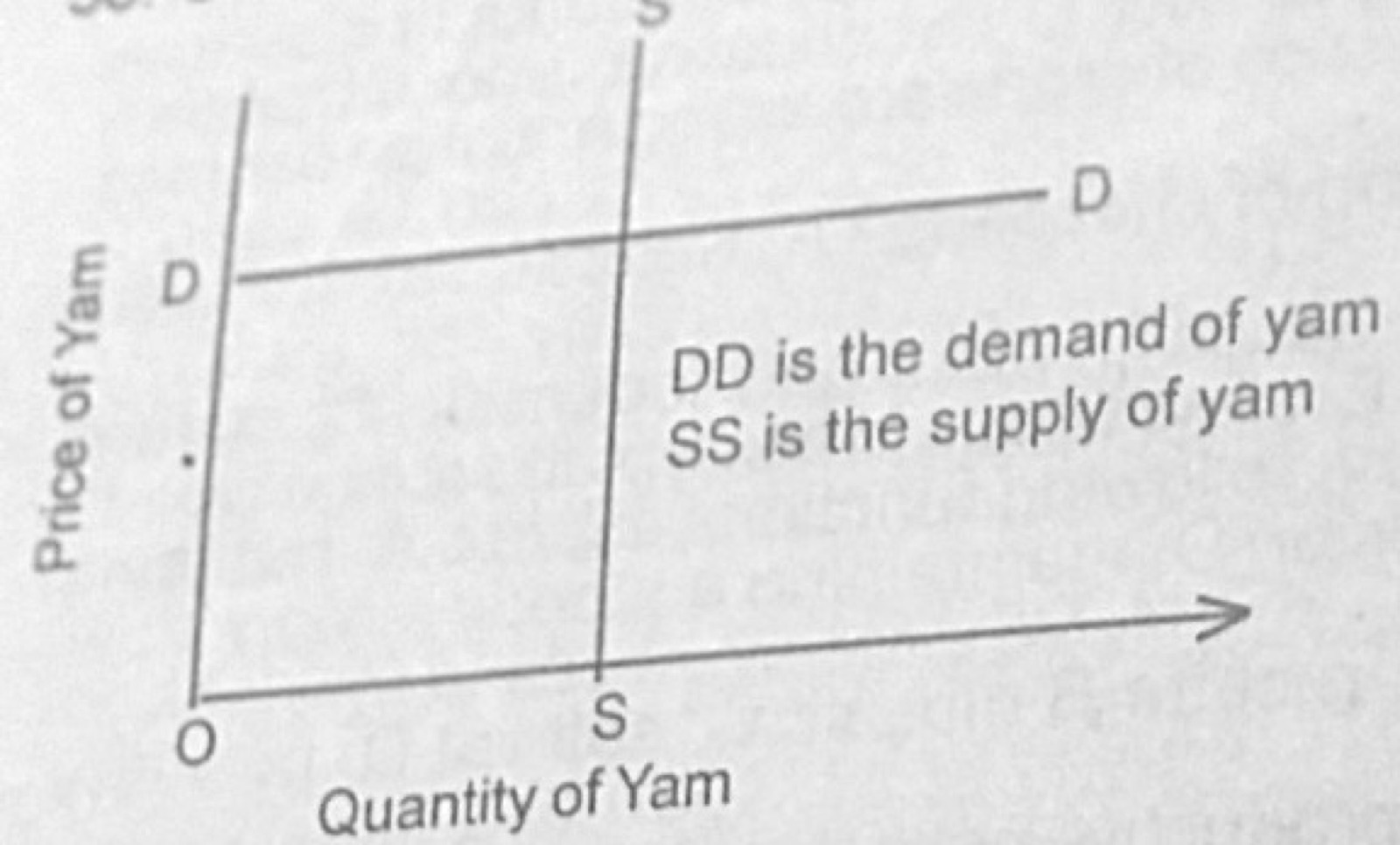
Use the graph to answer this question (DD is the demand of yam, SS is the supply of yam). Which of the following deduction is correct of the graph?

Diagram for this question
  1. A.A change in price has a drastic effect on quantity demanded but does not affect quantity supplied
  2. B.A change in price affects quantity demanded and supplied
  3. C.A change in price does not affect quantity demanded but had drastic effect on supply
  4. D.The quantity demanded or supplied does not change as prices change
  5. E.The quantity demanded or supplied changes as price changes.
Show the answer and explanation

Answer: A (A change in price has a drastic effect on quantity demanded but does not affect quantity supplied)

Explanation

DD is horizontal (perfectly elastic: any price change changes demand drastically) while SS is vertical (supply stays the same whatever the price).

Open this question

Question 59

Farm Management and Records

Which of the following is a day-to-day record of work on a farmer's farm?

  1. A.Crop yield book
  2. B.Labour diary
  3. C.Farm inventory
  4. D.Produce account
  5. E.Profit and loss account.
Show the answer and explanation

Answer: B (Labour diary)

Explanation

A diary records daily work done on the farm.

Open this question

Question 60

Agricultural Extension

Most farmers in Nigeria are hesitant in adopting new farming techniques because they

  1. A.are poor and cannot afford to take risks
  2. B.do not trust the extension worker
  3. C.do not accept anything that comes from the government
  4. D.are too old-fashioned to adopt new ideas
  5. E.are afraid of the market instability
Show the answer and explanation

Answer: A (are poor and cannot afford to take risks)

Explanation

Poor farmers cannot risk losing a harvest on an untested method, so they wait.

Open this question

Theory question 101

Land Use and Land Tenure

List and explain the four major systems of land tenure in Nigeria.

Show the model answer
Model answer

Any four, each explained:
Communal: land belongs to the community/family; members get use rights but cannot sell
Inheritance: land passes from parents to children; leads to fragmentation
Leasehold: land used for a fixed period on payment of fees under an agreement
Rent/tenancy: land used for a season or two on payment of rent; no long-term development
Outright purchase (freehold): buyer owns the land fully and can develop or sell it
Free gift; pledge; state ownership under the Land Use Act

Explanation

Name each system and say how land is held under it, with one effect on farming.

Open this question

Theory question 102

Farm Power

Write short notes on the following sources of farm power:
(a) Work animals
(b) Machine engines
(c) Water
(d) Sun.

Show the model answer
Model answer

(a) Work animals (bulls, donkeys, camels): used for ploughing, ridging and transport; cheap and give manure; but slow, tire, need feeding and get sick
(b) Machine engines (petrol/diesel, tractors): fast, powerful, do heavy work over large areas; but expensive, need fuel, skilled operators and spare parts; cause pollution
(c) Water: drives water wheels/turbines for grinding and generating hydro-electricity; used for irrigation and processing; only available near rivers/dams
(d) Sun: solar energy for drying crops, fish and hay, photosynthesis, solar panels for electricity and pumps; free but not available at night or in cloudy weather

Explanation

For each source give uses, one advantage and one disadvantage.

Open this question

Theory question 103

Rocks and Soil Formation

(a) What is rock weathering?
(b) Enumerate three processes involved in rock weathering.
(c) List and discuss briefly the agents of two of these processes.

Show the model answer
Model answer

(a) Weathering is the breaking down of rocks in place into smaller particles by physical, chemical and biological agents to form soil parent material
(b) Physical (mechanical) weathering; chemical weathering; biological weathering
(c) Any two: Physical – temperature (alternate heating and cooling cracks rocks), water (freezing, running water abrades), wind (sand blasting); Chemical – hydration, hydrolysis, oxidation, carbonation, solution change minerals; Biological – plant roots grow into cracks and split rocks, burrowing animals, micro-organisms and lichens release acids, man's activities

Explanation

Define, list three processes, then explain the agents of two of them.

Open this question

Theory question 104

Irrigation and Drainage

(a) Distinguish between irrigation and drainage.
(b) State and explain four systems of irrigation and two of drainage.

Show the model answer
Model answer

(a) Irrigation is the artificial supply of water to the soil for crops; drainage is the removal of excess water from the soil
(b) Irrigation (any four): surface/flood irrigation – water flooded over the field; furrow irrigation – water runs in furrows between ridges; basin/check irrigation – water held in levelled basins; sprinkler (overhead) – water sprayed like rain from pipes; drip/trickle – water delivered slowly to each plant; sub-surface irrigation – water supplied from below through pipes
Drainage (any two): surface drainage – open ditches/channels; sub-surface drainage – tile drains, mole drains, perforated pipes; vertical drainage (pumping from wells)

Explanation

Show the difference clearly, then describe each system in a line.

Open this question

Theory question 105

Crop Pests

Describe briefly the economic importance and the control measures of the following:
(a) Stem borers of cereal
(b) Grain weevils of stored produce
(c) Cotton stainer
(d) Cassava mealy-bug

Show the model answer
Model answer

(a) Stem borers: larvae tunnel in maize/sorghum/rice stems causing dead heart, lodging and lower yield; control – early planting, crop rotation, burning stubble, systemic/granular insecticides, resistant varieties
(b) Grain weevils: bore into stored grain, reduce weight and quality, cause heating and mould; control – dry grain well, clean stores, fumigation, storage insecticides (e.g. Actellic), airtight storage
(c) Cotton stainer: sucks developing seeds, stains lint, spreads boll rot; control – spraying insecticides, removing alternative host plants, hand picking, crop rotation
(d) Cassava mealybug: sucks sap, causes stunting, bunchy top and leaf loss, lowering tuber yield; control – biological control with parasitic wasp (Epidinocarsis lopezi), resistant varieties, clean planting material, insecticides

Explanation

For each pest give the damage (economic importance) and at least two control methods.

Open this question

Theory question 106

Forestry and Wildlife

Write short notes on the following:
(a) Selective exploitation
(b) Deforestation
(c) Regeneration
(d) Afforestation

Show the model answer
Model answer

(a) Selective exploitation: cutting only selected trees of the right species and size, leaving others to grow, so the forest is preserved
(b) Deforestation: complete removal of forest trees for farming, building, fuel or timber; causes erosion, loss of wildlife and climate change
(c) Regeneration: renewing a forest after cutting, naturally (from seeds, coppice) or artificially (planting seedlings)
(d) Afforestation: establishing a forest on land that had no forest before

Explanation

Each term needs a clear meaning and one point on its importance. (The book prints (a) as "Selective exploration".)

Open this question

Theory question 107

Fisheries and Aquaculture

(a) Describe five factors required for establishing a fish pond.
(b) Enumerate six management practices for maintaining high fish yield.

Show the model answer
Model answer

(a) Any five: reliable water supply; suitable soil that holds water (clay/loam); gentle topography for draining and filling; good water quality (pH, oxygen, free from pollution); accessibility/nearness to market; availability of fingerlings and feed; security; land tenure/cost
(b) Any six: stocking at the right density; regular feeding with good feed; fertilising/liming the pond; controlling water level and quality; controlling weeds and predators; disease and parasite control; harvesting at the right time; repairing dykes and screens

Explanation

Factors are about choosing the site; practices are about running the pond.

Open this question

Theory question 108

Animal Health

Discuss rinderpest disease of livestock under the following sub-headings:
(a) Causal organism
(b) Transmission
(c) Symptoms
(d) Effects and economic importance
(e) Control

Show the model answer
Model answer

(a) A virus (Morbillivirus)
(b) Contact with infected animals, their discharges, contaminated feed, water and equipment
(c) High fever, discharge from eyes and nose, mouth sores/ulcers, diarrhoea (often bloody), dehydration, loss of appetite, death
(d) High death rate in cattle; loss of meat, milk, hides and draught power; loss of income; restricts trade in livestock
(e) Vaccination; quarantine; isolation and slaughter of infected animals; restricting animal movement; disinfection

Explanation

Give the cause as a virus and cover all five headings.

Open this question

Theory question 109

Agricultural Extension

(a) What is meant by agricultural extension?
(b) Discuss briefly how the following can be used in disseminating new ideas and techniques to farmers in Nigeria:
(i) mass media
(ii) individual method
(iii) group method

Show the model answer
Model answer

(a) Agricultural extension is the education of farmers outside school, carrying research findings and improved practices to them to raise their output and living standard
(b)(i) Mass media: radio, television, newspapers, posters, films reach many farmers quickly and cheaply, in local languages
(ii) Individual method: farm and home visits, office calls, telephone; the extension worker gives personal advice on a farmer's own problems
(iii) Group method: meetings, demonstrations (method and result), field days, farmers' clubs and cooperatives; many farmers learn together and see results

Explanation

Define extension, then say how each method works and why it helps.

Open this question

Theory question 110

Farm Management and Records

(a) Define farm records and farm accounts.
(b) Give seven reasons for keeping such records.

Show the model answer
Model answer

(a) Farm records are written accounts of activities, inputs and outputs on a farm (e.g. diary, inventory, production records); farm accounts are records of money received and spent (sales, purchases, profit and loss, balance sheet)
(b) Any seven: show profit or loss; help planning and decision making; needed to get loans; for tax assessment; show the value of the farm; help compare enterprises; settle disputes/claims; track production and performance; help in budgeting; provide information for research and extension

Explanation

Give both definitions, then seven distinct reasons.
Open this question