Question 1
Number BasesIf 23x + 101x = 130x, find the value of x.
- A.7
- B.6
- C.5
- D.4
Show the answer and explanation
Answer: D (4)
Explanation
In base ten: (2x + 3) + (x² + 1) = x² + 3x, so 2x + 4 = 3x and x = 4.
60 questions. Try each one, then open the answer to check yourself and read the explanation.
If 23x + 101x = 130x, find the value of x.
Answer: D (4)
In base ten: (2x + 3) + (x² + 1) = x² + 3x, so 2x + 4 = 3x and x = 4.
Simplify: (¾ − ⅔) × 1⅕.
Answer: C (1/10)
¾ − ⅔ = 1/12, and 1/12 × 6/5 = 6/60 = 1/10.
Simplify: (10√3/√5 − √15)2
Answer: B (15.00)
10√3/√5 = 10√15/5 = 2√15, so the bracket is 2√15 − √15 = √15 and its square is 15.
The distance, d, through which a stone falls from rest varies directly as the square of the time, t, taken. If the stone falls 45 cm in 3 seconds, how far will it fall in 6 seconds?
Answer: C (180 cm)
d = kt²: 45 = 9k so k = 5; then d = 5 × 36 = 180 cm.
Which of the following is a vaild conclusion from the premise: 'Nigerian footballers are good footballers'?
Answer: C (Joseph is a Nigerian footballer therefore he is a good footballer.)
The set of Nigerian footballers lies inside the set of good footballers, so anyone who is a Nigerian footballer must be a good footballer.
On a map, 1 cm represents 5 km. Find the area on the map that respresents 100 km2.
Answer: B (4 cm2)
1 cm² on the map is 5 × 5 = 25 km², so 100 km² is 100 ÷ 25 = 4 cm².
Simplify: (3n−1 × 27n+1)/81n
Answer: B (9)
3n − 1 × 33n + 3 ÷ 34n = 32 = 9.
What sum of money will amount to D10,400.00 in 5 years at 6% simple interest?
Answer: A (D8,000.00)
Interest for 5 years at 6% is 30% of P, so 1.3P = 10 400 and P = D8,000.
Which of the following number lines illustrates the solution of the inequality 4 ≤ ⅓(2x − 1) < 5?
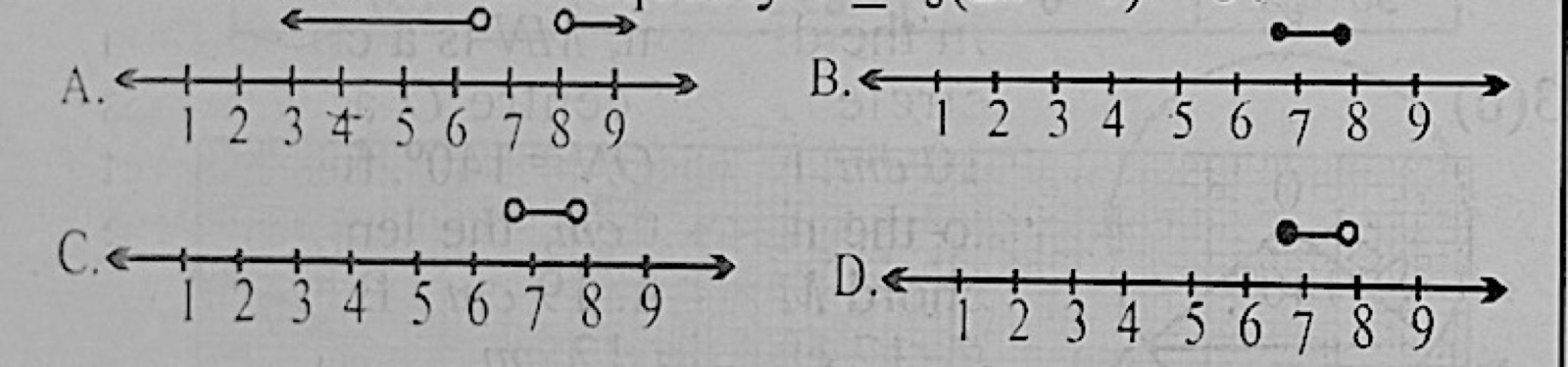
Answer: D (Closed circle at 6½ and open circle at 8)
12 ≤ 2x − 1 < 15 gives 6½ ≤ x < 8: a closed (shaded) circle at 6½ and an open circle at 8.
The roots of a quadratic equation are 4/3 and −3/7. Find the equation.
Answer: A (21x2 − 19x − 12 = 0)
(3x − 4)(7x + 3) = 21x² + 9x − 28x − 12 = 21x² − 19x − 12.
Find the values of y for which the expression (y2 − 9y + 18)/(y2 + 4y − 21) is undefined
Answer: C (3, −7)
It is undefined when the denominator is zero: y² + 4y − 21 = (y − 3)(y + 7) = 0, so y = 3 or −7.
Simplify: 2/(1 − x) − 1/x.
Answer: B ((3x − 1)/(x(1 − x)))
Over x(1 − x): (2x − (1 − x))/(x(1 − x)) = (3x − 1)/(x(1 − x)).
Make s the subject of the relation: p = s + sm2/nr
Answer: D (s = nrp/(nr + m2))
p = s(nr + m²)/nr, so s = nrp/(nr + m²).
Factorize: (2x + 3y)2 − (x − 4y)2.
Answer: A ((3x − y)(x + 7y))
Difference of two squares: (2x + 3y + x − 4y)(2x + 3y − x + 4y) = (3x − y)(x + 7y).
The curved surface area of a cylinder 5 cm high, is 110 cm2. Find the radius of its base. [Take π = 22/7]
Answer: B (3.5 cm)
2πrh = 110: 2 × 22/7 × r × 5 = 110, so r = 3.5 cm.
The volume of a pyramid with height 15 cm is 90 cm3. If its base is a rectangle with dimensions x cm by 6 cm, find the value of x.
Answer: A (3)
⅓ × 6x × 15 = 30x = 90, so x = 3.
In the diagram, YW is a tangent to the circle at X, |UV| = |VX| and ∠VXW = 50°. Find the value of ∠UXY
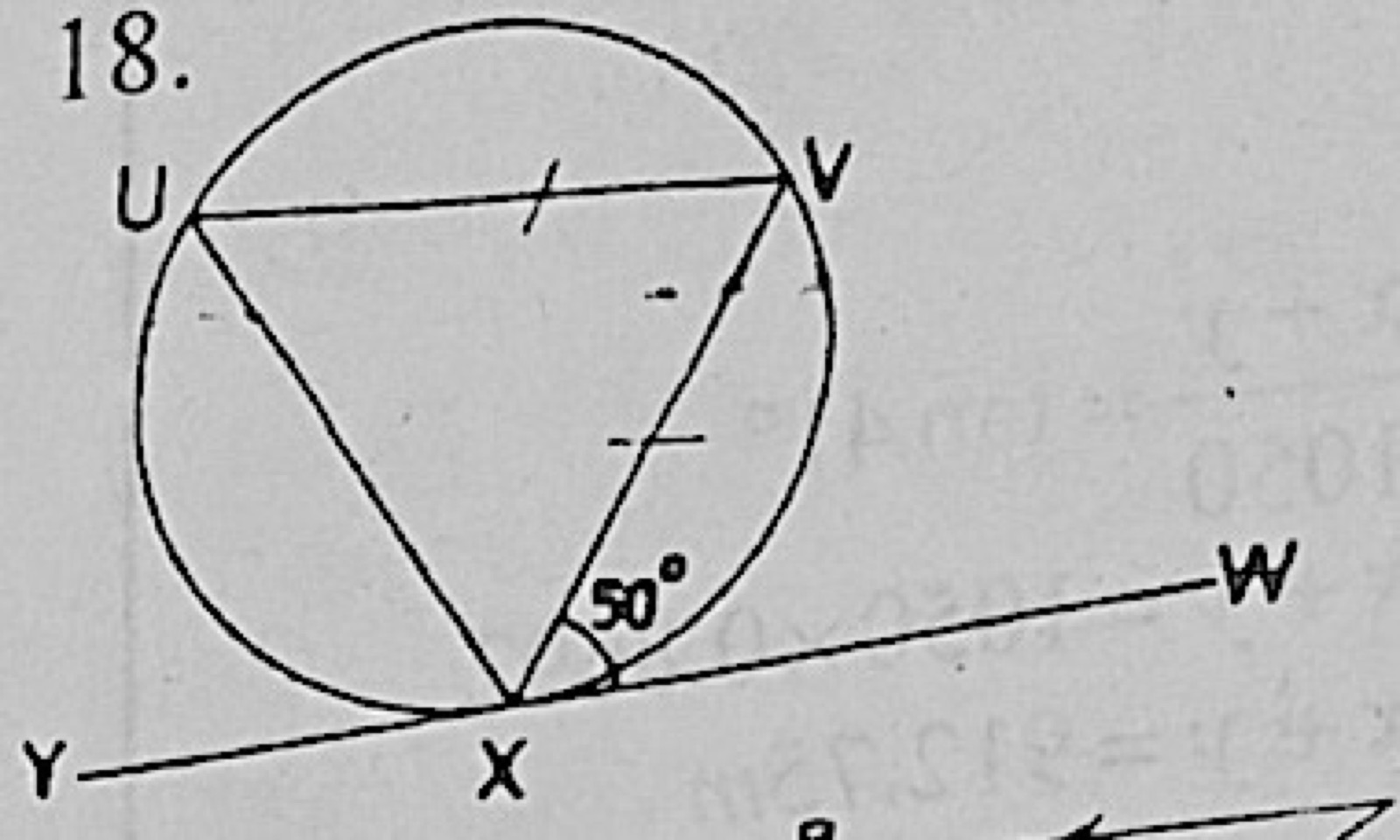
Answer: B (80°)
∠VUX = ∠VXW = 50° (alternate segment). Triangle UVX is isosceles, so ∠UXV = 50° and ∠UVX = 80°; by the alternate segment theorem ∠UXY = ∠UVX = 80°.
In the diagram, PF, QT, RG intersect at S and PQ/RG. If ∠SPQ = 113° and ∠RST = 22°, find ∠PSQ.
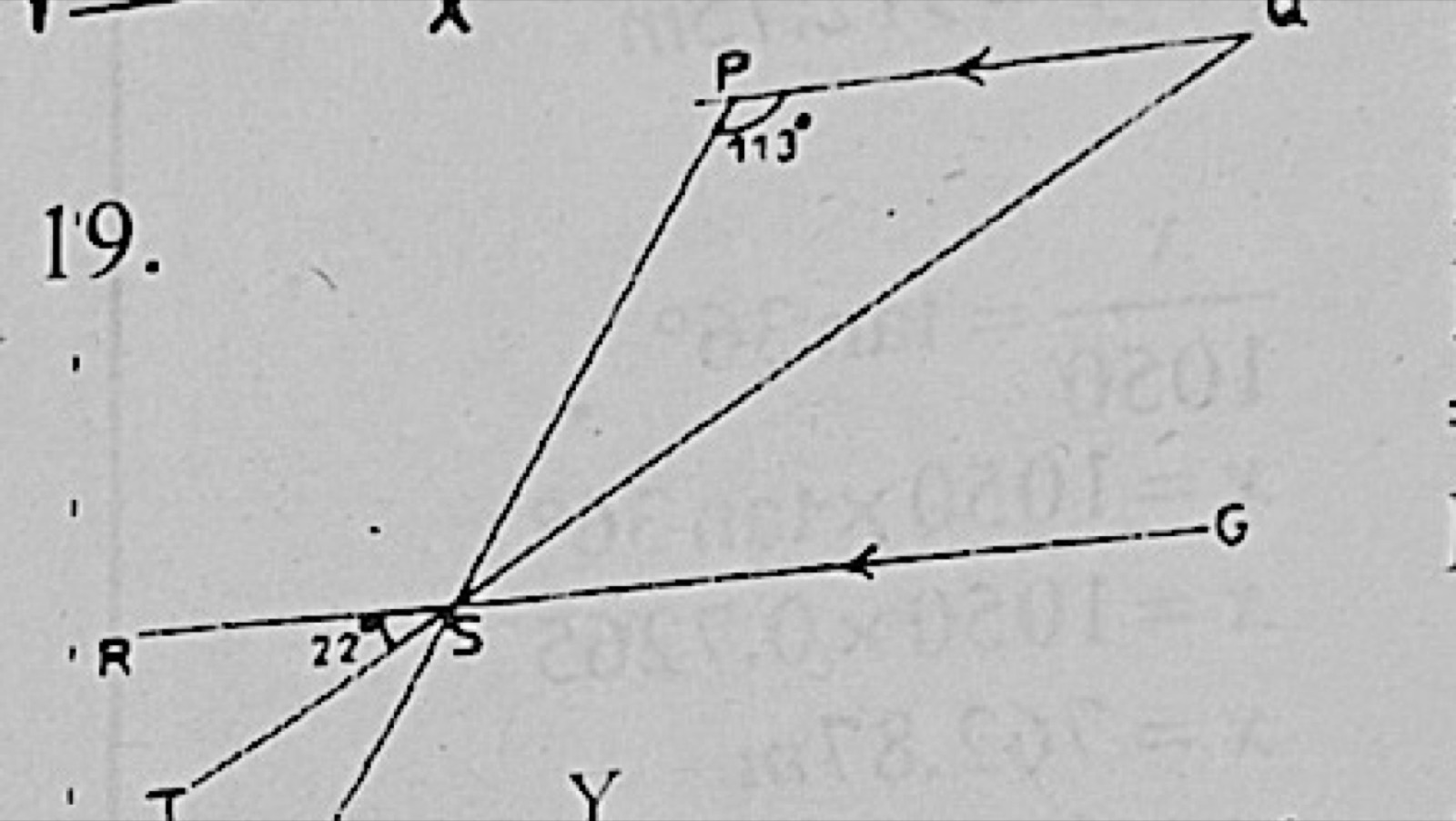
Answer: B (45°)
∠QSG = ∠RST = 22° (vertically opposite). PQ//RG makes ∠SPQ + ∠PSG = 180°, so ∠PSG = 67° and ∠PSQ = 67° − 22° = 45°.
In the diagram, O, is the centre of circle, ∠XOZ = (10m)° and ∠XWZ = m°. Calculate the value of m.
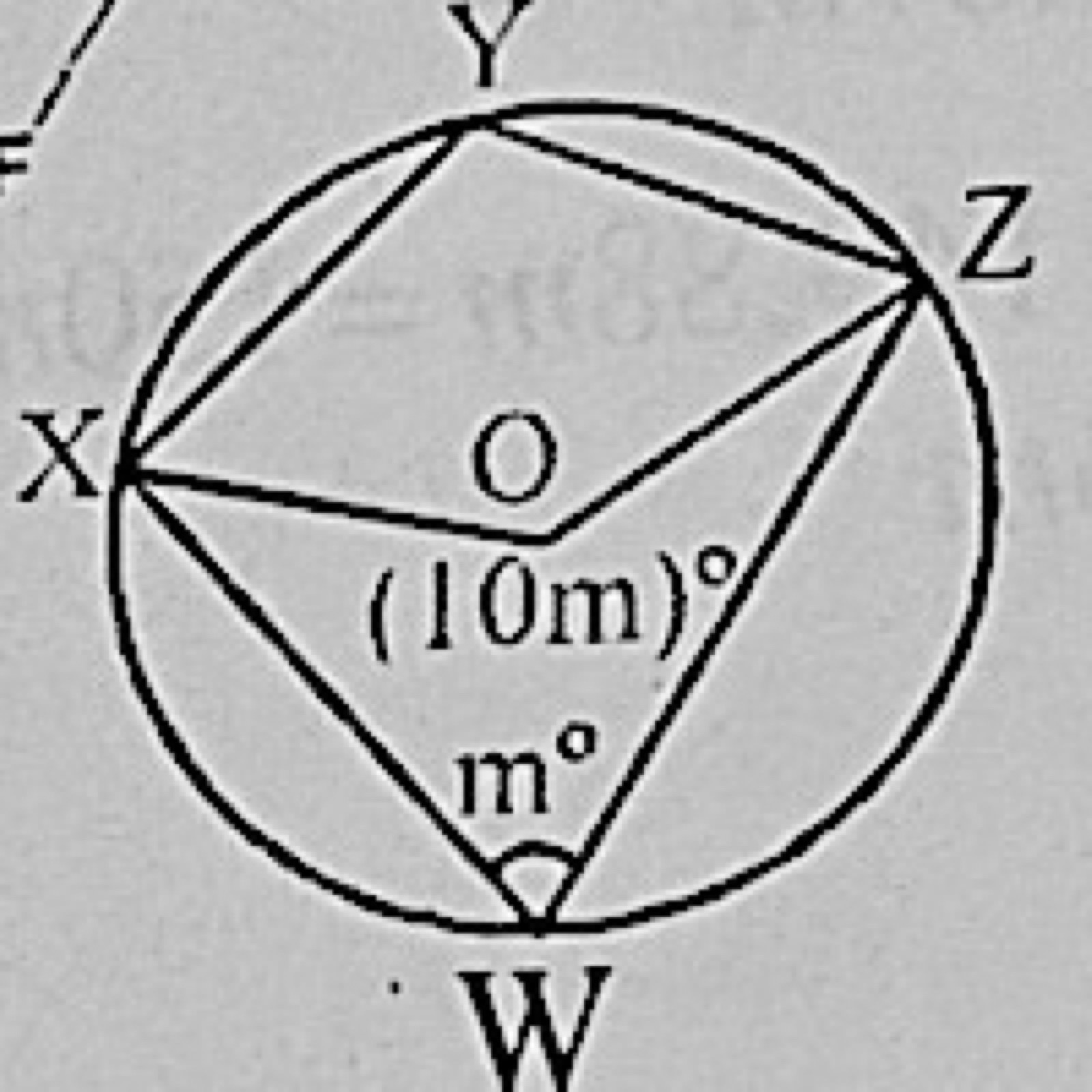
Answer: A (30)
∠XWZ = m stands on the arc XYZ, so the angle at the centre on that arc is 2m. The two angles at O add to 360°: 10m + 2m = 360, so m = 30.
Kweku walked 8 m up a slope and was 3 m above the ground. If he walks 12 m further up the slope, how far above the ground will he be?
Answer: C (7.5 m)
Height is proportional to distance along the slope: 3/8 × 20 = 7.5 m.
In the diagram, TS is a tangent to the circle at S, |PR| = |RS| and ∠PQR = 117°. Calculate ∠PST.
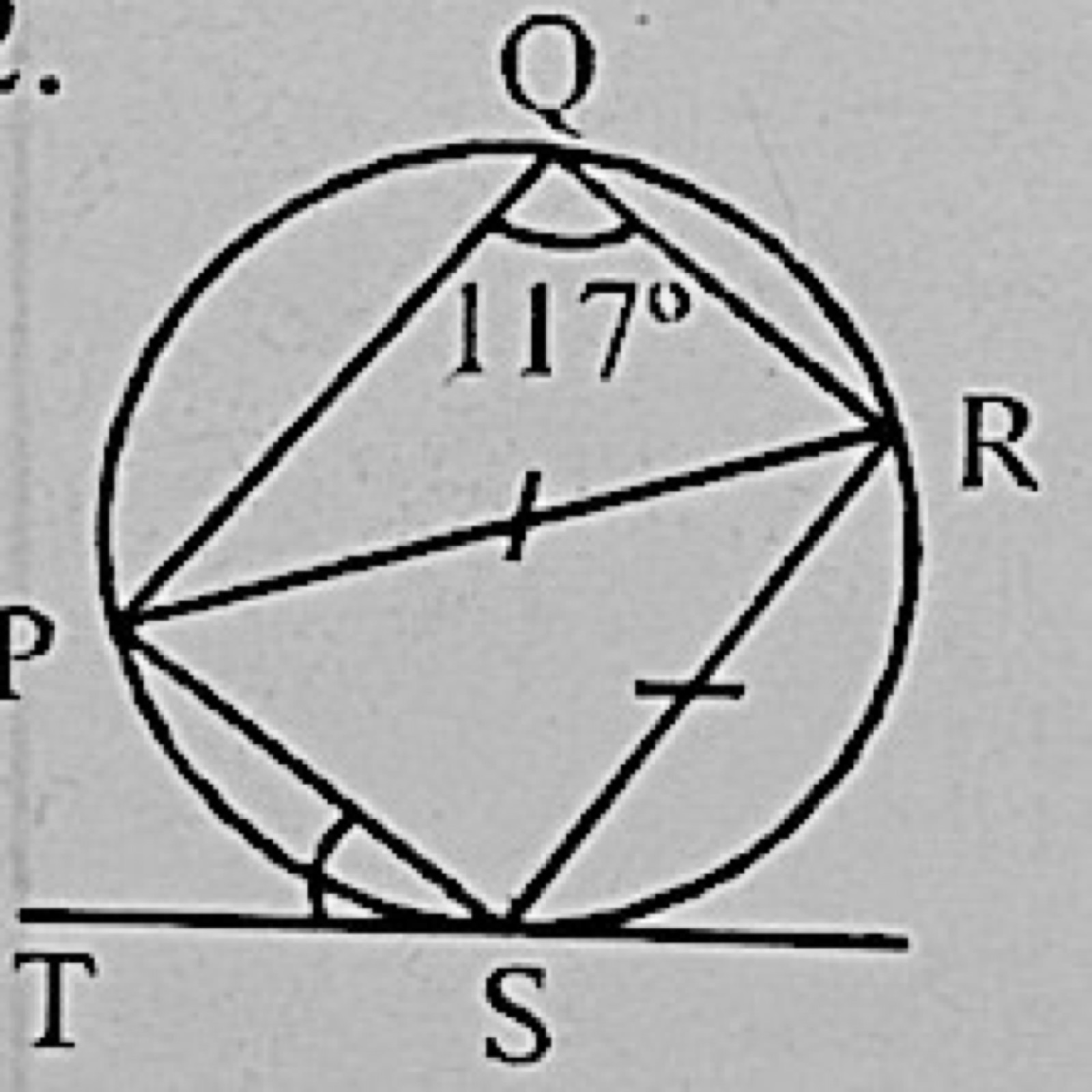
Answer: A (54°)
∠PSR = 180° − 117° = 63° (cyclic quadrilateral). Triangle PRS is isosceles so ∠RPS = 63° and ∠PRS = 54°; ∠PST = ∠PRS = 54° (alternate segment).
In the diagram, PR/SV/WY, TX/QY, ∠PQT = 48° and ∠TXW = 60°. Find ∠TQU.
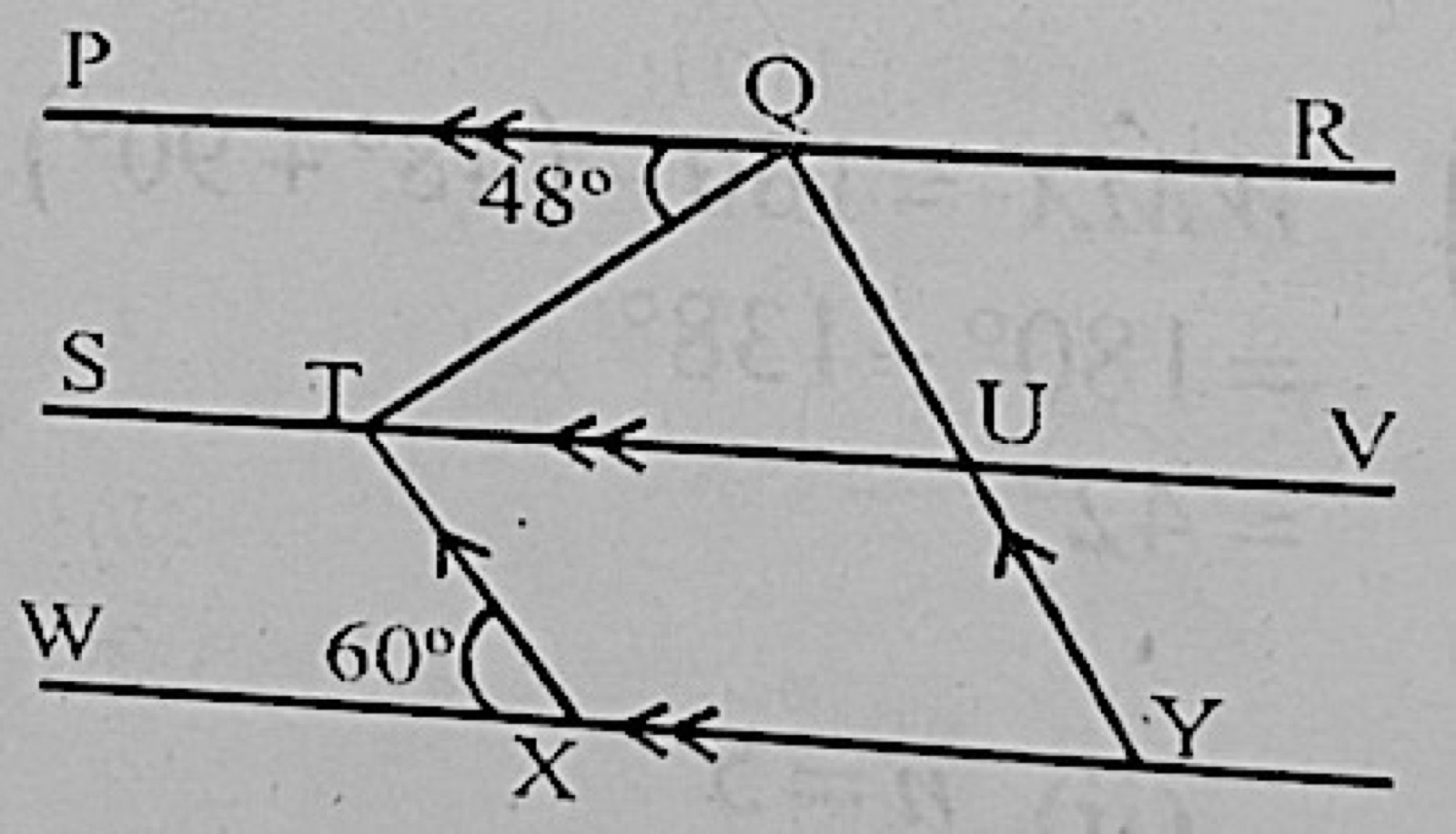
Answer: C (72°)
Since QY//TX and PR//WY, ∠PQU = 180° − 60° = 120°. Then ∠TQU = 120° − 48° = 72°.
A straight line passes through the points P(1,2) and Q(5,8). Calculate the gradient of the line PQ
Answer: C (3/2)
(8 − 2)/(5 − 1) = 6/4 = 3/2.
A straight line passes through the points P(1,2) and Q(5,8). Calculate the length PQ
Answer: D (2√13)
PQ = √(4² + 6²) = √52 = 2√13.
In the diagram, TX is prependicular to UW, |UX| = 1 cm and |TX| = |WX| = √3 cm. Find ∠UTW.
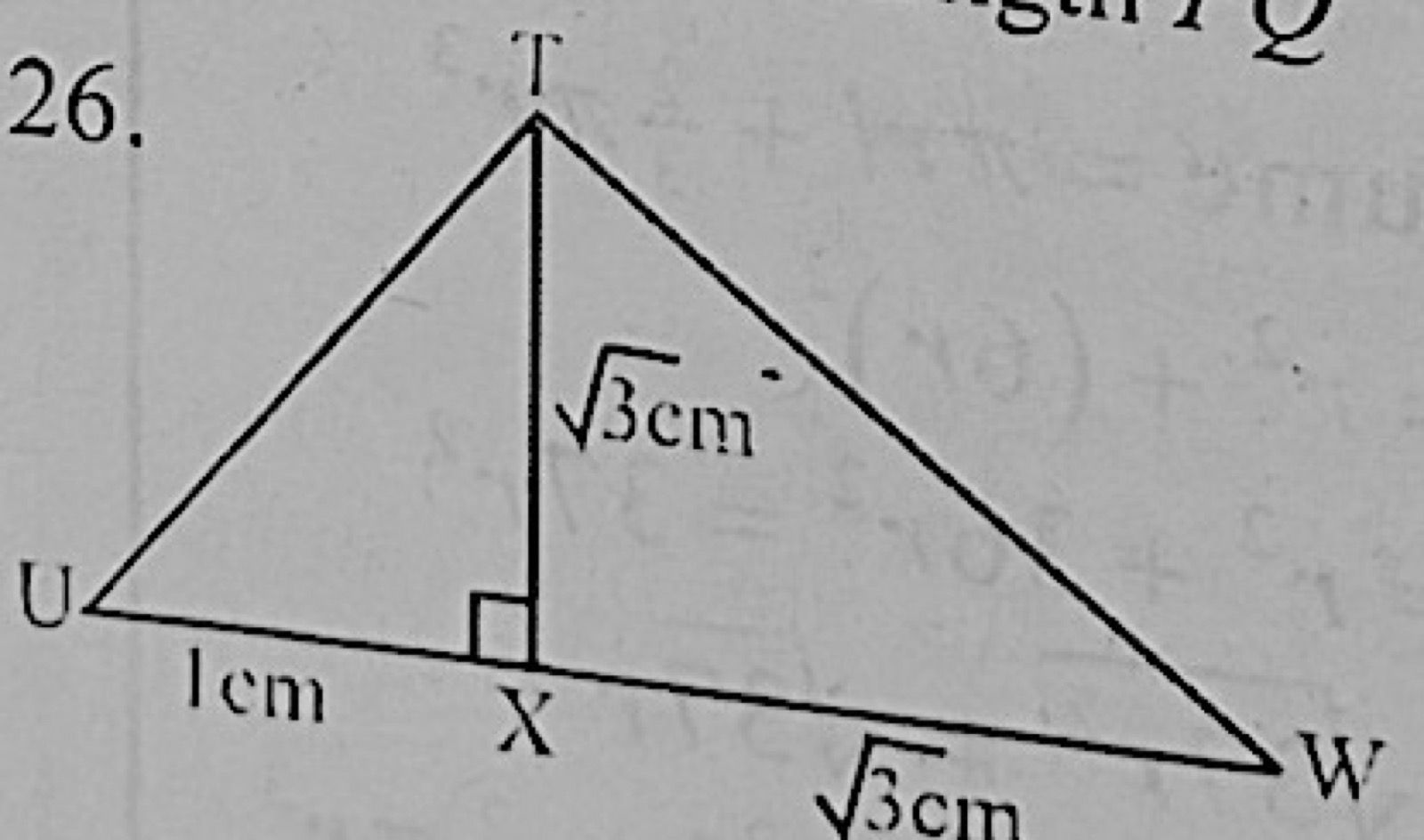
Answer: C (75°)
tan∠UTX = 1/√3 so ∠UTX = 30°; triangle TXW is right-angled and isosceles so ∠XTW = 45°. ∠UTW = 75°.
If cos θ = x and sin 60° = x + 0.5, 0° < θ < 90°, find, correct to the nearest degree, the value of θ.
Answer: D (69°)
x = 0.8660 − 0.5 = 0.3660, so θ = cos⁻¹ 0.3660 ≈ 68.5°, which is 69° to the nearest degree.
The table shows the ages of students in a club.
Age (Years): 13, 14, 15, 16, 17
Frequency: 10, 24, 8, 5, 3
How many student are in the club?
Answer: A (50)
10 + 24 + 8 + 5 + 3 = 50.
The table shows the ages of students in a club.
Age (Years): 13, 14, 15, 16, 17
Frequency: 10, 24, 8, 5, 3
Find the median age:
Answer: B (14)
With 50 students the median is the average of the 25th and 26th ages. The first 10 are 13 and the next 24 are 14, so both are 14.
The figure is a pie chart which represents the expenditure of a family in a year. If the total income of the family was Le 10,800,000.00, how much was spent on food?
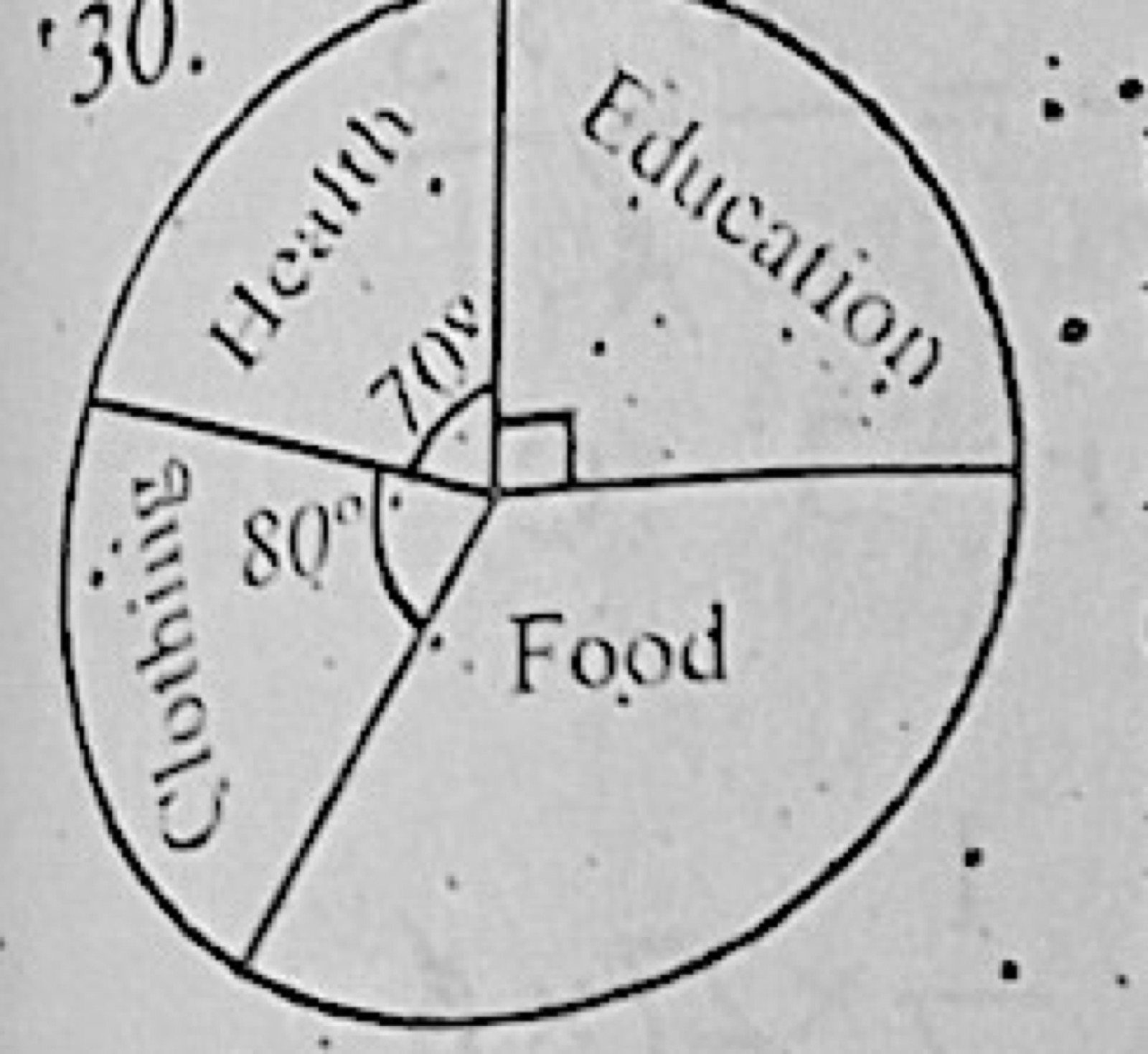
Answer: C (Le 3,600,000.00)
Food's angle = 360° − (70° + 80° + 90°) = 120°, so food = 120/360 × 10 800 000 = Le 3,600,000.
A fair die is thrown two times. What is the probability that the sum of the score is at least 10?
Answer: B (1/6)
Sums of 10, 11 or 12 come from (4,6), (5,5), (6,4), (5,6), (6,5), (6,6): 6 of 36 outcomes = 1/6.
The marks of eight students in a test are: 10, 4, 5, 3, 14, 16 and 7. Find the range.
Answer: C (13)
Range = highest − lowest = 16 − 3 = 13.
If log2(3x − 1) = 5, find x.
Answer: D (11.00)
3x − 1 = 2⁵ = 32, so 3x = 33 and x = 11.
A sphere of radius r cm has the same volume as a cylinder of radius 3 cm and height 4 cm. Find the value of r.
Answer: C (3)
⁴⁄₃πr³ = π × 3² × 4 = 36π, so r³ = 27 and r = 3.
Express 1975 correct to 2 significant figures.
Answer: D (2,000)
The third figure is 7, so 19 rounds up to 20 hundreds: 1975 ≈ 2,000.
In the diagram, MOPQ is a trapezium with QP//MO, MQ//NP, NQ//OP, |QP| = 9 cm and the height of ΔQNP = 6 cm, calculate the area of the trapezium.
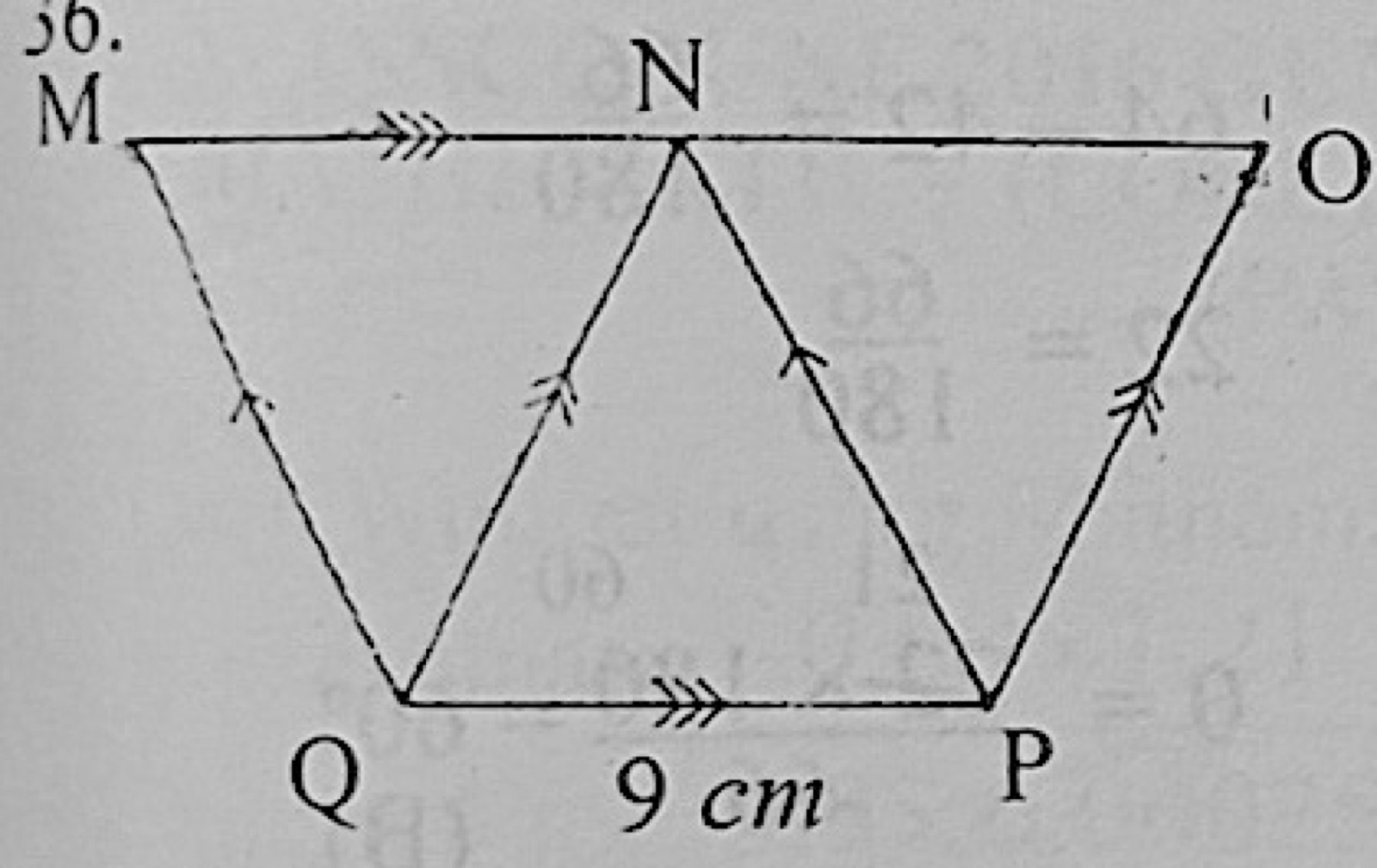
Answer: C (81 cm2)
MNPQ and NOPQ are parallelograms, so MN = NO = 9 cm and MO = 18 cm. Area = ½(18 + 9) × 6 = 81 cm².
The perimeter of a sector of a circle of radius 21 cm is 64 cm. Find the angle of the sector. [Take π = 22/7]
Answer: B (60°)
Arc = 64 − 42 = 22 cm. θ/360 × 2 × 22/7 × 21 = 22 gives θ/360 × 132 = 22, so θ = 60°.
Determine M′ ∩ N from the Venn diagram.
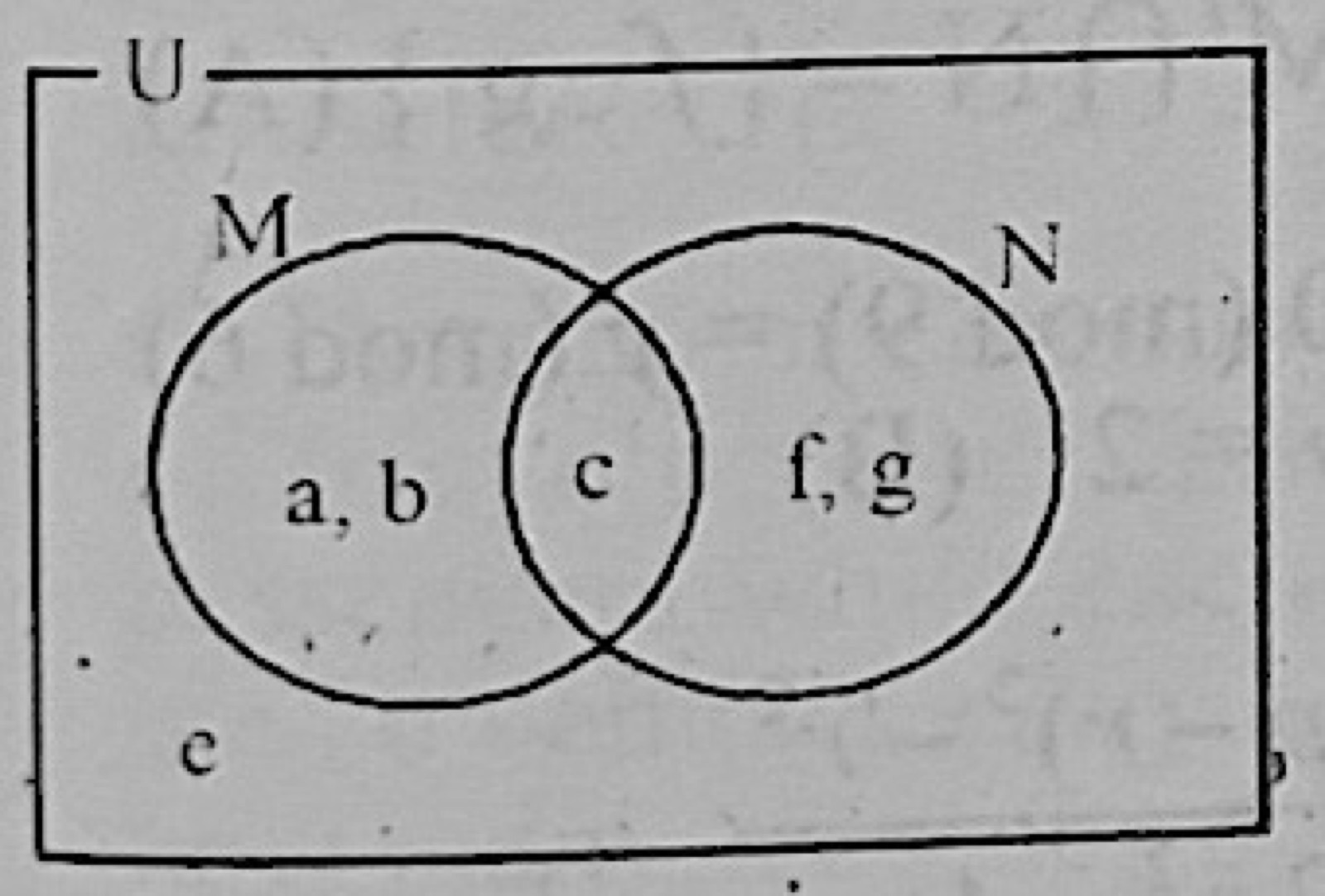
Answer: A ({f, g})
M′ = {f, g, e} (everything outside M); the part of it inside N is {f, g}.
If 20 (mod 9) is equivalent to y (mod 6), find y.
Answer: B (2)
20 = 2 × 9 + 2, so 20 ≡ 2 (mod 9); y = 2.
Simplify: ((p − r)2 − r2)/(2p2 − 4pr)
Answer: A (½)
Numerator = (p − r − r)(p − r + r) = p(p − 2r); denominator = 2p(p − 2r). The fraction is ½.
In the diagram, O is the centre of the circle, ∠QPS = 100°, ∠PSQ = 60° and ∠QSR = 80°. Calculate ∠SQR.
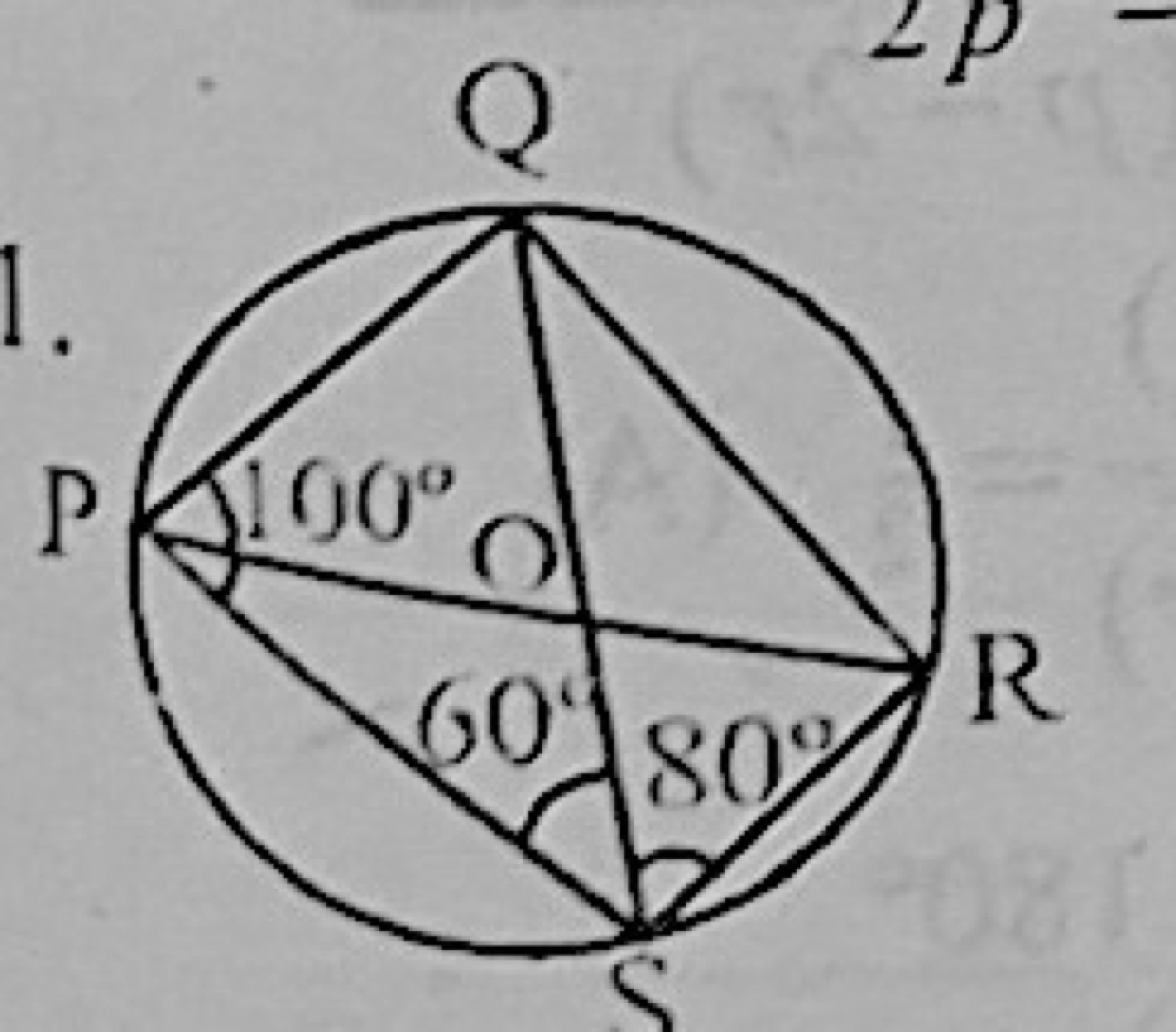
Answer: A (20°)
∠QRS = 180° − 100° = 80° (opposite angles of cyclic quadrilateral). In triangle QRS, ∠SQR = 180° − 80° − 80° = 20°.
A bag contains 5 red and 4 blue identical balls. If two balls are selected at random from the bag, one after the other, with replacement, find the probability that the first is red and the second blue.
Answer: C (20/81)
With replacement: 5/9 × 4/9 = 20/81.
Find the next three terms of the sequence: 0, 1, 1, 2, 3, 5, 8,…
Answer: D (13, 21, 34)
Each term is the sum of the two before it: 5 + 8 = 13, 8 + 13 = 21, 13 + 21 = 34.
Find the lower quartile of the distribution illustrated by the cumulative frequency curve.
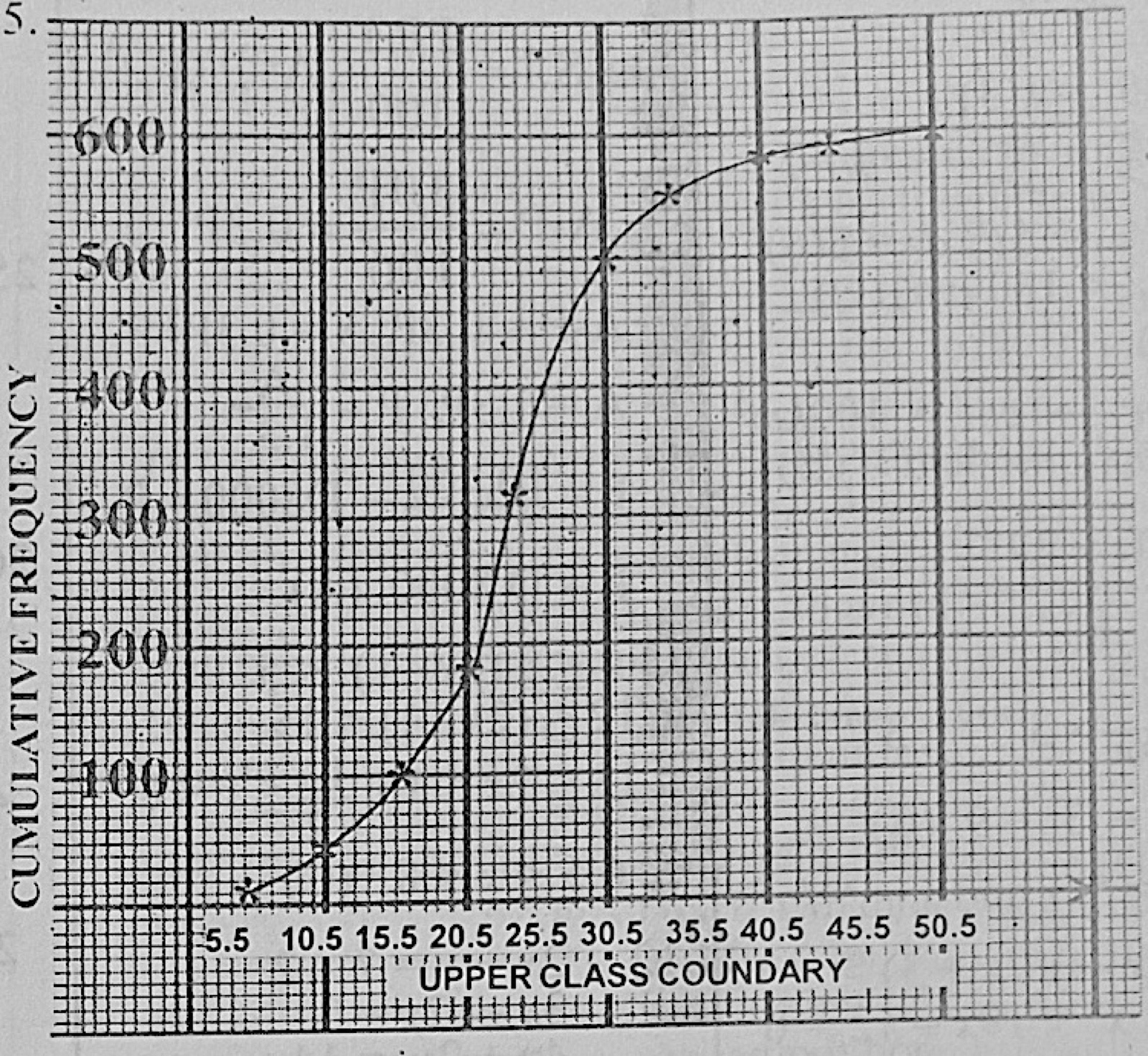
Answer: B (19.0)
Total frequency is 600, so the lower quartile is at cumulative frequency 150; reading across to the curve and down gives about 19.
The ratio of the exterior angle to the interior angle of a regular polygon is 1:11. How many sides has the polygon?
Answer: B (24)
Exterior = 1/12 × 180° = 15°, so the number of sides = 360 ÷ 15 = 24.
Halima is n years old. Her brother's age is 5 years more than half of her age. How old is her brother?
Answer: D (n/2 + 5)
Half her age is n/2; 5 more is n/2 + 5.
In the diagram, MN is a chord of a circle KMN centre O and radius 10 cm. If ∠MON = 140°, find correct to the nearest cm, the length of the chord MN.
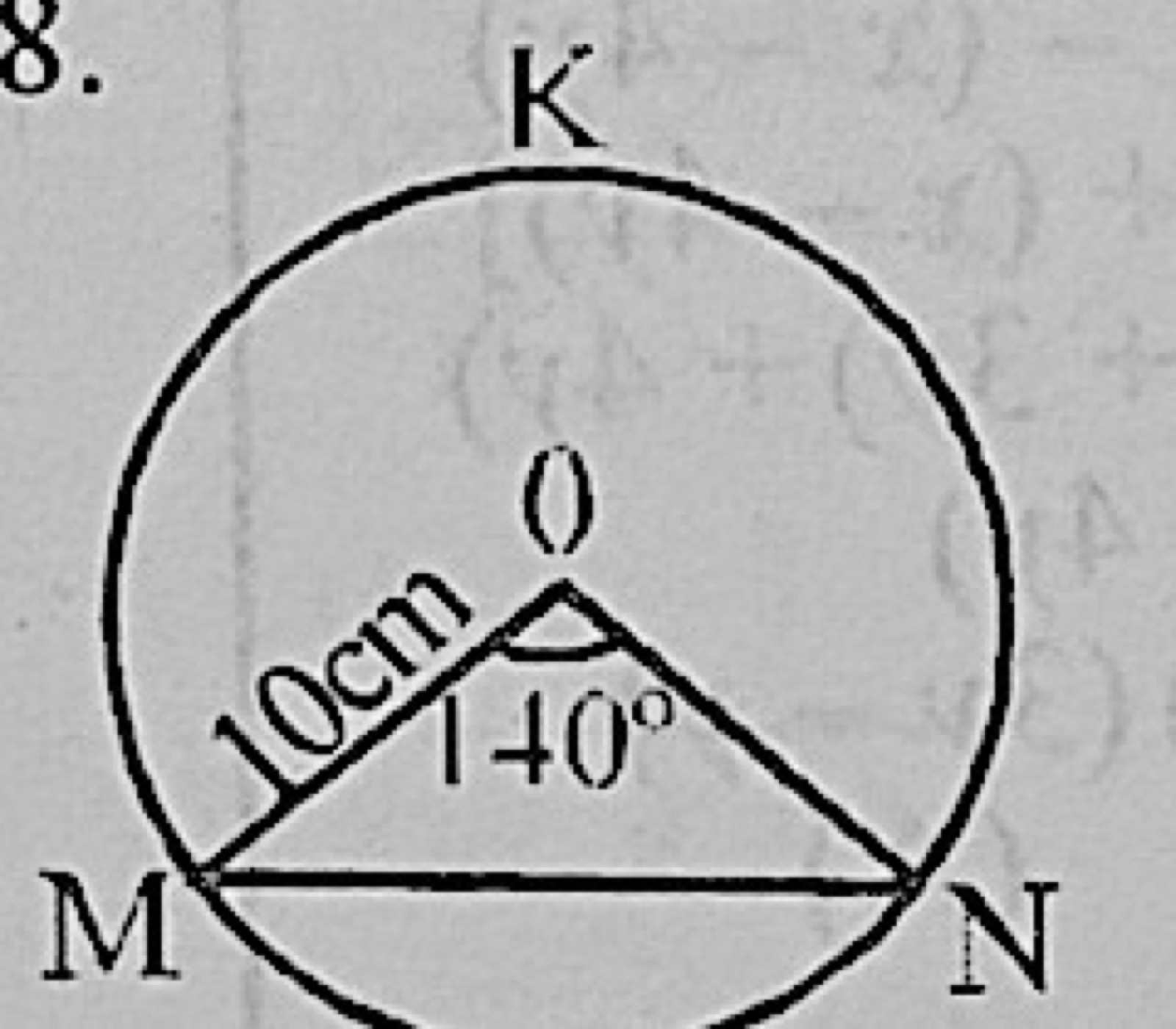
Answer: A (19 cm)
MN = 2 × 10 × sin 70° ≈ 18.8 ≈ 19 cm.
From the diagram, which of the following is true?
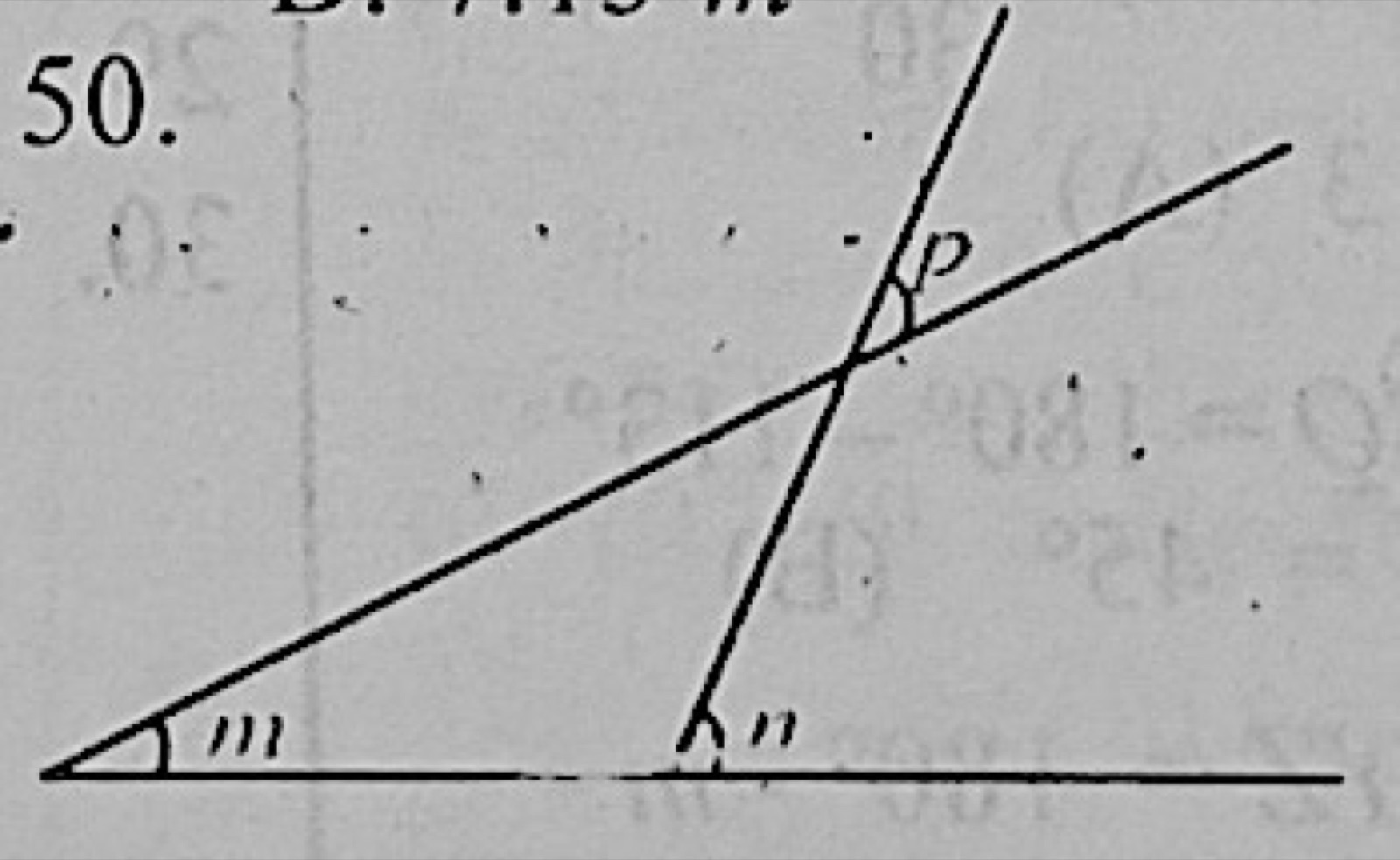
Answer: D (n = m + p)
n is an exterior angle of the triangle, and p equals the triangle's top angle (vertically opposite), so n = m + p.
(a) Without using Mathematical tables or calculators, evaluate: (0.09 × 1.21)/(3.3 × 0.00025), leaving the answer in standard form (Scientific Notation)
(b) A principal of GH¢5,600 was deposited for 3 years at compound interest. If the interest earned was GH¢1,200.00, find, correct to 3 significant figures, the interest rate per annum.
(a) = (9 × 10⁻² × 1.21)/(3.3 × 2.5 × 10⁻⁴) = (10.89/8.25) × 10² = 1.32 × 10²
(b) Amount = 5600 + 1200 = GH¢6,800
5600(1 + r/100)³ = 6800 → (1 + r/100)³ = 1.2143
1 + r/100 = 1.0669 → r ≈ 6.69% per annum
In (b) use the compound interest formula, not simple interest.
(a) Solve: 7(x + 4) − ⅔(x − 6) ≤ 2[x − 3(x + 5)].
(b) A transport company has a total 20 vehicles made up of tricycles and taxicabs. Each tricycle carries 2 passengers while each taxicab carries 4 passengers. If the 20 vehicles carry a total of 66 passengers at a time, how many tricycles does the company have?
(a) 7x + 28 − ⅔x + 4 ≤ 2(−2x − 15) = −4x − 30
7x − ⅔x + 4x ≤ −62 → (31/3)x ≤ −62 → x ≤ −6
(b) Let t = tricycles, c = taxicabs: t + c = 20 and 2t + 4c = 66
2t + 4(20 − t) = 66 → 80 − 2t = 66 → t = 7
The company has 7 tricycles (and 13 taxicabs).
Remove the inner bracket first in (a).
(a) In the diagram, ∠RTS = 28°, ∠VRM = 46°, MQ is a tangent to the circle VRSTU at the point R. Find ∠VUS.
(b) A cylindrical tin, 7 cm high, is closed at one end. If its total surface area is 462 cm2, calculate its radius. [Take π = 22/7]
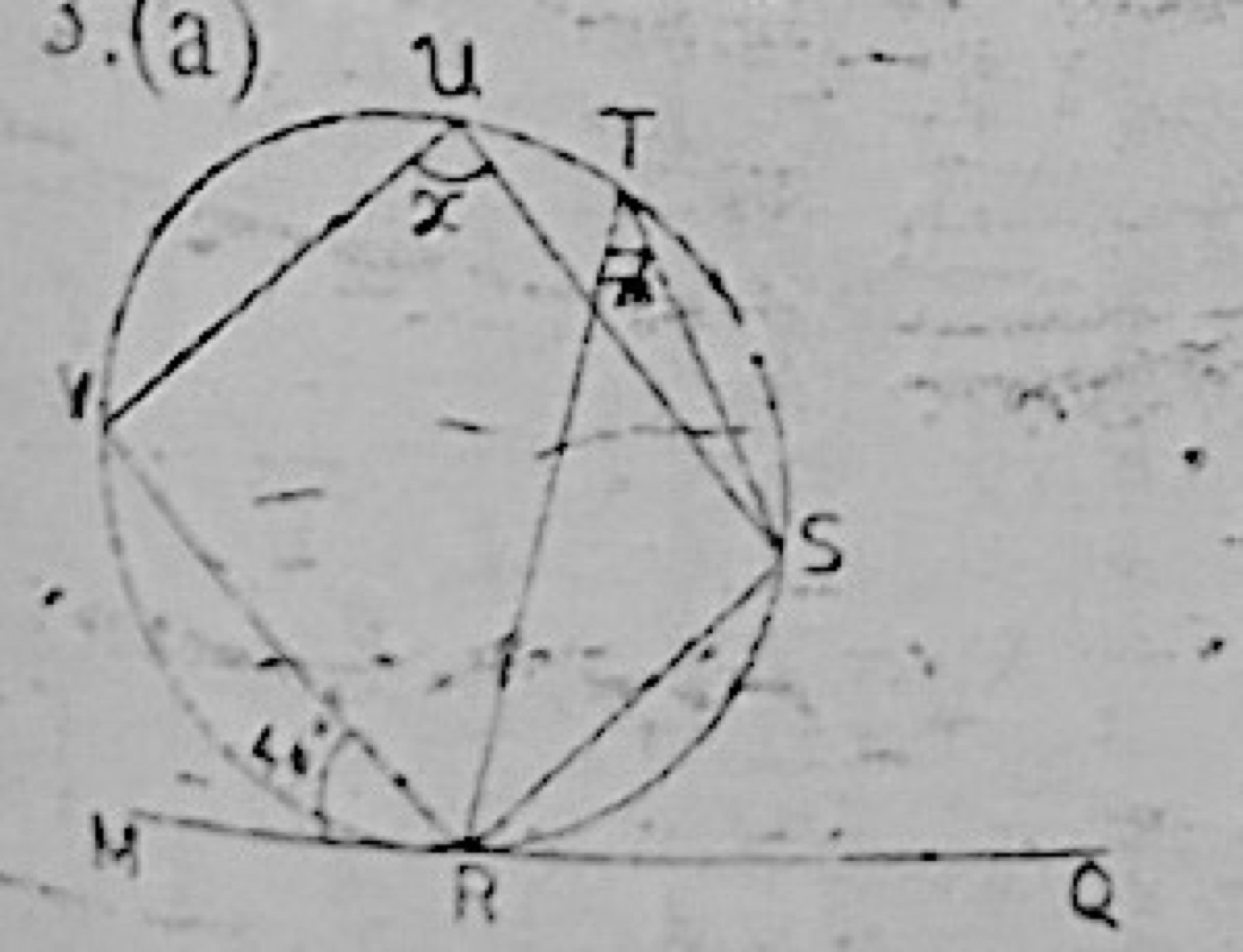
(a) ∠VUR = ∠VRM = 46° (angle in the alternate segment)
∠RUS = ∠RTS = 28° (angles in the same segment)
∠VUS = 46° + 28° = 74°
(b) Total surface area = 2πrh + πr² = 462
22/7 × r(14 + r) = 462 → r² + 14r − 147 = 0 → (r − 7)(r + 21) = 0
r = 7 cm (r cannot be negative)
Only one circular end is included because the tin is open at the other end.
The table shows the outcome when a die is thrown a number of times.
Scores: 1, 2, 3, 4, 5, 6
Frequency: 25, 30, x, 28, 40, 32
If the probability of obtaining a 3 is 0.225: (a) how many times was the die thrown? (b) calculate the probability that a trial chosen at random gives a score of an even number or a prime number.
(a) Total = 155 + x; x/(155 + x) = 0.225 → x = 0.225 × 155/0.775 = 45
The die was thrown 155 + 45 = 200 times.
(b) Even or prime scores are 2, 3, 4, 5, 6 (every score except 1)
Frequency = 200 − 25 = 175 → probability = 175/200 = 7/8
Count each score once, even though 2 is both even and prime.
(a) In the diagram, PQST is a parallelogram, PQR is a straight line, |TS| = 8 cm, |SM| = 6 cm and area of triangle PSR = 36 cm2. Find the value of |QR|
(b) A tree and a flagpole are on the same horizontal ground. A bird on top of the tree observes the top and bottom of the flagpole below it at angles of 45° and 60° respectively. If the tree is 10.65 m high, calculate, correct to 3 significant figures, the height of the flagpole.
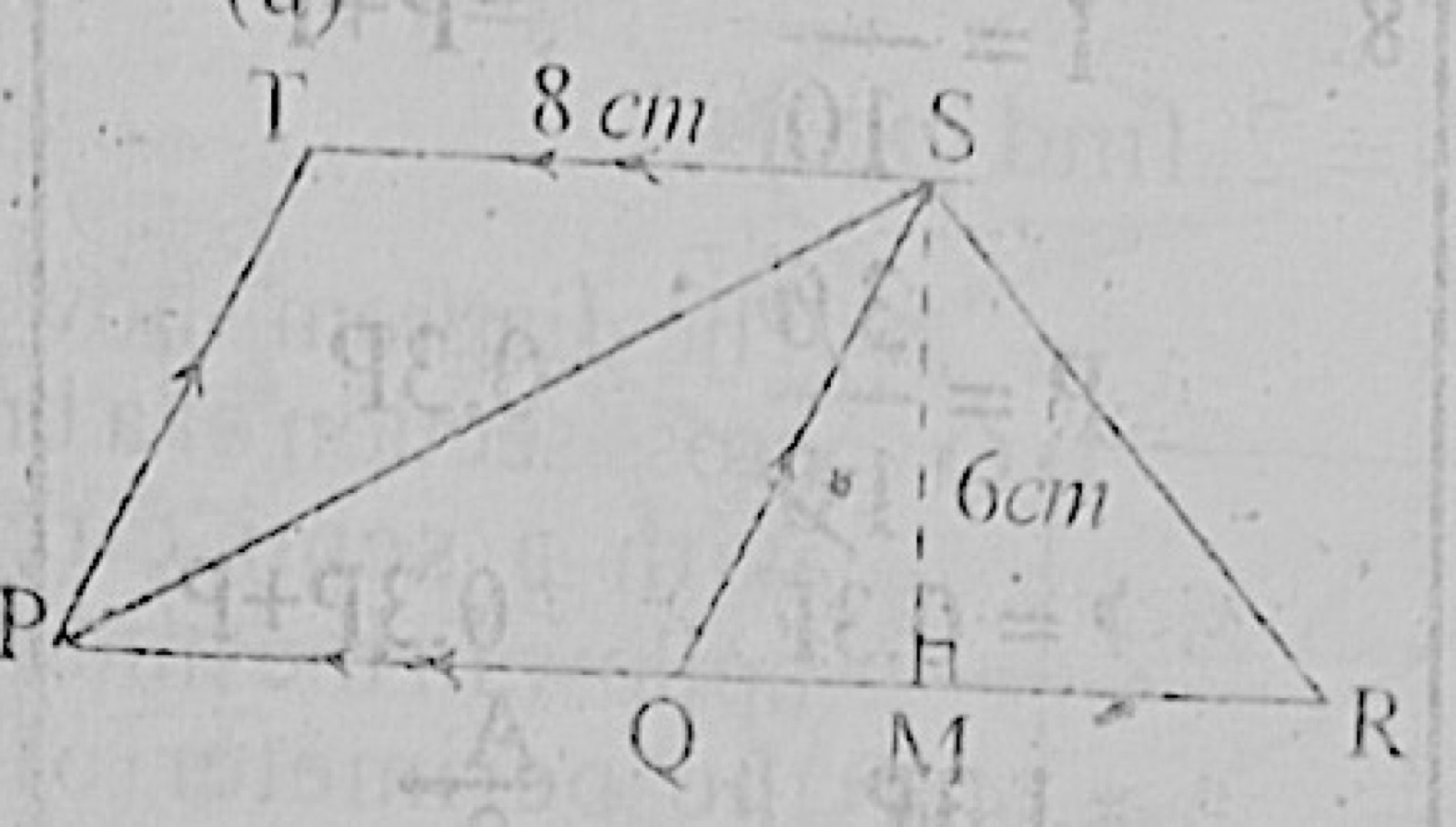
(a) Area of triangle PSR = ½ × |PR| × 6 = 36 → |PR| = 12 cm
|PQ| = |TS| = 8 cm (opposite sides of parallelogram), so |QR| = 12 − 8 = 4 cm
(b) Horizontal distance d = 10.65/tan 60° ≈ 6.149 m
Drop from the bird to the top of the pole = d tan 45° ≈ 6.149 m
Height of flagpole = 10.65 − 6.149 ≈ 4.50 m
Use the 60° angle (to the bottom) to find the horizontal distance first.
(a) Find the sum of the Arithmetic Progression (AP) 1, 3, 5, … 101.
(b) Out of the 95 travellers interviewed, 7 travelled by bus and train only, 3 by train and car only and 8 travelled by all three means of transport. The number, x, of travellers who travelled by bus only was equal to the number who travelled by bus and car only. If 47 people travelled by bus and 30 by train: (i) represent this information in a Venn diagram; (ii) calculate the I. value of x; II. number who travelled by at least two means.
(a) a = 1, d = 2: 101 = 1 + 2(n − 1) → n = 51
S = n/2 (a + l) = 51/2 × 102 = 2601
(b)(i) Three overlapping circles B, T, C in a universal set of 95: B only = x, B∩C only = x, B∩T only = 7, T∩C only = 3, all three = 8.
(ii) I. Bus: x + x + 7 + 8 = 47 → x = 16
II. At least two means = 7 + 3 + 8 + 16 = 34
Fill the Venn diagram from the centre (all three) outwards.
(a) Using completing the squares method, solve, correct to 2 decimal places, (x − 2)/4 = (x + 2)/2x.
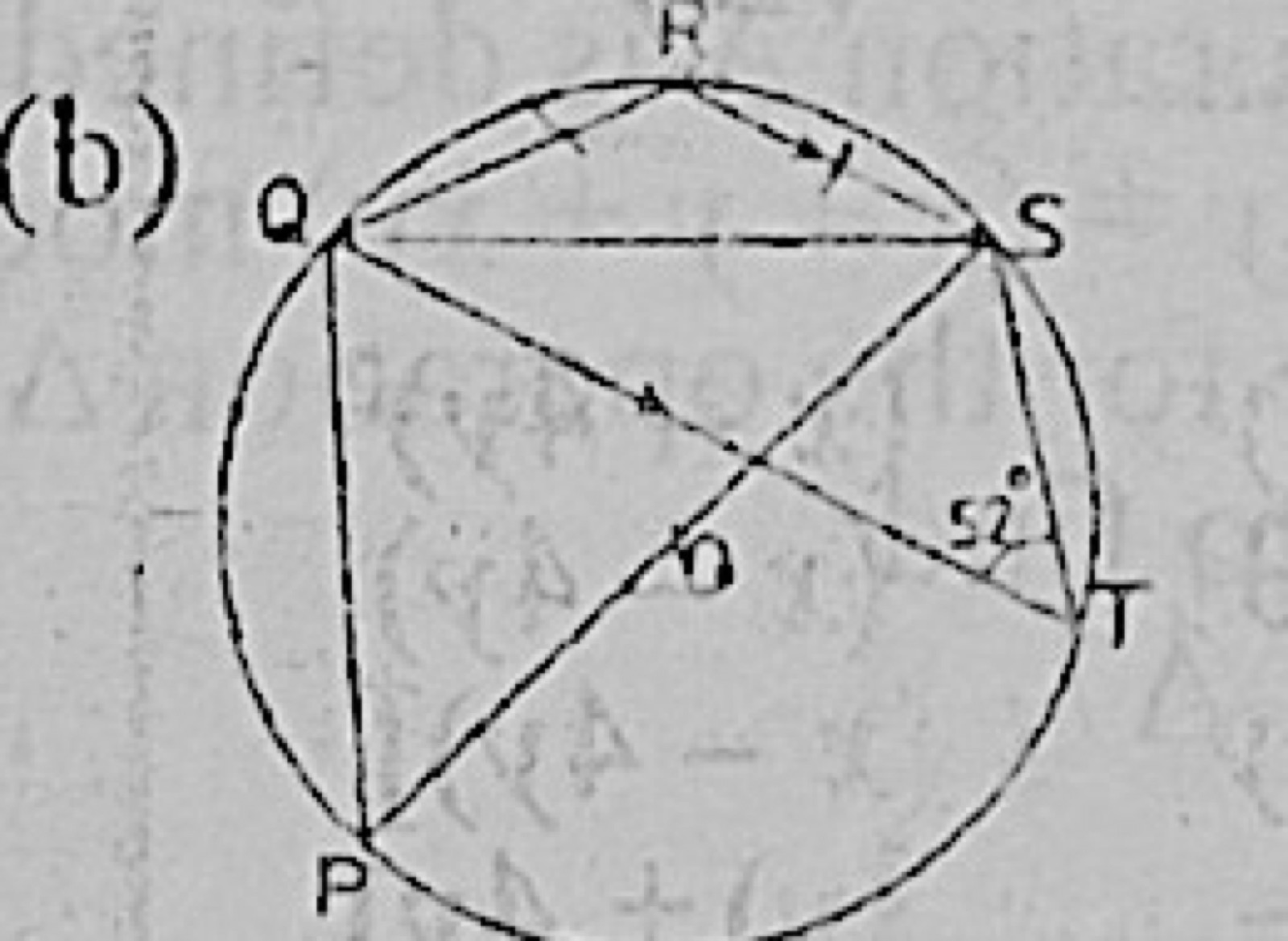
(b) In the diagram, PQRST is a circle with centre O. If PS is a diameter, RS//QT, |QR| = |RS| and ∠QTS = 52°, find: (i) ∠SQT; (ii) ∠PQT.
(a) 2x(x − 2) = 4(x + 2) → 2x² − 8x − 8 = 0 → x² − 4x = 4
x² − 4x + 4 = 8 → (x − 2)² = 8 → x − 2 = ±2.828
x ≈ 4.83 or x ≈ −0.83
(b)(i) ∠QRS = 180° − 52° = 128° (opposite angles of cyclic quadrilateral QRST)
Triangle QRS is isosceles: ∠RSQ = (180° − 128°)/2 = 26°
∠SQT = ∠RSQ = 26° (alternate angles, RS//QT)
(ii) ∠PQS = 90° (angle in a semicircle), so ∠PQT = 90° − 26° = 64°
Add the square of half the coefficient of x to both sides.
(a) In the diagram, ∠KLM = x, ∠LMK = y, ∠KJH = r and ∠KGF = 110°. If 2x = r = y, find the value of x.
(b) Ten boys and twelve girls collected donations for a project. The total amount colected by the boys was N600.00 greater than that collected by the girls. If the average collection of the boys was N100.00 greater than the average collection of the girls, how much was collected by the two groups?
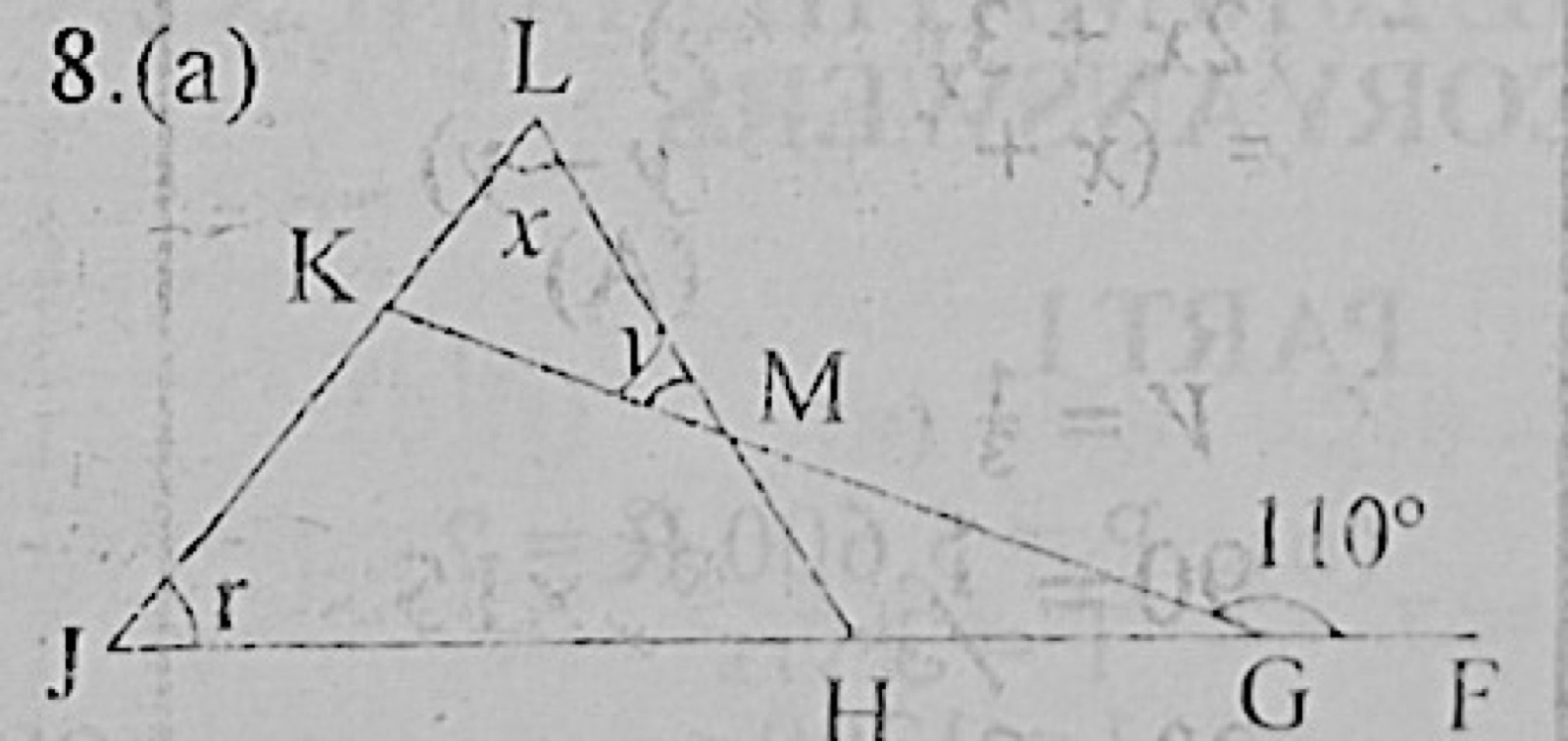
(a) ∠KGJ = 180° − 110° = 70°
∠JKM = x + y (exterior angle of triangle KLM)
In triangle JKG: r + (x + y) + 70° = 180°
With r = y = 2x: 2x + x + 2x = 110° → x = 22°
(b) Let the girls collect N g; boys collect N(g + 600)
(g + 600)/10 = g/12 + 100 → 6(g + 600) = 5g + 6000 → g = 2400
Girls N2,400, boys N3,000; together N5,400
Use the exterior angle of a triangle twice in (a).
The weight (in kg) of 50 contestants at a competition is as follows:
65 66 67 66 64 66 65 63 65 68
64 62 66 64 67 65 64 66 65 67
65 67 66 64 65 64 66 65 64 65
66 65 64 65 63 63 67 65 63 64
66 64 68 65 63 65 64 67 66 64
(a) Construct a frequency table for the discrete data.
(b) Calculate, correct to 2 decimal places, the: (i) mean; (ii) standard deviation of the data.
(a) Weight: 62, 63, 64, 65, 66, 67, 68
Frequency: 1, 5, 12, 14, 10, 6, 2 (total 50)
(b)(i) Σfx = 3253, mean = 3253/50 = 65.06 kg
(ii) Σf(x − x̄)² = 92.82
SD = √(92.82/50) = √1.8564 ≈ 1.36 kg
Multiply each squared deviation by its frequency before adding.
Using ruler and a pair of compasses only. (a) construct: (i) ΔXYZ such that |XY| = 10 cm, ∠XYZ = 30° and ∠YXZ = 45°; (ii) locus, l1, of points equidistant from Y and Z; (iii) locus, l2, of points parallel to XY through Z. (b) Locate point M, the point of intersection of l1 and l2. (c) Measure ∠ZMY.
(a)(i) Draw XY = 10 cm; construct 30° at Y and 45° at X; the arms meet at Z.
(ii) l₁ is the perpendicular bisector of YZ.
(iii) l₂ is the line through Z parallel to XY (e.g. copy the angle at Y onto Z).
(b) M is where l₁ meets l₂.
(c) ∠ZMY ≈ 120° (MZ = MY and ∠MZY = 30°, so ∠ZMY = 180° − 60°); accept 120° ± 1°.
Leave all construction arcs showing.
(a) If (3p + 4q)/(3p − 4q) = 2, find p : q
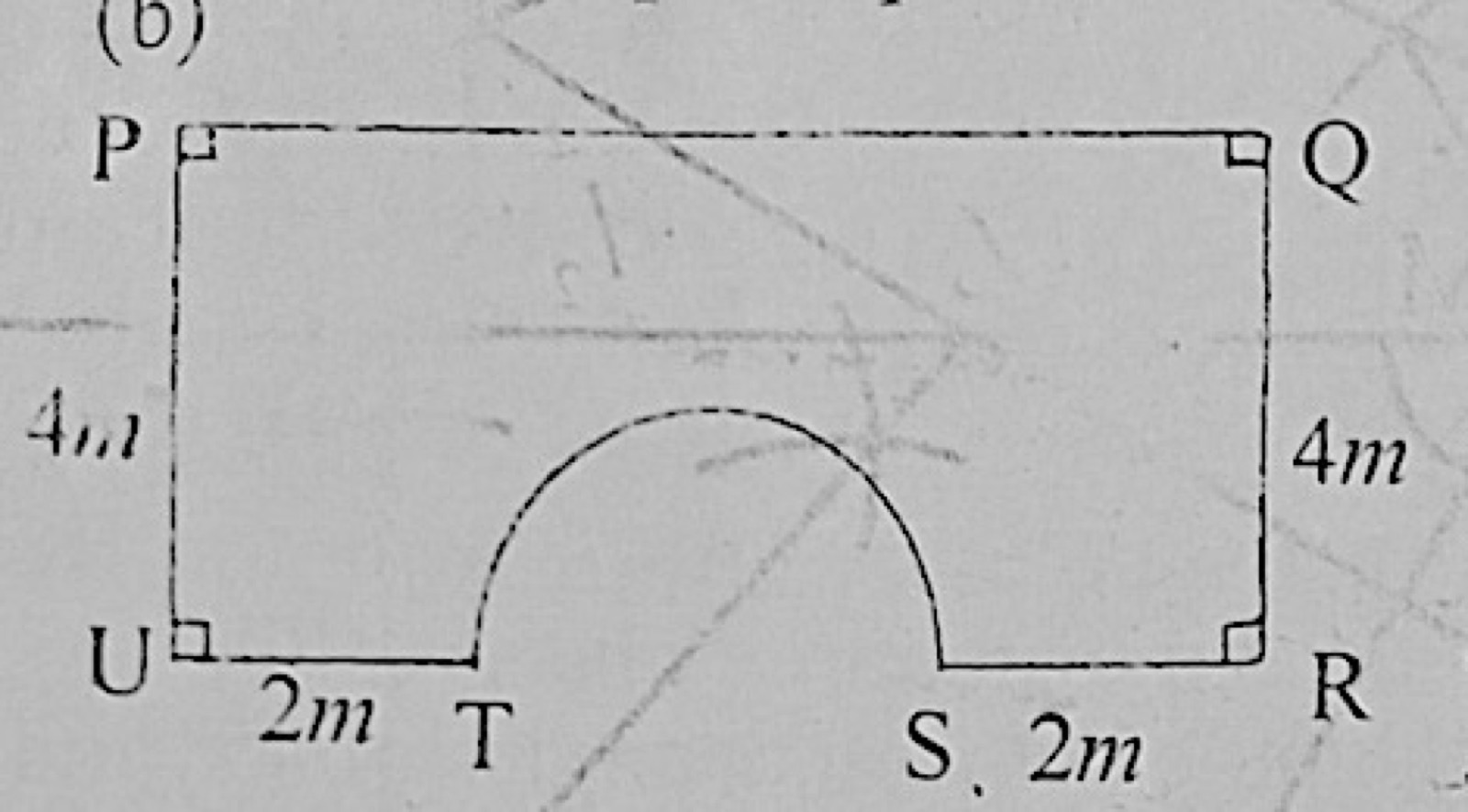
(b) The diagram shows the cross section of a bridge with a semi circular hollow in the middle. If the perimeter of the cross section is 34 m, calculate the: (i) length PQ; (ii) area of the cross section [Take π = 22/7]
(a) 3p + 4q = 6p − 8q → 3p = 12q → p : q = 4 : 1
(b)(i) Let |PQ| = L; diameter of semicircle TS = L − 4, radius (L − 4)/2
Perimeter = L + 4 + 2 + 2 + 4 + π(L − 4)/2 = 34
L + 11(L − 4)/7 = 22 → 18L = 198 → |PQ| = 11 m
(ii) Radius = 3.5 m; area = 11 × 4 − ½ × 22/7 × 3.5² = 44 − 19.25 = 24.75 m²
The perimeter includes the semicircular arc, not the straight gap TS.
x: 0°, 30°, 60°, 90°, 120°, 150°, 180°, 210°, 240°, 270°, 300°, 330°, 360°
y: 2.0, __, __, 3.0, 1.6, __, −2.0, __, −3.6, −3.0, __, __, 2.0
(a) Copy and complete the table of values, correct to one decimal place, for the relation y = 3sin x + 2cos x for 0° ≤ x ≤ 360°.
(b) Using scales of 2 cm to 30° on the x-axis and 2 cm to 1 unit on the y-axis, draw the graph of the relation y = 3sin x + 2cos x for 0° ≤ x ≤ 360°.
(c) Use the graph to solve: (i) 3sin x + 2cos x = 0; (ii) 2 + 2cos x + 3sin x = 0.
(a) x = 30°: 3.2; 60°: 3.6; 150°: −0.2; 210°: −3.2; 300°: −1.6; 330°: 0.2
(b) Plot the points and join them with a smooth wave (maximum about 3.6 near 56°, minimum about −3.6 near 236°).
(c)(i) Where the curve cuts y = 0: x ≈ 146° and x ≈ 326°
(ii) 3sin x + 2cos x = −2: where the curve meets y = −2: x ≈ 180° and x ≈ 293°
For (c)(ii) rearrange to 3sin x + 2cos x = −2 and draw the line y = −2.
(a) Find the equation of a straight line which passes through the point (2, −3) and is parallel to the line 2x + y = 6.
(b) The operation Δ is defined on the set T = {2, 3, 5, 7} by x Δ y = (x + y + xy) mod 8. (i) Construct modulo 8 table for the operation Δ on the set T. (ii) Use the table to find: I. 2 Δ (5 Δ 7); II. 2 Δ n = 5 Δ 7.
(a) Gradient of 2x + y = 6 is −2; y + 3 = −2(x − 2) → y = −2x + 1 (or 2x + y = 1)
(b)(i) Rows x = 2, 3, 5, 7; columns y = 2, 3, 5, 7:
2: 0, 3, 1, 7
3: 3, 7, 7, 7
5: 1, 7, 3, 7
7: 7, 7, 7, 7
(ii) I. 5 Δ 7 = 7, so 2 Δ 7 = 7
II. 5 Δ 7 = 7; from row 2, 2 Δ n = 7 when n = 7
Parallel lines have equal gradients.