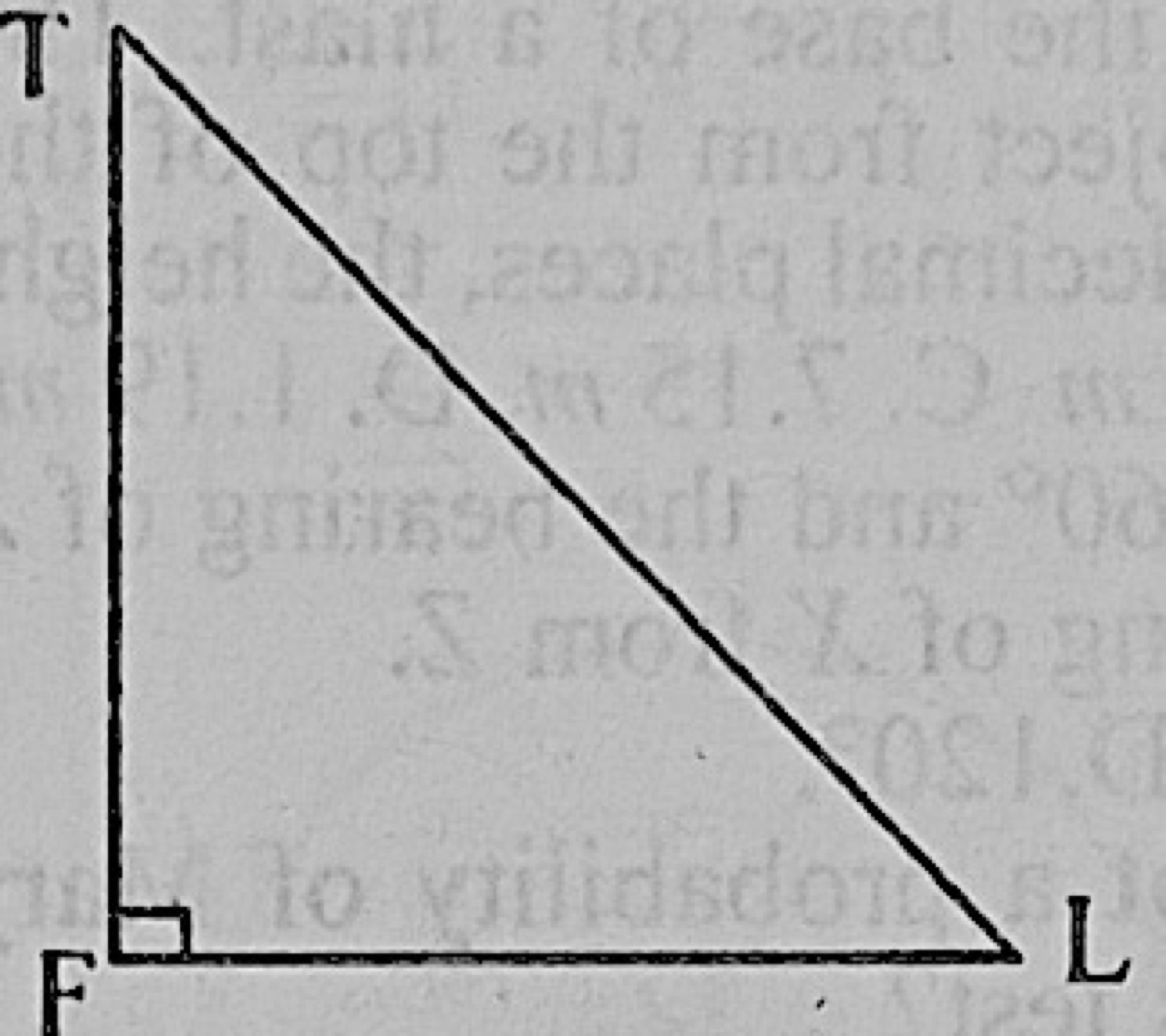
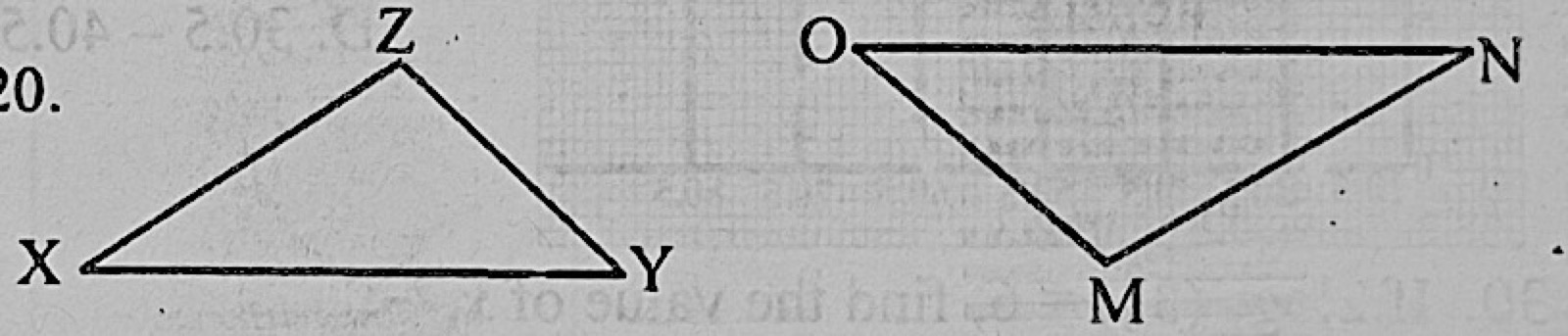
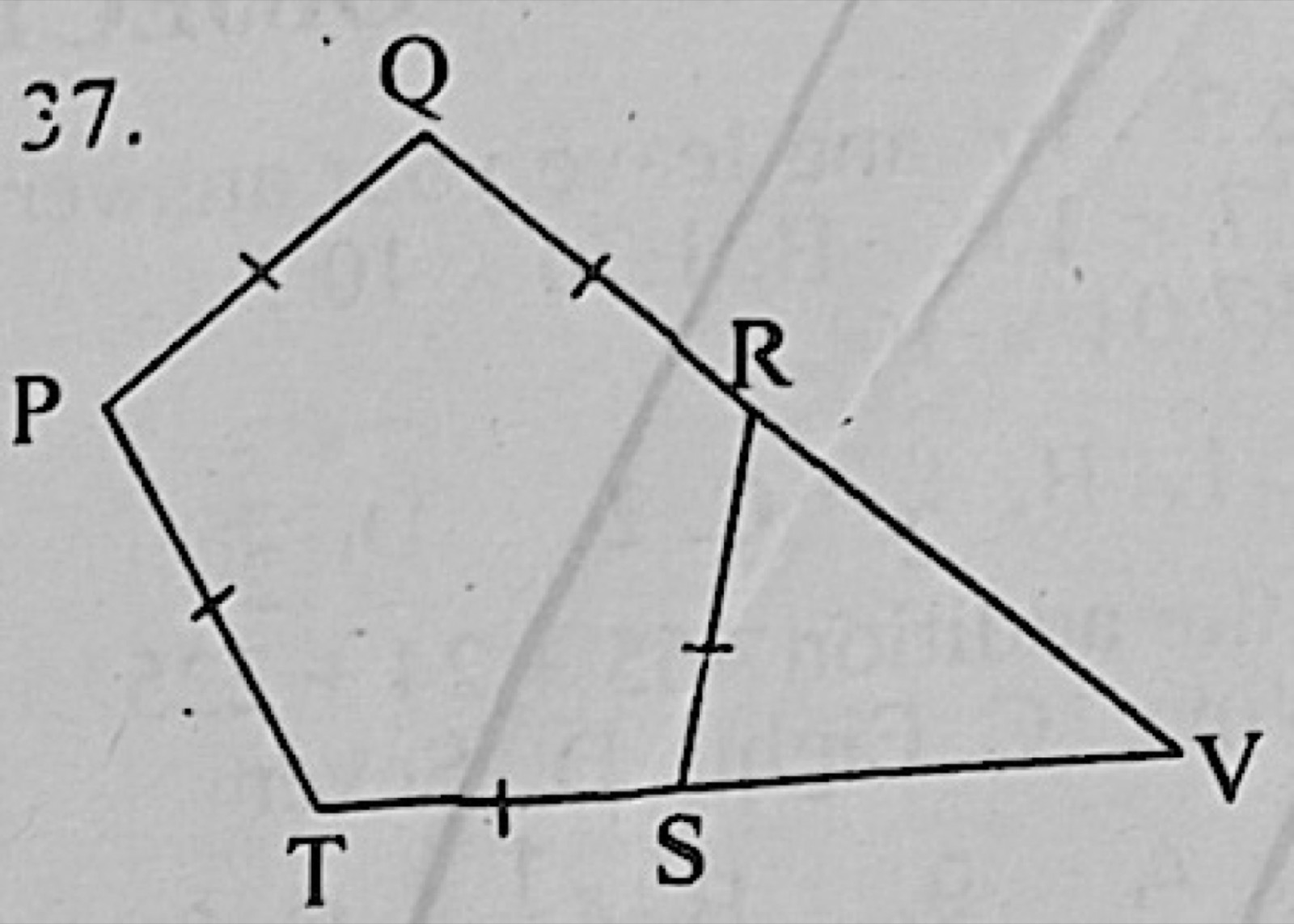
In the diagram, the height of a flagpole (TF) and the length of its shadow (FL) are in the ratio 6:8. Using K as a constant of proportionality, find the shortest distance between T and L.
A.7K units
B.10K units
C.12K units
D.14K units
Show the answer and explanation
Answer: B (10K units)
Explanation
TF = 6K and FL = 8K with a right angle at F. TL = √(36K2 + 64K2) = 10K.
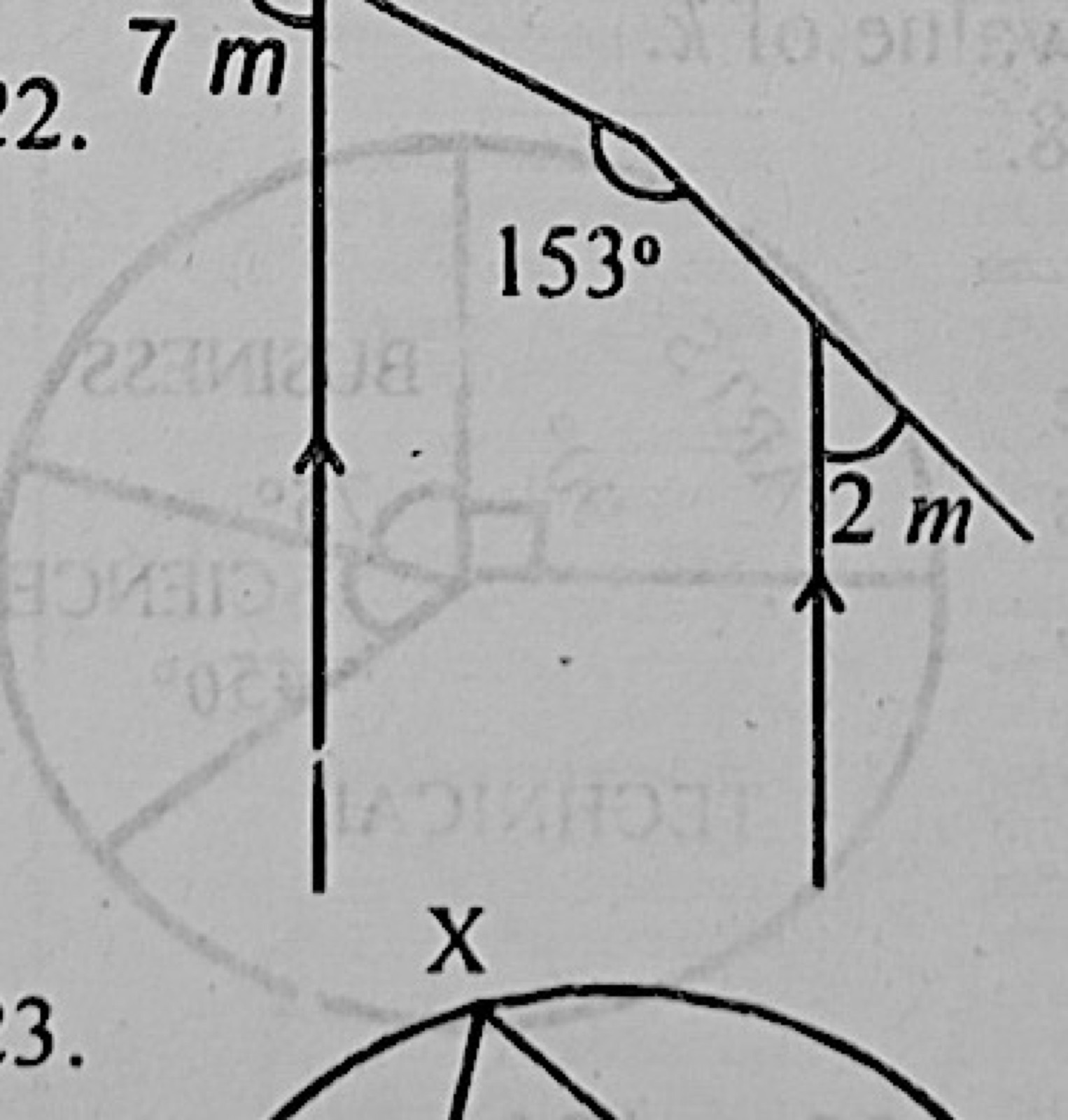
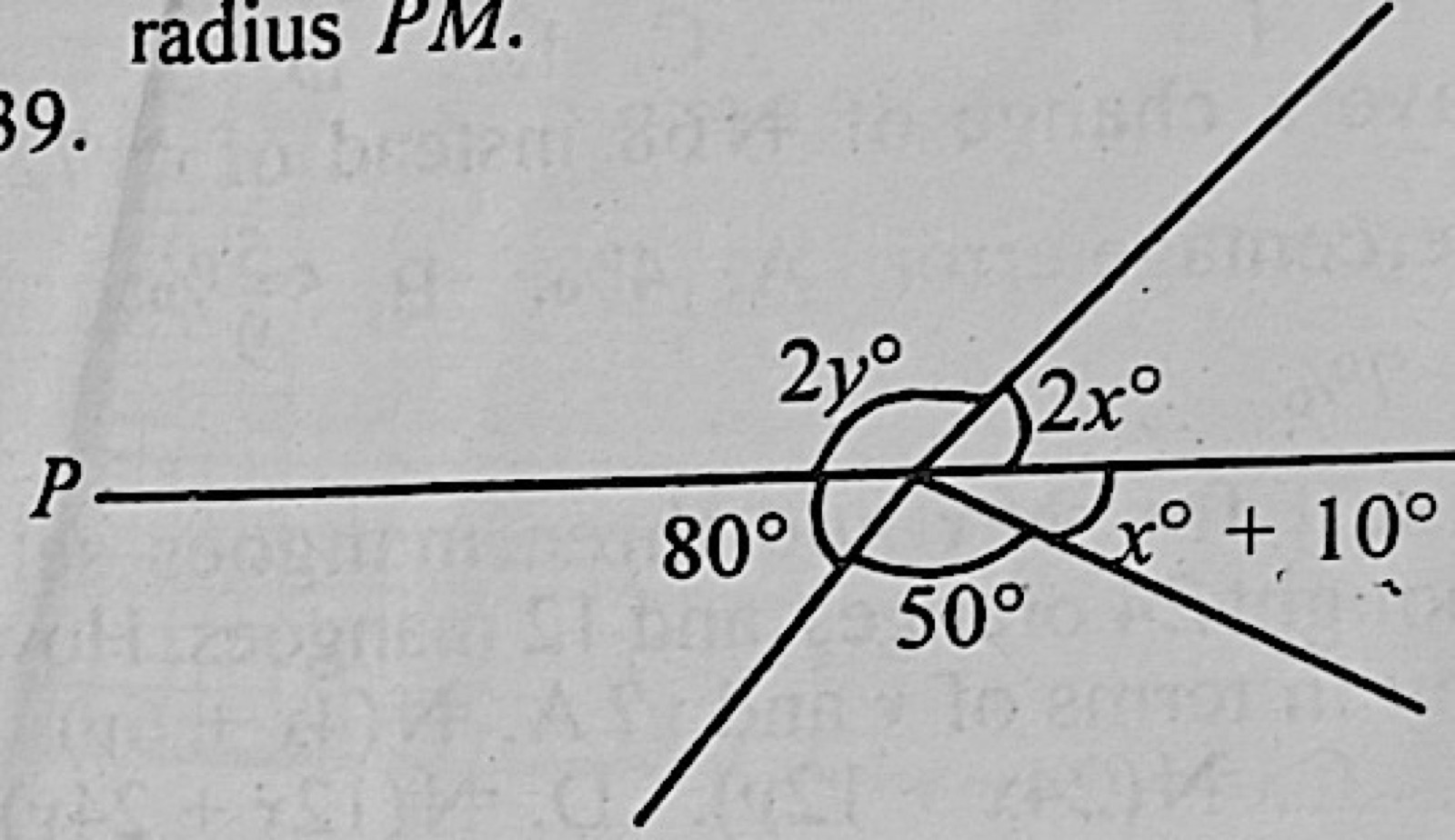
The two vertical lines are parallel. The bend of 153° turns the line by 180° − 153° = 27°, and the angles with the parallel lines give 7m + 2m + 27° = 180°. So 9m = 153° and m = 17°.
An object is 6 m away from the base of a mast. The angle of depression of the object from the top of the mast is 50°. Find, correct to 2 decimal places, the height of the mast.
A.8.60 m
B.7.51 m
C.7.15 m
D.1.19 m
Show the answer and explanation
Answer: C (7.15 m)
Explanation
The angle of elevation of the top from the object is 50°: height = 6 tan 50° = 6 × 1.1918 ≈ 7.15 m.
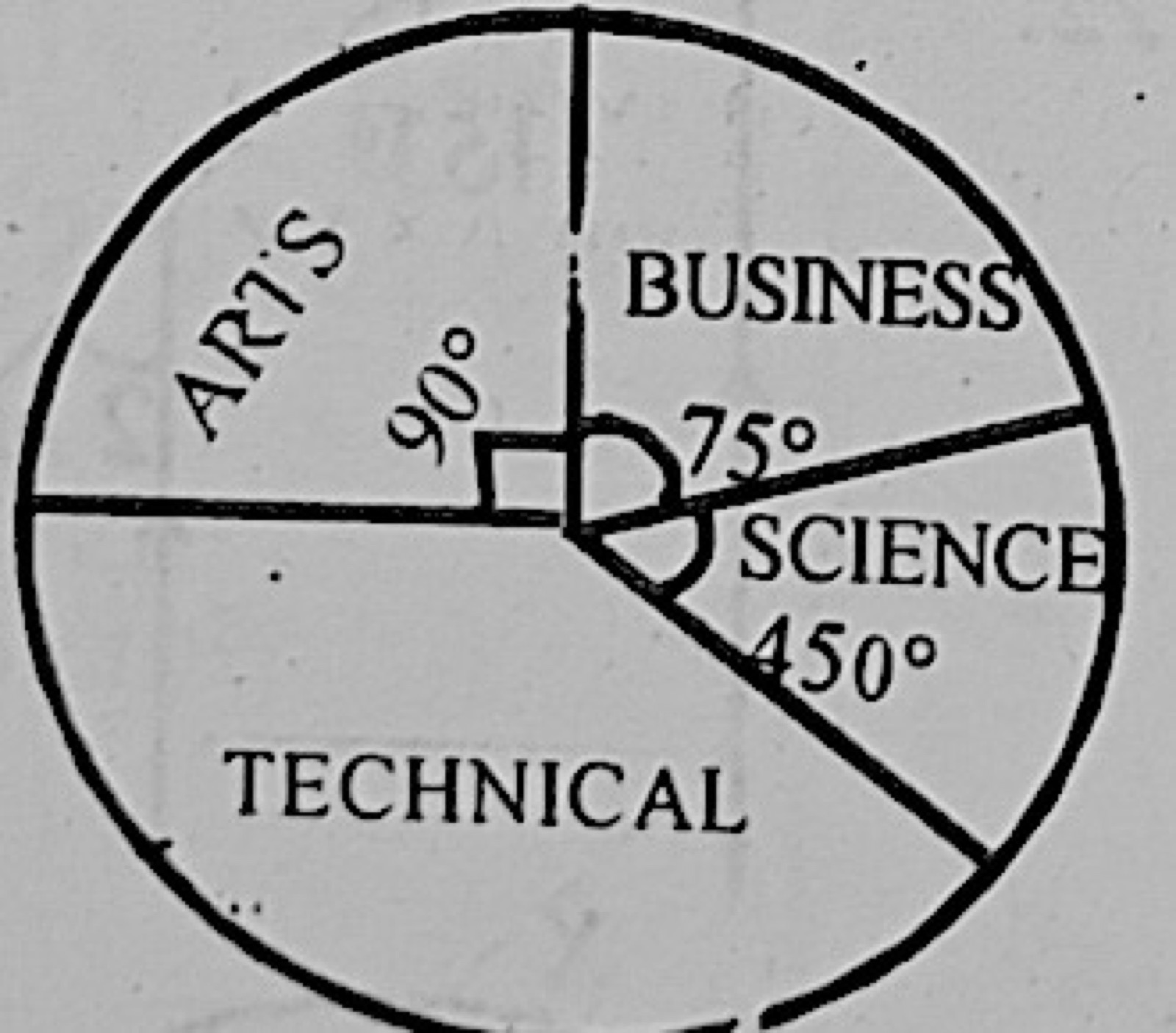
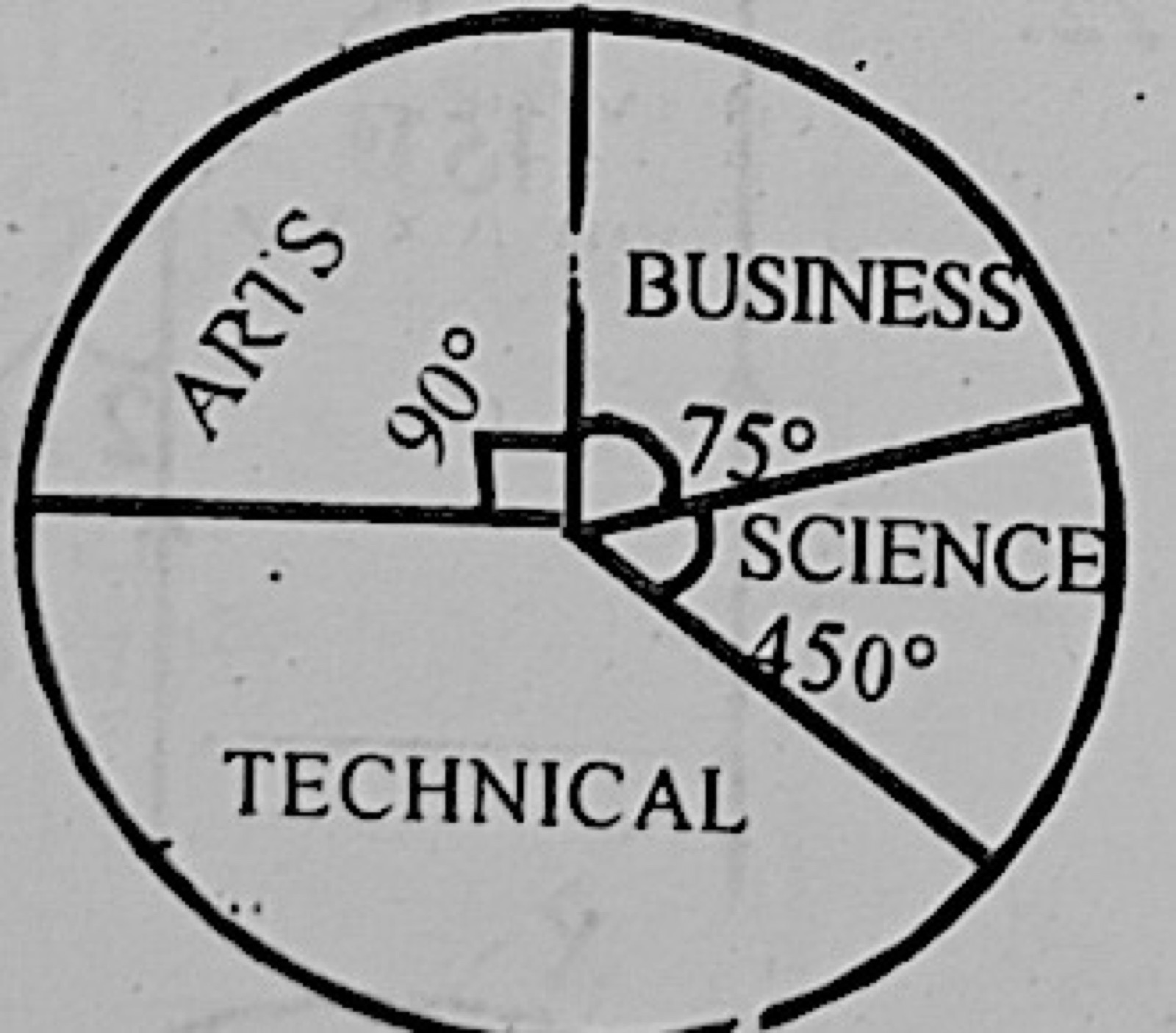
The pie chart shows the distribution of 600 Mathematics textbooks for Arts, Business, Science and Technical classes. How many textbooks are for the Technical class?
The pie chart shows the distribution of 600 Mathematics textbooks for Arts, Business, Science and Technical classes. What percentage of the total number of textbooks belongs to science?
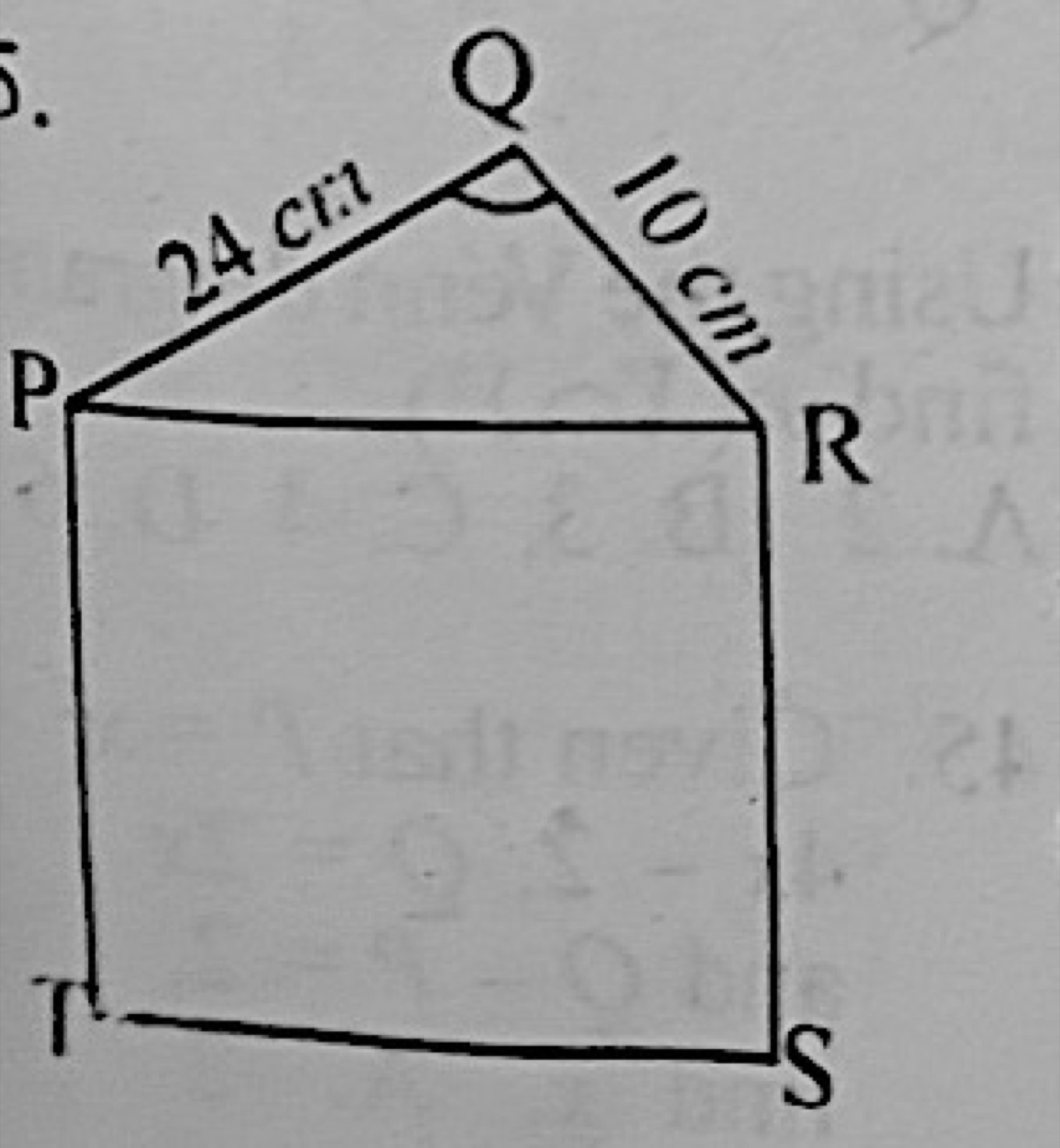
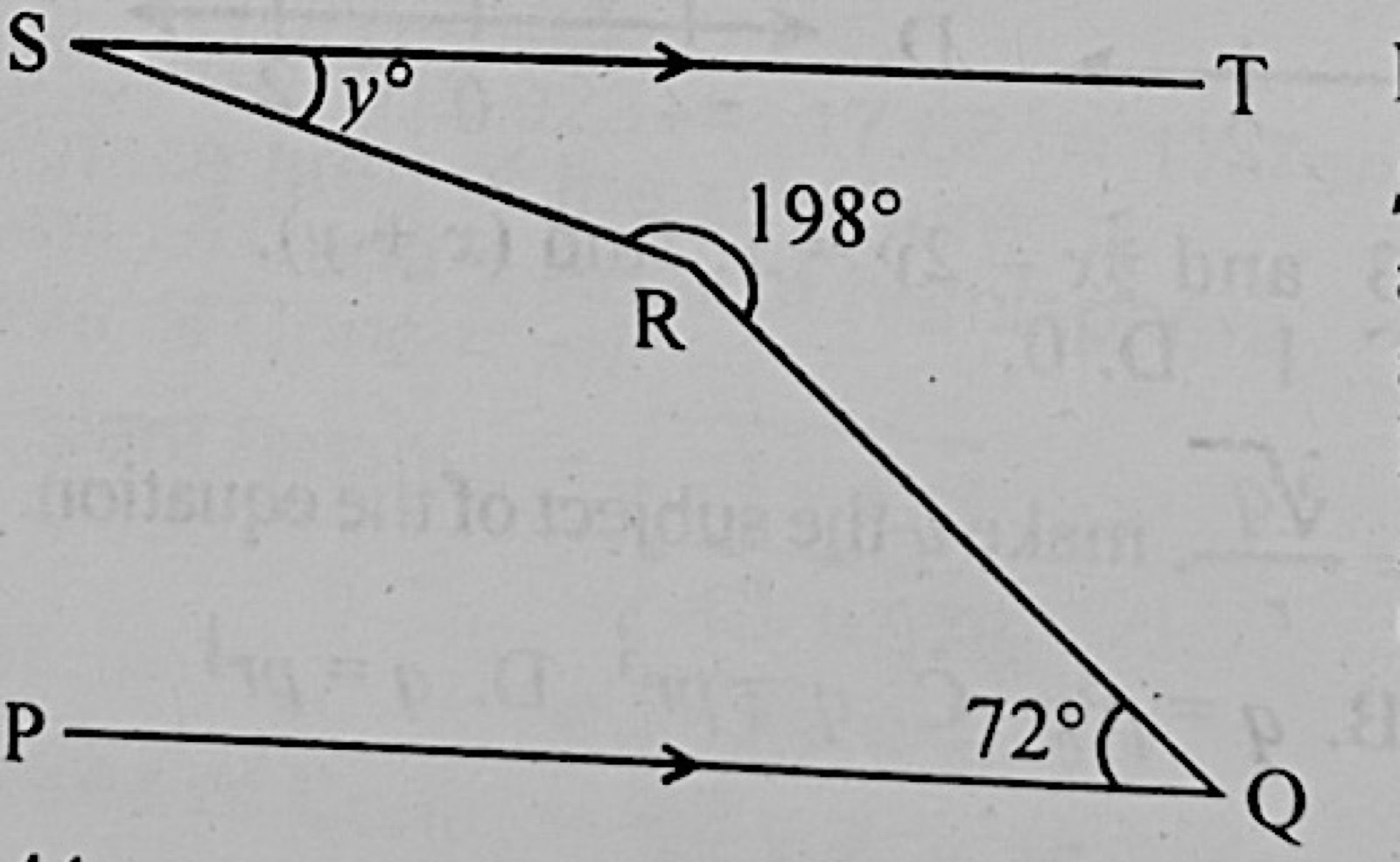
In the diagram, ST//PQ, reflex angle SRQ = 198° and ∠RQP = 72°. Find the value of y.
A.18°
B.54°
C.92°
D.108°
Show the answer and explanation
Answer: B (54°)
Explanation
Draw a line through R parallel to ST and PQ. It splits the reflex angle into (180° − y), co-interior with y at S, and 72°, alternate to ∠RQP. So (180° − y) + 72° = 198°, giving y = 54°.
The slant height of a cone is 5 cm and the radius of its base is 3 cm. Find, correct to the nearest whole number, the volume of the cone. [Take π = 22/7]
An open cone with base radius 28 cm and perpendicular height 96 cm was stretched to form a sector of a circle. Calculate the area of the sector. [Take π = 22/7]
A.8800 cm2
B.8448 cm2
C.4400 cm2
D.4224 cm2
Show the answer and explanation
Answer: A (8800 cm2)
Explanation
Slant height = √(282 + 962) = 100 cm. The sector is the cone's curved surface: πrl = 22/7 × 28 × 100 = 8800 cm2.
(a) Simplify, without using tables or calculator: ¾(3⅜ + 1⅝)/(2⅛ − 1½) (b) Given that log102 = 0.3010 and log103 = 0.4771, evaluate correct to 2 significant figures and without using tables or calculator, log101.125.
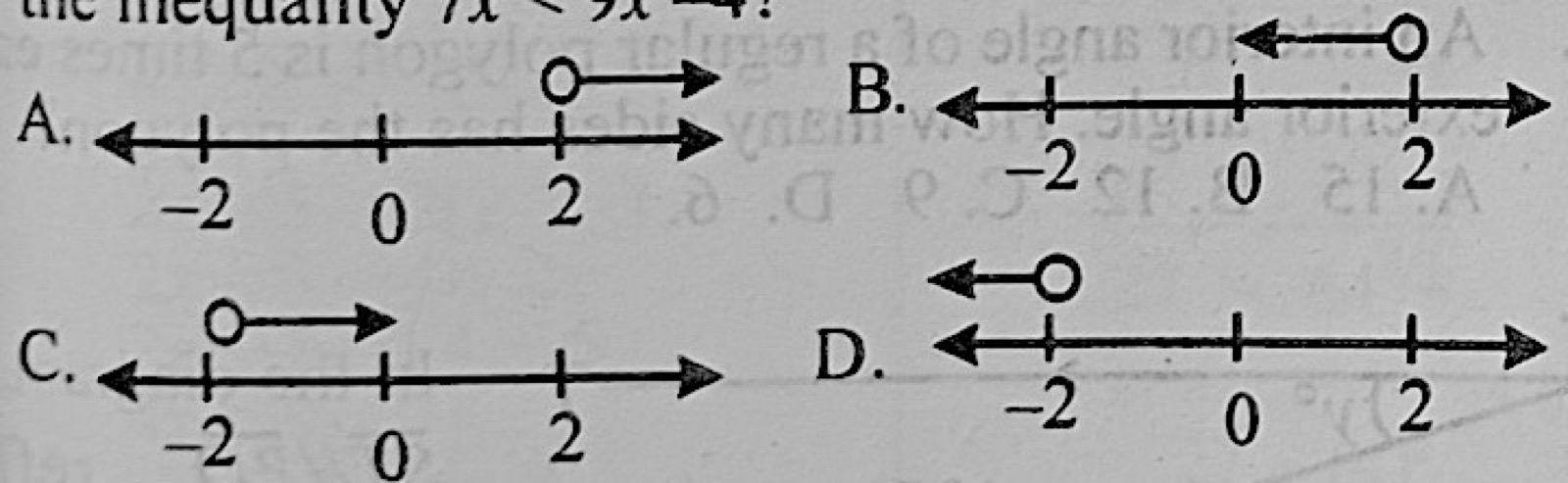
(a) Solve: 7x + 4 < ½(4x + 3). (b) Salem, Sunday and Shaka shared a sum of ₦1,100.00. For every ₦2.00 that Salem gets, Sunday gets 50 kobo and for every ₦4.00 Sunday gets, Shaka gets ₦2.00. Find Shaka's share.
(a) The present ages of a father and his son are in the ratio 10 : 3. If the son is 15 years old now, in how many years will the ratio of their ages be 2 : 1? (b) The arithmetic mean of x, y and z is 6 while that of x, y, z, t, u, v and w is 9. Calculate the arithmetic mean of t, u, v, and w.
Show the model answer
Model answer
(a) Father = 15 × 10/3 = 50. (50 + n)/(15 + n) = 2 → 50 + n = 30 + 2n → n = 20 years. (b) x + y + z = 18 and the seven numbers total 7 × 9 = 63. t + u + v + w = 45, so their mean = 45/4 = 11.25.
The area of a circle is 154 cm2. It is divided into three sectors such that two of the sectors are equal in size and the third sector is three times the size of the other two put together. Calculate the perimeter of the third sector. [Take π = 22/7]
Show the model answer
Model answer
22/7 × r2 = 154 → r2 = 49 → r = 7 cm. Angles a, a and 3(2a) = 6a: 8a = 360° → a = 45°, so the third sector is 270°. Arc = 270/360 × 2 × 22/7 × 7 = 33 cm. Perimeter = 33 + 7 + 7 = 47 cm.
Explanation
The perimeter of a sector is its arc plus two radii.
A boy 1.2 m tall, stands 6 m away from the foot of a vertical lamp pole 4.2 m long. If the lamp is at the tip of the pole, (a) represent this information in a diagram. (b) calculate the: (i) length of the shadow of the boy cast by the lamp; (ii) angle of elevation of the lamp from the boy, correct to the nearest degree.
Show the model answer
Model answer
(a) Sketch: pole 4.2 m and boy 1.2 m standing 6 m apart on level ground; a line from the lamp over the boy's head to the ground marks the end of the shadow s. (b)(i) Similar triangles: 1.2/s = 4.2/(6 + s) → 7.2 + 1.2s = 4.2s → s = 2.4 m. (ii) From the top of the boy's head: tan θ = (4.2 − 1.2)/6 = 0.5 → θ ≈ 27°. (Measured from the boy's feet: tan θ = 4.2/6 → θ ≈ 35°.)
Explanation
The lamp, the top of the boy's head and the tip of the shadow lie on one straight line.
(a) Two positive whole numbers P and q are such that P is greater than q and their sum is equal to three times their difference. (i) Express P in terms of q. (ii) Hence, evaluate (P2 + q2)/Pq. (b) A man sold 100 articles at 25 for ₦66.00 and made a gain of 32%. Calculate his gain or loss per cent if he sold them at 20 for ₦50.00.
Show the model answer
Model answer
(a)(i) P + q = 3(P − q) → 4q = 2P → P = 2q. (ii) (4q2 + q2)/(2q × q) = 5q2/2q2 = 5/2. (b) Selling price = 4 × 66 = ₦264 = 132% of the cost, so cost = ₦200. New selling price = 5 × 50 = ₦250. Gain = ₦50 = 50/200 × 100% = 25% gain.
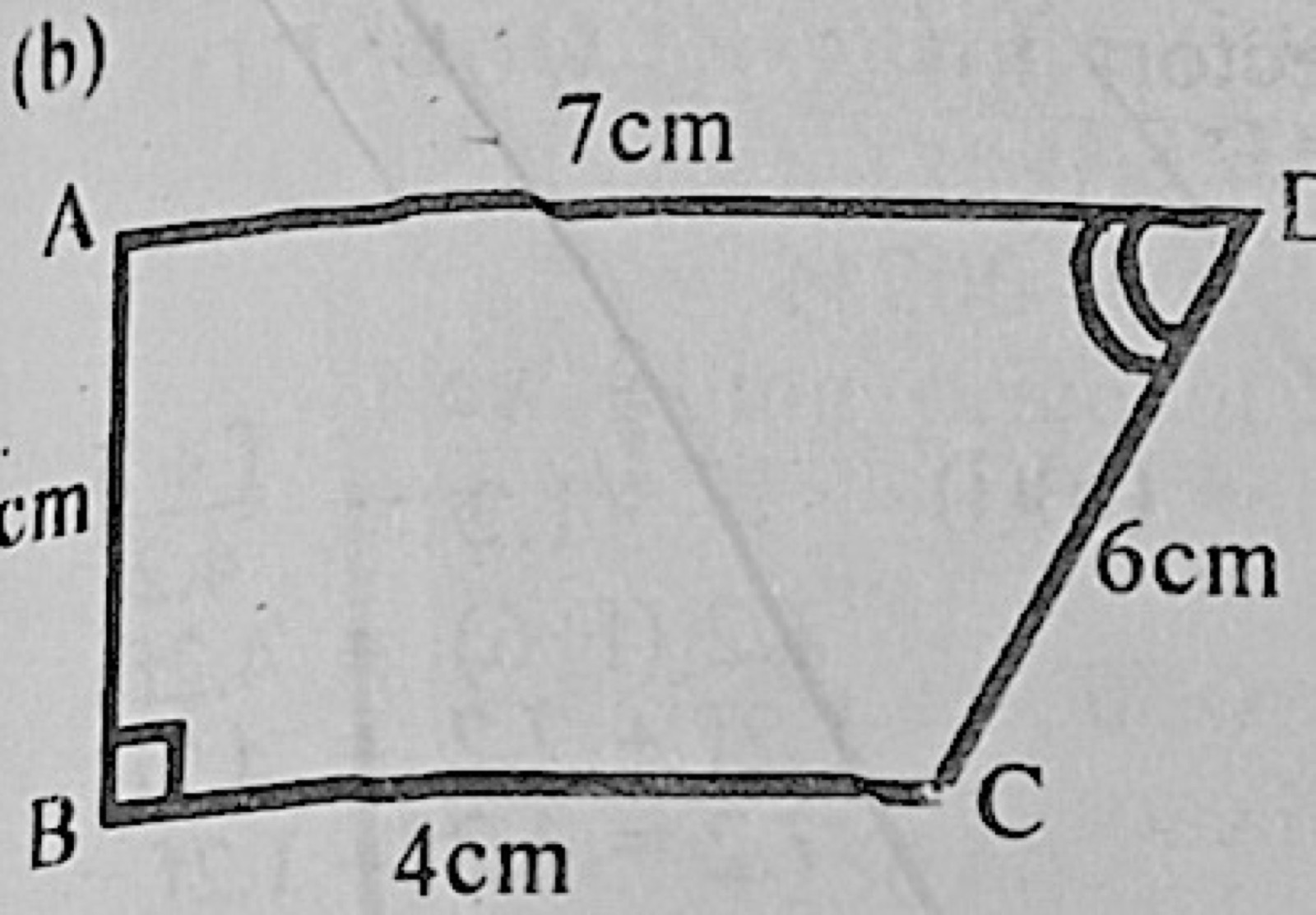
(a) If (3 − x), 6, (7 − 5x) are consecutive terms of a geometric progression (G.P.) with constant ratio r > 0; find the: (i) values of x; (ii) constant ratio. (b) In the diagram, |AB| = 3 cm, |BC| = 4 cm, |CD| = 6 cm and |DA| = 7cm. Calculate ∠ADC, correct to the nearest degree.
Show the model answer
Model answer
(a)(i) 62 = (3 − x)(7 − 5x) → 36 = 21 − 22x + 5x2 → 5x2 − 22x − 15 = 0 → (5x + 3)(x − 5) = 0 → x = −3/5 or 5. x = 5 gives −2, 6, −18 (ratio −3, not allowed). So x = −3/5. (ii) Terms 18/5, 6, 10: r = 6 ÷ 18/5 = 5/3. (b) ∠ABC = 90°, so |AC| = √(32 + 42) = 5 cm. In ΔACD: cos ∠ADC = (72 + 62 − 52)/(2 × 7 × 6) = 60/84 ≈ 0.714, so ∠ADC ≈ 44°.
Explanation
In a GP the middle term squared equals the product of its neighbours.
(a) Using ruler and a pair of compasses only, construct: (i) a trapezium WXYZ such that |WX| = 10.2 cm, |XY| = 5.6 cm, |YZ| = 5.8 cm, ∠WXY = 60° and WX is parallel to YZ; (ii) a perpendicular from Z to meet WX at N. (b) Measure: (i) |WZ|; (ii) |ZN|.
Show the model answer
Model answer
(a)(i) Draw WX = 10.2 cm; construct 60° at X and mark XY = 5.6 cm. Through Y draw a line parallel to WX (e.g. construct 120° at Y) and mark YZ = 5.8 cm towards W. Join WZ. (ii) From Z construct the perpendicular to WX, meeting it at N. (b)(i) |WZ| ≈ 5.1 cm. (ii) |ZN| ≈ 4.8 cm (= 5.6 sin 60° ≈ 4.85 cm).
Explanation
Co-interior angles: if ∠X = 60°, the angle at Y between YX and YZ is 120°.
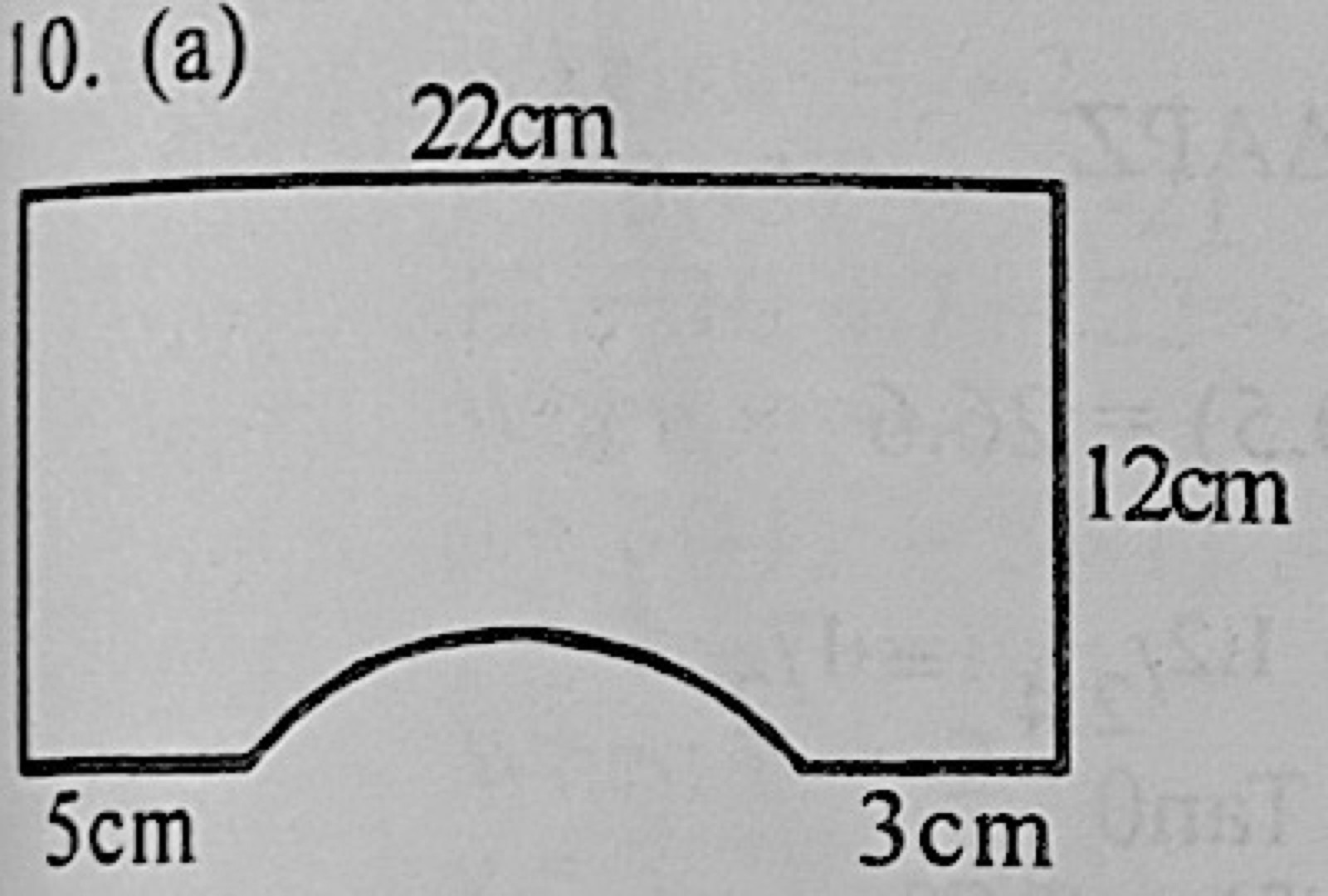
(a) A segment of a circle is cut off from a rectangular board as shown in the diagram. If the radius of the circle is 1½ times the length of the chord, calculate, correct to 2 decimal places, the perimeter of the remaining portion. [Take π = 22/7] (b) Evaluate without using calculators or tables, (3/√3)(2/√3 − √12/3).
The frequency distribution table shows the marks obtained by 100 students in a Mathematics test. Marks (%): 1-10, 11-20, 21-30, 31-40, 41-50, 51-60, 61-70, 71-80, 81-90, 91-100 Frequency: 2, 3, 5, 13, 19, 31, 13, 9, 4, 1 (a) Draw a cumulative frequency curve for the distribution. (b) Use the graph to find the: (i) 60th percentile; (ii) probability that a student passed the test if the pass mark was fixed at 35%.
Show the model answer
Model answer
(a) Upper boundaries 10.5, 20.5, …, 100.5 with cumulative frequencies 2, 5, 10, 23, 42, 73, 86, 95, 99, 100; plot and draw a smooth S-curve. (b)(i) 60th student: about 50.5 + (60 − 42)/31 × 10 ≈ 56.3 marks. (ii) Reading at 35: about 16 students scored below 35, so about 84 passed. Probability ≈ 84/100 = 0.84. (Accept readings close to these from the curve.)
Explanation
Plot each cumulative frequency at the upper class boundary.
An aeroplane flies due north from a town T on the equator at a speed of 950 km per hour for 4 hours to another town P. It then flies eastwards to town Q on longitude 65° E. If the longitude of T is 15° E, (a) represent this information in a diagram. (b) calculate the: (i) latitude of P, correct to the nearest degree; (ii) distance between P and Q, correct to 4 significant figures. [Take π = 22/7, Radius of the earth = 6400 km]
Show the model answer
Model answer
(a) Sketch of the earth with the equator, the meridian 15°E through T and P, and the parallel through P to Q on 65°E. (b)(i) T to P = 950 × 4 = 3800 km. θ/360 × 2 × 22/7 × 6400 = 3800 → θ ≈ 34.0°, so P is about 34°N. (ii) Longitude difference = 50°. PQ = 50/360 × 2 × 22/7 × 6400 × cos 34° ≈ 5587.3 × 0.8290 ≈ 4632 km.
Explanation
Along a parallel of latitude the radius is R cos(latitude).
When one end of a ladder, LM, is placed against a vertical wall at a point 5 metres above the ground, the ladder makes an angle of 37° with the horizontal ground. (a) Represent this information in a diagram. (b) Calculate, correct to 3 significant figures, the length of the ladder. (c) If the foot of the ladder is pushed towards the wall by 2 metres, calculate, correct to the nearest degree, the angle which the ladder now makes with the ground.
Show the model answer
Model answer
(a) Right triangle: wall 5 m, ladder LM as hypotenuse, 37° between ladder and ground. (b) |LM| = 5/sin 37° = 5/0.6018 ≈ 8.31 m. (c) Original foot distance = 5/tan 37° ≈ 6.64 m; new distance = 4.64 m. The ladder length stays 8.31 m: cos θ = 4.64/8.31 ≈ 0.558, so θ ≈ 56°.
Explanation
When the foot moves, the ladder slides up the wall; its length does not change.