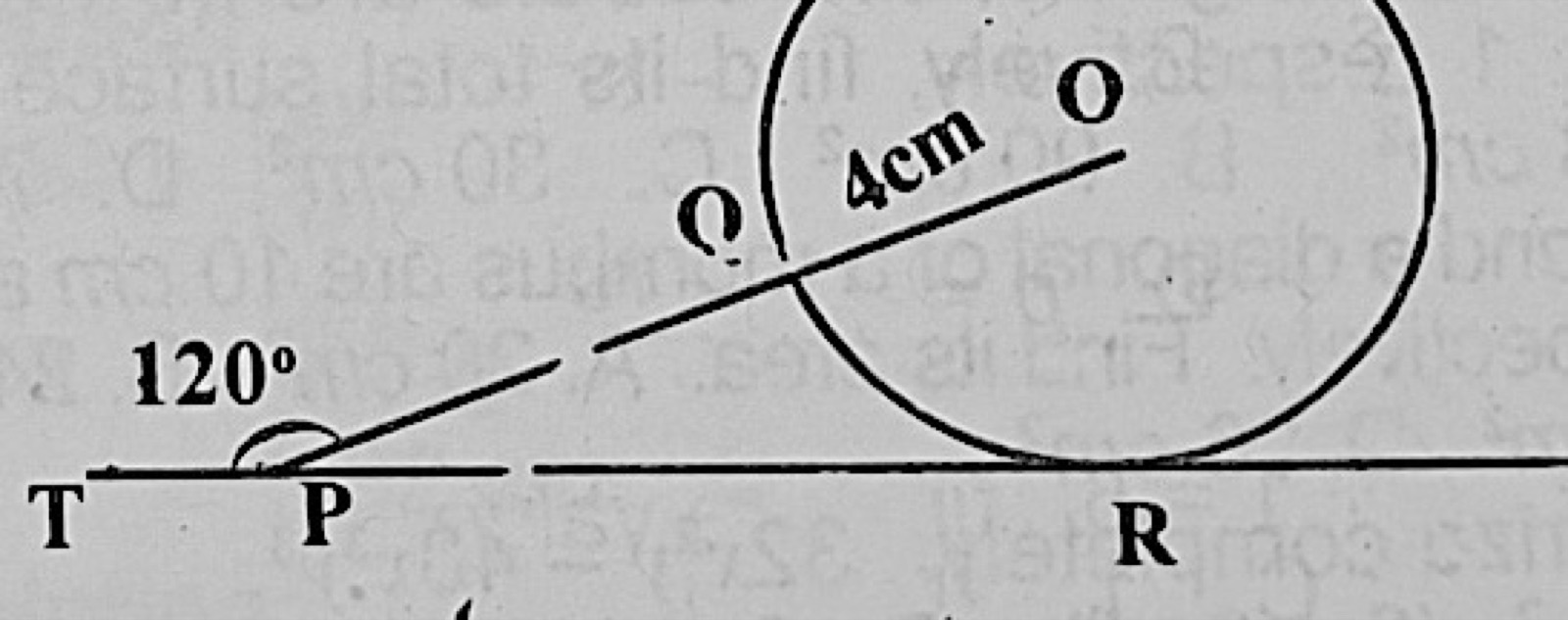
A sector of a circle which subtends 172° at the centre of the circle has a perimeter of 600 cm. Find, correct to the nearest cm, the radius of the circle. [Take π = 22/7]
A.120 cm
B.116 cm
C.107 cm
D.100 cm
Show the answer and explanation
Answer: A (120 cm)
Explanation
Arc = 172/360 × 2 × 22/7 × r ≈ 3.003r. Perimeter = arc + 2r = 5.003r = 600, so r ≈ 120 cm.
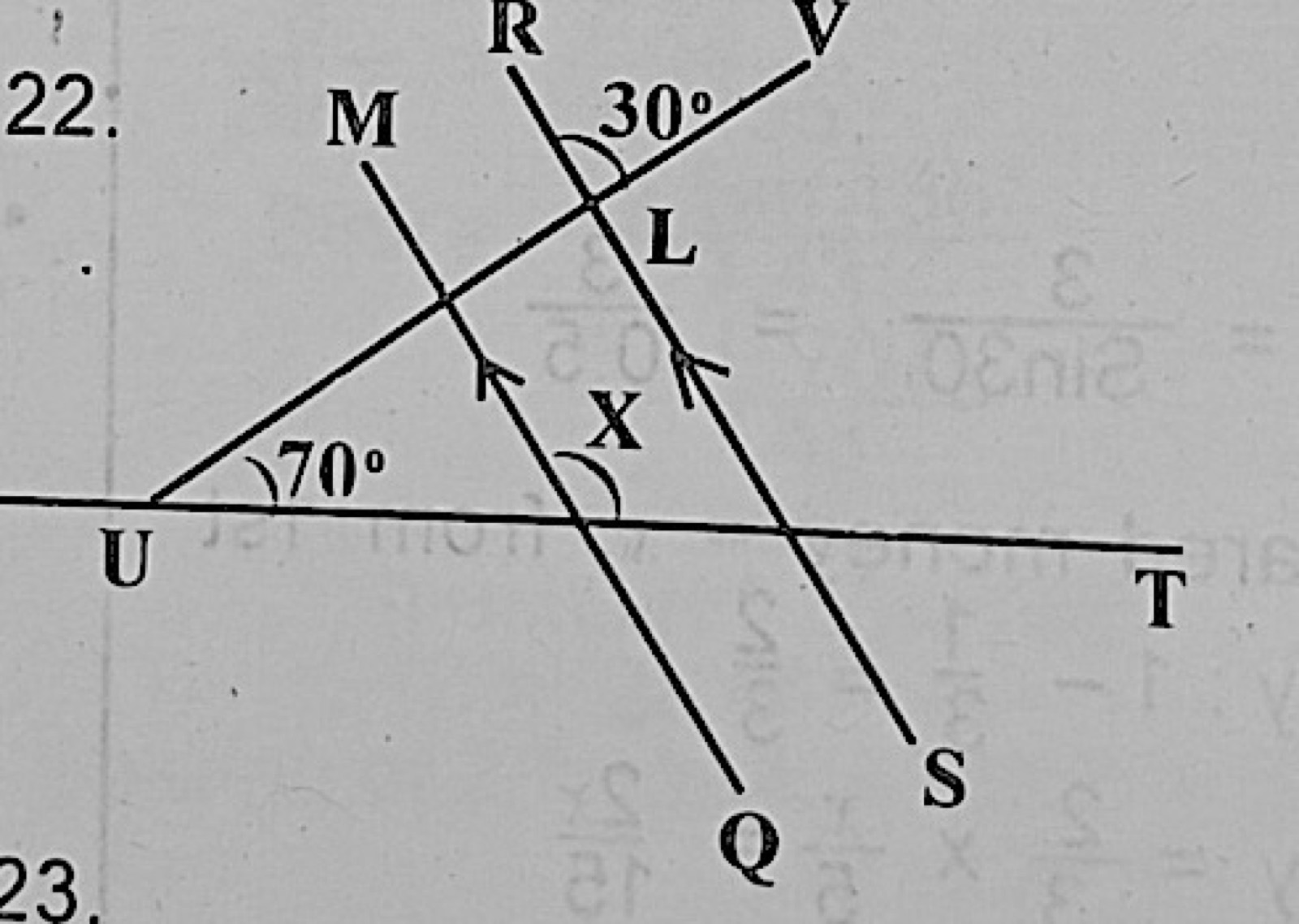
In the diagram, MQ||RS, ∠TUV = 70° and ∠RLV = 30°. Find the value of x.
A.150°
B.110°
C.100°
D.95°
Show the answer and explanation
Answer: C (100°)
Explanation
RS makes 30° with UV, so the parallel line MQ also makes 30° with UV (corresponding angles). In the triangle formed by UV, UT and MQ, the exterior angle x at X equals the sum of the opposite interior angles: 70° + 30° = 100°.
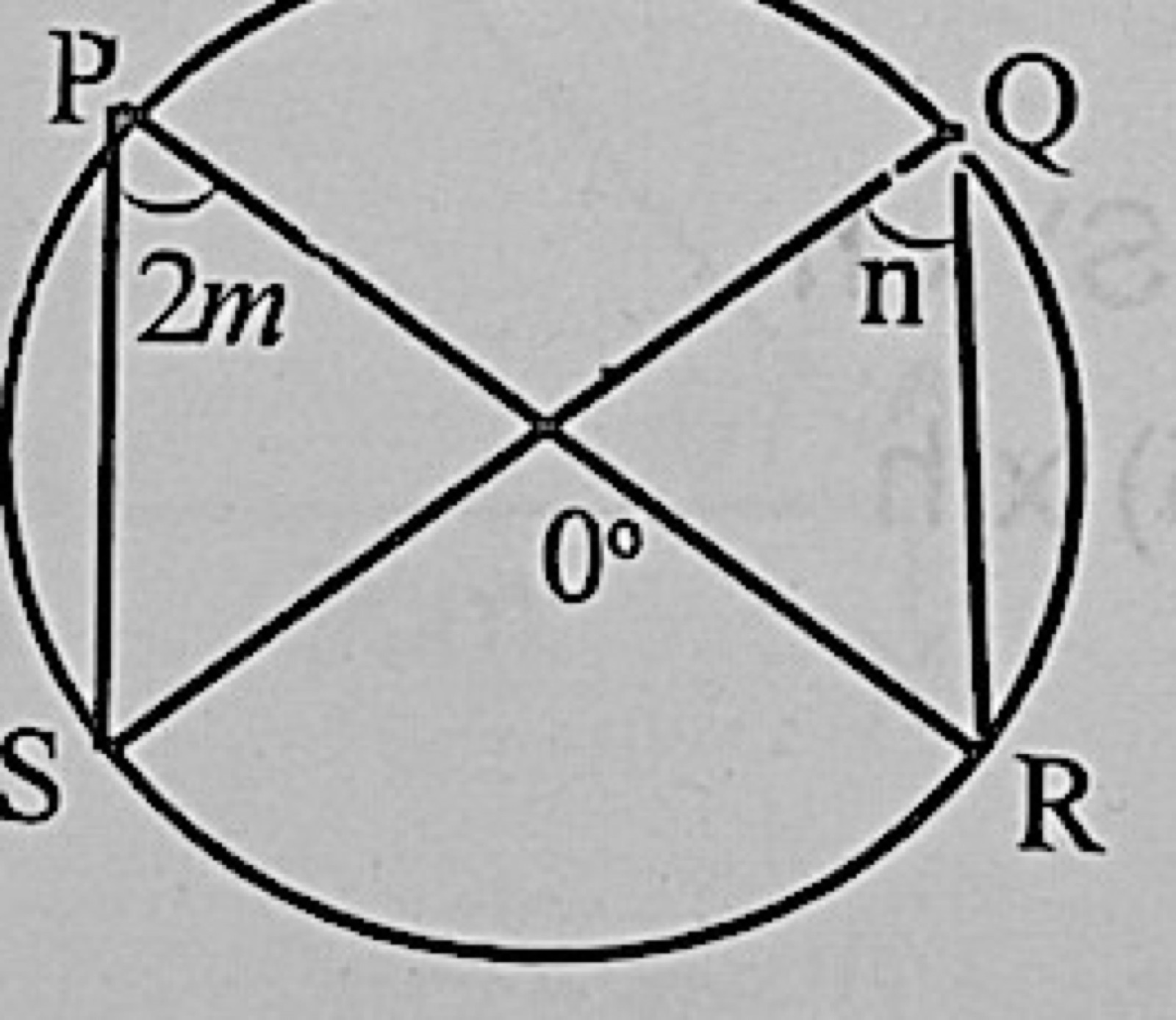
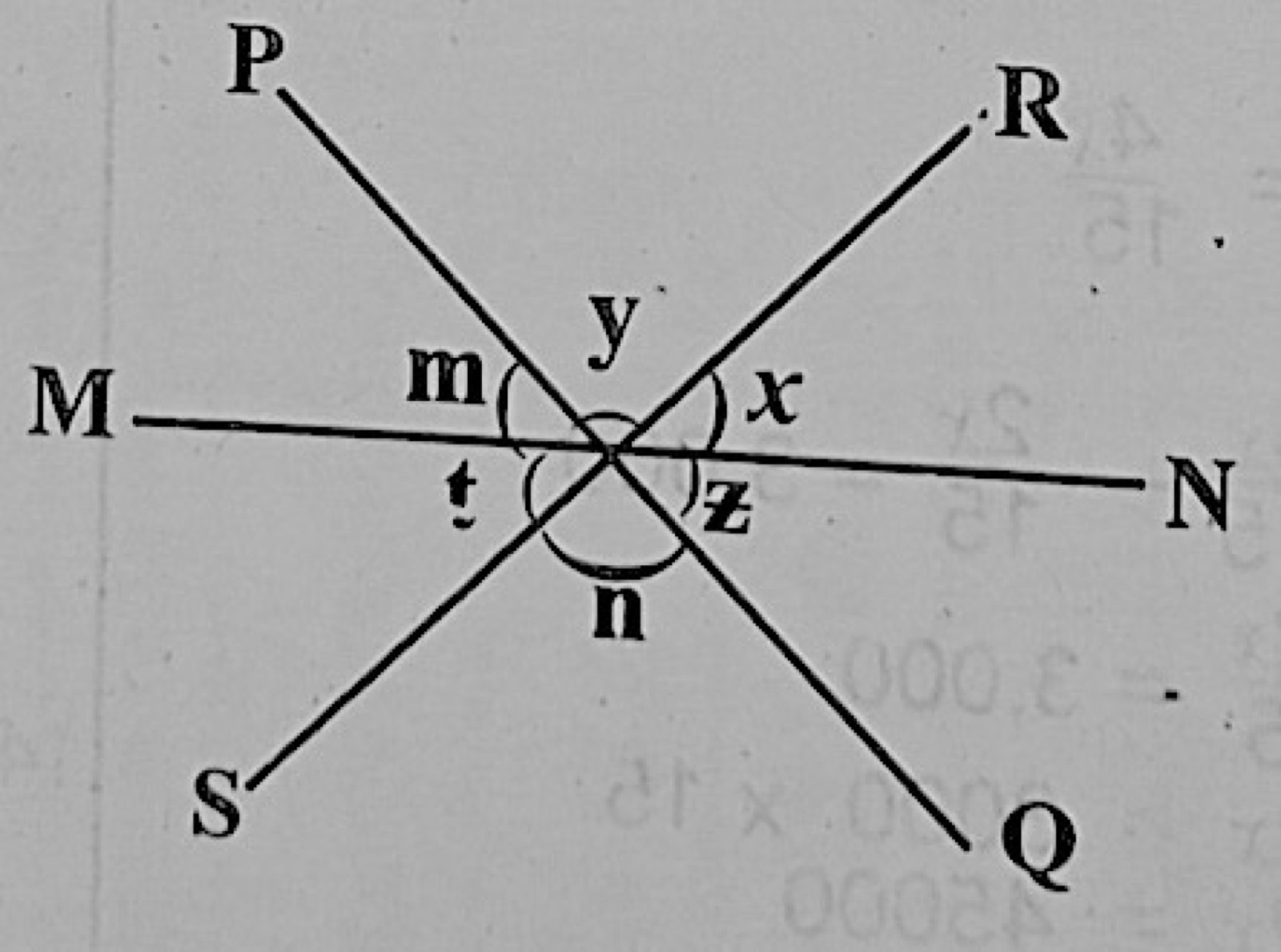
In the diagram, MN, PQ, and RS are three intersecting straight lines. Which of the following statement(s) is/are true? I. t = y II. x + y + z + m = 180° III. x + m + n = 180° IV. x + n = m + z
A.I and IV only
B.II only
C.III only
D.IV only
Show the answer and explanation
Answer: C (III only)
Explanation
n = y (vertically opposite), and m + y + x = 180° (angles on the straight line MN). So x + m + n = 180° (III). t equals x, not y, so I is false; II and IV are also false.
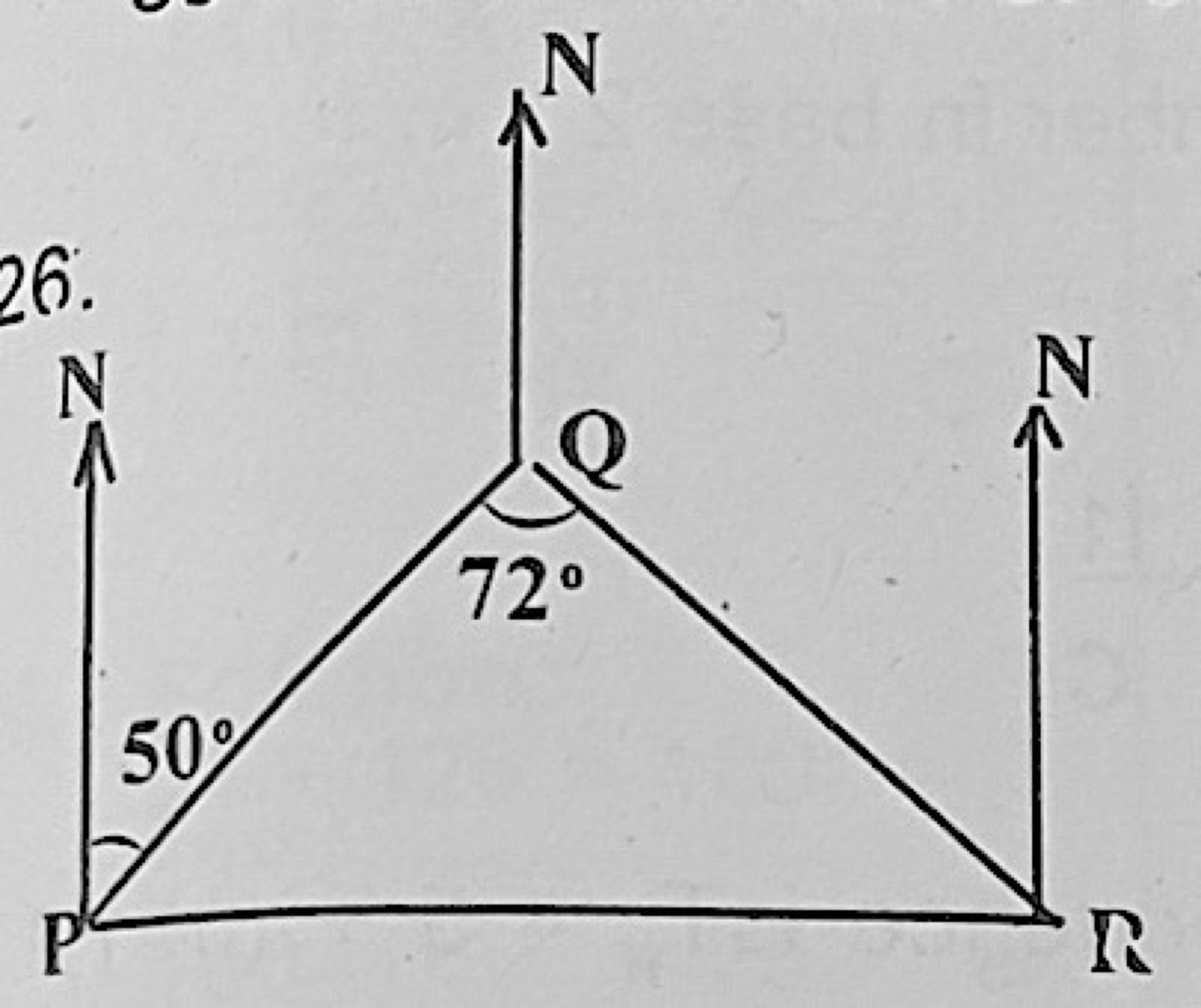
The positions of three ships P, Q and R at sea are illustrated in the diagram. The arrows indicate the North direction. The bearing of Q from P is 050° and ∠PQR = 72°. Calculate the bearing of R from Q.
A.130°
B.158°
C.222°
D.252°
Show the answer and explanation
Answer: B (158°)
Explanation
The bearing of P from Q is 050° + 180° = 230°. R is 72° anticlockwise from that direction: 230° − 72° = 158°.
A bag contains 4 red and 6 black balls of the same size. If the balls are shuffled briskly and two balls are drawn one after the other without replacement, find the probability of picking balls of different colours.
A.8/15
B.13/25
C.11/15
D.13/15
Show the answer and explanation
Answer: A (8/15)
Explanation
P(red then black) + P(black then red) = 4/10 × 6/9 + 6/10 × 4/9 = 48/90 = 8/15.
The diagram is a polygon. Find the largest of its interior angles.
A.30°
B.100°
C.120°
D.150°
Show the answer and explanation
Answer: D (150°)
Explanation
The marked angles 4x, x, 3x, 2x, 2x are exterior angles, which add to 360°: 12x = 360°, x = 30°. The smallest exterior angle (x = 30°) gives the largest interior angle: 180° − 30° = 150°.
(a) Simplify: (1¼ + 7/9)/(1 4/9 − 2⅔ × 9/64) (b) Given that sin x = 2/3, evaluate, leaving your answer in surd form and without using tables or calculator, tan x − cos x.
Show the model answer
Model answer
(a) Numerator: 5/4 + 7/9 = (45 + 28)/36 = 73/36. Denominator: 8/3 × 9/64 = 3/8; 13/9 − 3/8 = (104 − 27)/72 = 77/72. 73/36 × 72/77 = 146/77 = 1 69/77. (b) Opposite 2, hypotenuse 3, adjacent √(9 − 4) = √5. tan x = 2/√5, cos x = √5/3. tan x − cos x = 2/√5 − √5/3 = (6 − 5)/(3√5) = 1/(3√5) = √5/15.
Explanation
Do the multiplication in the denominator before subtracting.
Sonny is twice as old as Wale. Four years ago, he was four times as old as Wale. When will the sum of their ages be 66?
Show the model answer
Model answer
Let Wale be y, Sonny 2y. Four years ago: 2y − 4 = 4(y − 4), so 2y = 12 and y = 6. Sonny is 12. In n years: (12 + n) + (6 + n) = 66, so 2n = 48 and n = 24. The sum of their ages will be 66 in 24 years' time.
Explanation
Both ages increase by n, so the sum increases by 2n.
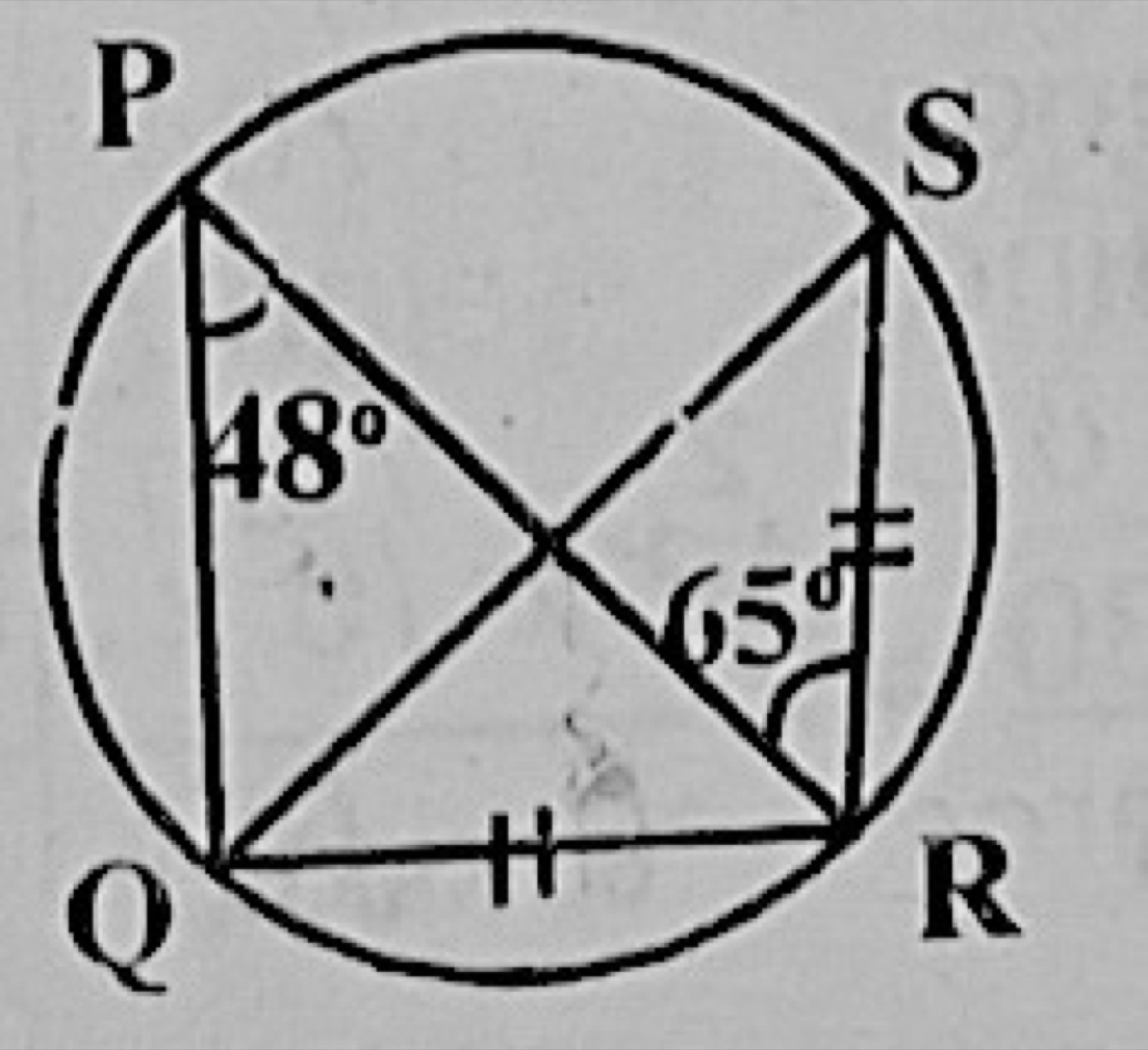
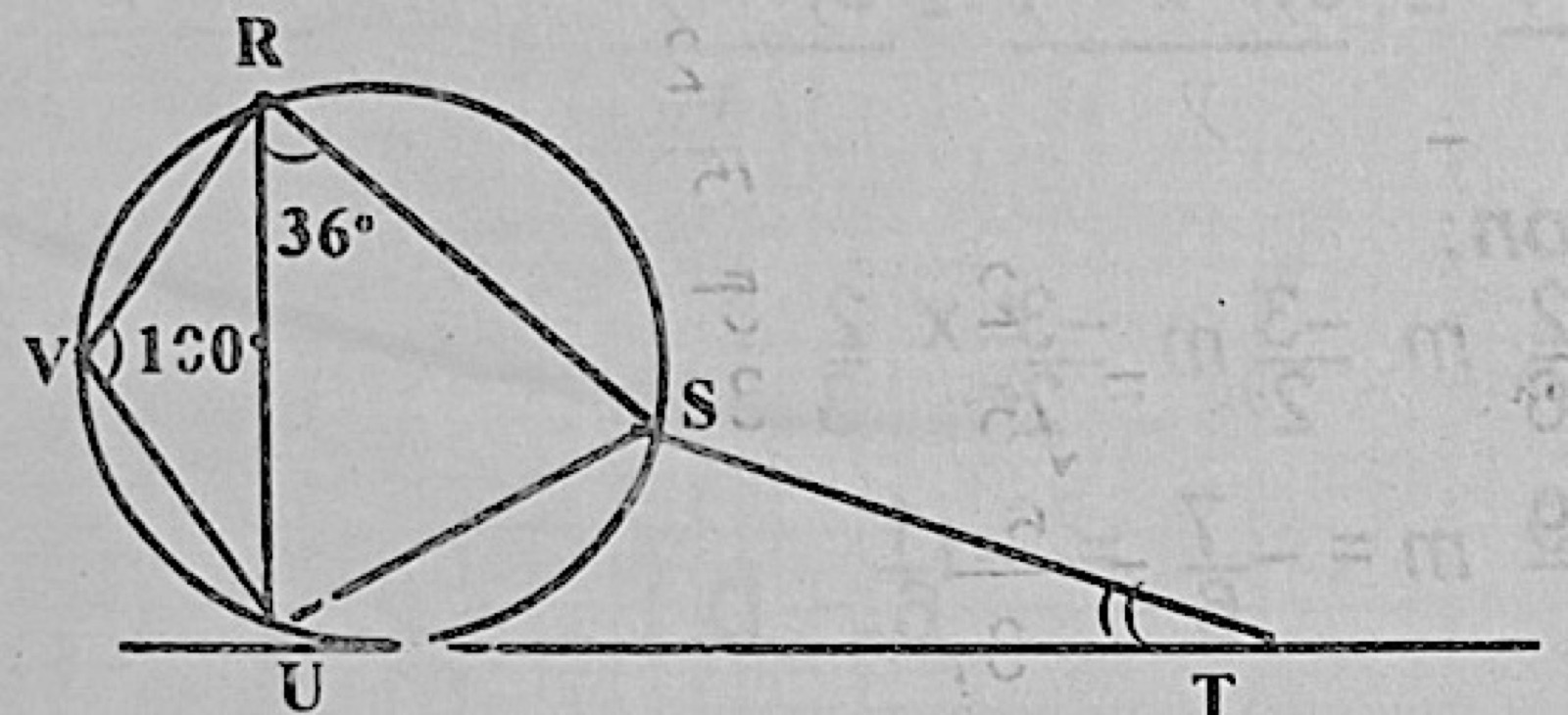
(a) In the diagram, TU is a tangent to the circle. RV̂U = 100° and ∠URS = 36°. Calculate the value of angle STU. (b) In triangle XYZ, |XY| = 5 cm, |YZ| = 8 cm and |XZ| = 6 cm. P is a point on the side XY such that |XP| = 2 cm and the line through P, parallel to YZ meets XZ at Q. Calculate |QZ|.
Show the model answer
Model answer
(a) RVUS is cyclic, so the exterior angle ∠UST = ∠RVU = 100°. Alternate segment: ∠SUT = ∠URS = 36°. In ΔSUT: ∠STU = 180° − 100° − 36° = 44°. (b) PQ ∥ YZ, so XQ/XZ = XP/XY = 2/5. XQ = 2/5 × 6 = 2.4 cm. |QZ| = 6 − 2.4 = 3.6 cm.
Explanation
The exterior angle of a cyclic quadrilateral equals the interior opposite angle.
(a) A box contains 40 identical discs which are either red or white. If the probability of picking a red disc is ¼, calculate the number of: (i) white discs; (ii) red discs that should be added such that the probability of picking a red disc will be ⅓. (b) A salesman bought some plates at ₦50.00 each. If he sold all of them for ₦600.00 and made a profit of 20% on the transaction, how many plates did he buy?
Show the model answer
Model answer
(a) Red = ¼ × 40 = 10. (i) White = 40 − 10 = 30. (ii) (10 + r)/(40 + r) = ⅓ → 30 + 3r = 40 + r → r = 5 red discs. (b) ₦600 is 120% of the cost, so cost = 600 × 100/120 = ₦500. Number of plates = 500 ÷ 50 = 10.
Explanation
Adding red discs increases both the red count and the total.
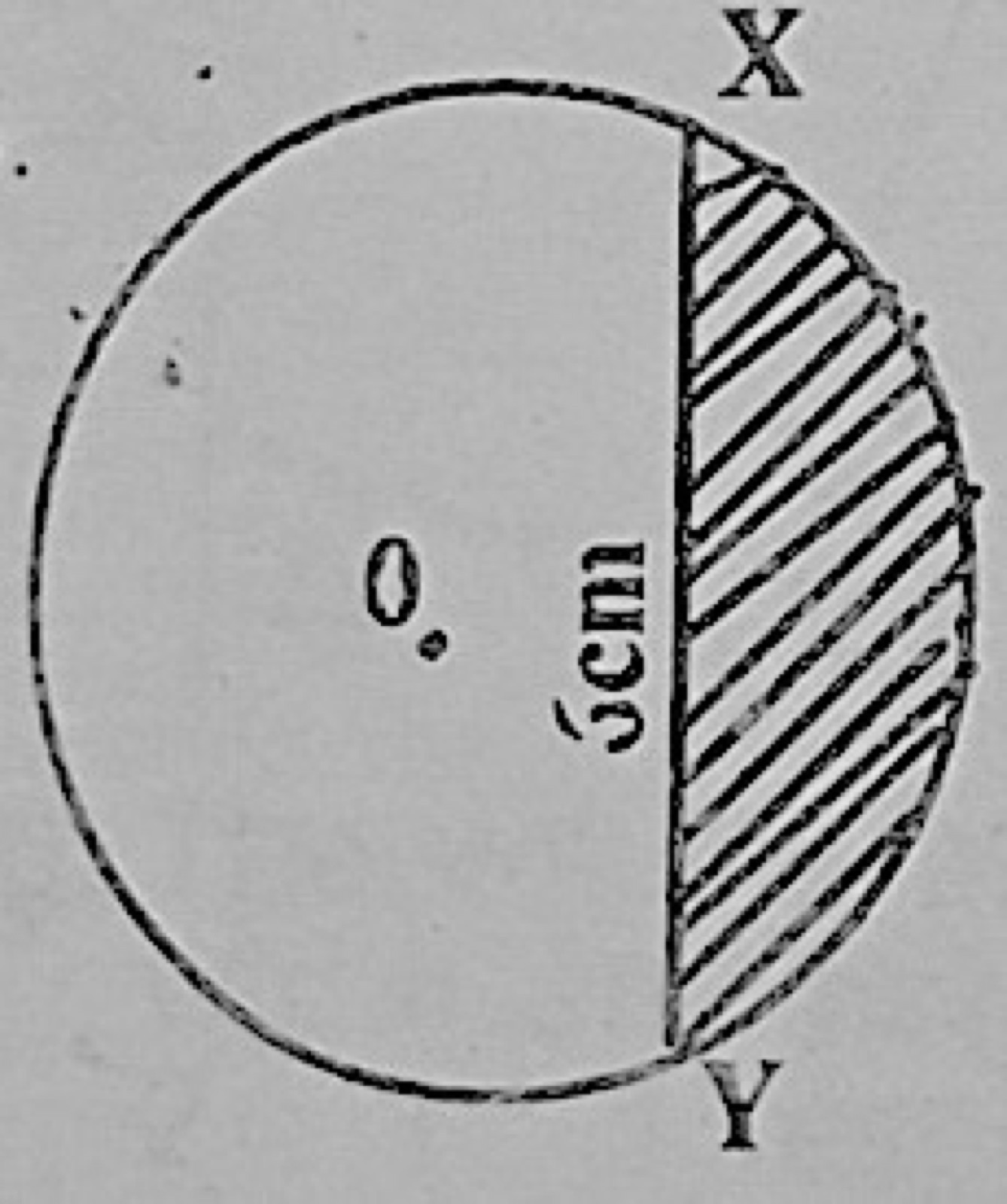
In the diagram, O is the centre of the circle and XY is a chord. If the radius is 5 cm and |XY| = 6 cm, calculate, correct to 2 decimal places, the: (a) angle which XY subtends at the centre O; (b) area of the shaded portion.
Show the model answer
Model answer
(a) Half the chord is 3 cm: sin(½θ) = 3/5 = 0.6, so ½θ = 36.87° and θ = 73.74°. (b) Sector = 73.74/360 × 22/7 × 52 ≈ 16.09 cm2. Triangle OXY = ½ × 6 × 4 = 12 cm2 (height from O = √(25 − 9) = 4). Shaded segment ≈ 16.09 − 12 = 4.09 cm2.
Explanation
The shaded minor segment is the sector minus the triangle.
(a) A boy had M Dalasis (D). He spent D15 and shared the remainder equally with his sister. If the sister's share was equal to ⅓ of M, find the value of M. (b) A number of tourists were interviewed on their choice of means of travel. Two-thirds said that they travelled by road, 13/30 by air and 4/15 by both air and road. If 20 tourists did not travel by either air or road, (i) represent the information on a Venn diagram; (ii) how many tourists (A) were interviewed; (B) travelled by air only?
Show the model answer
Model answer
(a) (M − 15)/2 = M/3 → 3M − 45 = 2M → M = 45. (b)(i) Two overlapping circles, Road and Air: road only 2/3 − 4/15 = 2/5, both 4/15, air only 13/30 − 4/15 = 1/6, outside 20 tourists. (ii)(A) Road or air = 2/5 + 4/15 + 1/6 = 5/6, so neither = 1/6 of the total = 20. Total = 120. (B) Air only = 1/6 × 120 = 20.
Explanation
Write each region as a fraction of the total, then use the 20 who used neither.
(a)(i) Using a scale of 2 cm to 1 unit on both axes, on the same graph sheet, draw the graphs of y − 3x/4 = 3 and y + 2x = 6. (ii) From your graph, find the coordinates of the point of intersection of the two graphs. (iii) Show, on the graph sheet, the region satisfied by the inequality y − 3x/4 ≥ 3. (b) Given that x2 + bx + 18 is factorized as (x + 2)(x + c). Find the values of c and b.
Show the model answer
Model answer
(a)(i) y = 3x/4 + 3 passes through (0, 3) and (−4, 0); y = 6 − 2x passes through (0, 6) and (3, 0). Draw both lines. (ii) 3x/4 + 3 = 6 − 2x → 11x/4 = 3 → x ≈ 1.1, y ≈ 3.8: about (1.1, 3.8). (iii) The region on and above the line y = 3x/4 + 3 (shade it, or shade the unwanted side, as instructed). (b) (x + 2)(x + c) = x2 + (2 + c)x + 2c. 2c = 18 → c = 9; b = 2 + 9 = 11.
Explanation
Compare coefficients after expanding the brackets.
A point H is 20 m away from the foot of a tower on the same horizontal ground. From the point H, the angle of elevation of the point (P) on the tower and the top (T) of the tower are 30° and 50° respectively. Calculate, correct to 3 significant figures: (a) |PT|; (b) the distance between H and the top of the tower; (c) the position of H if the angle of depression of H from the top of the tower is to be 40°.
Show the model answer
Model answer
(a) Height of T = 20 tan 50° = 23.84 m; height of P = 20 tan 30° = 11.55 m. |PT| = 12.3 m. (b) |HT| = 20/cos 50° ≈ 31.1 m. (c) New distance from the foot = 23.84/tan 40° ≈ 28.4 m, i.e. H must move about 8.41 m further away from the tower.
Explanation
The angle of depression from T equals the angle of elevation from H.
Three towns X, Y and Z are such that Y is 20 km from X and 22 km from Z. Town X is 18 km from Z. A Health Centre is to be built by the government to serve the three towns. The centre is to be located such that patients from X and Y will always travel equal distance to access the Health Centre while patients from Z will travel exactly 10 km to reach the Health Centre. (a) Using a scale of 1 cm to 2 km, find by construction, using a pair of compasses and ruler only, the possible positions the Health Centre can be located. (b) In how many possible locations can the Health Centre be built? (c) Measure and record the distances of the locations from town X. (d) Which of these locations would be convenient for all the three towns?
Show the model answer
Model answer
(a) Draw triangle XYZ with XY = 10 cm, YZ = 11 cm, XZ = 9 cm. Construct the perpendicular bisector of XY. With centre Z and radius 5 cm (10 km) draw a circle. The Health Centre is where they meet. (b) Two possible locations. (c) About 12.7 km and 28.0 km from X (6.3 cm and 14.0 cm on the drawing). (d) The location about 12.7 km from X (inside the triangle), since it is closest to all three towns.
Explanation
Points equidistant from X and Y lie on the perpendicular bisector of XY; points 10 km from Z lie on a circle.
The table shows the distribution of marks scored by students in an examination. Class Interval: 60 − 64, 65 − 69, 70 − 74, 75 − 79, 80 − 84, 85 − 89, 90 − 94, 95 − 99 Frequency: 2, 3, 6, 11, 8, 7, 2, 1 Calculate, correct to 2 decimal places, the (a) mean; (b) standard deviation of the distribution.
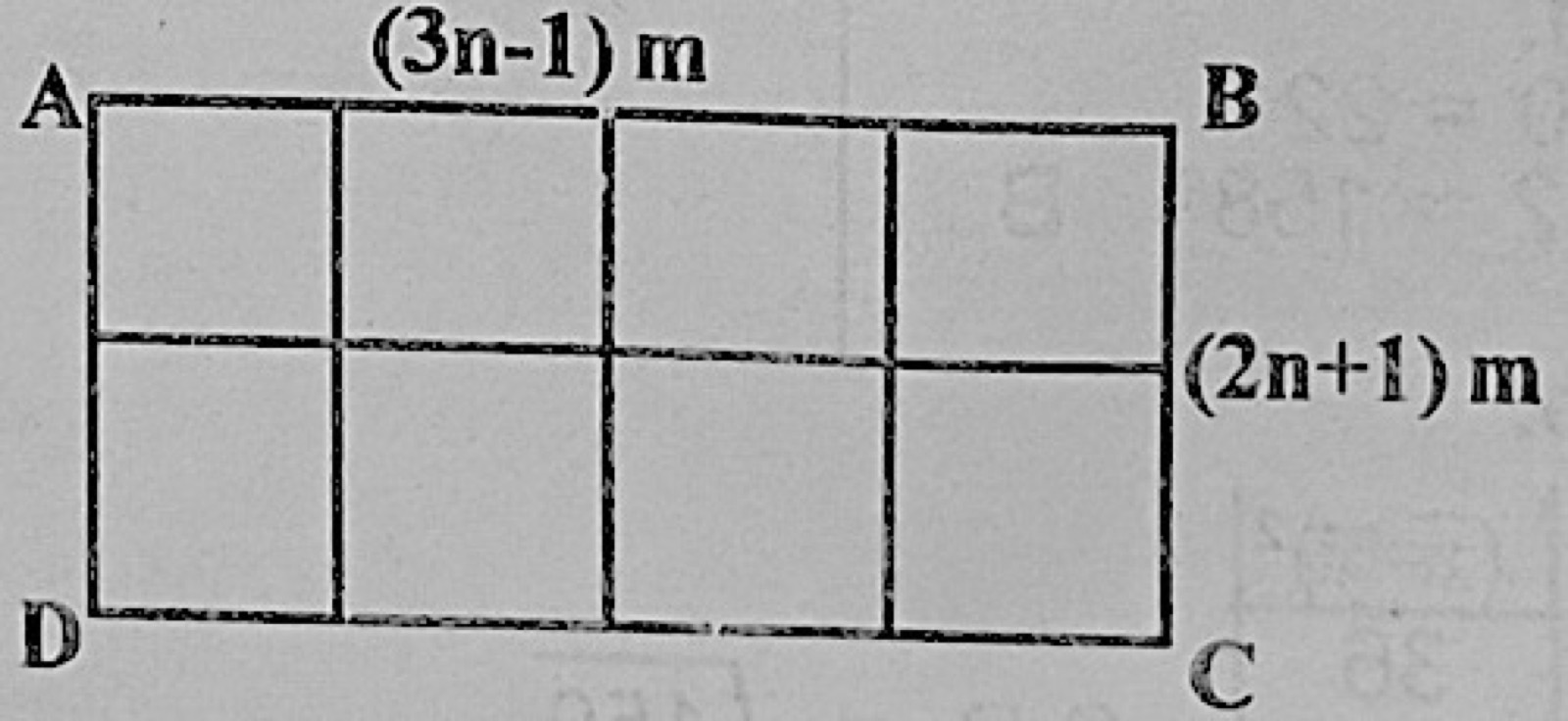
(a) In the diagram, ABCD is a rectangular garden (3n − 1)m long and (2n + 1) m wide. A wire-mesh 135 m long is used to mark its boundary and to divide it into 8 equal plots. Find the value of n. (b) A cylinder with base radius 14 cm has the same volume as a cube of side 22 cm. Calculate the ratio of the total surface area of the cylinder to that of the cube. [Take π = 22/7]
Show the model answer
Model answer
(a) The wire runs along 3 lines of length (3n − 1) (top, middle, bottom) and 5 lines of length (2n + 1) (two ends and three dividers). 3(3n − 1) + 5(2n + 1) = 135 → 19n + 2 = 135 → n = 7. (b) 22/7 × 142 × h = 223 = 10648, so h = 10648/616 ≈ 17.29 cm. Cylinder TSA = 2πr(r + h) = 2 × 22/7 × 14 × (14 + 17.29) ≈ 2753.1 cm2. Cube = 6 × 222 = 2904 cm2. Ratio ≈ 2753.1 : 2904 = 73 : 77 (about 0.95 : 1).
Explanation
Count every length of wire in the grid, including the inside dividers.
(a) Copy and complete the table of values for y = 1 − 4 cos x. x: 0°, 30°, 60°, 90°, 120°, 150°, 180°, 210°, 240°, 270°, 300° y: −3.0, __, __, 1.0, __, __, __, 4.5, __, __, −1.0 (b) Using a scale of 2 cm to 30° on the x-axis and 2 cm to 1 unit on the y-axis, draw the graph of y = 1 − 4 cos x for 0° ≤ x ≤ 300°. (c) Use the graph to: (i) solve the equation 1 − 4 cos x = 0; (ii) find the value of y when x = 105°; (iii) find x when y = 1.5.
Show the model answer
Model answer
(a) 30°: −2.5; 60°: −1.0; 120°: 3.0; 150°: 4.5; 180°: 5.0; 240°: 3.0; 270°: 1.0. (b) Plot the points and draw a smooth curve. (c)(i) Where the curve crosses the x-axis: x ≈ 76° and x ≈ 284°. (ii) At x = 105°, y ≈ 2.0. (iii) Where y = 1.5: x ≈ 97° and x ≈ 263°. (Accept graph readings within about ±2°.)
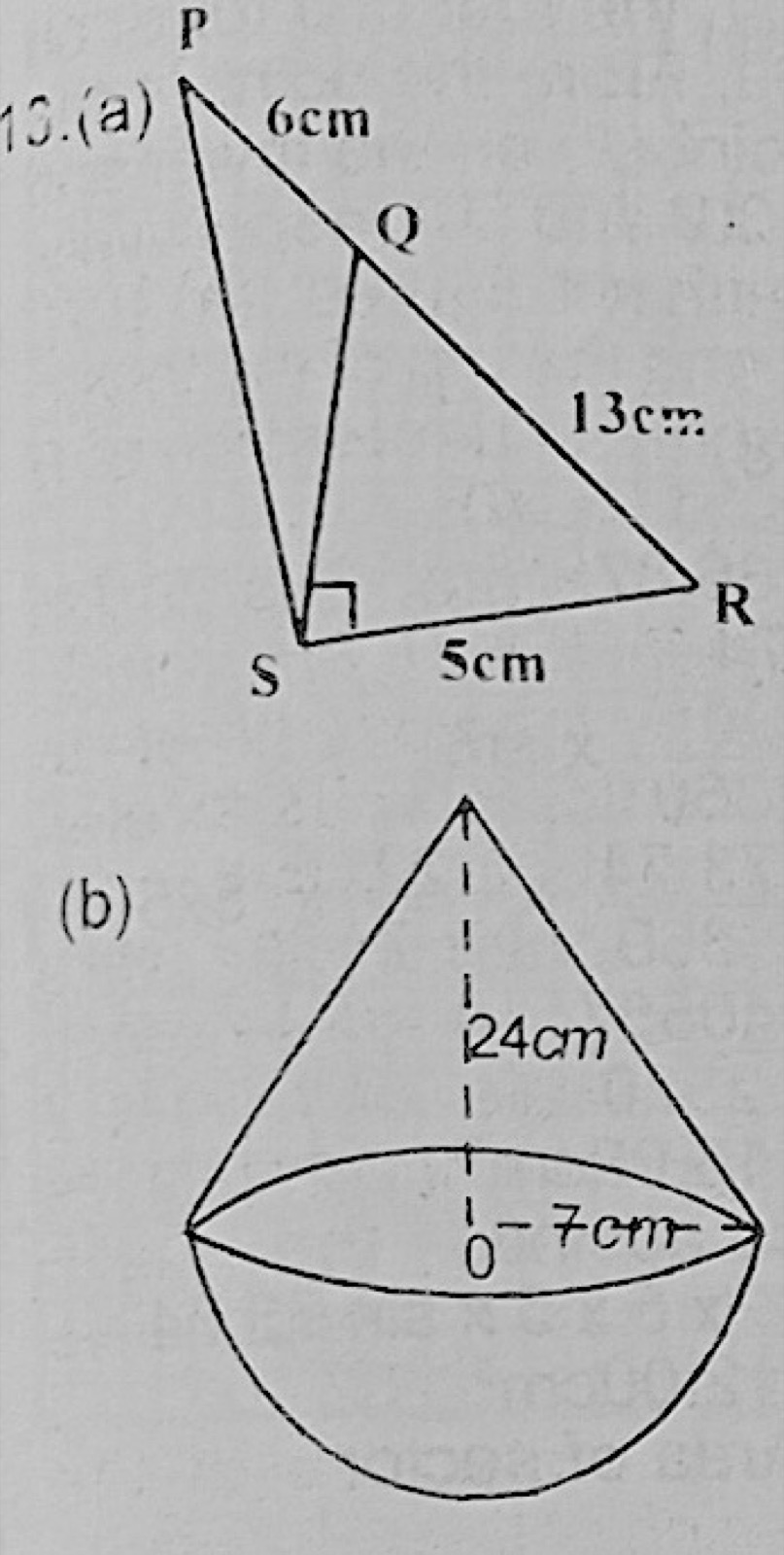
(a) In the diagram, |PQ| = 6 cm, |QR| = 13 cm, |RS| = 5 cm and ∠RSQ is a right angle. Calculate, correct to one decimal place, |PS|. (b) The diagram shows a wooden structure in the form of a cone mounted on a hemispherical base. The vertical height of the cone is 24 cm and the base radius 7cm. Calculate, correct to 3 significant figures, the surface area of the structure. [Take π = 22/7]
Show the model answer
Model answer
(a) |SQ| = √(132 − 52) = 12 cm. cos ∠SQR = 12/13. P, Q, R are on a straight line, so cos ∠PQS = −12/13. |PS|2 = 62 + 122 − 2(6)(12)(−12/13) = 180 + 132.9 = 312.9, so |PS| ≈ 17.7 cm. (b) Slant height = √(242 + 72) = 25 cm. Cone curved surface = 22/7 × 7 × 25 = 550 cm2; hemisphere curved surface = 2 × 22/7 × 72 = 308 cm2. Surface area = 858 cm2.
Explanation
Only the curved surfaces are on the outside; the flat circle is hidden where the two parts join.