A cylindrical container has a base radius of 14 cm and height 18 cm. How many litres, correct to the nearest litre, of liquid can it hold? [Take π = 22/7]
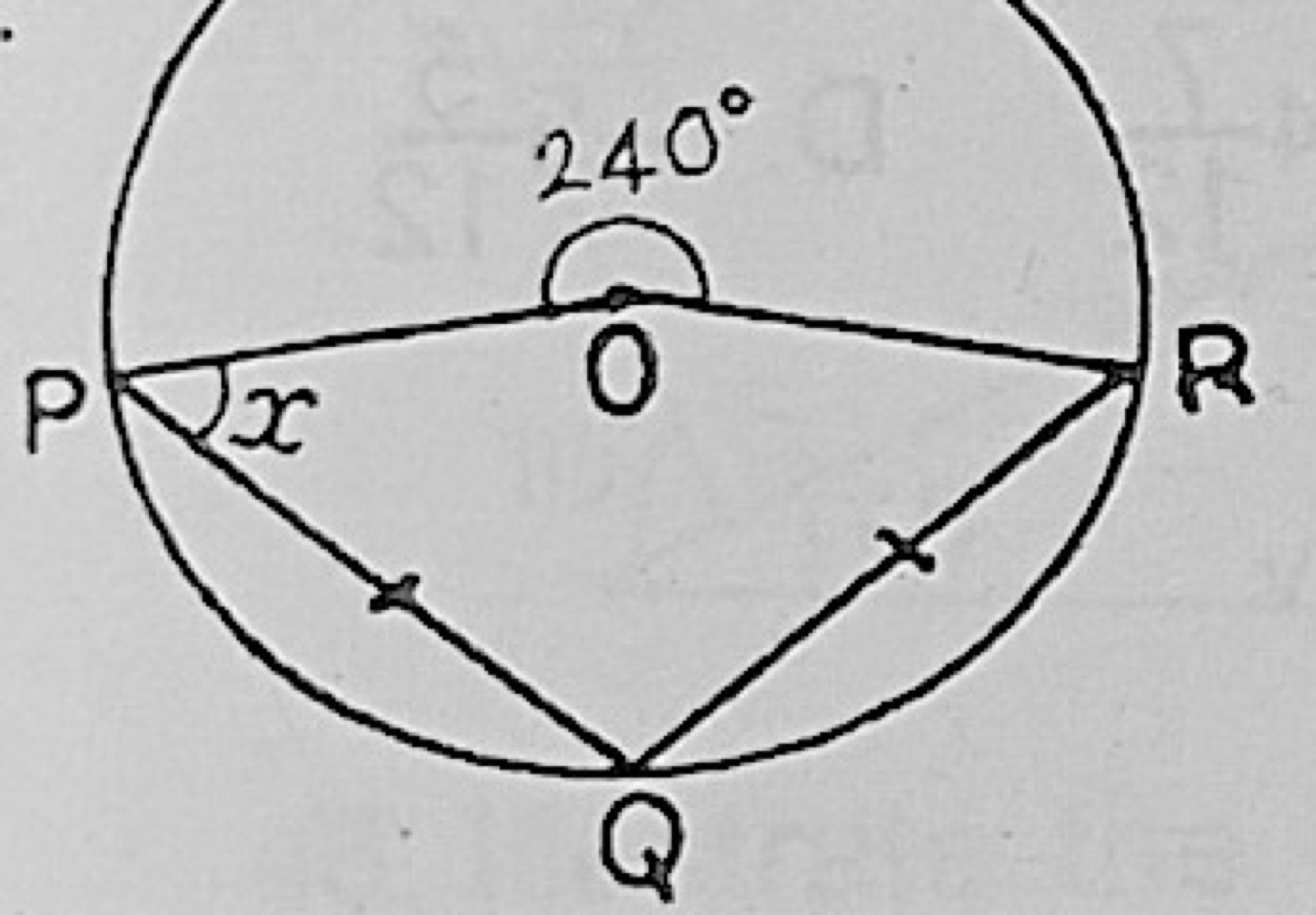
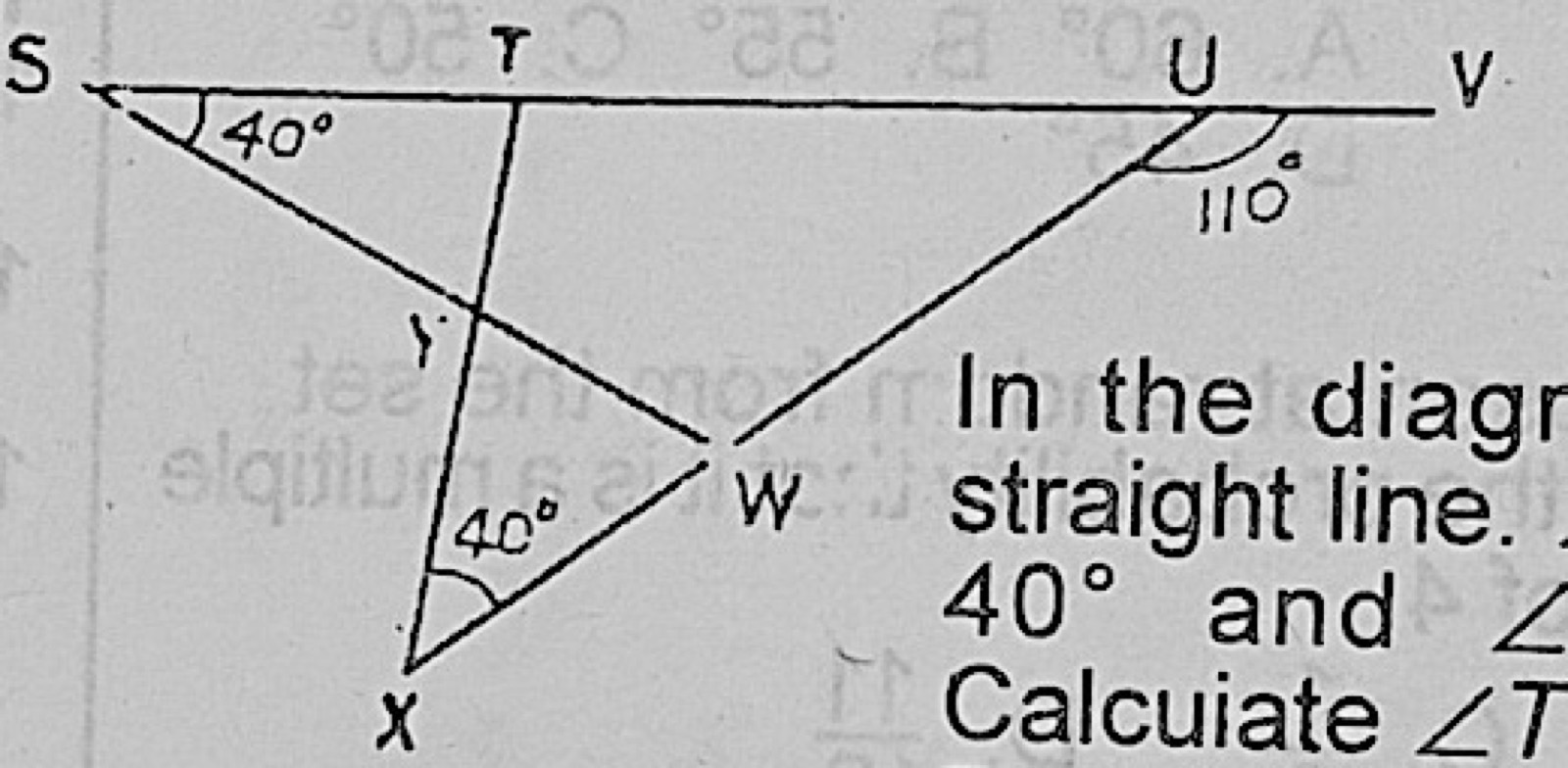
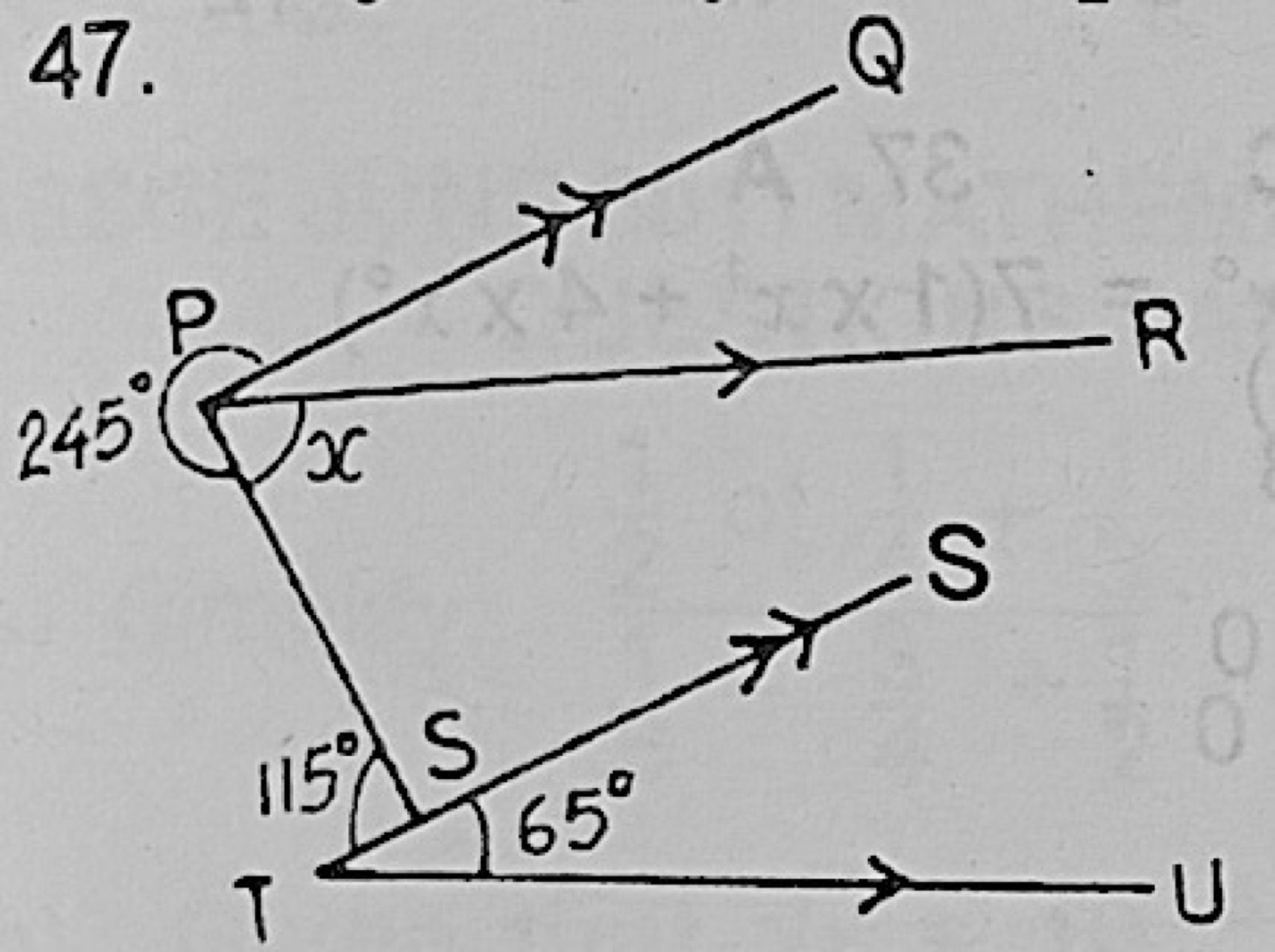
Find the size of the angle marked x in the diagram.
A.108°
B.112°
C.128°
D.142°
Show the answer and explanation
Answer: C (128°)
Explanation
Both slanting lines are perpendicular to the same line, so they are parallel. The slanting line makes 52° with the crossing line at the bottom, so it makes 52° with it at the top (alternate angles). x is on a straight line with that angle: x = 180° − 52° = 128°.
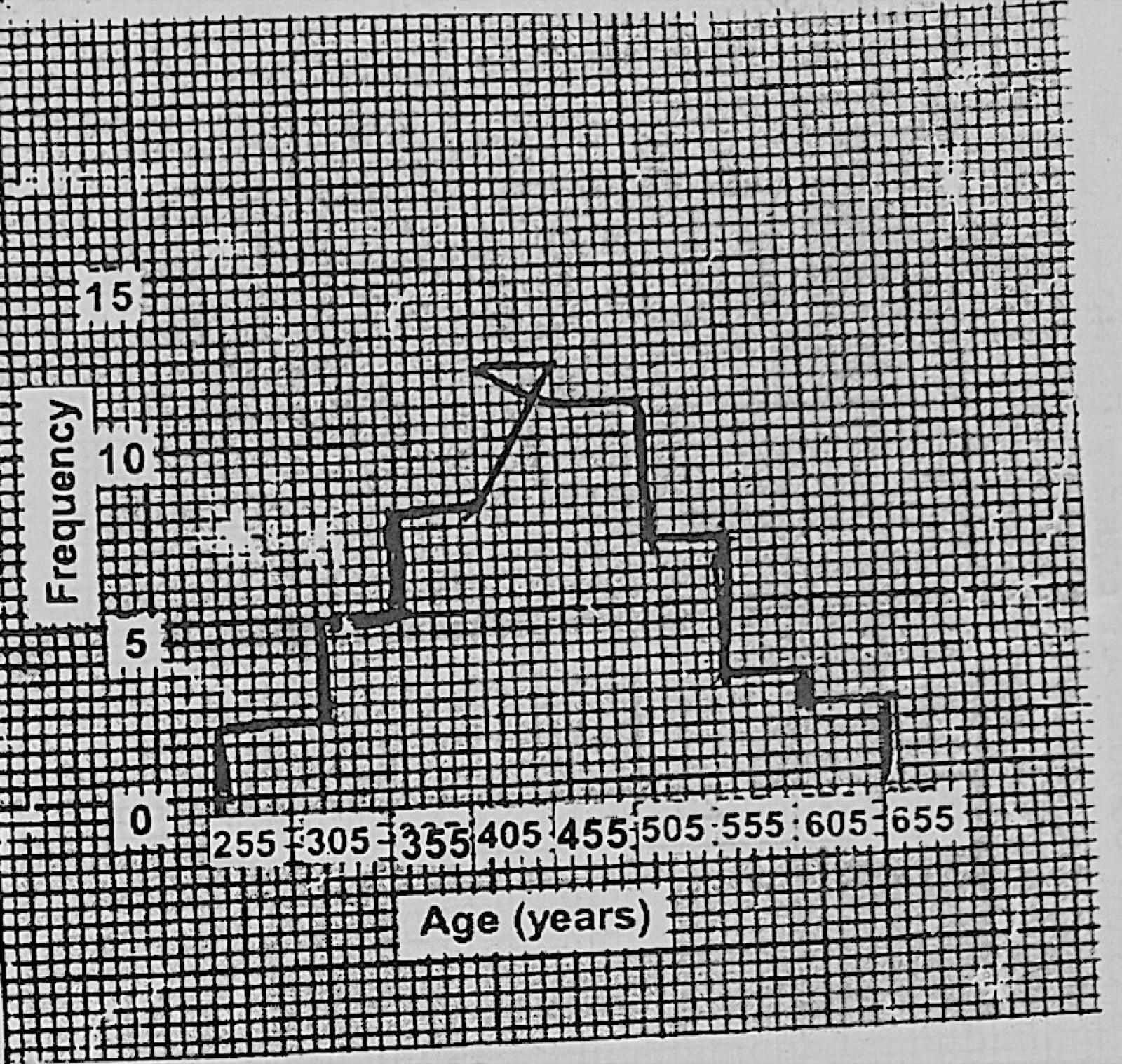
The histogram shows the age distribution of members of a club. What is their modal age?
A.44.5
B.42.5
C.41.5
D.40.5
Show the answer and explanation
Answer: A (44.5)
Explanation
The tallest bar is the 40.5–45.5 class. The crossed lines drawn from its top corners to the neighbouring bars meet near 44.5 years, which is the estimated mode.
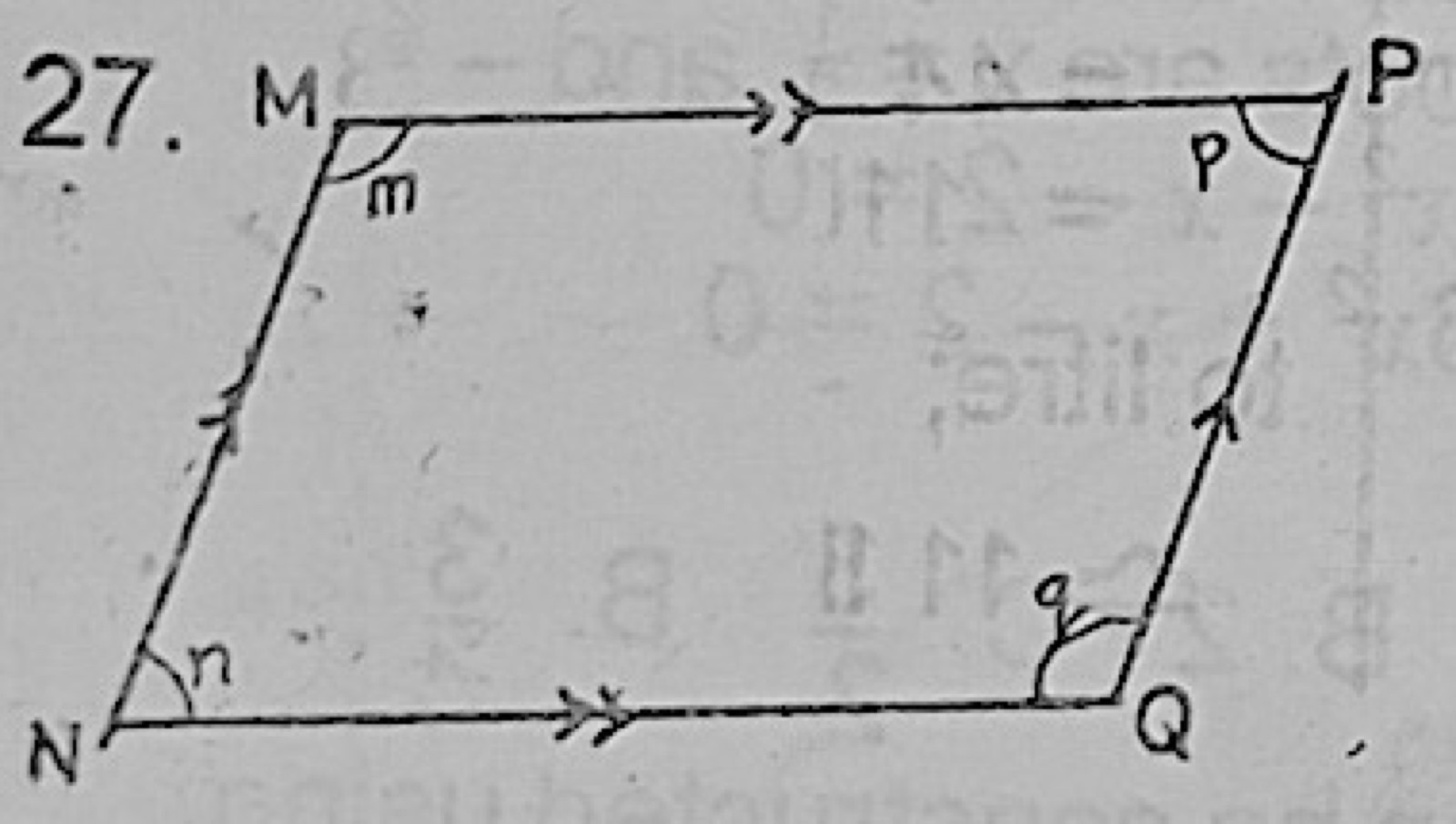
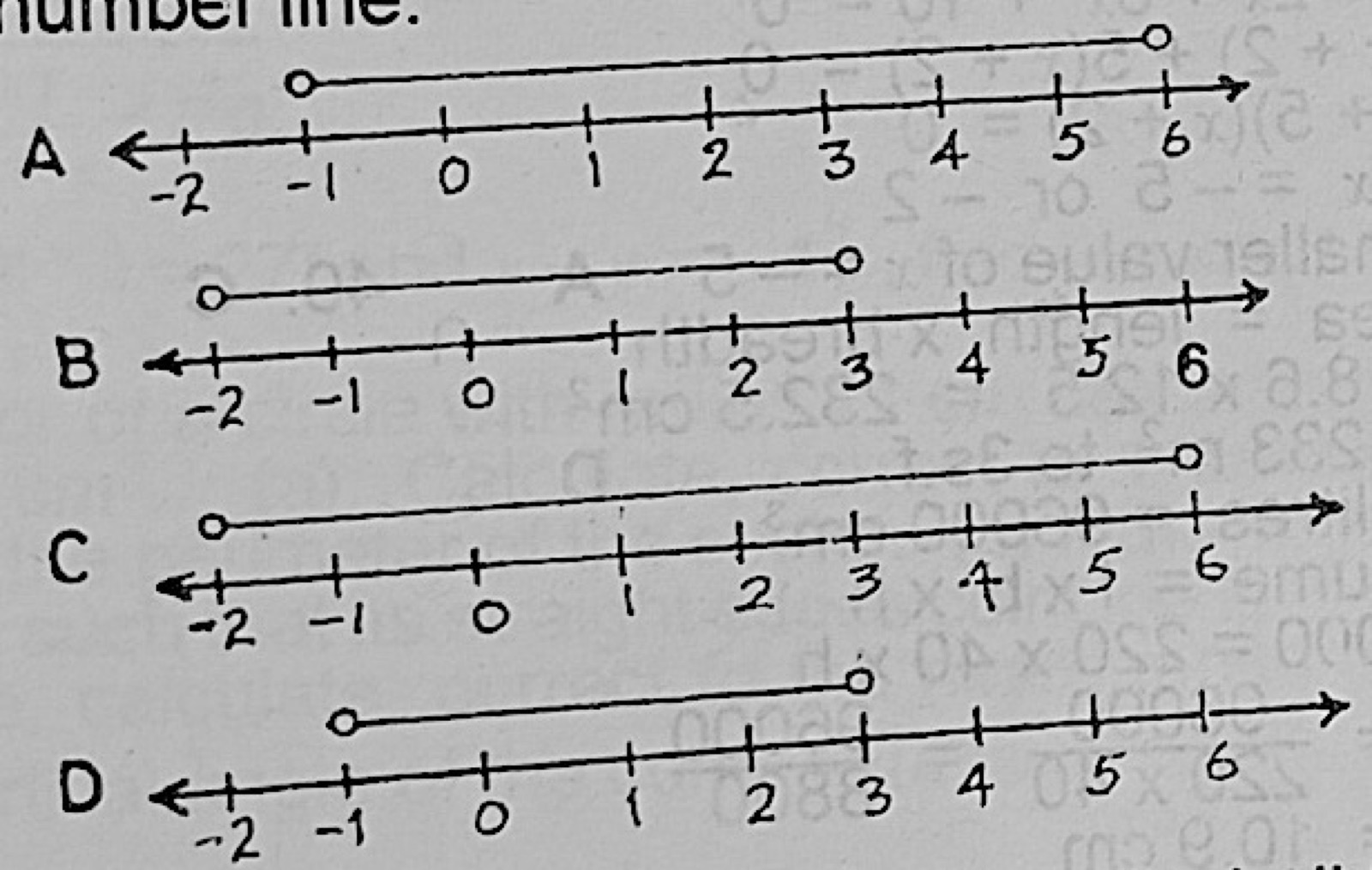
From the diagram, which of the following statements are true? I. m = q II. n = q III. n + p = 180° IV. p + m = 180°
A.I and III
B.I and IV
C.II and III
D.II and IV
Show the answer and explanation
Answer: B (I and IV)
Explanation
MNQP is a parallelogram (both pairs of sides parallel). Opposite angles are equal, so m = q (I), and neighbouring angles add to 180°, so p + m = 180° (IV).
John pours 96 litres of red oil into a rectangular container with length 220 cm and breadth 40 cm. Calculate, correct to the nearest cm, the height of the oil in the container.
In a quiz competition, a student answers n questions correctly and was given D(n + 50) for each question correctly answered. If he gets D600.00 altogether, how many questions did he answer correctly?
A.18
B.15
C.12
D.10
Show the answer and explanation
Answer: D (10)
Explanation
n(n + 50) = 600, so n2 + 50n − 600 = 0 and (n + 60)(n − 10) = 0. n cannot be negative, so n = 10.
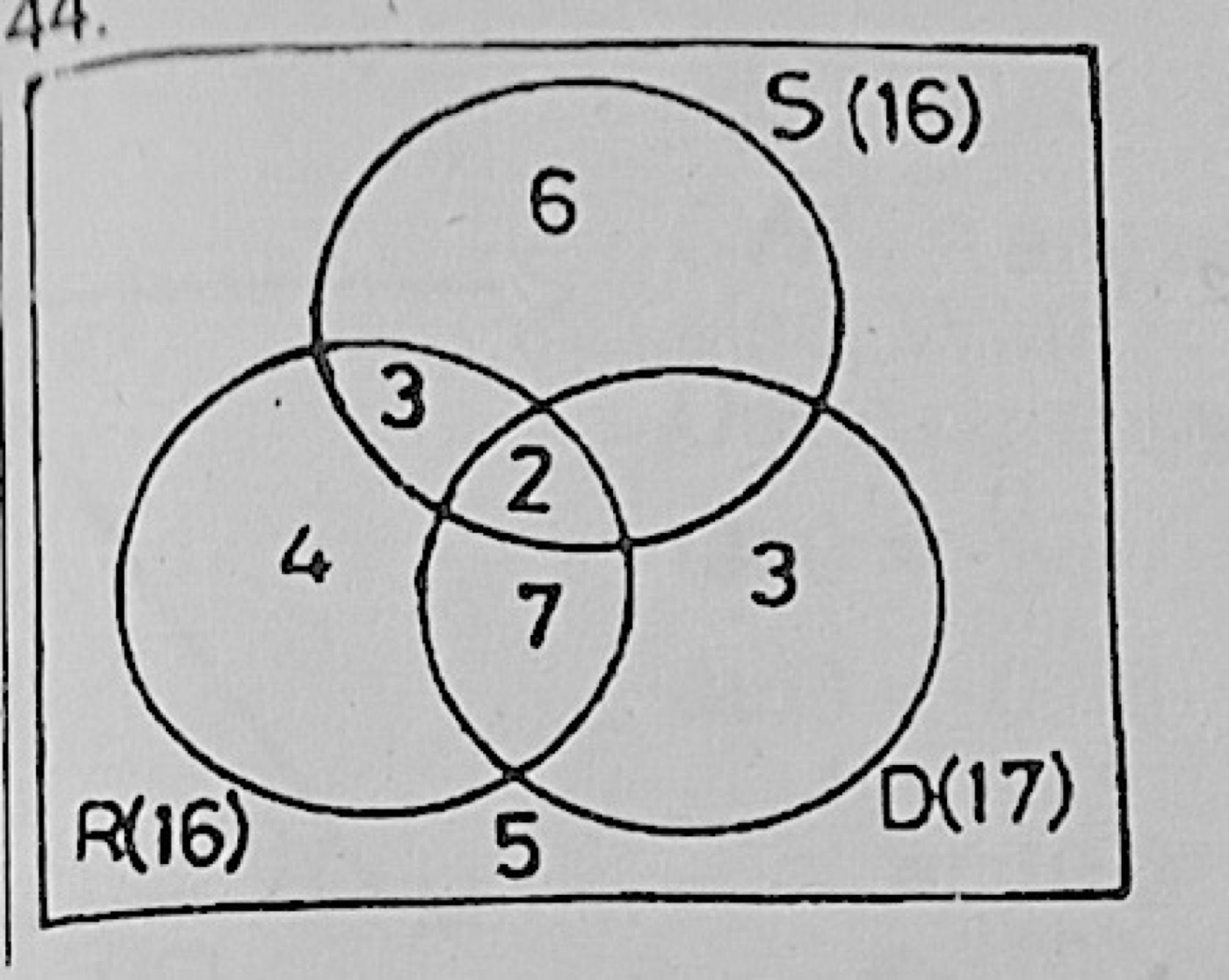
The Venn diagram shows the number of students in a class who like reading (R), dancing (D) and swimming (S). How many students like dancing and swimming?
A.7
B.9
C.11
D.13
Show the answer and explanation
Answer: A (7)
Explanation
S has 16 students: 6 + 3 + 2 + (S and D only) = 16, so S and D only = 5 (the 5 in the diagram). Dancing and swimming = 2 + 5 = 7.
A shopkeeper allows a discount of 15% on the marked price of a mobile phone. If a customer paid GH¢170.00 for a mobile phone, what was the marked price of the phone?
A.GH¢144.50
B.GH¢195.40
C.GH¢200.00
D.GH¢225.00
Show the answer and explanation
Answer: C (GH¢200.00)
Explanation
After a 15% discount the customer pays 85% of the marked price. Marked price = 170 × 100/85 = GH¢200.00.
A boy looks through a window of a building and sees a mango fruit on the ground 50 m away from the foot of the building. If the window is 9 m from the ground, calculate, correct to the nearest degree, the angle of depression of the mango from the window.
A sector of a circle with radius 21 cm has an area of 280 cm2. (a) Calculate, correct to 1 decimal place, the perimeter of the sector. (b) If the sector is bent such that its straight edges coincide to form a cone, calculate, correct to the nearest degree, the vertical angle of the cone. [Take π = 22/7]
Show the model answer
Model answer
(a) Area = ½ × r × arc, so arc = 2 × 280/21 = 26.67 cm (the angle is about 72.7°). Perimeter = 26.67 + 21 + 21 ≈ 68.7 cm. (b) The arc becomes the base circumference: 2 × 22/7 × r = 26.67, so r ≈ 4.24 cm. The slant height is 21 cm. sin(half the vertical angle) = 4.24/21 ≈ 0.202, so half-angle ≈ 11.7°. Vertical angle ≈ 23°.
Explanation
The radius of the sector becomes the slant height of the cone.
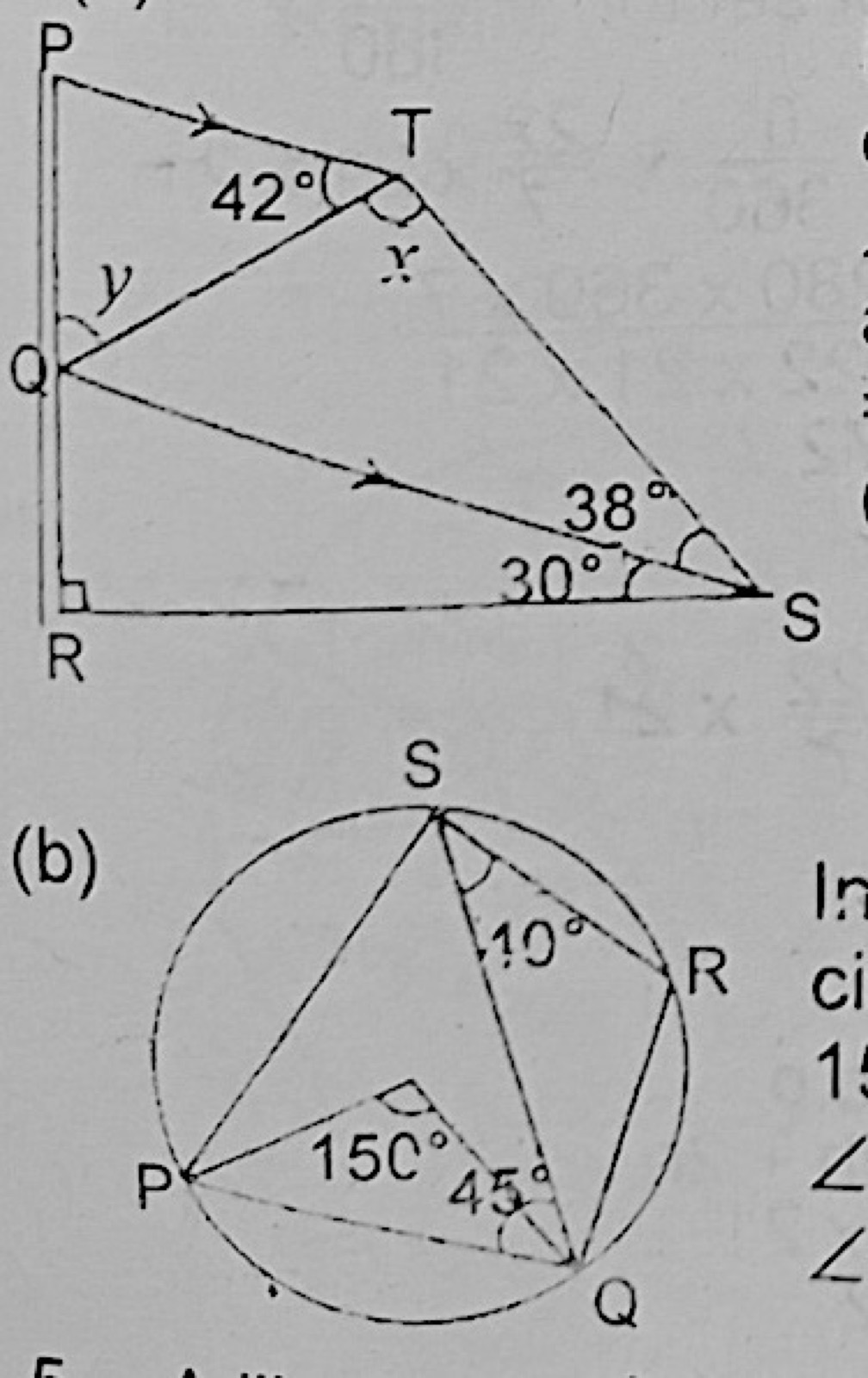
(a) In the diagram, PQRST is a quadrilateral. PT//QS, ∠PTQ = 42°, ∠TSQ = 38° and ∠QSR = 30°. If ∠QTS = x and ∠PQT = y, find: (i) x; (ii) y. (b) In the diagram, PQRS is a circle centre O. If PÔQ = 150°, ∠QSR = 40° and ∠SQP = 45°, calculate ∠RQS.
Show the model answer
Model answer
(a)(i) PT ∥ QS, so ∠TQS = ∠PTQ = 42° (alternate). In ΔQTS: x = 180° − 42° − 38° = 100°. (ii) In ΔQRS (right angle at R): ∠RQS = 180° − 90° − 30° = 60°. P, Q, R are on a straight line, so y = 180° − 60° − 42° = 78°. (b) ∠PSQ = ½ × 150° = 75° (angle at centre). ∠PSR = 75° + 40° = 115°. Opposite angles of cyclic PQRS: ∠PQR = 180° − 115° = 65°. ∠RQS = 65° − 45° = 20°.
Explanation
The angle at the centre is twice the angle at the circumference.
A library received a $1,300 grant. It spends 10% of the grant on magazine subscriptions, 35% on new books, 15% to repair damaged books, 30% to buy new furniture and 10% to train library staff. (a) Represent this information on a pie chart. (b) Calculate, correct to the nearest whole number, the percentage increase of the amount for buying new books over that of new furniture.
Show the model answer
Model answer
(a) Angles = percentage × 3.6°: magazines 36°, new books 126°, repairs 54°, furniture 108°, training 36°. Draw and label the pie chart. (b) New books = 35% of $1,300 = $455; furniture = 30% of $1,300 = $390. Increase = 65/390 × 100% ≈ 16.7% ≈ 17%.
Explanation
Percentage increase is measured against the smaller amount (furniture).
In a class of 40 students, 18 passed Mathematics, 19 passed Accounts, 16 passed Economics, 5 Mathematics and Accounts only, 6 Mathematics only, 9 Accounts only, 2 Accounts and Economics only. If each student offered at least one of the subjects, (a) how many students failed in all the subjects? (b) find the percentage number who failed in at least one of Economics and Mathematics; (c) calculate the probability that a student at random failed in Accounts.
Show the model answer
Model answer
Let x passed all three. Accounts: 9 + 5 + 2 + x = 19, so x = 3. Mathematics and Economics only = 18 − 6 − 5 − 3 = 4. Economics only = 16 − 2 − 3 − 4 = 7. (a) Passed at least one = 6 + 9 + 7 + 5 + 2 + 4 + 3 = 36, so 40 − 36 = 4 failed all. (b) Passed both Economics and Mathematics = 4 + 3 = 7, so 40 − 7 = 33 failed at least one of them: 33/40 × 100% = 82.5%. (If read as failing both: 40 − n(M ∪ E) = 40 − 27 = 13, i.e. 32.5%.) (c) Failed Accounts = 40 − 19 = 21; probability = 21/40.
Explanation
Fill in the Venn diagram from the 'only' numbers first, then use the totals.
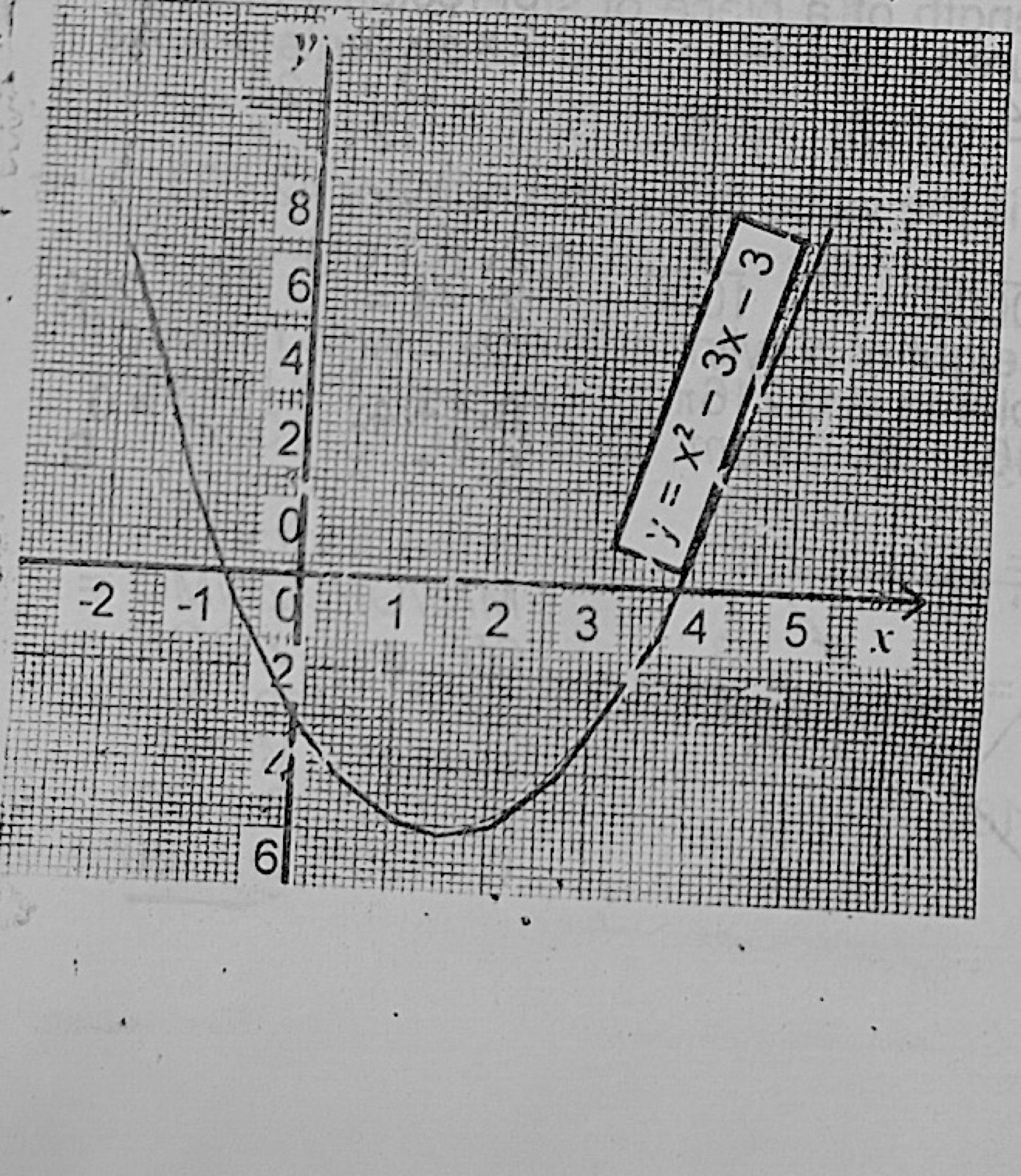
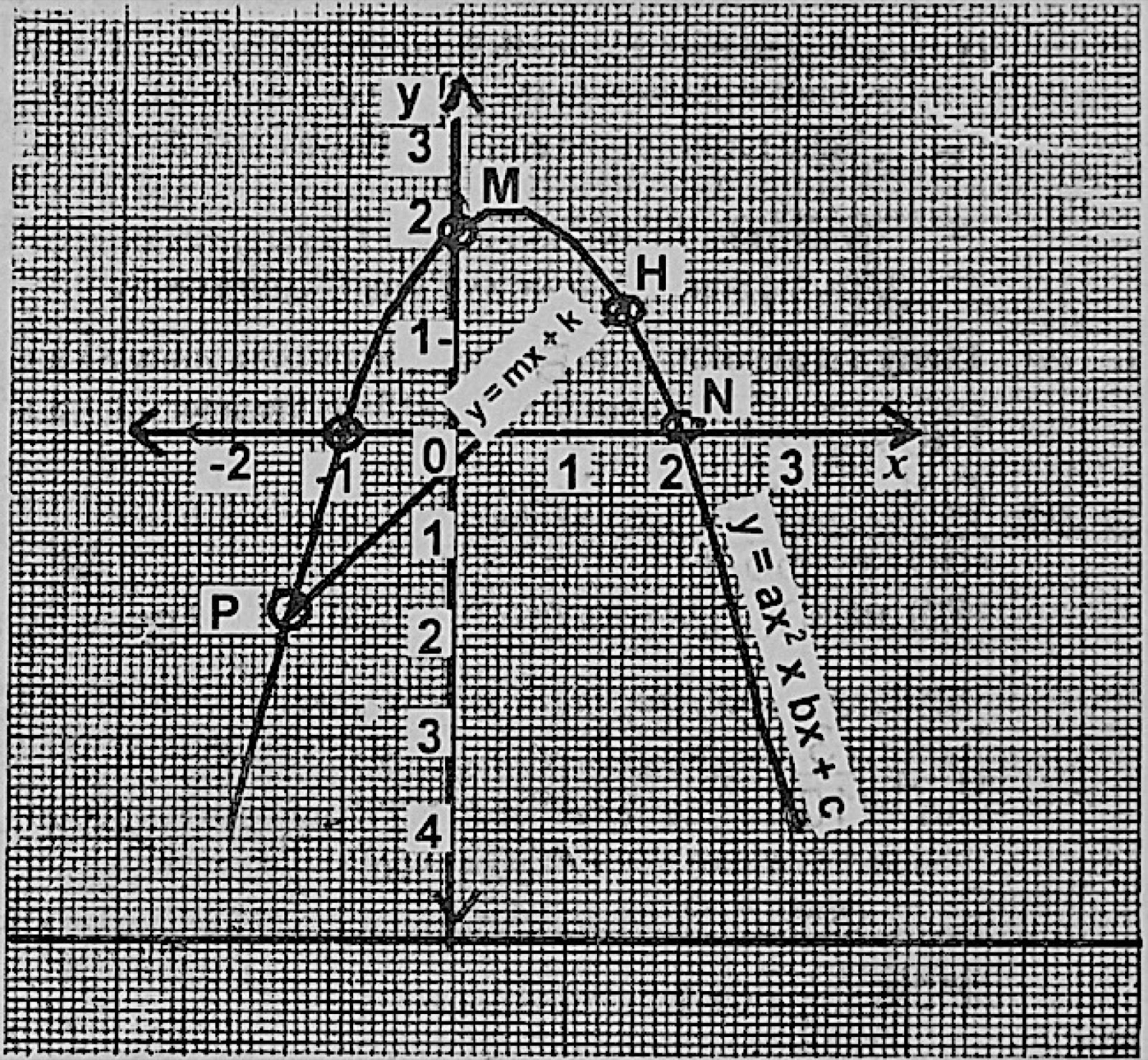
(a) Divide (x2 − 4)/(x2 + x) by (x2 − 4x + 4)/(x + 1). (b) The diagram shows the graphs of y = ax2 + bx + c and y = mx + k where a, b, c, m and k are constants. Use the graph(s) to: (i) find the roots of the equation ax2 + bx + c = mx + k; (ii) determine the values of a, b and c using the coordinates of points L, M and N and hence write down the equation of the curve; (iii) determine the line of symmetry of the curve y = ax2 + bx + c.
Show the model answer
Model answer
(a) (x − 2)(x + 2)/[x(x + 1)] × (x + 1)/(x − 2)2 = (x + 2)/[x(x − 2)]. (b)(i) The graphs meet at P and H: x ≈ −1.5 and x ≈ 1.5. (ii) L(−1, 0), M(0, 2), N(2, 0). M gives c = 2. L: a − b + 2 = 0; N: 4a + 2b + 2 = 0. Solving: a = −1, b = 1. Curve: y = −x2 + x + 2. (iii) The line of symmetry is halfway between the roots −1 and 2: x = 0.5.
Explanation
Substitute each point's coordinates into y = ax2 + bx + c.
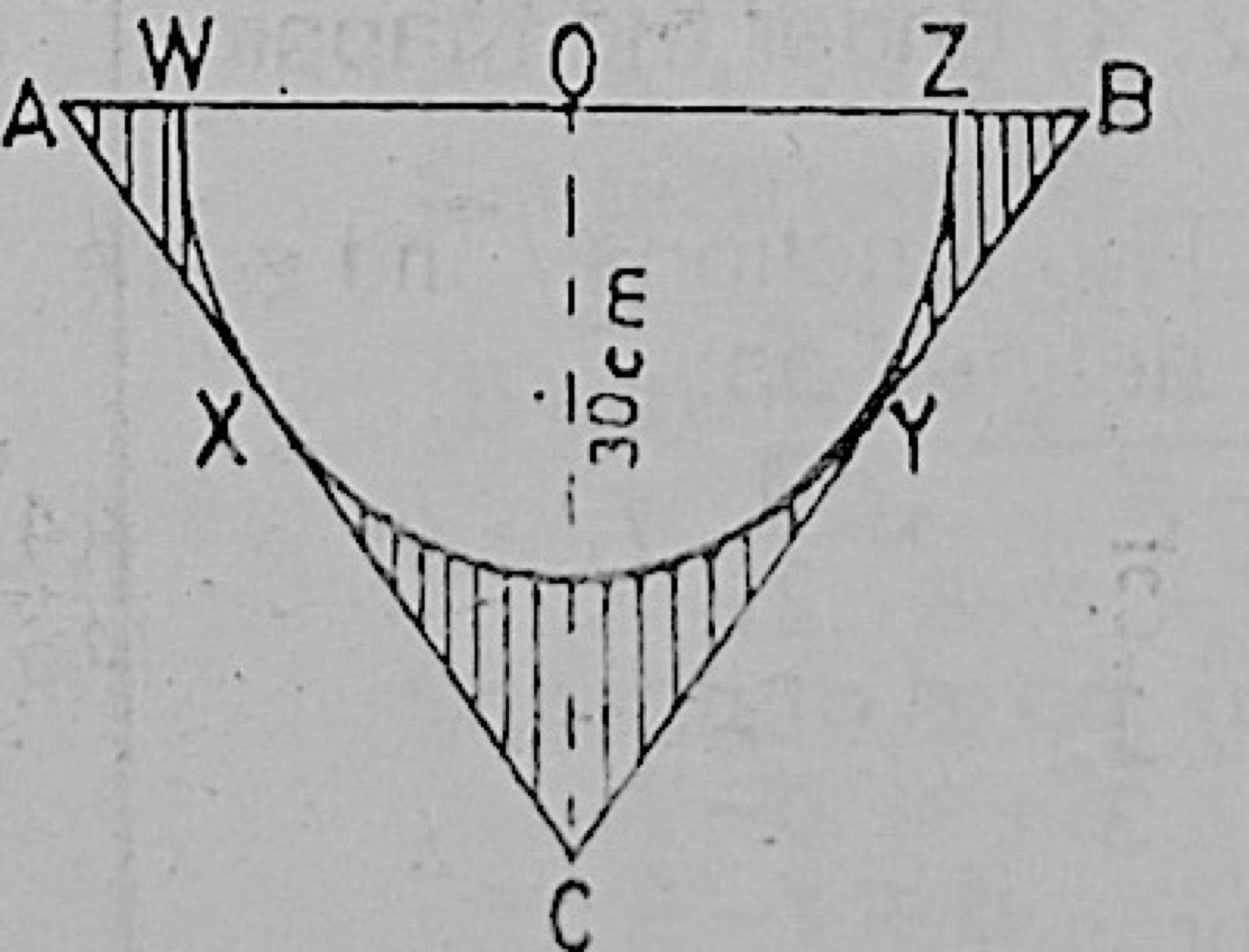
(a) Given that sin x = 0.6 and 0° ≤ x ≤ 90°, evaluate 2 cos x + 3 sin x, leaving your answer in the form m/n where m and n are integers. (b) In the diagram, a semi-circle WXYZ with centre O is inscribed in an isosceles triangle ABC. If |AC| = |BC|, |OC| = 30 cm and ∠ACB = 130°, calculate, correct to one decimal place, (i) radius of the circle; (ii) area of the shaded portion. (Take π = 22/7)
Show the model answer
Model answer
(a) cos x = √(1 − 0.36) = 0.8. 2(0.8) + 3(0.6) = 3.4 = 17/5. (b)(i) OC bisects ∠ACB, so ∠OCY = 65°. The radius OY is perpendicular to the tangent CB: r = 30 sin 65° ≈ 27.2 cm. (ii) OA = 30 tan 65° ≈ 64.3 cm. Area of ΔABC = ½ × 2(64.34) × 30 ≈ 1930.1 cm2. Semicircle = ½ × 22/7 × 27.192 ≈ 1161.7 cm2. Shaded area ≈ 1930.1 − 1161.7 ≈ 768.4 cm2 (767.5 cm2 if r = 27.2 is used).
Explanation
The radius to a point of contact is perpendicular to the tangent.
Using ruler and a pair of compasses only, (a) construct a rhombus PQRS of side 7 cm and ∠PQR = 60°; (b) locate point X such that X lies on the locus of points equidistant from PQ and QR and also equidistant from Q and R; (c) Measure |XR|.
Show the model answer
Model answer
(a) Draw QR = 7 cm; construct 60° at Q and mark QP = 7 cm; with centres P and R, radius 7 cm, find S. Join PS and RS. (b) Bisect ∠PQR (points equidistant from PQ and QR) and draw the perpendicular bisector of QR (points equidistant from Q and R). X is where they meet. (c) |XR| ≈ 4.0 cm (exactly 3.5/cos 30° ≈ 4.04 cm).
(a) The total surface area of two spheres are in the ratio 9:49. If the radius of the smaller sphere is 12 cm, find, correct to the nearest cm3, the volume of the bigger sphere. (b) A cyclist starts from a point X and rides 3 km due West to a point Y. At Y, he changes direction and rides 5 km North-West to a point Z. (i) How far is he from the starting point, correct to the nearest km? (ii) Find the bearing of Z from X, to the nearest degree.
Show the model answer
Model answer
(a) r2 : R2 = 9 : 49, so r : R = 3 : 7 and R = 12 × 7/3 = 28 cm. Volume = 4/3 × 22/7 × 283 ≈ 91,989 cm3. (b)(i) ∠XYZ = 90° + 45° = 135°. XZ2 = 32 + 52 − 2(3)(5) cos 135° = 34 + 21.21 = 55.21, so XZ ≈ 7.43 ≈ 7 km. (ii) sin ∠YXZ = 5 sin 135°/7.43 ≈ 0.476, so ∠YXZ ≈ 28.4°. Bearing of Z from X = 270° + 28.4° ≈ 298°.
The table shows the scores obtained when a fair die was thrown a number of times. Score: 1, 2, 3, 4, 5, 6 Frequency: 2, 5, x, 11, 9, 10 If the probability of obtaining a 3 is 0.26, find the (a) median (b) standard deviation of the distribution.
Show the model answer
Model answer
x/(x + 37) = 0.26 → x = 0.26x + 9.62 → 0.74x = 9.62 → x = 13. Total = 50. (a) Median = average of 25th and 26th scores. Cumulative frequencies: 2, 7, 20, 31, … so both are 4: median = 4. (b) Mean = (2 + 10 + 39 + 44 + 45 + 60)/50 = 200/50 = 4. Σf(x − 4)2 = 2(9) + 5(4) + 13(1) + 11(0) + 9(1) + 10(4) = 100. SD = √(100/50) = √2 ≈ 1.41.
Explanation
Find x first from the probability, then use the full table.
(a) The area of trapezium PQRS is 60 cm2. PQ//RS, |PQ| = 15 cm, |RS| = 25 cm and ∠PSR = 30°. Calculate the (i) perpendicular height of PQRS; (ii) |PS|. (b) Ade received 3/5 of a sum of money, Nelly 1/3 of the remainder while Austin took the rest. If Austin's share is greater than Nelly's share by ₦3,000, how much did Ade receive?
Show the model answer
Model answer
(a)(i) 60 = ½(15 + 25) × h = 20h, so h = 3 cm. (ii) sin 30° = h/|PS|, so |PS| = 3/0.5 = 6 cm. (b) Let the sum be x. Remainder = 2x/5. Nelly = ⅓ × 2x/5 = 2x/15; Austin = 4x/15. 4x/15 − 2x/15 = 2x/15 = 3000, so x = ₦22,500. Ade received 3/5 × 22,500 = ₦13,500.
Explanation
Express each share as a fraction of the whole sum.
(a) P varies directly as Q and inversely as the square of R. If P = 1 when Q = 8 and R = 2, find the value of Q when P = 3 and R = 5. (b) An aeroplane flies from town A(20°N, 60°E) to town B(20°N, 20°E). (i) If the journey takes 6 hours, calculate, correct to 3 significant figures, the average speed of the aeroplane. (ii) If it then flies due north from town B to town C, 420 km away, calculate, correct to the nearest degree, the latitude of town C. [Take radius of the earth = 6400 km and π = 3.142]
Show the model answer
Model answer
(a) P = kQ/R2: 1 = 8k/4, so k = ½. Q = 2PR2 = 2 × 3 × 25 = 150. (b)(i) Longitude difference = 40°. Distance = 40/360 × 2 × 3.142 × 6400 × cos 20° ≈ 4199 km. Speed = 4199 ÷ 6 ≈ 700 km/h. (ii) Along a meridian: 420 = θ/360 × 2 × 3.142 × 6400, so θ ≈ 3.76°. Latitude of C ≈ 20° + 3.76° ≈ 24°N.
Explanation
Along a parallel of latitude the radius is R cos(latitude); along a meridian it is R.
(Questions 14 and 15 are for candidates in Ghana, Sierra Leone and The Gambia only.) (a) Using a scale of 2cm to 2 units on both axes, draw on a graph sheet two perpendicular axes OX and OY for the interval −8 ≤ x ≤ 8 and −8 ≤ y ≤ 8. (b) Draw clearly and label the vertices as appropriate: (i) triangle PQR with P(1, 2), Q(5, 3) and RQ = (2, −3); (ii) the image ΔP′Q′R′ of ΔPQR under a rotation of 180° about the origin where P → P′, Q → Q′ and R → R′; (iii) the image ΔP″Q″R″ of ΔP′Q′R′ under a reflection in the line x = 0 where P′ → P″, Q′ → Q″ and R′ → R″. (c) Describe fully a single transformation that maps ΔPQR onto ΔP″Q″R″.
Show the model answer
Model answer
(b)(i) R = Q − RQ = (5 − 2, 3 + 3) = (3, 6). Plot P(1, 2), Q(5, 3), R(3, 6). (ii) (x, y) → (−x, −y): P′(−1, −2), Q′(−5, −3), R′(−3, −6). (iii) Reflection in x = 0 (the y-axis): (x, y) → (−x, y): P″(1, −2), Q″(5, −3), R″(3, −6). (c) PQR → P″Q″R″ is (x, y) → (x, −y): a reflection in the x-axis (the line y = 0).
Explanation
Combine the two rules: (x, y) → (−x, −y) → (x, −y).
(a) Find the image of (−2, 4) under the mapping (x, y) → (2x, y − 3x). (b) Two functions f and g are defined as: f: x → x2/4 − 9, g: x → 1/2x (x ≠ 0). (i) Evaluate f(4) + g(−1/3). (ii) If f × g = 2, solve for x.