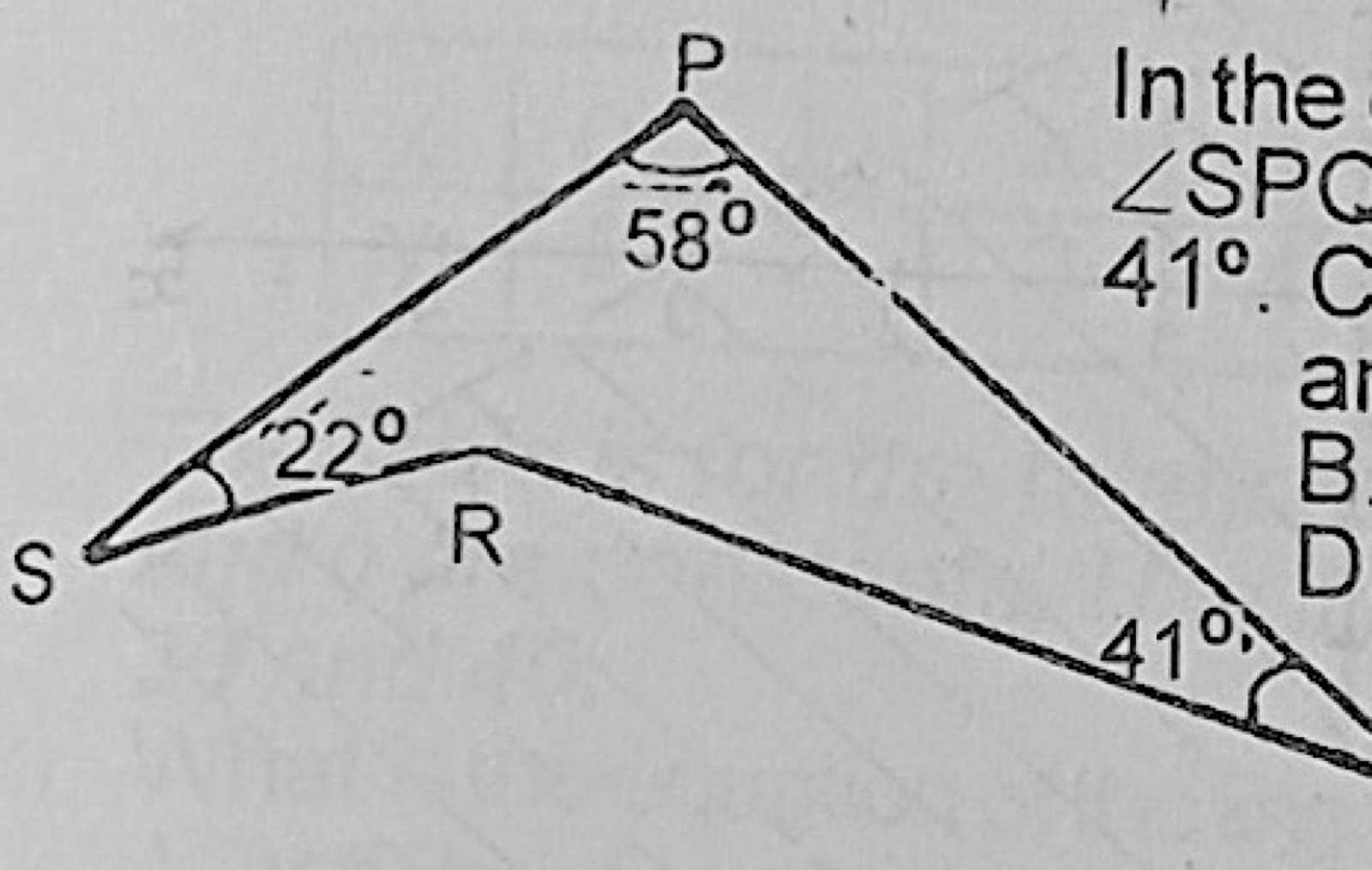
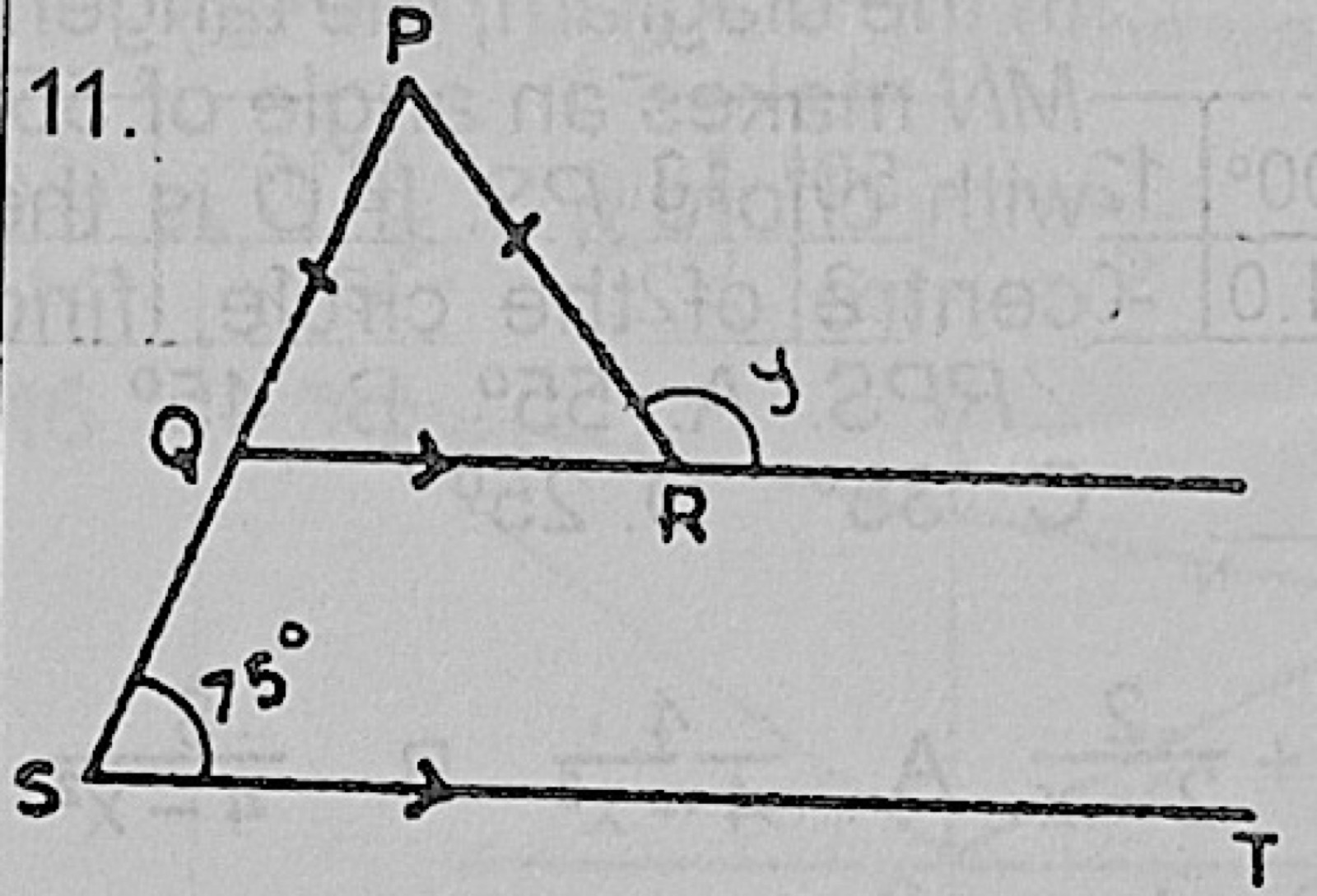
In the diagram, ∠PSR = 22°, ∠SPQ = 58° and ∠PQR = 41°. Calculate the obtuse angle QRS.
A.99°
B.100°
C.121°
D.165°
Show the answer and explanation
Answer: C (121°)
Explanation
Extend SR to meet PQ at X. In triangle PSX the exterior angle at X is 22° + 58° = 80°. In triangle XRQ the obtuse angle QRS is an exterior angle: 80° + 41° = 121°.
The table shows the number of pets kept by 30 students in a class. Number of pets: 0, 1, 2, 3, 4 Number of students: 8, 4, 5, 10, 3 If a student is picked at random from the class, what is the probability that he/she kept more than one pet?
A.1/5
B.2/5
C.3/5
D.4/5
Show the answer and explanation
Answer: C (3/5)
Explanation
Students with 2, 3 or 4 pets: 5 + 10 + 3 = 18. Probability = 18/30 = 3/5.
The table is for the relation y = mx + c where m and c are constants. x: 0, 2, 4, 6 y: 1, 2, 3, 4 What is the equation of the line described in the table?
A.y = 2x
B.y = x + 1
C.y = x
D.y = ½x + 1
Show the answer and explanation
Answer: D (y = ½x + 1)
Explanation
When x = 0, y = 1, so c = 1. y rises by 1 when x rises by 2, so m = ½: y = ½x + 1.
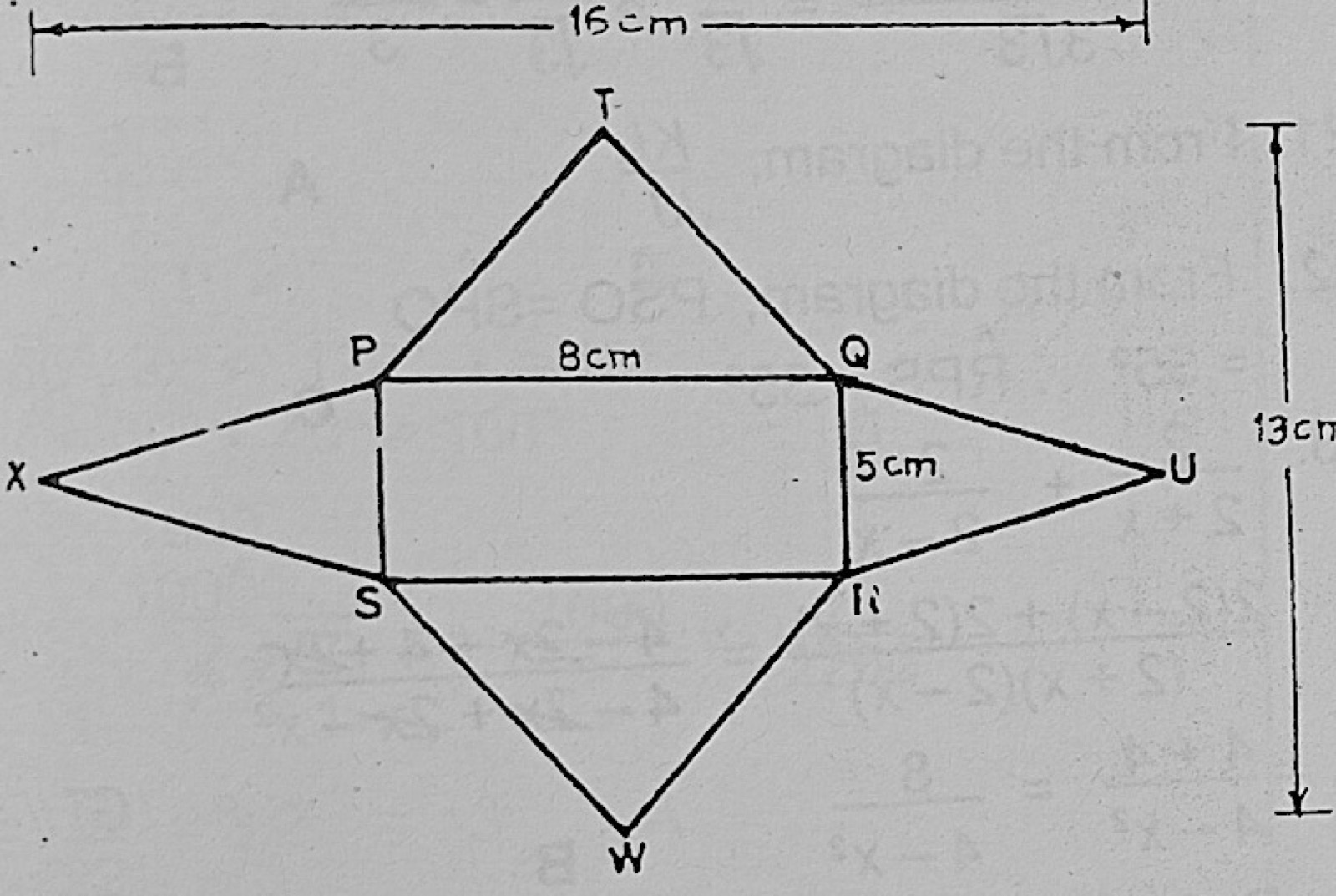
The diagram is a net of a right rectangular pyramid. Calculate the total surface area.
A.208 cm2
B.112 cm2
C.92 cm2
D.76 cm2
Show the answer and explanation
Answer: C (92 cm2)
Explanation
Base 8 × 5 = 40. The triangles on the 5 cm sides have height (16 − 8)/2 = 4 cm and those on the 8 cm sides have height (13 − 5)/2 = 4 cm. Total = 40 + 2(½ × 5 × 4) + 2(½ × 8 × 4) = 40 + 20 + 32 = 92 cm2.
The subtraction below is in base seven. Find the missing number. 5162 − 2644 = 2*15
A.2
B.3
C.4
D.5
Show the answer and explanation
Answer: A (2)
Explanation
In base seven: 2 − 4 needs a borrow: 9 − 4 = 5; then 5 − 4 = 1; then 1 − 6 needs a borrow: 8 − 6 = 2; then 4 − 2 = 2. So 5162 − 2644 = 2215 and the missing digit is 2.
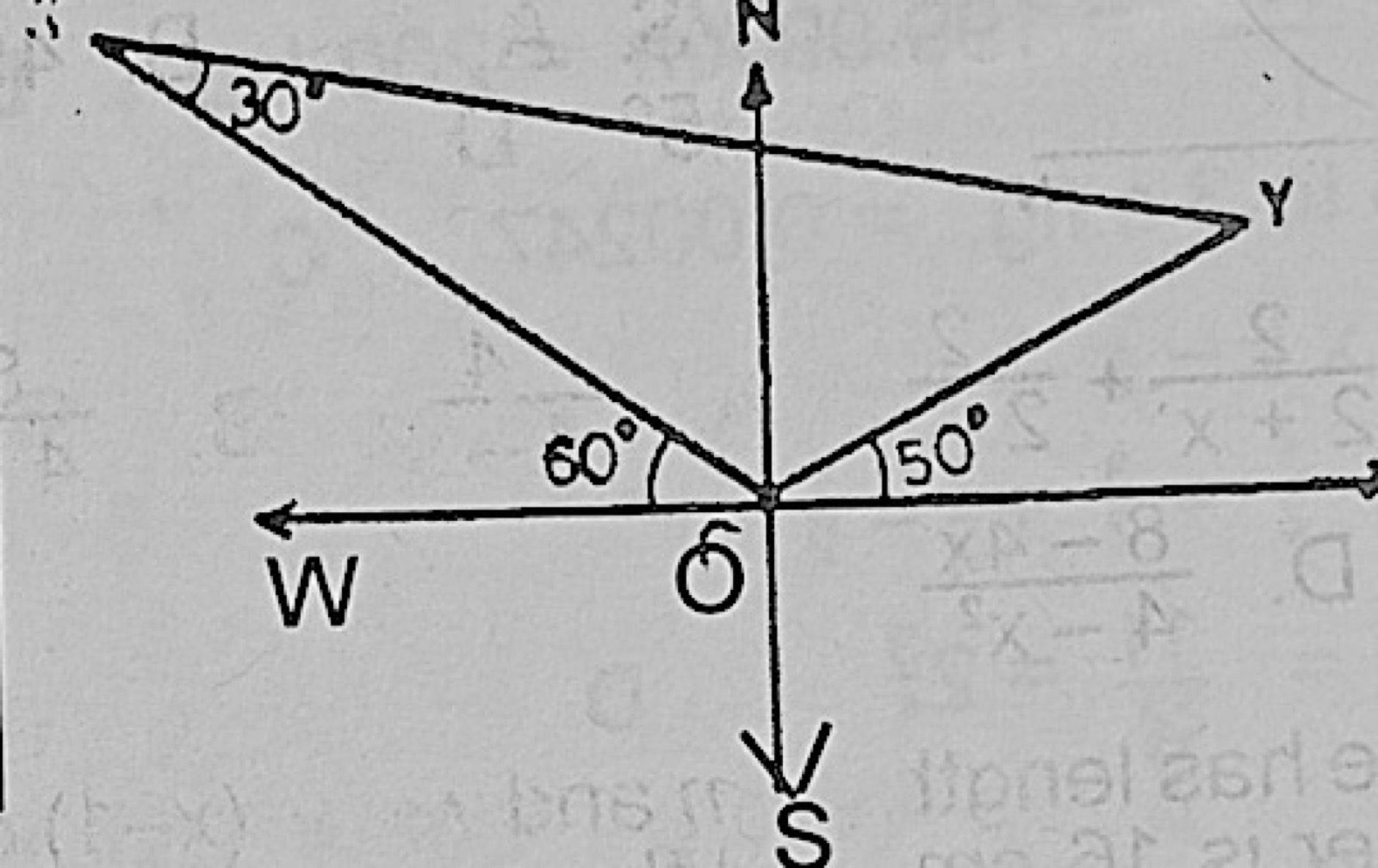
In the diagram, ∠WOX = 60°, ∠YOE = 50° and ∠OXY = 30°. What is the bearing of X from Y?
A.300°
B.240°
C.190°
D.150°
Show the answer and explanation
Answer: A (300°)
Explanation
∠XOY = 180° − 60° − 50° = 70°, so ∠OYX = 80°. The bearing of O from Y is 040° + 180° = 220°, and X is 80° clockwise from that direction: 220° + 80° = 300°.
In an athletics competition, the probability that an athlete wins a 100 m race is 1/8 and the probability that he wins in high jump is 1/4. What is the probability that he wins only one of the events?
A = {2, 4, 6, 8}, B = {2, 3, 7, 9} and C = {x: 3 < x < 9} are subsets of the universal set U = {2, 3, 4, 5, 6, 7, 8, 9}. Find (a) A ∩ (B ∩ C); (b) (A ∪ B) ∩ (B ∪ C).
Show the model answer
Model answer
C = {4, 5, 6, 7, 8}. (a) B ∩ C = {7}; A ∩ {7} = ∅ (empty set). (b) A ∪ B = {2, 3, 4, 6, 7, 8, 9}; B ∪ C = {2, 3, 4, 5, 6, 7, 8, 9}. (A ∪ B) ∩ (B ∪ C) = {2, 3, 4, 6, 7, 8, 9}.
Explanation
List C first: the integers strictly between 3 and 9.
(a) The angle of depression of a boat from the mid-point of a vertical cliff is 35°. If the boat is 120 m from the foot of the cliff, calculate the height of the cliff. (b) Towns P and Q are x km apart. Two motorists set out at the same time from P to Q at steady speeds of 60 km/h and 80 km/h. The faster motorist got to Q 30 minutes earlier than the other. Find the value of x.
Show the model answer
Model answer
(a) Height of the mid-point = 120 tan 35° = 120 × 0.7002 ≈ 84.0 m. Height of cliff = 2 × 84.02 ≈ 168 m. (b) x/60 − x/80 = ½ (30 minutes). (4x − 3x)/240 = ½, so x = 120 km.
Explanation
The angle of depression equals the angle of elevation from the boat.
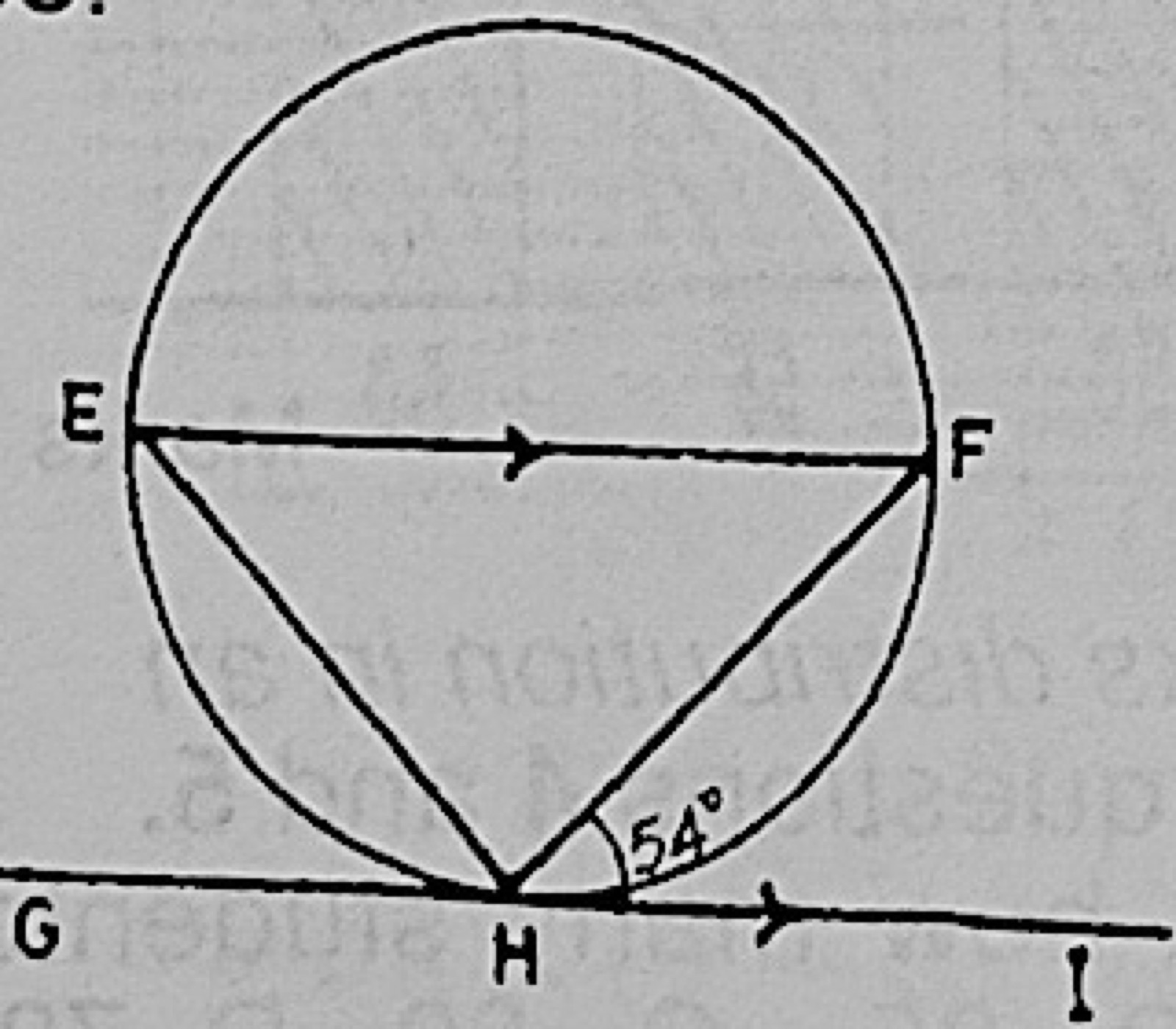
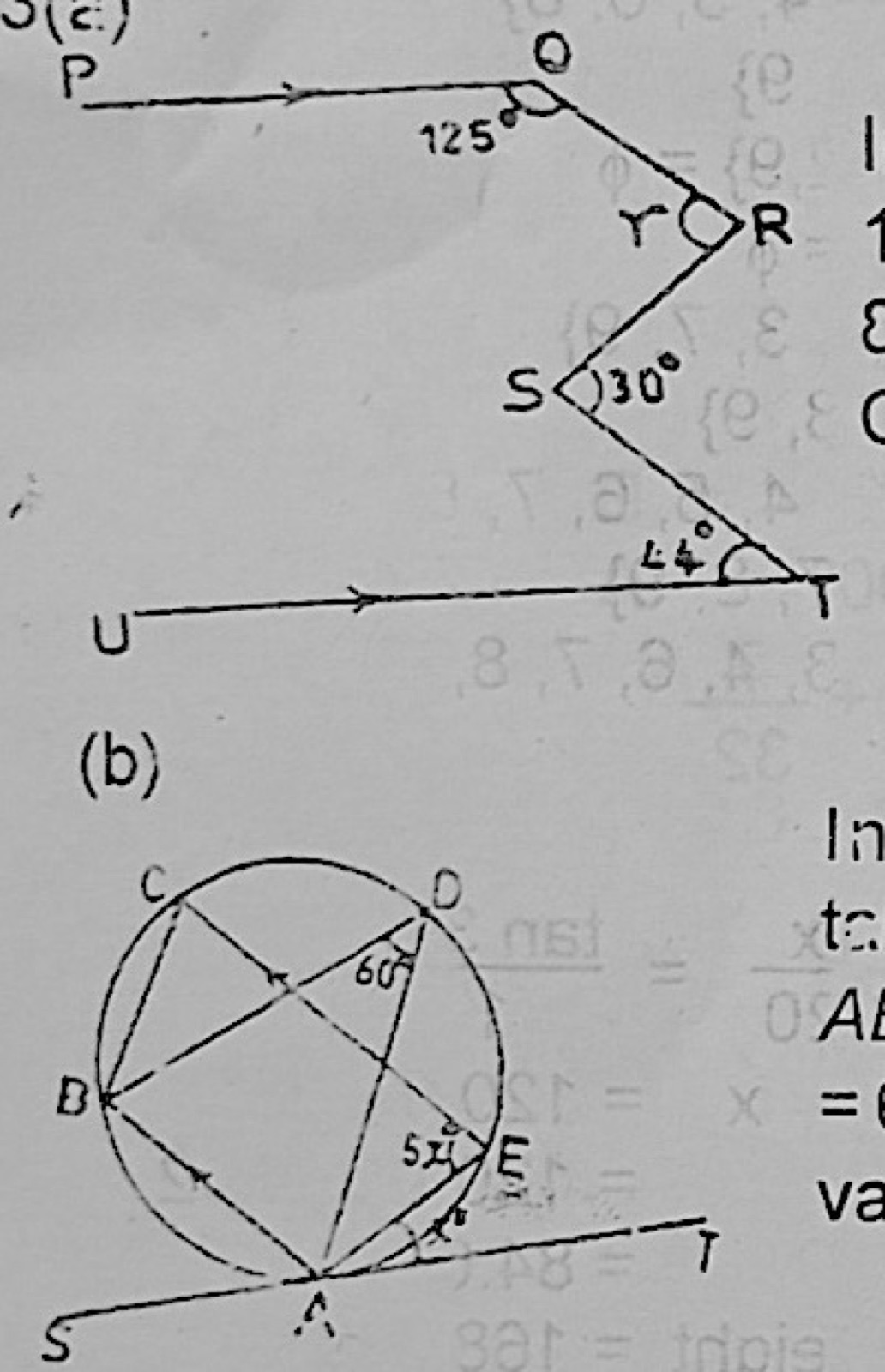
(a) In the diagram, ∠PQR = 125°, ∠QRS = r, ∠RST = 80° and ∠STU = 44°. Calculate the value of r. (b) In the diagram, TS is a tangent to the circle at A. AB//CE, ∠AEC = 5x°, ∠ADB = 60° and ∠TAE = x. Find the value of x.
Show the model answer
Model answer
(a) PQ ∥ UT. Draw lines through R and S parallel to them. QR makes 180° − 125° = 55° with the parallel through R. ST makes 44° with the parallel through S (alternate to ∠STU), so RS makes 80° − 44° = 36° with it, and also 36° at R. r = 55° + 36° = 91°. (b) ∠ACB = ∠ADB = 60° (same segment), so ∠SAB = 60° (alternate segment). On the straight line SAT: ∠BAE = 180° − 60° − x. AB ∥ CE, so ∠BAE + ∠AEC = 180° (co-interior): 120° − x + 5x = 180°, so x = 15°.
Explanation
Draw extra parallel lines through each corner of a zig-zag.
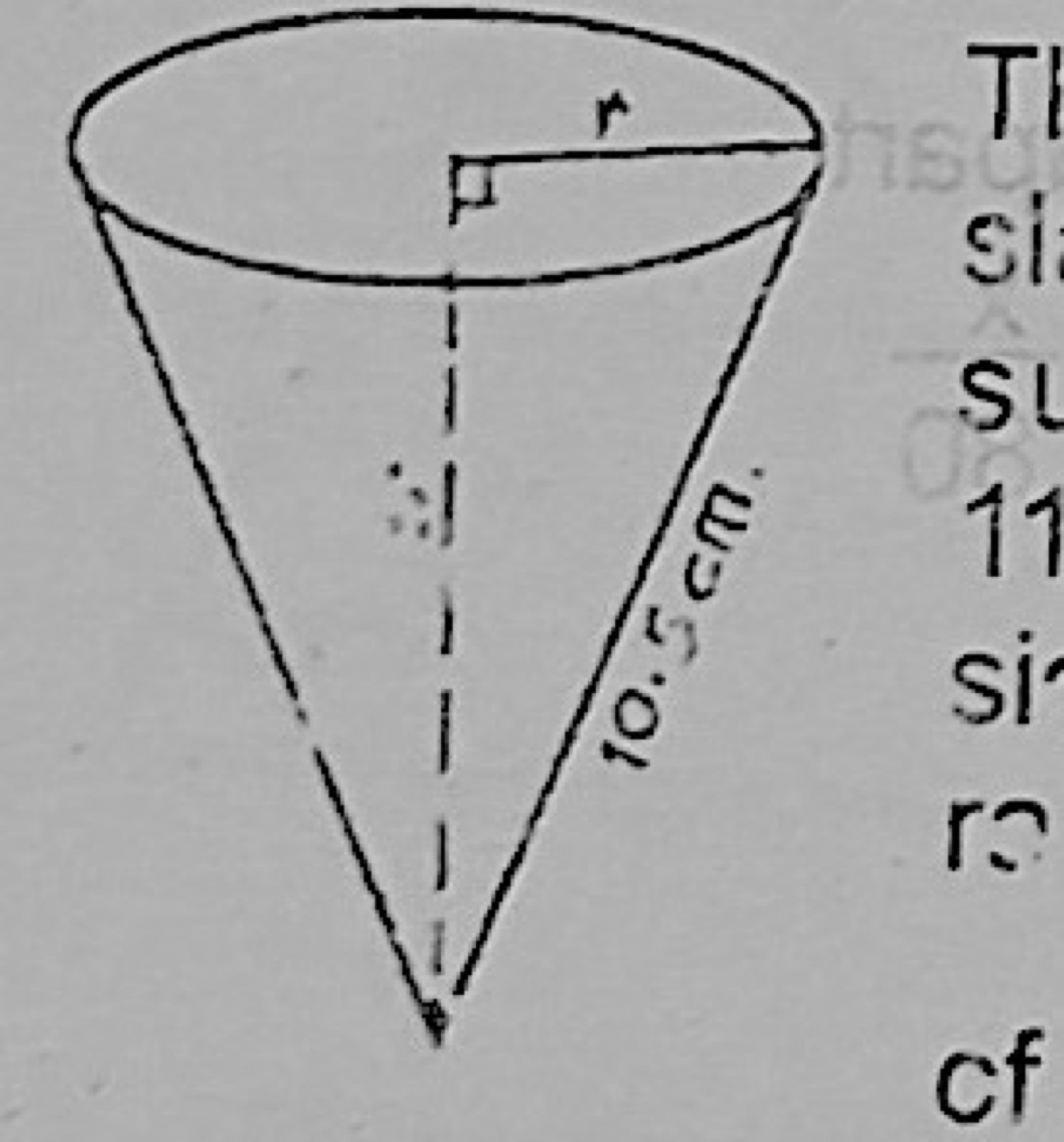
The diagram shows a cone with slant height 10.5cm. If the curved surface area of the cone is 115.5cm2, calculate, correct to 3 significant figures, the: (a) base radius, r; (b) height, h; (c) volume of the cone. [Take π = 22/7]
Show the model answer
Model answer
(a) πrl = 115.5: r = 115.5 ÷ (22/7 × 10.5) = 115.5 ÷ 33 = 3.50 cm. (b) h = √(10.52 − 3.52) = √98 ≈ 9.90 cm. (c) V = ⅓ × 22/7 × 3.52 × 9.899 ≈ 127 cm3.
Explanation
Curved surface area of a cone = πrl, where l is the slant height.
Two fair dice are thrown. M is the event described by "the sum of the scores is 10" and N is the event described by "the difference between the scores is 3". (a) Write out the elements of M and N. (b) Find the probability of M or N. (c) Are M and N mutually exclusive? Give reasons.
Show the model answer
Model answer
(a) M = {(4, 6), (5, 5), (6, 4)}; N = {(1, 4), (4, 1), (2, 5), (5, 2), (3, 6), (6, 3)}. (b) P(M) = 3/36, P(N) = 6/36. They share no outcome, so P(M or N) = 9/36 = 1/4. (c) Yes. No pair of scores has sum 10 and difference 3, so M ∩ N = ∅ and they cannot happen together.
Explanation
Mutually exclusive events have no outcome in common.
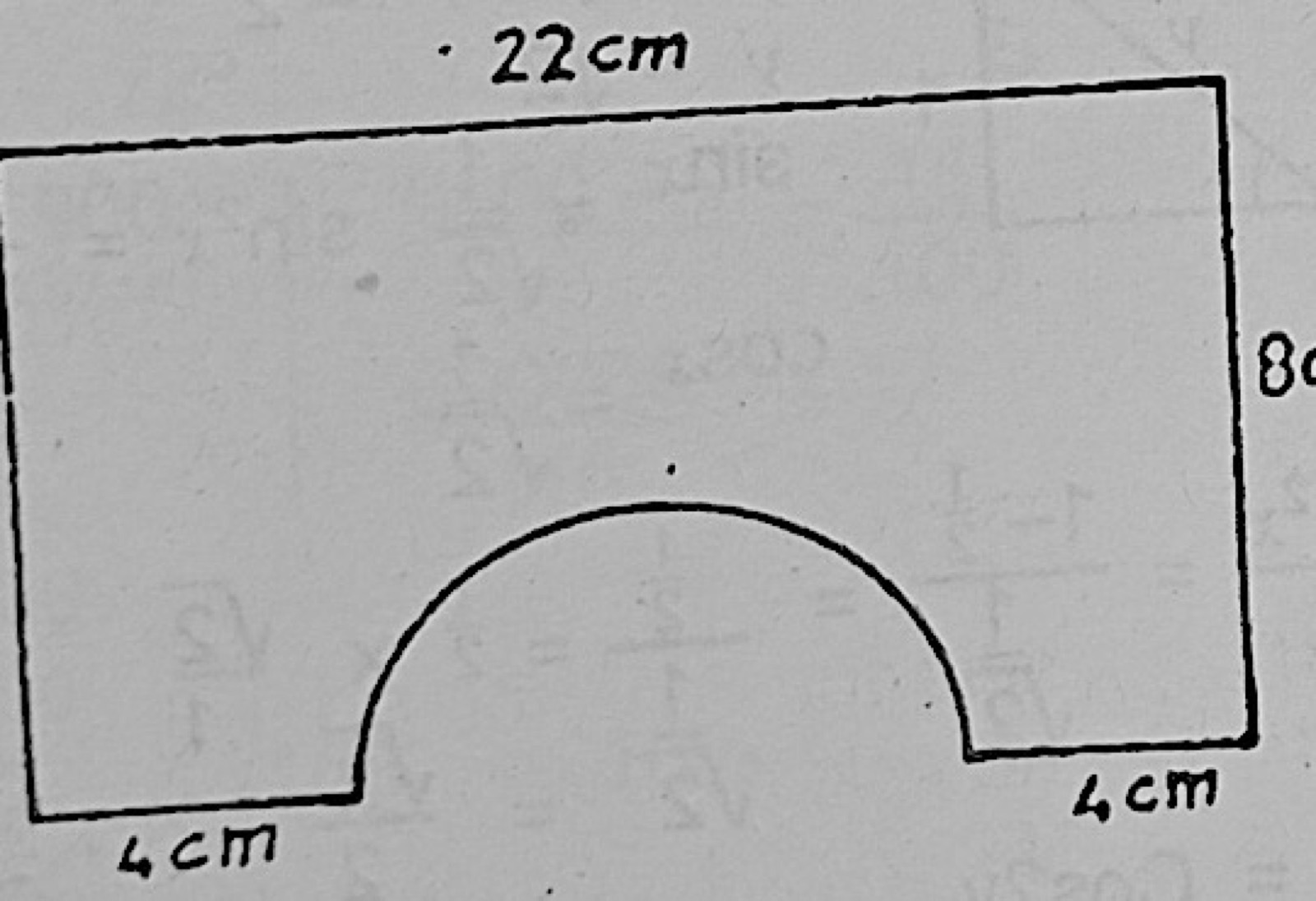
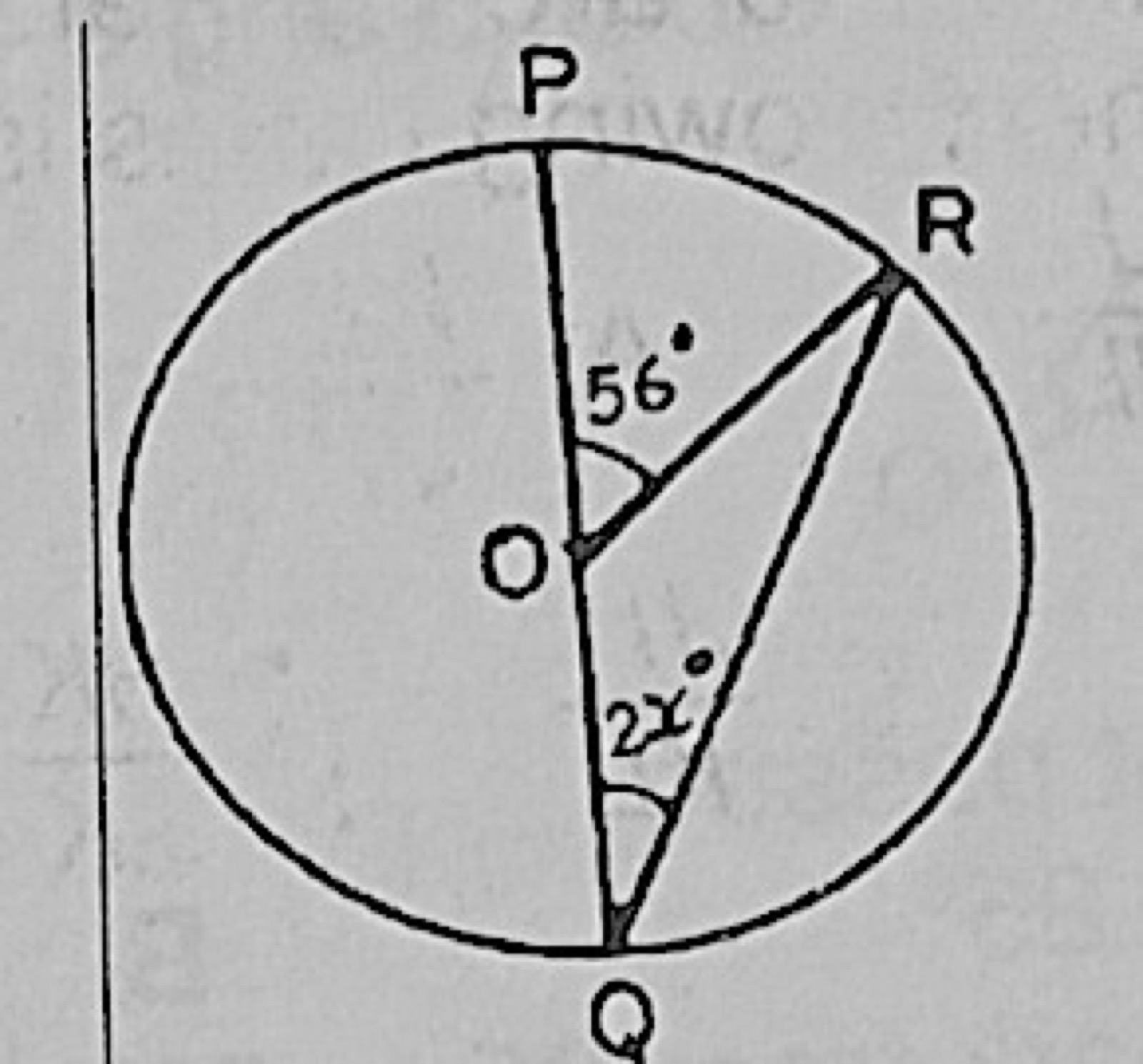
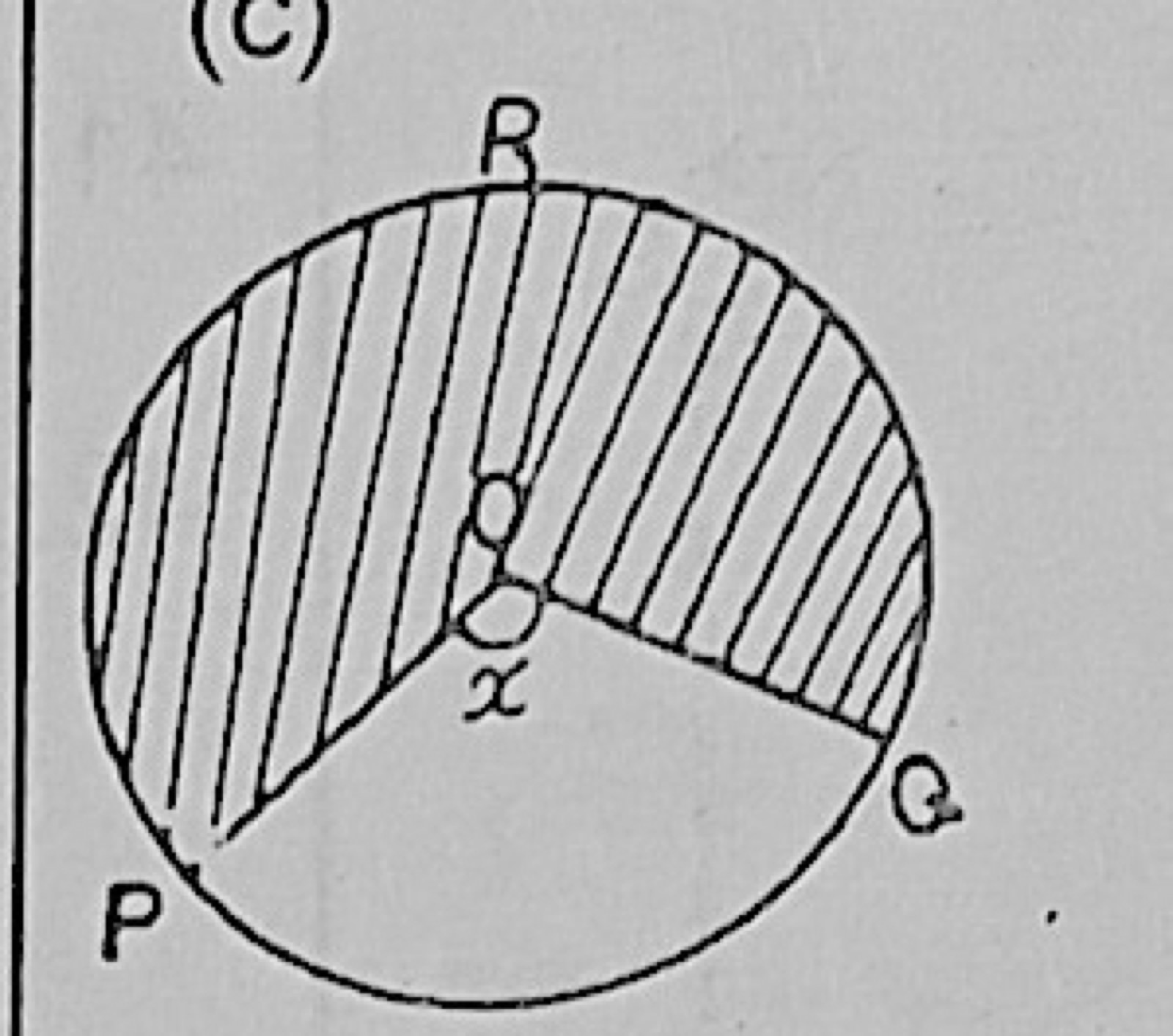
(a) The scale of a map is 1: 20,000. Calculate the area, in square centimetres, on the map of a forest reserve which covers 85 km2. (b) A rectangular playing field is 18m wide. It is surrounded by a path 6m wide such that its area is equal to the area of the path. Calculate the length of the field. (c) The diagram shows a circle centre O. If ∠POQ = x°, the diameter of the circle is 7cm and the area of the shaded portion is 27.5 cm2, find, correct to the nearest degree, the value of x. [Take π = 22/7]
Show the model answer
Model answer
(a) 1 cm represents 200 m, so 1 cm2 represents 0.04 km2. 85 ÷ 0.04 = 2125 cm2. (b) Outer rectangle = (l + 12) × 30. Path area = 30(l + 12) − 18l = 12l + 360 = field area 18l, so 6l = 360 and l = 60 m. (c) Circle area = 22/7 × 3.52 = 38.5 cm2. The shaded major sector has angle 360° − x: (360 − x)/360 × 38.5 = 27.5, so 360 − x ≈ 257.1 and x ≈ 103°.
(a) Madam Kwakyewaa imported a quantity of frozen fish costing GH¢400.00. The goods attracted an import duty of 15% of its cost. She also paid a sales tax of 10% of the total cost of the goods including the import duty and then sold the goods for GH¢660.00. Calculate her percentage profit. (b) In a school, there are 1000 boys and a number of girls. The 48% of the total number of students that were successful in an examination was made up of 50% of the boys and 40% of the girls. Find the number of girls in the school.
Show the model answer
Model answer
(a) Import duty = 15% of 400 = GH¢60. Sales tax = 10% of 460 = GH¢46. Total cost = GH¢506. Profit = 660 − 506 = GH¢154. Percentage profit = 154/506 × 100% ≈ 30.4%. (b) Let g be the number of girls: 0.5(1000) + 0.4g = 0.48(1000 + g). 500 + 0.4g = 480 + 0.48g, so 0.08g = 20 and g = 250.
Explanation
Profit percentage is on the total cost, including duty and tax.
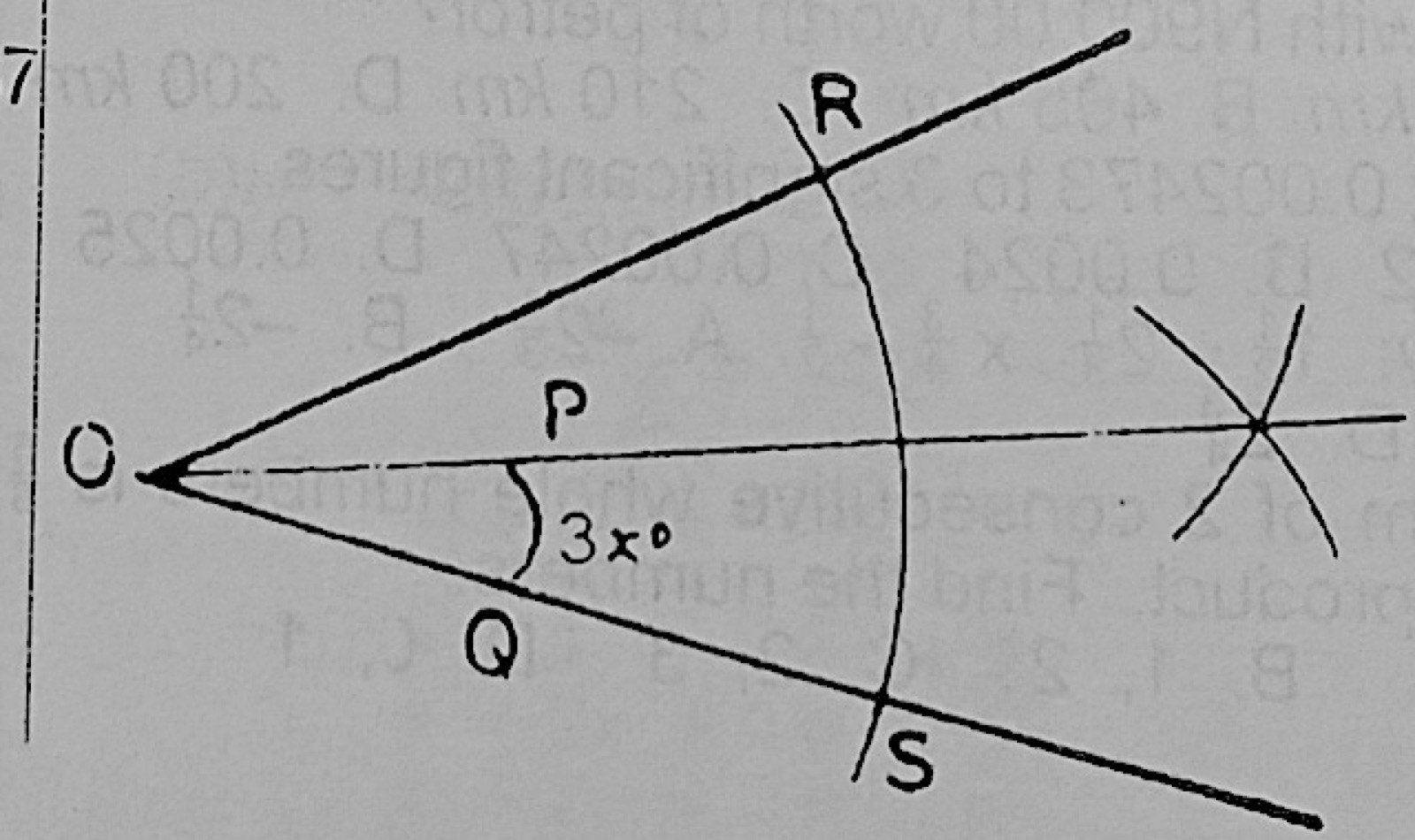
Using ruler and a pair of compasses only, (a) construct (i) a quadrilateral PQRS with |PS| = 6cm, ∠RSP = 90°, |RS| = 9cm, |QR| = 8.4cm and |PQ| = 5.4cm; (ii) the bisectors of ∠RSP and ∠SPQ to meet at X; (iii) the perpendicular XT to meet PS at T. (b) Measure |XT|.
Show the model answer
Model answer
(a)(i) Draw PS = 6 cm; construct 90° at S and mark SR = 9 cm. With centres P (radius 5.4 cm) and R (radius 8.4 cm) draw arcs meeting at Q outside triangle PSR; join PQ and QR. (ii) Bisect ∠RSP (giving 45°) and ∠SPQ; X is where the bisectors meet. (iii) From X drop a perpendicular to PS, meeting it at T. (b) |XT| ≈ 3.4 cm.
Explanation
To drop a perpendicular from X, draw an arc from X cutting PS twice and bisect the segment between the cuts.
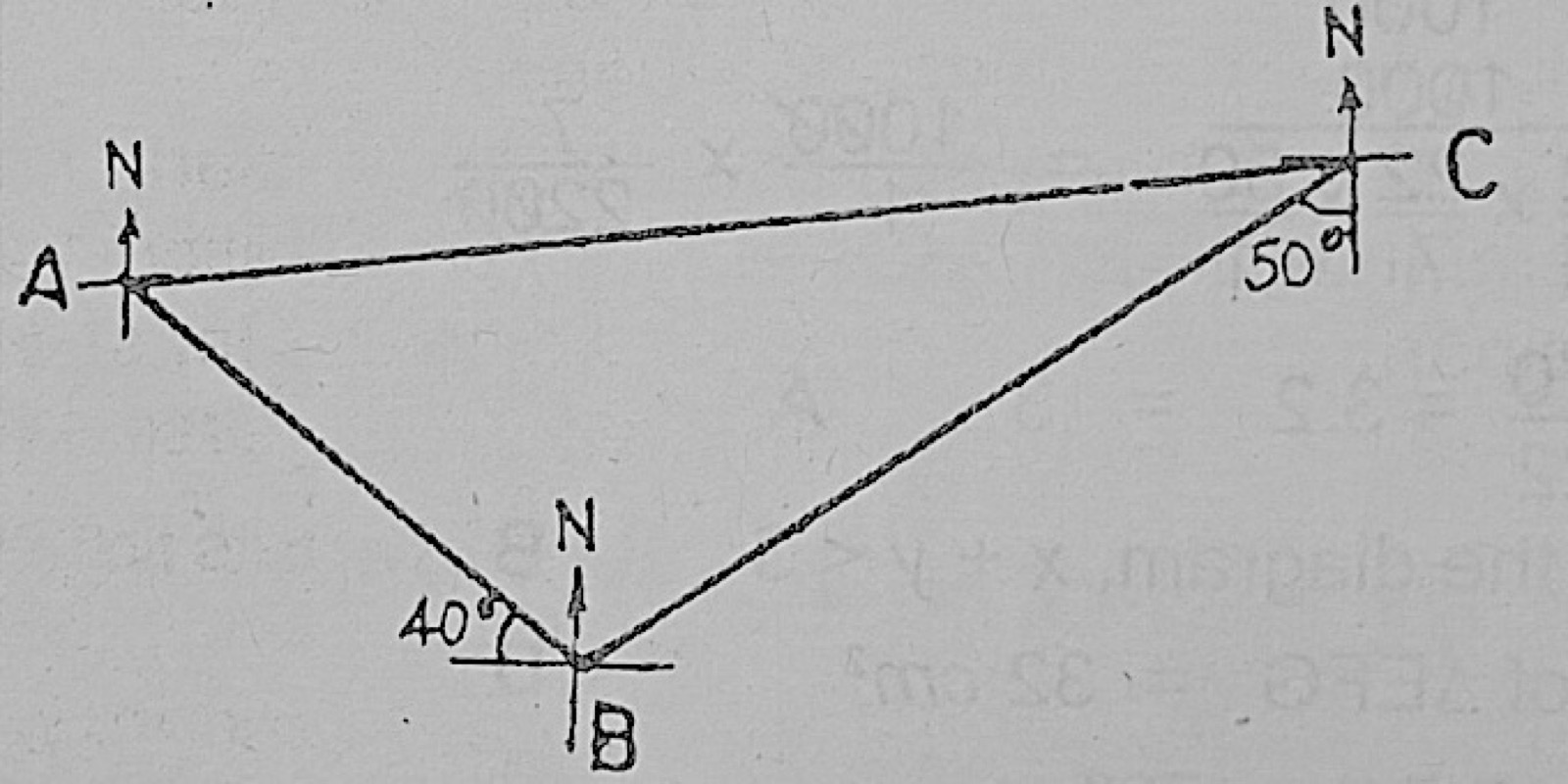
In the diagram, |AB| = 8km, |BC| = 13km, the bearing of A from B is 310° and the bearing of B from C is 230°. Calculate, correct to 3 significant figures, (a) the distance AC; (b) the bearing of C from A; (c) how far east of B, C is.
Show the model answer
Model answer
Bearing of C from B = 230° − 180° = 050°, so ∠ABC = 360° − 310° + 50° = 100°. (a) AC2 = 82 + 132 − 2(8)(13) cos 100° = 233 + 36.1 = 269.1, so AC ≈ 16.4 km. (b) sin ∠BAC = 13 sin 100°/16.40 ≈ 0.780, so ∠BAC ≈ 51.3°. Bearing of B from A = 130°, so bearing of C from A = 130° − 51.3° ≈ 078.7°. (c) 13 sin 50° ≈ 9.96 km east of B.
Explanation
Find the angle at B from the two bearings, then use the cosine rule.
(a) Copy and complete the table of values for the relation y = −x2 + x + 2 for −3 ≤ x ≤ 3. x: −3, −2, −1, 0, 1, 2, 3 y: __, −4, __, 2, __, __, −4 (b) Using scales of 2 cm to 1 unit on the x-axis and 2cm to 2 units on the y-axis, draw a graph of the relation y = −x2 + x + 2. (c) From the graph, find the: (i) minimum value of y; (ii) roots of the equation x2 − x − 2 = 0; (iii) gradient of the curve at x = −0.5.
Show the model answer
Model answer
(a) x = −3: −10; −1: 0; 1: 2; 2: 0 (given: −2: −4, 0: 2, 3: −4). (b) Plot the points and draw a smooth curve (it opens downwards). (c)(i) The curve turns at the top: maximum y = 2.25 at x = 0.5. (Over −3 ≤ x ≤ 3 the least value of y is −10, at x = −3.) (ii) x2 − x − 2 = 0 is the same as y = 0: x = −1 and x = 2. (iii) Draw the tangent at x = −0.5: gradient ≈ 2.
Explanation
x2 − x − 2 = 0 is −(the relation) = 0, so read where the curve cuts the x-axis.
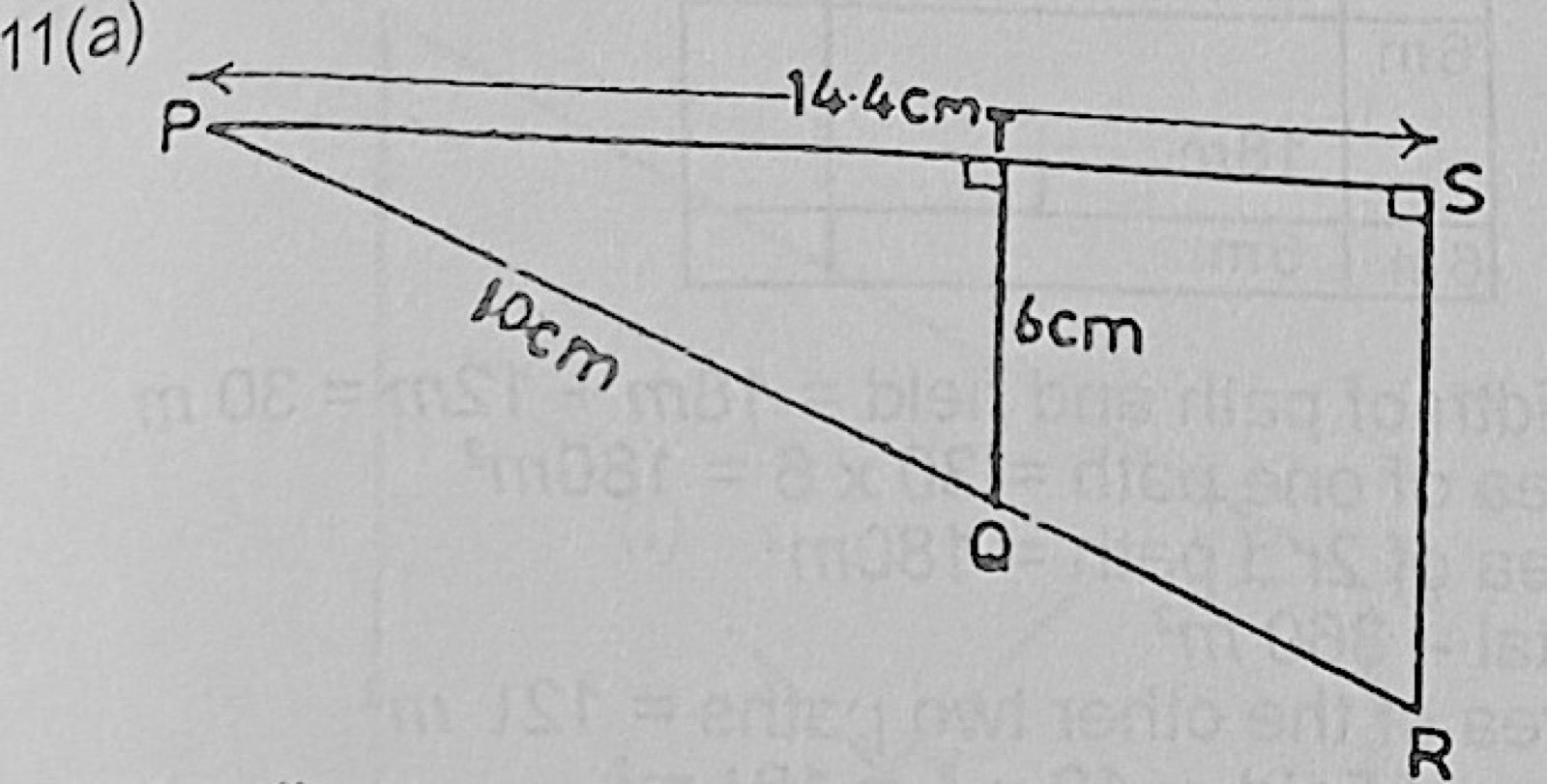
(a) In the diagram, ∠PTQ = ∠PSR = 90°, |PQ| = 10cm, |PS| = 14.4cm and |TQ| = 6cm. Calculate the area of quadrilateral QRST. (b) Two opposite sides of a square are each decreased by 10% while the other two are each increased by 15% to form a rectangle. Find the ratio of the area of the rectangle to that of the square.
Show the model answer
Model answer
(a) |PT| = √(102 − 62) = 8 cm. ΔPTQ ~ ΔPSR with scale factor 14.4/8 = 1.8, so |SR| = 6 × 1.8 = 10.8 cm. Area QRST = ½ × 14.4 × 10.8 − ½ × 8 × 6 = 77.76 − 24 = 53.76 cm2. (b) Side s: rectangle = 0.9s × 1.15s = 1.035s2. Ratio = 1.035 : 1 = 207 : 200.
Explanation
TQ and SR are both perpendicular to PS, so the triangles are similar.
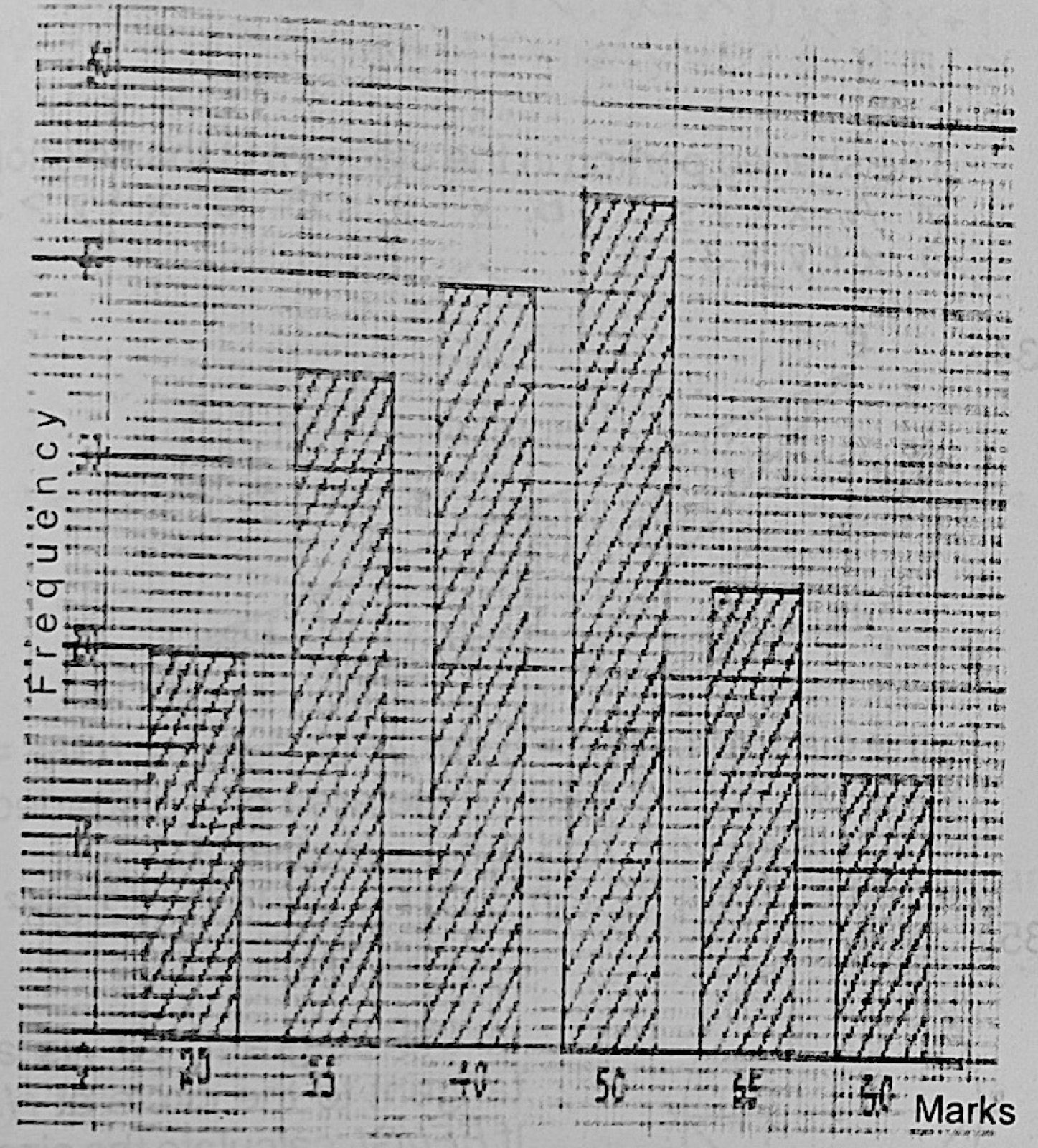
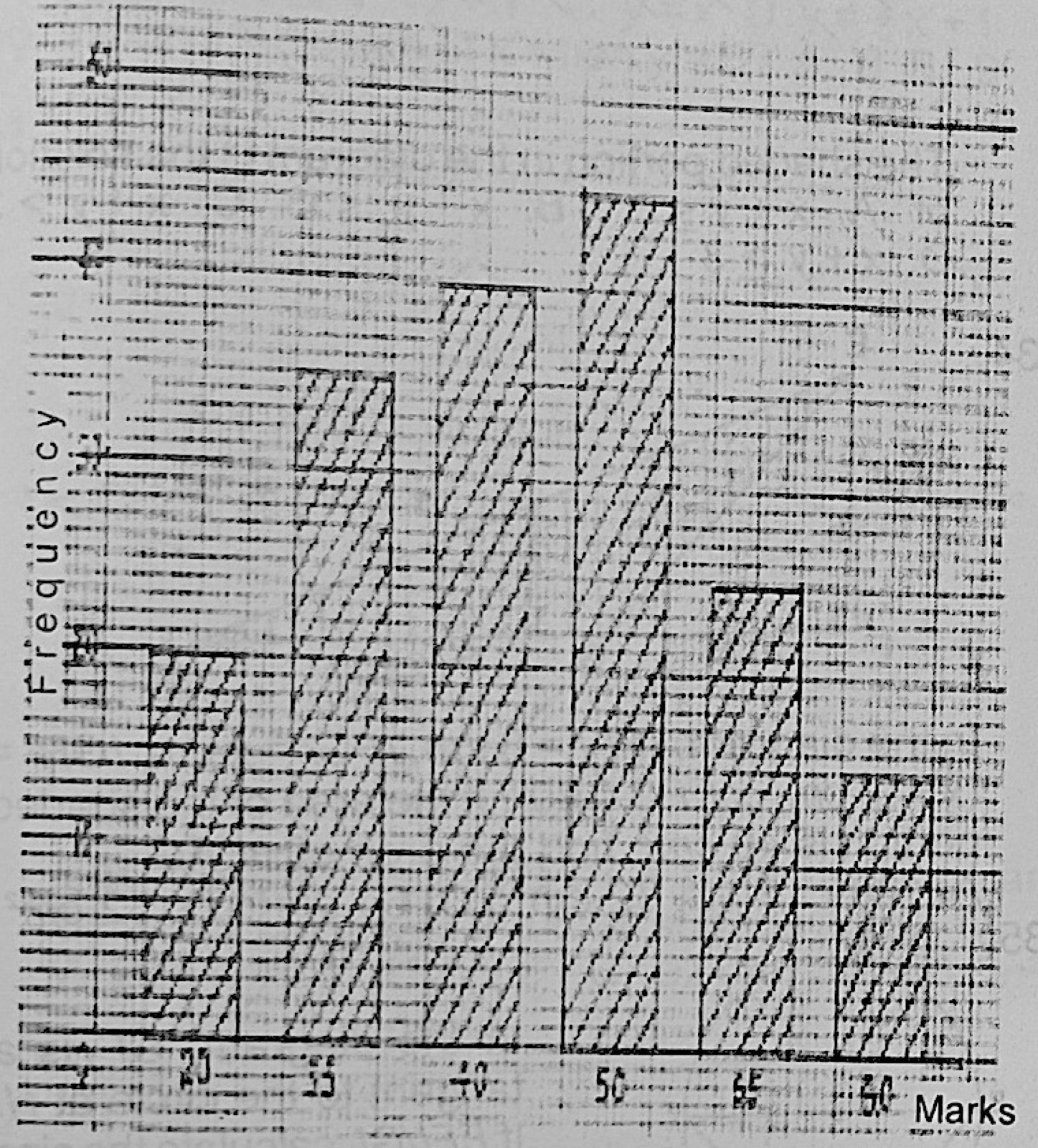
The frequency distribution of the weight of 100 participants in a high jump competition is as shown below: Weight (kg): 20-29, 30-39, 40-49, 50-59, 60-69, 70-79 Number of participants: 10, 18, 22, 25, 16, 9 (a) Construct the cumulative frequency table. (b) Draw the cumulative frequency curve. (c) From the curve, estimate the: (i) median; (ii) semi-interquartile range; (iii) probability that a participant chosen at random weighs at least 60kg.
Show the model answer
Model answer
(a) Upper class boundaries 29.5, 39.5, 49.5, 59.5, 69.5, 79.5 with cumulative frequencies 10, 28, 50, 75, 91, 100. (b) Plot cumulative frequency against upper boundary and join with a smooth S-shaped curve. (c)(i) Median (50th) ≈ 49.5 kg. (ii) Q1 (25th) ≈ 37.8 kg, Q3 (75th) ≈ 59.5 kg; semi-interquartile range ≈ (59.5 − 37.8)/2 ≈ 10.8 kg. (iii) At least 60 kg: 16 + 9 = 25 participants, probability = 25/100 = 1/4. (Accept readings close to these from the curve.)
Explanation
Plot cumulative frequencies at the upper class boundaries.
(a) The third term of a Geometric Progression (G.P) is 24 and its seventh term is 4 20/27. Find its first term. (b) Given that y varies directly as x and inversely as the square of z. If y = 4, when x = 3 and z = 1, find y when x = 3 and z = 2.
Show the model answer
Model answer
(a) ar2 = 24 and ar6 = 128/27. Dividing: r4 = 128/648 = 16/81, so r = ±2/3. a = 24 ÷ (4/9) = 54. (b) y = kx/z2: 4 = 3k, so k = 4/3. When x = 3, z = 2: y = (4/3 × 3)/4 = 1.
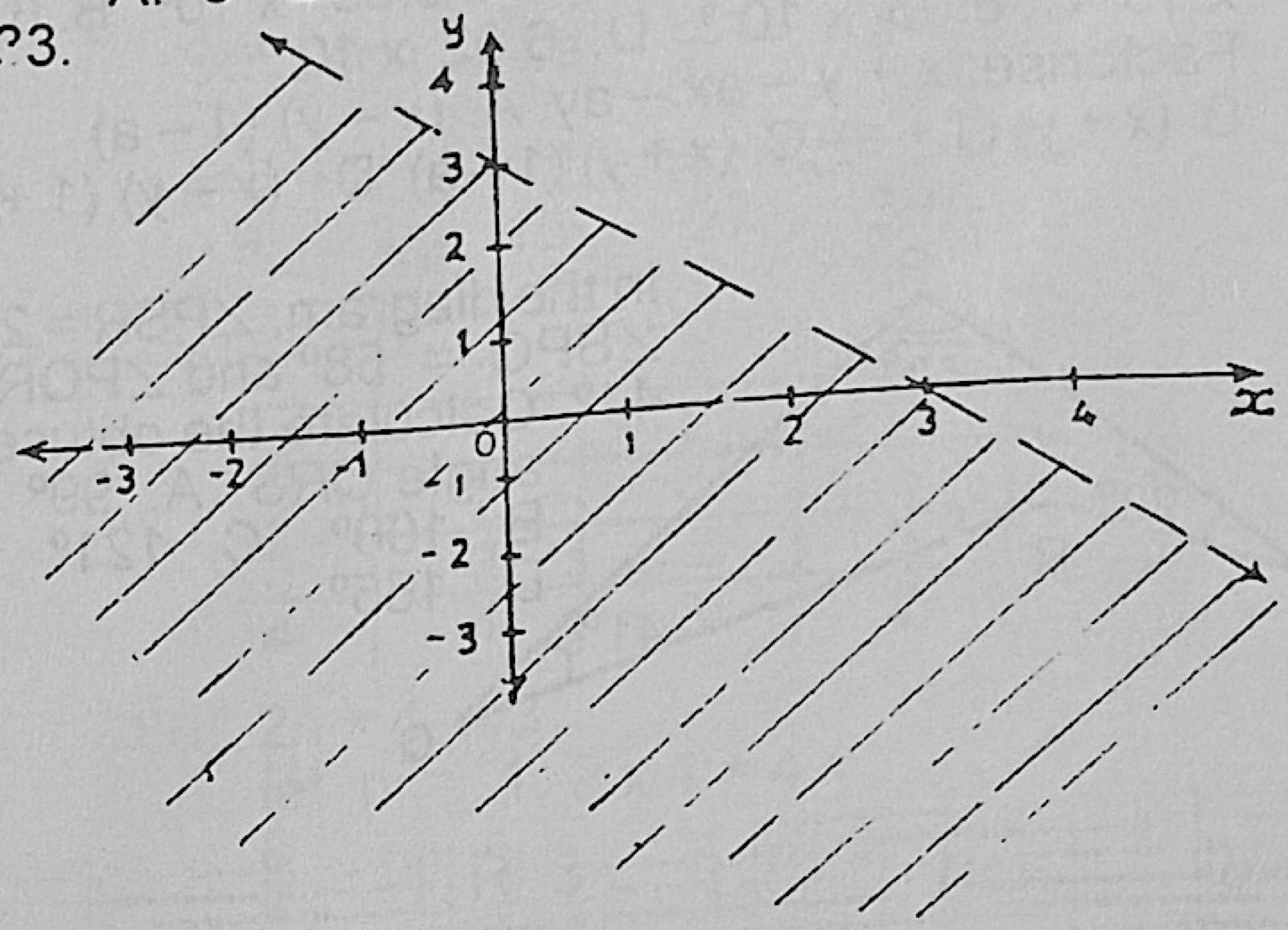
(Questions 14 and 15 are for candidates in Ghana, Sierra Leone and The Gambia only.) (a) Using a scale of 2cm to 1 unit on both axes, draw on a graph sheet, two perpendicular axes Ox and Oy, for the interval −5 ≤ x ≤ 5 and −6 ≤ y ≤ 6. (b) Draw clearly, indicating the coordinates of all vertices (i) rectangle ABCD with vertices A(−2, −1), B(1, −1), C(1, 1) and D(−2, 1); (ii) the image A1B1C1D1 of ABCD under an enlargement from the origin O with scale factor 2 where A → A1, B → B1, C → C1 and D → D1; (iii) the image A2B2C2D2 of ABCD under a reflection in the line y = 2 where A → A2, B → B2, C → C2 and D → D2. (c) Determine the equation of the line AC.
Show the model answer
Model answer
(a), (b)(i) Axes to scale; rectangle ABCD plotted and labelled. (ii) Multiply coordinates by 2: A1(−4, −2), B1(2, −2), C1(2, 2), D1(−4, 2). (iii) Reflection in y = 2 maps (x, y) to (x, 4 − y): A2(−2, 5), B2(1, 5), C2(1, 3), D2(−2, 3). (c) Gradient of AC = (1 − (−1))/(1 − (−2)) = 2/3. y + 1 = (2/3)(x + 2), i.e. 3y = 2x + 1.
Explanation
A point and its image are the same distance from the mirror line y = 2.
Consider the following statements: X: All lazy students are careless. Y: Most dull students are lazy. (a) Illustrate the information above on a Venn diagram. (b) Using the Venn diagram, or otherwise, determine whether or not each of the following statements is valid. (i) Stella is careless ⇒ Stella is lazy. (ii) Osei is lazy ⇒ Osei is careless. (iii) Kojo is dull ⇒ Kojo is lazy. (iv) Kwame is lazy ⇒ Kwame is dull. (v) Adwoa is lazy and dull ⇒ Adwoa is careless. (vi) Fiifi is careless and dull ⇒ Fiifi is lazy. (c) If x is a positive integer, determine the least value of x for which 13 + 2x = 3 (mod 8).
Show the model answer
Model answer
(a) U = students. Set L (lazy) drawn completely inside set C (careless). Set D (dull) overlaps L, with most of D inside L and part of D outside L. (b)(i) Not valid (a careless student need not be lazy). (ii) Valid (L ⊂ C). (iii) Not valid (only most dull students are lazy). (iv) Not valid (some lazy students are not dull). (v) Valid (lazy ⇒ careless). (vi) Not valid (careless and dull does not force lazy). (c) 2x ≡ 3 − 13 = −10 ≡ 6 (mod 8). x = 3 works: 13 + 6 = 19 = 2 × 8 + 3. Least x = 3.
Explanation
'All A are B' means draw A inside B; 'most' means an overlap, not a subset.