Question 1
Number BasesEvaluate (111two)2 and leave your answer in base 2.
- A.111001two
- B.110001two
- C.101001two
- D.10010two
Show the answer and explanation
Answer: B (110001two)
Explanation
111two = 7, and 72 = 49 = 32 + 16 + 1 = 110001two.
63 questions. Try each one, then open the answer to check yourself and read the explanation.
Evaluate (111two)2 and leave your answer in base 2.
Answer: B (110001two)
111two = 7, and 72 = 49 = 32 + 16 + 1 = 110001two.
Find the LCM of 23 × 3 × 52, 2 × 32 × 5 and 22 × 33 × 5.
Answer: D (23 × 33 × 52)
The LCM takes the highest power of each prime: 23, 33 and 52.
Simplify (0.3 × 10⁵) ÷ (0.4 × 10⁷), leaving your answer in the standard form.
Answer: B (7.5 × 10⁻³)
0.3/0.4 = 0.75 and 105/107 = 10−2, so the result is 0.75 × 10−2 = 7.5 × 10⁻³.
If p ∝ 1/q, which of the following is true?
Answer: D (q ∝ 1/p)
p = k/q means pq = k, so q = k/p: q varies inversely as p.
Simplify 3√45 − 12√5 + 16√20, leaving your answer in surd form.
Answer: A (29√5)
3√45 = 9√5 and 16√20 = 32√5, so 9√5 − 12√5 + 32√5 = 29√5.
Which of the following statements is true for the set P = {−3.2 ≤ x < 5} where x is an integer?
Answer: B (Least value of x is −3)
The integers with −3.2 ≤ x < 5 are −3, −2, …, 4. The least is −3 and the greatest is 4.
Simplify: 3x3/(3x)3
Answer: C (1/9)
(3x)3 = 27x3, so 3x3/27x3 = 1/9.
N140,000 is shared between Abu, Kayode and Uche. Abu has twice as much as Kayode, and Kayode has twice as much as Uche. What is Kayode's share?
Answer: B (N40,000)
If Uche gets u, Kayode gets 2u and Abu 4u: 7u = 140,000, so u = 20,000 and Kayode gets N40,000.
I am x years old and my brother is 3 years older. How old was my brother last year?
Answer: B ((x + 2) years)
The brother is now x + 3, so last year he was x + 3 − 1 = x + 2.
If x = 3, y = 2 and z = 4, what is the value of 3x2 − 2y + z?
Answer: B (27)
3(9) − 2(2) + 4 = 27 − 4 + 4 = 27.
Solve the simultaneous equations: x + y = 2 and 3x − 2y = 1.
Answer: B (x = 1 and y = 1)
Double the first equation (2x + 2y = 4) and add the second: 5x = 5, so x = 1 and y = 1.
If 8x+1 = 1/4, find x.
Answer: A (−5/3)
Write both as powers of 2: 23(x+1) = 2−2, so 3x + 3 = −2 and x = −5/3.
The area of a square field is 110.25 m2. Find the cost of fencing it round at N75.00 per metre.
Answer: B (N3,150.00)
Side = √110.25 = 10.5 m, perimeter = 4 × 10.5 = 42 m, cost = 42 × 75 = N3,150.00.
A chord of length 6 cm is drawn in a circle of radius 5 cm. Find the distance of the chord from the centre of the circle.
Answer: D (4.0 cm)
The perpendicular from the centre bisects the chord: d2 = 52 − 32 = 16, so d = 4 cm.
A sector of a circle of radius 14 cm containing an angle 60° is folded to form a cone. Calculate the radius of the base of the cone.
Answer: D (2⅓ cm)
Arc length = circumference of base: (60/360) × 2π × 14 = 2πr, so r = 14/6 = 2⅓ cm.
In the diagram, |LN| = 4 cm, LN̂M = 90° and tan y = 2/3. What is the area of the ΔLMN?
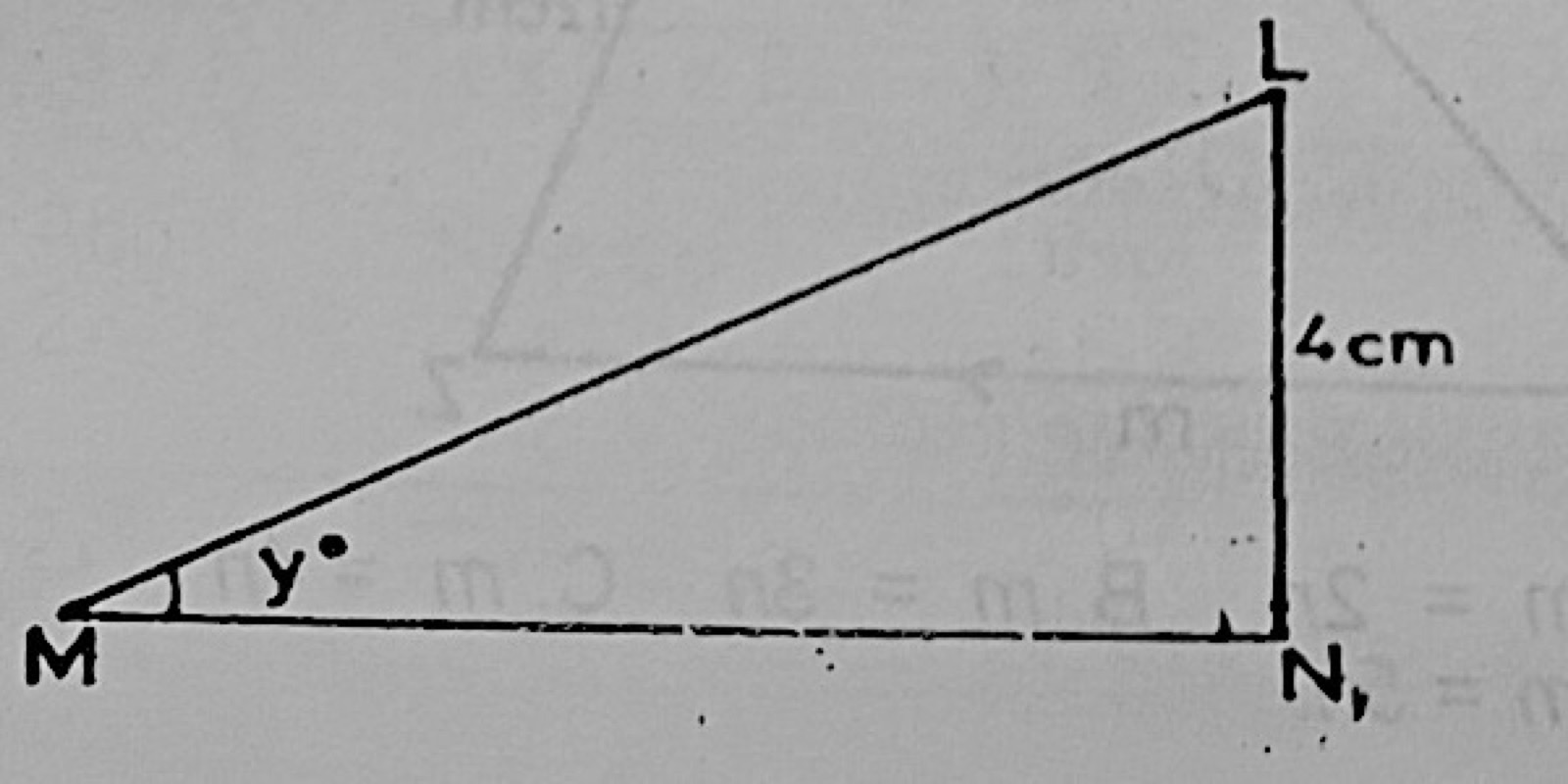
Answer: B (12 cm2)
tan y = LN/MN = 4/MN = 2/3, so MN = 6 cm. Area = ½ × 6 × 4 = 12 cm2.
Find the volume of a solid cylinder with base radius 10 cm and height 14 cm. (Take π = 22/7)
Answer: D (4400 cm3)
V = πr2h = 22/7 × 100 × 14 = 4400 cm3.
From the diagram, find the value of x.
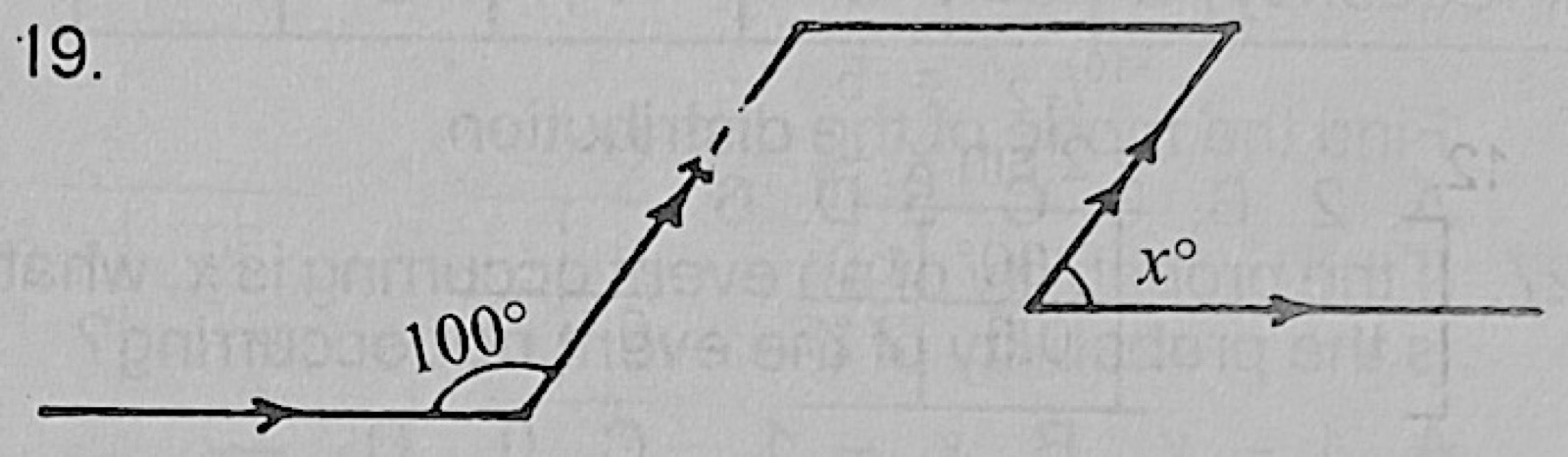
Answer: A (80°)
The slanting lines are parallel and the horizontal lines are parallel. The 100° angle and the angle between the slanting line and the horizontal going right are on a straight line, so that angle is 80°, and x equals it (corresponding angles).
Find the value of x in the diagram.

Answer: A (281°)
Through the vertex of x draw a line parallel to the two parallel lines. The upper arm makes 45° with it (vertically opposite the 45° and alternate angles) and the lower arm makes 34°, so the angle on the left is 45° + 34° = 79°. The reflex angle x = 360° − 79° = 281°.
Each interior angle of a regular polygon is 162°. How many sides has the polygon?
Answer: D (20)
Each exterior angle = 180° − 162° = 18°, and n = 360° ÷ 18° = 20.
From the diagram, find the value of x.
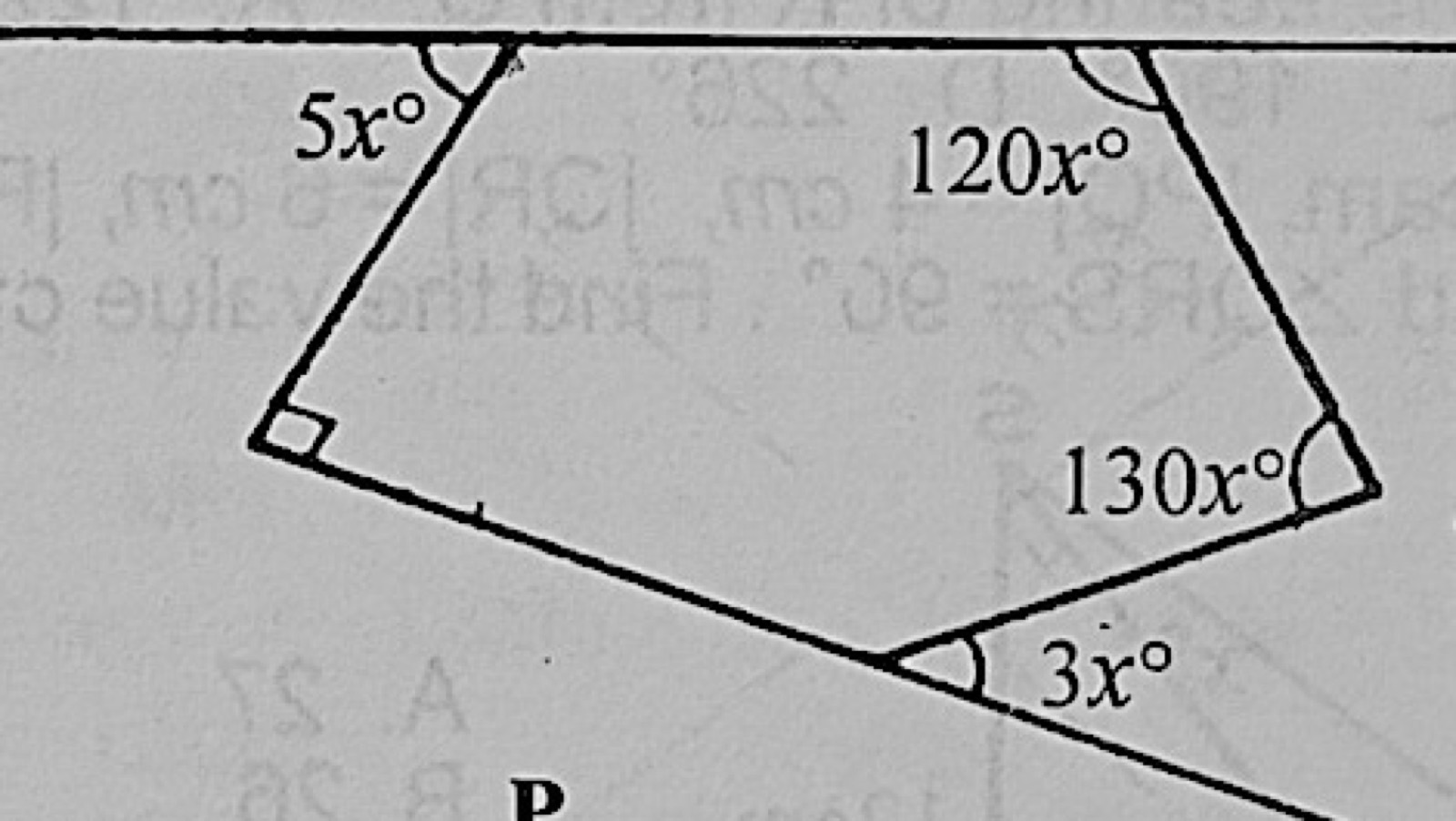
Answer: D (20)
The pentagon's angles add to 540°. Its interior angles are (180 − 5x)°, 120°, 130°, 90° and (180 − 3x)°: 700 − 8x = 540, so x = 20.
In the diagram, |SP| = |SR| and ∠PRS = 50°. Calculate ∠PQR.
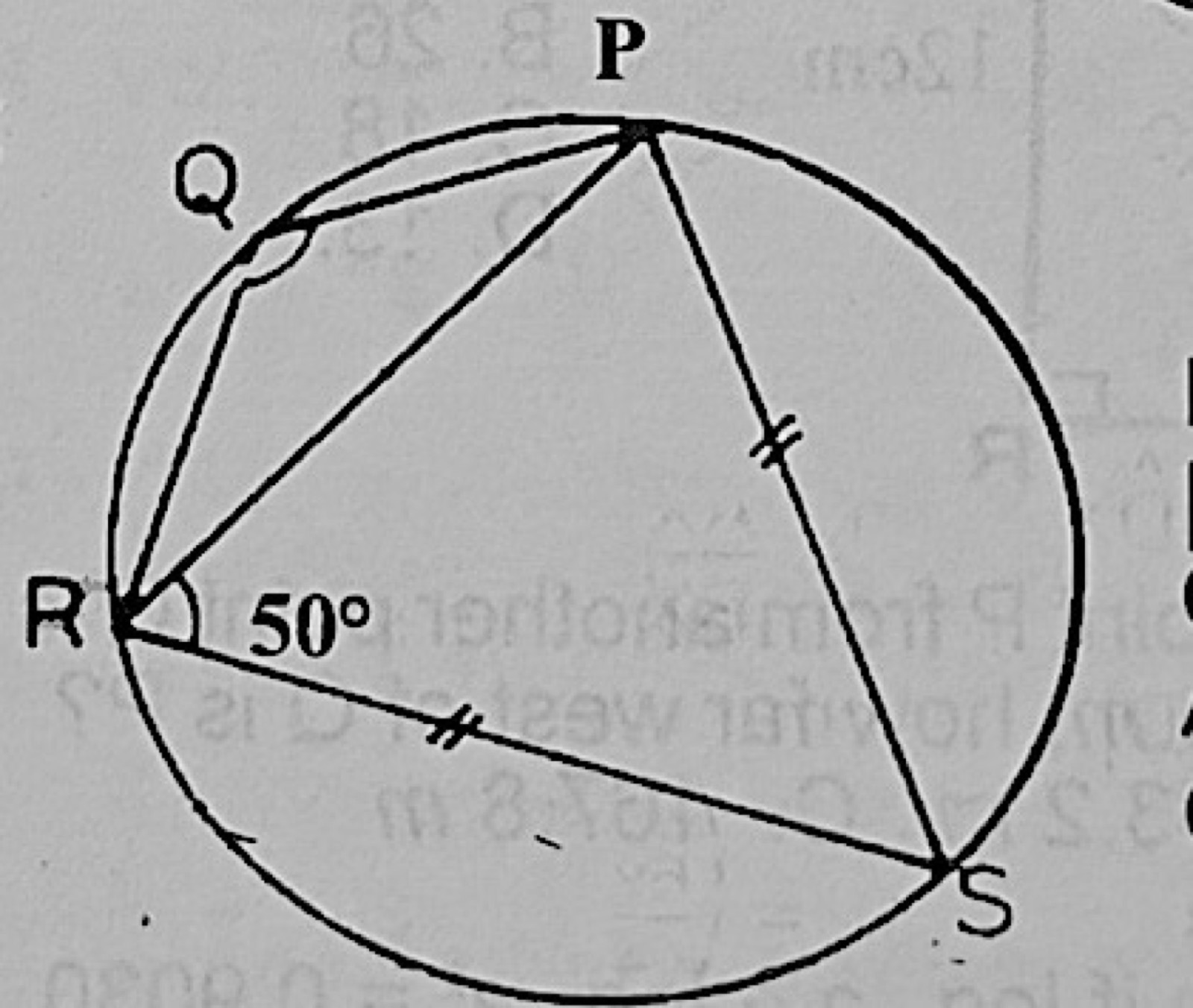
Answer: C (100°)
Triangle PSR is isosceles, so ∠SPR = 50° and ∠PSR = 180° − 100° = 80°. PQRS is cyclic, so ∠PQR = 180° − 80° = 100°.
In the diagram, O is the centre of the circle and ∠PQR = 106°. Find the value of y.
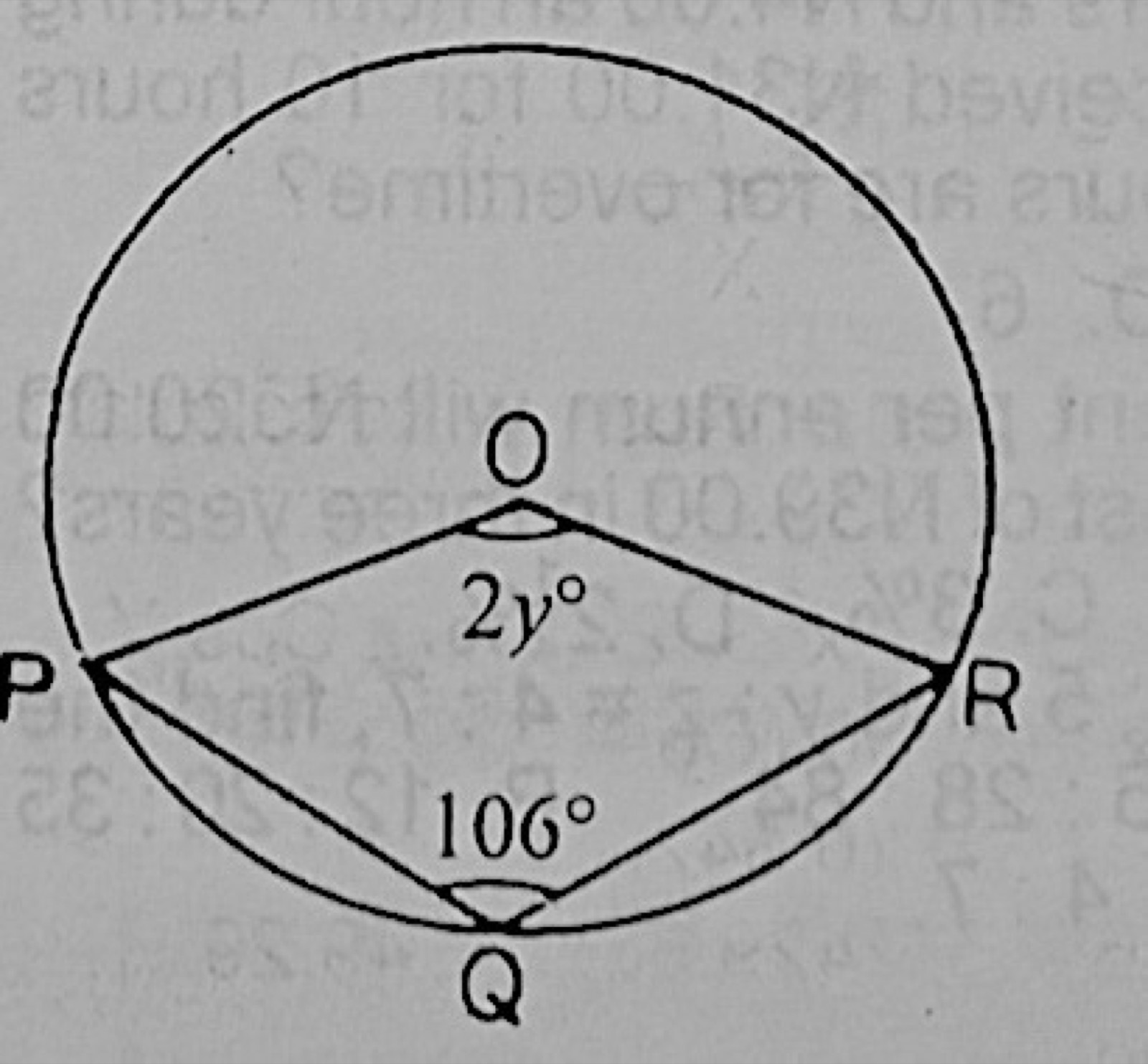
Answer: C (74)
The reflex angle POR at the centre is twice ∠PQR = 212°. So 2y = 360° − 212° = 148° and y = 74.
In a ΔPQR, ∠PQR = ∠PRQ = 45°. Which of the following statements is/are correct?
I. ΔPQR is an equilateral triangle
II. ΔPQR is an isosceles triangle
III. ΔPQR is a right-angled triangle
Answer: C (II and III only)
Two equal angles make it isosceles, and the third angle is 180° − 90° = 90°, so it is also right-angled. It is not equilateral.
The table gives the distribution of the marks of a number of students in a test.
Mark: 1, 2, 3, 4, 5, 6
Frequency: 5, 3, 6, 4, 2, 5
Find the mode of the distribution.
Answer: B (3)
The mode is the mark with the highest frequency: mark 3 occurs 6 times.
If the probability of an event occurring is x, what is the probability of the event not occurring?
Answer: A (1 − x)
P(not E) = 1 − P(E) = 1 − x.
The table shows the ages (in years) of twenty children chosen at random from a community.
Age (years): 1, 2, 3, 4, 5
Number of children: 2, 3, 5, 6, 4
What is the mean age?
Answer: B (3.35 years)
Σfx = 2 + 6 + 15 + 24 + 20 = 67 and Σf = 20, so the mean = 67/20 = 3.35 years.
The table shows the ages (in years) of twenty children chosen at random from a community.
Age (years): 1, 2, 3, 4, 5
Number of children: 2, 3, 5, 6, 4
What is the median of the distribution?
Answer: A (3.5 years)
With 20 children the median is the average of the 10th and 11th ages. Cumulative frequencies 2, 5, 10, 16: the 10th is 3 and the 11th is 4, so the median is 3.5 years.
Divide the sum of 8, 6, 7, 2, 0, 4, 7, 2, 3 by their mean.
Answer: A (9)
Mean = sum ÷ 9, so sum ÷ mean = 9, the number of values (sum 39, mean 39/9).
Q is 32 km away from P on a bearing 042° and R is 25 km from P on a bearing of 132°. Calculate the bearing of R from Q.
Answer: B (184°)
∠QPR = 132° − 42° = 90°, and tan ∠PQR = 25/32 gives ∠PQR ≈ 38°. The bearing of P from Q is 222°, so the bearing of R from Q is 222° − 38° = 184°.
In the diagram, |PQ| = 4 cm, |QR| = 6 cm, |RS| = 12 cm and ∠QRS = 90°. Find the value of x.
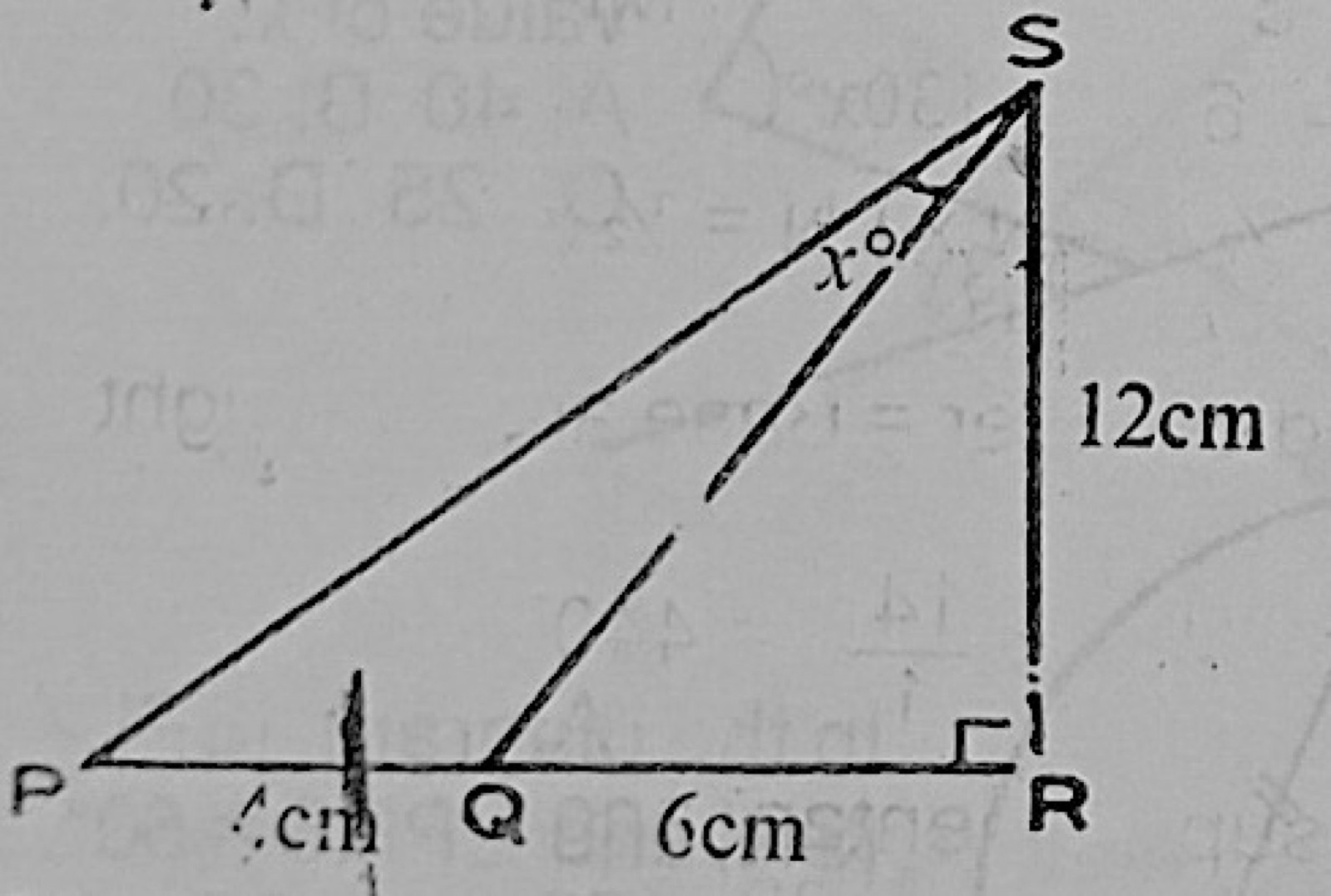
Answer: D (13)
tan ∠PSR = 10/12 gives 39.8°, and tan ∠QSR = 6/12 gives 26.6°. x = 39.8° − 26.6° ≈ 13°.
The bearing of a point P from another point Q is 310°. If |PQ| = 200 m, how far west of Q is P?
Answer: B (153.2 m)
A bearing of 310° is 50° west of north. Distance west = 200 sin 50° = 200 × 0.766 ≈ 153.2 m.
Find the value of a if log10a + log10a2 = 0.9030.
Answer: B (2.0)
log a + 2 log a = 3 log a = 0.9030, so log a = 0.3010 and a = 2.0.
A messenger was paid N2.50 an hour during the normal working hours and N4.00 an hour during overtime. If he received N31.00 for 10 hours work, how many hours are for overtime?
Answer: C (4)
Let t be overtime hours: 2.5(10 − t) + 4t = 31, so 25 + 1.5t = 31 and t = 4.
At what rate per cent per annum will N520.00 yield a simple interest of N39.00 in three years?
Answer: D (2½%)
R = 100I/(PT) = (100 × 39)/(520 × 3) = 3900/1560 = 2.5%.
If the ratio x : y = 3 : 5 and y : z = 4 : 7, find the ratio x : y : z.
Answer: B (12 : 20 : 35)
Make y the same in both: x : y = 12 : 20 and y : z = 20 : 35, so x : y : z = 12 : 20 : 35.
The Venn diagram shows the choice of food of a number of visitors to a canteen. If there were 35 visitors in all, find the value of x.
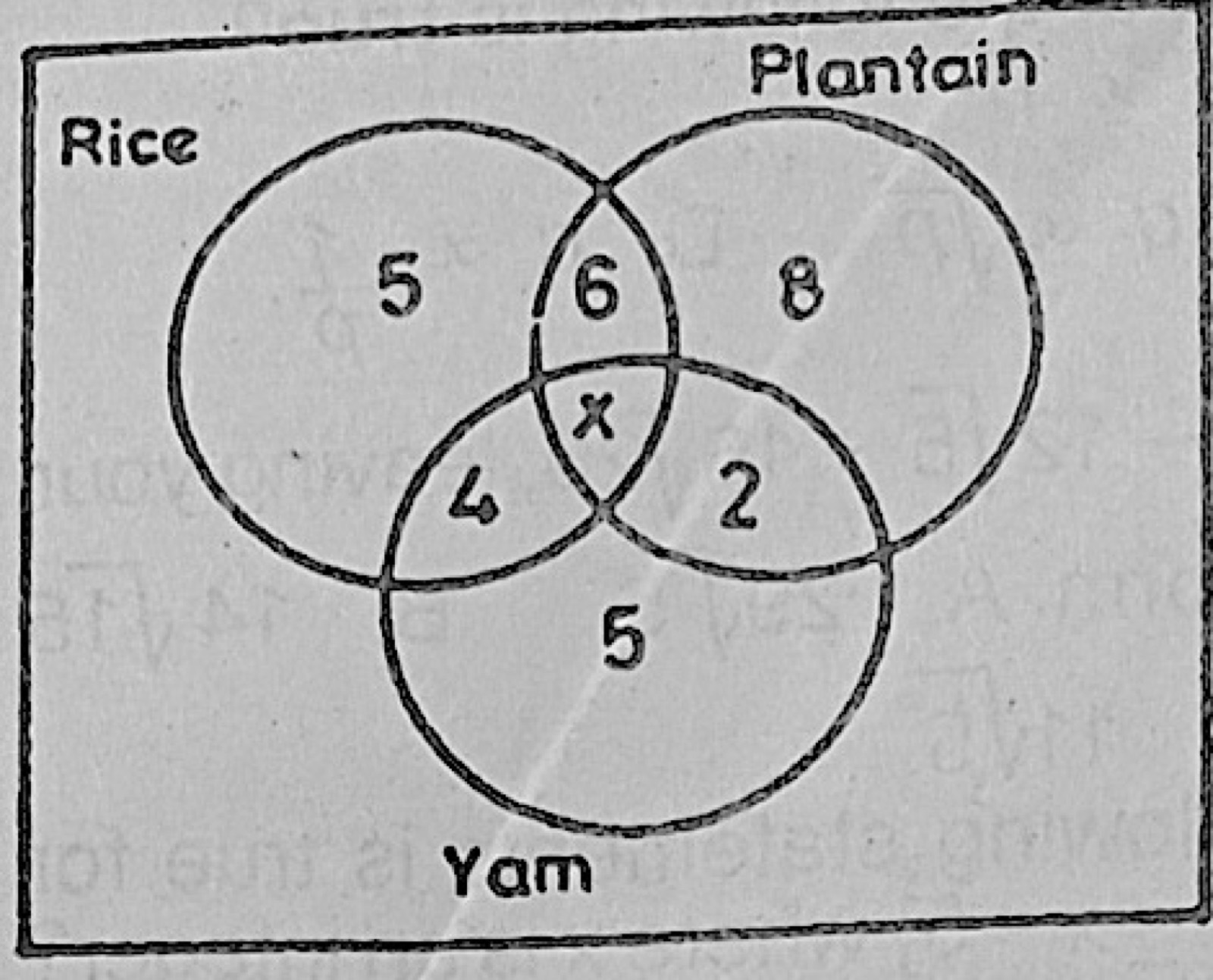
Answer: A (5)
Add all the regions: 5 + 6 + 8 + 4 + 2 + 5 + x = 30 + x = 35, so x = 5.
The Venn diagram shows the choice of food of a number of visitors to a canteen. How many people took at least two kinds of food?
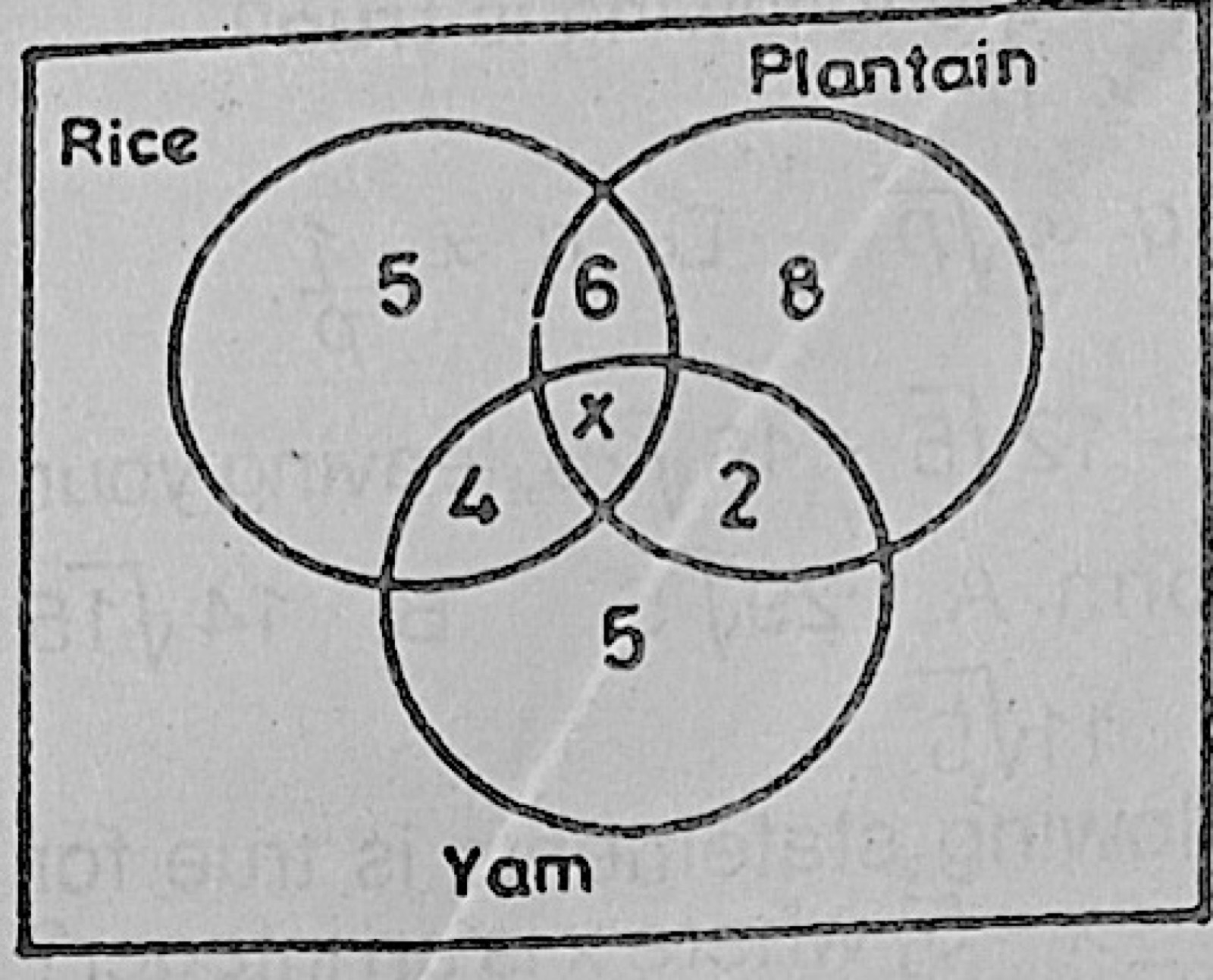
Answer: D (17)
Add the overlap regions: 6 + 4 + 2 + x = 12 + 5 = 17 (x = 5 from the total of 35).
PQR is an equilateral triangle with side 2√3 cm. Calculate its height.
Answer: B (3.0 cm)
The height bisects the base: h2 = (2√3)2 − (√3)2 = 12 − 3 = 9, so h = 3 cm.
Which of the following is a factor of 2 − x − x2?
Answer: A (1 − x)
2 − x − x2 = (1 − x)(2 + x), so 1 − x is a factor.
Make w the subject of the relation (a + bc)/(wd + f) = g
Answer: A ((a + bc − fg)/dg)
a + bc = g(wd + f) = gwd + fg, so gwd = a + bc − fg and w = (a + bc − fg)/dg.
Expand the expression (3a − xy)(3a + xy).
Answer: A (9a2 − x2y2)
Difference of two squares: (3a)2 − (xy)2 = 9a2 − x2y2.
For what range of values of x is 4x − 3(2x − 1) > 1?
Answer: C (x < 1)
4x − 6x + 3 > 1 gives −2x > −2. Dividing by −2 reverses the sign: x < 1.
Find the smallest value of k such that 22 × 33 × 5 × k is a perfect square.
Answer: C (15)
Every prime needs an even power. 33 needs one more 3 and 5 needs one more 5, so k = 3 × 5 = 15.
Two circles have radii 16 cm and 23 cm. What is the difference between their circumferences? (Take π = 22/7)
Answer: C (44.00 cm)
Difference = 2π(23 − 16) = 2 × 22/7 × 7 = 44.00 cm.
The volume of a cylinder is 1200 cm3 and the area of its base is 150 cm2. Find the height of the cylinder.
Answer: B (8.00 cm)
Volume = base area × height, so height = 1200 ÷ 150 = 8 cm.
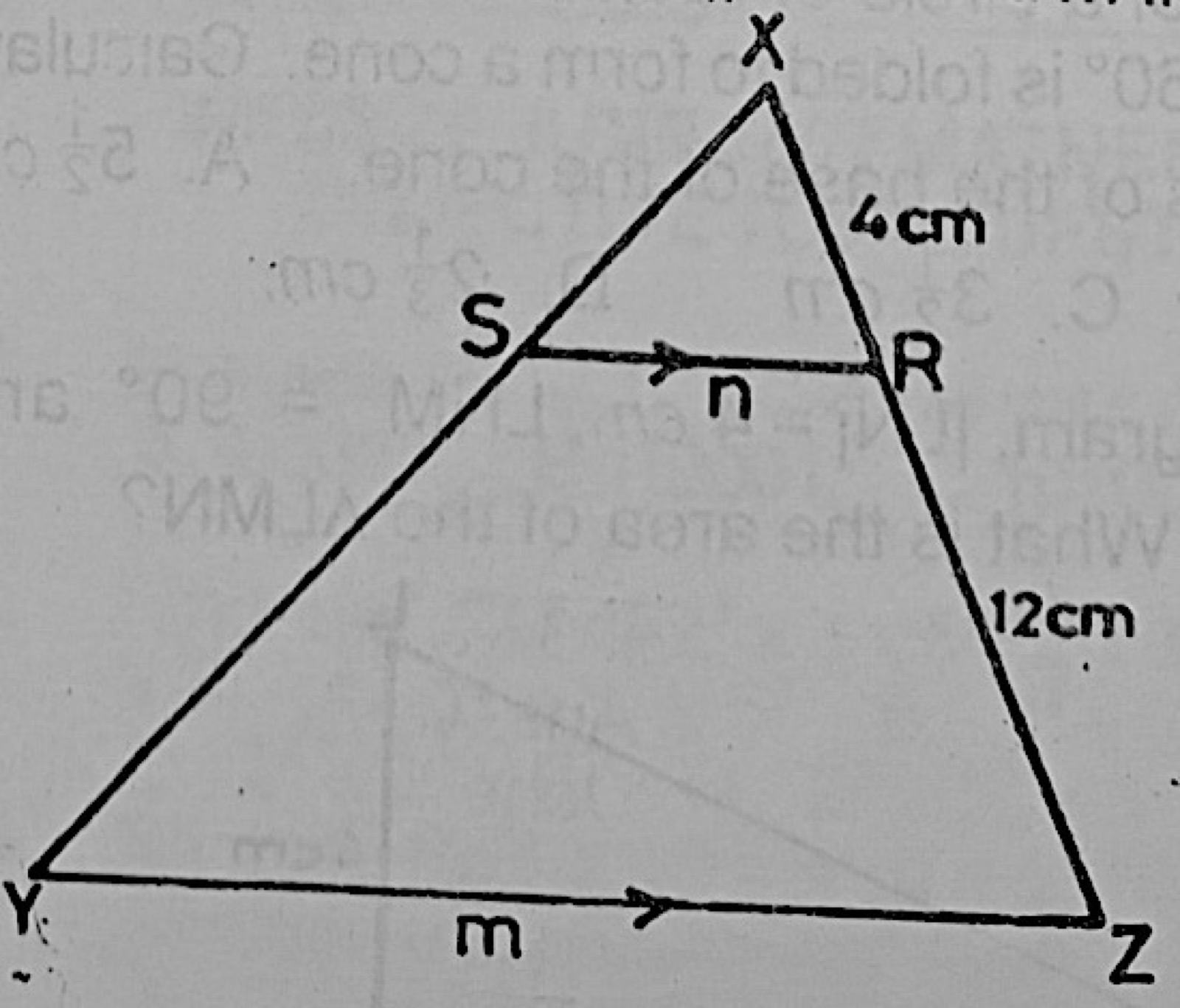
In the diagram, |XR| = 4 cm, |RZ| = 12 cm, |SR| = n, |YZ| = m and SR || YZ. Find m in terms of n.
Answer: C (m = 4n)
SR ∥ YZ, so triangles XSR and XYZ are similar: SR/YZ = XR/XZ = 4/16. So n/m = 1/4 and m = 4n.
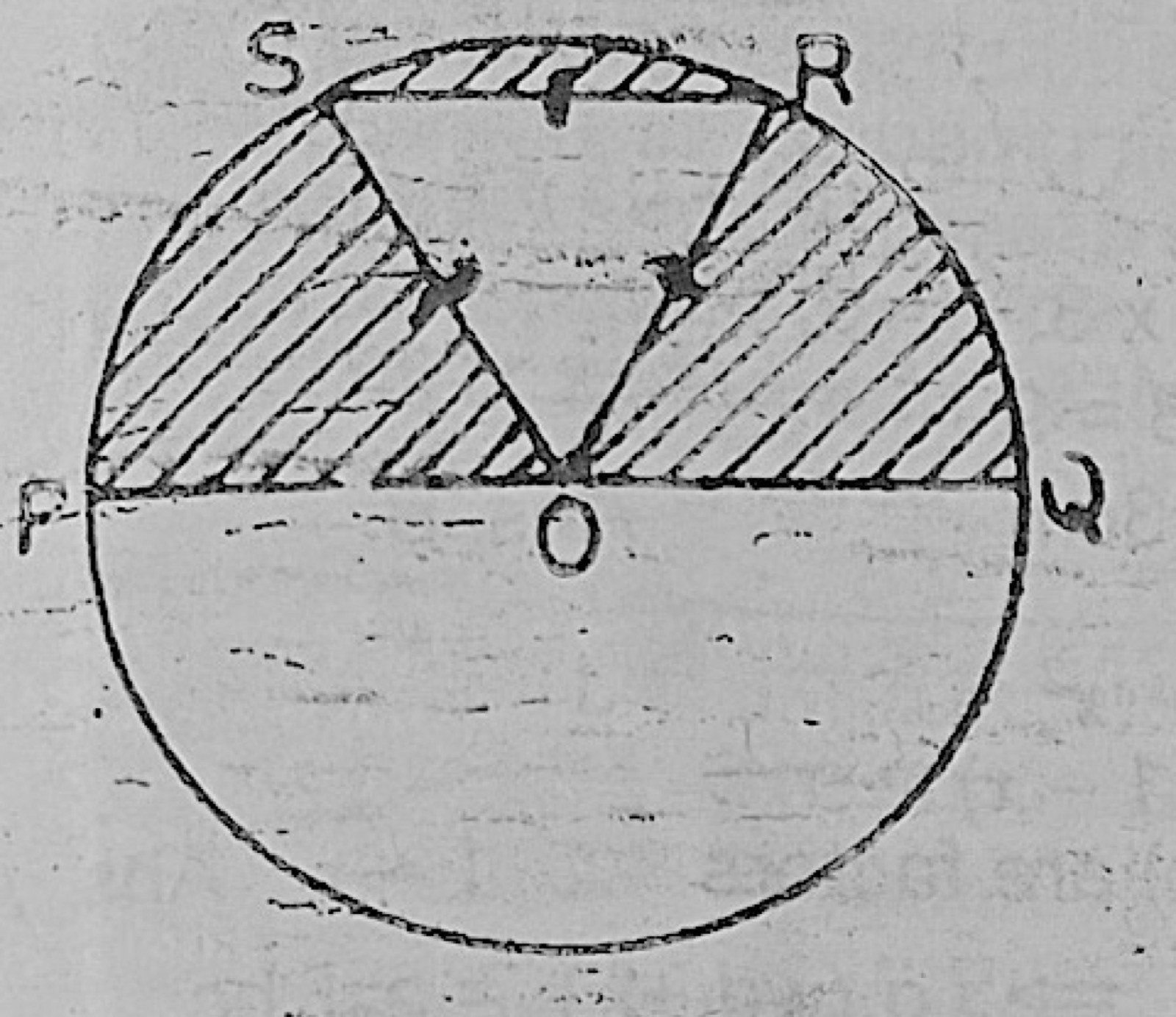
In the diagram, O is the centre of the circle and PQ is a diameter. Triangle RSO is an equilateral triangle of side 4 cm. Find the area of the shaded region.
Answer: C (18.21 cm2)
Radius = 4 cm. Shaded = semicircle − triangle = ½ × 22/7 × 16 − ½ × 4 × 4 × sin 60° = 25.14 − 6.93 = 18.21 cm2.
(a) Evaluate, without using mathematical tables or calculator, (3.69 × 10⁵) ÷ (1.64 × 10⁻³), leaving your answer in the standard form.
(b) A man invested N20,000 in bank A and N25,000 in bank B at the beginning of a year. Bank A pays simple interest at a rate of y% per annum and B pays 1.5y% per annum. If his total interest at the end of the year from the two banks was N4,600, find the value of y.
(a) 3.69 ÷ 1.64 = 2.25 and 105 ÷ 10−3 = 108, so the answer is 2.25 × 10⁸.
(b) Interest from A = 20,000 × y/100 = 200y; from B = 25,000 × 1.5y/100 = 375y.
200y + 375y = 4600, so 575y = 4600 and y = 8.
Divide the numbers and subtract the powers of 10 separately.
(a) Simplify: (x2 − 8x + 16)/(x2 − 7x + 12)
(b) If 1/2, 1/x, 1/3 are successive terms of an arithmetic progression (A.P.), show that (2 − x)/(x − 3) = 2/3.
(a) (x − 4)(x − 4)/[(x − 4)(x − 3)] = (x − 4)/(x − 3).
(b) Equal common difference: 1/x − 1/2 = 1/3 − 1/x.
So (2 − x)/2x = (x − 3)/3x. Multiply by 6x: 3(2 − x) = 2(x − 3).
Hence (2 − x)/(x − 3) = 2/3.
In an AP the difference between consecutive terms is constant.
The diagram shows the cross-section of a railway tunnel. If |AB| = 100 m and the radius of the arc is 56 m, calculate, correct to the nearest metre, the perimeter of the cross-section.
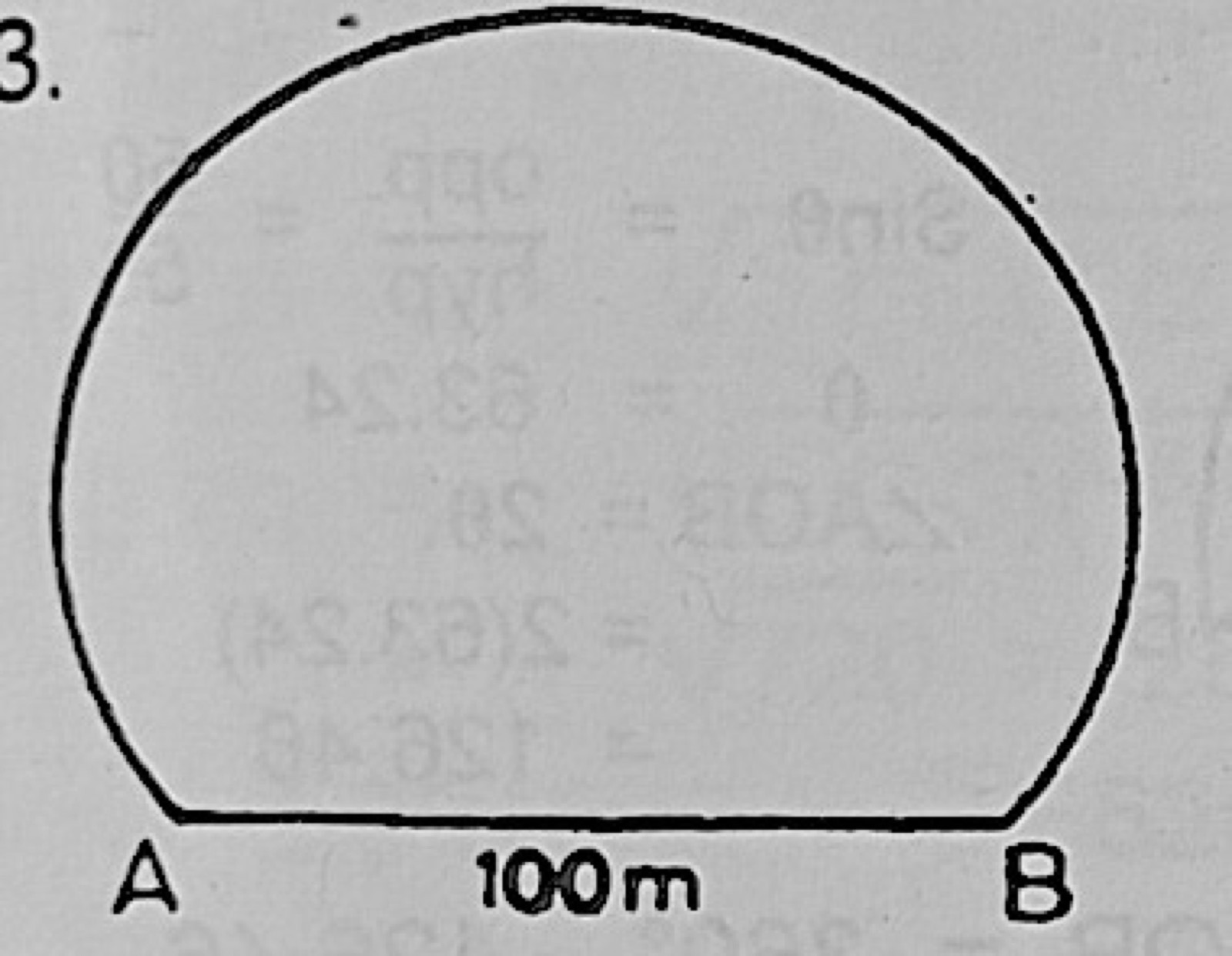
Let O be the centre. Half of AB = 50 m, so sin ½∠AOB = 50/56 and ½∠AOB ≈ 63.23°, giving ∠AOB ≈ 126.5°.
The arc of the tunnel is the major arc: 360° − 126.5° = 233.5°.
Arc length = 233.5/360 × 2 × 22/7 × 56 ≈ 228.4 m.
Perimeter = 228.4 + 100 ≈ 328 m.
The tunnel's curved part is the major arc, so use the reflex angle at the centre.
Y is 60 km away from X on a bearing of 135°. Z is 80 km away from X on a bearing of 225°. Find the: (a) distance of Z from Y; (b) bearing of Z from Y.
(a) ∠YXZ = 225° − 135° = 90°, so |ZY| = √(602 + 802) = 100 km.
(b) tan ∠XYZ = 80/60, so ∠XYZ ≈ 53.1°. The bearing of X from Y is 315°.
Bearing of Z from Y = 315° − 53.1° ≈ 262°.
Draw a sketch with north lines at X and Y; the angle at X is a right angle.
Out of the 24 apples in a box, 6 are bad. If three apples are taken from the box at random, with replacement, find the probability that: (a) the first two are good and the third is bad; (b) all the three are bad; (c) all the three are good.
P(bad) = 6/24 = 1/4, P(good) = 3/4; with replacement the draws are independent.
(a) 3/4 × 3/4 × 1/4 = 9/64.
(b) (1/4)3 = 1/64.
(c) (3/4)3 = 27/64.
With replacement the probabilities stay the same for each draw, so multiply.
(a) Simplify: (3 1/12 + 7/8)/(2 1/4 − 1/6)
(b) If p = m/2 − n2/5m, (i) make n the subject of the relation; (ii) find, correct to three significant figures, the value of n when p = 14 and m = −8.
(a) Numerator: 37/12 + 7/8 = 74/24 + 21/24 = 95/24. Denominator: 9/4 − 1/6 = 27/12 − 2/12 = 25/12.
95/24 ÷ 25/12 = 95/24 × 12/25 = 19/10 = 1 9/10.
(b)(i) n2/5m = m/2 − p, so n2 = 5m(m − 2p)/2 and n = ±√[5m(m − 2p)/2].
(ii) n2 = 5(−8)(−8 − 28)/2 = (−40)(−36)/2 = 720, so n = ±26.8.
Isolate the n2 term first, then take the square root.
(a) With the aid of four-figure logarithm tables, evaluate (0.004592)1/3.
(b) If log10y + 3log10x = 2, express y in terms of x.
(c) Solve the equations: 3x − 2y = 21; 4x + 5y = 5.
(a) log 0.004592 = 3̄.6620. Divide by 3: (−3 + 0.6620)/3 = 1̄.2207. Antilog = 0.1663.
(b) log(yx3) = 2, so yx3 = 100 and y = 100/x3.
(c) 15x − 10y = 105 and 8x + 10y = 10. Adding: 23x = 115, so x = 5; then 3(5) − 2y = 21 gives y = −3.
When dividing a log with a negative characteristic, make the characteristic a multiple of 3 first.
(a) A cylinder with radius 3.5 cm has its two ends closed. If the total surface area is 209 cm2, calculate the height of the cylinder. (Take π = 22/7)
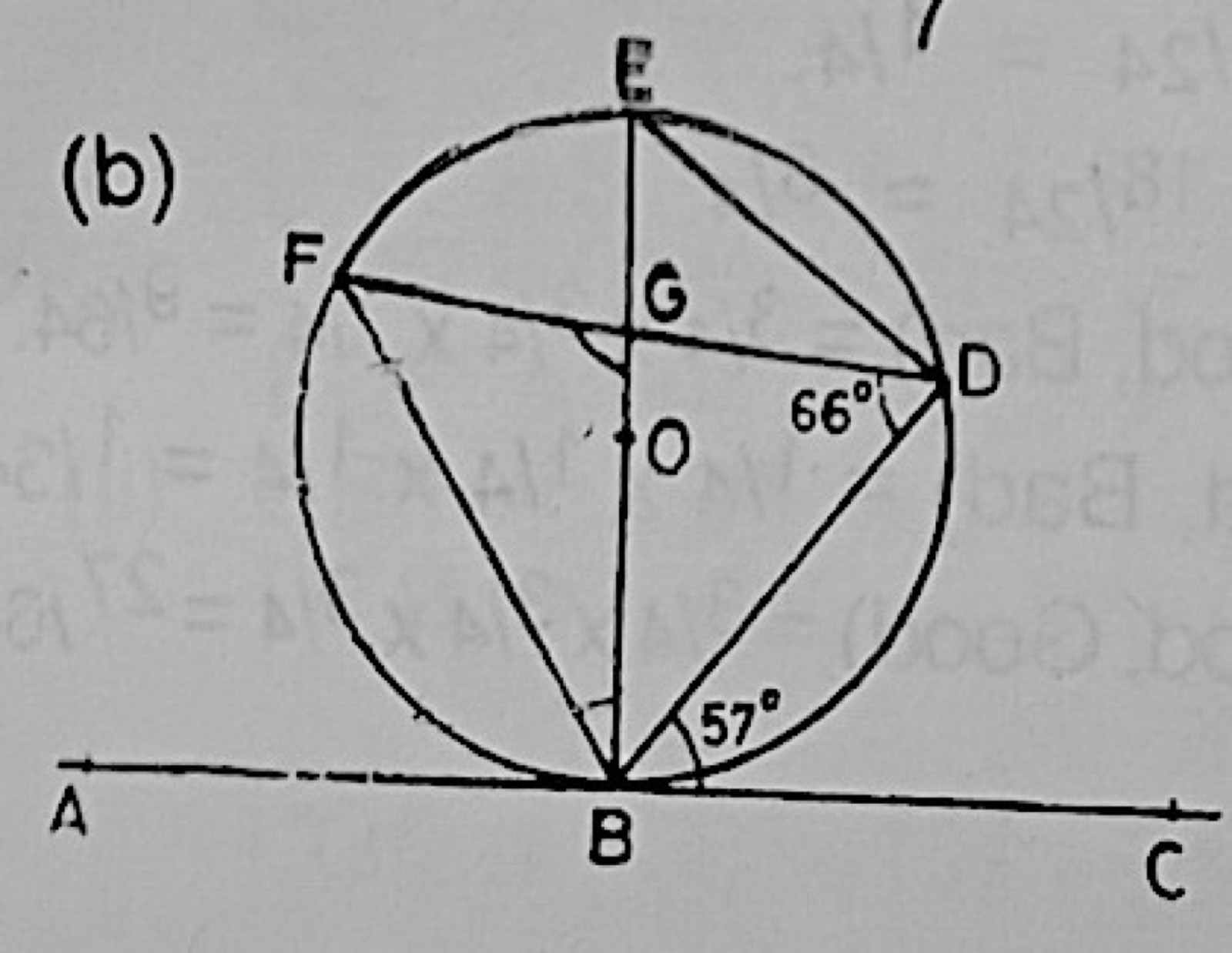
(b) In the diagram, O is the centre of the circle and ABC is a tangent at B. If BD̂F = 66° and DB̂C = 57°, calculate, (i) EB̂F (ii) BĜF.
(a) Total surface area = 2πr2 + 2πrh = 2 × 22/7 × 12.25 + 2 × 22/7 × 3.5 × h = 77 + 22h = 209, so h = 6 cm.
(b)(i) EB is a diameter, so ∠EDB = 90° (angle in a semicircle). ∠EDF = 90° − 66° = 24°, and ∠EBF = ∠EDF = 24° (same segment).
(ii) The radius OB is perpendicular to the tangent, so ∠EBD = 90° − 57° = 33°. In ΔGBD: ∠BGD = 180° − 33° − 66° = 81°, so ∠BGF = 180° − 81° = 99°.
Use the angle in a semicircle and the right angle between a tangent and a radius.
(a) Using a ruler and a pair of compasses only, construct: (i) a triangle PQR such that |PQ| = 10 cm, |QR| = 7 cm and PQ̂R = 90°; (ii) the locus l1 of points equidistant from Q and R; (iii) the locus l2 of points equidistant from P and Q.
(b) Locate the point O equidistant from P, Q and R.
(c) With O as centre, draw the circumcircle of the triangle PQR.
(d) Measure the radius of the circumcircle.
(a)(i) Draw PQ = 10 cm, construct 90° at Q and mark QR = 7 cm; join PR.
(ii) l1 is the perpendicular bisector of QR. (iii) l2 is the perpendicular bisector of PQ.
(b) O is where l1 and l2 meet (it is the midpoint of PR).
(c) Circle with centre O through P, Q and R.
(d) Radius ≈ 6.1 cm (half of PR = ½√149 ≈ 6.10 cm).
Points equidistant from two points lie on their perpendicular bisector.
(a) Simplify (x2 − y2)/(3x + 3y)
(b) In the diagram, PQRS is a rectangle. |PK| = 15 cm, |SK| = |KR| and PK̂S = 37°. Calculate, correct to three significant figures: (i) |PS|; (ii) |SK|; (iii) the area of the shaded portion.
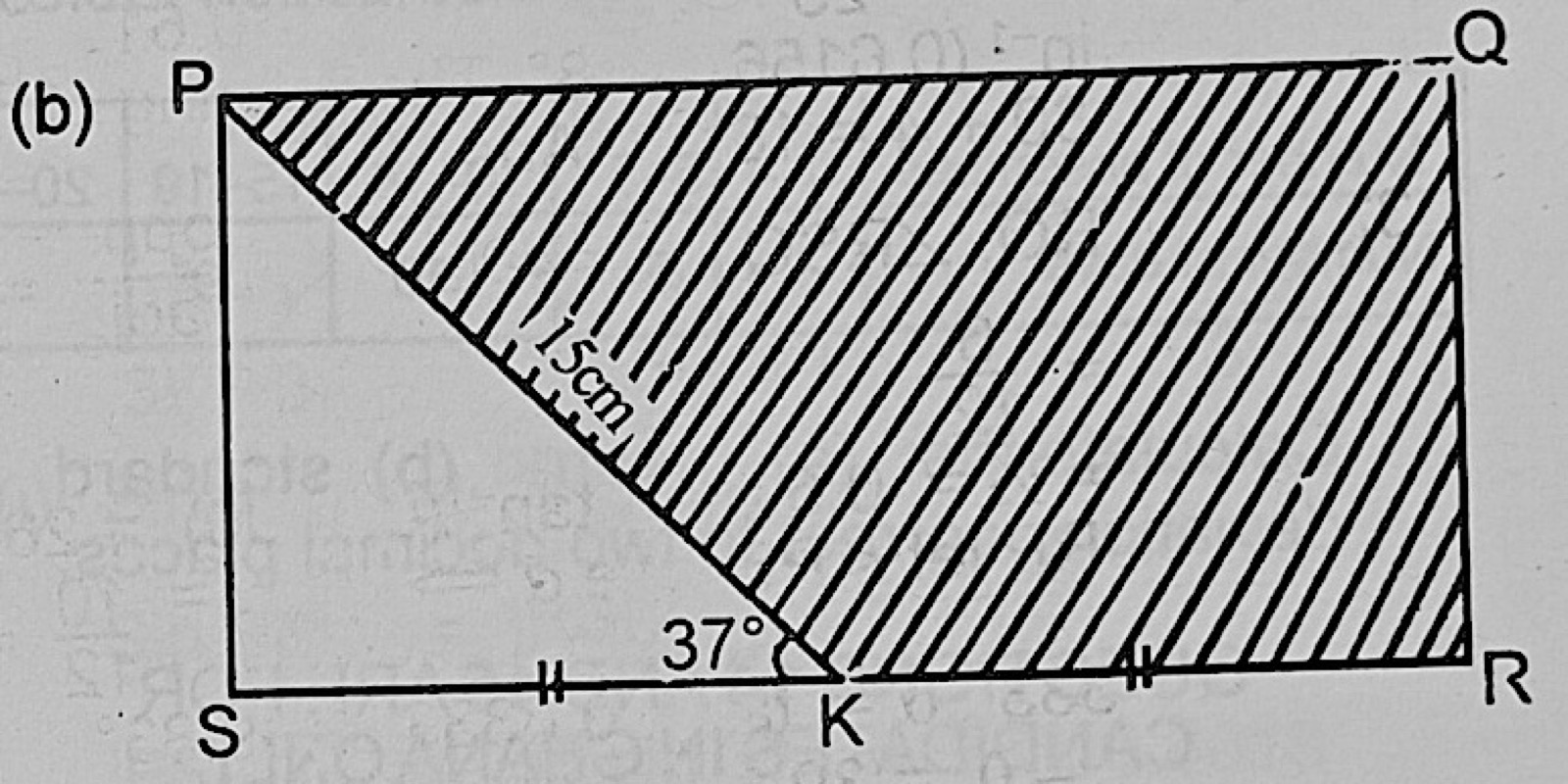
(a) (x − y)(x + y)/3(x + y) = (x − y)/3.
(b)(i) |PS| = 15 sin 37° ≈ 9.03 cm.
(ii) |SK| = 15 cos 37° ≈ 12.0 cm (11.98 cm).
(iii) |SR| = 2 × 11.98 = 23.96 cm. Rectangle = 23.96 × 9.027 ≈ 216.3 cm2; ΔPSK = ½ × 11.98 × 9.027 ≈ 54.1 cm2.
Shaded area ≈ 216.3 − 54.1 ≈ 162 cm2.
The shaded part is the rectangle minus the right triangle PSK.
(a) In the diagram, AOB is a straight line, ∠AOC = 3(x + y)°, ∠COB = 45°, ∠AOD = (5x + y)° and ∠DOB = y°. Find the values of x and y.
(b) From two points on opposite sides of a pole 33 m high, the angles of elevation of the top of the pole are 53° and 67°. If the two points and the base of the pole are on the same horizontal level, calculate, correct to three significant figures, the distance between the two points.
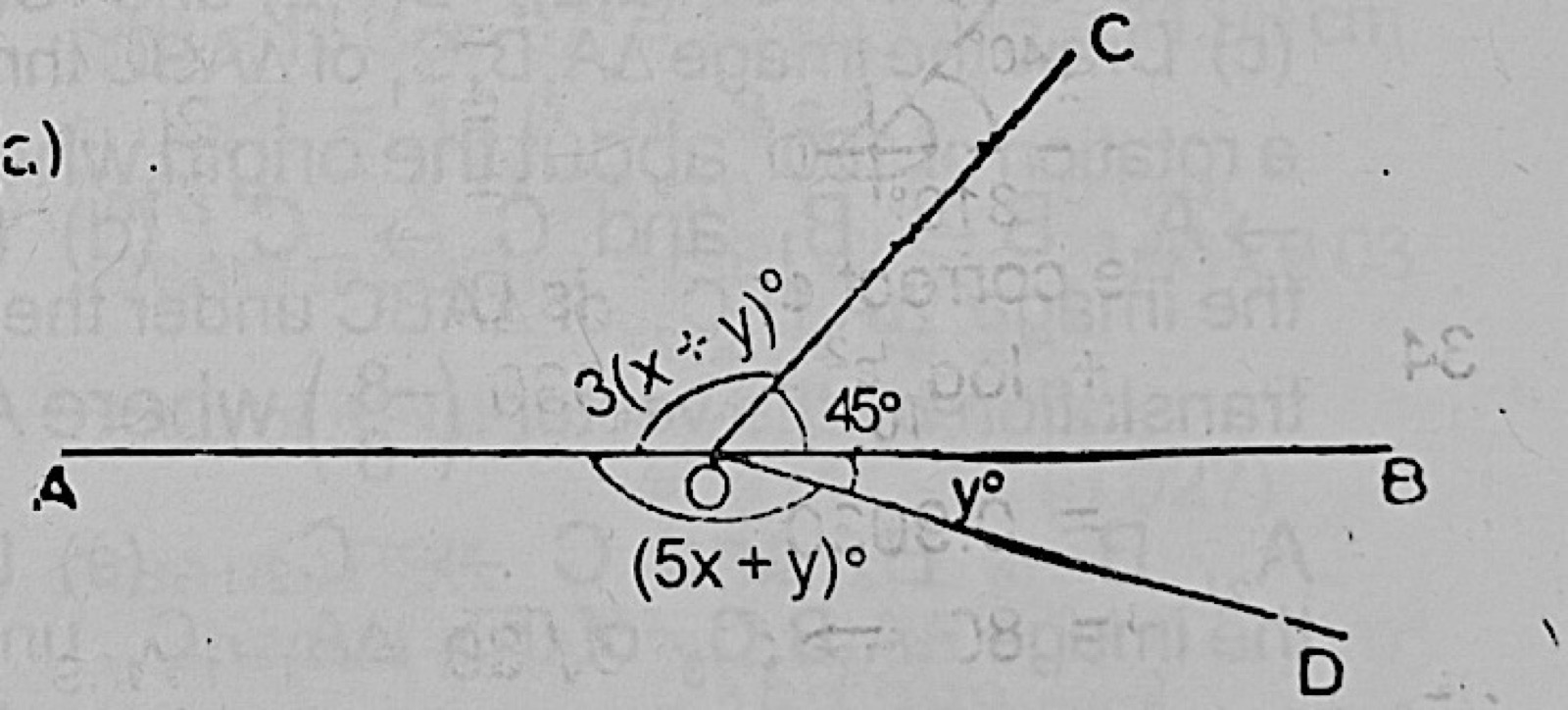
(a) Angles on a straight line: 3(x + y) + 45 = 180, so x + y = 45.
(5x + y) + y = 180, so 5x + 2y = 180.
Substituting x = 45 − y: 225 − 3y = 180, so y = 15 and x = 30.
(b) Distances from the pole: 33/tan 53° ≈ 24.87 m and 33/tan 67° ≈ 14.01 m.
Distance between the points ≈ 24.87 + 14.01 ≈ 38.9 m.
The points are on opposite sides, so add the two horizontal distances.
(a) The 3rd and 8th terms of an arithmetic progression (A.P.) are −9 and 26 respectively. Find the: (i) common difference; (ii) first term.
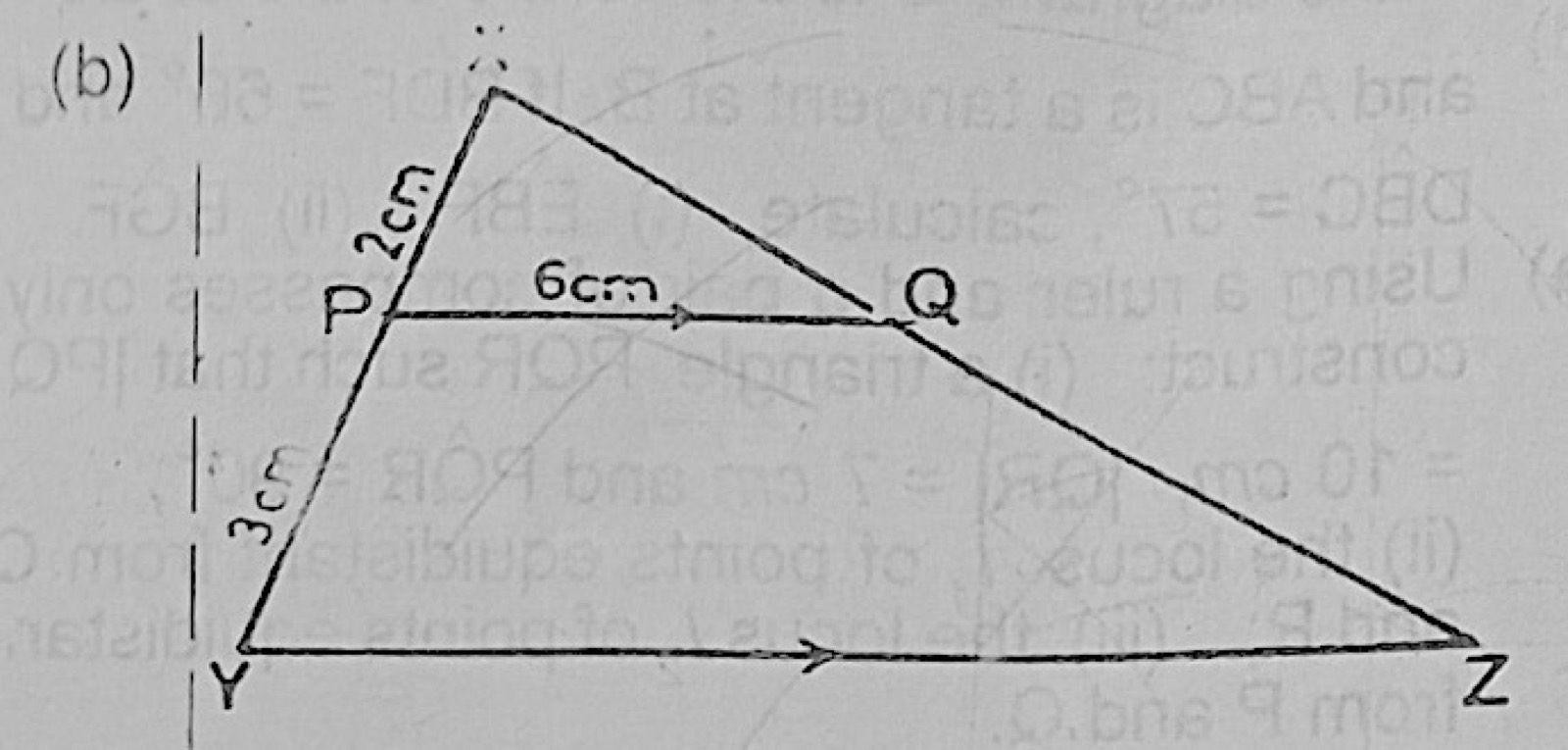
(b) In the diagram, PQ||YZ, |XP| = 2 cm, |PY| = 3 cm, |PQ| = 6 cm and the area of ΔXPQ = 24 cm2. Calculate the area of the trapezium PQZY.
(a) a + 2d = −9 and a + 7d = 26. Subtracting: 5d = 35.
(i) d = 7. (ii) a = −9 − 14 = −23.
(b) ΔXPQ ~ ΔXYZ with ratio XP : XY = 2 : 5, so the areas are in the ratio 4 : 25.
Area of ΔXYZ = 24 × 25/4 = 150 cm2.
Area of PQZY = 150 − 24 = 126 cm2.
Areas of similar triangles are in the ratio of the squares of their sides.
In a college, the number of absentees recorded over a period of 30 days was as shown in the frequency distribution table.
Number of absentees: 0–4, 5–9, 10–14, 15–19, 20–24
Number of days: 1, 5, 10, 9, 5
Calculate the: (a) mean; (b) standard deviation, correct to two decimal places.
Class marks x: 2, 7, 12, 17, 22; Σf = 30.
(a) Σfx = 2 + 35 + 120 + 153 + 110 = 420. Mean = 420/30 = 14.00.
(b) Deviations d = x − 14: −12, −7, −2, 3, 8. Σfd2 = 144 + 245 + 40 + 81 + 320 = 830.
SD = √(830/30) = √27.67 ≈ 5.26.
Use the class mid-points as x.
(Questions 14 and 15 are for candidates in Ghana only.)
(a) Using a scale of 2 cm to 4 units on both axes, draw on a graph sheet, two perpendicular axes Ox and Oy for the intervals −16 ≤ x ≤ 16, −16 ≤ y ≤ 16.
(b) Draw the triangle ABC with the vertices A(2, 2), B(8, 2) and C(6, 6).
(c) Draw the image ΔA1B1C1 of ΔABC through a rotation of 180° about the origin where A → A1, B → B1 and C → C1.
(d) Draw the image ΔA2B2C2 of ΔABC under the translation by the vector (−8, 8) where A → A2, B → B2 and C → C2.
(e) Draw the image ΔA3B3C3 of the ΔA1B1C1 under the reflection in the line x − 2 = 0, where A1 → A3, B1 → B3 and C1 → C3.
(f) Describe the transformation that will map ΔABC onto ΔA3B3C3.
(a), (b) Axes to scale; A(2, 2), B(8, 2), C(6, 6).
(c) (x, y) → (−x, −y): A1(−2, −2), B1(−8, −2), C1(−6, −6).
(d) Add (−8, 8): A2(−6, 10), B2(0, 10), C2(−2, 14).
(e) Reflection in x = 2: (x, y) → (4 − x, y): A3(6, −2), B3(12, −2), C3(10, −6).
(f) ABC → A3B3C3 is (x, y) → (x + 4, −y): a reflection in the x-axis followed by a translation of 4 units in the positive x-direction (vector (4, 0)).
Write each transformation as a rule on (x, y) and combine them.
(a) Given that f(x) = 2x − 1 and g(x) = x2 + 1: (i) find f(1 + x); (ii) find the range of values of x for which f(x) < −3; (iii) simplify f(x) − g(x).
(b) Given that A(1, 3), B(−2, −1) and C(2, 3m) where m is a constant; find: (i) |BA|; (ii) the value of m if BC = (4, −5).
(a)(i) f(1 + x) = 2(1 + x) − 1 = 2x + 1.
(ii) 2x − 1 < −3, so 2x < −2 and x < −1.
(iii) f(x) − g(x) = 2x − 1 − x2 − 1 = −x2 + 2x − 2.
(b)(i) |BA| = √[(1 + 2)2 + (3 + 1)2] = √25 = 5 units.
(ii) BC = (2 − (−2), 3m − (−1)) = (4, 3m + 1) = (4, −5), so 3m + 1 = −5 and m = −2.
A vector from B to C is (position of C) − (position of B).