Theory question 108
Mensuration of Solids(a) A cylinder with radius 3.5 cm has its two ends closed. If the total surface area is 209 cm2, calculate the height of the cylinder. (Take π = 22/7)
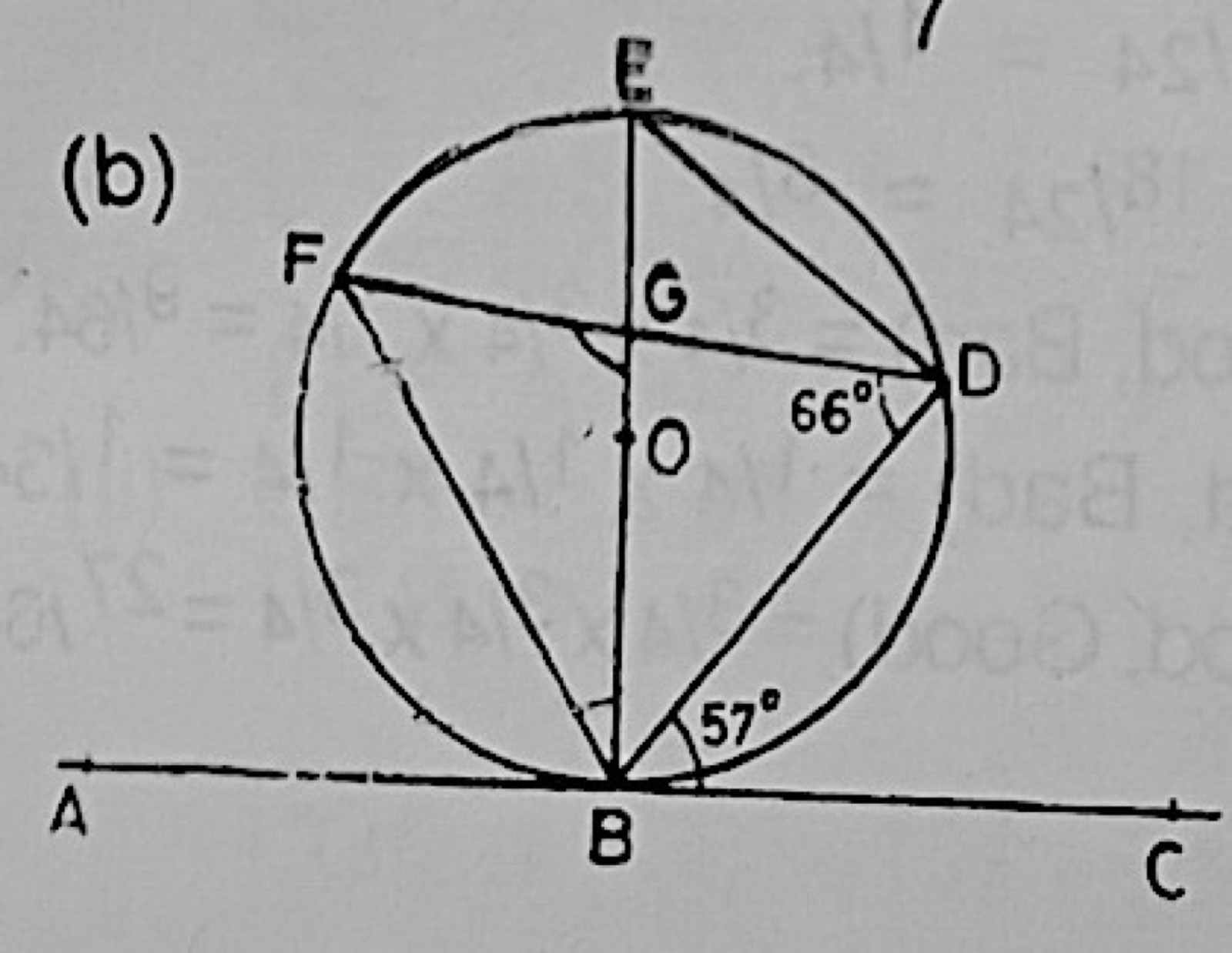
(b) In the diagram, O is the centre of the circle and ABC is a tangent at B. If BD̂F = 66° and DB̂C = 57°, calculate, (i) EB̂F (ii) BĜF.
Show the model answer
Model answer
(a) Total surface area = 2πr2 + 2πrh = 2 × 22/7 × 12.25 + 2 × 22/7 × 3.5 × h = 77 + 22h = 209, so h = 6 cm.
(b)(i) EB is a diameter, so ∠EDB = 90° (angle in a semicircle). ∠EDF = 90° − 66° = 24°, and ∠EBF = ∠EDF = 24° (same segment).
(ii) The radius OB is perpendicular to the tangent, so ∠EBD = 90° − 57° = 33°. In ΔGBD: ∠BGD = 180° − 33° − 66° = 81°, so ∠BGF = 180° − 81° = 99°.
Explanation
Use the angle in a semicircle and the right angle between a tangent and a radius.