WAEC Mathematics 2001 past questions and answers

59 questions. Try each one, then open the answer to check yourself and read the explanation.

Question 1

Fractions, Decimals and Approximation

Which of the following correctly expresses 48 as a product of prime factors?

  1. A.3 × 4 × 4
  2. B.2 × 3 × 8
  3. C.2 × 2 × 3 × 4
  4. D.2 × 2 × 2 × 2 × 3.
Show the answer and explanation

Answer: D (2 × 2 × 2 × 2 × 3.)

Explanation

Only D uses prime numbers alone: 2 × 2 × 2 × 2 × 3 = 48. 4 and 8 are not prime.

Open this question

Question 2

Number Bases

Evaluate (20three)2 − (11three)2 in base three

  1. A.101
  2. B.121
  3. C.202
  4. D.2020
Show the answer and explanation

Answer: C (202)

Explanation

20three = 6 and 11three = 4. 36 − 16 = 20 = 2×9 + 0×3 + 2 = 202three.

Open this question

Question 3

Logarithms

Evaluate log105 + log1020

  1. A.2
  2. B.3
  3. C.4
  4. D.5
Show the answer and explanation

Answer: A (2)

Explanation

log10(5 × 20) = log10100 = 2.

Open this question

Question 5

Variation

If N varies directly as M and N = 8 when M = 20, find M when N = 7.

  1. A.13
  2. B.15
  3. C.17½
  4. D.18½
Show the answer and explanation

Answer: C (17½)

Explanation

N = kM with k = 8/20 = 2/5. Then 7 = 2M/5, so M = 35/2 = 17½.

Open this question

Question 7

Ratio, Percentages and Rates

In a bag of oranges, the ratio of the good ones to the bad ones is 5:4. If the number of bad oranges in the bag is 36, how many oranges are there altogether?

  1. A.81
  2. B.72
  3. C.54
  4. D.45
Show the answer and explanation

Answer: A (81)

Explanation

4 parts = 36, so 1 part = 9 and the total of 9 parts = 81.

Open this question

Question 8

Ratio, Percentages and Rates

A boy estimated his transport fare for a journey as N190 instead of N200. Find the percentage error in his estimate.

  1. A.95%
  2. B.47.5%
  3. C.5.26%
  4. D.5%
Show the answer and explanation

Answer: D (5%)

Explanation

Error = 10; as a percentage of the actual fare, 10/200 × 100% = 5%.

Open this question

Question 9

Fractions, Decimals and Approximation

Evaluate 5 2/5 × (2/3)2 ÷ (1 1/2)−1

  1. A.8/25
  2. B.12/25
  3. C.3 3/5
  4. D.4 1/8
Show the answer and explanation

Answer: C (3 3/5)

Explanation

27/5 × 4/9 = 12/5, and (3/2)−1 = 2/3. 12/5 ÷ 2/3 = 12/5 × 3/2 = 18/5 = 3 3/5.

Open this question

Question 10

Progressions

The nth term of a sequence is 22n−1. Which term of the sequence is 29?

  1. A.3rd
  2. B.4th
  3. C.5th
  4. D.6th
Show the answer and explanation

Answer: C (5th)

Explanation

2n − 1 = 9 gives n = 5, the 5th term.

Open this question

Question 11

Fractions, Decimals and Approximation

Evaluate 1/2 + 3/4 of 2/5 ÷ 1 3/5

  1. A.15/16
  2. B.11/16
  3. C.49/50
  4. D.3 1/5
Show the answer and explanation

Answer: B (11/16)

Explanation

'Of' first: 3/4 × 2/5 = 3/10. Then ÷ 8/5: 3/10 × 5/8 = 3/16. Finally 1/2 + 3/16 = 11/16.

Open this question

Question 12

Linear and Simultaneous Equations

A man is four times as old as his son. The difference between their ages is 36 years. Find the sum of their ages.

  1. A.45 years
  2. B.48 years
  3. C.60 years
  4. D.74 years.
Show the answer and explanation

Answer: C (60 years)

Explanation

4x − x = 36 gives x = 12. The father is 48, so the sum is 60 years.

Open this question

Question 13

Linear and Simultaneous Equations

Given that y = px + q and y = 5 when x = 3, while y = 4 when x = 2, find the values of p and q.

  1. A.p = 1, q = 3
  2. B.p = 1, q = 2
  3. C.p = −2, q = 3
  4. D.p = 3, q = −2
Show the answer and explanation

Answer: B (p = 1, q = 2)

Explanation

3p + q = 5 and 2p + q = 4. Subtracting gives p = 1, then q = 2.

Open this question

Question 14

Algebraic Expressions

Evaluate (x2 + x − 2)/(2x2 + x − 3) when x = −1

  1. A.−2
  2. B.−1
  3. C.−½
  4. D.1
Show the answer and explanation

Answer: D (1)

Explanation

Numerator: 1 − 1 − 2 = −2. Denominator: 2 − 1 − 3 = −2. −2 ÷ −2 = 1.

Open this question

Question 15

Algebraic Expressions

Factorize 6x2 + 7x − 20

  1. A.(6x − 5)(x + 4)
  2. B.2(3x − 5)(x + 2)
  3. C.(3x + 4)(2x − 5)
  4. D.(3x − 4)(2x + 5)
Show the answer and explanation

Answer: D ((3x − 4)(2x + 5))

Explanation

(3x − 4)(2x + 5) = 6x2 + 15x − 8x − 20 = 6x2 + 7x − 20.

Open this question

Question 16

Algebraic Expressions

Simplify (2x − 1)/3 − (x + 3)/2

  1. A.(x + 7)/6
  2. B.(x + 8)/6
  3. C.(x − 11)/6
  4. D.(x − 4)/6
Show the answer and explanation

Answer: C ((x − 11)/6)

Explanation

Over 6: 2(2x − 1) − 3(x + 3) = 4x − 2 − 3x − 9 = x − 11.

Open this question

Question 17

Inequalities

If (y − 3)/2 < (2y − 1)/3, which of the following is true?

  1. A.y > 7
  2. B.y < −7
  3. C.y > −7
  4. D.y < 7
Show the answer and explanation

Answer: C (y > −7)

Explanation

Multiply by 6: 3y − 9 < 4y − 2, so −7 < y, i.e. y > −7.

Open this question

Question 18

Ratio, Percentages and Rates

If (4m + 3n)/(4m − 3n) = 5/2, find the ratio m:n

  1. A.7 : 4
  2. B.4 : 3
  3. C.3 : 4
  4. D.4 : 7
Show the answer and explanation

Answer: A (7 : 4)

Explanation

8m + 6n = 20m − 15n, so 21n = 12m and m : n = 21 : 12 = 7 : 4.

Open this question

Question 19

Inequalities

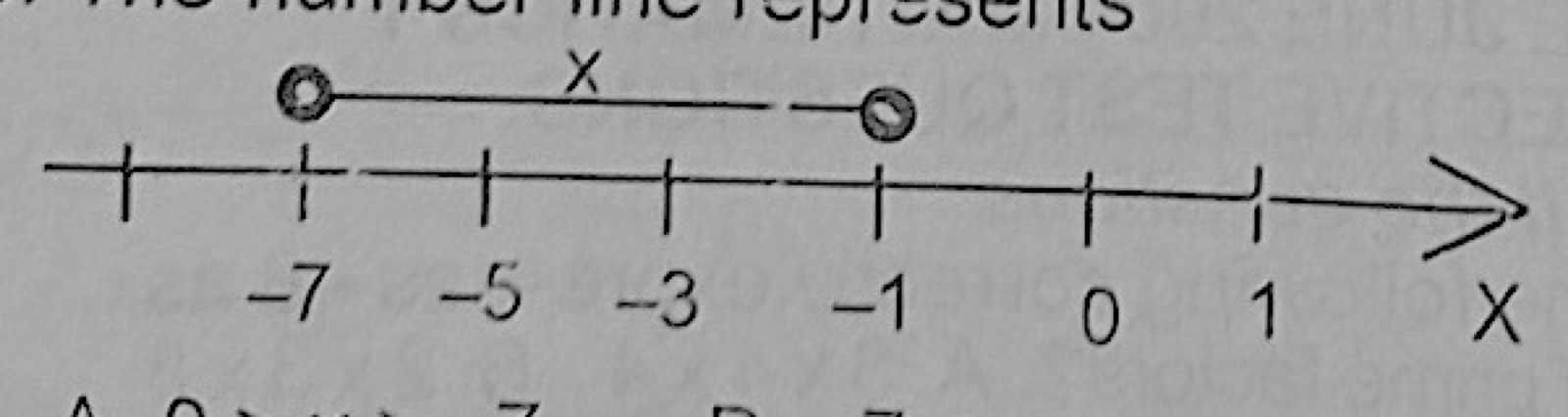
The number line represents

Diagram for this question
  1. A.0 > x ≥ −7
  2. B.−7 ≤ x < −1
  3. C.−7 < x ≤ −1
  4. D.−7 < x < −1
Show the answer and explanation

Answer: C (−7 < x ≤ −1)

Explanation

The circle at −7 is open (not included) and the circle at −1 is shaded (included): −7 < x ≤ −1.

Open this question

Question 20

Algebraic Expressions

If 2x2 + Kx − 14 = (x + 2)(2x − 7), find the value of K.

  1. A.−3
  2. B.5
  3. C.9
  4. D.11
Show the answer and explanation

Answer: A (−3)

Explanation

(x + 2)(2x − 7) = 2x2 − 3x − 14, so K = −3.

Open this question

Question 21

Quadratic Equations

Which of the following is not a quadratic expression?

  1. A.y = 2x2 − 5x
  2. B.y = x(x − 5)
  3. C.y = x2 − 5
  4. D.y = 5(x − 1)
Show the answer and explanation

Answer: D (y = 5(x − 1))

Explanation

5(x − 1) = 5x − 5 has no x2 term, so it is linear.

Open this question

Question 22

Graphs of Functions

The graph of the curve y = 2x2 − 5x − 1 and a straight line PQ were drawn to solve the equation 2x2 − 5x + 2 = 0. What is the equation of the line PQ?

  1. A.y = −1
  2. B.y = 1
  3. C.y = 3
  4. D.y = −3
Show the answer and explanation

Answer: D (y = −3)

Explanation

2x2 − 5x + 2 = 0 is the same as 2x2 − 5x − 1 = −3, so the line is y = −3.

Open this question

Question 23

Algebraic Expressions

Subtract (−y + 3x + 5z) from (4y − x − 2z).

  1. A.5y − 4x − 7z
  2. B.3y + 2x + 3z
  3. C.−5y + 4x + 7z
  4. D.2x − 5y + 3z
Show the answer and explanation

Answer: A (5y − 4x − 7z)

Explanation

(4y − x − 2z) − (−y + 3x + 5z) = 4y + y − x − 3x − 2z − 5z = 5y − 4x − 7z.

Open this question

Question 24

Variation

If y ∝ 1/√x and x = 16 when y = 2, find x when y = 24

  1. A.1/9
  2. B.1/6
  3. C.1/3
  4. D.2/3
Show the answer and explanation

Answer: A (1/9)

Explanation

y = k/√x: 2 = k/4, so k = 8. Then 24 = 8/√x gives √x = 1/3 and x = 1/9.

Open this question

Question 25

Linear and Simultaneous Equations

If 2x : (x + 1) = 3:2, what is the value of x?

  1. A.1/2
  2. B.1
  3. C.1 1/2
  4. D.3
Show the answer and explanation

Answer: D (3)

Explanation

2x/(x + 1) = 3/2, so 4x = 3x + 3 and x = 3.

Open this question

Question 26

Bearings

The bearing S40°E is the same as

  1. A.040°
  2. B.050°
  3. C.130°
  4. D.140°
Show the answer and explanation

Answer: D (140°)

Explanation

From south (180°) turn 40° towards east: 180 − 40 = 140°.

Open this question

Question 27

Trigonometry

Given that sin p = 5/13, where p is acute, find the value of cos p − tan p.

  1. A.79/156
  2. B.85/156
  3. C.7/13
  4. D.8/13
Show the answer and explanation

Answer: A (79/156)

Explanation

The adjacent side is 12, so cos p = 12/13 and tan p = 5/12. 12/13 − 5/12 = (144 − 65)/156 = 79/156.

Open this question

Question 28

Bearings

Three observation posts P, Q and R are such that Q is due east of P and R is due north of Q. If |PQ| = 5km and |PR| = 10 km, find |QR|.

  1. A.5.0 km
  2. B.7.5 km
  3. C.7.6 km
  4. D.8.7 km
Show the answer and explanation

Answer: D (8.7 km)

Explanation

The angle at Q is 90°, so QR = √(102 − 52) = √75 ≈ 8.7 km.

Open this question

Question 29

Angles and Polygons

Express 25° 45' in decimal (Hint 1° = 60')

  1. A.25.75°
  2. B.25.55°
  3. C.25.45°
  4. D.25.15°
Show the answer and explanation

Answer: A (25.75°)

Explanation

45' = 45/60 of a degree = 0.75°, so 25°45' = 25.75°.

Open this question

Question 30

Probability

A box contains 5 red, 3 green and 4 blue balls. A boy is allowed to take away two balls from the box. What is the probability that the two balls are red?

  1. A.5/33
  2. B.5/36
  3. C.103/132
  4. D.31/36
Show the answer and explanation

Answer: A (5/33)

Explanation

There are 12 balls. P(red, red) = 5/12 × 4/11 = 20/132 = 5/33.

Open this question

Question 31

Probability

A box contains 5 red, 3 green and 4 blue balls. A boy is allowed to take away two balls from the box. What is the probability that one is green the other is blue?

  1. A.2/11
  2. B.5/12
  3. C.8/12
  4. D.7/11
Show the answer and explanation

Answer: A (2/11)

Explanation

Green then blue or blue then green: 3/12 × 4/11 + 4/12 × 3/11 = 24/132 = 2/11.

Open this question

Question 32

Probability

If the probability that an event will occur is p and the probability that it will not occur is q, which of the following is true?

  1. A.p − q = 1
  2. B.q − p = 0
  3. C.p + q = 1
  4. D.p + q = 0
Show the answer and explanation

Answer: C (p + q = 1)

Explanation

An event either happens or it does not, so the two probabilities add up to 1.

Open this question

Question 33

Measures of Dispersion

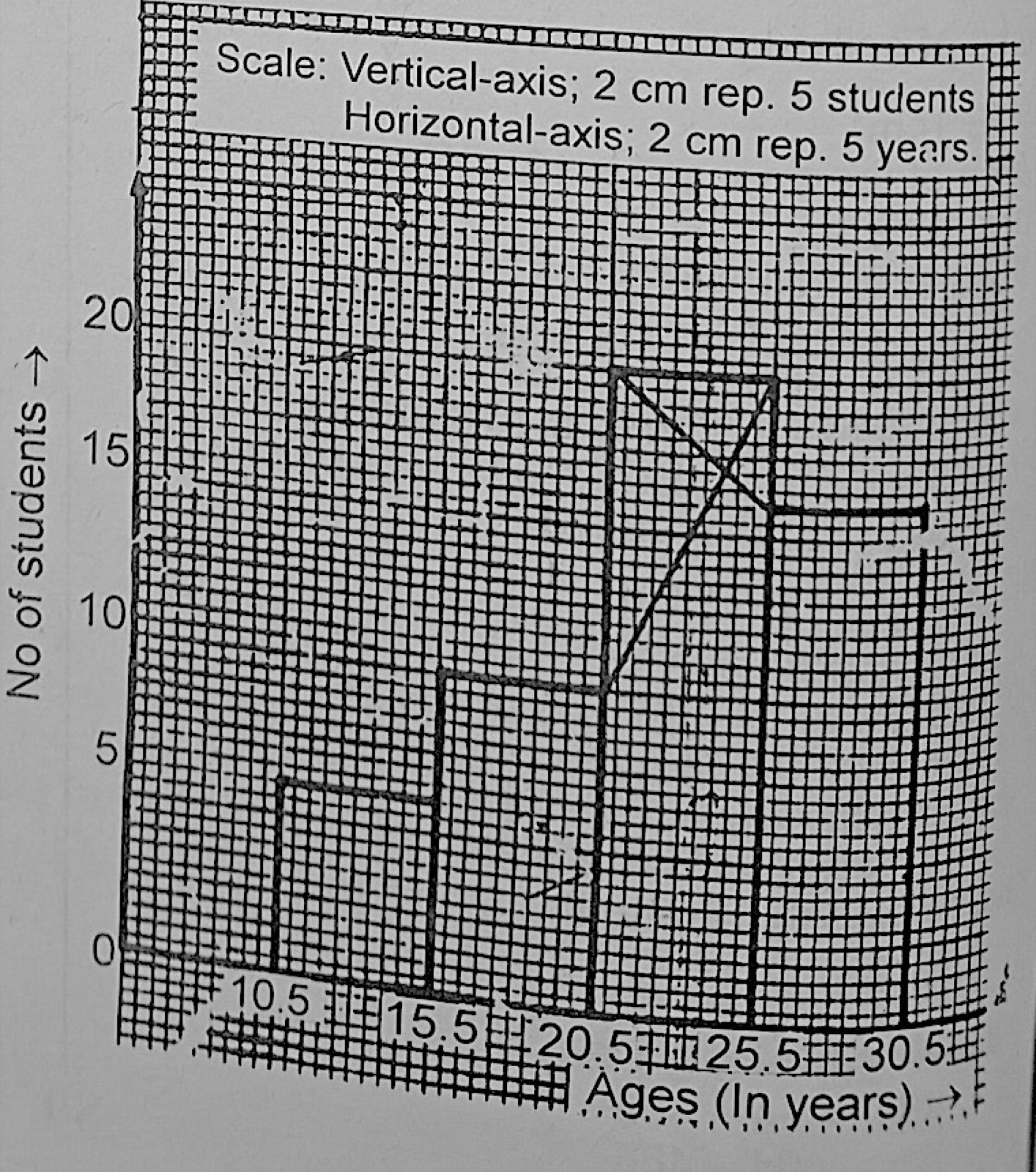
The histogram shows the distribution of a group of students according to their ages. What is the range of their ages?

Diagram for this question
  1. A.14 years
  2. B.20 years
  3. C.30.5 years
  4. D.31 years
Show the answer and explanation

Answer: B (20 years)

Explanation

The ages run from 10.5 to 30.5 years on the histogram, so the range is 30.5 − 10.5 = 20 years.

Open this question

Question 36

Angles and Polygons

Which of the following is not the size of an exterior angle of a regular polygon?

  1. A.15°
  2. B.18°
  3. C.20°
  4. D.21°
Show the answer and explanation

Answer: D (21°)

Explanation

An exterior angle must divide 360° exactly. 360 ÷ 21 is not a whole number, so 21° is impossible.

Open this question

Question 37

Triangles and Quadrilaterals

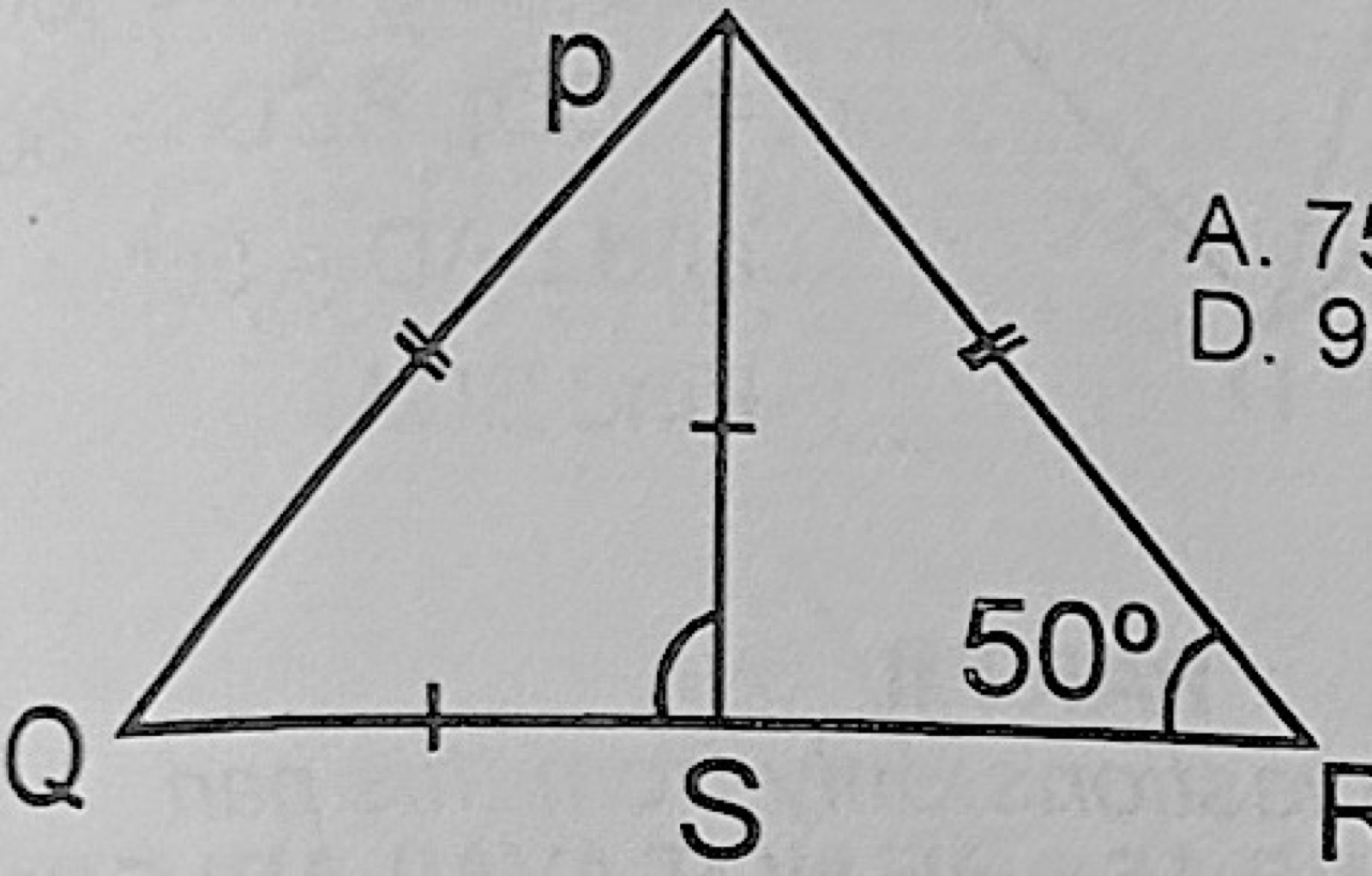
In the diagram, PQR is a triangle. |PQ| = |PR|, |PS| = |SQ| and ∠PRS = 50°. What is the size of ∠PSQ?

Diagram for this question
  1. A.75°
  2. B.80°
  3. C.85°
  4. D.95°
Show the answer and explanation

Answer: B (80°)

Explanation

PQ = PR, so ∠PQR = 50°. PS = SQ, so ∠SPQ = 50° too, and ∠PSQ = 180 − 50 − 50 = 80°.

Open this question

Question 38

Trigonometry

PQRS is a rhombus of side 16 cm. The diagonal |QS| = 20 cm. Calculate, correct to the nearest degree, ∠PQR.

  1. A.51°
  2. B.64°
  3. C.77°
  4. D.103°
Show the answer and explanation

Answer: D (103°)

Explanation

Half of QS is 10 cm, so half of ∠QPS has sine 10/16, giving ∠QPS ≈ 77.4°. Adjacent angles of a rhombus add to 180°, so ∠PQR ≈ 103°.

Open this question

Question 39

Circle Theorems

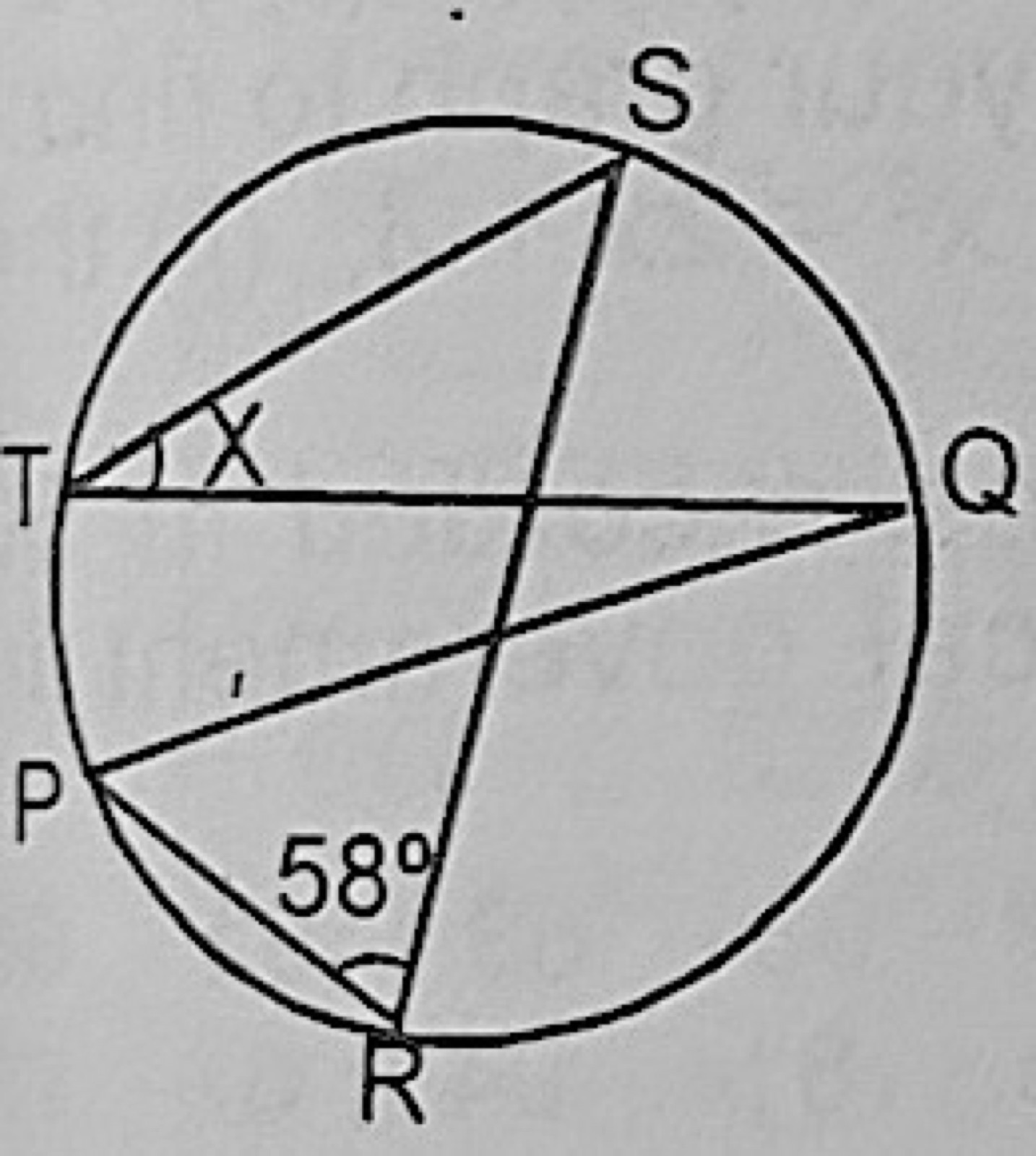
In the diagram, PQ is a diameter of the circle and ∠PRS = 58°. Find ∠STQ.

Diagram for this question
  1. A.29°
  2. B.32°
  3. C.42°
  4. D.53°
Show the answer and explanation

Answer: B (32°)

Explanation

∠PQS = ∠PRS = 58° (same arc PS) and ∠PSQ = 90° (semicircle), so ∠SPQ = 32°. ∠STQ = ∠SPQ (same arc SQ) = 32°.

Open this question

Question 40

Triangles and Quadrilaterals

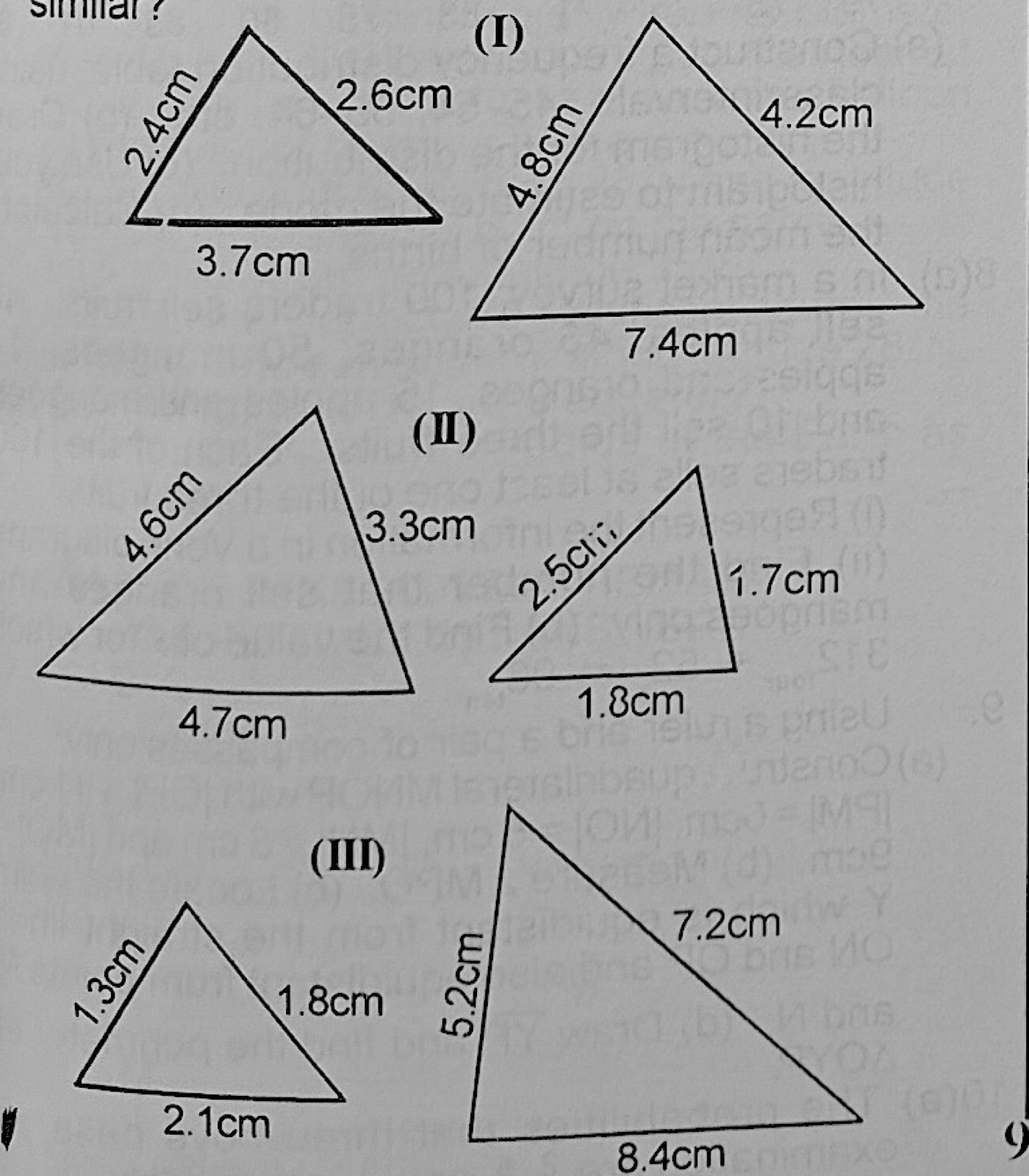
Which of the following pairs of triangles is/are similar?

Diagram for this question
  1. A.II only
  2. B.III only
  3. C.I and III only
  4. D.II and III only
Show the answer and explanation

Answer: B (III only)

Explanation

In III every side of the larger triangle is 4 times the smaller (5.2, 7.2, 8.4 against 1.3, 1.8, 2.1). In I, 4.2 is not twice 2.6, and the sides in II are not in one ratio.

Open this question

Question 41

Mensuration of Plane Shapes

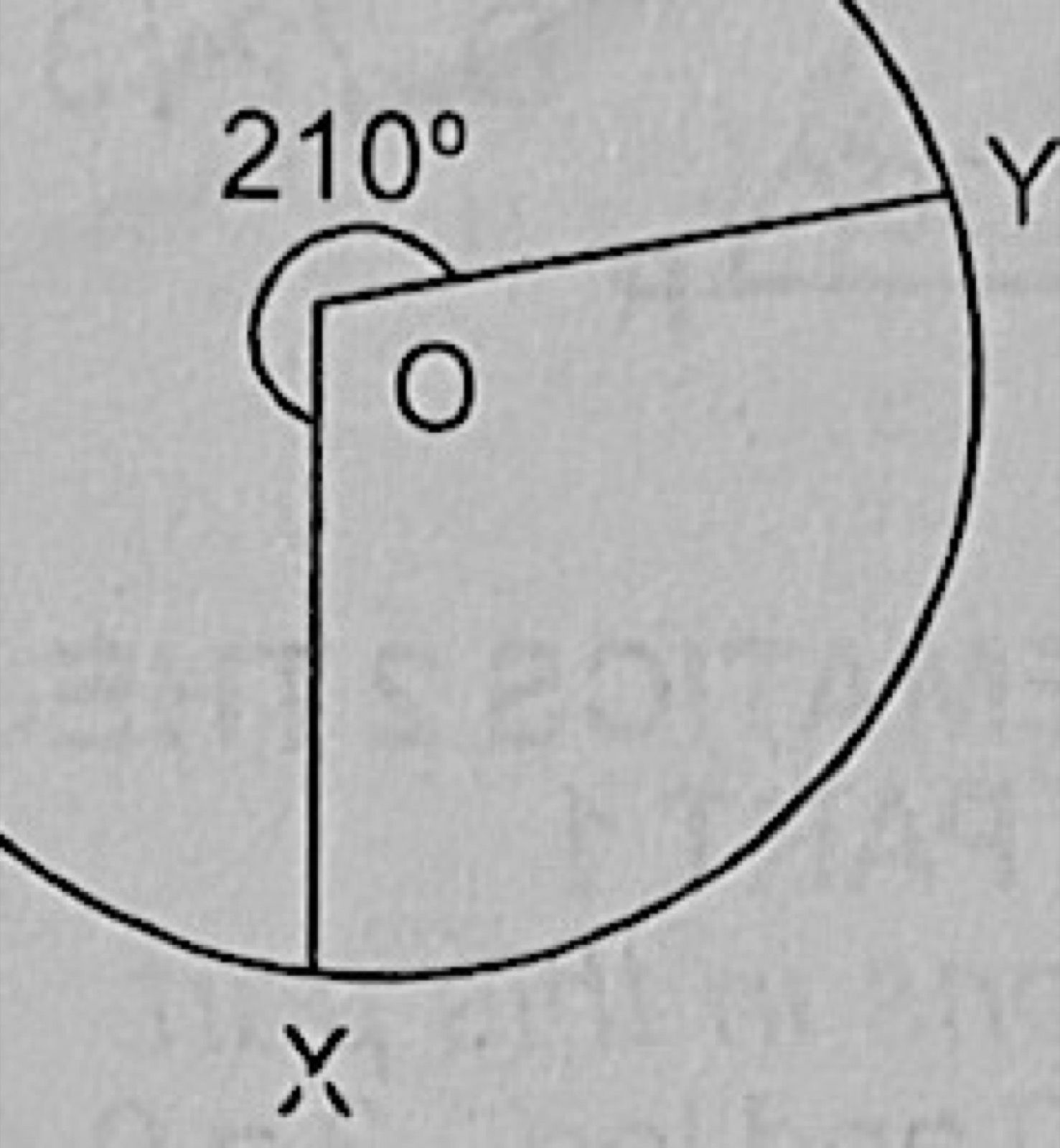
In the diagram, O is the centre of the circle. Reflex angle XOY = 210° and the length of the minor arc is 5.5m. Find, correct to the nearest metre the length of the major arc.

Diagram for this question
  1. A.8 m
  2. B.9 m
  3. C.10 m
  4. D.13 m
Show the answer and explanation

Answer: A (8 m)

Explanation

The minor arc has angle 150°. Arc lengths are in proportion to their angles: 5.5 × 210/150 = 7.7 ≈ 8 m.

Open this question

Question 42

Mensuration of Solids

A right pyramid is on a square base of side 4 cm. The slanting side of the pyramid is 2√3 cm. Calculate the volume of the pyramid.

  1. A.5 1/3 cm3
  2. B.10 2/3 cm3
  3. C.16cm3
  4. D.32cm3
Show the answer and explanation

Answer: B (10 2/3 cm3)

Explanation

Half the base diagonal = 2√2, so height = √(12 − 8) = 2 cm. V = ⅓ × 16 × 2 = 10 2/3 cm3.

Open this question

Question 43

Mensuration of Solids

The height of a right circular cone is 4 cm. The radius of its base is 3 cm. Find its curved surface area.

  1. A.9π cm2
  2. B.15π cm2
  3. C.16π cm2
  4. D.20π cm2
Show the answer and explanation

Answer: B (15π cm2)

Explanation

Slant height = √(32 + 42) = 5 cm. Curved surface = πrl = π × 3 × 5 = 15π cm2.

Open this question

Question 44

Circle Theorems

A chord of length 30 cm is 8 cm away from the centre of the circle. What is the radius of the circle?

  1. A.16 cm
  2. B.17 cm
  3. C.18 cm
  4. D.20 cm
Show the answer and explanation

Answer: B (17 cm)

Explanation

r = √(152 + 82) = √289 = 17 cm.

Open this question

Question 45

Mensuration of Plane Shapes

A sector of a circle radius 14 cm subtends an angle 135° at the centre of the circle. What is the perimeter of the sector? [Take π = 22/7].

  1. A.47 cm
  2. B.61 cm
  3. C.88 cm
  4. D.231 cm
Show the answer and explanation

Answer: B (61 cm)

Explanation

Arc = 135/360 × 2 × 22/7 × 14 = 33 cm. Perimeter = 33 + 14 + 14 = 61 cm.

Open this question

Question 46

Mensuration of Plane Shapes

In the diagram, MN||PQ, |LM| = 3 cm and |LP| = 4cm. If the area of ΔLMN is 18 cm2, find the area of quadrilateral MPQN.

Diagram for this question
  1. A.3 cm2
  2. B.6 cm2
  3. C.14 cm2
  4. D.24 cm2
Show the answer and explanation

Answer: C (14 cm2)

Explanation

ΔLMN and ΔLPQ are similar with sides in ratio 3 : 4, so their areas are in ratio 9 : 16. Area LPQ = 32 cm2, and MPQN = 32 − 18 = 14 cm2.

Open this question

Question 47

Mensuration of Solids

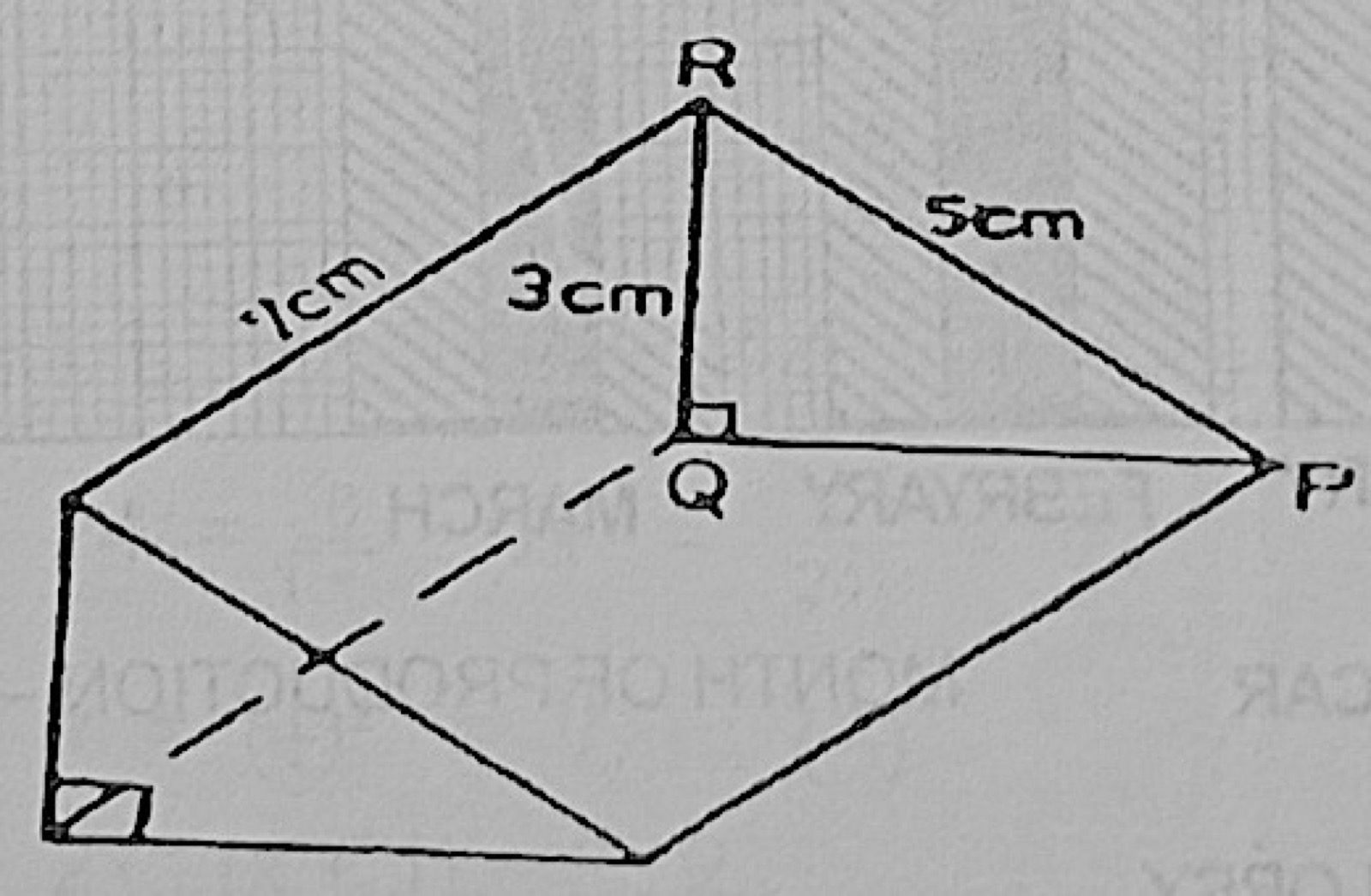
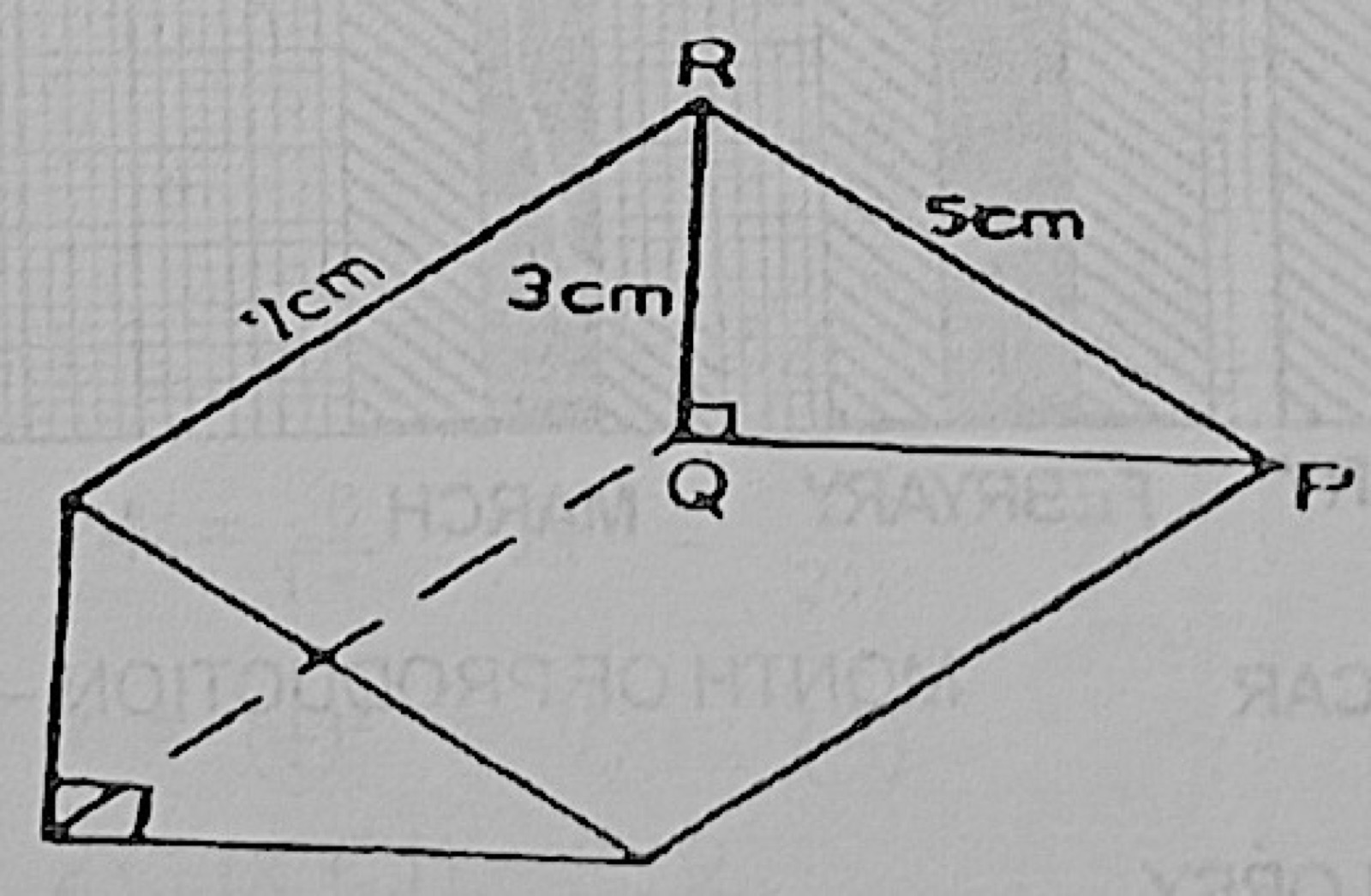
The diagram shows a triangular prism of length 7 cm. The right-angled triangle PQR is a cross-section of the prism. |PR| = 5 cm and |RQ| = 3 cm. What is the area of the cross-section?

Diagram for this question
  1. A.4 cm2
  2. B.6 cm2
  3. C.15 cm2
  4. D.20 cm2
Show the answer and explanation

Answer: B (6 cm2)

Explanation

PR is the hypotenuse, so PQ = √(25 − 9) = 4 cm. Area = ½ × 4 × 3 = 6 cm2.

Open this question

Question 48

Mensuration of Solids

The diagram shows a triangular prism of length 7 cm. The right-angled triangle PQR is a cross-section of the prism. |PR| = 5 cm and |RQ| = 3 cm. What is the volume of the prism?

Diagram for this question
  1. A.28 cm3
  2. B.42 cm3
  3. C.70 cm3
  4. D.84 cm3
Show the answer and explanation

Answer: B (42 cm3)

Explanation

Volume = cross-section × length = 6 × 7 = 42 cm3.

Open this question

Question 49

Mensuration of Solids

A solid cylinder of radius 7 cm is 10 cm long. Find its total surface area.

  1. A.70π cm2
  2. B.189π cm2
  3. C.210π cm2
  4. D.238π cm2
Show the answer and explanation

Answer: D (238π cm2)

Explanation

2πrh + 2πr2 = 2π × 7 × 10 + 2π × 49 = 140π + 98π = 238π cm2.

Open this question

Question 50

Mensuration of Plane Shapes

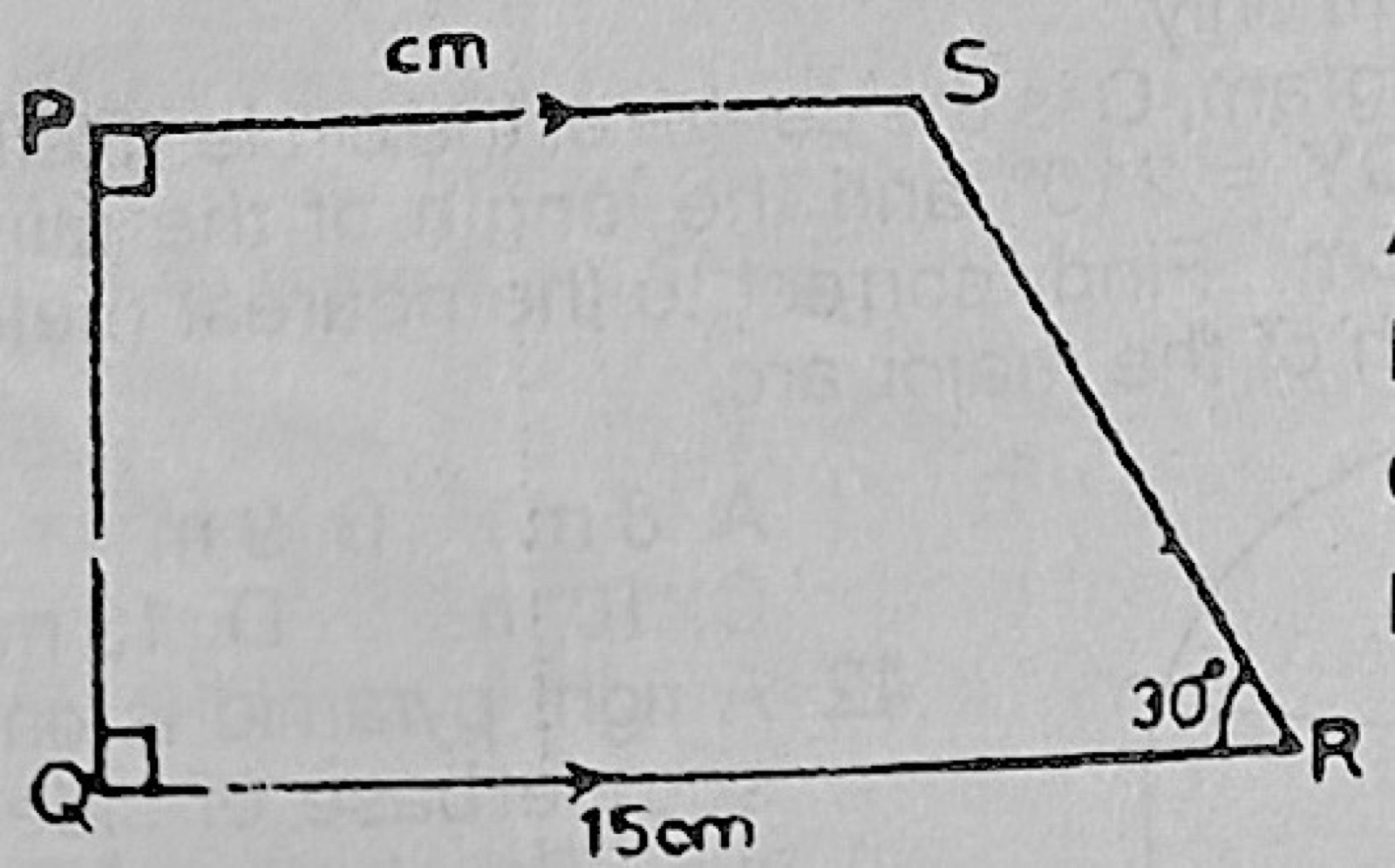
PQRS is a trapezium in which |PS| = 9 cm, |QR| = 15 cm, |PQ| = 2√3, ∠PQR = 90° and ∠QRS = 30°. Calculate the area of the trapezium.

Diagram for this question
  1. A.24√3 cm2
  2. B.36√3 cm2
  3. C.42√3 cm2
  4. D.72√3 cm2
Show the answer and explanation

Answer: A (24√3 cm2)

Explanation

PQ is the height. Area = ½(9 + 15) × 2√3 = 24√3 cm2.

Open this question

Theory question 101

Logarithms

Given that log102 = 0.3010 and log103 = 0.4771, calculate without using mathematical tables or calculator, the value of: (a) log1054, (b) log100.24.

Show the model answer
Model answer

(a) 54 = 2 × 33: log 54 = log 2 + 3 log 3 = 0.3010 + 1.4313 = 1.7323.
(b) 0.24 = 23 × 3 ÷ 100: log 0.24 = 3(0.3010) + 0.4771 − 2 = 1.3801 − 2 = −0.6199 (= 1̄.3801).

Explanation

Write each number as a product of powers of 2, 3 and 10.

Open this question

Theory question 102

Indices

(a) Simplify (1/35n) × 9n−1 × 27n+1
(b) The sum of the ages of a woman and her daughter is 46 years. In 4 years time, the ratio of their ages will be 7:2. Find their present ages.

Show the model answer
Model answer

(a) Write everything as powers of 3: 3−5n × 32n−2 × 33n+3 = 3−5n + 2n − 2 + 3n + 3 = 31 = 3.
(b) w + d = 46 and (w + 4)/(d + 4) = 7/2, so 2w + 8 = 7d + 28, i.e. 2w − 7d = 20.
Substitute w = 46 − d: 92 − 9d = 20, d = 8 and w = 38.
The woman is 38 and the daughter is 8.

Explanation

Change 9 and 27 to powers of 3 and add the indices.

Open this question

Theory question 103

Quadratic Equations

The sides of a rectangular floor are xm and (x + 7)m. The diagonal is (x + 8)m, calculate, in metres: (a) the value of x; (b) the area of the floor.

Show the model answer
Model answer

(a) Pythagoras: x2 + (x + 7)2 = (x + 8)2, so 2x2 + 14x + 49 = x2 + 16x + 64.
x2 − 2x − 15 = 0, (x − 5)(x + 3) = 0, x = 5 (a length is positive).
(b) Area = 5 × 12 = 60 m2.

Explanation

The diagonal is the hypotenuse of the right-angled triangle formed by two sides.

Open this question

Theory question 104

Data Presentation

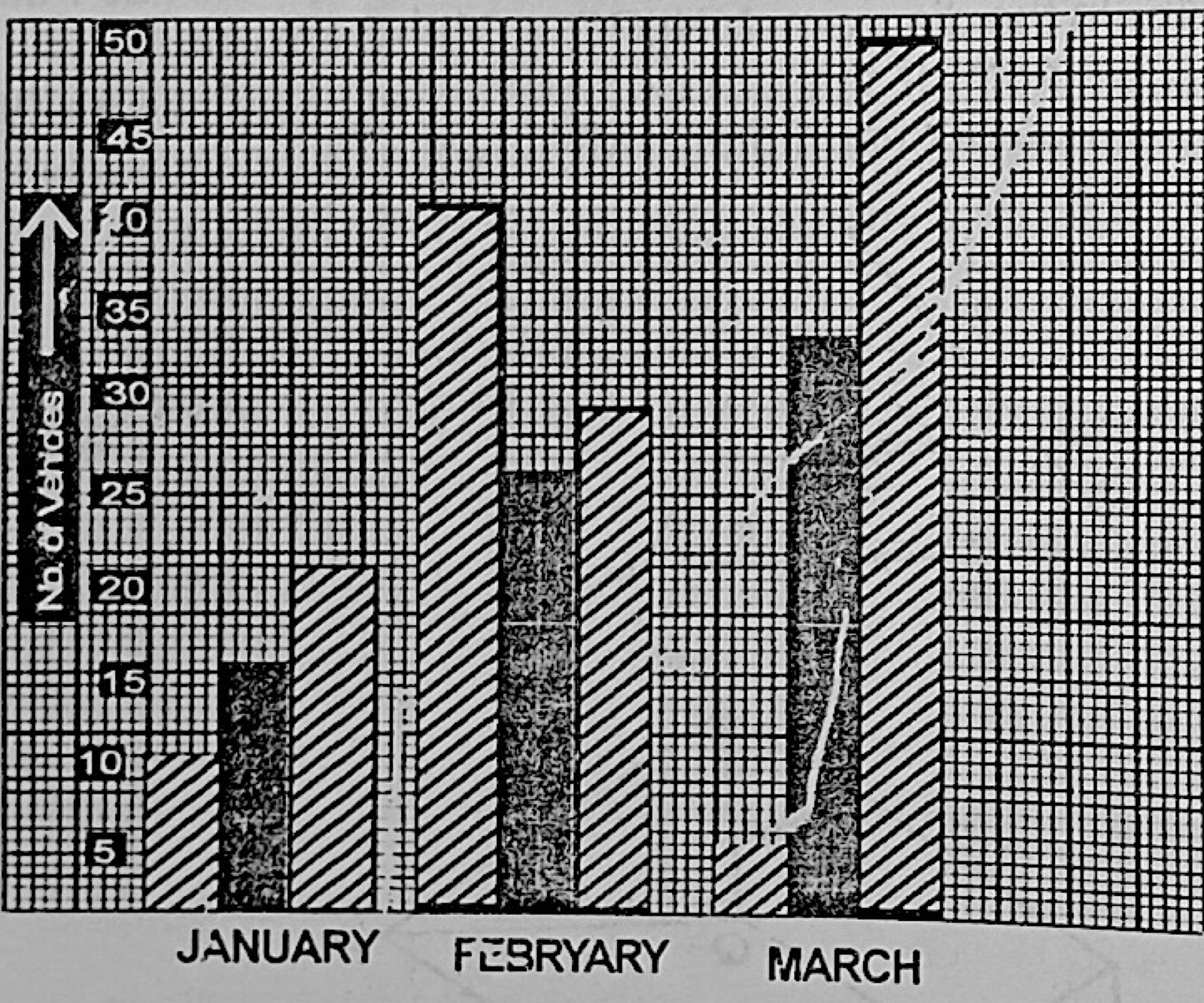
The diagram above shows the bar charts representing the number of vehicles manufactured by a company in January, February and March, 1992. (a) How many vehicles were produced in February? (b) What fraction of the vehicles manufactured in February were cars? (c) How many buses were produced altogether from January to March, 1992? (d) What is the ratio in lowest term of the number of lorries produced in February to that in March?

Diagram for this question
Show the model answer
Model answer

Readings from the chart (car, lorry, bus): January 10, 15, 20; February 40, 25, 30; March 5, 35, 50.
(a) February: 40 + 25 + 30 = 95 vehicles.
(b) Cars in February: 40/95 = 8/19.
(c) Buses: 20 + 30 + 50 = 100.
(d) Lorries February : March = 25 : 35 = 5 : 7.

Explanation

Read each bar against the vertical scale, then add or compare as asked.

Open this question

Theory question 105

Angles and Polygons

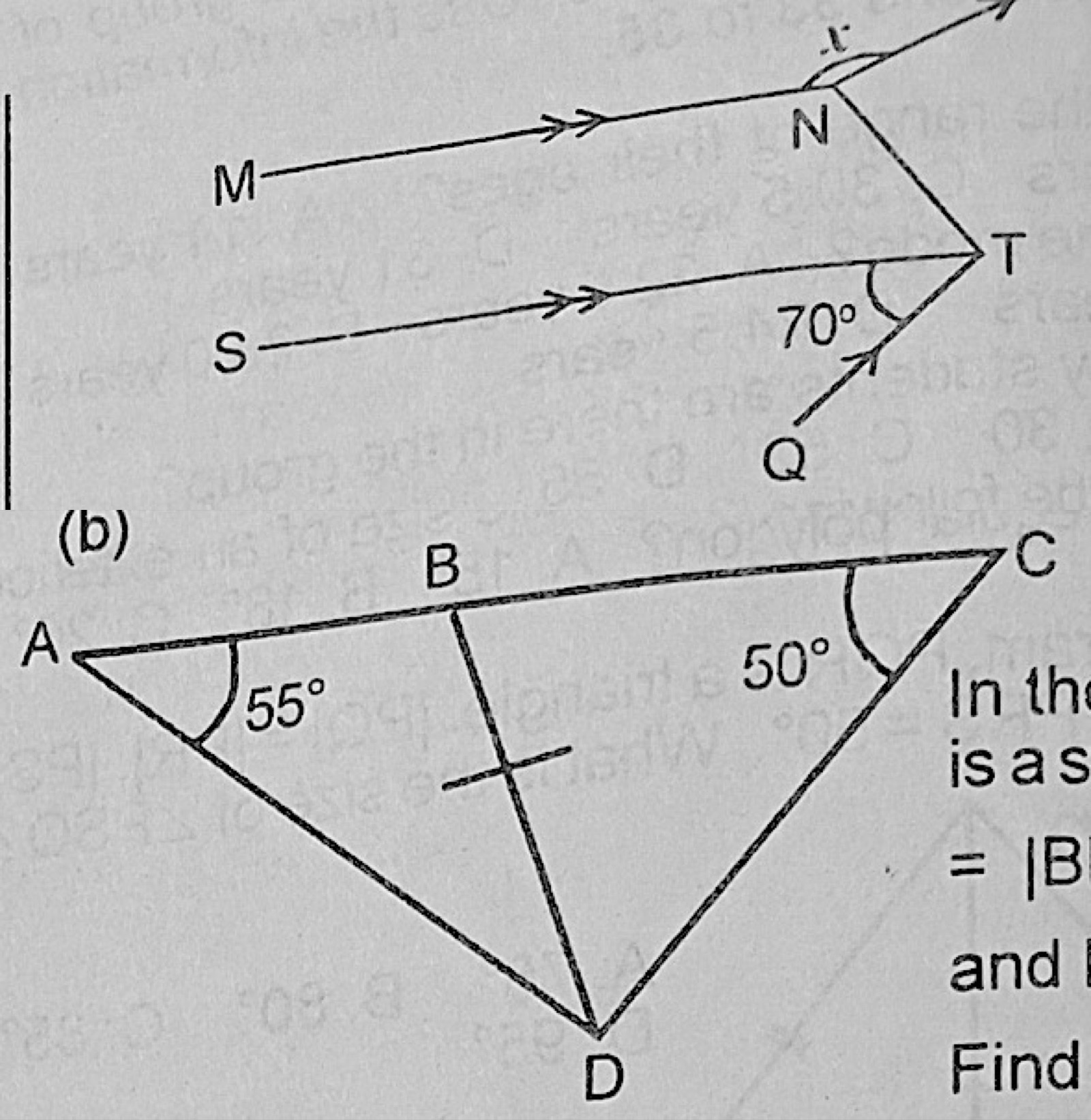
(a) In the diagram, MN||ST, NP||QT and ∠STQ = 70°. Find x.
(b) In the diagram, AC is a straight line, |BC| = |BD|, ∠BCD = 50° and ∠BAD = 55°. Find ∠BDA.

Diagram for this question
Show the model answer
Model answer

(a) MN ∥ ST and NP ∥ QT, but NP points the opposite way to TQ, so ∠MNP and ∠STQ add up to 180°.
x = 180° − 70° = 110°.
(b) BC = BD, so ∠BDC = ∠BCD = 50° and ∠CBD = 180 − 100 = 80°.
∠CBD is an exterior angle of triangle ABD: 80° = 55° + ∠BDA, so ∠BDA = 25°.

Explanation

An exterior angle of a triangle equals the sum of the two opposite interior angles.

Open this question

Theory question 106

Graphs of Functions

(a) Draw the table of values for the relation y = x2 for the interval −3 ≤ x ≤ 4. (b) Using a scale of 2 cm to 1 unit on the x-axis and 2cm to 2 units on the y-axis, draw the graphs of: (i) y = x2 (ii) y = 2x + 3 for −3 ≤ x ≤ 4. (c) Use your graph to find: (i) the roots of the equation x2 = 2x + 3; (ii) the gradient of y = x2 at x = −2.

Show the model answer
Model answer

(a) x: −3, −2, −1, 0, 1, 2, 3, 4; y: 9, 4, 1, 0, 1, 4, 9, 16.
(b) Plot the parabola and the straight line through (0, 3) and (3, 9).
(c)(i) The graphs meet at x = −1 and x = 3.
(ii) Draw the tangent at (−2, 4); its gradient is about −4.

Explanation

To find a gradient from a graph, draw a tangent and use rise ÷ run.

Open this question

Theory question 107

Data Presentation

The number of child births recorded in 50 maternity centres of a local government in August 1993 are as follows:
50 99 81 86 69 85 93 63 92 65
77 74 76 71 90 74 81 94 67 75
95 81 68 105 99 68 75 75 76 73
79 74 80 69 74 62 74 80 79 68
79 75 75 71 83 75 80 85 81 82
(a) Construct a frequency distribution table, using class intervals 45–54, 55–64, etc. (b) Draw the histogram for the distribution. (c) Use your histogram to estimate the mode. (d) Calculate the mean number of births.

Show the model answer
Model answer

(a) 45–54: 1; 55–64: 2; 65–74: 15; 75–84: 21; 85–94: 7; 95–104: 3; 105–114: 1 (total 50).
(b) Bars on class boundaries 44.5, 54.5, … 114.5 with heights equal to the frequencies.
(c) In the tallest bar (74.5–84.5) join its top corners to the neighbouring bars' tops; the lines cross at about 77.5, so the mode ≈ 77.5.
(d) Class marks 49.5, 59.5, … 109.5: Σfx = 49.5 + 119 + 1042.5 + 1669.5 + 626.5 + 298.5 + 109.5 = 3915. Mean = 3915/50 = 78.3.

Explanation

Tally the data one class at a time and check the frequencies add to 50.

Open this question

Theory question 108

Sets

(a) In a market survey, 100 traders sell fruits. 40 sell apples, 46 oranges, 50 mangoes, 14 apples and oranges, 15 apples and mangoes and 10 sell the three fruits. Each of the 100 traders sells at least one of the three fruits. (i) Represent the information in a Venn diagram. (ii) Find the number that sell oranges and mangoes only.
(b) Find the value of x for which 312four + 52x = 96ten.

Show the model answer
Model answer

(a)(i) Let y sell oranges and mangoes only. Regions: all three 10; apples and oranges only 4; apples and mangoes only 5; apples only 40 − 19 = 21; oranges only 46 − 14 − y = 32 − y; mangoes only 50 − 15 − y = 35 − y.
(ii) Total: 21 + 4 + 5 + 10 + y + (32 − y) + (35 − y) = 100, so 107 − y = 100 and y = 7.
(b) 312four = 48 + 4 + 2 = 54, so 52x = 42: 5x + 2 = 42 and x = 8.

Explanation

Fill the Venn diagram from the centre (all three) outwards.

Open this question

Theory question 109

Constructions

Using a ruler and a pair of compasses only, (a) Construct a quadrilateral MNOP with |OP| = 11 cm, |PM| = 6cm, |NO| = 5 cm, |MN| = 8 cm and |MO| = 9cm. (b) Measure ∠MPO. (c) Locate the point Y which is equidistant from the straight lines ON and OP and also equidistant from points M and N. (d) Draw YP and find the perimeter of ΔOYP.

Show the model answer
Model answer

(a) Draw OP = 11 cm. Arcs: centre P radius 6 cm and centre O radius 9 cm meet at M. Then arcs centre M radius 8 cm and centre O radius 5 cm meet at N (same side as M). Join MN, NO, PM.
(b) ∠MPO ≈ 55° (cos P = (36 + 121 − 81)/132).
(c) Bisect ∠NOP and construct the perpendicular bisector of MN; Y is where they cross.
(d) OY ≈ 5.2 cm, YP ≈ 8.4 cm, OP = 11 cm: perimeter ≈ 24.6 cm (accept 24–25 cm).

Explanation

Equidistant from two lines means on the angle bisector; equidistant from two points means on the perpendicular bisector.

Open this question

Theory question 110

Probability

(a) The probabilities that three boys pass an examination are 2/3, 5/8 and 3/4 respectively. Find the probability that: (i) all the boys pass; (ii) none of the boys pass; (iii) only two of the boys pass.
(b) A shopkeeper marks a television set for sale at N36,000 so as to make a profit of 20% on the cost price. When he sells it, he allows a discount of 5% off the marked price. Calculate the actual percentage profit.

Show the model answer
Model answer

(a)(i) 2/3 × 5/8 × 3/4 = 30/96 = 5/16.
(ii) 1/3 × 3/8 × 1/4 = 3/96 = 1/32.
(iii) Exactly two pass: 2/3 × 5/8 × 1/4 + 2/3 × 3/8 × 3/4 + 1/3 × 5/8 × 3/4 = 10/96 + 18/96 + 15/96 = 43/96.
(b) Cost price = 36,000 ÷ 1.2 = N30,000. Selling price = 95% of 36,000 = N34,200.
Profit = N4,200; actual percentage profit = 4,200/30,000 × 100% = 14%.

Explanation

For 'only two pass' add the three cases where exactly one boy fails.

Open this question

Theory question 111

Quadratic Equations

(a) The roots of the equation 2x2 + (p + 1)x + q = 0, are 1 and 3, where p and q are constants. Find the values of p and q.
(b) The weight of an object varies inversely as the square of its distance from the centre of the earth. A small satellite weighs 80kg on the earth's surface. Calculate, correct to the nearest whole number, the weight of the satellite when it is 800 km above the surface of the earth. [Take the radius of the earth as 6,400 km]

Show the model answer
Model answer

(a) The equation is 2(x − 1)(x − 3) = 2x2 − 8x + 6 = 0.
Compare: p + 1 = −8, so p = −9; q = 6.
(b) W = k/d2. On the surface d = 6400 km; at 800 km up, d = 7200 km.
W = 80 × (6400/7200)2 = 80 × 64/81 ≈ 63.2, so about 63 kg.

Explanation

Distance is measured from the centre of the earth, so add the radius to the height.

Open this question

Theory question 112

Bearings

In the diagram, three points A, B and C are on the same horizontal ground. B is 15 m from A, on a bearing of 053°. C is 18m from B on a bearing of 161°. A vertical pole with top T is erected at B such that angle ATB = 58°. Calculate, correct to three significant figures, (a) the length of AC; (b) the bearing of C from A; (c) the height of the pole BT.

Diagram for this question
Show the model answer
Model answer

(a) The bearing of A from B is 233°, so ∠ABC = 233 − 161 = 72°.
AC2 = 152 + 182 − 2(15)(18) cos 72° = 549 − 166.9 = 382.1, so AC ≈ 19.5 m.
(b) sin ∠BAC = 18 sin 72°/19.55 = 0.8758, so ∠BAC ≈ 61.1°. Bearing of C from A = 53 + 61.1 ≈ 114°.
(c) In right-angled triangle ABT: tan 58° = AB/BT, so BT = 15/tan 58° = 15/1.600 ≈ 9.37 m.

Explanation

Find the angle at B from the two bearings first, then use the cosine rule.

Open this question

Theory question 113

Mensuration of Solids

(a) A boy blew his rubber balloon to a spherical shape. The balloon burst when its diameter was 15 cm. Calculate, correct to the nearest whole number, the volume of air in the balloon at the point of bursting. [Take π = 22/7].
(b) A point X is on latitude 28°N and longitude 105°W. Y is another point on the same latitude as X but on longitude 35°E. (i) Calculate, correct to 3 significant figures, the distance between X and Y along latitude 28°N. (ii) How far is X from the equator? [Take π = 22/7, and the radius of the Earth as 6,400 km]

Show the model answer
Model answer

(a) r = 7.5 cm: V = 4/3 × 22/7 × 7.53 ≈ 1768 cm3.
(b)(i) Difference in longitude = 105 + 35 = 140°. Radius of the latitude circle = 6400 cos 28°.
Distance = 140/360 × 2 × 22/7 × 6400 × cos 28° ≈ 15644 × 0.8829 ≈ 13,800 km.
(ii) Along the meridian: 28/360 × 2 × 22/7 × 6400 ≈ 3,130 km.

Explanation

One point is west and the other east of Greenwich, so add the longitudes.
Open this question