A boy measured the length and breadth of a rectangular lawn as 59.6m and 40.3m respectively instead of 60m and 40m. What is the percentage error in his calculation of the perimeter of the lawn?
A.10%
B.1.4%
C.0.7%
D.0.2%
E.0.1%
Show the answer and explanation
Answer: E (0.1%)
Explanation
His perimeter is 2(59.6 + 40.3) = 199.8 m; the true perimeter is 2(60 + 40) = 200 m. Error = 0.2 m, so percentage error = 0.2/200 × 100 = 0.1%.
If x is a real number which of the following is more illustrated on the number line?
A.x < 4
B.x > −2
C.−2 < x ≤ 4
D.−3 ≤ x < 4
E.−2 ≤ x < 4
Show the answer and explanation
Answer: E (−2 ≤ x < 4)
Explanation
A filled (solid) dot means the end value is included and an open dot means it is not. The line runs from a solid dot at −2 to an open dot at 4, so −2 ≤ x < 4.
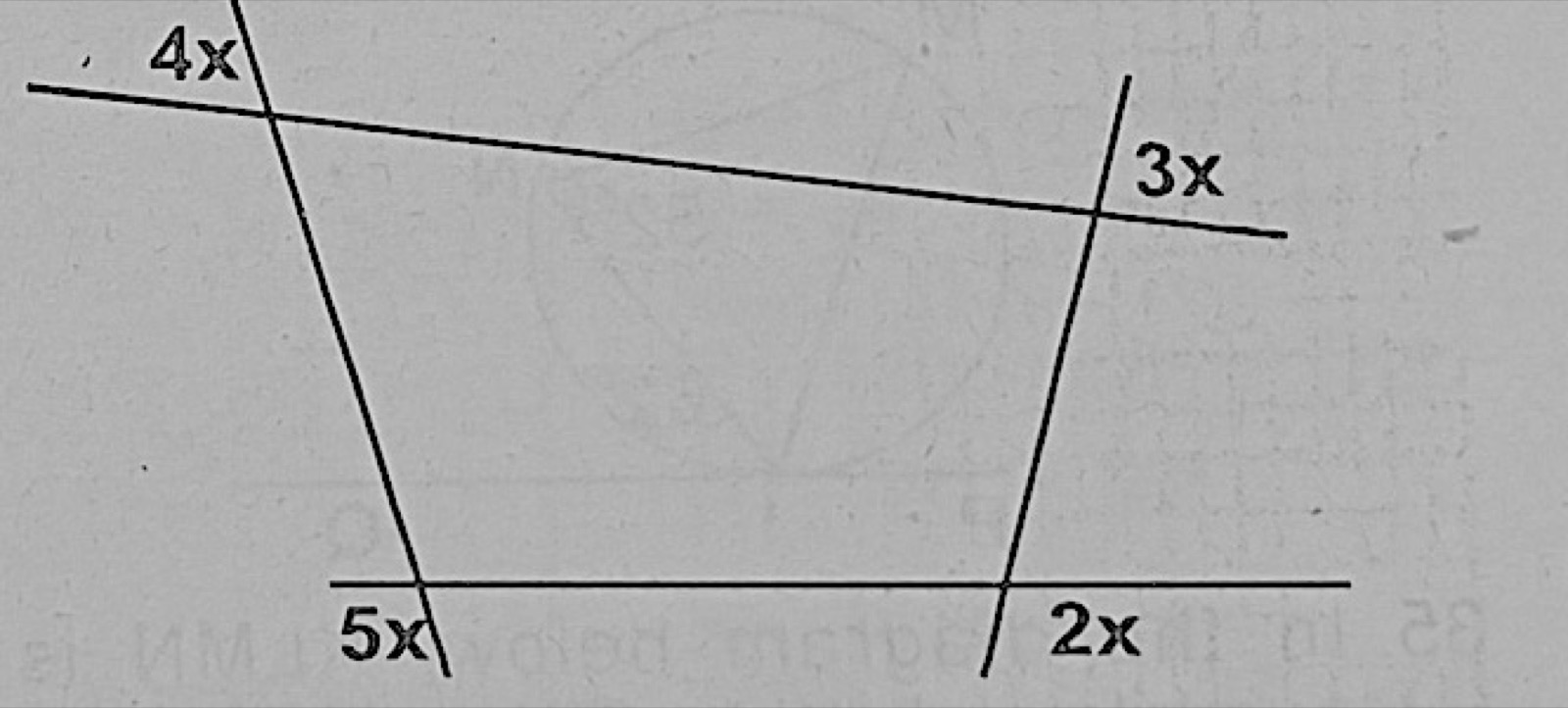
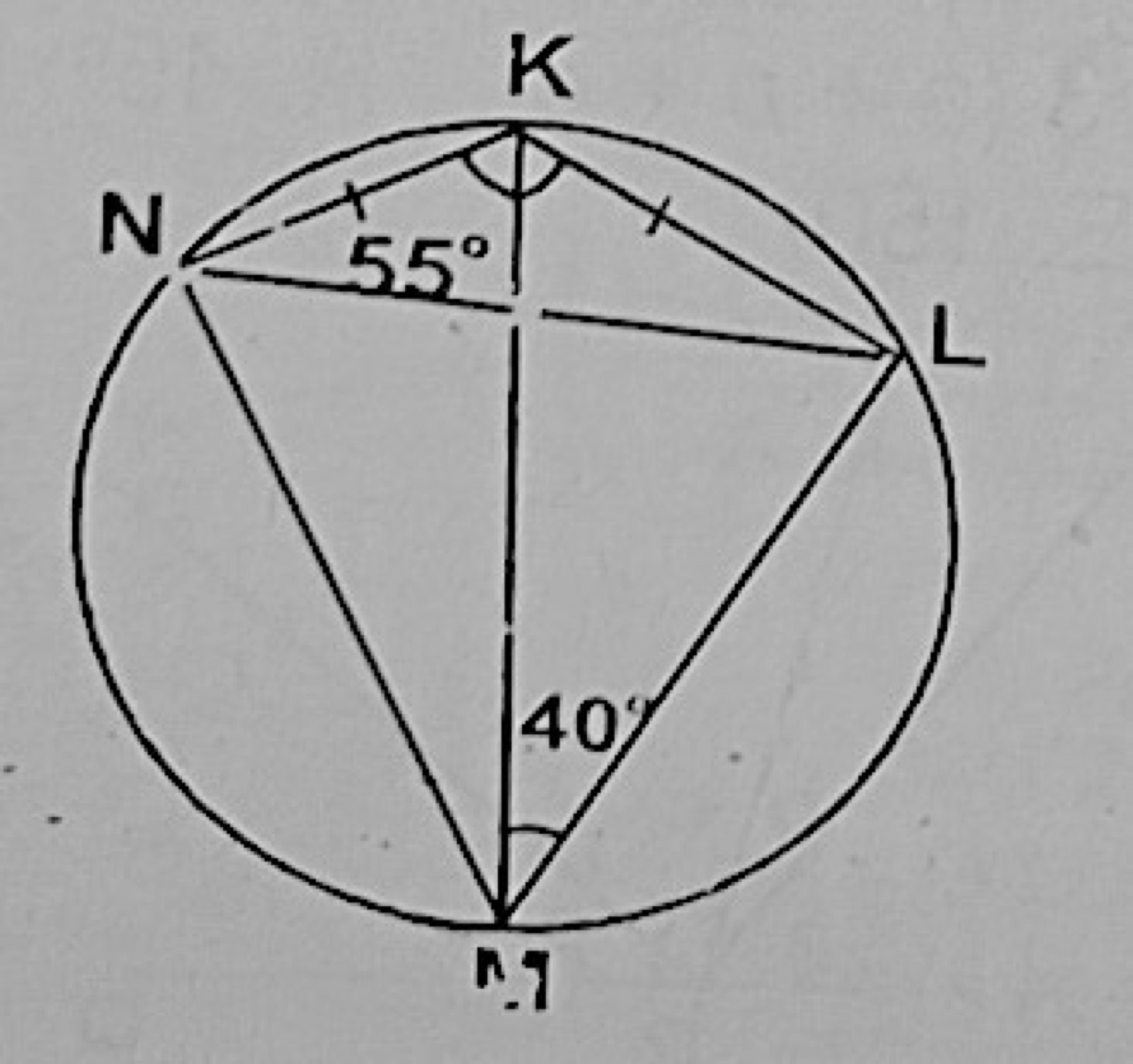
In the diagram below, find x correct to the nearest degree.
A.15°
B.25°
C.26°
D.36°
E.72°
Show the answer and explanation
Answer: C (26°)
Explanation
The four marked angles are the angles of the four-sided figure (or vertically opposite to them), so they add up to 360°: 4x + 3x + 5x + 2x = 14x = 360°, x = 25.7° ≈ 26°.
Which of the following is not true? You may construct a
A.triangle given all the three sides
B.triangle given one side and two angles
C.triangle given two sides and the included angle
D.quadrilateral given all the four sides
E.parallelogram given two adjacent sides and the diagonal joining them.
Show the answer and explanation
Answer: D (quadrilateral given all the four sides)
Explanation
Four sides alone do not fix a quadrilateral: it can be pushed into many different shapes with the same sides. The other sets of data each fix one unique figure.
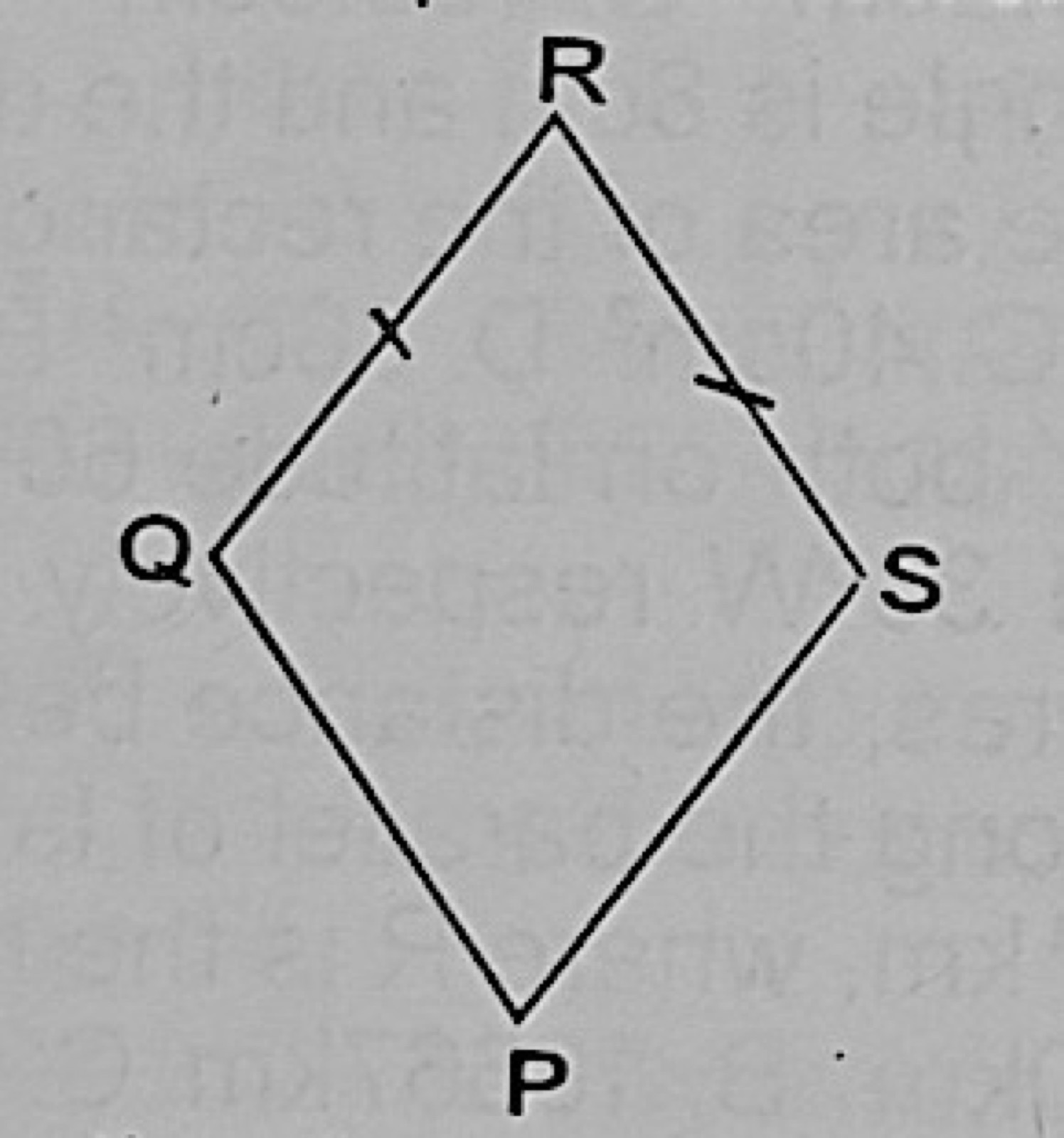
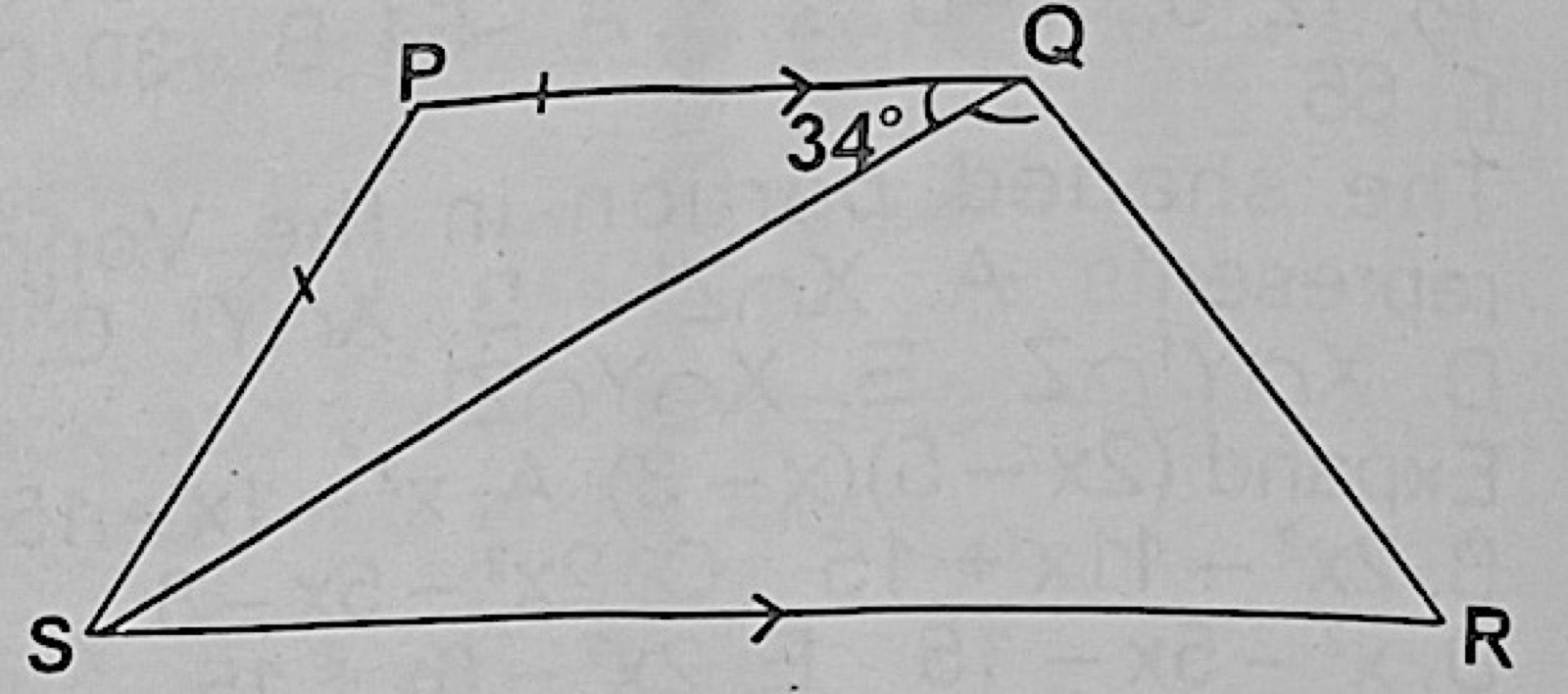
In the diagram below, /PQ/ = /PS/ and /QR/ = /SR/. Which of the following is/are true? I. the line PR bisects < QRS II. The line PR is the perpendicular bisector of the line segment QS III. Every point on PR is equidistant from SP and QP.
A.I only
B.III only
C.I and II only
D.I and III only
E.I, II and III
Show the answer and explanation
Answer: E (I, II and III)
Explanation
PQRS is a kite, symmetric about PR. So PR bisects angles R and P (I true), cuts QS at right angles through its midpoint (II true), and any point on the bisector of angle P is the same distance from the lines PS and PQ (III true).
The angle of elevation of the top X of a vertical pole from a point P on a level ground is 60°. The distance from P to the foot of the pole is 55m. Without using tables, find the height of the pole.
A.50/3 m
B.50m
C.55√3m
D.60m
E.65m
Show the answer and explanation
Answer: C (55√3m)
Explanation
tan 60° = height/55, so height = 55 × tan 60° = 55√3 m.
The number of goals scored by a football team in 20 matches is shown in the table below. No. of goals: 0, 1, 2, 3, 4, 5 No. of matches: 3, 5, 7, 4, 1, 0 What is the mean goal scored?
The number of goals scored by a football team in 20 matches is shown in the table below. No. of goals: 0, 1, 2, 3, 4, 5 No. of matches: 3, 5, 7, 4, 1, 0 What is the modal goal scored?
A.0
B.1
C.2
D.5
E.7
Show the answer and explanation
Answer: C (2)
Explanation
The mode is the score that happened most often. 2 goals were scored in 7 matches, more than any other score.
The marks obtained by pupils of class are grouped as shown below; 0 – 4, 5 – 9, 10 – 14, 15 – 19. Which of the following is/are not true? I. The mid values of the grouped marks are 2, 7, 12 and 17. II The class interval is 4. III The class boundaries are 0.5, 4.5, 9.5, 14.5 and 19.5
A.I only
B.II only
C.III only
D.I and II only
E.II and III only.
Show the answer and explanation
Answer: E (II and III only.)
Explanation
The mid-values 2, 7, 12, 17 are correct. Each class covers 5 marks (e.g. −0.5 to 4.5), so the interval is 5, not 4, and the first boundary is −0.5, not 0.5. So II and III are not true.
A bag contains 3 red, 4 black and 5 green identical balls. Two balls are picked at random, one after the other without replacement. Find the probability that one is red and the other is green
A.2/3
B.5/11
C.5/22
D.5/24
E.5/48.
Show the answer and explanation
Answer: C (5/22)
Explanation
There are 12 balls. P(red then green) = 3/12 × 5/11 = 15/132, and P(green then red) = 5/12 × 3/11 = 15/132. Total = 30/132 = 5/22.
The table gives the distribution of outcomes obtained when a die was rolled 100 times. No. of die: 1, 2, 3, 4, 5, 6 Frequency: 18, 14, 20, 16, 15, 17 What is the experimental probability that it shows at most 4 when rolled again?
A.8/25
B.12/25
C.13/25
D.2/3
E.17/25.
Show the answer and explanation
Answer: E (17/25.)
Explanation
'At most 4' means 1, 2, 3 or 4: 18 + 14 + 20 + 16 = 68 times out of 100. Probability = 68/100 = 17/25.
PART I. A shopkeeper buys 40kg of fruits for N120.00. He sells 20kg at N5.00 (per kg, 10kg at N3.00 per kg, 5kg at N2.00 per kg and the remaining 5kg at 50k per kg. Calculate the (a) amount he realises from the sales: (b) total profits (c) percentage profit on his outlay of N120.00.
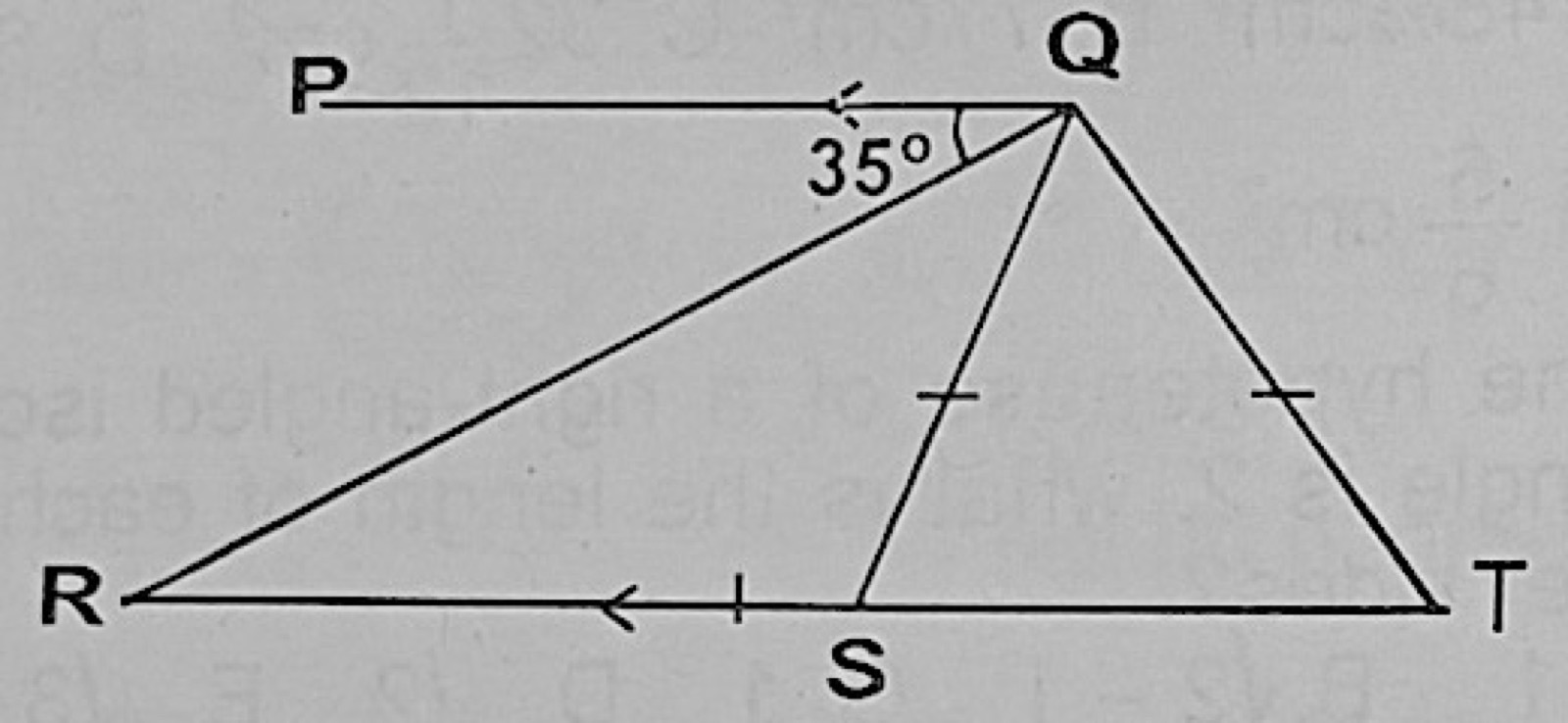
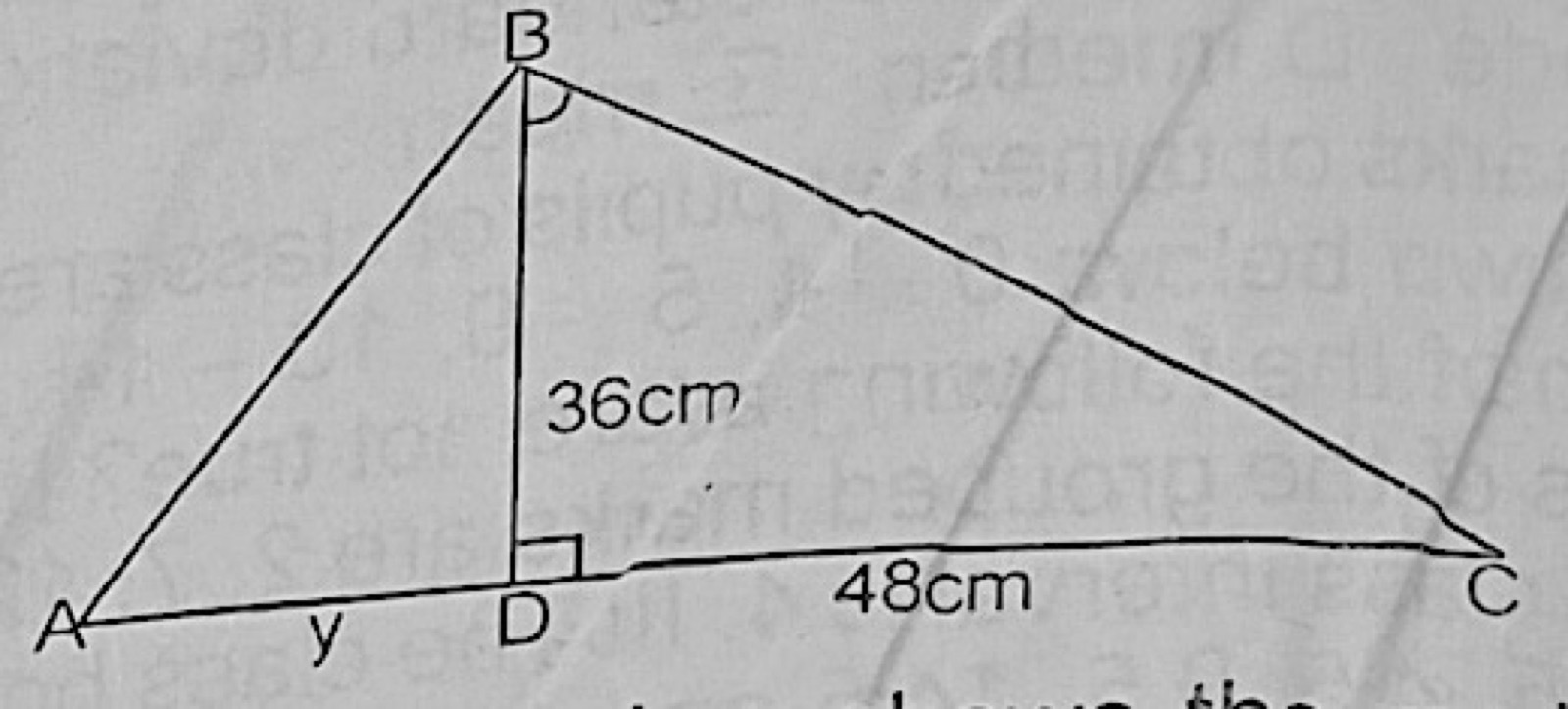
(a) Solve the simultaneous equations: 6y + 5x = −12; 4y − 3x = 11 (b) in the diagram below, ADC is a striaght line /CD/ = 48cm, /BD/ = 36cm and /AD/ = ycm. Find the value of y.
Show the model answer
Model answer
(a) Multiply the first equation by 3: 18y + 15x = −36. Multiply the second by 5: 20y − 15x = 55. Add: 38y = 19, so y = ½. Substitute: 4(½) − 3x = 11, so −3x = 9 and x = −3. Answer: x = −3, y = ½. (b) BD is perpendicular to AC and the marked angles are equal (<ABD = <BCD), so triangles ABD and BCD are similar. AD/BD = BD/DC, so y/36 = 36/48. y = 36 × 36 ÷ 48 = 27 cm. (Alternatively: tan <BCD = 36/48 = 0.75 and tan <ABD = y/36 = 0.75, so y = 27 cm.)
Explanation
In (b), the angle marked at B equals the angle at C, which makes the two smaller right-angled triangles similar.
The table below shows the marks obtained by forty pupils in a mathematics test Marks: 0 – 9, 10 – 19, 20 – 29, 30 – 39, 40 – 49, 50 – 59 No. of Pupils: 4, 5, 6, 12, 8, 5 (a) Draw a histogram for the mark distribution. (b) Use your histogram to estimate the mode (c) Calculate the median of the distribution.
Show the model answer
Model answer
(a) Class boundaries −0.5 (or 0), 9.5, 19.5, 29.5, 39.5, 49.5, 59.5 on the marks axis; bars of heights 4, 5, 6, 12, 8, 5 with no gaps; suitable scale and labelled axes. (b) Modal class is 30 – 39 (the tallest bar). Join the top corners of the tallest bar to the adjacent corners of the neighbouring bars; the crossing point gives mode ≈ 29.5 + (12 − 6)/((12 − 6) + (12 − 8)) × 10 = 35.5 (accept about 35 to 36). (c) Median position = 40/2 = 20th pupil. Cumulative frequencies: 4, 9, 15, 27, 35, 40, so the median class is 30 – 39. Median = 29.5 + (20 − 15)/12 × 10 = 29.5 + 4.17 = 33.67 (≈ 33.7).
Explanation
For a grouped median use L + ((N/2 − cumulative frequency before the class)/class frequency) × class width.
(a) If Log102 = 0.3010 and log103 = 0.4771, calculate without using tables the value of Log 0.72. (b) A hawk on top of a tree, 20 metres high, views a chick on the ground at an angle of depression of 39°. Find correct to 2 significant figures the distance of the chick from the bottom of the tree.
Show the model answer
Model answer
(a) 0.72 = 72/100 = (23 × 32)/102. log 0.72 = 3 log 2 + 2 log 3 − 2 = 3(0.3010) + 2(0.4771) − 2 = 0.9030 + 0.9542 − 2 = −0.1428 (or 1̄.8572). (b) The angle of elevation of the hawk from the chick is also 39° (alternate angles). tan 39° = 20/x, so x = 20/tan 39° = 20/0.8098 = 24.7 m. Distance ≈ 25 m (2 s.f.).
Explanation
Write 0.72 using only powers of 2, 3 and 10, then use the laws of logarithms.
(a) ABCD is a trapezium with AB parallel to DC and /AD/ = /AB/, If <BAD = 106°, find <BDC. (b) The table below shows the distribution of 20 cards labelled A – E. Card: A, B, C, D, E Frequency: 3, 4, 7, 5, 1 (i) If a card is selected at random from the pack, what is the probability that the card is E? (ii) If two cards are selected at random one after the other without replacement from the pack, what is the probability that one of the two cards is B?
Show the model answer
Model answer
(a) AD = AB, so triangle ABD is isosceles: <ABD = <ADB = (180° − 106°)/2 = 37°. AB ∥ DC, so <BDC = <ABD = 37° (alternate angles). (b)(i) P(E) = 1/20. (ii) 'One of the two is B' (exactly one): P(B then not B) + P(not B then B) = 4/20 × 16/19 + 16/20 × 4/19 = 64/380 + 64/380 = 128/380 = 32/95.
Explanation
Without replacement the second probability uses 19 cards; remember the B card can come first or second.
PART II. (a) Without using tables, find the value of (0.45 × 0.91)/0.0117 (b) Find the number which is exactly half way between 1 6/7 and 2 11/28 (c) If each interior angle of a regular polygon is five times the exterior angle, how many sides has the polygon? (d) Calculate the volume of the material used in making a pipe 20cm long, with an internal diameter 6cm and external diameter 8cm. [Take π = 22/7].
Show the model answer
Model answer
(a) (0.45 × 0.91)/0.0117 = (45 × 91)/117 = (45 × 91)/(9 × 13) = 5 × 7 = 35. (b) 1 6/7 = 52/28 and 2 11/28 = 67/28. Half way = (52/28 + 67/28) ÷ 2 = 119/56 = 2 1/8. (c) Let the exterior angle be x; then 5x + x = 180°, so x = 30°. Number of sides = 360° ÷ 30° = 12. (d) External radius 4 cm, internal radius 3 cm. Volume = π(R2 − r2)h = 22/7 × (16 − 9) × 20 = 22/7 × 7 × 20 = 440 cm3.
Explanation
In (d) the material is the outer cylinder minus the hollow inner cylinder.
(a) The Universal set U is the set of all integers, P, Q and R are subsets of U defined as follows: P = {x : x ≤ 2}; Q = {x : −7 < x < 15}; R = {x : −2 ≤ x < 19}. Where R' is the complement of R with respect to U. Find (i) P∩Q (ii) P∩(Q∪R'). (b) The following data shows the marks of 40 students in a History examination. 41 52 37 56 63 48 65 46 54 32 51 66 74 23 35 61 58 44 49 53 45 57 56 38 59 28 50 49 67 56 36 45 79 68 43 56 26 47 55 71 (i) Form a grouped frequency table with the class intervals 20 – 29, 30 – 39, 40 – 49, etc. (ii) Find the mean of the distribution.
Show the model answer
Model answer
(a)(i) P = {…, 0, 1, 2}; Q = {−6, −5, …, 14}. P∩Q = {−6, −5, −4, −3, −2, −1, 0, 1, 2}. (ii) R' = {x : x < −2 or x ≥ 19}. Q∪R' = {x : x ≤ 14 or x ≥ 19}. Every member of P (x ≤ 2) is in Q∪R', so P∩(Q∪R') = P = {x : x ≤ 2} = {…, −1, 0, 1, 2}. (b)(i) Frequencies (by tally): 20 – 29: 3; 30 – 39: 5; 40 – 49: 10; 50 – 59: 13; 60 – 69: 6; 70 – 79: 3 (total 40). (ii) Mid-values 24.5, 34.5, 44.5, 54.5, 64.5, 74.5. Σfx = 73.5 + 172.5 + 445 + 708.5 + 387 + 223.5 = 2010. Mean = 2010 ÷ 40 = 50.25.
Explanation
Grouped mean = Σ(frequency × mid-value) ÷ Σfrequency.
(a) Find the number N such that when 1/3 of it is added to 8, the result is the same as when ½ of it is subtracted from 18. (b) Using a ruler and a pair of compasses only construct a trapezium ABCD, in which the parallel sides AB and DC are 4cm apart. <DAB = 60°, /AB/ = 8cm and /BC/ = 5cm. Measure /DC/.
Show the model answer
Model answer
(a) N/3 + 8 = 18 − N/2. Multiply by 6: 2N + 48 = 108 − 3N, so 5N = 60 and N = 12. (b) Draw AB = 8 cm. Construct 60° at A. Construct a line parallel to AB, 4 cm from it (e.g. erect a perpendicular at A or B, mark 4 cm, and draw the parallel through that point). D is where the 60° arm meets the parallel line. With centre B and radius 5 cm, cut the parallel line at C (on the same side as D, so that ABCD is a trapezium with DC between the 60° arm and B's arc). Join BC. Construction lines and arcs must be shown. /DC/ ≈ 2.7 cm (accept 2.6 – 2.8 cm).
Explanation
AD = 4/sin 60° ≈ 4.6 cm and C is 3 cm horizontally from B, so DC ≈ 8 − 2.3 − 3 = 2.7 cm; use this to check your drawing.
(a) Copy and complete the table below for y = 3x2 − 5x − 7 x: −3, −2, −1, 0, 1, 2, 3, 4 y = 3x2 − 5x − 7: 35, __, __, −7, −9, __, 5, __ (b) Using a scale of 2cm = 1 unit along the X-axis and 2cm = 5 units along the y-axis, draw the graph of y = 3x2 − 5x − 7. (c) On the same axis draw the graph of y + 3x + 2 = 0. (d) From your graph, find the: (i) range of values of x for which 3x2 − 5x − 7 < 0 (ii) roots of the equation 3x2 − 2x − 5 = 0.
Show the model answer
Model answer
(a) x = −2: y = 15; x = −1: y = 1; x = 2: y = −5; x = 4: y = 21. Full row: 35, 15, 1, −7, −9, −5, 5, 21. (b) Plot the points with the given scale and join them with a smooth U-shaped curve. (c) y = −3x − 2: points such as (−3, 7), (0, −2), (4, −14); draw the straight line. (d)(i) The curve is below the x-axis between where it crosses it: −0.9 < x < 2.6 (approximately). (ii) 3x2 − 2x − 5 = 0 is the same as 3x2 − 5x − 7 = −3x − 2, so read the x-values where the curve meets the line: x = −1 and x ≈ 1.7 (exactly 5/3).
Explanation
Rearrange the new equation so one side is the curve's expression; the other side is the line to draw.
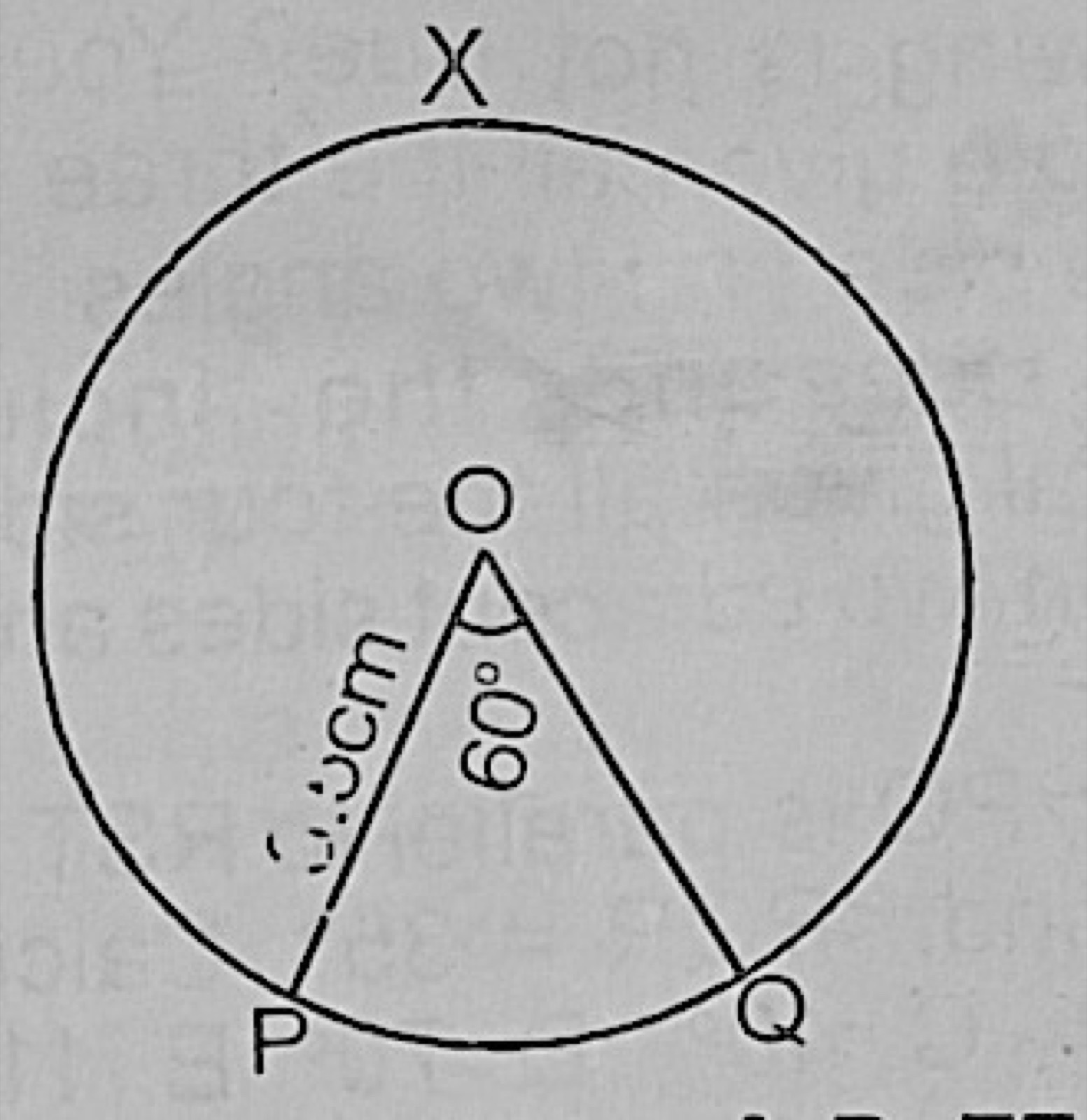
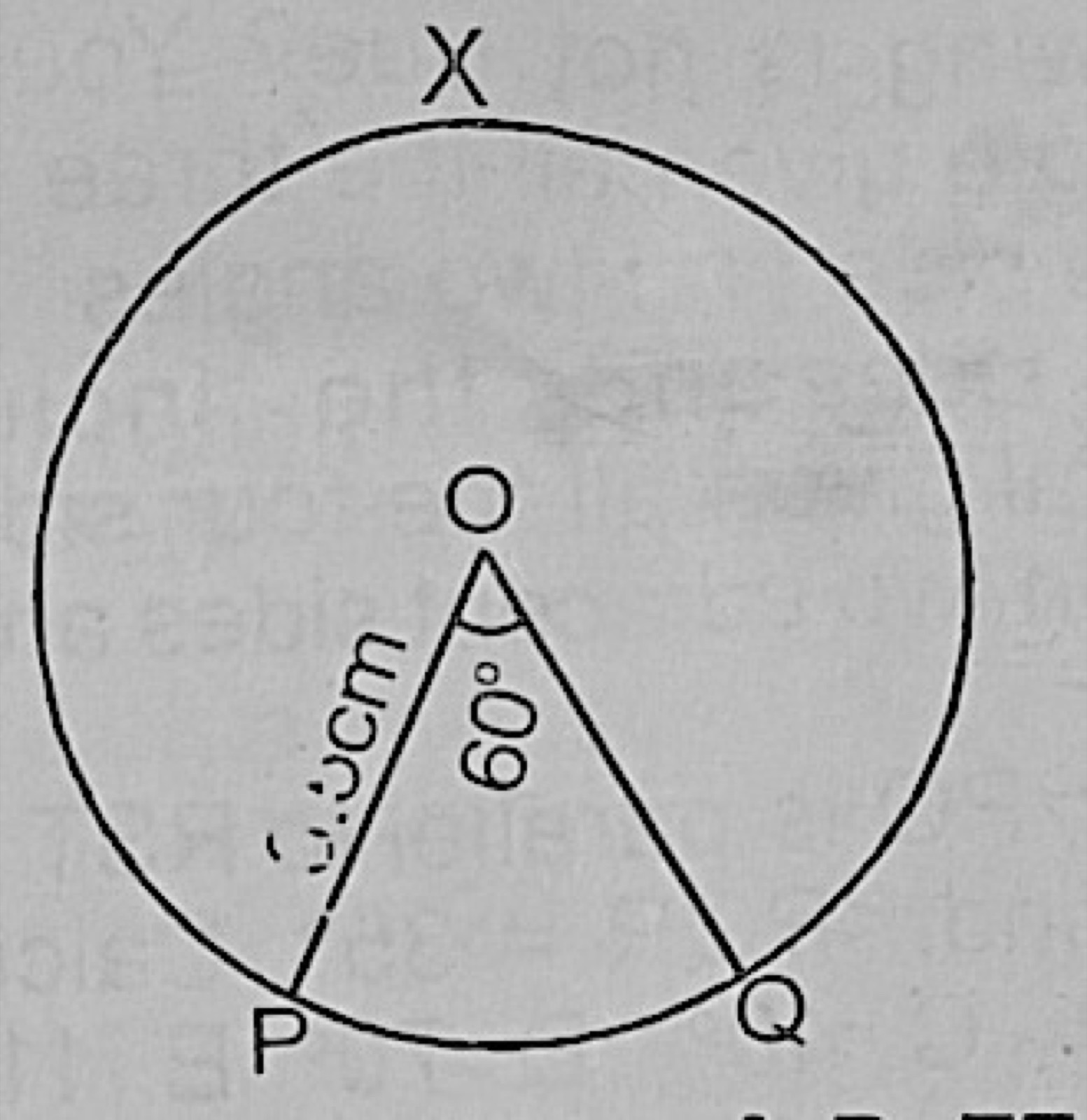
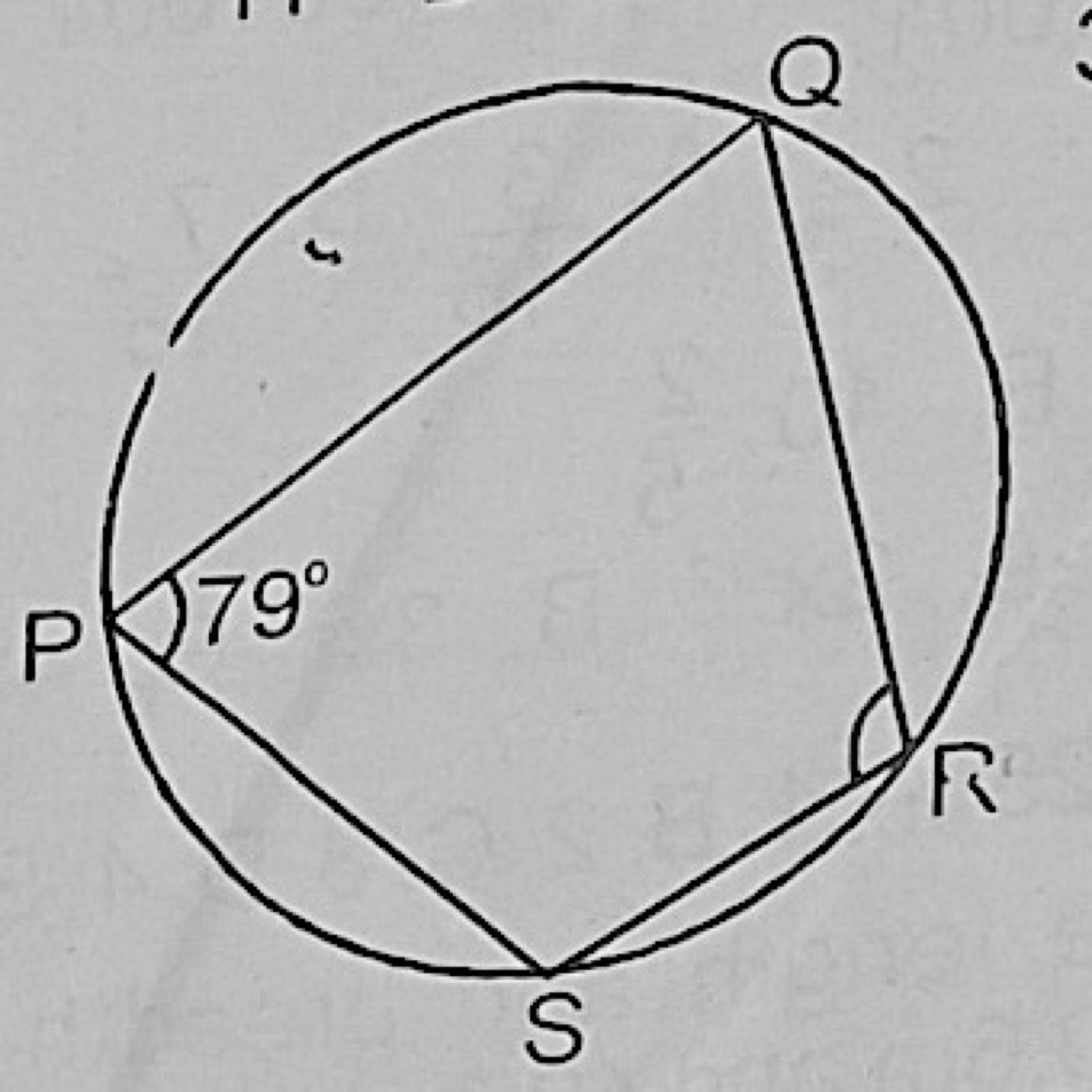
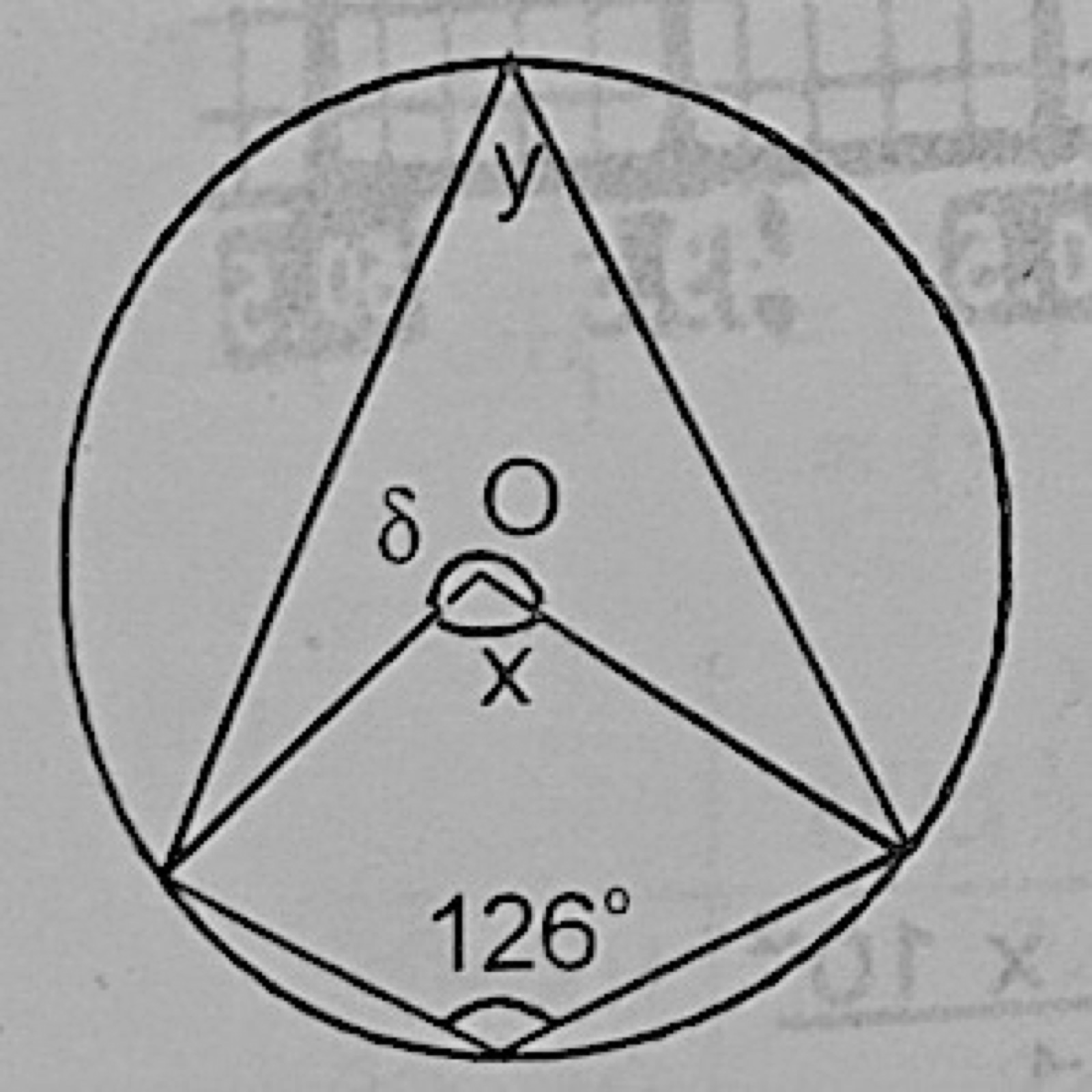
(a) Make d the subject of the formula S = n/2 (2a + (n − 1) d) (b) (i) In the diagram, O is the centre of the circle: A, B and P are points on the circumference. Prove that <AOB = 2 <APB. (ii) Find angles x, y and δ in the diagram below.
Show the model answer
Model answer
(a) 2S = n(2a + (n − 1)d) = 2an + n(n − 1)d, so n(n − 1)d = 2S − 2an and d = (2S − 2an)/(n(n − 1)). (b)(i) Join PO and produce it to a point X. OA = OP (radii), so <OAP = <OPA = a; the exterior angle <AOX = 2a. Likewise OB = OP gives <OBP = <OPB = b and <BOX = 2b. So <AOB = <AOX + <BOX = 2(a + b) = 2<APB (or the difference, if P is placed so that both angles are on one side of PX). (ii) The angle at the circumference 126° stands on the major arc, so the reflex angle at the centre δ = 2 × 126° = 252°. x = 360° − 252° = 108° (angles at a point). y = ½x = 54° (angle at centre is twice angle at circumference); or y = 180° − 126° = 54° (opposite angles of a cyclic quadrilateral).
Explanation
The angle at the centre is twice the angle at the circumference standing on the same arc.
(a) P and Q are points on the parallel of latitude 68.7°S, their longitude being 124°W and 56°E respectively. What is their distance apart measured along the parallel of latitude. [Take R = 6400 km, π = 3.142]. (Give your answers to 3 significant figures). (b) A bag contains four red, three white and five green balls (i) If one ball is picked at random, what is the probability that it is not green? (ii) If two balls are picked at random without replacement, what is the probability that one is red and the other white?
Show the model answer
Model answer
(a) Longitude difference = 124° + 56° = 180° (one west, one east). Radius of the parallel r = R cos 68.7°. Distance = 180/360 × 2πR cos 68.7° = 3.142 × 6400 × 0.3633 ≈ 7305 km ≈ 7300 km (3 s.f.). (b) Total = 4 + 3 + 5 = 12 balls. (i) P(not green) = 1 − 5/12 = 7/12. (ii) P(red then white) + P(white then red) = 4/12 × 3/11 + 3/12 × 4/11 = 1/11 + 1/11 = 2/11.
Explanation
Along a parallel of latitude, distance = (longitude difference/360°) × 2πR cos(latitude).
Two men P and Q set off from a base camp R prospecting for oil. P moves 20km on a bearing of 205° and Q moves 15km on bearing of 060°. Calculate the (a) distance of Q from P. (b) bearing of Q from P. (Give your answer in each case, correct to the nearest whole number).
Show the model answer
Model answer
Sketch: from R, P is 20 km on 205° and Q is 15 km on 060°; <PRQ = 205° − 60° = 145°. (a) Cosine rule: PQ2 = 202 + 152 − 2(20)(15) cos 145° = 625 + 600 × 0.8192 = 1116.5. PQ = 33.4 ≈ 33 km. (b) Sine rule in triangle PRQ: sin <RPQ = 15 sin 145°/33.41 = 0.2575, so <RPQ ≈ 14.9°. The bearing of R from P is 205° − 180° = 025°, so the bearing of Q from P = 025° + 14.9° ≈ 040°.
Explanation
Find the angle at R from the two bearings, then use the cosine rule for the distance and the sine rule for the angle at P.