From a point on the edge of the sea, one ship is 24km away on a bearing S 50°E and another ship is 7km away on a bearing S40°W. How far apart are the ships?
A.20km
B.24km
C.25km
D.31km
E.84km
Show the answer and explanation
Answer: C (25km)
Explanation
The angle between S50°E and S40°W is 50° + 40° = 90°. Distance = √(242 + 72) = √625 = 25 km.
The angle of elevation of the top of a tower from a point on the horizontal ground, 40m away from the foot of the tower is 30°. Find the height of the tower.
The table below shows the scores of a group of 40 students in a Physics test. Score: 1, 2, 3, 4, 5, 6, 7, 8, 9 Freq.: 2, 3, 6, 7, 9, 6, 2, 2, 3 If the mode is m and the median is n, then (m,n) is
A.(5,5)
B.(5,6)
C.(6,5)
D.(9,4)
E.(9,5)
Show the answer and explanation
Answer: A ((5,5))
Explanation
The highest frequency (9) is at score 5, so m = 5. Cumulative totals 2, 5, 11, 18, 27 show the 20th and 21st scores are both 5, so n = 5.
The table below shows the scores of a group of 40 students in a Physics test. Score: 1, 2, 3, 4, 5, 6, 7, 8, 9 Freq.: 2, 3, 6, 7, 9, 6, 2, 2, 3 What is the mean of the distribution?
The distribution by state of 840 students in the Faculty of Science of a Nigerian University in a certain session is as follows: Bendel 45 kwara 410 Ogun 105 Ondo 126 Oyo 154 In a pie chart drawn to represent this distribution, the angle subtended by Ondo is
A die is rolled 200 times. The outcomes obtained are shown in the table below. Number: 1, 2, 3, 4, 5, 6 No. of times: 25, 30, 45, 28, 40, 32 Find the probability of obtaining 2.
A die is rolled 200 times. The outcomes obtained are shown in the table below. Number: 1, 2, 3, 4, 5, 6 No. of times: 25, 30, 45, 28, 40, 32 What is the probability of obtaining a number less than 3?
A.0.125
B.0.150
C.0.275
D.0.500
E.0.725
Show the answer and explanation
Answer: C (0.275)
Explanation
1 or 2 came up 25 + 30 = 55 times out of 200: 55/200 = 0.275.
(a) Simplify, without using Mathematical tables: log10(30/16) − 2log10(5/9) + log10(400/243) (b) Without using Mathematical tables, calculate √(P/Q) where P = 3.6 × 10⁻³ and Q = 2.25 × 10⁶, leaving your answer in standard form.
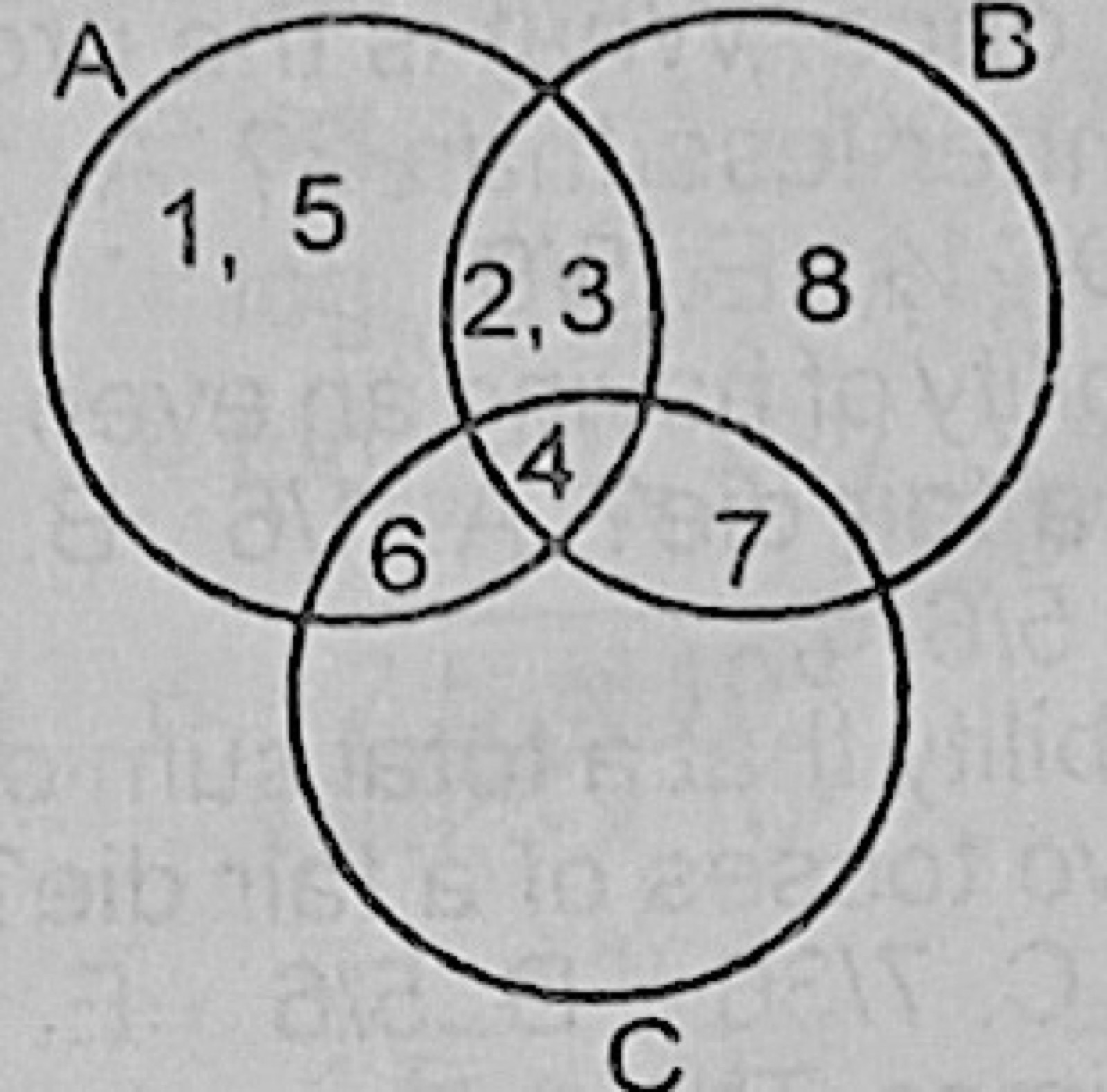
The Universal set is the set of all integers and the subjects P, Q, R of ε are given by P = {x: x < 0} Q = {…, −5, −3, −1, 1, 3, 5, …..} R = {x: −2 ≤ x < 7} (a) Find Q∩R. (b) Find R' where R' is the complement of R with respect to ε. (c) Find P'∩R'. (d) List the members of (P∩Q)'.
Show the model answer
Model answer
R = {−2, −1, 0, 1, 2, 3, 4, 5, 6}; Q is the set of odd integers (a) Q∩R = {−1, 1, 3, 5} (b) R' = {x: x < −2 or x ≥ 7} = {…, −5, −4, −3, 7, 8, 9, …} (c) P' = {0, 1, 2, 3, …}, so P'∩R' = {7, 8, 9, …} (d) P∩Q = {…, −5, −3, −1} (negative odd integers) (P∩Q)' = {…, −6, −4, −2, 0, 1, 2, 3, 4, …}: all even integers together with the non-negative odd integers
Explanation
Since ε is all integers, a complement contains every integer not in the set.
A simple measuring device is used at points X and Y on the same horizontal level to measure the angles of elevation of the peak P of a certain mountain. If X is known to be 5,200m above sea level, |XY| = 4,000m and the measurements of the angles of elevation of P at X and Y are 15° and 35° respectively, find the height of the mountain. (Take tan 15° = 0.3 and tan 35° = 0.7)
Show the model answer
Model answer
Let h be the height of P above the level of X and Y, and O the point on that level directly below P. X, Y and O are in a line, Y nearer the mountain. XO = h/tan 15° = h/0.3; YO = h/tan 35° = h/0.7 XO − YO = 4000: h(1/0.3 − 1/0.7) = 4000, h × 40/21 = 4000 h = 2100 m Height of mountain above sea level = 5200 + 2100 = 7300 m (If X and Y are taken on opposite sides of the mountain, XO + YO = 4000 gives h(1/0.3 + 1/0.7) = 4000, h = 840 m and the height is 6040 m.)
Explanation
Express both horizontal distances in terms of h, then use the 4,000 m between X and Y.
(a) Simplify 3/(m + 2n) − 2/(m − 3n) (b) A number is made up of two digits. The sum of the digits is 11. If the digits are interchanged, the original number is increased by 9. Find the number.
Show the model answer
Model answer
(a) = [3(m − 3n) − 2(m + 2n)] / [(m + 2n)(m − 3n)] = (3m − 9n − 2m − 4n)/[(m + 2n)(m − 3n)] = (m − 13n)/[(m + 2n)(m − 3n)] (b) Let the number be 10t + u. Then t + u = 11 Interchanged: (10u + t) − (10t + u) = 9, so 9u − 9t = 9 and u − t = 1 Solving: u = 6, t = 5 The number is 56 (check: 65 − 56 = 9)
Explanation
A two-digit number with tens digit t and units digit u has value 10t + u.
A box contains identical balls of which 12 are red, 16 white and 8 blue. Three balls are drawn from the box one after the other without replacement. Find the probability that: (a) three are red; (b) the first is blue and the other two are red; (c) two are white and one is blue.
Show the model answer
Model answer
Total = 36 balls (a) P(3 red) = 12/36 × 11/35 × 10/34 = 11/357 (b) P(blue, red, red) = 8/36 × 12/35 × 11/34 = 44/1785 (c) One order (W, W, B): 16/36 × 15/35 × 8/34 = 32/714 = 16/357 The blue ball can be 1st, 2nd or 3rd, so P = 3 × 16/357 = 16/119 (If the order white, white, blue is intended, the answer is 16/357.)
Explanation
Without replacement, each draw has one ball fewer in the box.
(a)(i) Given that log105 = 0.699 and log103 = 0.477, find log1045, without using mathematical tables. (ii) Hence, solve x0.8265 = 45 (b) Use mathematical tables to evaluate √(2.067/(0.0348 × 0.538))
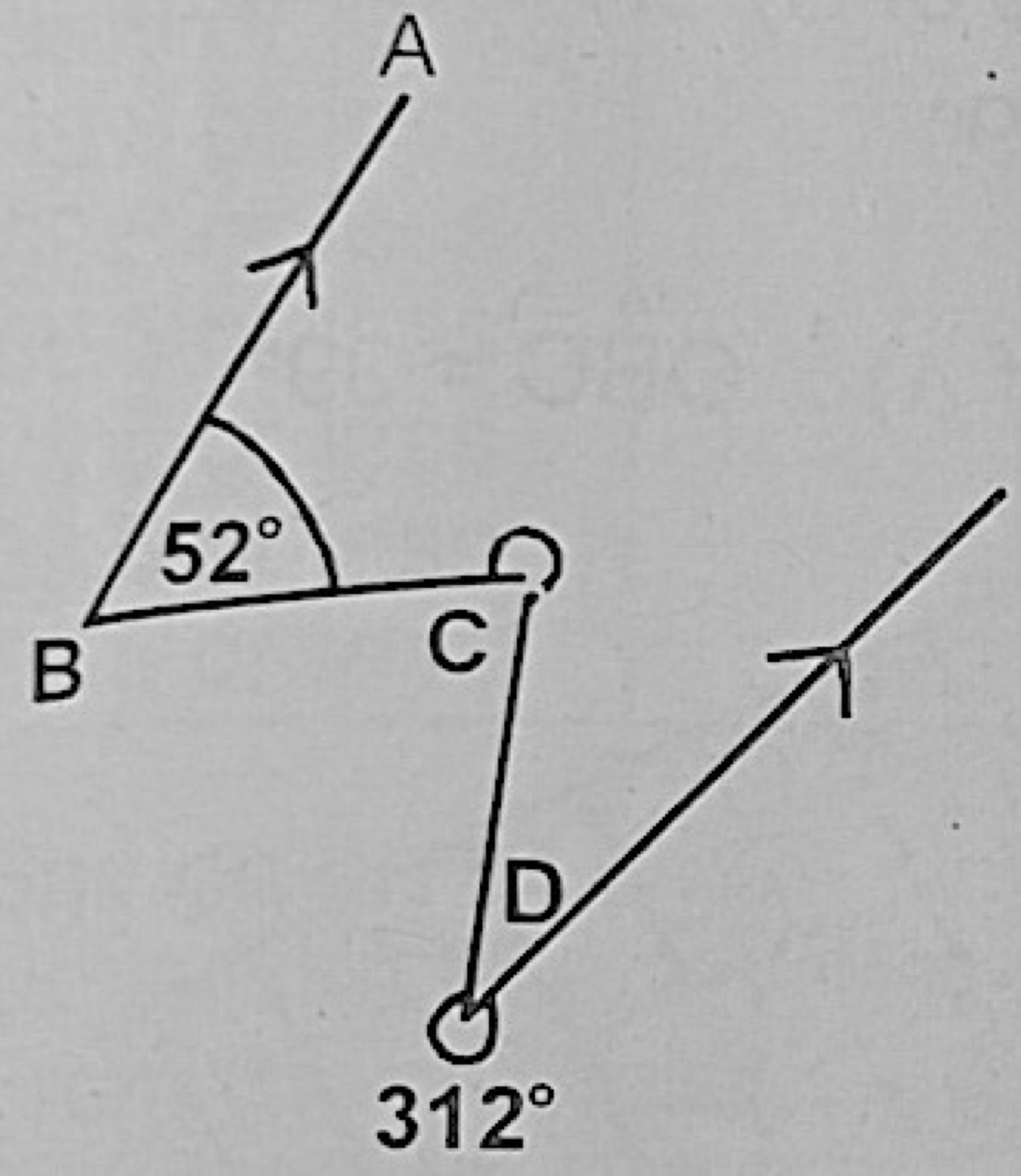
(a) In the diagram below, BA is parallel to DE. Find the value of x. (b) Illustrate graphically and shade the region in which the inequalities y − 2x < 5, 2y + x ≥ 4
Show the model answer
Model answer
(a) The interior angle at D is 360° − 312° = 48°. Draw a line through C parallel to BA and DE: it splits ∠BCD into 52° (alternate to ∠ABC) and 48° (alternate to the 48° at D), so ∠BCD = 100°. x is the reflex angle at C: x = 360° − 100° = 260° (b) Draw y − 2x = 5 as a broken line (through (0, 5) and (−2.5, 0)) and x + 2y = 4 as a solid line (through (0, 2) and (4, 0)). The required region is below y = 2x + 5 and on or above x + 2y = 4 (it contains e.g. (2, 2)); the lines meet at (−1.2, 2.6). Shade (or leave unshaded, as instructed) and label the region.
Explanation
Through the bend point, draw a line parallel to the two parallel lines and use alternate angles.
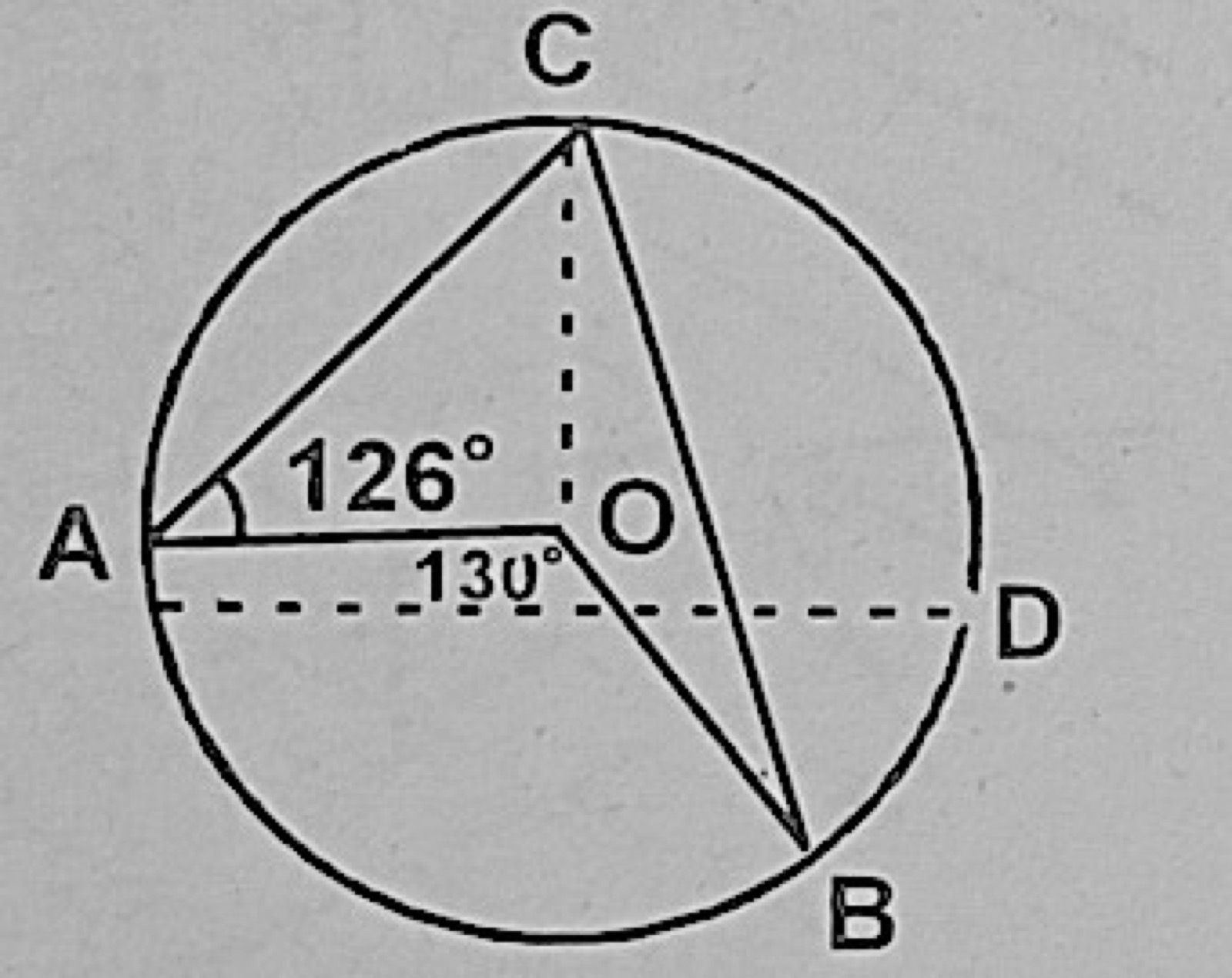
(a) Prove that the angle which an arc of a circle subtends at the centre is twice that which it subtends at any point on the remaining part of the circumference. (b) In the diagram below, O is the centre of the circle ACDB. If ∠CAO = 26° and ∠AOB = 130°, calculate: (i) ∠OBC; (ii) ∠COB
Show the model answer
Model answer
(a) Given: arc AB subtends ∠AOB at the centre O and ∠ACB at C on the remaining arc. To prove: ∠AOB = 2∠ACB. Join CO and produce it to D. OA = OC (radii), so ∠OAC = ∠OCA = x; the exterior angle ∠AOD = 2x. Similarly OB = OC gives ∠OCB = ∠OBC = y and ∠BOD = 2y. ∠AOB = 2x + 2y = 2(x + y) = 2∠ACB. (Diagram, given, to prove, construction and proof required.) (b)(i) ∠ACB = ½ × 130° = 65° (angle at centre = twice angle at circumference) OA = OC, so ∠ACO = ∠CAO = 26°; ∠BCO = 65° − 26° = 39° OB = OC, so ∠OBC = ∠BCO = 39° (ii) ∠COB = 180° − 39° − 39° = 102°
Explanation
Equal radii make isosceles triangles, so their base angles are equal.
(a) What is the 25th term of 5, 9, 13……..? (b) Find the 5th term of 8/9, −4/3, 2 ……… (c) The 3rd and 6th terms of a Geometric Progression (G.P) are 48 and 14 2/9 respectively. Write down the first four terms of the G.P.
Show the model answer
Model answer
(a) A.P. with a = 5, d = 4: T25 = 5 + 24 × 4 = 101 (b) G.P. with a = 8/9, r = (−4/3) ÷ (8/9) = −3/2 T5 = 8/9 × (−3/2)4 = 8/9 × 81/16 = 9/2 = 4½ (c) ar2 = 48 and ar5 = 128/9 Divide: r3 = 128/432 = 8/27, so r = 2/3 a = 48 ÷ 4/9 = 108 First four terms: 108, 72, 48, 32
Explanation
Dividing two terms of a G.P. removes a and leaves a power of r.
(a) Copy and complete the following table of values for y = 3 sin 2θ − cos θ θ: 0°, 30°, 60°, 90°, 120°, 150°, 180° y: −1.0, , , 0, , , 1.0 (b) Using a scale of 2cm to 30° on the θ axis and 2cm to 1 unit on the y axis, draw the graph of y = 3sin 2θ − cos θ for 0° ≤ θ ≤ 180°. (c) Use your graph to find the: (i) solution of the equation 3 sin 2θ − cos θ = 0, correct to the nearest degree; (ii) maximum value y, correct to one decimal place.
Show the model answer
Model answer
(a) θ = 0° → −1.0; 30° → 1.7; 60° → 2.1; 90° → 0; 120° → −2.1; 150° → −1.7; 180° → 1.0 (b) Plot the points with the given scales and join with a smooth curve. (c)(i) Read where the curve cuts the θ-axis: θ ≈ 10°, 90° and 170° (exact: cos θ(6 sin θ − 1) = 0 gives 9.6°, 90°, 170.4°) (ii) Maximum y ≈ 2.3 (at about θ = 49°)
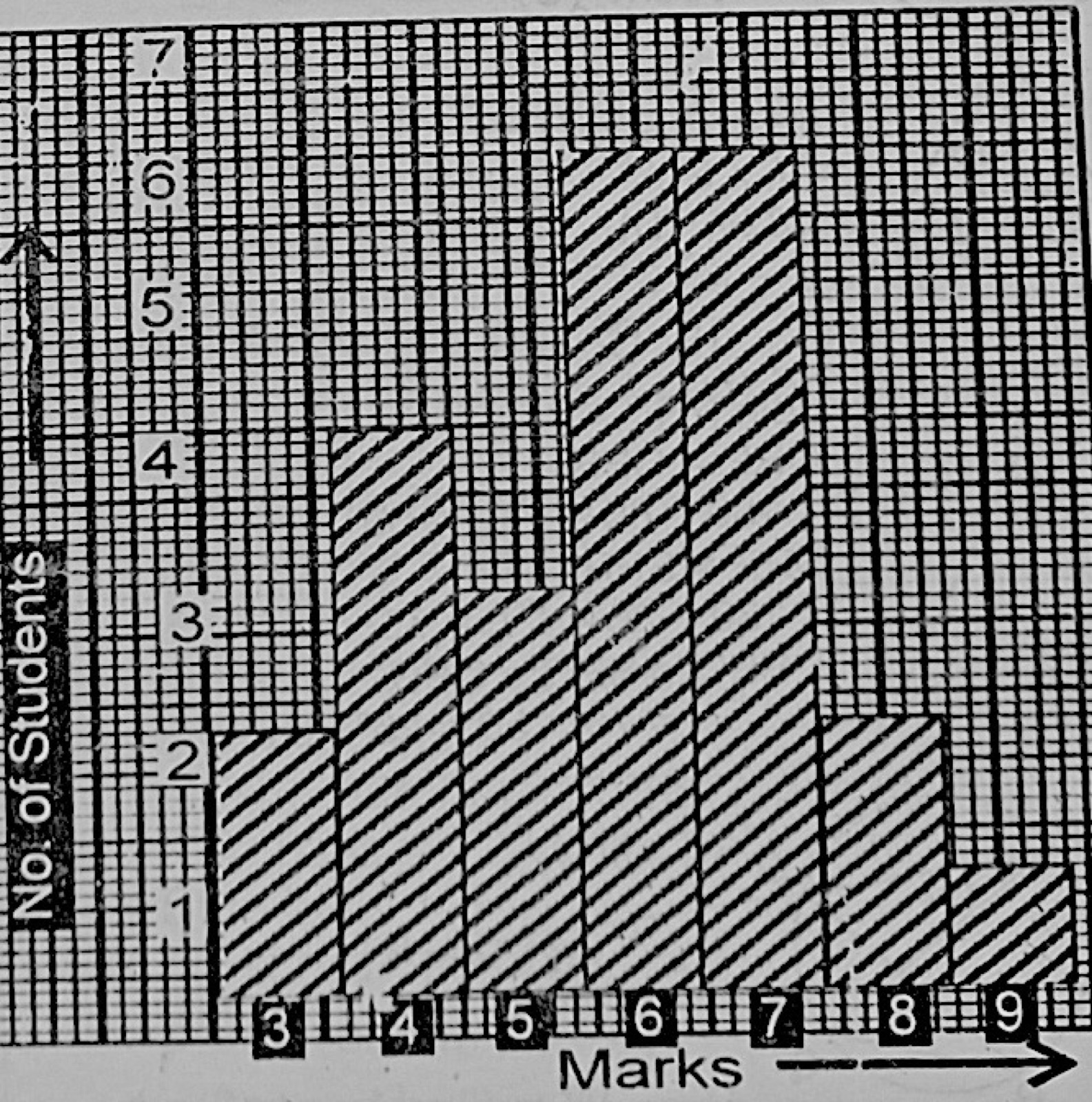
The table below shows the frequency distribution of the marks scored by fifty students in an examination. Marks (%): 0-9, 10-19, 20-29, 30-39, 40-49, 50-59, 60-69, 70-79, 80-89, 90-99 Frequency: 2, 3, 4, 6, 13, 10, 5, 3, 2, 2 (a) Draw a cumulative frequency curve for the distribution. (b) Use your curve to estimate the: (i) upper quartile; (ii) pass mark if 60% of the students passed.
Show the model answer
Model answer
(a) Upper class boundaries 9.5, 19.5, …, 99.5 with cumulative frequencies 2, 5, 9, 15, 28, 38, 43, 46, 48, 50. Plot them (start at (−0.5, 0)) and draw a smooth ogive. (b)(i) Upper quartile at the ¾ × 50 = 37.5th student: about 59 marks (49.5 + 9.5/10 × 10) (ii) 60% passed, so 40% (20 students) failed. The pass mark is the mark at cumulative frequency 20: about 43 (39.5 + 5/13 × 10 = 43.3)
Explanation
The pass mark is the score below which the failing 40% lie.
P and Q are two points on latitude 55°N and their longitudes are 33°W and 20°E respectively. Calculate the distance between P and Q measured along (a) the parallel of latitude; (b) a great circle. (Take π = 22/7 and radius of the earth = 6400km)
Show the model answer
Model answer
Difference in longitude = 33° + 20° = 53° (a) Radius of the parallel = 6400 cos 55° = 3671 km Distance = 53/360 × 2 × 22/7 × 6400 × cos 55° ≈ 3397 km (about 3400 km) (b) Chord PQ = 2 × 6400 cos 55° × sin 26.5° ≈ 3277 km Half the angle at the earth's centre: sin(θ/2) = 3277 ÷ (2 × 6400) = 0.2560, so θ ≈ 29.7° Great-circle distance = 29.7/360 × 2 × 22/7 × 6400 ≈ 3316 km
Explanation
Along a parallel use the smaller radius R cos(latitude); along a great circle use the full earth radius.