A cylinder of base radius 4cm is open at one end. If the ratio of the area of its base to that of its curved surface is 1:4, calculate the height of the cylinder.
A.1cm
B.2cm
C.4cm
D.8cm
E.16cm
Show the answer and explanation
Answer: D (8cm)
Explanation
πr2 : 2πrh = r : 2h = 1 : 4, so 2h = 4r and h = 2r = 8cm.
A headmaster contributes 7% of his income into a fund and his wife contributes 4% of her income. If the husband earns N5,500 per annum (p.a) and the wife earns N4,000 (p.a), find the sum of their annual contribution to the fund.
A.N1.045
B.N605
C.N545
D.N490
E.N440
Show the answer and explanation
Answer: C (N545)
Explanation
7% of N5,500 = N385 and 4% of N4,000 = N160; together N545.
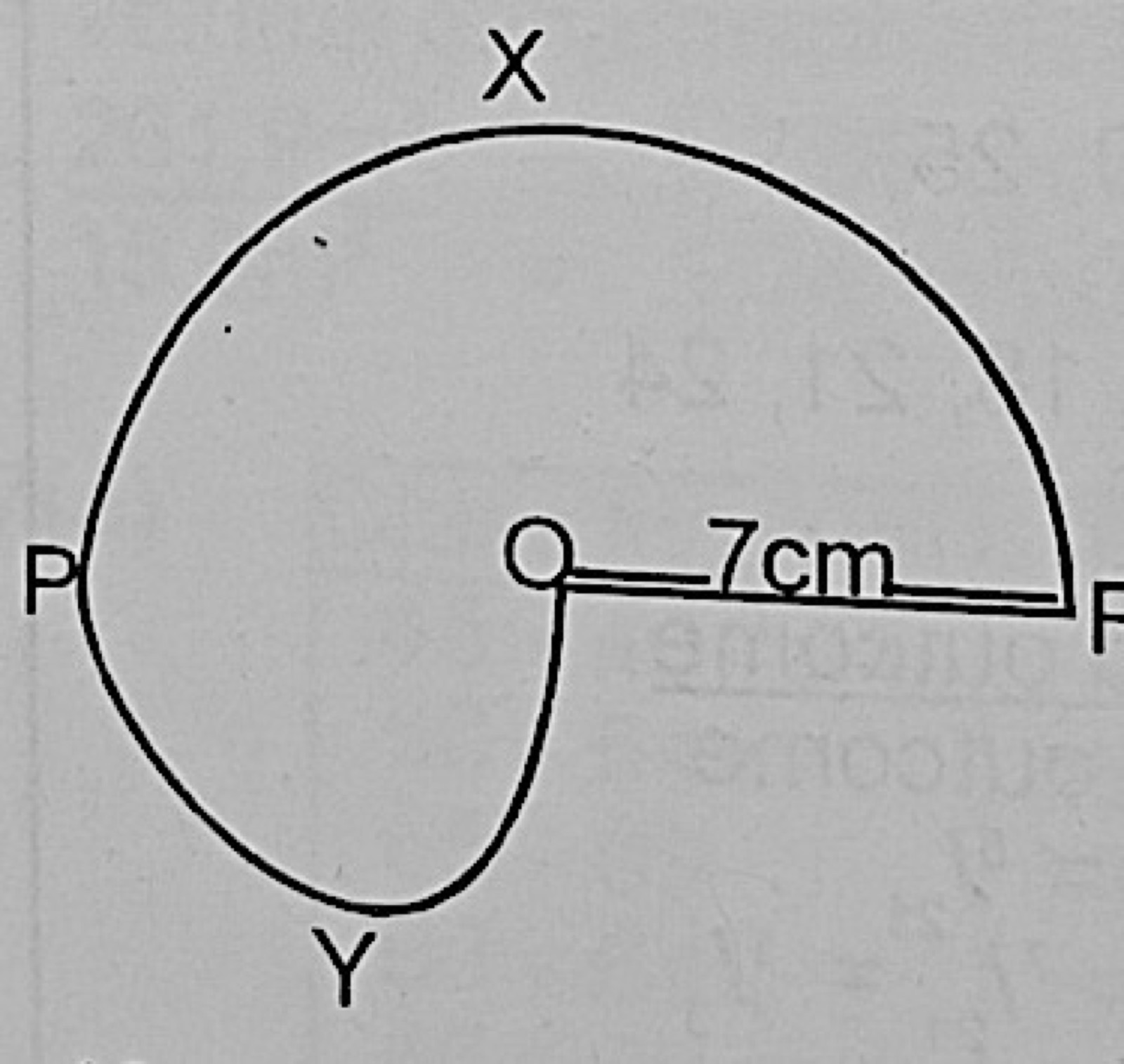
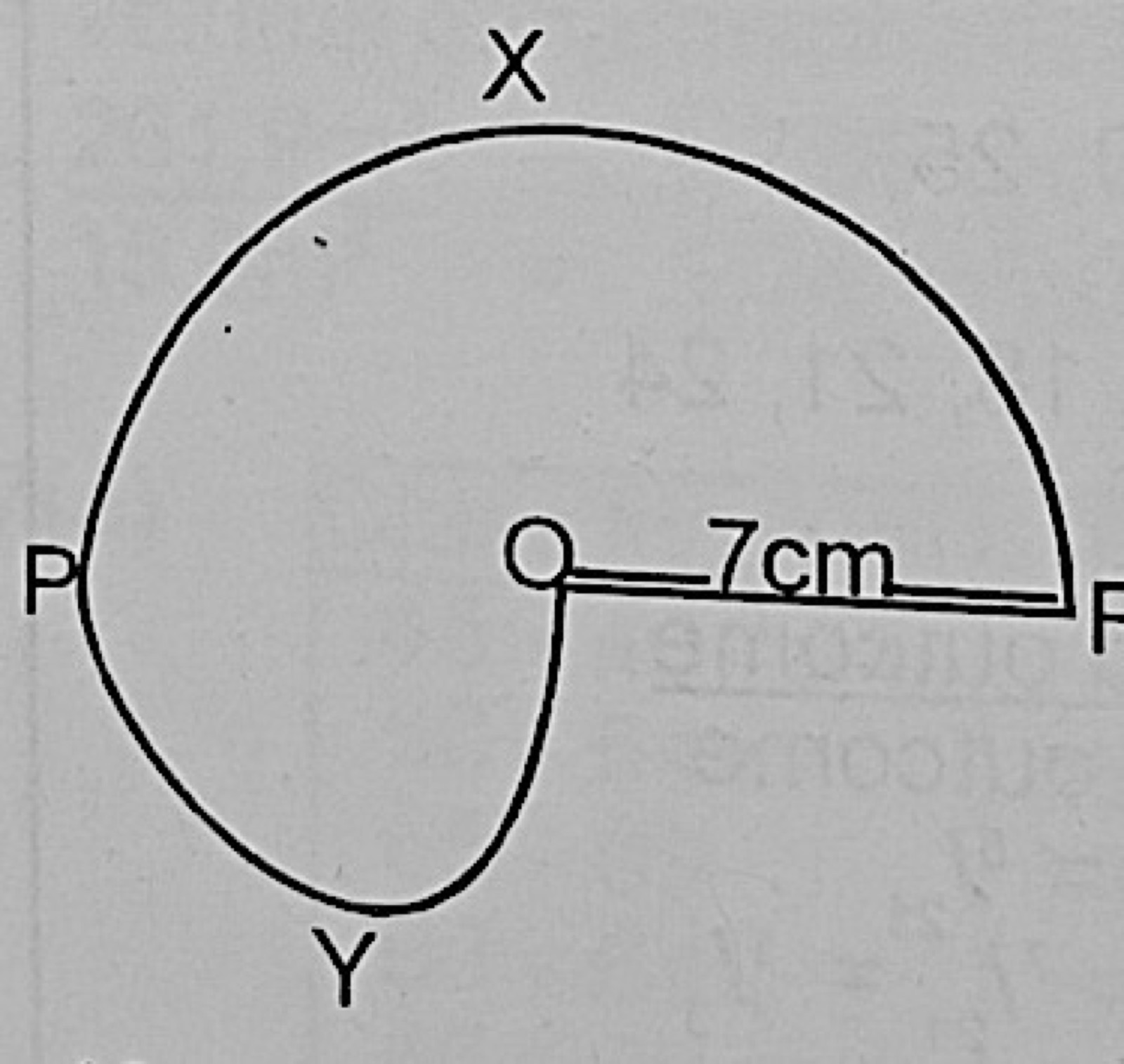
In the diagram below, PXR and PYO are two semi-circles with diameters 14cm and 7cm respectively. (Take π = 22/7) Find the area of the enclosed region, PXROY correct to the nearest whole number.
A.96cm2
B.116cm2
C.154cm2
D.192cm2
E.385cm2
Show the answer and explanation
Answer: A (96cm2)
Explanation
Large semicircle: ½ × 22/7 × 72 = 77cm2. Small semicircle: ½ × 22/7 × 3.52 = 19.25cm2. Total = 96.25 ≈ 96cm2.
Two towns, P and Q, are on (4°N 40°W) and (4°N 20°E) respectively. What is the distance between them, along their line of latitude? (Give your answer in terms of π and R, the radius of the earth).
A.2πRcos4°
B.πR sin 40°
C.(πR/2) cos 4°
D.(πR/3) cos 4°
E.(πR/6) sin 4°
Show the answer and explanation
Answer: D ((πR/3) cos 4°)
Explanation
Difference in longitude = 40° + 20° = 60°. Distance = 60/360 × 2πR cos 4° = (πR/3) cos 4°.
From the top of a cliff, the angle of depression of a boat on the sea is 60°, if the top of the cliff is 25m above the sea level, calculate the horizontal distance from the bottom of the cliff to the boat.
The mean of 30 observations recorded in an experiment is 5. If the observed largest value of 34 is deleted, find the mean of the remaining obsvervations
The table below shows the frequency distribution of a number of chairs in each of 40 rooms of various houses. No. of chairs: 1, 2, 3, 4, 5, 6, 7 Frequency: 2, 7, 5, 4, 9, 7, 6 Find the mean of the distribution.
The table below shows the frequency distribution of a number of chairs in each of 40 rooms of various houses. No. of chairs: 1, 2, 3, 4, 5, 6, 7 Frequency: 2, 7, 5, 4, 9, 7, 6 Find the mode of the distribution.
A.40
B.9
C.7
D.5
E.2
Show the answer and explanation
Answer: D (5)
Explanation
The highest frequency is 9, for 5 chairs, so the mode is 5.
The table below shows the frequency distribution of a number of chairs in each of 40 rooms of various houses. No. of chairs: 1, 2, 3, 4, 5, 6, 7 Frequency: 2, 7, 5, 4, 9, 7, 6 Find the median of the distribution.
A.9
B.6.5
C.5
D.4.5
E.4
Show the answer and explanation
Answer: C (5)
Explanation
The median is between the 20th and 21st rooms. Cumulative frequencies 2, 9, 14, 18, 27 show both are in the 5-chair group.
A box contains 2 white and 3 blue identical marbles. If two marbles are picked at random, one after the other without replacement, what is the probability of picking two marbles of different colours?
Mrs. Jones is expecting a baby. The probability that it will be a boy is ½ and probability that the baby will have blue eyes is ¼. What is the probability that she will have a blue-eyed boy?
A.1/8
B.¼
C.3/8
D.½
E.3/4
Show the answer and explanation
Answer: A (1/8)
Explanation
Multiply the independent probabilities: ½ × ¼ = 1/8.
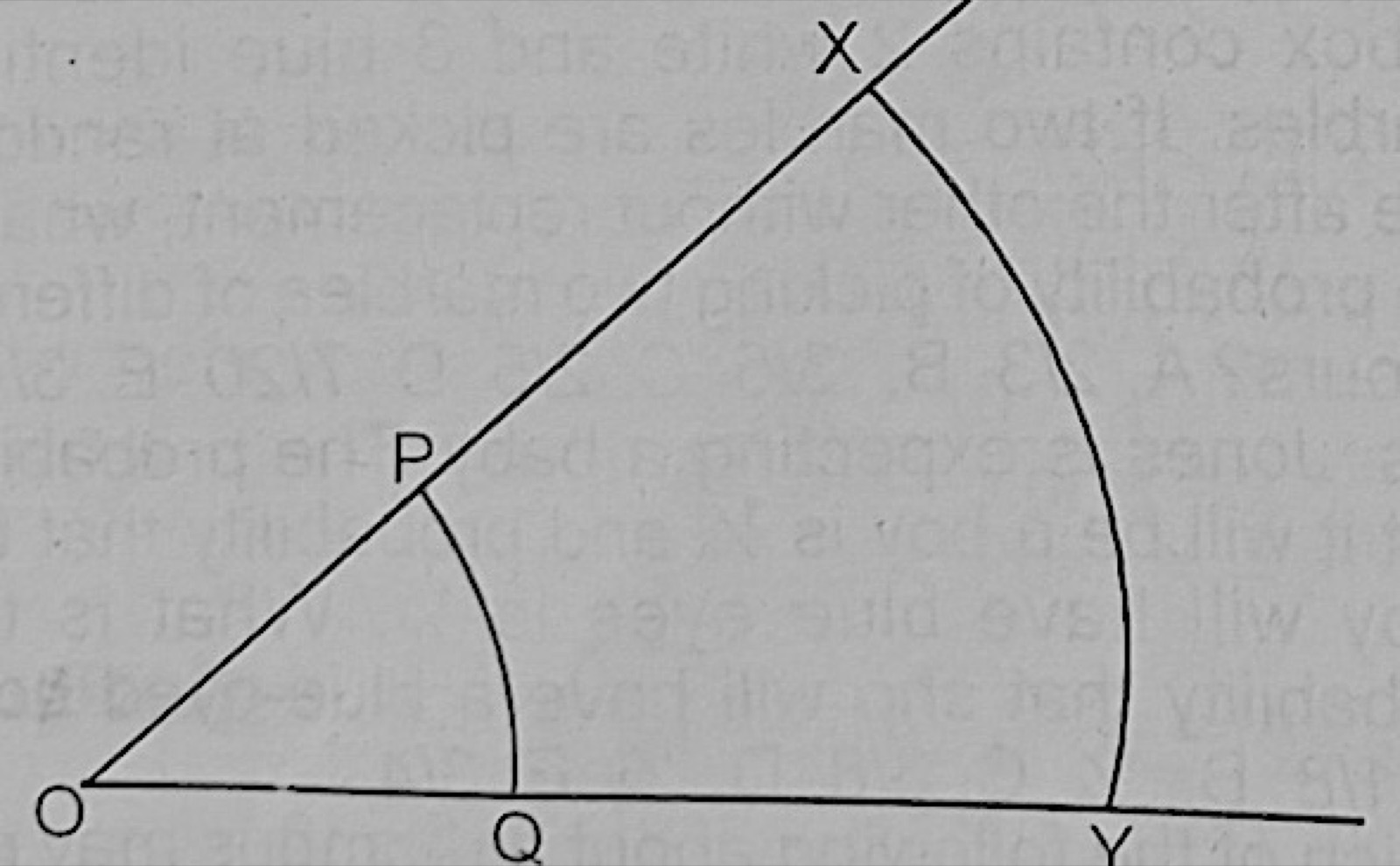
In the diagram below, PQ and XY are two concentric arcs; centre O. If the ratio of the lengths of the two arcs is 1 : 3, find the ratio of the areas of the two sectors OPQ and OXY.
A.1 : 3
B.1 : 6
C.1 : 9
D.2 : 3
E.4 : 9
Show the answer and explanation
Answer: C (1 : 9)
Explanation
Both sectors have the same angle, so the arc lengths are in the ratio of the radii, 1 : 3. Areas go as the square of the radius: 1 : 9.
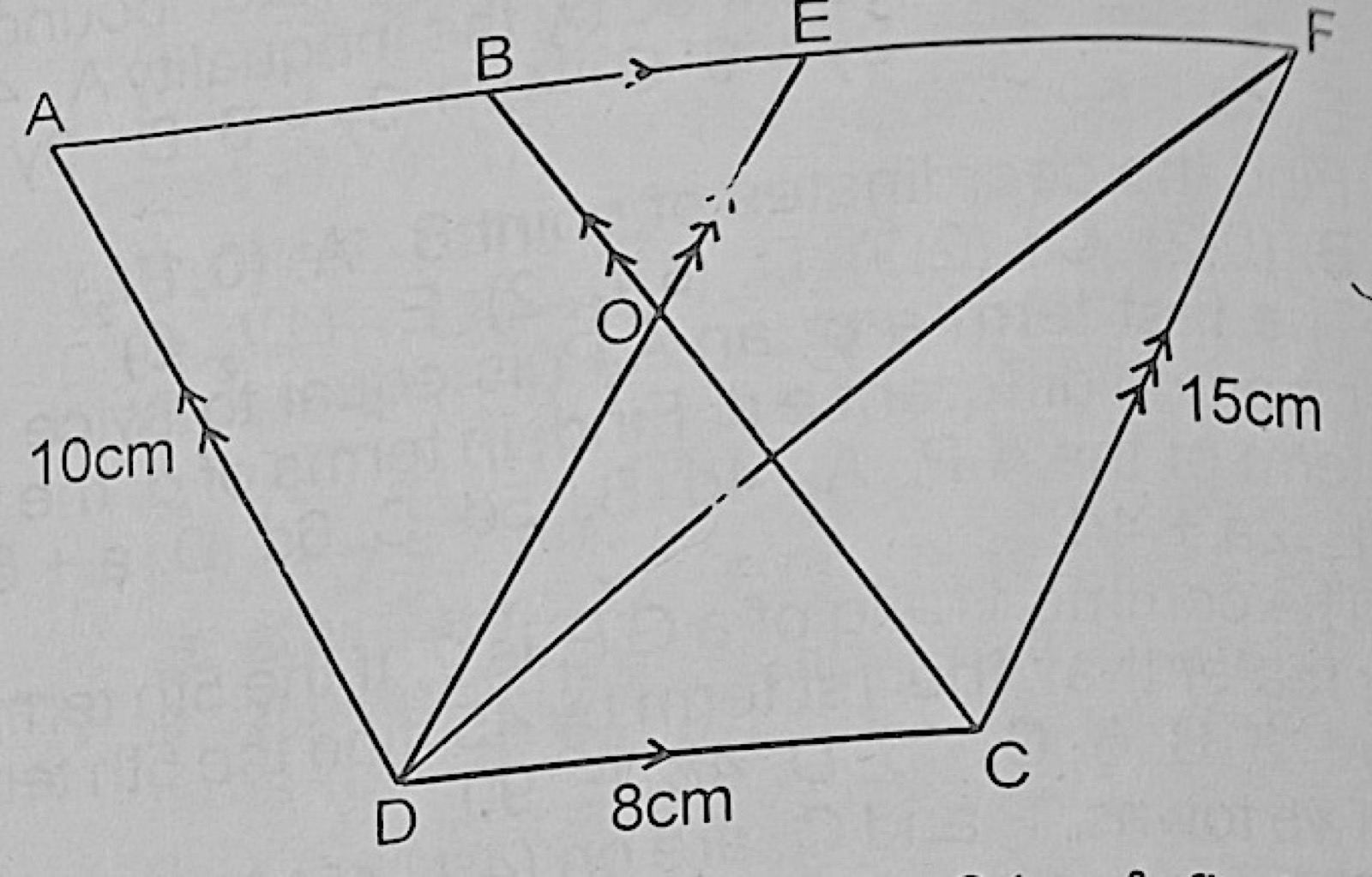
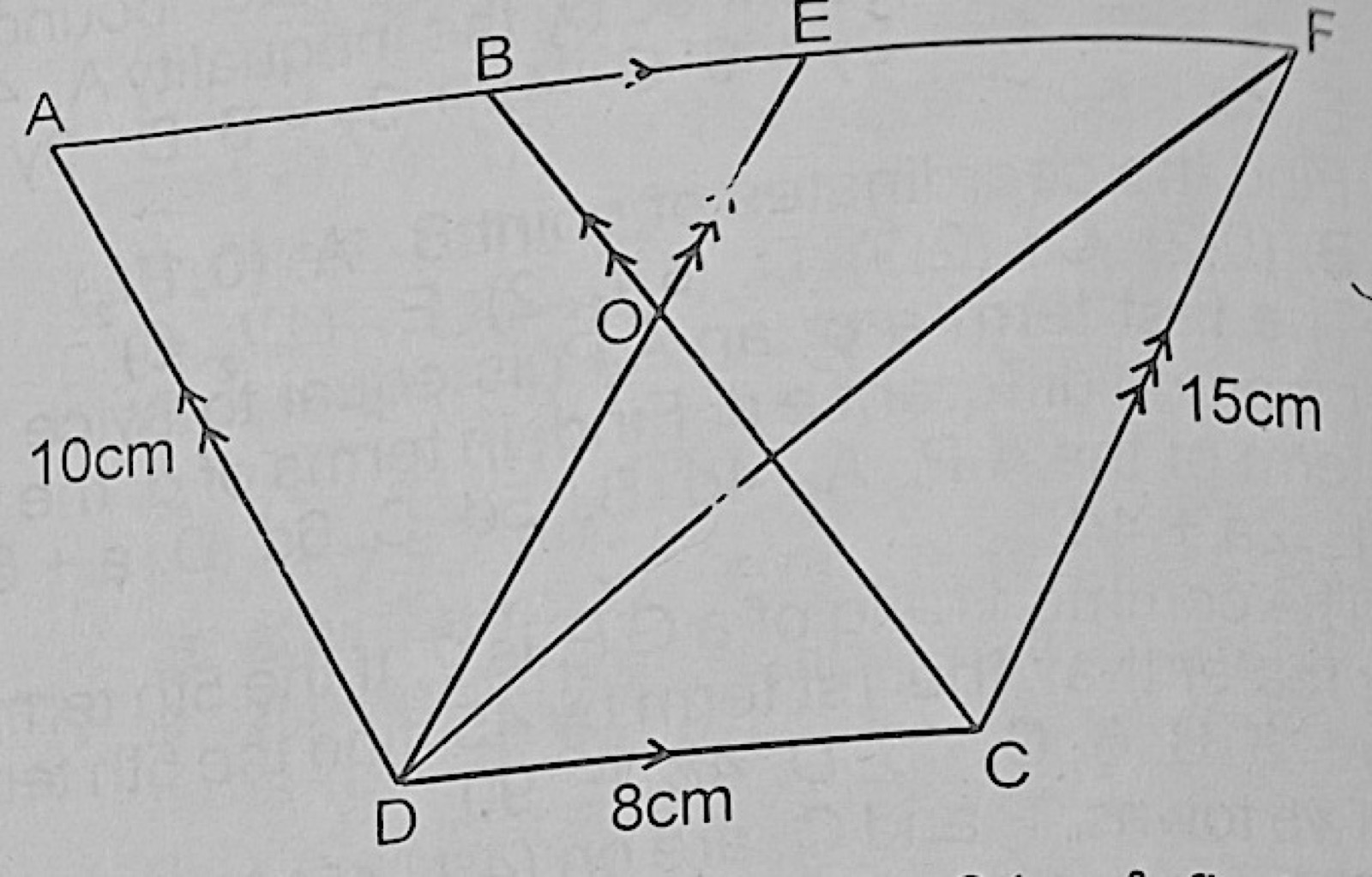
In the diagram below, |AD| = 10cm, |DC| = 8cm and |CF| = 15cm. If the area of triangle DCF = 24cm2, find the area of the quadrilateral ABCD.
A.24cm2
B.48cm2
C.80cm2
D.96cm2
E.120cm2
Show the answer and explanation
Answer: B (48cm2)
Explanation
DCFE is a parallelogram, so its area is twice triangle DCF: 48cm2. Parallelogram ABCD has the same base DC and lies between the same parallels, so its area is also 48cm2.
In a certain class, 22 pupils take one or more of Chemistry, Economics and Government. 12 take Economics (E), 8 take Government (G) and 7 take Chemistry (C). Nobody takes Economics and Chemistry and 4 pupils take Economics and Government. (a)(i) Using set notation and the letters indicated above, write down the two statements in the last sentence. (ii) Draw a Venn diagram to illustrate the information. (b) How many pupils take (i) both Chemistry and Government? (ii) Government only?
Show the model answer
Model answer
(a)(i) E ∩ C = ∅ (or n(E ∩ C) = 0); n(E ∩ G) = 4 (ii) Circles E and G overlap (4 in the overlap); circle C overlaps G only and does not touch E; let x be in C ∩ G E only = 8, G only = 4 − x, C only = 7 − x (b)(i) 8 + 4 + (4 − x) + x + (7 − x) = 22, so 23 − x = 22 and x = 1 (ii) Government only = 8 − 4 − 1 = 3
Explanation
Draw the C circle so that it does not overlap E, because nobody takes both.
A man has 9 identical balls in a bag. Out of these, 3 are black, 2 are blue and the remaining are red. (a) If a ball is drawn at random, what is the probability that it is (i) not blue? (ii) not red? (b) If 2 balls are drawn at random, one after the other, what is the probability that both of them will be (i) black, if there is no replacement? (ii) blue, if there is a replacement?
ABCDE is a regular pentagon and a rectangle. AXYE is drawn on the side AE such that the vertices X and Y lie on the sides BC and CD respectively. Calculate the size of (i) an interior angle of the pentagon, (ii) ∠BXA.
Show the model answer
Model answer
(i) Sum of interior angles = (5 − 2) × 180° = 540°; each angle = 540° ÷ 5 = 108° (ii) ∠XAE = 90° (rectangle), so ∠BAX = 108° − 90° = 18° In triangle ABX: ∠BXA = 180° − 108° − 18° = 54°
Explanation
Draw the figure: the rectangle shares side AE with the pentagon.
(a) Solve the equation, correct to two decimal places. 2x2 + 7x − 11 = 0 (b) Using the substitution p = 1/x, q = 1/y Solve the simultaneous equation 2/x + 1/y = 3, 1/x − 5/y = 7
Show the model answer
Model answer
(a) x = (−7 ± √(49 + 88))/4 = (−7 ± √137)/4 = (−7 ± 11.705)/4 x = 1.18 or x = −4.68 (b) 2p + q = 3 and p − 5q = 7 From the first, q = 3 − 2p; then p − 15 + 10p = 7, so 11p = 22, p = 2 and q = −1 x = 1/p = ½, y = 1/q = −1
Explanation
Solve for p and q first, then turn them back into x and y.
A man bought 5 reams of duplicating paper, each of which was supposed to contain 480 sheets. The actual number of sheets in the packets were 435, 420, 405, 415 and 440. (a) Calculate, correct to the nearest whole number the average percentage error for the packets of paper (b) If the agreed price for a full ream was N35.00, find, correct to the nearest naira, the amount by which the buyer was cheated.
Using a scale of 2cm to 1unit on the x-axis and 1cm to 1unit on the y-axis, draw on the same axes the graphs of y = 3 + 2x − x2 y = 2x − 3 for −3 ≤ x ≤ 4. Using your graph: (i) Solve the equation 6 − x2 = 0. (ii) find the maximum value of 3 + 2x − x2, (iii) find the range of x for which 3 + 2x − x2 ≤ 1, expressing all your answers correct to one decimal place.
Show the model answer
Model answer
Table for y = 3 + 2x − x2: x = −3, −2, −1, 0, 1, 2, 3, 4 gives y = −12, −5, 0, 3, 4, 3, 0, −5 Line y = 2x − 3: e.g. (−3, −9), (0, −3), (4, 5) (i) 6 − x2 = 0 is where the curve meets the line (3 + 2x − x2 = 2x − 3): x ≈ −2.4 or x ≈ 2.4 (ii) Maximum value = 4 (at x = 1) (iii) Draw y = 1: the curve is on or below it for −3 ≤ x ≤ −0.7 and 2.7 ≤ x ≤ 4
Explanation
Rearrange the equation to show it is the curve minus the line equal to zero.
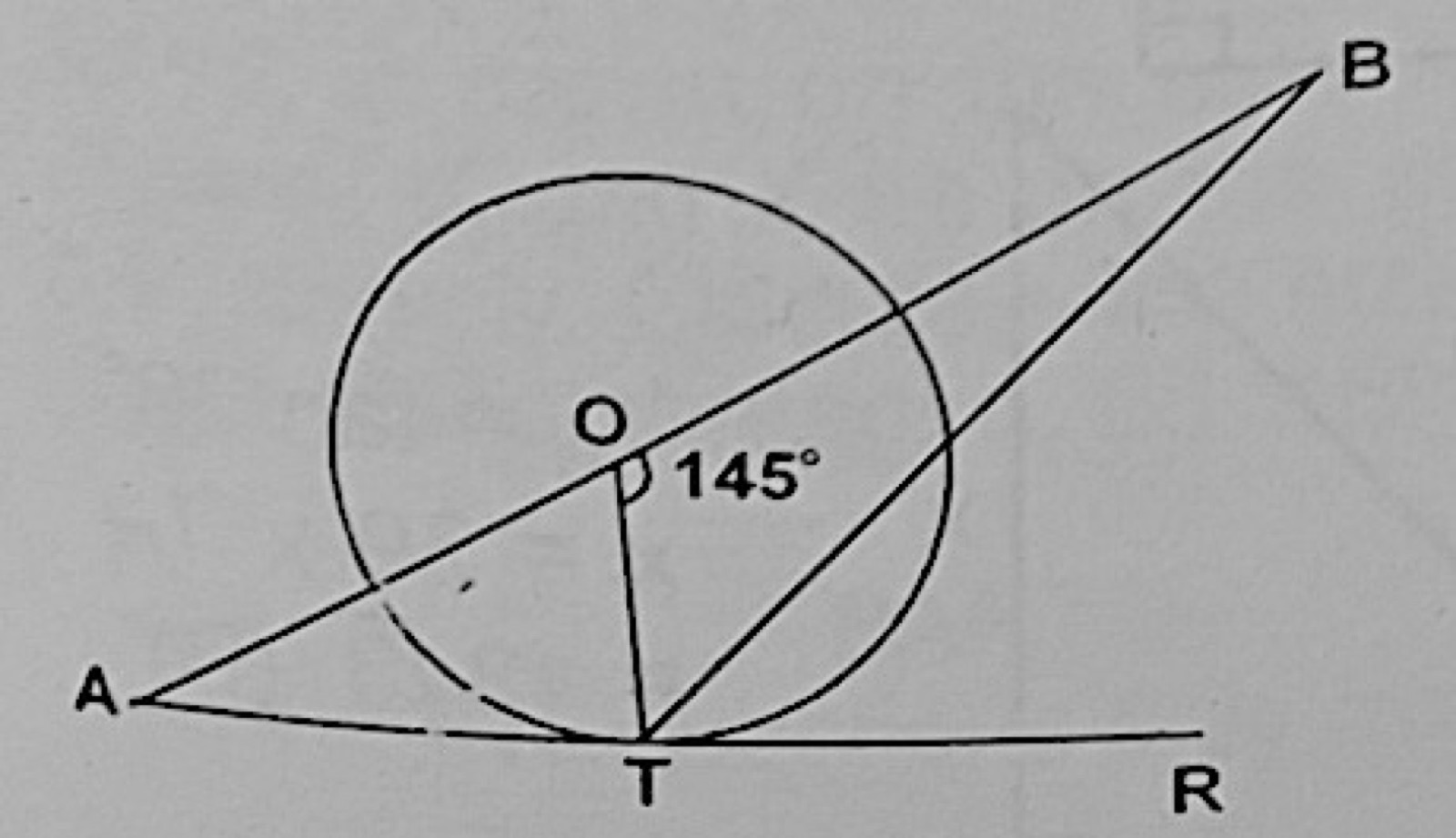
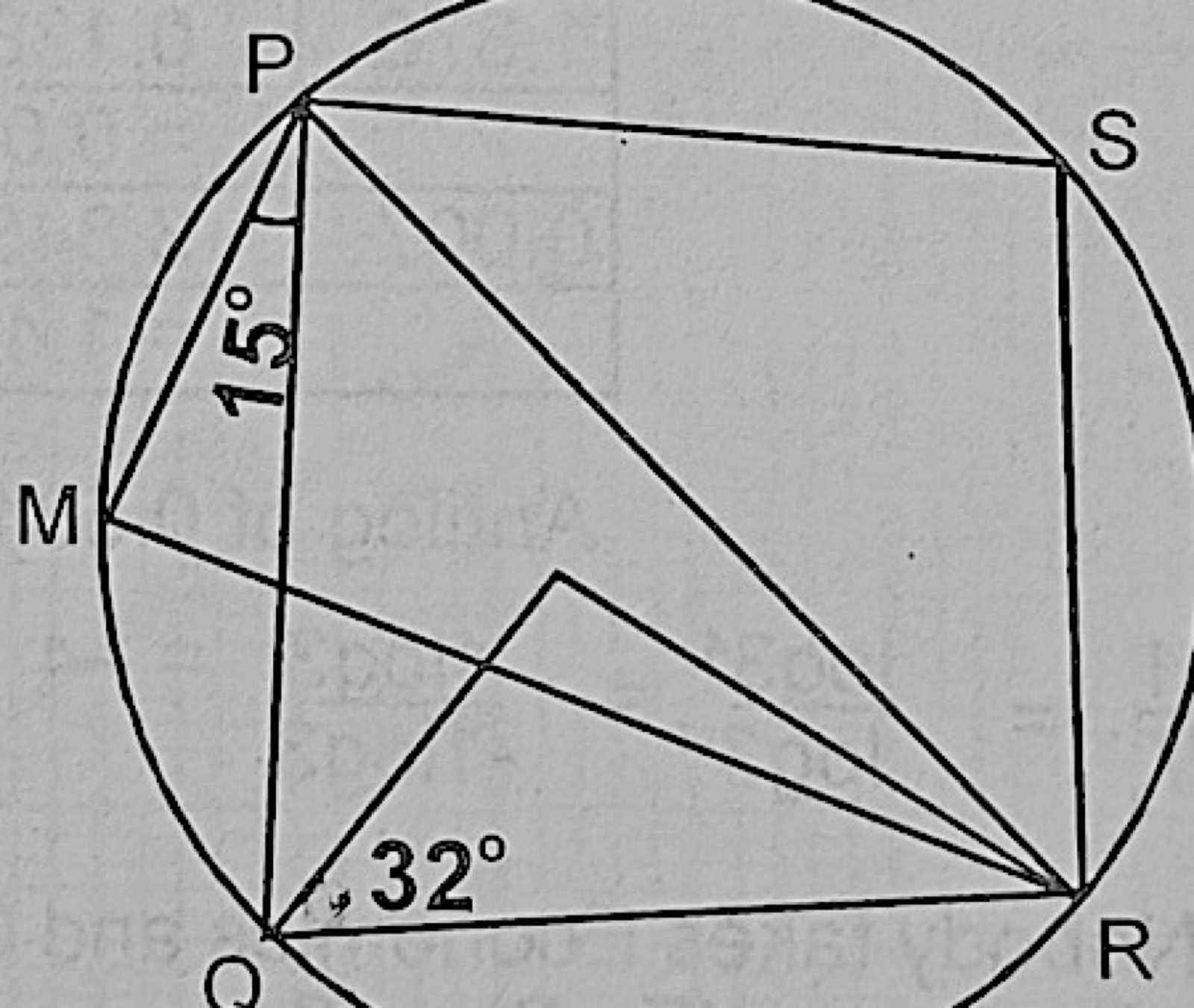
(a) Prove that the angle which an arc of a circle subtends at the centre is twice that which it subtends at any point on the remaining part of the circumference. (b) In the diagram above, O is the centre of the circle, ∠OQR = 32° and ∠MPQ = 15°. Calculate (i) ∠QPR; (ii) ∠MQO.
Show the model answer
Model answer
(a) Given a circle centre O, arc BC subtending ∠BOC at O and ∠BAC at A on the circumference. Join AO and produce to N. OA = OB (radii), so ∠OAB = ∠OBA = x; exterior angle ∠BON = 2x. Similarly ∠CON = 2y where y = ∠OAC. ∠BOC = 2x + 2y = 2(x + y) = 2∠BAC. (b)(i) OQ = OR, so ∠ORQ = 32° and ∠QOR = 180° − 64° = 116°; ∠QPR = ½ × 116° = 58° (ii) ∠MOQ = 2 × ∠MPQ = 30°; triangle MOQ is isosceles, so ∠MQO = (180° − 30°)/2 = 75°
Explanation
Use the angle at the centre twice: once for chord QR and once for chord MQ.
The table below shows the distribution of the waiting times for some customers in a certain petrol station. Waiting time (in min.): 1.5 − 1.9, 2.0 − 2.4, 2.5 − 2.9, 3.0 − 3.4, 3.5 − 3.9, 4.0 − 4.4 No. of Customers: 3, 10, 18, 10, 7, 2 (a) Write down the class boundaries of the distribution. (b) Construct a cumulative frequency curve for the data. (c) Using your graph, estimate: (i) the interquartile range of the distribution; (ii) the proportion of customers who would have waited for more than 3 minutes.
Show the model answer
Model answer
(a) 1.45−1.95, 1.95−2.45, 2.45−2.95, 2.95−3.45, 3.45−3.95, 3.95−4.45 (b) Cumulative frequencies 3, 13, 31, 41, 48, 50 plotted against the upper boundaries 1.95, 2.45, 2.95, 3.45, 3.95, 4.45 (start at (1.45, 0)); join with a smooth S-shaped curve (c)(i) Q1 (12.5th) ≈ 2.4 min, Q3 (37.5th) ≈ 3.3 min; interquartile range ≈ 0.8−0.9 min (ii) About 32 customers waited up to 3 minutes, so about 18 of 50 waited longer: 18/50 = 0.36 (36%)
Explanation
Plot cumulative frequency at the upper class boundary, not at the class mark.
(a) Using a ruler and a pair of compasses only, construct a parallelogram PQRS with diagonals |PR| = 9cm and |QS| = 6cm intersecting at K and ∠QKR = 60°. (b) Construct a rectangle PABS which is equal in area to PQRS in (a) above and on the same side of PS as PQRS. Measure |PA|
Show the model answer
Model answer
(a) Draw PR = 9cm and bisect it to get K. Construct 60° at K for ∠QKR; mark KQ = KS = 3cm on the line through K. Join PQ, QR, RS, SP. Arcs must be shown. (b) Area of PQRS = ½ × 9 × 6 × sin 60° ≈ 23.4cm2; PS ≈ 4.0cm Construct perpendiculars to PS at P and S on the side of the parallelogram. The rectangle has the same base PS and lies between the same parallels, so the line QR (extended) cuts the perpendiculars at A and B. |PA| ≈ 5.9cm (accept 5.8−6.0cm)
Explanation
A rectangle and a parallelogram on the same base and between the same parallels have equal areas.
From a horizontal distance of 8.5km, a pilot observes that the angles of depression of the top and base of a control tower are 30° and 33° respectively. Calculate, correct to three significant figures: (i) the shortest distance between the pilot and the base of the control tower; (ii) the height of the control tower.
Show the model answer
Model answer
(i) cos 33° = 8.5/d, so d = 8.5/0.8387 = 10.1km (ii) Height of pilot above the base = 8.5 tan 33° = 5.520km; above the top = 8.5 tan 30° = 4.907km Height of tower = 5.520 − 4.907 = 0.612km (612m)
Explanation
Draw one horizontal line from the pilot; both angles of depression are measured from it.