Question 1
Indices and LogarithmsSolve: 8x−2 = 43x
- A.−2
- B.−1
- C.1
- D.2
Show the answer and explanation
Answer: A (−2)
Explanation
In powers of 2: 2^(3x − 6) = 2^(6x), so 3x − 6 = 6x and x = −2.
50 questions. Try each one, then open the answer to check yourself and read the explanation.
Solve: 8x−2 = 43x
Answer: A (−2)
In powers of 2: 2^(3x − 6) = 2^(6x), so 3x − 6 = 6x and x = −2.
Evaluate tan 75°, leaving the answer in surd form (radicals).
Answer: A (√3 + 2)
tan 75° = (1 + 1/√3)/(1 − 1/√3) = (√3 + 1)/(√3 − 1) = (4 + 2√3)/2 = 2 + √3.
Solve: p/2 + k/3 = 5 and 2p − k = 6 simultaneously.
Answer: C (p = 6, k = 6)
3p + 2k = 30 and k = 2p − 6, so 3p + 4p − 12 = 30, p = 6 and k = 6.
Rationalize: 1/(√2 + 1)
Answer: A (√2 − 1)
Multiply top and bottom by (√2 − 1): (√2 − 1)/(2 − 1) = √2 − 1.
If nC2 = 15, find the value of n.
Answer: C (6)
n(n − 1)/2 = 15 gives n² − n − 30 = 0, (n − 6)(n + 5) = 0, so n = 6.
An operation (*) is defined on the set T = {−1, 0, …, 5} by x * y = x + y − xy. Which of the following operation(s) will give an image which is an element of T? I. 2(*)5 II. 3(*)2 III. 3(*)4
Answer: B (II only)
2 * 5 = 7 − 10 = −3 (not in T); 3 * 2 = 5 − 6 = −1 (in T); 3 * 4 = 7 − 12 = −5 (not in T). Only II.
Given that g: x → 3x and f: x → cos x, find the value of g o f(20°).
Answer: D (2.82)
f(20°) = cos 20° ≈ 0.9397, then g gives 3 × 0.9397 ≈ 2.82.
A linear transformation is defined by T: (x, y) → (−x + y, −4y). Find the image, Q′, of Q(−3, 2) under T.
Answer: A (Q′(5, −8))
T(−3, 2) = (3 + 2, −8) = (5, −8).
If g: r → 5 − 2r, r is a real number, find the image of −3.
Answer: B (11)
g(−3) = 5 + 6 = 11.
Consider the following statements: p: Birds fly
q: The sky is blue
r: The grass is green
What is the symbolic representation of "If the grass is green and the sky is not blue, then the birds do not fly"?
Answer: C ((r ∧ ~q) ⇒ ~p)
'Grass is green and sky is not blue' is r ∧ ~q; 'birds do not fly' is ~p. So (r ∧ ~q) ⇒ ~p.
Given that 1/(x2 − 4) ≡ P/(x + 2) + Q/(x − 2), x ≠ ±2, find the value of (P + Q)
Answer: D (0)
1 = P(x − 2) + Q(x + 2). x = 2 gives Q = ¼; x = −2 gives P = −¼. P + Q = 0.
Find the sum of the first 20 terms of the sequence −7, −3, 1, ….
Answer: A (620)
a = −7, d = 4. S₂₀ = 10[2(−7) + 19(4)] = 10 × 62 = 620.
Find the value of x for which 6√(4x2 + 1) = 13x, where x > 0.
Answer: A (6/5)
Square: 36(4x² + 1) = 169x², so 25x² = 36 and x = 6/5 (x > 0).
Calculate the distance between points (−2, −5) and (−1, 3).
Answer: C (√65 units)
√((−1 + 2)² + (3 + 5)²) = √(1 + 64) = √65.
If P = (2 3 / −4 1), Q = (6 / 8) and PQ = k(45 / −20), find the value of k. (Matrices written row by row; / separates the rows.)
Answer: C (4/5)
PQ = (12 + 24 / −24 + 8) = (36 / −16) = (4/5)(45 / −20), so k = 4/5.
The second and fourth terms of an exponential sequence (G.P.) are 2/9 and 8/81 respectively. Find the sixth term of the sequence
Answer: D (32/729)
r² = (8/81) ÷ (2/9) = 4/9, so r = 2/3 and a = 1/3. T₆ = ar⁵ = (1/3)(32/243) = 32/729.
Points X and Y are on the same horizontal base as the foot of a building such that X is 96 m due east of the building and Y is due west. If the angle of elevation of the top of the building from X is 30° and that of Y is 60°, calculate the distance of Y from the base of the building.
Answer: B (32 m)
Height = 96 tan 30° ≈ 55.43 m. Distance of Y = height ÷ tan 60° = 96/3 = 32 m.
Find the coordinates of the point on the curve y = 3x2 − 2x − 5 where the tangent is parallel to the line y − 5 = 8x.
Answer: D ((5/3, 0))
dy/dx = 6x − 2 = 8 gives x = 5/3; y = 25/3 − 10/3 − 5 = 0. Point (5/3, 0).
A particle starts from rest and moves in a straight line such that its velocity, V ms−1, at time t second is given by V = 3t2 − 6t. Calculate the distance in 4 seconds.
Answer: B (16 m)
s = ∫(3t² − 6t) dt = t³ − 3t² (s = 0 at t = 0). At t = 4, s = 64 − 48 = 16 m from the start.
Find the constant term in the binomial expansion of (2x2 + 1/x2)4.
Answer: C (24)
The constant term has (2x²)² and (1/x²)²: ⁴C₂ × 4 × 1 = 6 × 4 = 24.
Which of these inequalities is represented by the shaded portion of the graph?
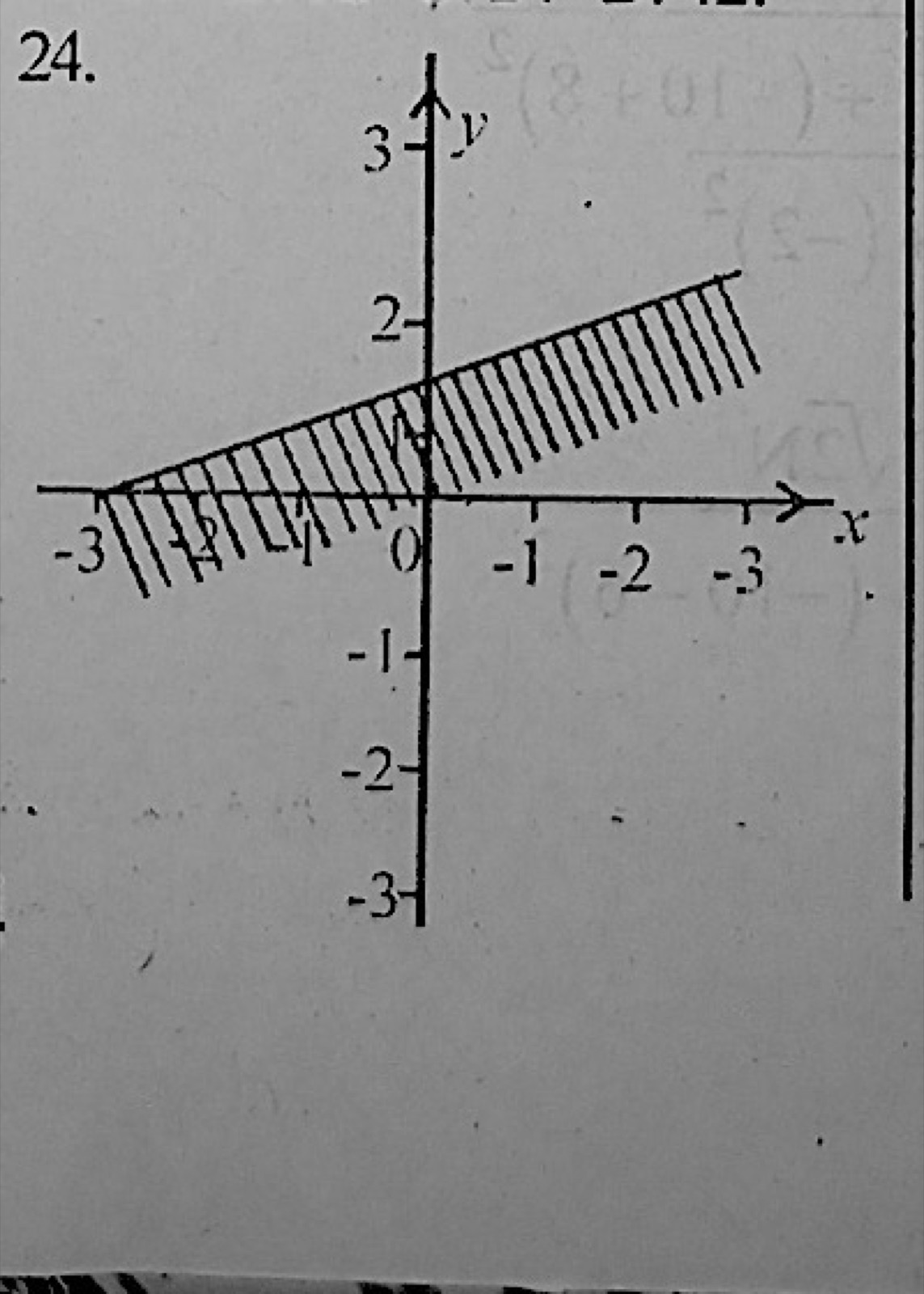
Answer: B (2y − x − 3 < 0)
The boundary line passes through (−3, 0) and (0, 1.5), so it is 2y = x + 3. The shaded side is below the line, where 2y − x − 3 < 0.
A 35 N force acts on a body of mass 5 kg for 2 seconds. Calculate the change in momentum of the body.
Answer: A (70 kg ms−1)
Change in momentum = impulse = Ft = 35 × 2 = 70 kg ms⁻¹.
Solve, correct to three significant figures, (0.3)x = (0.5)8.
Answer: A (4.61)
x = 8 log 0.5 / log 0.3 = 8(−0.3010)/(−0.5229) ≈ 4.606, which is 4.61 to three significant figures.
Given that P and Q are two non-empty subsets of the universal set, U. Find P ∩ (Q ∪ Q′)
Answer: A (P)
Q ∪ Q′ = U, and P ∩ U = P.
Find the coefficient of the third term in the binomial expansion of (2x + 3y/4)3 in descending powers of x.
Answer: B (27y2/8)
The third term is ³C₂(2x)(3y/4)² = 3 × 2x × 9y²/16 = (27y²/8)x, so its coefficient (of x) is 27y²/8.
Find the coordinates of the centre of the circle 3x2 + 3y2 − 6x + 9y − 5 = 0.
Answer: C ((1, −3/2))
Divide by 3: x² + y² − 2x + 3y − 5/3 = 0. The centre is (1, −3/2).
Evaluate ∫09 √x dx.
Answer: C (18)
∫√x dx = (2/3)x^(3/2); from 0 to 9: (2/3)(27) = 18.
The function f: x → x2 + px + q has turning point when x = −3 and remainder of −6 when divided by (x + 2). Find the vale of q.
Answer: B (2)
f′(x) = 2x + p = 0 at x = −3, so p = 6. f(−2) = 4 − 12 + q = −6, so q = 2.
If y = (5 − x)−3, find dy/dx.
Answer: C (3/(5 − x)4)
dy/dx = −3(5 − x)⁻⁴ × (−1) = 3/(5 − x)⁴.
Find correct to the nearest degree, the angle between p = 12i − 5j and q = 4i + 3j.
Answer: A (59°)
p·q = 48 − 15 = 33; |p| = 13, |q| = 5. cos θ = 33/65 ≈ 0.5077, so θ ≈ 59°.
Find, the area between line y = x + 1 and the x − axis from x = −2 to x = 0.
Answer: D (1 square unit)
The line crosses the x-axis at x = −1. From −2 to −1 the region is a triangle of area ½ (below the axis) and from −1 to 0 another of area ½. Total area = 1 square unit.
How many numbers greater than 200 can be formed from the digits 1, 2, 3, 4, 5 if no digit is to be repeated in any particular number?
Answer: C (288)
3-digit numbers above 200: 4 × 4 × 3 = 48. 4-digit: 5 × 4 × 3 × 2 = 120. 5-digit: 5! = 120. Total 288.
The probabilities that John and Jane will pass an examination are 0.9 and 0.7 respectively. Find the probability that at least one of them will pass the examination.
Answer: D (0.97)
P(neither) = 0.1 × 0.3 = 0.03, so P(at least one) = 0.97.
Given that X and Y are independent events such that P(X) = 0.5, P(Y) = m and P(X ∪ Y) = 0.75, find the value of m.
Answer: B (0.5)
P(X ∪ Y) = P(X) + P(Y) − P(X)P(Y): 0.75 = 0.5 + m − 0.5m, so 0.5m = 0.25 and m = 0.5.
A uniform beam, PQ, is 100 cm long and weighs 35 N. It is placed on a support at a point 40 cm from P. If weights of 54 N and F N are attached at P and Q respectively in order to keep it in a horizontal position, calculate, correct to the nearest whole number, the value of F.
Answer: D (30)
Moments about the support: 54 × 40 = 35 × 10 + F × 60, so 60F = 1810 and F ≈ 30.
Simplify: (625(3x/4 − 1) + 125(x−1))/5(3x−2).
625^(3x/4 − 1) = 5^(3x − 4); 125^(x − 1) = 5^(3x − 3).
Divide by 5^(3x − 2): 5^(−2) + 5^(−1) = 1/25 + 1/5 = 6/25.
Write everything as a power of 5.
(a) Find the coordinates of the point which divides the line joining (7, −5) and (−2, 7) externally in the ratio 3 : 2.
(b) Without using calculators or mathematical tables, evaluate 2/(1 − √2) − 2/(2 + √2), leaving the answer in the form p + q√n, where p, q and n are integers.
(a) External division: ((3(−2) − 2(7))/(3 − 2), (3(7) − 2(−5))/(3 − 2)) = (−20, 31).
(b) 2/(1 − √2) = −2 − 2√2; 2/(2 + √2) = 2 − √2.
Difference = −2 − 2√2 − 2 + √2 = −4 − √2 (p = −4, q = −1, n = 2).
For external division use (mx₂ − nx₁)/(m − n).
How many terms of the series −3 − 1 + 1 + … add up to 165?
a = −3, d = 2. Sₙ = (n/2)[−6 + 2(n − 1)] = n(n − 4) = 165.
n² − 4n − 165 = 0, (n − 15)(n + 11) = 0, so n = 15.
Set Sₙ = 165 and solve the quadratic.
If sin X = (p − q)/(p + q), where 0° ≤ X ≤ 90°, find 1 − tan2X.
Opposite p − q, hypotenuse p + q, adjacent √((p + q)² − (p − q)²) = 2√(pq).
tan²X = (p − q)²/(4pq).
1 − tan²X = (4pq − (p − q)²)/(4pq) = (6pq − p² − q²)/(4pq).
Draw a right triangle and use Pythagoras for the third side.
Three forces 10 N, 14 N and 16 N acting on a particle keep it in equilibrium. Find the angle between the forces 10 N and 16 N.
The 14 N force balances the resultant of the 10 N and 16 N forces.
14² = 10² + 16² + 2(10)(16) cos θ, so 196 = 356 + 320 cos θ and cos θ = −½.
θ = 120°.
The resultant of two forces equals the third force reversed.
A uniform beam, WX, of length 90 cm and weight 50 N is suspended on a pivot, 35 cm from W. It is kept in equilibrium by means of forces T and 20 N applied at Y and Z respectively. |WY| = 10 cm and |XZ| = 10 cm. Find the value of T.
Positions from W: Y at 10 cm, pivot at 35 cm, centre of the beam at 45 cm, Z at 80 cm.
Taking both forces downwards, moments about the pivot: T × 25 = 50 × 10 + 20 × 45 = 500 + 900.
T = 1400/25 = 56 N.
Don't forget the beam's own weight acting at its midpoint.
The table shows the age distribution in years of a group of people.
Age (in years): 1 − 5, 6 − 10, 11 − 15, 16 − 20, 21 − 25, 26 − 30
Number of People: 18, 12, 25, 15, 20, 10
Using an assumed mean of 13 years, find the mean age of the people.
Class marks 3, 8, 13, 18, 23, 28; d = x − 13 = −10, −5, 0, 5, 10, 15.
Σf = 100; Σfd = −180 − 60 + 0 + 75 + 200 + 150 = 185.
Mean = 13 + 185/100 = 14.85 years.
Mean = A + Σfd/Σf.
Two fair dice are thrown together two times. Find the probability of obtaining a sum of seven in the first throw and a sum of four in the second throw.
P(sum 7) = 6/36 = 1/6; P(sum 4) = 3/36 = 1/12.
The throws are independent: 1/6 × 1/12 = 1/72.
List the outcome pairs for each sum.
The curve y = 7 − 6/x and the line y + 2x − 3 = 0 intersect at two points. Find the: (a) coordinates of the two points; (b) equation of the perpendicular bisector of the line joining the two points.
(a) 7 − 6/x = 3 − 2x gives 2x² + 4x − 6 = 0, i.e. x² + 2x − 3 = 0, x = 1 or −3. Points (1, 1) and (−3, 9).
(b) Midpoint (−1, 5); the joining line has gradient −2, so the bisector has gradient ½.
y − 5 = ½(x + 1), i.e. 2y − x − 11 = 0.
The perpendicular bisector passes through the midpoint with gradient −1/m.
(a) Find the range of values of p for which 4x2 − px + 1 = 0 has real roots. (b)(i) Expand (1 + 3xy)6 in assending powers of x. (ii) Using the expansion in 10(b)(i), find, correct to four significant figures, the value of (1.03)6.
(a) p² − 16 ≥ 0, so p ≤ −4 or p ≥ 4.
(b)(i) 1 + 18xy + 135x²y² + 540x³y³ + 1215x⁴y⁴ + 1458x⁵y⁵ + 729x⁶y⁶.
(ii) 3xy = 0.03, so xy = 0.01: 1 + 0.18 + 0.0135 + 0.00054 + 0.0000122 + … ≈ 1.194.
Choose xy so that 1 + 3xy = 1.03.
Given that M: (x, y) → (7y, 3x − y) and N: (x, y) → (2x − y, 5x + 3y), (a) write down matrices M and N of the linear transformations; (b) find the image of P(2, −3) under the linear transformation N followed by M; (c) find the coordinates of the point Q whose image is Q′(2, 4) under the linear transformation N.
Matrices written row by row:
(a) M = (0 7 / 3 −1), N = (2 −1 / 5 3).
(b) N(2, −3) = (7, 1); then M(7, 1) = (7, 20). (MN = (35 21 / 1 −6).)
(c) 2x − y = 2 and 5x + 3y = 4 give x = 10/11, y = −2/11. Q(10/11, −2/11).
'N followed by M' means apply N first.
In an examination, 60% of the candidates passed. If 10 candidates are selected at random, find the probability that: (a) at least two of them failed; (b) exactly half of them passed; (c) at most two of them failed.
Binomial: n = 10, P(fail) = 0.4, P(pass) = 0.6.
(a) 1 − 0.6¹⁰ − 10(0.4)(0.6)⁹ ≈ 1 − 0.0060 − 0.0403 = 0.9536.
(b) ¹⁰C₅(0.6)⁵(0.4)⁵ ≈ 0.2007.
(c) P(0) + P(1) + P(2) = 0.0060 + 0.0403 + 0.1209 ≈ 0.1673.
Use P(X = r) = ⁿCᵣ pʳ qⁿ⁻ʳ with p = probability of failing.
In a research to determine the relationship between performance of students in an entrance examination and subsequent school performance, the results of ten randomly selected students were obtained as follows:
Students: A, B, C, D, E, F, G, H, I, J
Performance in Entrance Examination: 11, 12, 8, 13, 6, 15, 10, 14, 17, 16
School Performance: 5, 10, 9, 7, 4, 8, 6, 14, 11, 12
(a) Calculate the Spearman's rank correlation coefficient. (b) What would be the researcher's conclusion from the result in 13(a)?
(a) Ranks (highest = 1): Entrance 7, 6, 9, 5, 10, 3, 8, 4, 1, 2; School 9, 4, 5, 7, 10, 6, 8, 1, 3, 2.
Σd² = 4 + 4 + 16 + 4 + 0 + 9 + 0 + 9 + 4 + 0 = 50.
ρ = 1 − 6(50)/990 ≈ 0.70.
(b) There is a fairly strong positive relationship: students who do well in the entrance examination tend to do well in school.
Rank each set, find the differences, then use ρ = 1 − 6Σd²/(n(n² − 1)).
A body, moving at 20 ms−1 accelerates uniformly at 2½ ms−2 for 4 seconds. It continues the journey at this speed for 8 seconds, before coming to rest t seconds after with uniform retardation. If the ratio of the acceleration to retardation is 3 : 4, (a) sketch the velocity − time graph of the journey; (b) find t; (c) find the total distance of the journey.
Speed after 4 s: 20 + 2.5 × 4 = 30 ms⁻¹.
(a) Sketch: a line from (0, 20) up to (4, 30), horizontal to (12, 30), then down to (12 + t, 0); label axes.
(b) Retardation = (4/3) × 2.5 = 10/3 ms⁻², so t = 30 ÷ (10/3) = 9 s.
(c) Distance = area = ½(20 + 30)(4) + 30 × 8 + ½ × 30 × 9 = 100 + 240 + 135 = 475 m.
Distance is the area under the velocity–time graph.
(a) Given that m = i − j, n = 2i + 3j and 2m + n − r = 0, find |r|. (b) The distance, S metres of a moving particle at any time t seconds is given by S = 3t − t3/3 + 9. Find the: (i) time; (ii) distance travelled; when the particle is momentarily at rest.
(a) r = 2m + n = 4i + j; |r| = √17 ≈ 4.12.
(b)(i) v = 3 − t² = 0 at t = √3 ≈ 1.73 s.
(ii) S(√3) = 3√3 − √3 + 9 = 9 + 2√3 ≈ 12.46 m; since S = 9 at t = 0, the particle has travelled 2√3 ≈ 3.46 m by then.
Momentarily at rest means v = dS/dt = 0.