Question 2
TrigonometrySolve Sin θ = tan θ.
- A.200°
- B.90°
- C.60°
- D.0°
Show the answer and explanation
Answer: D (0°)
Explanation
sin θ = sin θ/cos θ gives sin θ = 0 or cos θ = 1. Of the options only θ = 0° works.
57 questions. Try each one, then open the answer to check yourself and read the explanation.
Solve Sin θ = tan θ.
Answer: D (0°)
sin θ = sin θ/cos θ gives sin θ = 0 or cos θ = 1. Of the options only θ = 0° works.
Given that a5/6 × a−1/n = 1, solve for n.
Answer: D (1.20)
a^(5/6 − 1/n) = a⁰, so 5/6 = 1/n and n = 6/5 = 1.20.
Express log ¼ + log ½ in terms of log 2.
Answer: C (−3 log 2)
log ¼ + log ½ = log ⅛ = log 2⁻³ = −3 log 2.
If f(x) = x2 and g(x) = Sin x, find g o f.
Answer: B (Sin x2)
g o f(x) = g(f(x)) = g(x²) = sin x².
Find the third term in the expansion of (a − b)6 in ascending powers of b.
Answer: B (15a4b2)
Third term = ⁶C₂ a⁴(−b)² = 15a⁴b².
If √x + √(x + 1) = √(2x + 1), find the possible value of x.
Answer: D (0 and −1)
Squaring: 2x + 1 + 2√(x(x + 1)) = 2x + 1, so x(x + 1) = 0 and x = 0 or −1. Only D contains these values (and x = 0 is the one that checks in the real numbers).
If α and β are the roots of the equation 2x2 − 6x + 5 = 0, evaluate β/α + α/β.
Answer: B (8/5)
α + β = 3, αβ = 5/2. β/α + α/β = ((α + β)² − 2αβ)/αβ = (9 − 5)/(5/2) = 8/5.
Given that f(x) = 2x3 − 3x2 − 11x + 6 and f(3) = 0, factorize f(x).
Answer: C ((x − 3)(x + 2)(2x − 1))
Dividing by (x − 3) gives 2x² + 3x − 2 = (2x − 1)(x + 2). So f(x) = (x − 3)(x + 2)(2x − 1).
Find the equation of the line that is perpendicular to 2y + 5x − 6 = 0 and bisects the line joining the points P(4, 3) and Q(−6, 1).
Answer: D (5y − 2x − 12 = 0)
The given line has gradient −5/2, so the perpendicular has gradient 2/5. Midpoint of PQ is (−1, 2): y − 2 = (2/5)(x + 1), i.e. 5y − 2x − 12 = 0.
Differentiate x2 + xy − 5 = 0 with respect to x.
Answer: A (−(2x + y)/x)
2x + y + x(dy/dx) = 0, so dy/dx = −(2x + y)/x.
The fourth term of an exponential sequence is 192 and its ninth term is 6. Find the common ratio of the sequence.
Answer: B (1/2)
ar⁸ ÷ ar³ = r⁵ = 6/192 = 1/32, so r = ½.
Find the range of values of x for which x2 + 4x + 5 is less than 3x2 − x + 2.
Answer: B (x < −½, x > 3)
We need 2x² − 5x − 3 > 0, i.e. (2x + 1)(x − 3) > 0, so x < −½ or x > 3.
Given that dy/dx = √x, find y.
Answer: B ((2/3)x3/2 + c)
y = ∫x^½ dx = x^(3/2)/(3/2) + c = (2/3)x^(3/2) + c.
Given that P = (y − 2 y − 1 / y − 4 y + 2) and |P| = −23, find the value of y. (Matrix written row by row; / separates the rows.)
Answer: B (−3)
|P| = (y − 2)(y + 2) − (y − 1)(y − 4) = 5y − 8 = −23, so y = −3.
An object is thrown vertically upwards from the top of a cliff with a velocity of 25 ms−1. Find the time in seconds, when it is 20 meters above the cliff. [Take g = 10 ms−2]
Answer: D (1 and 4)
20 = 25t − 5t², so t² − 5t + 4 = 0 and t = 1 or 4 (going up, then coming down).
Evaluate ∫02 (8x − 4x2) dx.
Answer: C (16/3)
[4x² − (4/3)x³] from 0 to 2 = 16 − 32/3 = 16/3.
Find the coordinates of the point which divides the line joining P(−2, 3) and Q(4, 9) internally in the ratio 2 : 3.
Answer: B ((⅖, 5⅖))
x = (3(−2) + 2(4))/5 = 2/5, y = (3(3) + 2(9))/5 = 27/5 = 5⅖.
The angle subtended by an arc of a circle at the centre is π/3 radians. If the radius of the circle is 12 cm, calculate the perimeter of the major sector.
Answer: A (4(6 + 5π))
The major sector angle is 2π − π/3 = 5π/3. Perimeter = 2(12) + 12(5π/3) = 24 + 20π = 4(6 + 5π).
The function f : R → R is defined by f(x) = 3x + 2 : x > 4; 3x − 2 : x = 4; 5x − 3 : x < 4. Find f(4) − f(−3).
Answer: A (28)
f(4) = 3(4) − 2 = 10 and f(−3) = 5(−3) − 3 = −18, so f(4) − f(−3) = 28.
A committee consists of 5 boys namely Kofi, John, Ojo, Ozo and James and 3 girls namely: Rose, Ugo and Ama. In how many ways can a subcommittee consisting of 3 boys and 2 girls be chosen, if Ozo must be on the sub-committee?
Answer: C (18)
Ozo takes one place, so choose 2 of the other 4 boys (⁴C₂ = 6) and 2 of the 3 girls (³C₂ = 3): 6 × 3 = 18.
Forces 50N and 80N act on a body as shown in the diagram. Find, correct to the nearest whole number, the horizontal component of the resultant force.
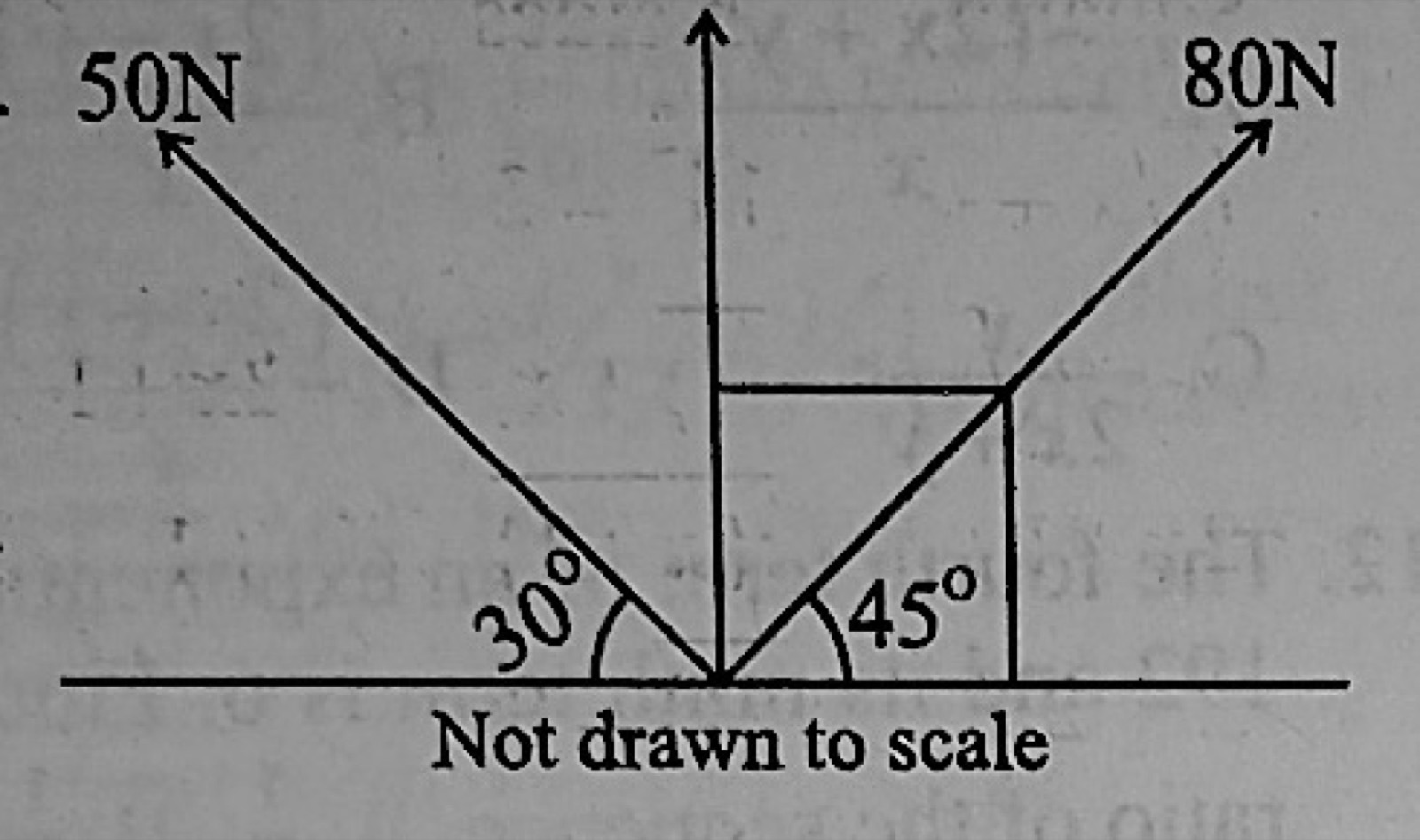
Answer: A (13N)
Horizontal: 80 cos 45° − 50 cos 30° = 56.57 − 43.30 = 13.27 ≈ 13 N.
The sales of five sales girls on a certain day are as follows: GH¢26.00, GH¢39.00, GH¢33.00, GH¢25.00, GH¢37.00. Calculate the standard deviation if the mean sale is GH¢32.00.
Answer: B (GH¢5.66)
Deviations −6, 7, 1, −7, 5; squares add to 160. SD = √(160/5) = √32 ≈ 5.66.
A circular ink blot on a piece of paper increases its area at the rate of 4 mm2/s. Find the rate of increase of the radius of the blot when the radius is 8 mm. [Take π = 22/7].
Answer: C (0.08 mm/s)
dA/dt = 2πr × dr/dt, so dr/dt = 4/(2 × 22/7 × 8) = 7/88 ≈ 0.08 mm/s.
Express (x2 + x + 4)/((1 − x)(x2 + 1)) in partial fractions.
Answer: B (3/(1 − x) + (2x + 1)/(x2 + 1))
Write A/(1 − x) + (Bx + C)/(x² + 1). x = 1 gives 6 = 2A, A = 3; comparing x² terms, 1 = 3 − B so B = 2; constants, 4 = 3 + C so C = 1.
Two bodies of masses 3kg and 5kg moving with velocities 2 ms−1 and V ms−1 respectively in opposite directions collide. If they move together after collision with velocity 3.5 ms−1 in the direction of the 5kg mass, find the value of V.
Answer: B (6.8 ms−1)
Taking the 3 kg body's direction as positive: 3(2) − 5V = 8(−3.5), so 6 − 5V = −28 and V = 6.8.
The equation of a circle is x2 + y2 − 8x + 9y + 15 = 0. Find its radius.
Answer: C (½√85)
Centre (4, −9/2); r² = 16 + 81/4 − 15 = 85/4, so r = ½√85.
A particle is acted upon by two forces 6N and 3N inclined at an angle of 120° to each other. Find the magnitude of the resultant force.
Answer: D (3√3 N)
R² = 6² + 3² + 2(6)(3) cos 120° = 45 − 18 = 27, so R = 3√3 N.
If s = 3i − j and t = 2i + 3j, find (t + 3s) · (t − 3s).
Answer: A (−77)
t + 3s = 11i + 0j and t − 3s = −7i + 6j. Dot product = 11(−7) + 0(6) = −77.
If 2sin2 θ = 1 + Cos θ, 0° ≤ θ ≤ 90°, find θ.
Answer: C (60°)
2(1 − cos²θ) = 1 + cos θ gives 2cos²θ + cos θ − 1 = 0, so cos θ = ½ (or −1). θ = 60°.
Find the upper quartile of the following scores: 41, 29, 17, 2, 12, 33, 45, 18, 21, 43 and 5.
Answer: B (41)
In order: 2, 5, 12, 17, 18, 21, 29, 33, 41, 43, 45. The upper quartile is the ¾(11 + 1) = 9th score, 41.
Given that P = (3 4 / 2 x), Q = (1 3 / −2 4), R = (−5 25 / −8 26) and PQ = R, find the value of x. (Matrices written row by row; / separates the rows.)
Answer: D (5)
PQ = (−5 25 / 2 − 2x 6 + 4x). So 2 − 2x = −8 (and 6 + 4x = 26), giving x = 5.
Two out of 10 tickets on sale for a raffle draw are winning tickets. If a guest bought two tickets, what is the probability that both tickets are winning ticket?
Answer: B (1/45)
P = 2/10 × 1/9 = 1/45.
P and Q are the points (3, 1) and (7, 4) respectively. Find the unit vector along PQ. (Column vectors written as (x, y).)
Answer: C ((0.8, 0.6))
PQ = (7 − 3, 4 − 1) = (4, 3) and |PQ| = 5, so the unit vector is (0.8, 0.6).
If g(x) = (x + 1)/(x + 2), (x ≠ −2), find g−1(2).
Answer: D (−3)
Solve (x + 1)/(x + 2) = 2: x + 1 = 2x + 4, so x = −3.
Calculate the mean deviation of 1, 2, 3, 4, 5, 5, 6, 7, 8, 9.
Answer: A (2)
Mean = 50/10 = 5. The absolute deviations 4, 3, 2, 1, 0, 0, 1, 2, 3, 4 add to 20, so MD = 20/10 = 2.
If V = (−2, 4) and U = (−1, 5) (column vectors), find |U + V|.
Answer: A (3√10)
U + V = (−3, 9), |U + V| = √(9 + 81) = √90 = 3√10.
Find the equation of the straight line that passes through (2, −3) and perpendicular to the line 3x − 2y + 4 = 0.
Answer: C (3y + 2x + 5 = 0)
The given line has gradient 3/2, so the perpendicular has gradient −2/3: 3(y + 3) = −2(x − 2), i.e. 3y + 2x + 5 = 0.
If nC3/nP2 = 1, find the value of n.
Answer: A (8)
ⁿC₃ ÷ ⁿP₂ = [n!/(3!(n − 3)!)] × [(n − 2)!/n!] = (n − 2)/6 = 1, so n = 8.
A body is kept at rest by three forces F1 = (10N, 030°), F2 = (10N, 150°) and F3. Find F3.
Answer: B ((10 N, 270°))
F₃ must equal −(F₁ + F₂). As bearings, F₁ + F₂ = 10 N due east, so F₃ = (10 N, 270°). (Measuring angles from the x-axis instead, F₁ + F₂ = 10 N at 90° and F₃ is again at 270°.)
(a) If the coefficient of x2 and x3 in the expansion of (p + qx)7 are equal, express q in terms of p.
(b) A man makes a weekly contribution into a fund. In the first week, he paid ₦180.00, second week ₦260.00, third week ₦340.00 and so on. How much would he have contributed in 16 weeks?
(a) Coefficient of x² = ⁷C₂p⁵q² = 21p⁵q²; of x³ = ⁷C₃p⁴q³ = 35p⁴q³.
21p⁵q² = 35p⁴q³ gives q = 21p/35 = (3/5)p.
(b) A.P. with a = 180, d = 80, n = 16.
S₁₆ = (16/2)[2(180) + 15(80)] = 8 × 1560 = ₦12,480.00.
The general term of (p + qx)ⁿ is ⁿCᵣ pⁿ⁻ʳ(qx)ʳ.
Calculate the gradient of the curve x3 + y3 − 2xy = 11 at the point (2, −1).
Differentiate implicitly: 3x² + 3y²(dy/dx) − 2y − 2x(dy/dx) = 0.
dy/dx = (2y − 3x²)/(3y² − 2x).
At (2, −1): (−2 − 12)/(3 − 4) = 14.
Differentiate xy with the product rule.
A side of a rectangle is three times the other. If the perimeter increases by 2%, find the percentage increase in the area of the rectangle.
Sides x and 3x: perimeter 8x, area 3x².
A 2% increase in perimeter (same shape) makes each side 1.02 times as long.
New area = 3(1.02x)² = 1.0404 × 3x².
Percentage increase in area = 4.04%.
Area scales as the square of the length factor.
The line 2y = x + 3 meets the circle x2 + y2 − 2x + 6y − 15 = 0 at point M and N, where N is in the first quadrant. Find the coordinates of M and N.
Substitute x = 2y − 3: (2y − 3)² + y² − 2(2y − 3) + 6y − 15 = 0.
5y² − 10y = 0, so y = 0 or y = 2.
y = 0: x = −3; y = 2: x = 1.
N = (1, 2) (first quadrant), M = (−3, 0).
Solve the line and circle simultaneously.
Three school prefects are to be chosen from four girls and five boys. What is the probability that: (a) Only boys will be chosen; (b) more girls than boys will be chosen?
Total selections ⁹C₃ = 84.
(a) ⁵C₃ = 10, P = 10/84 = 5/42.
(b) 3 girls: ⁴C₃ = 4; 2 girls and 1 boy: ⁴C₂ × ⁵C₁ = 30. P = 34/84 = 17/42.
Count favourable selections with combinations.
The table shows the distribution of ages of 22 students in a school.
Age (years): 12 − 14, 15 − 17, 18 − 20, 21 − 23, 24 − 26
Freq.: 6, 10, 3, 2, 1
Using an assumed mean of 19, calculate, correct to three significant figures, the: (a) mean age; (b) standard deviation of the distribution.
Class marks 13, 16, 19, 22, 25; d = x − 19 = −6, −3, 0, 3, 6.
Σfd = −36 − 30 + 0 + 6 + 6 = −54; Σfd² = 216 + 90 + 0 + 18 + 36 = 360.
(a) Mean = 19 + (−54/22) = 16.5 years (16.545).
(b) SD = √(360/22 − (54/22)²) = √(16.364 − 6.025) = √10.339 = 3.22.
Use class marks and the coded deviations d = x − 19.
The initial velocity of a particle of mass 0.1 kg is 40 ms−1 in the direction of the unit vector j. The velocity of the particle changed to 30 ms−1 in the direction of the unit vector i. Find the change in momentum.
Initial momentum = 0.1(40j) = 4j; final = 0.1(30i) = 3i.
Change = 3i − 4j (N s).
Magnitude = √(9 + 16) = 5 kg m s⁻¹.
Momentum is a vector: subtract the initial from the final.
A stone is dropped vertically downwards from the top of a tower of height 45m with a speed of 20 ms−1. Find the: (a) time it takes to reach the ground; (b) speed with which it hits the ground. [Take g = 10 ms−2]
(a) s = ut + ½gt²: 45 = 20t + 5t², so t² + 4t − 9 = 0.
t = −2 + √13 ≈ 1.61 s.
(b) v² = u² + 2gs = 400 + 900 = 1300, v ≈ 36.06 ms⁻¹.
Take downwards as positive; u = 20 and g = 10 both act downwards.
(a) Differentiate (x2 + 1)/(x + 1)2 with respect to x.
(b)(i) Evaluate the determinant (1 2 −1 / 2 3 −1 / −1 1 3) (rows separated by /).
(ii) Using the answer in 9(b)(i), solve the system of equations: x + 2y − z = 4; 2x + 3y − z = 2; −x + y + 3z = −1.
(a) Quotient rule: [2x(x + 1)² − 2(x + 1)(x² + 1)]/(x + 1)⁴ = [2x(x + 1) − 2(x² + 1)]/(x + 1)³ = 2(x − 1)/(x + 1)³.
(b)(i) Δ = 1(9 + 1) − 2(6 − 1) − 1(2 + 3) = −5.
(ii) Cramer's rule: Δₓ = 25, Δᵧ = −15, Δ_z = 15.
x = 25/−5 = −5, y = −15/−5 = 3, z = 15/−5 = −3.
Check the solution in all three equations.
(a) Using a scale of 2 cm to 30° on the x-axis and 2 cm to 0.2 units on the y-axis, on the same graph sheet, draw the graphs of y = sin 2x and y = cos x for 0° ≤ x ≤ 210° at intervals of 30°.
(b) Using the graphs in 10(a), find the truth set of: (i) sin 2x = 0; (ii) sin 2x − cos x = 0.
(a) x: 0, 30, 60, 90, 120, 150, 180, 210
sin 2x: 0, 0.87, 0.87, 0, −0.87, −0.87, 0, 0.87
cos x: 1, 0.87, 0.5, 0, −0.5, −0.87, −1, −0.87
Plot both smooth curves on the same axes.
(b)(i) Where y = sin 2x crosses the x-axis: x = 0°, 90°, 180°.
(ii) Where the curves meet: x = 30°, 90°, 150°.
The truth set in (ii) is where the two curves intersect.
(a) The sum of the first three terms of a decreasing exponential sequence (GP) is equal to 7 and the product of these three terms is equal to 8. Find the: (i) common ratio; (ii) first three terms of the sequence.
(b) Using the trapezium rule with ordinates at x = 1, 2, 3, 4 and 5, calculate, correct to two decimal places, the value of ∫15 (x + 2/x2) dx.
(a) Let the terms be a/r, a, ar. Product a³ = 8, so a = 2.
2/r + 2 + 2r = 7 gives 2r² − 5r + 2 = 0, r = ½ or 2. Decreasing: (i) r = ½.
(ii) 4, 2, 1.
(b) y = 3, 2.5, 3.2222, 4.125, 5.08 at x = 1 to 5; h = 1.
Area ≈ ½(3 + 5.08) + 2.5 + 3.2222 + 4.125 = 13.89.
Writing the terms as a/r, a, ar makes the product easy.
(a) Find the maximum and minimum points of the curve y = 2x3 − 3x2 − 12x + 4.
(b) Sketch the curve in 12(a) above.
(a) dy/dx = 6x² − 6x − 12 = 6(x − 2)(x + 1) = 0, so x = 2 or −1.
d²y/dx² = 12x − 6: at x = −1 it is −18 (maximum), at x = 2 it is 18 (minimum).
Maximum point (−1, 11); minimum point (2, −16).
(b) Cubic rising from the left to (−1, 11), down through (0, 4) to (2, −16), then rising again.
Use the second derivative to tell the maximum from the minimum.
The table gives the relationship between the height, in meters, of a plant and the number of days it is left to grow.
Number of days (x): 10, 20, 30, 40, 50, 60, 70, 80
Height (y): 1.0, 1.1, 1.2, 1.4, 1.6, 1.8, 2.0, 2.3
(a) Using a scale of 2cm to represent 0.5 units on the y-axis and 2 cm to represent 10 units on the x-axis, draw a scatter diagram for the information. (b) Find x̄ the mean of x, and ȳ the mean of y, and plot (x̄, ȳ) on the diagram. (c) Draw the line of best fit to pass through (x̄, ȳ) and (10, 1). (d) From the graph, find the: (i) equation of the line of best fit; (ii) height of plant in 75 days.
(a) Plot the eight points (10, 1.0) … (80, 2.3).
(b) x̄ = 360/8 = 45; ȳ = 12.4/8 = 1.55. Plot (45, 1.55).
(c) Straight line through (10, 1) and (45, 1.55).
(d)(i) Gradient = 0.55/35 ≈ 0.0157; y = 0.0157x + 0.843 (about y = 0.016x + 0.84).
(ii) At x = 75: y ≈ 2.02 m.
Read values from your line, or use its equation.
(a) A bag contains 5 blue, 4 green and 3 yellow balls. All the balls are identical except for colour. Three balls are drawn at random without replacement. Find the probability that: (i) all three balls have the same colour; (ii) two balls have the same colour.
(b) The table shows the ranks of the marks scored by 7 candidates in Physics and Chemistry tests.
Physics: 6, 5, 4, 3, 2, 7, 1
Chemistry: 7, 6, 2, 4, 1, 5, 3
Calculate the Spearman's rank correlation coefficient.
(a) ¹²C₃ = 220 selections.
(i) ⁵C₃ + ⁴C₃ + ³C₃ = 10 + 4 + 1 = 15; P = 15/220 = 3/44.
(ii) Exactly two the same: ⁵C₂ × 7 + ⁴C₂ × 8 + ³C₂ × 9 = 70 + 48 + 27 = 145; P = 145/220 = 29/44.
(b) d = −1, −1, 2, −1, 1, 2, −2; Σd² = 16.
ρ = 1 − 6(16)/(7(49 − 1)) = 1 − 96/336 = 0.714.
Spearman: ρ = 1 − 6Σd²/(n(n² − 1)).
(a) The probability that a man wins a race is 0.8. In four different races, what is the probability that he wins: (i) all races; (ii) no race; (iii) at most 3 races?
(b) A class consists of 5 girls and 10 boys. If a committee of 5 is chosen at random from the class find the probability that: (i) 3 boys are selected; (ii) at least one girl is selected.
(a) p = 0.8, q = 0.2, n = 4.
(i) 0.8⁴ = 0.4096. (ii) 0.2⁴ = 0.0016. (iii) 1 − 0.4096 = 0.5904.
(b) ¹⁵C₅ = 3003.
(i) ¹⁰C₃ × ⁵C₂ = 120 × 10 = 1200; P = 1200/3003 = 400/1001 ≈ 0.400.
(ii) No girl: ¹⁰C₅ = 252; P(at least one girl) = 1 − 252/3003 = 131/143 ≈ 0.916.
'At least one' is 1 minus 'none'.
(a) Three vectors a, b and c are (8, 3), (6, −5) and (2, 3) (column vectors) respectively. Find the vector d such that |d| = √41 and d is in the direction of a + b − 2c.
(b) The coordinates of A and B are (3, 4) and (3, n) respectively. If O is the origin and ∠AOB = 30°, find, correct to 2 decimal places, the values of n.
(a) a + b − 2c = (10, −8), magnitude √164 = 2√41.
d = √41 × (10, −8)/(2√41) = (5, −4).
(b) OA·OB = 9 + 4n = |OA||OB| cos 30° = 5√(9 + n²)(√3/2).
Square: 4(9 + 4n)² = 75(9 + n²) gives 11n² − 288n + 351 = 0.
n = (288 ± √67500)/22: n = 24.90 or n = 1.28.
Use the dot product for the angle between two vectors.
(a) A particle is under the action of forces P = (4N, 030°) and R = (10N, 300°). Find the force that will keep the particle in equilibrium.
(b) A train travelling at 45 ms−1 is brought to rest after covering a distance of 1500m. Find the: (i) time taken to come to rest; (ii) uniform retardation.
(a) East/north components: P = (2, 3.464), R = (−8.660, 5).
Resultant = (−6.660, 8.464). The equilibrant is (6.660, −8.464).
Magnitude = √(44.36 + 71.64) = 10.77 N; bearing = 180° − tan⁻¹(6.660/8.464) = 141.8°.
Force = (10.77 N, 141.8°).
(b)(i) s = ½(u + v)t: 1500 = 22.5t, t = 66.7 s.
(ii) 0 = 45² + 2a(1500), a = −0.675; retardation 0.675 ms⁻².
The equilibrant is equal and opposite to the resultant.
The displacement S metres of the particle from a fixed point O at time t seconds is given by S = t2 − 6t + 5.
(a) On a graph sheet, draw a displacement-time graph for the interval 0 ≤ t ≤ 6.
(b) From the graph, find the: (i) time at which the velocity is zero; (ii) average velocity over the interval 0 ≤ t ≤ 4; (iii) total distance covered in the interval 0 ≤ t ≤ 5.
(a) t: 0, 1, 2, 3, 4, 5, 6; S: 5, 0, −3, −4, −3, 0, 5. Plot a smooth U-shaped curve.
(b)(i) Velocity is zero at the lowest point, t = 3 s.
(ii) (S(4) − S(0))/4 = (−3 − 5)/4 = −2 ms⁻¹.
(iii) From S = 5 to −4 (9 m) then back to 0 (4 m): 13 m.
Distance counts both directions; displacement does not.