The Traffic in Persons Prohibition and Administration Act was passed in Nigeria in
A.December 2001.
B.October 2002.
C.August 2003.
D.April 2004.
Show the answer and explanation
Answer: C (August 2003.)
Explanation
The Trafficking in Persons (Prohibition) Law Enforcement and Administration Act was enacted in 2003 and NAPTIP began work in August 2003; it was replaced by a new Act in 2015.
Naturalized citizens cannot be denied their legal status as members of a country unless if they
A.are jailed for one year within seven years of acquiring citizenship.
B.are found guilty to be spies or secret agents for another country.
C.refuse to represent the country in an international sporting event.
D.give adequate information to the host country.
Show the answer and explanation
Answer: B (are found guilty to be spies or secret agents for another country.)
Explanation
Citizenship by naturalization can be withdrawn for disloyalty such as spying for another country. (Under s.30 of the 1999 Constitution a prison term of three years or more within seven years can also lead to deprivation, so option A's one year is not enough.)
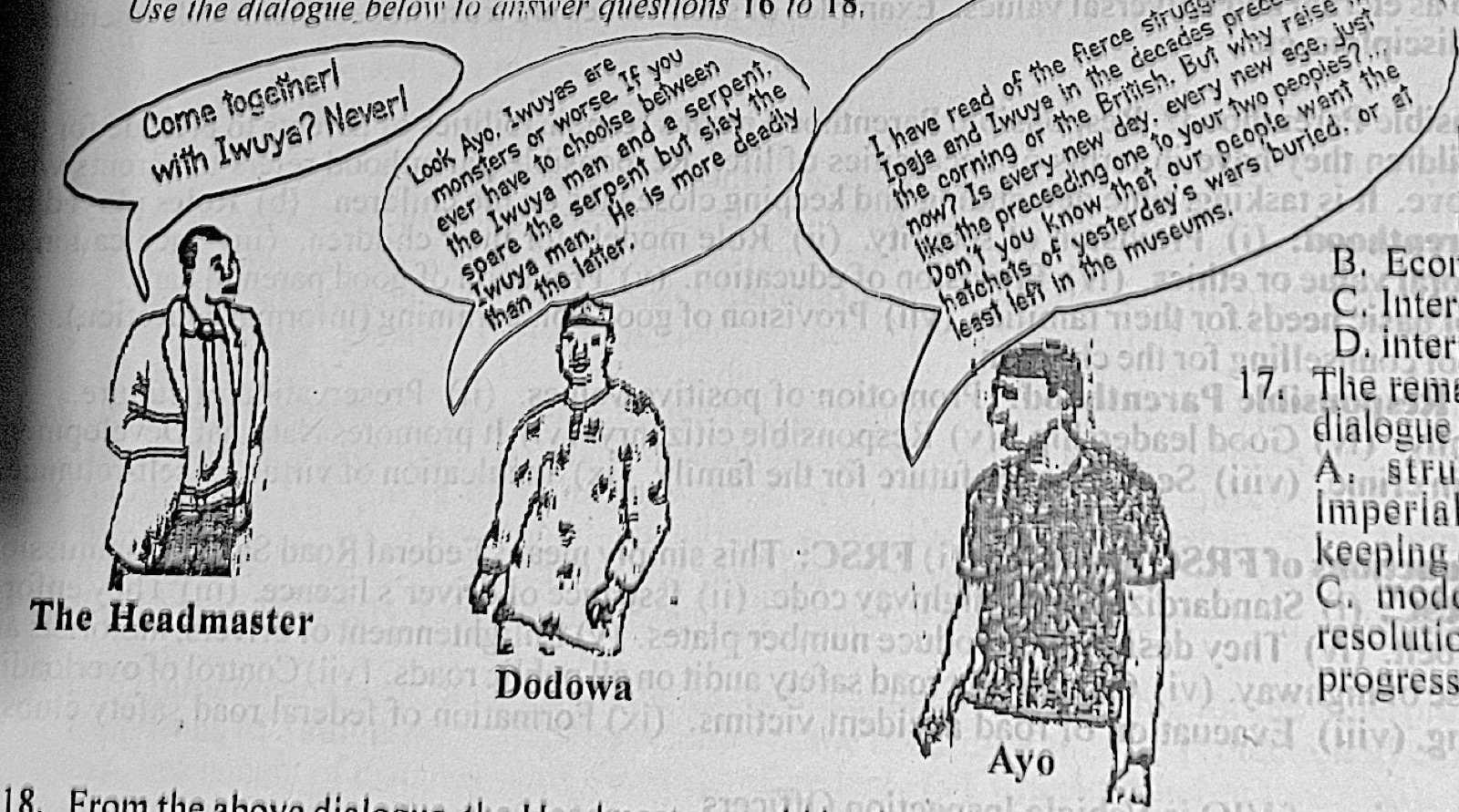
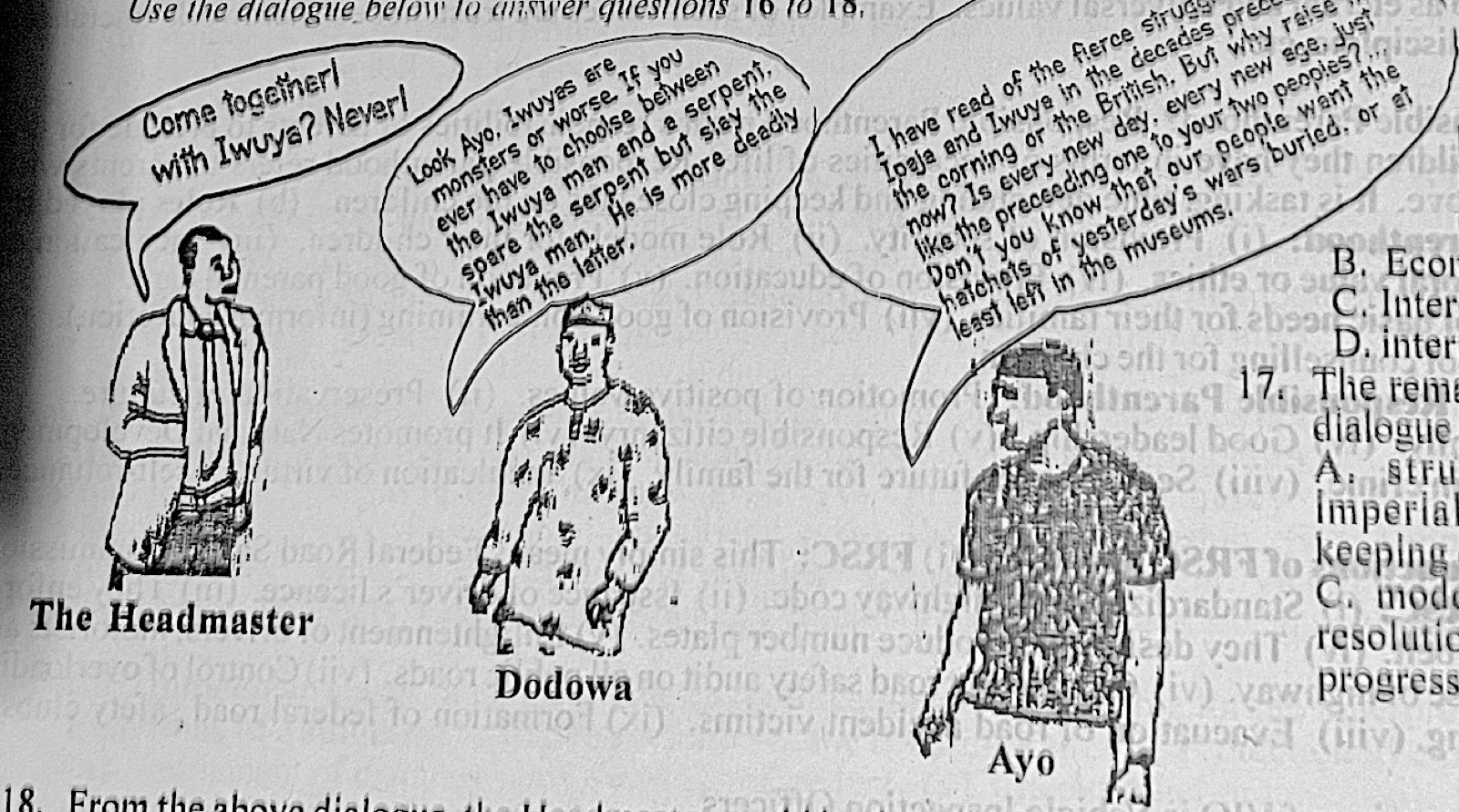
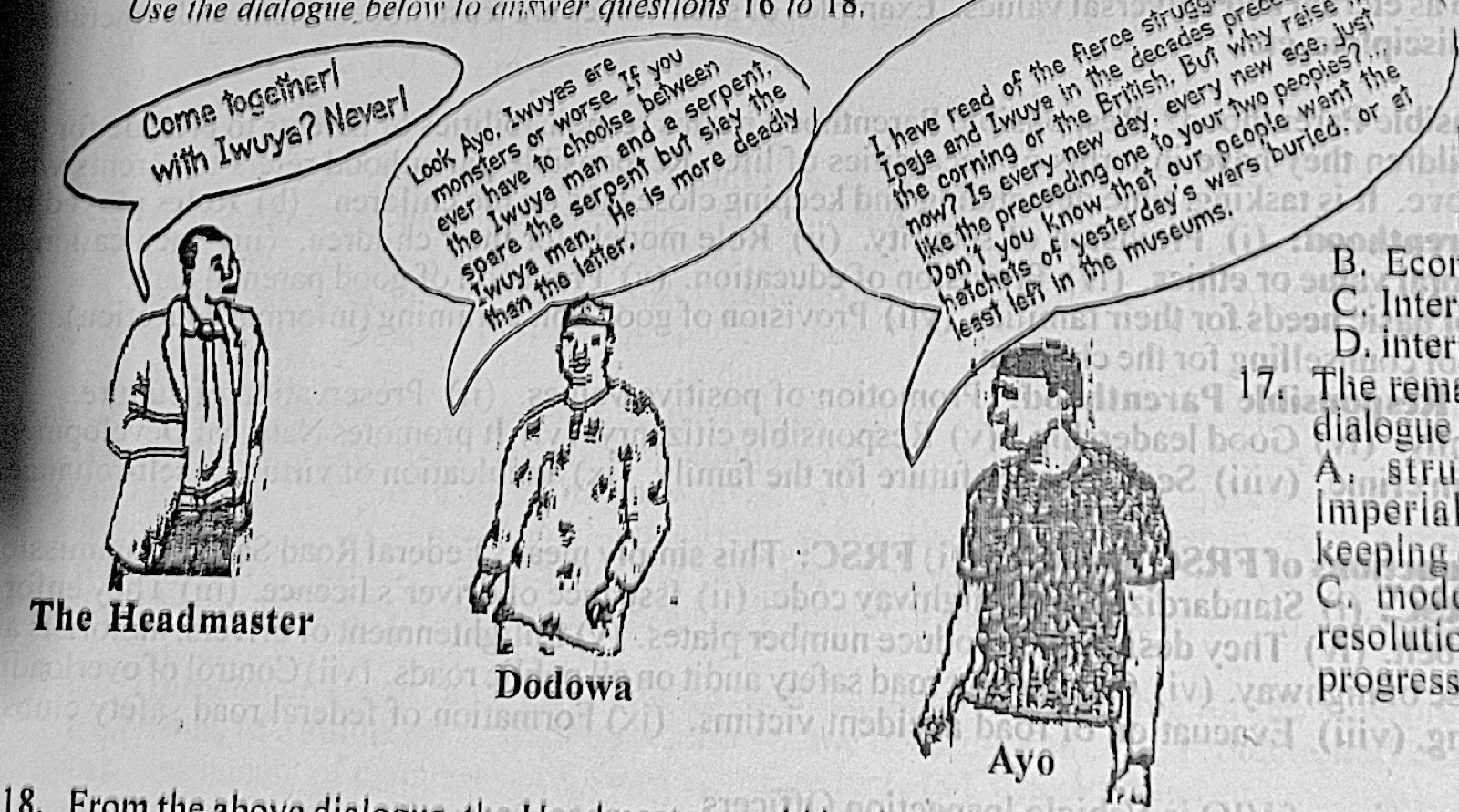
The Headmaster: Come together! with Iwuya? Never! Dodowa: Look Ayo, Iwuyas are monsters or worse. If you ever have to choose between the Iwuya man and a serpent, spare the serpent but slay the Iwuya man. He is more deadly than the latter. Ayo: I have read of the fierce struggle between Ipaja and Iwuya in the decades preceeding the coming of the British. But why raise it now? Is every new day, every new age, just like the preceeding one to your two peoples? Don't you know that our people want the hatchets of yesterday's wars buried, or at least left in the museums.
Which of the following is a consequence of lack of under-standing between the Iwuya and Ipaja?
A.Intra-communal conflict
B.Economic dislocation
C.Inter-communal feud
D.interpersonal violence
Show the answer and explanation
Answer: C (Inter-communal feud)
Explanation
Iwuya and Ipaja are two different communities with a long history of fighting: an inter-communal feud.
Oh Motherland, you were a precious country, a beacon of hope and aspiration as well as toga of pride of your citizens at independence. However, today you are bedeviled with evil, engulfed in darkness and to say the obvious, at the edge of total moral collapse. Corruption, fraud, deception and dishonesty are prevalent; drug peddlers are having a field day. In schools and colleges, radicalism, prostitution, cultism, examination malpractice among other social vices are order of the day.
The motherland in the monologue could best be described as
A.a nation in transition.
B.a morally upgrading country.
C.a socially viable nation.
D.an ethically bankrupt country.
Show the answer and explanation
Answer: D (an ethically bankrupt country.)
Explanation
The monologue says the country is at the edge of total moral collapse: ethically bankrupt.
Dr. Fajir was the Minister of Works and Urban Development in the Ganiba Republic. As such, he was entrusted with the public fund so that his ministry could construct new roads and rehabilitate the existing ones. Unfortunately, Dr. Fajir embezzled the money entrusted in his care and siphoned same to his foreign accounts. This led to the deplorable conditions of roads in the Republic. The Crime Commission arrested and prosecuted him accordingly. Subsequently, he was given the opportunity to be defended by lawyers of his choice in a Court of Law. However, he was found guilty and sentenced to 15 years imprisonment with hard labour without the option of a fine. In addition, he forfeited all his ill-gotten wealth to the Republic.
Dr. Fajir cannot exercise some basic rights because he
A.was a suspect in a criminal case.
B.was found guilty of a criminal offence.
C.failed to comply with court order.
D.embezzled public fund.
Show the answer and explanation
Answer: B (was found guilty of a criminal offence.)
Explanation
Rights such as personal liberty can be lawfully restricted only after a court convicts a person; a suspect keeps his rights.
According to the above story, the open trial of Dr. Fajir and his representation by lawyers of his choice in a court of competent jurisdiction is an indication of
A.respect for habeas corpus.
B.freedom of expression.
C.respect for human rights.
D.freedom of legal representation.
Show the answer and explanation
Answer: C (respect for human rights.)
Explanation
A public trial with a lawyer of one's choice is the right to fair hearing, showing respect for human rights.
Section A: National Ethics, Discipline, Rights and Obligations (a) State four significance of contentment in the Nigerian society. (b) Mention three negative effects of lack of contentment on the society.
Show the model answer
Model answer
(a) Any four: Reduces corruption, embezzlement and fraud. Reduces crime (robbery, kidnapping, cybercrime). Promotes peace and harmony; reduces envy and conflicts. Encourages hard work and dignity of labour. Promotes honesty and self-respect. Good national image. (b) Any three: Corruption and fraud (e.g. advance fee fraud). Crime such as robbery and kidnapping. Envy, unhealthy rivalry and conflict. Materialism and living beyond one's means. Retarded national development and bad image.
Explanation
Contentment means being satisfied with what one lawfully has.
Section A: National Ethics, Discipline, Rights and Obligations Explain five nationalistic roles expected of individuals in the society.
Show the model answer
Model answer
Any five, explained: Placing national interest above personal or ethnic interest. Obeying laws and respecting constituted authority. Paying taxes and rates. Voting and taking part in politics. Defending the nation and its unity; reporting acts of sabotage. Fighting corruption and exposing wrongdoing. Patronising made-in-Nigeria goods. Respecting national symbols (flag, anthem, pledge). Constructive criticism of government policies.
Section A: National Ethics, Discipline, Rights and Obligations (a) Define national consciousness. (b) State four ways of promoting national consciousness.
Show the model answer
Model answer
(a) National consciousness is a strong feeling of belonging to and loyalty to one's country, putting its interest above ethnic, religious or personal interests. (b) Any four: Citizenship/civic education in schools. Respect for national symbols (anthem, pledge, flag). Programmes like NYSC and unity schools. Fair treatment and equal opportunity for all groups. Good, exemplary leadership. Public enlightenment by NOA and the mass media. Patronage of made-in-Nigeria goods; national festivals and sports.
Section B: Emerging Issues in the Society (a) Define Youth empowerment. (b) List three youth empowerment skills. (c) State three efforts of government towards youth empowerment.
Show the model answer
Model answer
(a) Youth empowerment is the process of giving young people skills, knowledge, resources and opportunities to become self-reliant and contribute to society. (b) Any three: tailoring/fashion design; hairdressing/barbing; ICT/computer skills; carpentry; welding; farming/agriculture; catering; shoe-making; vehicle repairs. (c) Any three (as at 2016): National Directorate of Employment (NDE) skills programmes; SURE-P graduate internship scheme; YouWiN! business plan competition; N-Power (2016); NYSC Skill Acquisition and Entrepreneurship Development (SAED); Bank of Industry/SMEDAN loans; vocational and technical schools.
Section B: Emerging Issues in the Society (a) State four preventive measures for HIV/AIDS. (b) Mention three ways by which HIV/AIDS can be managed.
Show the model answer
Model answer
(a) Any four: Abstinence from sex / faithfulness to one uninfected partner. Correct use of condoms. Screening of blood before transfusion. Use of sterile needles and sharp objects; no sharing of razors. Prevention of mother-to-child transmission (PMTCT). Public enlightenment on HIV/AIDS. (b) Any three: Taking antiretroviral drugs regularly. Eating a balanced diet. Regular medical check-ups and counselling. Rest, exercise and avoiding alcohol and drugs. Love and support from family; avoiding stigmatisation.
Section B: Emerging Issues in the Society (a) State two functions of the National Drug Law Enforcement Agency (NDLEA). (b) Outline three functions of the National Agency for Food and Drug Administration and Control (NAFDAC).
Show the model answer
Model answer
(a) Any two NDLEA functions: Arrests and prosecutes drug traffickers. Seizes and destroys illegal drugs; destroys cannabis farms. Controls drug smuggling at airports, seaports and borders. Enlightenment and rehabilitation of drug users. (b) Any three NAFDAC functions: Registers and regulates food, drugs, cosmetics, chemicals and water. Controls manufacture, import, export and sale of these products. Seizes and destroys fake, expired and substandard products. Inspects factories and shops; tests products in laboratories. Educates the public on safe use of regulated products.
Section C: Governmental System and Processes (a) List three features of the 1999 Constitution of Nigeria. (b) Highlight four significance of the 1999 Constitution of Nigeria.
Show the model answer
Model answer
(a) Any three: Federal system with 36 states, FCT and 774 local governments. Presidential system of government. Bicameral National Assembly. Separation of powers and checks and balances. Fundamental human rights (Chapter IV). Fundamental objectives and directive principles (Chapter II). Federal character principle. Multi-party system; independent electoral commission. Rigid: amendment needs special majorities. (b) Any four: It is the supreme law; any law inconsistent with it is void. It brought back civilian, democratic rule in 1999. It protects citizens' rights. It sets out the powers of each arm and tier of government. It provides for national unity (federal character). It provides the framework for elections and peaceful change of government.
Explanation
Features describe the document; significance says why it matters.
Section C: Governmental System and Processes (a) Define representative democracy. (b) State three reasons Nigeria adopts representative democracy. (c) List three factors that retard the growth of democracy in Nigeria.
Show the model answer
Model answer
(a) Representative (indirect) democracy is a system in which the people elect representatives in periodic elections to make laws and govern on their behalf. (b) Any three: Nigeria's large population makes direct democracy impossible. Large size of the country. Complexity of modern government needs full-time representatives. Ensures every constituency/group is represented. Promotes accountability through periodic elections. (c) Any three: Corruption. Electoral malpractice and violence. Political apathy. Illiteracy and poverty. Ethnicity and religious bigotry. Weak institutions; history of military rule. Poor leadership / godfatherism.
Section C: Governmental System and Processes (a) State four importance of public service in Nigeria. (b) List three ways by which public service can be improved in the country.
Show the model answer
Model answer
(a) Any four: Implements government policies and programmes. Advises ministers on policy. Provides continuity of government when governments change. Delivers public services (health, education, etc.). Keeps government records and data. Collects revenue. Provides employment. (b) Any three: Recruitment and promotion on merit. Training and retraining of staff. Good pay and welfare. Use of modern technology. Discipline and punishment of corruption. Political neutrality.