Home › Past questions › JAMB › Physics › 2013 44 questions. Try each one, then open the answer to check yourself and read the explanation.
Sign up free to answer these questions on a CBT screen with a timer, then see your score and every answer explained.
Start practising free
Question 2 Gravitational Field When a brick is taken from the earth's surface to the moon, its mass
A. remains constant. B. reduces. C. increases. D. becomes zero. Show the answer and explanation Answer: A (remains constant. )
Explanation Mass is the amount of matter in a body and does not depend on where it is. Only its weight changes on the moon.
Open this question
Question 3 Scalars and Vectors The resultant of two forces is 50N. If the forces are perpendicular to each other and one of them makes an angle of 30° with the resultant, find its magnitude.
A. 100.0N. B. 57.7N. C. 43.3N. D. 25.0N. Show the answer and explanation Answer: C (43.3N. )
Explanation Two perpendicular forces are the components of the resultant. The one at 30° to the resultant is 50 cos 30° ≈ 43.3 N.
Open this question
Question 4 Scalars and Vectors The pair of physical quantities that are scalar only are
A. volume and area. B. moment and momentum. C. length and displacement. D. impulse and time. Show the answer and explanation Answer: A (volume and area. )
Explanation Volume and area have size only. Moment, momentum, displacement and impulse all have a direction, so they are vectors.
Open this question
Question 5 Simple Harmonic Motion A simple pendulum of length 0.4m has a period of 2s. What is the period a similar pendulum of length 0.8m at the same place?
A. 8s. B. 4s. C. 2√2s. D. √2s. Show the answer and explanation Answer: C (2√2s. )
Explanation T ∝ √L. Doubling the length multiplies the period by √2: T = 2√2 s.
Open this question
Question 6 Motion A train with an initial velocity of 20ms−1 is subjected to a uniform deceleration of 2m−2 . The time required to bring the train to a complete halt is
A. 5s. B. 10s. C. 20s. D. 40s. Show the answer and explanation Answer: B (10s. )
Explanation t = (v − u)/a = (0 − 20) ÷ (−2) = 10 s.
Open this question
Question 7 Newton's Laws and Momentum Calculate the apparent weight loss of a man weighing 70kg in an elevator moving downwards with an acceleration of 1.5ms−2 . [g = 10ms−2 ]
A. 686N. B. 595N. C. 581N. D. 105N. Show the answer and explanation Answer: D (105N. )
Explanation Apparent weight = m(g − a) = 70 × 8.5 = 595 N, compared with a true weight of 700 N. The loss is ma = 70 × 1.5 = 105 N.
Open this question
Question 8 Density and Upthrust A piece of cork floats in a liquid. What fraction of its volume will be immersed in the liquid? [Density of the cork = 0.25 × 10³ kgm−3 , density of the liquid = 1.25 × 10³ kgm−3 ]
A. 0.8. B. 0.5. C. 0.2. D. 0.1. Show the answer and explanation Answer: C (0.2. )
Explanation For a floating body, fraction immersed = density of body ÷ density of liquid = 0.25 ÷ 1.25 = 0.2.
Open this question
Question 9 Work, Energy and Power An object is moving with a velocity of 5ms−1 . At what height must a similar body be situated to have a potential energy equal in value with kinetic energy of the moving body?
A. 25.0m. B. 20.0m. C. 1.3m. D. 1.0m. Show the answer and explanation Answer: C (1.3m. )
Explanation mgh = ½mv2 , so h = v2 /2g = 25 ÷ 20 = 1.25 m ≈ 1.3 m (g = 10 m s−2 ).
Open this question
Question 10 Work, Energy and Power If a pump is capable of lifting 5000 kg of water through a vertical height of 60 m in 15 min, the power of the pump is
A. 2.5 × 10⁵ Js−1 B. 2.5 × 10⁴ Js−1 C. 3.3 × 10³ Js−1 D. 3.3 × 10² Js−1 Show the answer and explanation Answer: C (3.3 × 10³ Js−1 )
Explanation Power = mgh/t = 5000 × 10 × 60 ÷ (15 × 60) ≈ 3333 W = 3.3 × 10³ J s−1 .
Open this question
Question 11 Friction The coefficient of friction between two perfectly smooth surface is
A. infinity. B. one. C. half. D. zero. Show the answer and explanation Answer: D (zero. )
Explanation Perfectly smooth surfaces give no friction at all, so the coefficient of friction is zero.
Open this question
Question 12 Simple Machines What effort will a machine of efficiency 90% apply to lift a load of 180N if its efforts arm is twice as long as its load arm?
A. 80N. B. 90N. C. 100N. D. 120N. Show the answer and explanation Answer: C (100N. )
Explanation VR = effort arm ÷ load arm = 2. MA = 0.9 × 2 = 1.8. Effort = 180 ÷ 1.8 = 100 N.
Open this question
Question 13 Elasticity Calculate the work done when a force of 20N stretches a spring by 50mm.
A. 0.5J. B. 1.5J. C. 2.0J. D. 2.5J. Show the answer and explanation Answer: A (0.5J. )
Explanation Work done in stretching = ½Fe = ½ × 20 × 0.05 = 0.5 J.
Open this question
Question 14 Pressure At what depth below the sea-level would one experience a change of pressure equal to one atmosphere? [Density of sea water = 1013kgm−3 one atmosphere = 1.01 × 10⁵ Nm−2 g = 10ms−2 ]
A. 0.1m. B. 1.0m. C. 10.0m. D. 100.0m. Show the answer and explanation Answer: C (10.0m. )
Explanation p = hρg, so h = p/(ρg) = 1.01 × 10⁵ ÷ (1013 × 10) ≈ 10 m.
Open this question
Question 16 Temperature and Thermometers Calculate the length which corresponds to a temperature of 20°C if the ice and steam points of an ungraduated thermometer are 400 mm apart.
A. 20mm. B. 30mm. C. 60mm. D. 80mm. Show the answer and explanation Answer: D (80mm. )
Explanation 100°C corresponds to 400 mm, so 1°C is 4 mm and 20°C is 20 × 4 = 80 mm above the ice point.
Open this question
Question 17 Thermal Expansion A wire of length 100.0m at 30°C has linear expansivity of 2 × 10⁻⁵ K−1 . Calculate the length of the wire at a temperature of −10°C.
A. 100.08m. B. 100.04m. C. 99.96m. D. 99.92m. Show the answer and explanation Answer: D (99.92m. )
Explanation Change in length = αLΔθ = 2 × 10−5 × 100 × (−40) = −0.08 m. New length = 100 − 0.08 = 99.92 m.
Open this question
Question 18 Gas Laws A gas at a pressure of 105 Nm−2 expands from 0.6m3 to 1.2m3 at constant temperature, the work done is
A. 7.0 × 10⁶ J. B. 6.0 × 10⁶ J. C. 6.0 × 10⁵ J. D. 6.0 × 10⁴ J. Show the answer and explanation Answer: D (6.0 × 10⁴ J. )
Explanation Taking the pressure as constant, work done = pΔV = 105 × (1.2 − 0.6) = 6.0 × 10⁴ J.
Open this question
Question 19 Quantity of Heat Two liquids X and Y having the same mass are supplied with the same quantity of heat. If the temperature rise in X is twice that of Y, the ratio of specific heat capacity of X to that of Y is
A. 2:1. B. 1:2. C. 4:1. D. 1:4. Show the answer and explanation Answer: B (1:2. )
Explanation Q = mcΔθ is the same for both, so c is inversely proportional to Δθ. X rises twice as much, so cX : cY = 1 : 2.
Open this question
Question 20 Change of State and Vapours Foods cook quicker in salt water than in pure water because of the effect of
A. dissolved substances on the boiling point. B. atmospheric pressure on the boiling point. C. food nutrients on the thermal energy. D. salts on the thermal conductivity of water. Show the answer and explanation Answer: A (dissolved substances on the boiling point. )
Explanation Dissolved salt raises the boiling point of water, so salt water boils at a higher temperature and food cooks faster.
Open this question
Question 22 Change of State and Vapours What will happen to the boiling point of pure water when it is heated in a place 30m below sea level?
A. It will be more than 100°C. B. It will be less than 100°C. C. It will still be at 100°C. D. It will be fluctuating. Show the answer and explanation Answer: A (It will be more than 100°C. )
Explanation Below sea level the atmospheric pressure is greater than normal, and a higher pressure raises the boiling point above 100°C.
Open this question
Question 23 Structure of Matter and Kinetic Theory The rise or fall of a liquid in a narrow tube is because of the
A. viscosity of the liquid. B. surface tension of the liquid. C. friction between the walls of the tube and the liquid. D. osmotic pressure of the liquid. Show the answer and explanation Answer: B (surface tension of the liquid. )
Explanation Capillary rise or fall is caused by surface tension together with the adhesion between the liquid and the tube.
Open this question
Question 24 Heat Transfer The mechanism of heat transfer from one point to another through the vibration of the molecules of the medium is
A. convection. B. conduction. C. radiation. D. diffusion. Show the answer and explanation Answer: B (conduction. )
Explanation In conduction the molecules vibrate about fixed positions and pass energy on to their neighbours, without the medium itself flowing.
Open this question
Question 25 Waves A wave that travels through stretched strings is known as
A. electromagnetic wave. B. micro wave. C. mechanical wave. D. seismic wave. Show the answer and explanation Answer: C (mechanical wave. )
Explanation A wave on a string needs the material of the string to carry it, so it is a mechanical wave.
Open this question
Question 26 Waves A transverse wave and a longitudinal wave travelling in the same direction in a medium differ essentially in their
A. frequency. B. amplitude. C. direction of vibration of the particles of the medium. D. period of vibration of the particles of the medium. Show the answer and explanation Answer: C (direction of vibration of the particles of the medium. )
Explanation In a transverse wave the particles vibrate at right angles to the direction of travel; in a longitudinal wave they vibrate along it.
Open this question
Question 27 Sound What is the velocity of sound at 100°C if the velocity of sound at 0°C is 340ms−1 ?
A. 497m−1 B. 440m−1 C. 397m−1 D. 240m−1 Show the answer and explanation Answer: C (397m−1 )
Explanation The speed of sound is proportional to the square root of the absolute temperature: v = 340 × √(373/273) ≈ 340 × 1.17 ≈ 397 m s−1 .
Open this question
Question 28 Sound If a sonometer has a fundamental frequency of 450Hz, what is the frequency of the fifth overtone?
A. 2700Hz. B. 456Hz. C. 444Hz. D. 75Hz. Show the answer and explanation Answer: A (2700Hz. )
Explanation A stretched string gives all harmonics; the fifth overtone is the sixth harmonic: 6 × 450 = 2700 Hz.
Open this question
Question 29 Light and Reflection A man 1.5m tall is standing 3m in front of a pinhole camera whose distance between the hole and the screen is 0.1m. What is the height of the image of the man on the screen?
A. 0.05m. B. 0.15m. C. 0.30m. D. 1.00m. Show the answer and explanation Answer: A (0.05m. )
Explanation Image height = object height × image distance ÷ object distance = 1.5 × 0.1 ÷ 3 = 0.05 m.
Open this question
Question 30 Light and Reflection A ray of light passing through the centre of curvature of a concave mirror is reflected by the mirror at
A. 0°. B. 45°. C. 90°. D. 180°. Show the answer and explanation Answer: A (0°. )
Explanation A ray through the centre of curvature travels along a radius, so it meets the mirror along the normal (angle of incidence 0°) and is reflected straight back at 0°.
Open this question
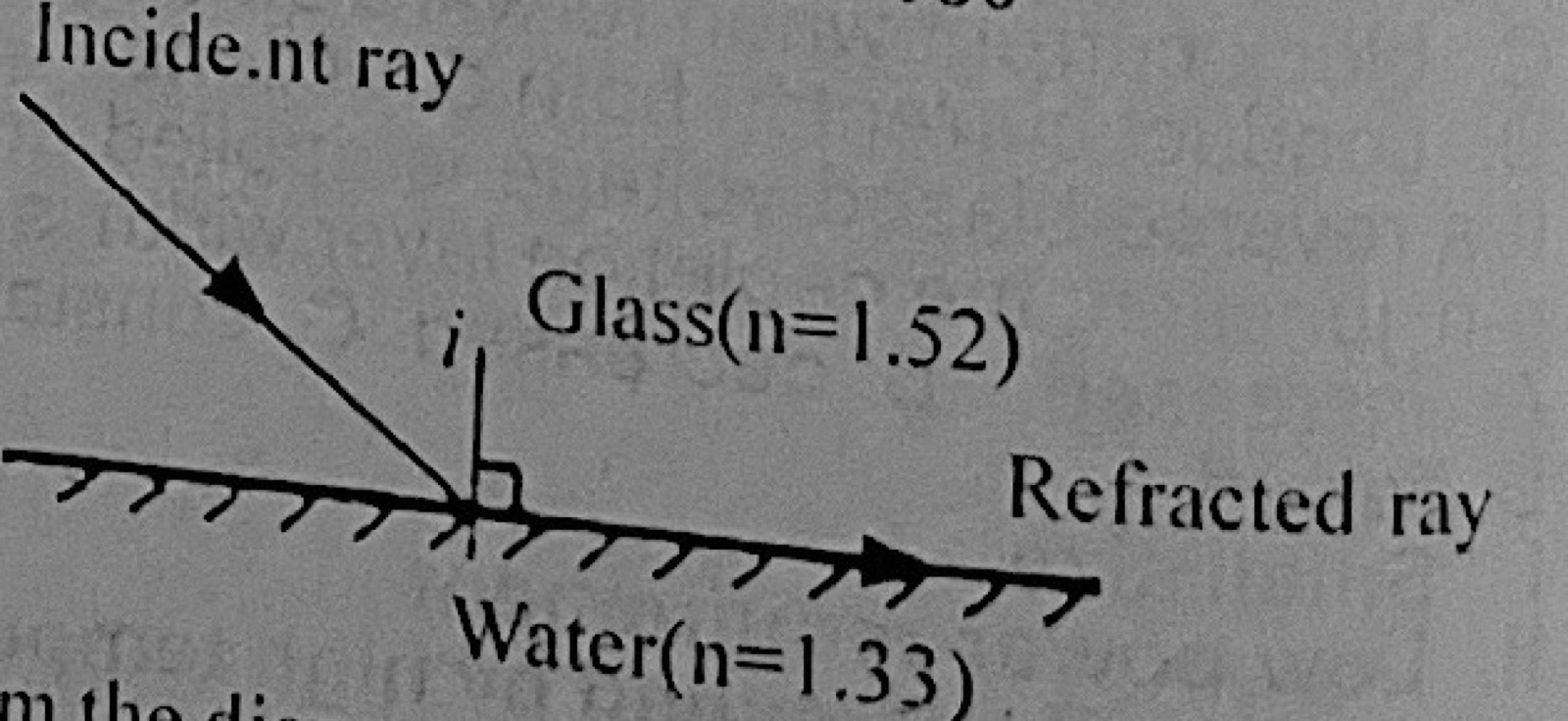
Question 31 Refraction of Light From the diagram above, calculate the incident angle i.
A. 41°. B. 49°. C. 55°. D. 61°. Show the answer and explanation Answer: D (61°. )
Explanation The refracted ray runs along the boundary, so i is the critical angle for glass to water: sin i = 1.33 ÷ 1.52 ≈ 0.875, giving i ≈ 61°.
Open this question
Question 32 Refraction of Light Total internal reflection will not occur when light travels from
A. water to air. B. water into glass. C. glass to air. D. glass into water. Show the answer and explanation Answer: B (water into glass. )
Explanation Total internal reflection can only happen when light goes from a denser to a less dense medium. Water into glass is less dense to denser, so it cannot occur.
Open this question
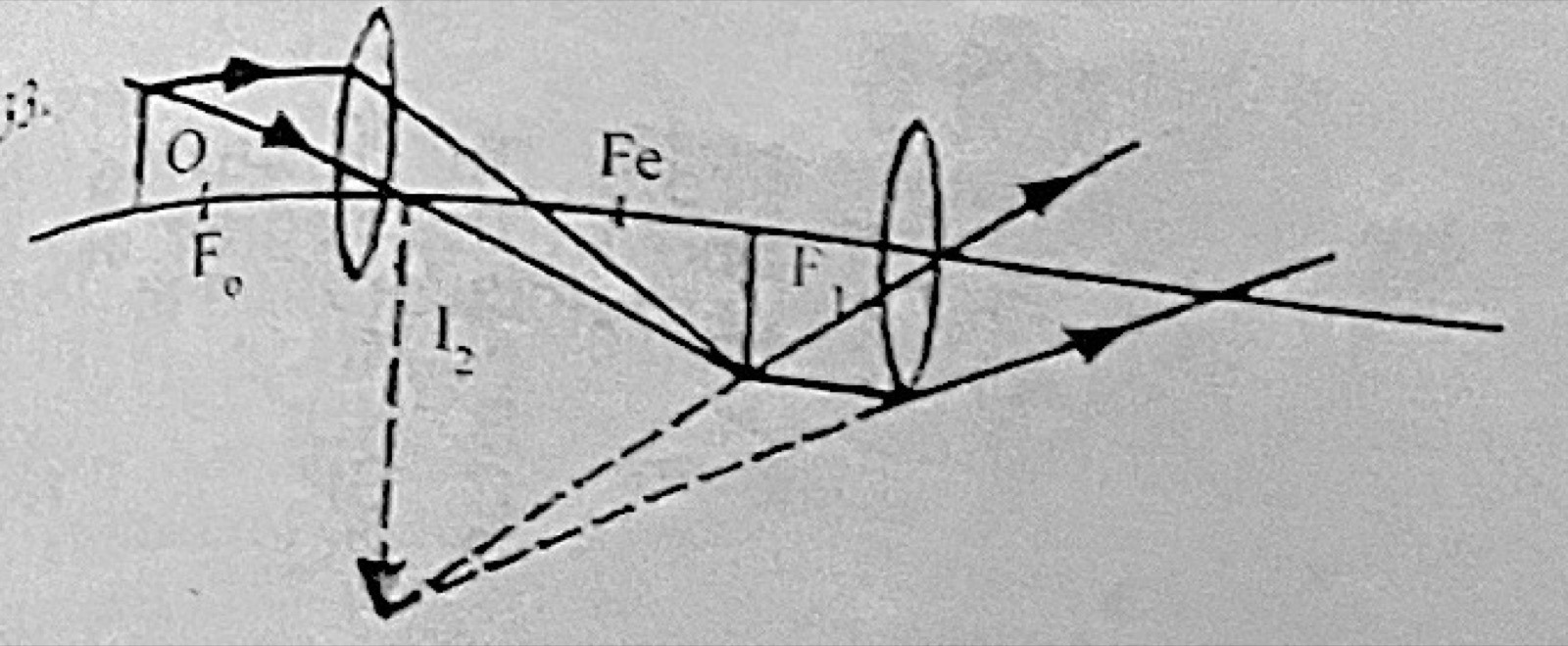
Question 33 Lenses and Optical Instruments What does the diagram above represent?
A. telescope in normal use. B. microscope in normal use. C. telescope in abnormal use. D. microscope in abnormal use. Show the answer and explanation Answer: B (microscope in normal use. )
Explanation The object sits just beyond the focal point Fo of the objective, which forms a real, magnified image inside the focus of the eyepiece. The eyepiece then gives a large virtual image I2 : a compound microscope used normally.
Open this question
Question 34 Lenses and Optical Instruments If the linear magnification of the objective and eyepiece convex lenses of a compound microscope are 4 and 7 respectively, calculate the angular magnification of the microscope.
A. 2. B. 3. C. 11. D. 28. Show the answer and explanation Answer: D (28. )
Explanation The total magnification of a compound microscope is the product of the two lens magnifications: 4 × 7 = 28.
Open this question
Question 35 Dispersion of Light and Colours The angle of deviation of light of various colours passing through a triangular prism increases in the order
A. red → green → blue. B. green → violet → blue. C. blue → red → green. D. blue → green → red. Show the answer and explanation Answer: A (red → green → blue. )
Explanation Red is deviated least and violet most, so the deviation increases from red to green to blue.
Open this question
Question 36 Electrostatics Calculate the force acting on an electron of charge 1.5 × 10⁻¹⁹ C placed in an electric field of intensity 105 Vm−1 .
A. 1.5 × 10⁻¹¹ N. B. 1.5 × 10⁻¹² N. C. 1.5 × 10⁻¹³ N. D. 1.5 × 10⁻¹⁴ N. Show the answer and explanation Answer: D (1.5 × 10⁻¹⁴ N. )
Explanation F = qE = 1.5 × 10−19 × 105 = 1.5 × 10⁻¹⁴ N.
Open this question
Question 37 Electromagnetic Induction Capacitors are used in the induction coil to
A. control circuits. B. dissipate energy. C. prevent electric sparks. D. prevent distortion of electric fields. Show the answer and explanation Answer: C (prevent electric sparks. )
Explanation The capacitor across the make-and-break contacts absorbs the surge when the circuit breaks, preventing sparking and making the current fall faster.
Open this question
Question 38 Current Electricity A cell of emf 1.5V is connected in series with a 1Ω resistor and a current of 0.3A flows through the resistor. Find the internal resistance of the cell.
A. 4.0Ω. B. 3.0Ω. C. 1.5Ω. D. 1.0Ω. Show the answer and explanation Answer: A (4.0Ω. )
Explanation E = I(R + r): 1.5 = 0.3(1 + r), so 1 + r = 5 and r = 4.0 Ω.
Open this question
Question 41 Electrical Energy and Power An electric device is rated 2000W, 250V. Calculate the maximum current it can take.
A. 9A. B. 8A. C. 7A. D. 6A. Show the answer and explanation Answer: B (8A. )
Explanation I = P/V = 2000 ÷ 250 = 8 A.
Open this question
Question 42 Electrostatics When a charge moves through an electric circuit in the direction of an electric force, it
A. gains both potential and kinetic energy. B. gains potential energy and loses kinetic energy. C. loses potential energy and gains kinetic energy. D. loses both potential and kinetic energy. Show the answer and explanation Answer: C (loses potential energy and gains kinetic energy. )
Explanation When a charge moves the way the electric force pushes it, the field does work on it: electrical potential energy is turned into kinetic energy.
Open this question
Question 43 Current Electricity To convert a galvanometer to a voltmeter, a
A. high resistance is connected to it in series. B. high resistance is connected to it in parallel. C. low resistance is connected to it in series. D. low resistance is connected to it in parallel. Show the answer and explanation Answer: A (high resistance is connected to it in series. )
Explanation A voltmeter must draw very little current, so a large resistance (multiplier) is put in series with the galvanometer.
Open this question
Question 44 Electromagnetic Induction Induced emfs are best explained using
A. Ohm's law. B. Faraday's law. C. Colomb's law. D. Lenz's law. Show the answer and explanation Answer: B (Faraday's law. )
Explanation Faraday's law says an e.m.f. is induced whenever the magnetic flux through a circuit changes, and its size equals the rate of change of flux. Lenz's law only adds the direction.
Open this question
Question 45 Conduction through Liquids and Gases If a current of 2.5A flows through an electrolyte for 3 hours and 1.8g of a substance is deposited, what is the mass of the substance that will be deposited if a current of 4A flows through it for 4.8 hours?
A. 2.4g. B. 3.2g. C. 4.6g. D. 4.8g. Show the answer and explanation Answer: C (4.6g. )
Explanation Mass ∝ It. m = 1.8 × (4 × 4.8) ÷ (2.5 × 3) = 1.8 × 19.2 ÷ 7.5 ≈ 4.6 g.
Open this question
Question 46 Modern Physics Calculate the energy of the third level of an atom if the ground state energy is −24.8eV
A. −9.20eV. B. −8.20eV. C. −2.75eV. D. −1.75eV. Show the answer and explanation Answer: C (−2.75eV. )
Explanation En = E1 /n2 , so E3 = −24.8 ÷ 9 ≈ −2.75 eV.
Open this question
Question 47 Modern Physics In photo-emission, the number of photoelectrons ejected per second depends on the
A. frequency of the beam. B. work function of the metal. C. threshold frequency of the metal. D. intensity of the beam. Show the answer and explanation Answer: D (intensity of the beam. )
Explanation Each photon can free one electron. A more intense beam carries more photons per second, so more photoelectrons are emitted per second.
Open this question
Question 48 Modern Physics The particle nature of light is demonstrated by the
A. photoelectric effect. B. speed of light. C. colours of light. D. diffraction of light. Show the answer and explanation Answer: A (photoelectric effect. )
Explanation The photoelectric effect can only be explained if light comes in packets (photons), which shows its particle nature. Diffraction is a wave effect.
Open this question
Question 49 Modern Physics The energy of a photon having a wavelength of 10−10 m is (h = 6.63 × 10⁻³⁴ Js c = 3.0 × 10⁸ ms−1 )
A. 2.0 × 10⁻¹⁵ J. B. 1.7 × 10⁻¹³ J. C. 2.0 × 10⁻¹² J. D. 1.7 × 10⁻¹² J. Show the answer and explanation Answer: A (2.0 × 10⁻¹⁵ J. )
Explanation E = hc/λ = 6.63 × 10−34 × 3.0 × 108 ÷ 10−10 ≈ 2.0 × 10⁻¹⁵ J.
Open this question Sign up free for every JAMB Physics year, practice by topic and timed mocks.
Start practising free