45 questions. Try each one, then open the answer to check yourself and read the explanation.
Question 2
Motion
Two cars moving in the same direction have speeds of 100 kmh−1 and 130 kmh−1. What is the velocity of the faster car as measured by an observer in the slower car?
A.130kmh−1
B.230 kmh−1
C.200kmh−1
D.30kmh−1
Show the answer and explanation
Answer: D (30kmh−1)
Explanation
For bodies moving in the same direction, the relative velocity is the difference of their speeds: 130 − 100 = 30 km h−1.
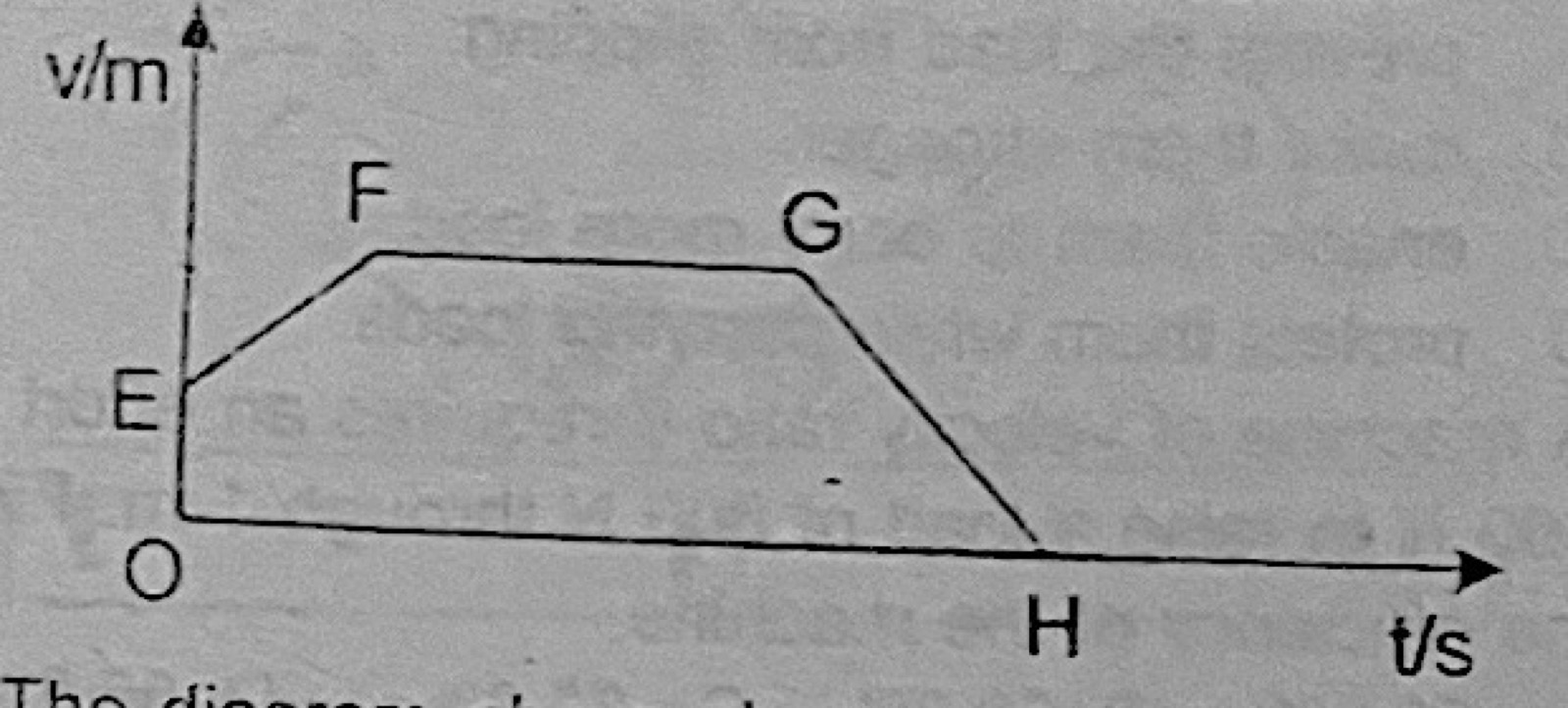
The diagram above shows a velocity-time graph. The statement that is true about this motion is that, the car
A.decelerates between points F and H.
B.accelerates between points F and G.
C.has a constant speed between points E and F.
D.has no acceleration between point F and G.
Show the answer and explanation
Answer: D (has no acceleration between point F and G.)
Explanation
Between F and G the graph is horizontal, so the velocity does not change and the acceleration is zero. E to F is acceleration and G to H is deceleration.
A bob of weight 0.1 N hangs from a massless string of length 50 cm. A variable horizontal force which increases from zero is applied to pull the bob until the string makes an angle of 60° with the vertical. The work done is
A.0.250 J.
B.0.025 J.
C.0.050 J.
D.0.500 J.
Show the answer and explanation
Answer: B (0.025 J.)
Explanation
The bob rises h = L(1 − cos 60°) = 0.5 × 0.5 = 0.25 m. Work done = gain in potential energy = 0.1 × 0.25 = 0.025 J.
In a hydraulic press, the pump piston exerts a pressure of 100 Pa on the liquid. What force is exerted in the second piston of cross-sectional area 3 m2?
A.200 N
B.100 N
C.150 N
D.300 N
Show the answer and explanation
Answer: D (300 N)
Explanation
Pressure is transmitted equally through the liquid, so F = pA = 100 × 3 = 300 N.
Two metals P and Q of lengths l1 and l2 are heated through the same temperature difference. If the ratio of the linear expansivities of P to Q is 2:3 and the ratio of their lengths is 3:4. What is the ratio of increase in lengths of P to Q?
A.5:7
B.2:1
C.1:2
D.7:5
Show the answer and explanation
Answer: C (1:2)
Explanation
Increase in length = αlΔθ. Ratio = (2/3) × (3/4) = 1/2, so 1 : 2.
The density of a certain oil on frying becomes 0.4 kgm−3 with a volume of 20 m3. What will be its initial volume when its initial density is 0.8 kgm−3 assuming no loss of oil due to spillage?
A.10 kgm−3
B.5 kgm−3
C.8 kgm−3
D.12 kgm−3
Show the answer and explanation
Answer: A (10 kgm−3)
Explanation
Mass = density × volume = 0.4 × 20 = 8 kg, and the mass does not change. Initial volume = 8 ÷ 0.8 = 10 m3.
Which of the following has no effect on radiation?
A.density
B.temperature
C.surface area
D.nature of the surface
Show the answer and explanation
Answer: A (density)
Explanation
The rate of radiation depends on the body's temperature, its surface area and the nature of its surface (dull black radiates best), not on its density.
During a thunderstorm, the sound is heard over a long time. This phenomenon is referred to as
A.refraction of sound
B.reverberation
C.superposition
D.diffraction of sound.
Show the answer and explanation
Answer: B (reverberation)
Explanation
The thunder is reflected many times by clouds, hills and buildings, and these overlapping reflections make the sound last a long time: reverberation (rolling of thunder).
An object is embedded in a block of ice, 10 cm below the plane surface. If the refractive index of the ice is 1.50, the apparent depth of the object below the surface is
A.6.77 cm.
B.7.63 cm.
C.7.50cm.
D.2.50cm.
Show the answer and explanation
Answer: A (6.77 cm.)
Explanation
Apparent depth = real depth ÷ refractive index = 10 ÷ 1.5 ≈ 6.67 cm, which is option A.
Three capacitors of capacitance, 2μF, 4μF and 8μF are connected in parallel and a p.d of 6 V is maintained across each capacitor, the total energy stored is
A.6.90 × 10−5 J.
B.6.90 × 10−4 J.
C.2.52 × 10−4 J.
D.2.52 × 10−6 J.
Show the answer and explanation
Answer: C (2.52 × 10⁻⁴ J.)
Explanation
In parallel C = 2 + 4 + 8 = 14 μF. Energy = ½CV2 = ½ × 14 × 10−6 × 62 = 2.52 × 10⁻⁴ J.
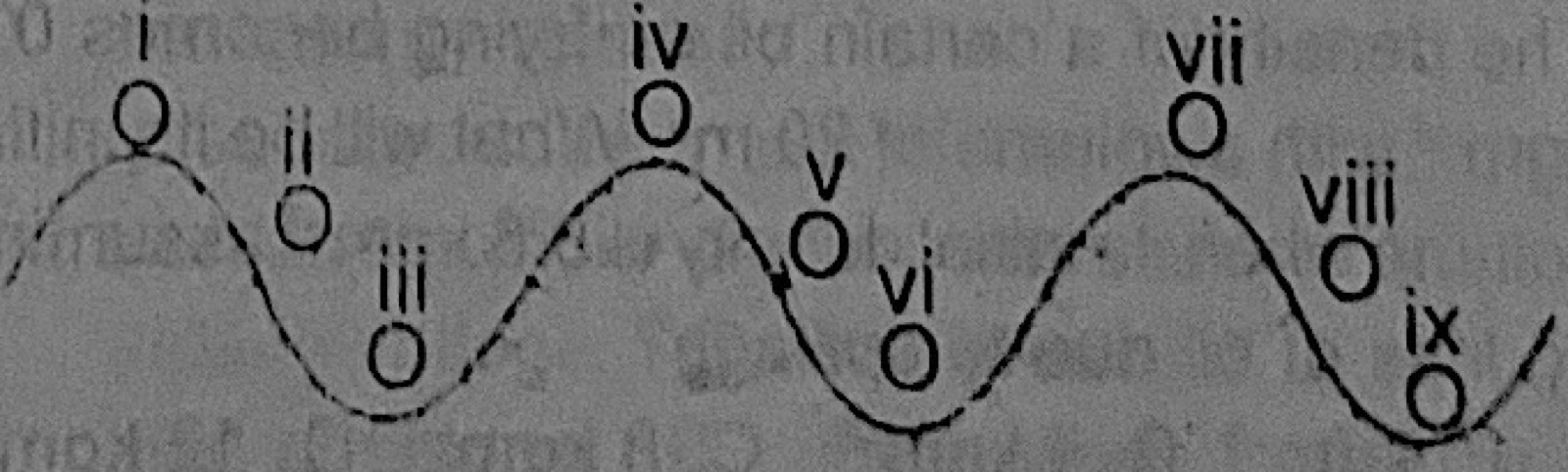
In the diagram above, if the south-poles of two magnets stroke a steel bar, the polarities at T and V will respectively be
A.north and south.
B.south and south.
C.north and north.
D.south and north.
Show the answer and explanation
Answer: C (north and north.)
Explanation
In the divided-touch method, each end of the bar where the stroke finishes gets the opposite polarity to the stroking pole. Both S poles finish at the ends T and V, so both become north poles.
A galvanometer with full-scale deflection of 10 mA is to be converted to a voltmeter with full-scale deflection of 5 V. If a series resistance of 498Ω is used for the conversion, the resistance of the galvanometer is
A.2 Ω.
B.10 Ω.
C.5 Ω.
D.1 Ω.
Show the answer and explanation
Answer: A (2 Ω.)
Explanation
At full scale V = I(Rg + R): 5 = 0.01 × (Rg + 498), so Rg + 498 = 500 and Rg = 2 Ω.
The radioisotope 23592U decays by emitting two alpha particles, three beta particles and a gamma ray. What is the mass and atomic numbers of the resulting daughter element?
A.91 and 227
B.92 and 238
C.227 and 91
D.215 and 88.
Show the answer and explanation
Answer: C (227 and 91)
Explanation
Two alphas remove 8 from the mass number and 4 from the atomic number; three betas add 3 to the atomic number; gamma changes neither. Mass number = 235 − 8 = 227, atomic number = 92 − 4 + 3 = 91.
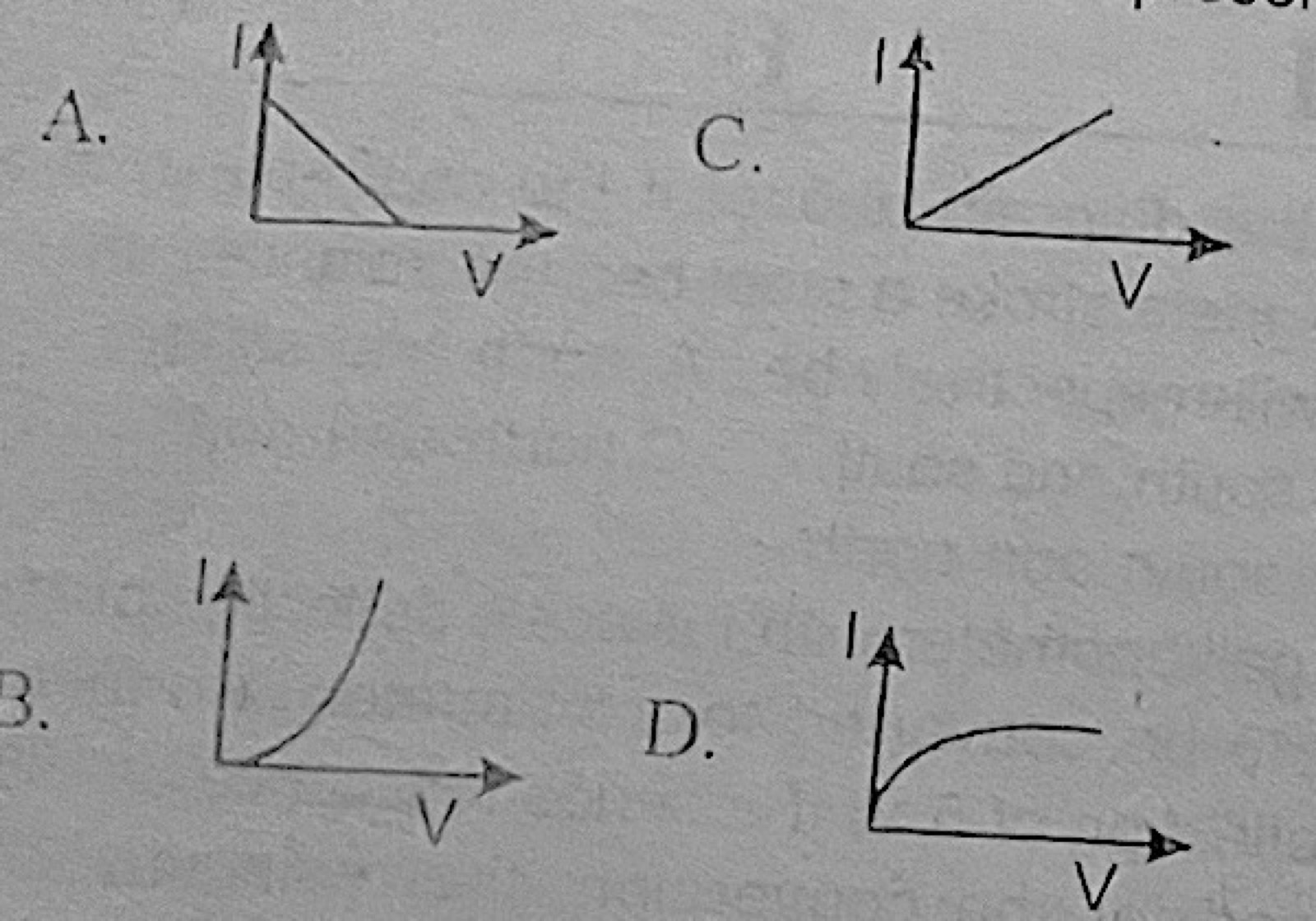
A typical transistor characteristic is represented as
A.A
B.B
C.C
D.D
Show the answer and explanation
Answer: D (D)
Explanation
The output characteristic of a transistor (collector current against collector voltage) rises quickly at first and then becomes almost flat, as in graph D.