I. Diameter of a small ball bearing. II. Thickness of a piece of paper. III. Diameter of a measuring cylinder. IV. Length of a piece of wire. Which of the above can be measured using a micrometer screw gauge?
A.I, II and IV only
B.I and II only
C.II and III only.
D.III and IV only
Show the answer and explanation
Answer: B (I and II only)
Explanation
A micrometer screw gauge measures very small lengths (to 0.01 mm), such as the diameter of a ball bearing or the thickness of paper. A measuring cylinder or a length of wire is too big for it.
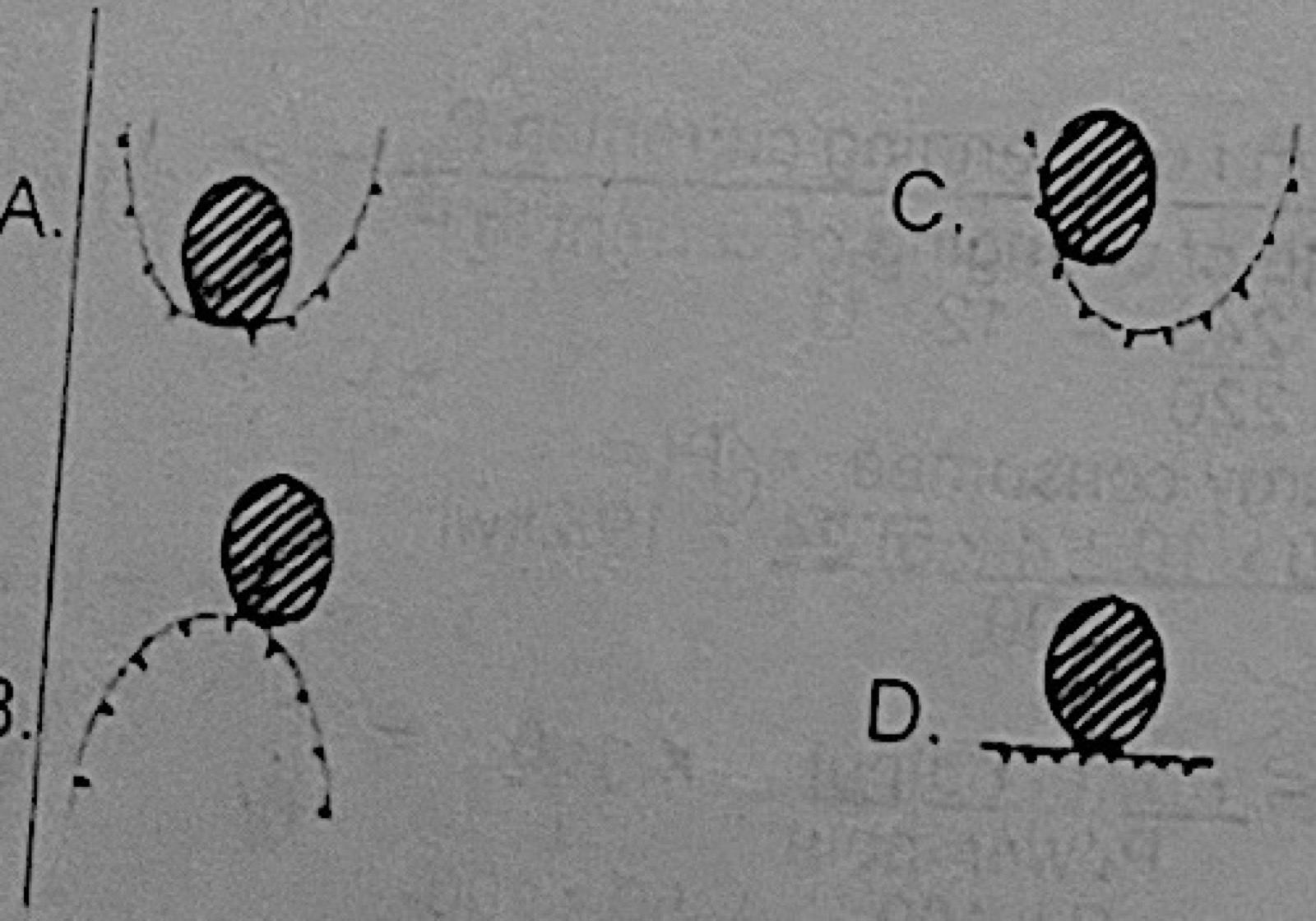
Which of the diagrams below shows the position at which a small ball-bearing is in neutral equilibrium?
A.A
B.B
C.C
D.D
Show the answer and explanation
Answer: D (D)
Explanation
On a flat surface (D) the ball stays at rest wherever it is moved, so it is in neutral equilibrium. At the bottom of a bowl it is stable; on top of a dome it is unstable.
A body of mass 12 kg travelling at 4.2 ms−1 collides with a second body of mass 18 kg at rest. Calculate their common velocity if the two bodies coalesce after collision.
A.1.5 ms−1.
B.1.4 ms−1.
C.2.1 ms−1.
D.1.7 ms−1.
Show the answer and explanation
Answer: D (1.7 ms−1.)
Explanation
Momentum is conserved: 12 × 4.2 = (12 + 18)v, so v = 50.4 ÷ 30 = 1.68 ≈ 1.7 m s−1.
A bullet fired vertically upward from a gun held 2.0 m above the ground reaches its maximum height in 4.0 s. Calculate its initial velocity. [g ≈ 10 ms−2]
A.10 ms−1.
B.8 ms−1.
C.40 ms−1.
D.20 ms−1.
Show the answer and explanation
Answer: C (40 ms−1.)
Explanation
At maximum height the velocity is zero: 0 = u − gt, so u = gt = 10 × 4.0 = 40 m s−1. The 2.0 m height of the gun does not matter.
I. The motion of the tyres of a moving car. II. The motion of a loaded test tube oscillating vertically. III. The beating of the heart. IV. A stone tied to a string and whirled round. V. The motion of the pistons in a gasoline engine. Which of the motions above is simple harmonic?
A.III, IV and V only
B.II, III and V only
C.II, III and IV only
D.I, II and III only
Show the answer and explanation
Answer: B (II, III and V only)
Explanation
A loaded test tube bobbing in water, the heartbeat and an engine piston all move to and fro about a fixed point, which is simple harmonic motion. Tyres and a whirled stone go round in circles (rotational/circular motion).
The terminal velocity of a ball-bearing falling through a viscous fluid is reached when the
A.upthrust is equal to the weight of the ball.
B.ball accelerates uniformly.
C.upthrust is equal to the velocity of the ball.
D.velocity is unform.
Show the answer and explanation
Answer: D (velocity is unform.)
Explanation
At terminal velocity the weight is balanced by upthrust plus viscous drag, so the resultant force is zero and the ball falls at a constant (uniform) velocity.
I. Density of the liquid. II. Acceleration due to gravity III. Type of container of the liquid IV. The constituents of the liquid. Which of the above conditions will NOT affect the pressure of fluids?
A.I and III only
B.II and III only
C.III and IV only
D.I and II only
Show the answer and explanation
Answer: C (III and IV only)
Explanation
Fluid pressure is p = hρg, so it depends on depth, density and g. It does not depend on the shape or type of container, or on what the liquid is made of apart from its density.
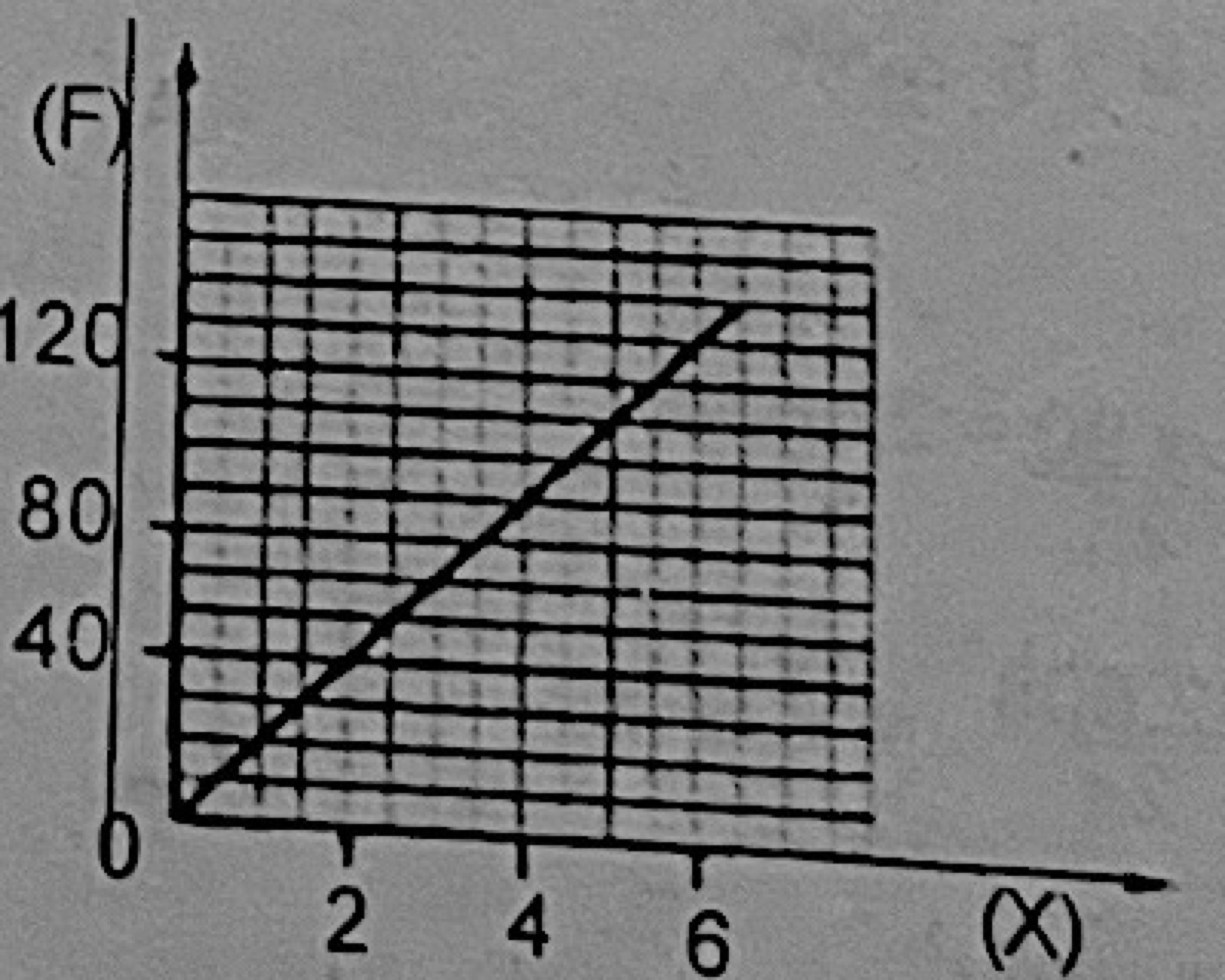
The diagram above represents the graph of the force (F) applied in stretching a spiral spring against the corresponding extension(X). The force constant of the spring is
A.20 Nm−1.
B.40 Nm−1.
C.30 Nm−1.
D.10 Nm−1.
Show the answer and explanation
Answer: A (20 Nm−1.)
Explanation
The force constant is the slope of the F–X graph. The line reaches F = 120 at X = 6, so k = 120 ÷ 6 = 20 N m−1 (for example 40 at 2).
A plastic sphere floats in water with 50% of its volume submerged. If it floats in glycerine with 40% of its volume submerged, the density of the glycerine is [density of water = 1000 kgm−3]
A.1400 kgm−3.
B.1250 kgm−3.
C.500 kgm−3.
D.1000 kgm−3.
Show the answer and explanation
Answer: B (1250 kgm−3.)
Explanation
The upthrust equals the same weight in both liquids: 1000 × 0.5V = ρ × 0.4V, so ρ = 500 ÷ 0.4 = 1250 kg m−3.
An electric heater rated 220 V, 1000 W is immersed into a bucket full of water. Calculate the mass of water if the temperature changes from 30°C to 100°C and the current flows for 300 seconds. [specific heat capacity of water = 4200 J kg−1 K−1]
A.4.28 kg.
B.42.86 kg.
C.1.02 kg.
D.7.14 kg.
Show the answer and explanation
Answer: C (1.02 kg.)
Explanation
Heat given = Pt = 1000 × 300 = 300 000 J = mcΔθ. m = 300 000 ÷ (4200 × 70) ≈ 1.02 kg.
A heating coil rated 1000 W is used to boil off completely 2 kg of boiling water. The time required to boil off the water is [specific latent heat of vaporization of water = 2.3 × 10⁶ Jkg−1]
A.1.15 × 104 s.
B.1.15 × 103 s.
C.4.6 × 104 s.
D.4.6 × 103 s.
Show the answer and explanation
Answer: D (4.6 × 10³ s.)
Explanation
Heat needed = mL = 2 × 2.3 × 106 = 4.6 × 10⁶ J. Time = 4.6 × 10⁶ ÷ 1000 = 4.6 × 10³ s.
It is observed that water will wet a clean glass because the
A.cohesion of water to glass is stronger than the cohesion of water molecules.
B.adhesion of water molecules is weaker than the cohesion of water to glass.
C.cohesion of water to glass is weaker than the cohesion of water molecules.
D.adhesion of water molecules is stronger than the cohesion of water molecules.
Show the answer and explanation
Answer: D (adhesion of water molecules is stronger than the cohesion of water molecules.)
Explanation
Water wets glass because the adhesion between water and glass molecules is stronger than the cohesion between water molecules, so water spreads over the glass.
A man standing 2 m from a charcoal fire is warmed mainly by
A.convection.
B.radiation.
C.refraction.
D.conduction.
Show the answer and explanation
Answer: B (radiation.)
Explanation
Hot air from the fire rises upwards (convection), and air conducts poorly, so the heat reaching a person standing beside the fire comes mainly by radiation.
Calculate the position of an object placed in front of a convex mirror having focal length of 12cm such that an image is formed 6cm away from the mirror.
A.4.0 cm.
B.3.0 cm.
C.12.0 cm.
D.9.0 cm.
Show the answer and explanation
Answer: C (12.0 cm.)
Explanation
With real-is-positive signs, f = −12 cm and v = −6 cm (virtual). 1/u = 1/f − 1/v = −1/12 + 1/6 = 1/12, so u = 12 cm.
A band of 500 rectangular loops of wire of area 20 cm by 20 cm, encloses a region of magnetic field which changes from 1.0T to 0.4T within 5 seconds, calculate the induced e.m.f.
A.5.60 V.
B.24.00 V.
C.0.24 V.
D.2.40 V.
Show the answer and explanation
Answer: D (2.40 V.)
Explanation
Area = 0.2 × 0.2 = 0.04 m2. E = NAΔB/Δt = 500 × 0.04 × 0.6 ÷ 5 = 2.4 V.
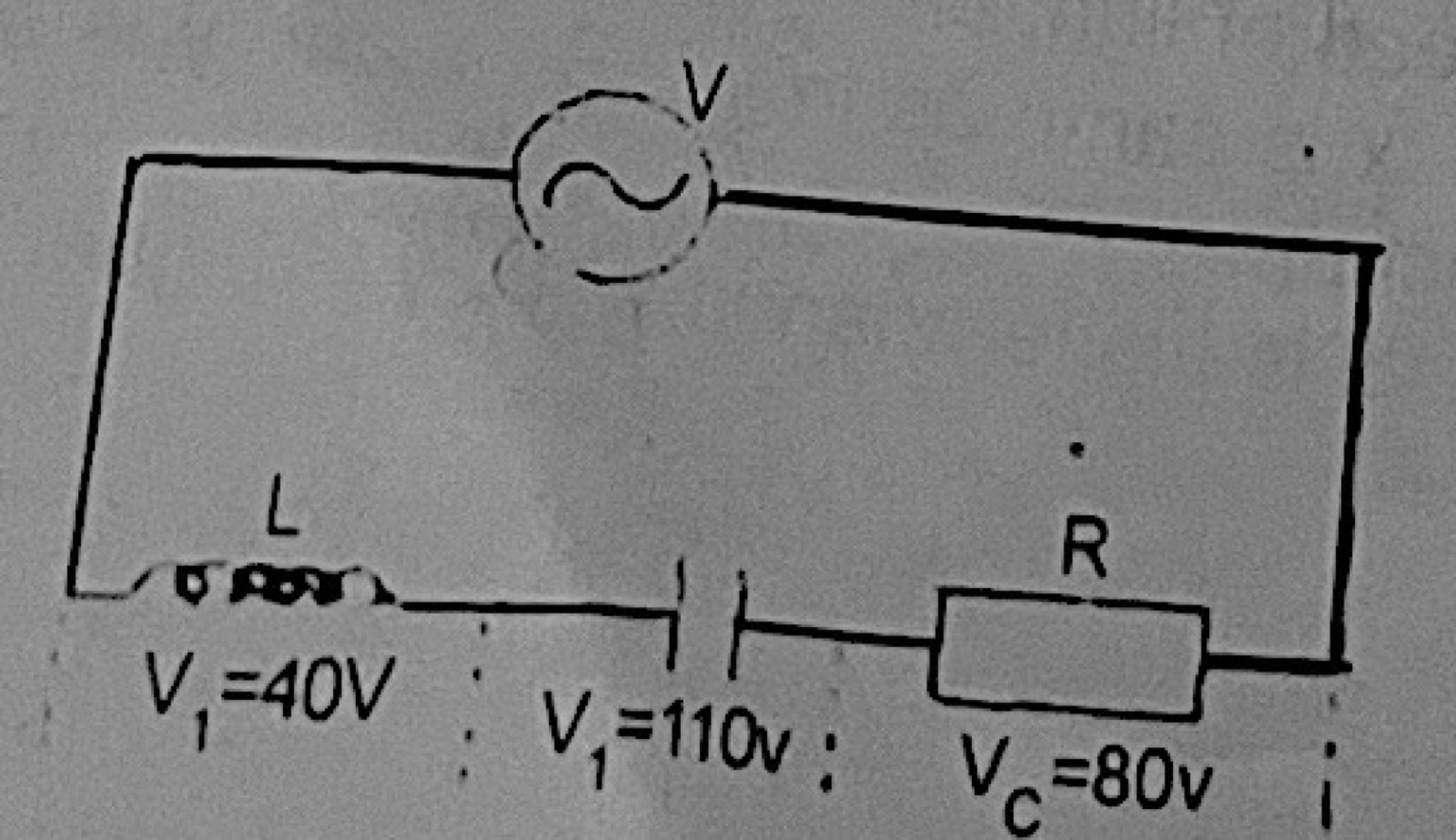
From the diagram above, if the potential difference across the resistor, capacitor and inductor are 80 V, 110 V and 40 V respectively, the effective potential difference is
A.116.3 V.
B.50.0 V.
C.230.0 V.
D.106.3 V.
Show the answer and explanation
Answer: D (106.3 V.)
Explanation
In a series a.c. circuit V = √(VR2 + (VC − VL)2) = √(802 + 702) = √11 300 ≈ 106.3 V.
A piece of radioactive material contains 1020 atoms. If the half-life of the material is 20 seconds, the number of disintegrations in the first second is