A body of mass 4 kg resting on a smooth horizontal plane is simultaneously acted upon by two perpendicular forces 6 N and 8 N. Calculate the acceleration of the motion.
A.2.5 ms−1.
B.3.0 ms−1.
C.4.0 ms−1.
D.4.5 ms−1.
Show the answer and explanation
Answer: A (2.5 ms−1.)
Explanation
The resultant of perpendicular forces is √(62 + 82) = 10 N. a = F/m = 10 ÷ 4 = 2.5 m s−2.
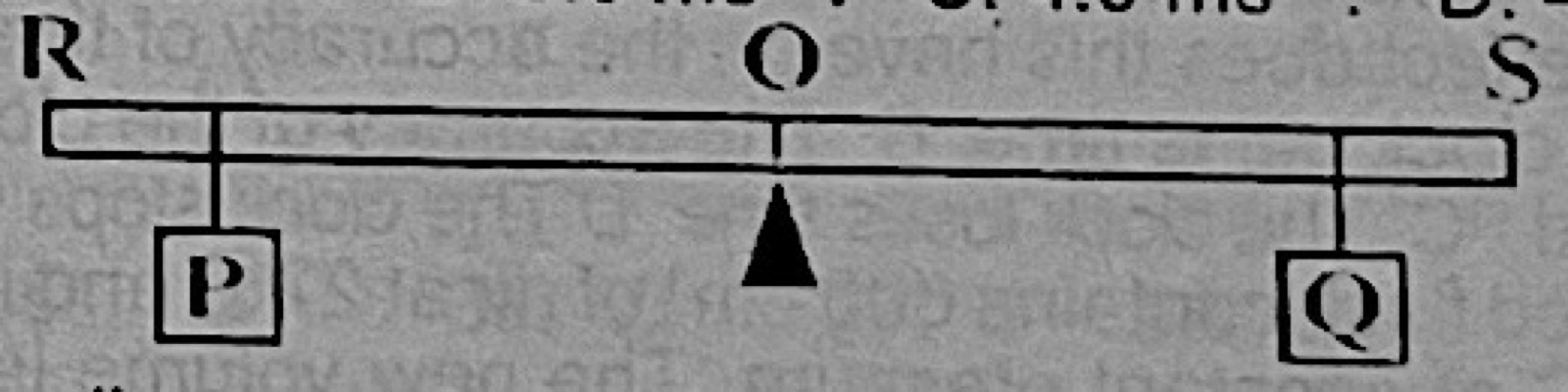
The diagram above shows plank RS pivoted at its centre of gravity O and is in equilibrium with the weights P and Q. If a weight 2P is added to P, the plank will be in equilibrium again by
A.moving Q nearer to O.
B.moving P nearer to O.
C.adding a weight Q to Q.
D.moving P further away from O.
Show the answer and explanation
Answer: B (moving P nearer to O.)
Explanation
The load on P's side becomes 3P, so its moment about O increases. To balance again, that moment must be reduced by moving P (now 3P) nearer to O so that 3P × new distance equals Q's moment.
I. All the three forces must be concurrent II. The upward force is equal to the downward force III. The algebraic sum of the moment about any point must be zero. Which of the above conditions must hold for a body acted upon by a system of three coplanar forces in equilibrium?
A.I and II only
B.I and III only
C.II and III only
D.I,II and III
Show the answer and explanation
Answer: D (I,II and III)
Explanation
Three non-parallel forces in equilibrium must meet at one point, the forces must balance (upward = downward, left = right), and the total moment about any point must be zero. All three statements hold.
A motorcycle of mass 100 kg moves round in a circle of radius 10 m with a velocity of 5ms−1. Find the coefficient of friction between the road and the tyres. [g=10ms−2]
A.25.00
B.2.50
C.0.50
D.0.25
Show the answer and explanation
Answer: D (0.25)
Explanation
Friction provides the centripetal force: μmg = mv2/r, so μ = v2/(rg) = 25 ÷ (10 × 10) = 0.25.
In the Hare's apparatus, water rises to a height of 26.5 cm in one limb. If a liquid rises to a height of 20.4 cm in the other limb, what is the relative density of the liquid?
A.0.8
B.1.1
C.1.2
D.1.3
Show the answer and explanation
Answer: D (1.3)
Explanation
Both columns are held up by the same pressure difference, so ρliquidhliquid = ρwaterhwater. Relative density = 26.5 ÷ 20.4 ≈ 1.3.
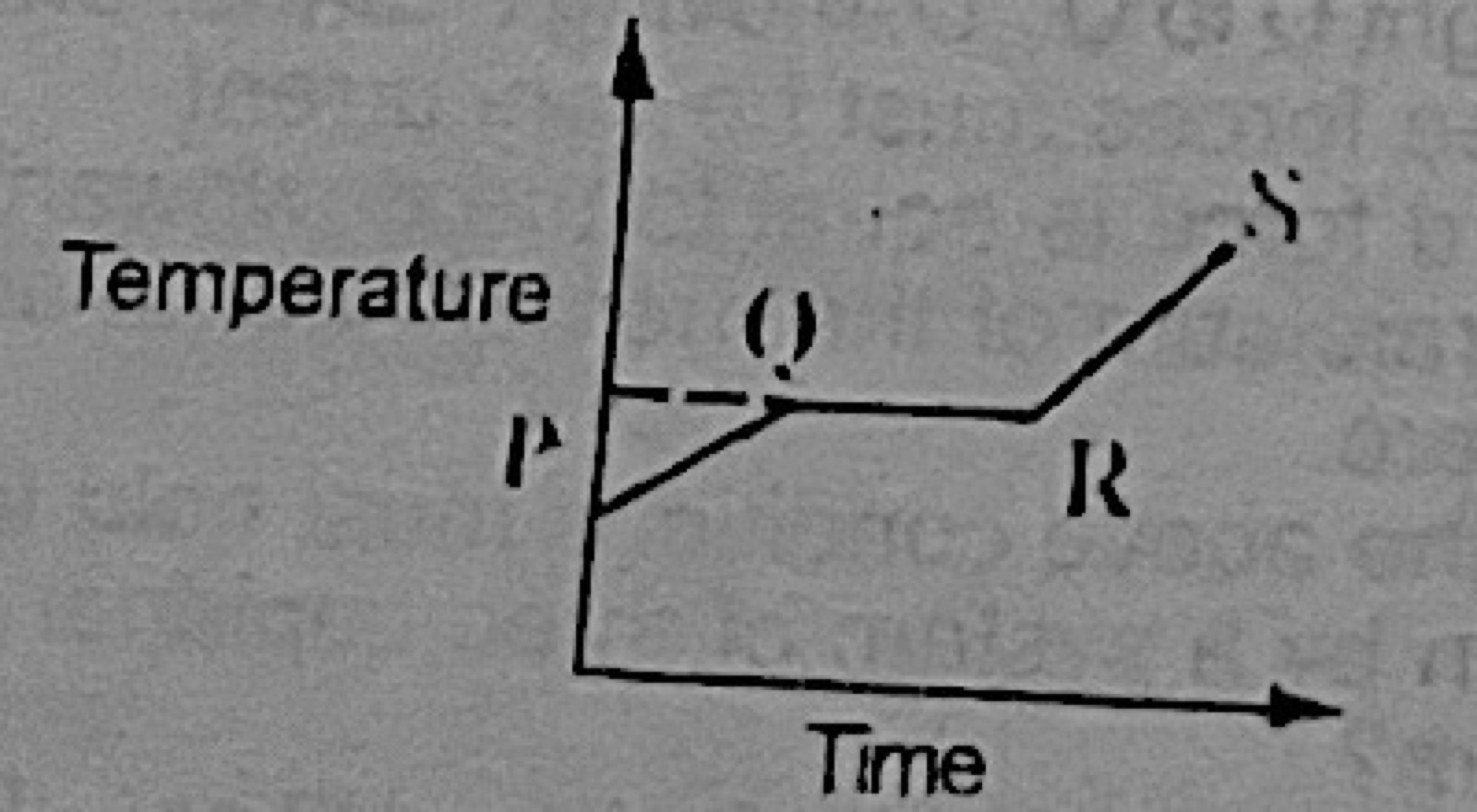
The diagram above is the heating curve for a solid. QR is the
A.melting region.
B.boiling region.
C.sublimation region.
D.evaporating process.
Show the answer and explanation
Answer: A (melting region.)
Explanation
PQ shows the solid warming up. Along QR the temperature stays constant while heat is absorbed as the solid turns to liquid, so QR is the melting region.
If the partial pressure of water vapour at 27°C is 18mm Hg and the saturated vapour pressure of the atmosphere at the same temperature is 24 mm Hg, the relative humidity at this temperature is
In a good thermos flask, the main cause of heat loss is
A.conduction through the cork.
B.the plastic base of the thermos flask.
C.the silvered walls and shiny metals.
D.the outer cover or jacket.
Show the answer and explanation
Answer: A (conduction through the cork.)
Explanation
The vacuum stops conduction and convection through the walls and the silvering cuts radiation, so most of the heat that still escapes is conducted through the cork stopper.
I. Total internal reflection of light II. Conservation of light energy III. Relative motion of the earth, sun and moon IV. Rectilinear propagation of light. Which of the above is a phenomenon of total solar eclipse?
A.I and IV only
B.II and IV only
C.I and III only
D.III and IV only
Show the answer and explanation
Answer: D (III and IV only)
Explanation
A solar eclipse happens when the moon moves between the sun and earth (relative motion) and casts a shadow because light travels in straight lines.
An object of height 4cm is placed in front of a cuboid pinhole camera of size 6 cm. If the image formed is 2 cm high, how far is the object from the pinhole?
A.3.0 cm
B.8.0 cm
C.12.0 cm
D.16.0 cm
Show the answer and explanation
Answer: C (12.0 cm)
Explanation
Magnification = image height ÷ object height = image distance ÷ object distance. 2/4 = 6/u, so u = 12 cm.
If a convex lens of focal length 12 cm is used to produce a real image four times the size of the object, how far from the lens must the object be placed?
A.10cm
B.15cm
C.20cm
D.25cm
Show the answer and explanation
Answer: B (15cm)
Explanation
Magnification 4 means v = 4u. 1/u + 1/4u = 1/12 gives 5/4u = 1/12, so u = 15 cm.
An observer with normal eyes views an object with a magnifying glass of focal length 5 cm. The angular magnification is [least distance of distinct vision D = 25cm]
A.−6.
B.−5.
C.5.
D.6.
Show the answer and explanation
Answer: C (5.)
Explanation
For a relaxed normal eye (final image at infinity), angular magnification = D/f = 25 ÷ 5 = 5.
An electric generator has an e.m.f. of 240 V and an internal resistance of 1 Ω. If the current supplied by the generator is 20 A when the terminal voltage is 220 V, find the ratio of the power supplied to the power dissipated.
A.11:1.
B.1:11
C.12:11.
D.11:12.
Show the answer and explanation
Answer: C (12:11.)
Explanation
Power supplied by the generator = EI = 240 × 20; power delivered to the external circuit = VI = 220 × 20. Ratio = 240 : 220 = 12 : 11.
A step-down transformer has a power output of 50W and efficiency of 80%. If the mains supply voltage is 200V, calculate the primary current of the transformer.
A.0.31A.
B.3.20A.
C.3.40A.
D.5.00A.
Show the answer and explanation
Answer: A (0.31A.)
Explanation
Input power = output ÷ efficiency = 50 ÷ 0.8 = 62.5 W. Primary current = 62.5 ÷ 200 ≈ 0.31 A.
If electrons are accelerated from rest through a potential difference of 10 kV, what is the wavelength of the associated electron? [me=9.1 × 10⁻³¹kg, e=1.6 × 10⁻¹⁹C, h=6.6 × 10⁻³⁴Js]
A.1.22 × 10−11m
B.3.87 × 10−10m
C.2.27 × 1011m
D.2.27 × 1014m
Show the answer and explanation
Answer: A (1.22 × 10⁻¹¹m)
Explanation
Kinetic energy eV = 1.6 × 10⁻¹⁵ J, so v = √(2eV/m) ≈ 5.9 × 10⁷ m s−1. De Broglie wavelength λ = h/mv = 6.6 × 10⁻³⁴ ÷ (9.1 × 10−31 × 5.9 × 107) ≈ 1.22 × 10⁻¹¹ m.
Caesium has a work function of 3 × 10⁻¹⁹J. The maximum energy of liberated electrons when it is illuminated by light of frequency 6.7 × 10¹⁴Hz is [h=6.6 × 10⁻³⁴Js]
A.1.42 × 10−19J.
B.3.00 × 10−19J.
C.4.42 × 10−19J.
D.7.42 × 10−19J.
Show the answer and explanation
Answer: A (1.42 × 10⁻¹⁹J.)
Explanation
Photon energy hf = 6.6 × 10−34 × 6.7 × 1014 = 4.42 × 10⁻¹⁹ J. Maximum kinetic energy = hf − W = 4.42 × 10⁻¹⁹ − 3.00 × 10−19 = 1.42 × 10⁻¹⁹ J.
In reverse breakdown a Zener diode keeps an almost constant voltage across itself even when the current changes, so it is used to regulate (stabilise) voltage.
I. For current amplification II. For voltage stabilization III. For power amplification IV. As a switch. Which of the above are the uses of a transistor?
A.I,II,III and IV
B.I,III and IV only
C.I,II and III only
D.I,II and IV only
Show the answer and explanation
Answer: B (I,III and IV only)
Explanation
A transistor can amplify current and power and can act as a switch (I, III and IV). Voltage stabilisation (II) is done by a Zener diode, not listed as a transistor use.