Home › Past questions › JAMB › Physics › 2004 48 questions. Try each one, then open the answer to check yourself and read the explanation.
Sign up free to answer these questions on a CBT screen with a timer, then see your score and every answer explained.
Start practising free
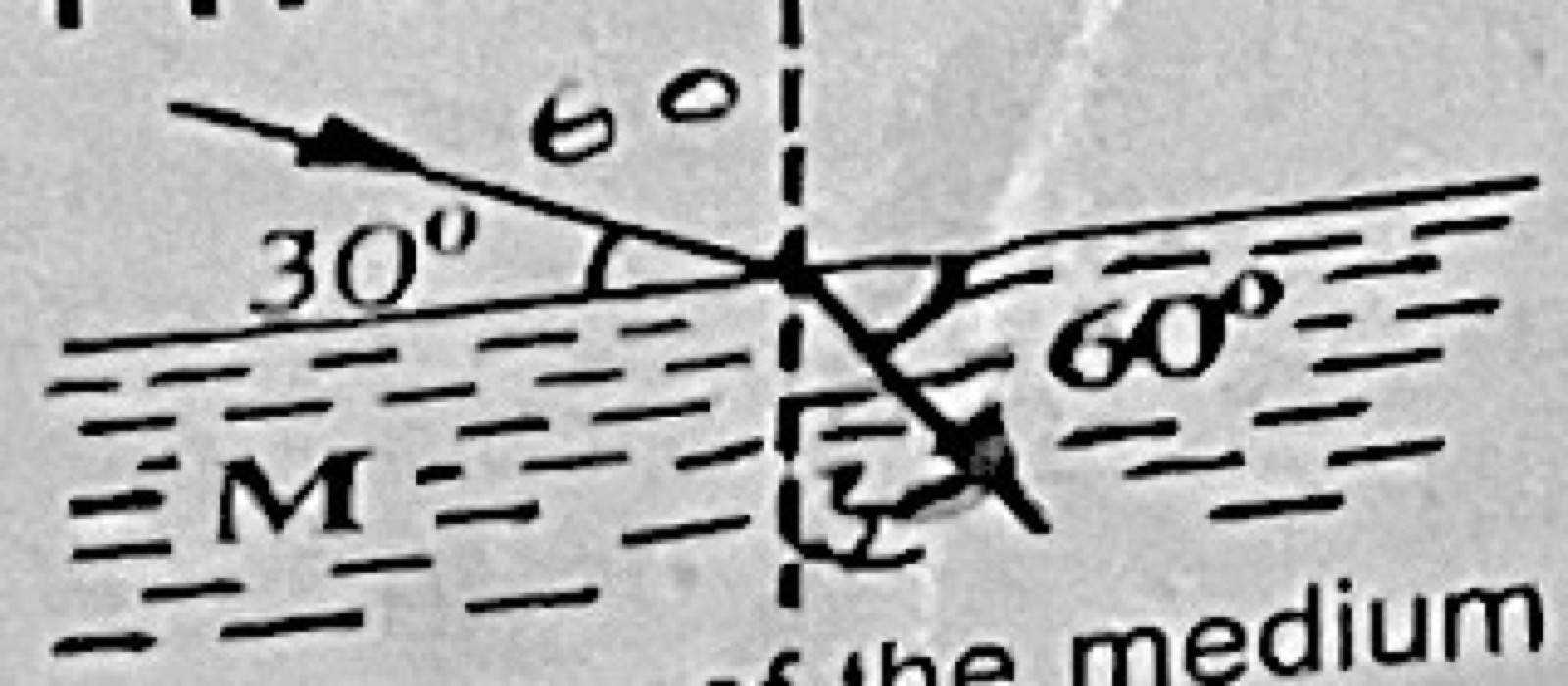
Question 1 Refraction of Light The refractive index of the medium M in the diagram above is
A. 2/√3 B. 1/√3 C. 2√3 D. √3 Show the answer and explanation Answer: D (√3 )
Explanation The ray meets the surface at 30°, so the angle of incidence is 60°; inside M it makes 60° with the surface, so the angle of refraction is 30°. n = sin 60° ÷ sin 30° = √3.
Open this question
Question 2 Light and Reflection What types of mirrors are capable of producing parallel beams of light such as those arising from the headlamps of a car?
A. cylindrical mirrors B. parabolic mirrors C. spherical mirrors D. plane mirrors Show the answer and explanation Answer: B (parabolic mirrors )
Explanation A lamp at the focus of a parabolic mirror sends out a parallel beam; a spherical mirror only does this roughly.
Open this question
Question 3 Lenses and Optical Instruments A person can focus an object only when it lies within 200 cm from him. Which spectacles should be used to increase his maximum distance of distinct vision to infinity?
A. concave lens B. plane glasses C. binoculars D. convex lens Show the answer and explanation Answer: A (concave lens )
Explanation He is short-sighted (far point 200 cm). A diverging (concave) lens makes rays from distant objects seem to come from within his far point.
Open this question
Question 4 Sound In which of the following material media would sound travel fastest?
A. water B. oil C. metal D. gas Show the answer and explanation Answer: C (metal )
Explanation Sound travels fastest in solids such as metals, where particles are closely bound, and slowest in gases.
Open this question
Question 5 Refraction of Light Calculate the angle of minimum deviation for a ray which is refracted through an equiangular prism of refractive index 1.4.
A. 29° B. 60° C. 99° D. 90° Show the answer and explanation Answer: A (29° )
Explanation n = sin((A + D)/2) ÷ sin(A/2): sin((60 + D)/2) = 1.4 × 0.5 = 0.7, so (60 + D)/2 = 44.4° and D ≈ 29°.
Open this question
Question 6 Light and Reflection What happens to the rays in a parallel beam of light?
A. they diverge as they travel B. they meet at infinity C. they intersect D. they converge as they travel Show the answer and explanation Answer: B (they meet at infinity )
Explanation Parallel rays never come together at any finite distance; in optics we say they meet at infinity.
Open this question
Question 7 Lenses and Optical Instruments If u is the object distance and v the image distance, which of the following expressions gives the linear magnification produced by a convex lens of focal length f?
A. u/v + f B. u/f − f C. v/f − 1 D. v/f + 1 Show the answer and explanation Answer: C (v/f − 1 )
Explanation From 1/u + 1/v = 1/f, multiplying by v gives v/u + 1 = v/f, so m = v/u = v/f − 1.
Open this question
Question 8 Light and Reflection A ray of light makes an angle of 35° with a plane mirror. What is the angle of reflection?
A. 55° B. 35° C. 70° D. 65° Show the answer and explanation Answer: A (55° )
Explanation Angles are measured from the normal: 90° − 35° = 55° is the angle of incidence, and the angle of reflection equals it.
Open this question
Question 9 Sound The pitch of a sound note depends on
A. timbre. B. harmonics. C. quality. D. frequency. Show the answer and explanation Answer: D (frequency. )
Explanation Pitch is how high or low a note sounds, and it is set by the frequency.
Open this question
Question 10 Scalars and Vectors If the angle between two vectors P and Q is 0°, the vectors are said to
A. be perpendicular. B. be parallel. C. intersect at angle 60°. D. intersect at angle 45°. Show the answer and explanation Answer: B (be parallel. )
Explanation An angle of 0° between two vectors means they point in the same direction: they are parallel.
Open this question
Question 11 Simple Machines A machine whose efficiency is 60% has a velocity ratio of 5. If a force of 500N is applied to lift a load P, what is the magnitude of P?
A. 750N B. 4166N C. 500N D. 1500N Show the answer and explanation Answer: D (1500N )
Explanation MA = efficiency × VR = 0.6 × 5 = 3, so P = 3 × 500 = 1500 N.
Open this question
Question 12 Work, Energy and Power A body of mass 4kg is acted on by a constant force of 12N for 3 seconds. The kinetic energy gained by the body at the end of the time is
A. 162J. B. 144J. C. 72J. D. 81J. Show the answer and explanation Answer: A (162J. )
Explanation a = 12/4 = 3 m s−2 , v = 3 × 3 = 9 m s−1 , KE = ½ × 4 × 92 = 162 J.
Open this question
Question 13 Friction As the pressure of a fluid increases, its viscosity
A. decreases. B. remains constant. C. increases then decreases. D. increases. Show the answer and explanation Answer: D (increases. )
Explanation Squeezing a liquid packs its molecules closer, so it resists flow more: viscosity increases with pressure.
Open this question
Question 14 Newton's Laws and Momentum I. Jet-propelled aircraft II. Rocket propulsion III. The recoil of a gun IV. A person walking
A. I, II, III and IV B. I and III only C. I and II only D. I, II and III only. Show the answer and explanation Answer: A (I, II, III and IV )
Explanation All four are action–reaction pairs: jets and rockets push gas backwards, a gun pushes the bullet forwards, and a walker pushes the ground backwards.
Open this question
Question 15 Pressure In a hydraulic press, a force of 40N is applied on the effort piston of area 0.4m2 . If the force exerted on the load piston is 400N, the area of the large piston is
A. 8m2 . B. 4m2 . C. 2m2 . D. 1m2 . Show the answer and explanation Answer: B (4m2 . )
Explanation Pressure is the same on both pistons: 40/0.4 = 400/A, so A = 4 m2 .
Open this question
Question 16 Friction A 100kg box is pushed along a road with a force of 500N. If the box moves with a uniform velocity, the coefficient of friction between the box and the road is
A. 0.5. B. 0.4. C. 1.0. D. 0.8. Show the answer and explanation Answer: A (0.5. )
Explanation Uniform velocity means friction equals the push: μ = 500 ÷ (100 × 10) = 0.5.
Open this question
Question 17 Gravitational Field The earth is four times the size of the moon and the acceleration due to gravity on the earth is 80 times that on the moon. The ratio of the mass of the moon to that of the earth is
A. 1:320. B. 1:1280. C. 1:80. D. 1:4. Show the answer and explanation Answer: B (1:1280. )
Explanation g = GM/R2 , so M ∝ gR2 . Mmoon /Mearth = (1/80) × (1/4)2 = 1/1280.
Open this question
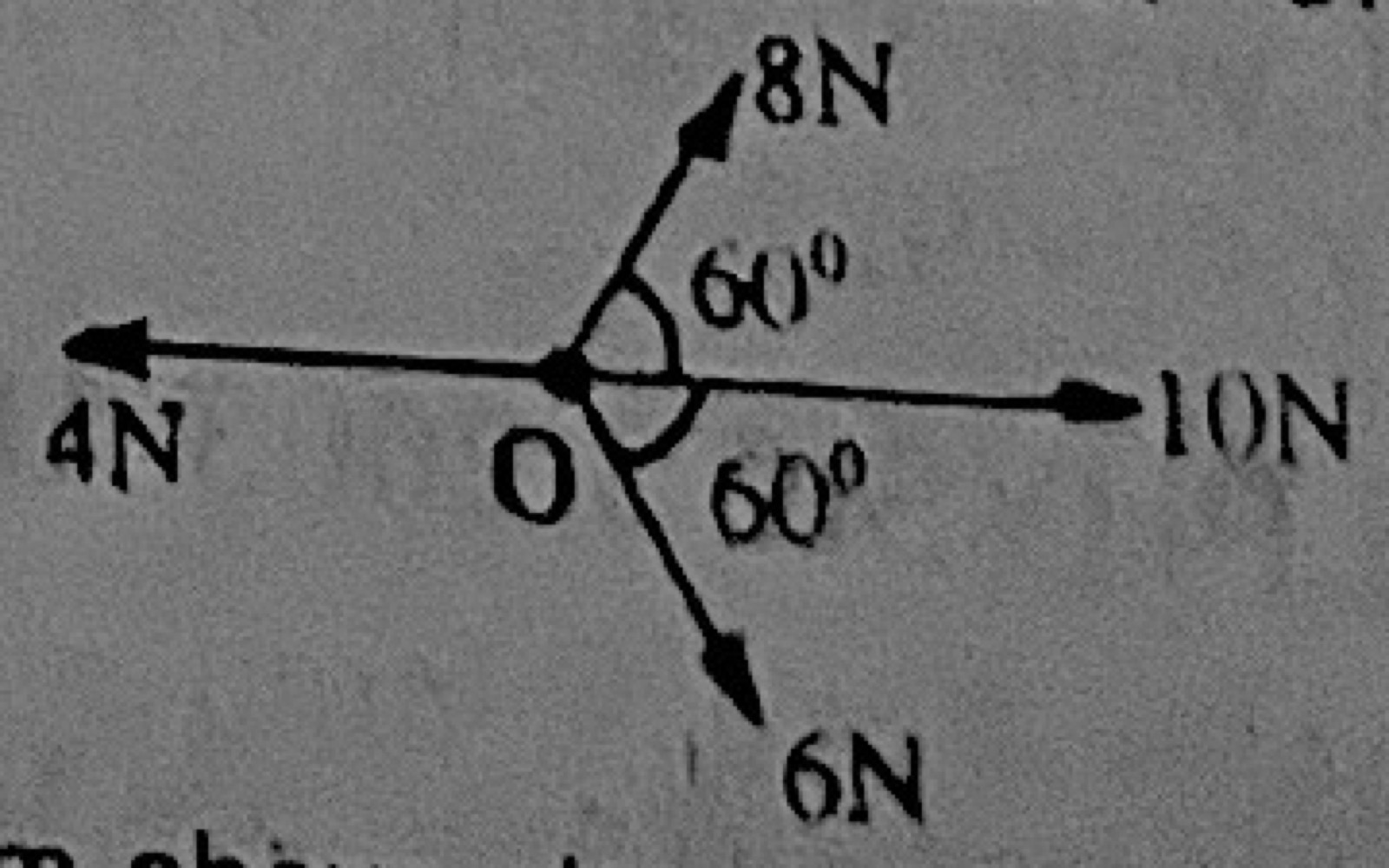
Question 18 Scalars and Vectors The diagram above shows forces 4N, 6N, 10N and 8N which act at a point O in the directions indicated. The net horizontal force is
A. 7√3 N B. 17N C. √3N D. 13N Show the answer and explanation Answer: D (13N )
Explanation The 8 N and 6 N forces each make 60° with the horizontal, so their horizontal parts are 8 cos 60° = 4 N and 6 cos 60° = 3 N. Net = 10 + 4 + 3 − 4 = 13 N.
Open this question
Question 19 Radioactivity and Nuclear Physics A radioisotope has a decay constant of 10−7 s−1 . The average life of the radioisotope is
A. 6.93 × 10⁶ s. B. 1.00 × 10⁻⁷ s. C. 1.00 × 10⁷ s. D. 6.93 × 10⁷ s. Show the answer and explanation Answer: C (1.00 × 10⁷ s. )
Explanation The average (mean) life is 1/λ = 1/10−7 = 1.00 × 10⁷ s. (0.693/λ would be the half-life.)
Open this question
Question 20 Magnetism A moving-coil galvanometer has a full-scale deflection of 3A equivalent to 30° deflection. The sensitivity of the instrument is
A. 10.0. B. 33.0. C. 90.0. D. 0.1. Show the answer and explanation Answer: A (10.0. )
Explanation Sensitivity is deflection per unit current: 30° ÷ 3 A = 10° per ampere.
Open this question
Question 22 Alternating Current Circuits In a tuned radio receiver R, L, C series circuit for resonance, the inductive and capacitive reactance XL and XC respectively are related as
A. XL = 1/XC B. XL = ½XC C. XL = XC D. XL = 2XC Show the answer and explanation Answer: C (XL = XC )
Explanation At resonance the inductive and capacitive reactances are equal and cancel, so the impedance is just R.
Open this question
Question 23 Modern Physics The particle and wave nature of matter are demonstrated in the equation
A. λ = h/p B. λ = c/f C. λ = 2d sin θ D. λ = hc/E Show the answer and explanation Answer: A (λ = h/p )
Explanation de Broglie's equation λ = h/p links a wave property (wavelength) to a particle property (momentum).
Open this question
Question 24 Electronics For semiconductors to have negative temperature coefficient of resistance implies that
A. they have electrons and holes at high temperatures. B. their resistance is constantly changing with temperature. C. their resistance increases with temperature. D. their resistance decreases with temperature. Show the answer and explanation Answer: D (their resistance decreases with temperature. )
Explanation A negative temperature coefficient means resistance falls as temperature rises.
Open this question
Question 25 Conduction through Liquids and Gases Fluorescent tubes produce light by the
A. refraction of light by gas molecules. B. excitation of gas molecules. C. conduction of solar energy. D. thermal agitation of electrons in the tube. Show the answer and explanation Answer: B (excitation of gas molecules. )
Explanation Electrons excite the gas (mercury vapour) atoms; as they return to lower levels they emit radiation that makes the coating glow.
Open this question
Question 26 Electronics In a reverse biased junction diode, current flows in by
A. electrons alone. B. majority carriers. C. minority carriers. D. positive holes alone. Show the answer and explanation Answer: C (minority carriers. )
Explanation Reverse bias blocks the majority carriers; the tiny leakage current is carried by minority carriers.
Open this question
Question 27 Electromagnetic Induction The energy stored in an inductor of inductance 5mH when a current of 6A flows through it is
A. 1.8 × 10⁻² J. B. 9.0 × 10⁻³ J. C. 1.4 × 10⁻² J. D. 9.0 × 10⁻² J. Show the answer and explanation Answer: D (9.0 × 10⁻² J. )
Explanation E = ½LI2 = ½ × 5 × 10−3 × 62 = 9.0 × 10⁻² J.
Open this question
Question 28 Modern Physics X-rays can be used in the study of crystal structures because they
A. have an extremely short wavelength. B. have a very long-reaching wavelength. C. are very fast. D. are invisible. Show the answer and explanation Answer: A (have an extremely short wavelength. )
Explanation X-ray wavelengths are about the same as the spacing of atoms in a crystal, so crystals diffract them.
Open this question
Question 29 Alternating Current Circuits An a.c. circuit of emf 12V has a resistor of resistance 8Ω connected in series to an inductor of inductive reactance 16Ω and a capacitor of capacitive reactance 10Ω. The current flow in the circuit is
A. 1.4A. B. 14.0A. C. 1.2A. D. 12.0A. Show the answer and explanation Answer: C (1.2A. )
Explanation Z = √(82 + (16 − 10)2 ) = 10 Ω, so I = 12/10 = 1.2 A.
Open this question
Question 30 Electromagnetic Induction A generator-manufacturing company was contracted to produce an a.c dynamo but inadvertently produced a d.c. dynamo. To correct this error, the
A. commutator should be replaced with slip rings. B. commutator should be replaced with split rings. C. armature coil should be made of aluminium. D. armature coil should be made of silver. Show the answer and explanation Answer: A (commutator should be replaced with slip rings. )
Explanation A d.c. dynamo uses a split-ring commutator; replacing it with slip rings gives alternating current.
Open this question
Question 31 Waves Transverse waves can be distinguished from longitudinal waves using the characteristics of
A. diffraction. B. polarization. C. reflection. D. refraction. Show the answer and explanation Answer: B (polarization. )
Explanation Only transverse waves can be polarized; all waves show reflection, refraction and diffraction.
Open this question
Question 32 Pressure A man exerts a pressure of 2.8 × 10³ Nm−2 on the ground and has 4 × 10⁻² m2 of his feet in contact with the ground. The weight of the man is
A. 112 N. B. 140 N. C. 102 N. D. 70 N. Show the answer and explanation Answer: A (112 N. )
Explanation Weight = pressure × area = 2.8 × 103 × 4 × 10−2 = 112 N.
Open this question
Question 33 Thermal Expansion When left in a freezer, a bottle full of water cracks on freezing into ice because of the
A. decrease in the volume of water. B. contraction of the bottle. C. expansion of the bottle. D. increase in the volume of water. Show the answer and explanation Answer: D (increase in the volume of water. )
Explanation Water expands when it freezes, so the ice takes more space than the water and breaks the bottle.
Open this question
Question 34 Change of State and Vapours The change in volume when 450kg of ice is completely melted is [density of ice = 900 kgm−3 , density of water = 1000 kgm−3 ]
A. 0.05m3 . B. 0.45m3 . C. 4.50m3 . D. 0.50m3 Show the answer and explanation Answer: A (0.05m3 . )
Explanation Volume of ice = 450/900 = 0.50 m3 ; volume of water = 450/1000 = 0.45 m3 ; change = 0.05 m3 .
Open this question
Question 35 Elasticity If a force of 50N stretches a wire from 20m to 20.01m, what is the amount of force required to stretch the same material from 20m to 20.05m?
A. 100N B. 50N C. 250N D. 200N Show the answer and explanation Answer: C (250N )
Explanation By Hooke's law force ∝ extension: 0.05 m is 5 times 0.01 m, so F = 5 × 50 = 250 N.
Open this question
Question 36 Heat Transfer Tea pots are often silver-coated to prevent heat loss by
A. convection and conduction B. radiation only. C. conduction only. D. convection only. Show the answer and explanation Answer: B (radiation only. )
Explanation A shiny silver surface is a poor emitter of radiation, so it cuts heat loss by radiation.
Open this question
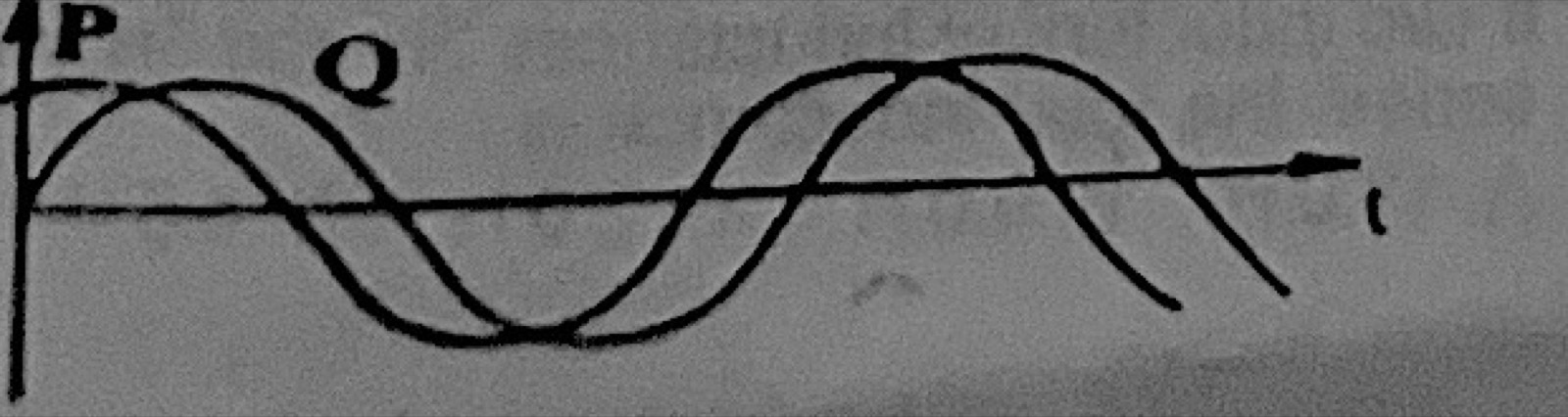
Question 37 Waves The phase difference between waves P and Q in the diagram above is
A. π/2 B. 2π C. π/4 D. π Show the answer and explanation Answer: C (π/4 )
Explanation Q's crests lag P's by about one-eighth of a wavelength; one full wavelength is 2π, so the phase difference is 2π/8 = π/4.
Open this question
Question 38 Thermal Expansion Metal rods of length 20m each are laid end to end to form a bridge at 25°C. What gap will be provided between consecutive rails for the bridge to withstand 75°C? [Linear expansivity of the material = 2.0 × 10⁻⁵ K−1 ]
A. 0.22m B. 0.25m C. 0.02m D. 0.20m Show the answer and explanation Answer: C (0.02m )
Explanation Expansion = αLΔθ = 2.0 × 10−5 × 20 × 50 = 0.02 m, so the gap must be 0.02 m.
Open this question
Question 39 Quantity of Heat A 50W electric heater is used to heat a metal block of mass 5kg. If in 10 minutes a temperature rise of 12°C is achieved, the specific heat capacity of the metal is
A. 500 J kg−1 K−1 B. 130 J kg−1 K−1 C. 390 J kg−1 K−1 D. 400 J kg−1 K−1 Show the answer and explanation Answer: A (500 J kg−1 K−1 )
Explanation Pt = mcΔθ: c = 50 × 600 ÷ (5 × 12) = 500 J kg−1 K−1 .
Open this question
Question 40 Waves I. Wavelength II. Medium of propagation III. Wave velocity IV. Frequency V. Energy
A. I, II and V B. III, IV and V C. I and IV D. I, III and IV Show the answer and explanation Answer: D (I, III and IV )
Explanation A wave is described by its wavelength, frequency and speed (linked by v = fλ); the medium and energy do not characterise it.
Open this question
Question 41 Electrostatics The instrument used for securing a large number of similar charges by induction is called
A. capacitor. B. electrophorus. C. electroscope. D. proof-plane. Show the answer and explanation Answer: B (electrophorus. )
Explanation The electrophorus can be charged by induction again and again from one charged plate, giving many similar charges.
Open this question
Question 43 Current Electricity If 16mA of current flows through a conductor in one second, the number of electrons transported per second is [1 electronic charge = 1.6 × 10⁻¹⁹ C]
A. 1.00 × 10²⁰ . B. 1.00 × 10¹⁷ . C. 2.56 × 10⁻¹⁷ . D. 2.56 × 10⁻¹⁸ . Show the answer and explanation Answer: B (1.00 × 10¹⁷ . )
Explanation n = It/e = 16 × 10−3 × 1 ÷ 1.6 × 10−19 = 1.0 × 10¹⁷ .
Open this question
Question 44 Electromagnetic Spectrum The difference between x-rays and gamma rays is that
A. x-rays arise from energy changes in the electronic structure of atoms while gamma rays come from the nucleus. B. x-rays are electromagnetic radiations while gamma rays are negatively charged radiations. C. x-rays have higher frequencies than gamma rays. D. x-rays are more penetrating than gamma rays. Show the answer and explanation Answer: A (x-rays arise from energy changes in the electronic structure of atoms while gamma rays come from the nucleus. )
Explanation Both are electromagnetic waves; X-rays come from electron energy changes in atoms, gamma rays from the nucleus.
Open this question
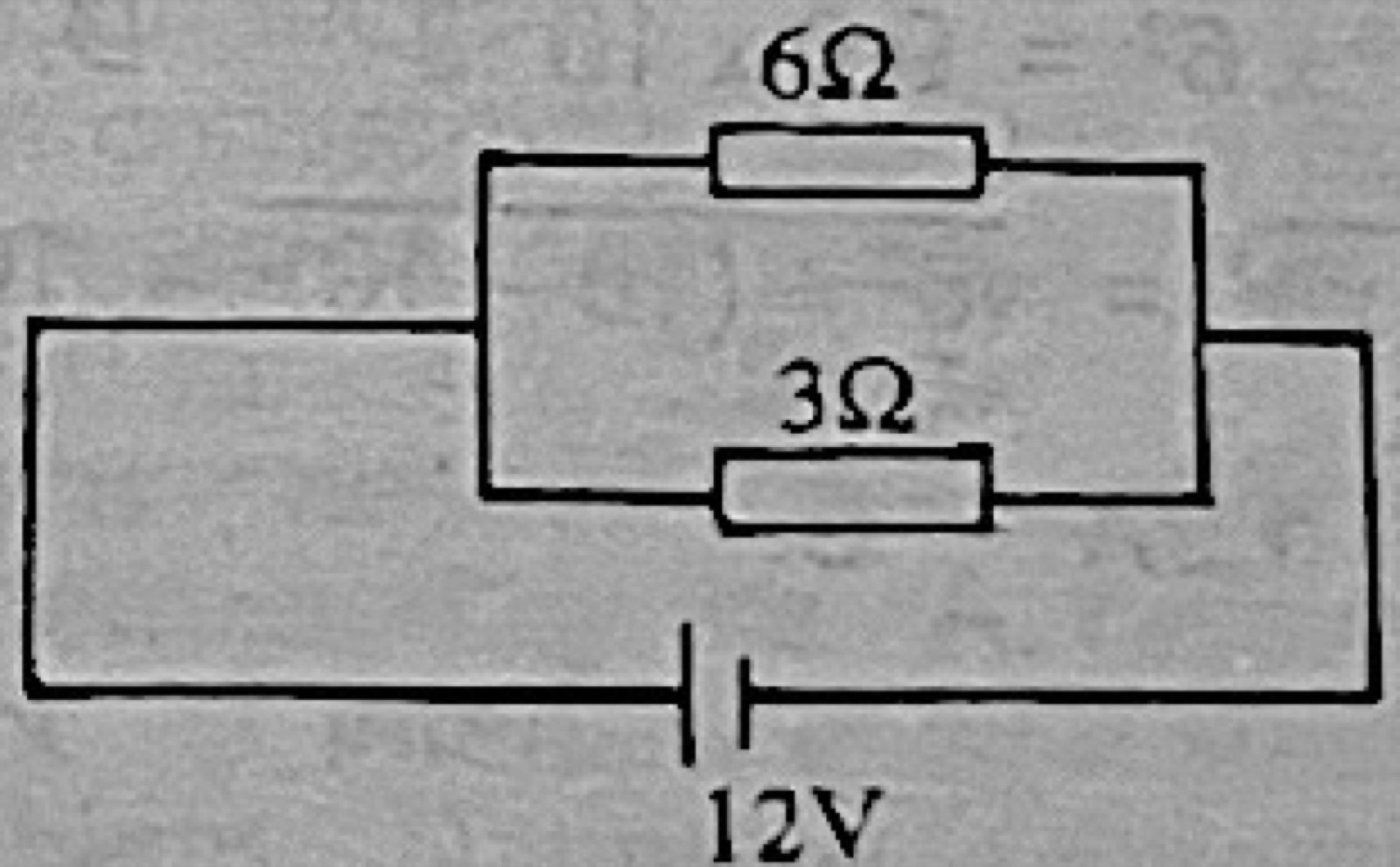
Question 45 Electrical Energy and Power In the diagram above, the ratio of the electric power dissipated in the 6Ω and 3Ω resistors respectively is
A. 2:3. B. 1:2. C. 1:3. D. 2:1. Show the answer and explanation Answer: B (1:2. )
Explanation Both resistors have the full 12 V across them. P = V2 /R gives 24 W and 48 W, a ratio of 1 : 2.
Open this question
Question 46 Magnetism To protect a material from the influence of an external magnetic field, the material should be kept in a
A. square steel ring. B. loop of copper wire. C. triangular zinc ring. D. soft iron ring. Show the answer and explanation Answer: D (soft iron ring. )
Explanation Soft iron is very permeable, so the field lines pass through the ring instead of the space inside it (magnetic shielding).
Open this question
Question 47 Conduction through Liquids and Gases Which of the following is an electrolyte?
A. grape juice B. sugar solution C. alcohol D. paraffin Show the answer and explanation Answer: A (grape juice )
Explanation Grape juice contains acids and salts that form ions, so it conducts and is decomposed by current; the others do not ionise.
Open this question
Question 48 Electrical Energy and Power Electrical appliances in homes are normally earthed so that
A. both the a.c. and d.c. sources can be used. B. a person touching the appliances is safe from electric shock. C. the appliances are maintained at a higher p.d. than the earth. D. the appliances are maintained at a lower p.d. than the earth. Show the answer and explanation Answer: B (a person touching the appliances is safe from electric shock. )
Explanation If a fault makes the casing live, current runs to earth (and blows the fuse) instead of through the person.
Open this question
Question 49 Current Electricity A cell whose internal resistance is 0.5Ω delivers a current of 4A to an external resistor. The lost voltage of the cell is
A. 1.250V. B. 8.000V. C. 0.125V. D. 2.000V. Show the answer and explanation Answer: D (2.000V. )
Explanation Lost volts = Ir = 4 × 0.5 = 2 V.
Open this question
Question 50 Capacitors Given three capacitors 0.3μF, 0.5μF and 0.2μF, the joint capacitance when arranged to give minimum capacitance is
A. 0.3μF. B. 1.0μF. C. 0.1μF. D. 0.5μF. Show the answer and explanation Answer: C (0.1μF. )
Explanation Minimum capacitance is in series: 1/C = 1/0.3 + 1/0.5 + 1/0.2 ≈ 10.3, so C ≈ 0.1 μF.
Open this question Sign up free for every JAMB Physics year, practice by topic and timed mocks.
Start practising free