The height at which the atmosphere ceases to exist is about 80 km. If the atmospheric pressure on the ground level is 760 mmHg, the pressure at a height of 20 km above the ground level is
A.380 mmHg
B.570 mmHg
C.190 mmHg
D.480 mmHg
Show the answer and explanation
Answer: B (570 mmHg)
Explanation
Taking the pressure to fall evenly from 760 mmHg at 0 km to 0 at 80 km, 20 km is a quarter of the way up, so the pressure is 760 × ¾ = 570 mmHg.
A stone of mass 1 kg is dropped from a height of 10 m above the ground and falls freely under gravity. Its kinetic energy 5 m above the ground is then equal to
A.its kinetic energy on the ground
B.twice its initial potential energy
C.its initial potential energy
D.half its initial potential energy
Show the answer and explanation
Answer: D (half its initial potential energy)
Explanation
After falling 5 m of the 10 m, the stone has turned half of its starting potential energy into kinetic energy.
If a spherical metal bob of radius 3 cm is fully immersed in a cylinder containing water and the water level rises by 1 cm, what is the radius of the cylinder?
A.12 cm
B.1 cm
C.3 cm
D.6 cm
Show the answer and explanation
Answer: D (6 cm)
Explanation
Volume of bob = water displaced: (4/3)π × 33 = πr2 × 1, so 36 = r2 and r = 6 cm.
I. The earth is not spherical but elliptical in shape. II. Variation in latitude and longitude. III. Rotation of the earth on its axis. IV. Variation in the density of the earth. On which combination of the above does the weight of an object vary on the earth's surface?
A.I, II, III and IV.
B.II, III and IV only
C.I, II and III only
D.I and II only
Show the answer and explanation
Answer: C (I, II and III only)
Explanation
g changes over the earth's surface because the earth is flattened at the poles, because of the earth's rotation, and so with latitude. So weight varies for reasons I, II and III.
Which of the following consists entirely of vector quantities?
A.Velocity, magnetic flux and reaction
B.Tension, magnetic flux and mass
C.Displacement, impulse and power
D.Work, pressure and moment.
Show the answer and explanation
Answer: A (Velocity, magnetic flux and reaction)
Explanation
Velocity and reaction are vectors, and the magnetic field (flux) is treated here as a vector. Each other option contains a clear scalar: mass, power or work.
A ray of light strikes a plane mirror at an angle of incidence of 35°. If the mirror is rotated through 10°, through what angle is the reflected ray rotated?
A.70°
B.45°
C.25°
D.20°
Show the answer and explanation
Answer: D (20°)
Explanation
When a plane mirror turns through an angle θ, the reflected ray turns through 2θ, so 2 × 10° = 20°.
The driving mirror of a car has a radius of curvature of 1 m. A vehicle behind the car is 4 m from the mirror. Find the image distance behind the mirror.
A.8/7
B.4/9
C.9/2
D.4/7
Show the answer and explanation
Answer: B (4/9)
Explanation
A driving mirror is convex, so f = −r/2 = −0.5 m. 1/v = 1/f − 1/u = −2 − ¼ = −9/4, so v = −4/9 m: a virtual image 4/9 m behind the mirror.
The pressure of a given mass of a gas changes from 300 N m−2 to 120 N m−2 while the temperature drops from 127 °C to −73 °C. The ratio of the final volume to the initial volume is
A plane sound wave of frequency 85.5 Hz and velocity 342 m s−1 is reflected from a vertical wall. At what distance from the wall does the wave have an antinode?
A.2 m
B.4 m
C.1 m
D.3 m
Show the answer and explanation
Answer: C (1 m)
Explanation
λ = v/f = 342/85.5 = 4 m. There is a node at the wall, and the first antinode is λ/4 = 1 m from it.
The thermometric substance of an absolute thermometer is
A.alcohol
B.mercury
C.helium
D.platinum
Show the answer and explanation
Answer: C (helium)
Explanation
The absolute (thermodynamic) scale is realised with a constant-volume gas thermometer, and helium behaves almost like an ideal gas down to very low temperatures.
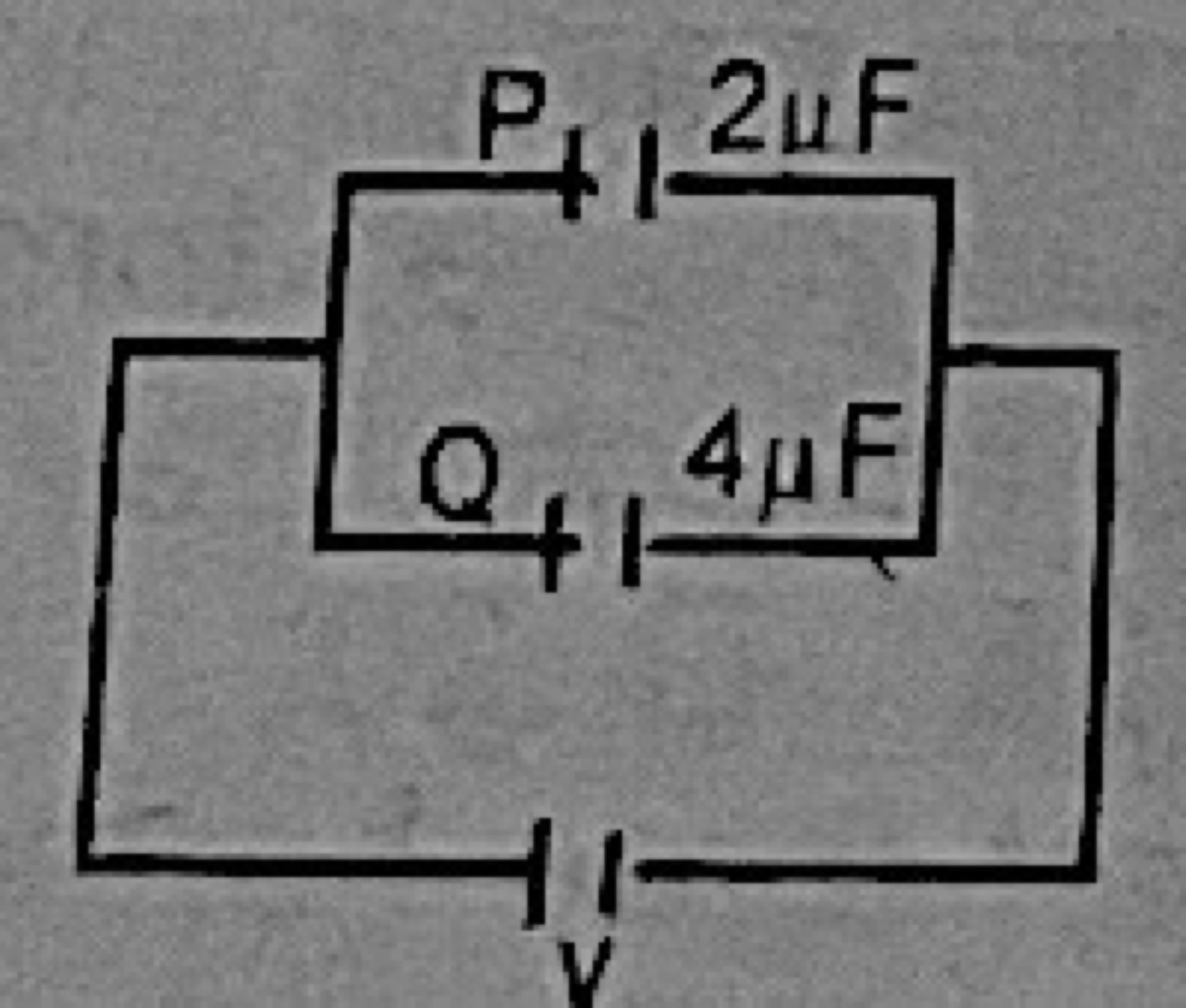
The diagram above shows two capacitors P and Q of capacitances 2 μF and 4 μF respectively connected to a d.c. source. The ratio of energy stored in P to Q is
A.4 : 1
B.2 : 1
C.1 : 4
D.1 : 2
Show the answer and explanation
Answer: D (1 : 2)
Explanation
P and Q are in parallel, so they have the same voltage. Energy = ½CV2 is proportional to C, so the ratio is 2 : 4 = 1 : 2.
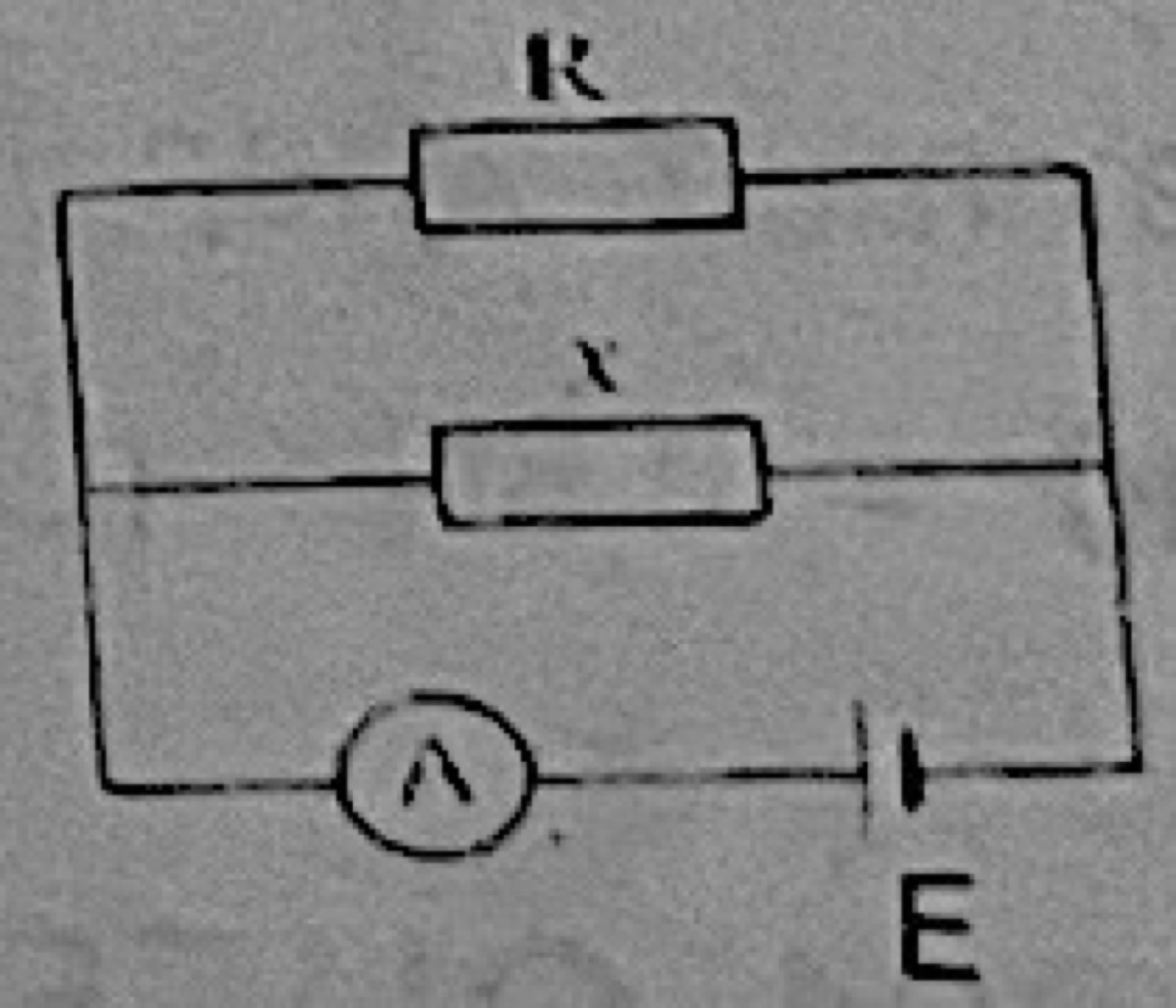
A resistance R is connected across the terminal of an electric cell of internal resistance 2 Ω and the voltage was reduced to 3/5 of its nominal value. The value of R is
A.3 Ω
B.2 Ω
C.1 Ω
D.6 Ω
Show the answer and explanation
Answer: A (3 Ω)
Explanation
Terminal p.d. = E × R/(R + r) = 3/5 E, so 5R = 3R + 6 and R = 3 Ω.
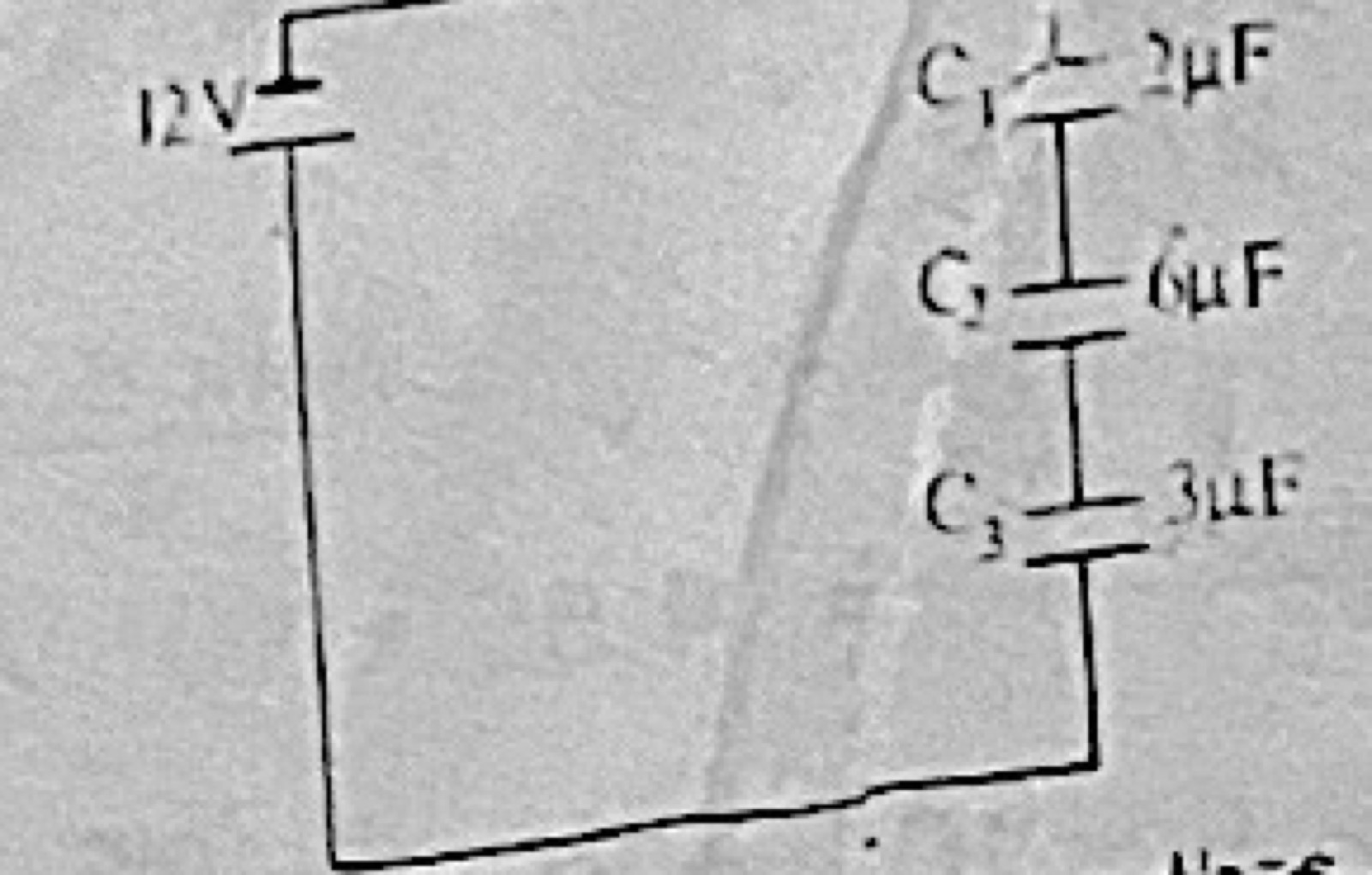
The diagram above shows three capacitors C1, C2 and C3 of capacitances 2 μF, 6 μF and 3 μF respectively. The potential differences across C1, C2 and C3 respectively are
A.4 V, 6 V and 2 V
B.2 V, 6 V and 4 V
C.6 V, 4 V and 2 V
D.6 V, 2 V and 4 V
Show the answer and explanation
Answer: D (6 V, 2 V and 4 V)
Explanation
In series: 1/C = ½ + ⅙ + ⅓ = 1, so C = 1 μF and Q = 1 × 12 = 12 μC. V = Q/C gives 12/2 = 6 V, 12/6 = 2 V and 12/3 = 4 V.
A student is at a height 4 m above the ground during a thunderstorm. Given that the potential difference between the thundercloud and the ground is 107 V, the electric field created by the storm is
A.2.0 × 106 N C−1
B.2.5 × 106 N C−1
C.1.0 × 107 N C−1
D.4.0 × 107 N C−1
Show the answer and explanation
Answer: B (2.5 × 10⁶ N C−1)
Explanation
Taking the 4 m as the distance over which the 107 V acts, E = V/d = 107/4 = 2.5 × 10⁶ N C−1.
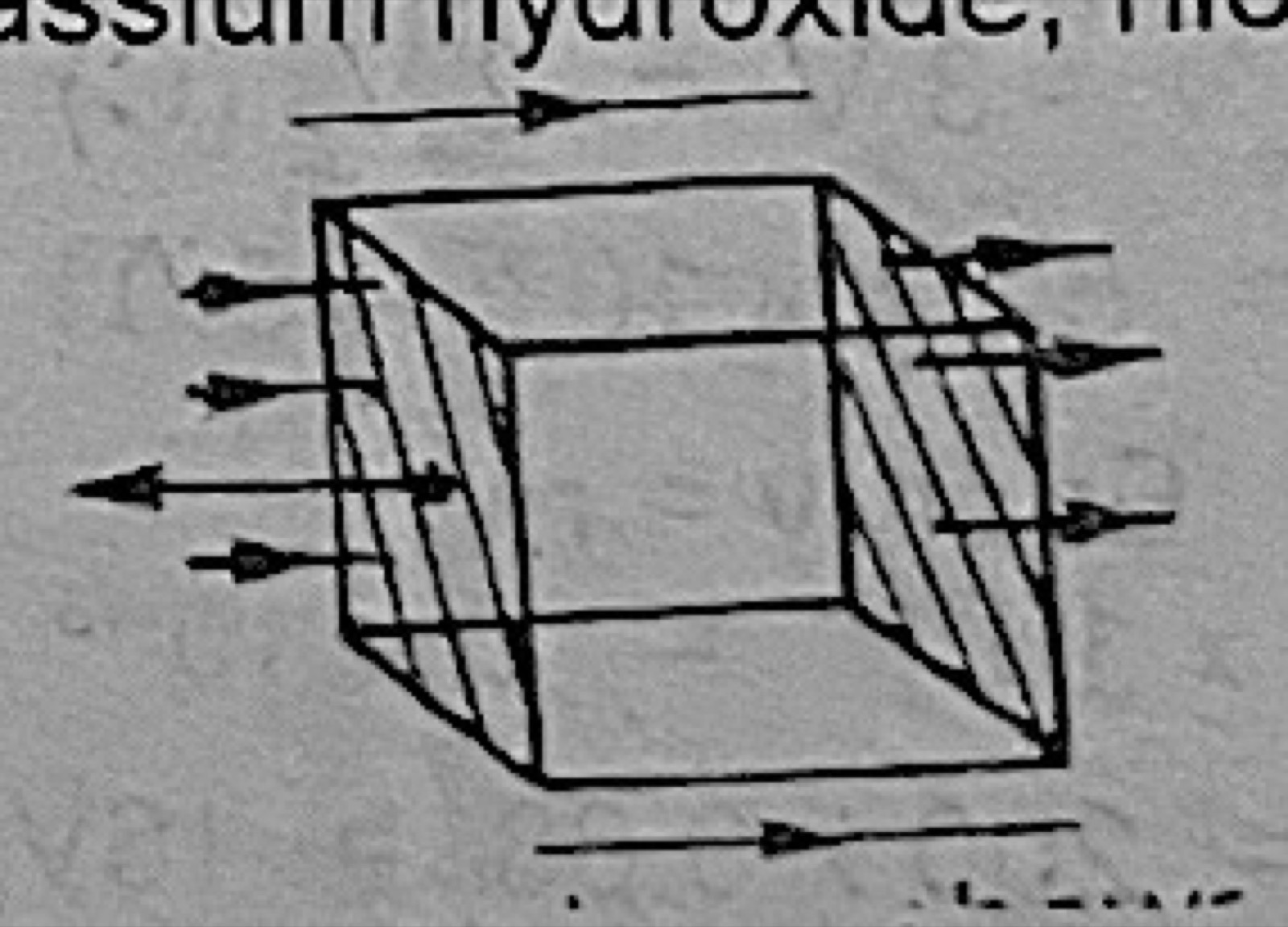
The diagram above shows a closed square box of side 0.5 m in a uniform electric field E in the direction shown by the arrows. What is the flux ϕ for the box?
A.0.5 E
B.2.0 E
C.0.2 E
D.0.0 E
Show the answer and explanation
Answer: D (0.0 E)
Explanation
In a uniform field every field line that enters the closed box also leaves it, so the flux in equals the flux out and the net flux is zero.
A bread toaster uses a current of 4 A when plugged in a 240 volts line. It takes one minute to toast slices of bread. What is the energy consumed by the toaster?
A.5.76 × 104 J
B.1.60 × 104 J
C.3.60 × 103 J
D.1.60 × 102 J
Show the answer and explanation
Answer: A (5.76 × 10⁴ J)
Explanation
Energy = IVt = 4 × 240 × 60 = 57 600 J = 5.76 × 10⁴ J.
When a piece of rectangular glass block is inserted between two parallel plate capacitor, at constant plate area and distance of separation, the capacitance of the capacitor will
A.increase
B.decrease
C.decrease, then increase
D.remain constant
Show the answer and explanation
Answer: A (increase)
Explanation
Glass has a higher permittivity than air, and C = εA/d, so putting a glass dielectric between the plates increases the capacitance.
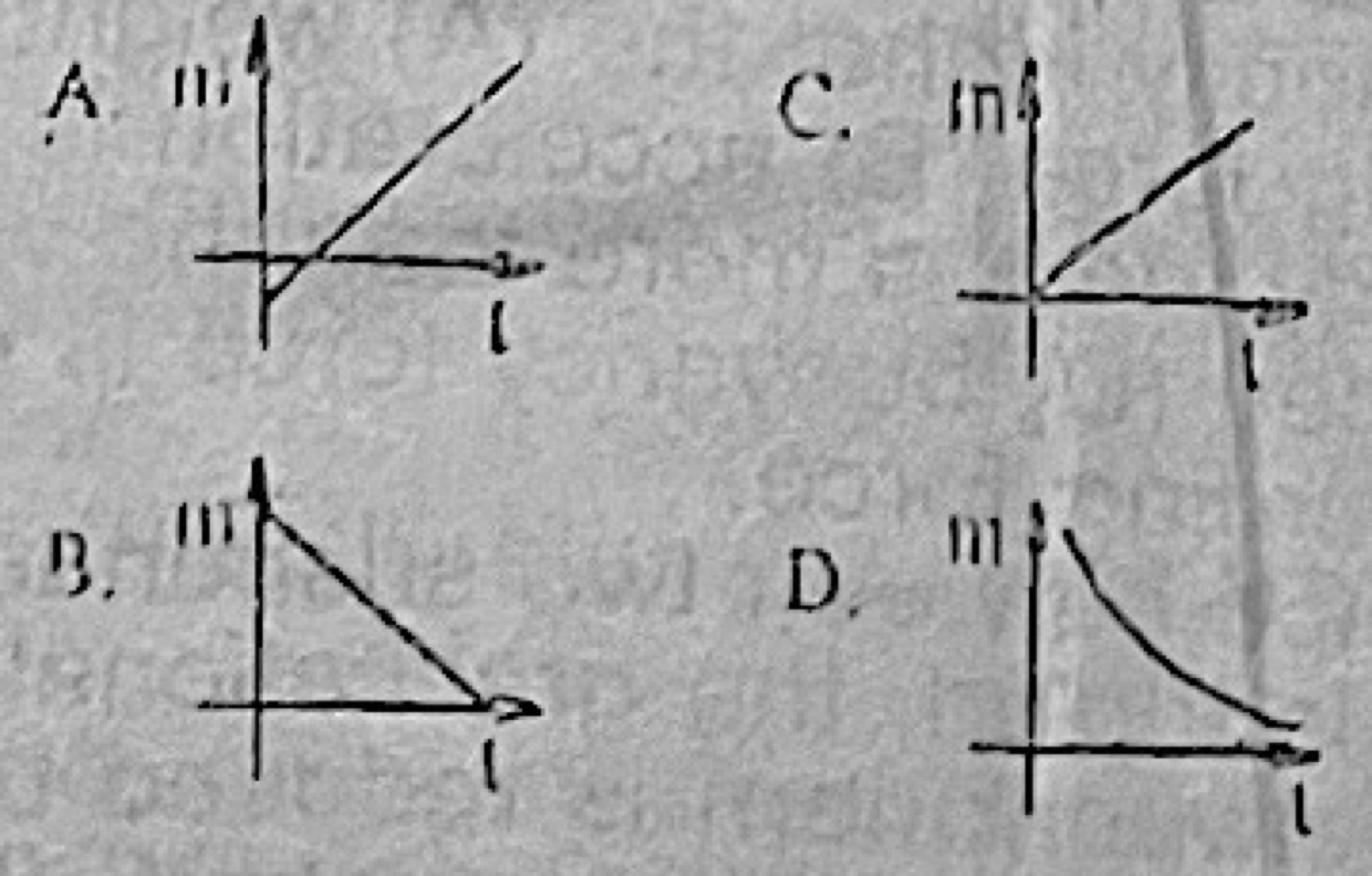
Which of the following graphs correctly represents the variation of mass of a given material deposited with time for constant current in Faraday's law of electrolysis?
A.Graph A
B.Graph B
C.Graph C
D.Graph D
Show the answer and explanation
Answer: C (Graph C)
Explanation
m = ZIt, so with constant current the mass is proportional to time: a straight line through the origin, which is graph C.
The primary coil of a transformer has N turns and is connected to a 120 V a.c power line. If the secondary coil has 1,000 turns and a terminal voltage of 1,200 volts, what is the value of N?
A capacitor of 20 × 10−12 F and an inductor are joined in series. The value of the inductance that will give the circuit a resonant frequency of 200 kHz is [π2 = 10]
A.1/16 H
B.1/8 H
C.1/64 H
D.1/32 H
Show the answer and explanation
Answer: D (1/32 H)
Explanation
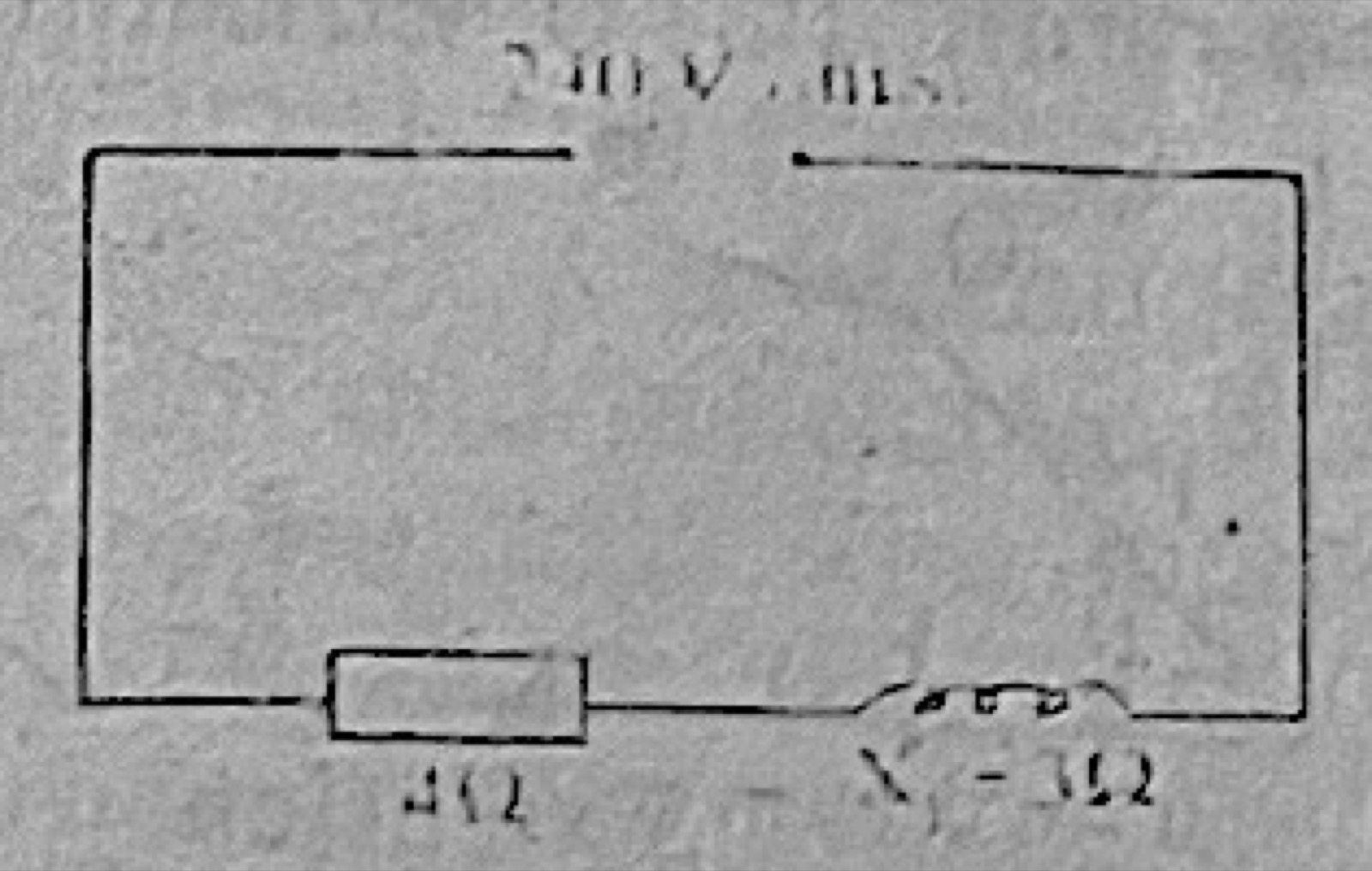
At resonance f = 1/(2π√(LC)), so L = 1/(4π2f2C) = 1/(4 × 10 × (2 × 105)2 × 20 × 10−12) = 1/32 H.