JAMB Physics 1988 past questions and answers

48 questions. Try each one, then open the answer to check yourself and read the explanation.

Question 1

Simple Harmonic Motion

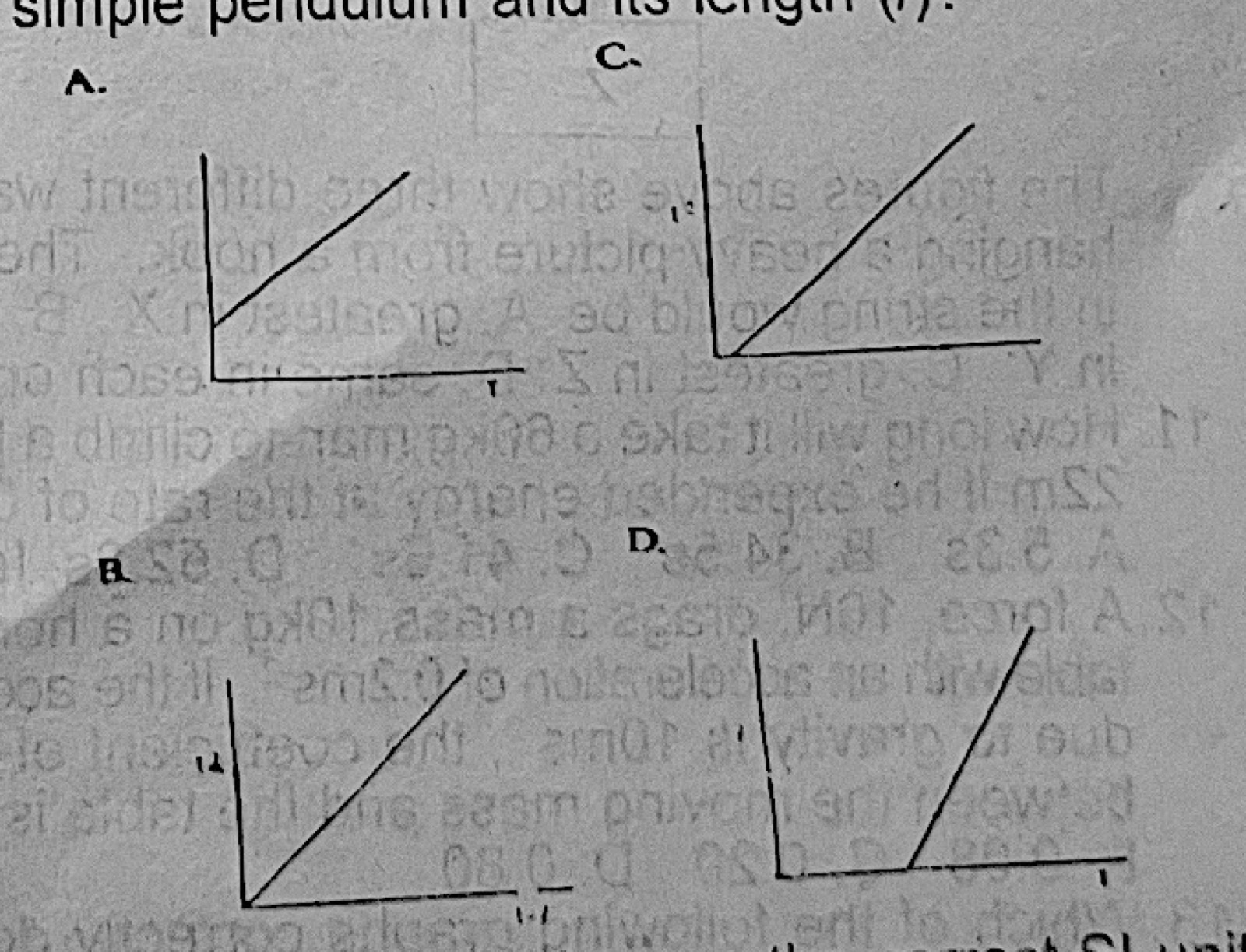
Which of the following diagrams correctly represents the relationship between the time (T) of swing of a simple pendulum and its length (l)?

Diagram for this question
  1. A.A
  2. B.B
  3. C.C
  4. D.D
Show the answer and explanation

Answer: C (C)

Explanation

T = 2π√(l/g), so T² is proportional to l and the graph of T² against l is a straight line through the origin, as in C.

Open this question

Question 2

Measurement and Units

Which of the following are the correct SI units of the quantities indicated? I. N (Force) II. N m−1 (Torque) III. Watt (Power) IV. kg m s−2 (Momentum)

  1. A.I and II only
  2. B.I, II and III only
  3. C.I, II and IV only
  4. D.I and III only.
Show the answer and explanation

Answer: D (I and III only.)

Explanation

Force is in newtons and power in watts. Torque is in N m (not N m−1) and momentum in kg m s−1 (not kg m s−2).

Open this question

Question 3

Scalars and Vectors

A lorry travels 10 km northwards, 4 km eastwards, 6 km southwards and 4 km westwards to arrive at a point T. What is the total displacement?

  1. A.6 km south
  2. B.4 km north
  3. C.6 km north
  4. D.4 km east
Show the answer and explanation

Answer: B (4 km north)

Explanation

East and west cancel (4 − 4 = 0). North–south: 10 − 6 = 4 km north.

Open this question

Question 4

Scalars and Vectors

Two forces whose resultant is 100 N, are at right angles to each other. If one of them makes an angle of 30° with the resultant, determine its magnitude.

  1. A.8.66 N
  2. B.50.0 N
  3. C.57.7 N
  4. D.86.6 N
Show the answer and explanation

Answer: D (86.6 N)

Explanation

The component of the resultant along that force is 100 cos 30° = 86.6 N.

Open this question

Question 5

Scalars and Vectors

Which of the following quantities are scalars? I. Electrical potential II. Torque III. Momentum IV. Kinetic energy

  1. A.II and III only
  2. B.I and II only
  3. C.III and IV only
  4. D.I and IV only.
Show the answer and explanation

Answer: D (I and IV only.)

Explanation

Electrical potential and kinetic energy have size only. Torque and momentum have direction, so they are vectors.

Open this question

Question 6

Motion

A particle starts from rest and moves with a constant acceleration of 0.5 m s−2. The distance covered by the particle in 10 s is

  1. A.2.5 m
  2. B.5.0 m
  3. C.25.0 m
  4. D.50.0 m
Show the answer and explanation

Answer: C (25.0 m)

Explanation

s = ½at² = ½ × 0.5 × 100 = 25 m.

Open this question

Question 7

Newton's Laws and Momentum

When taking a penalty kick, a footballer applies a force of 30.0 N for a period of 0.05 s. If the mass of the ball is 0.075 kg, calculate the speed with which the ball moves off.

  1. A.4.50 m s−1
  2. B.11.25 m s−1
  3. C.20.00 m s−1
  4. D.45.00 m s−1.
Show the answer and explanation

Answer: C (20.00 m s−1)

Explanation

Impulse = change in momentum: 30 × 0.05 = 0.075 × v, so v = 1.5/0.075 = 20 m s−1.

Open this question

Question 8

Simple Machines

A 20-toothed gear wheel drives a 60-toothed one. If the angular speed of the smaller wheel is 120 rev s−1, the angular speed of the larger wheel is

  1. A.3 rev s−1
  2. B.40 rev s−1
  3. C.360 rev s−1
  4. D.2400 rev s−1
Show the answer and explanation

Answer: B (40 rev s−1)

Explanation

The same number of teeth pass the contact point on each wheel, so speed × teeth is equal: 120 × 20 = ω × 60, giving ω = 40 rev s−1. The bigger wheel turns more slowly.

Open this question

Question 9

Motion

The figure above shows the displacement – time graphs for three different motions. Which of the following statements is correct?

Diagram for this question
  1. A.Graph 2 corresponds to the highest velocity
  2. B.Graph 1 corresponds to zero velocity
  3. C.Graph 3 corresponds to a particle moving in the negative x direction
  4. D.Graph 2 corresponds to a particle moving in the positive x direction.
Show the answer and explanation

Answer: B (Graph 1 corresponds to zero velocity)

Explanation

Velocity is the slope of a displacement–time graph. Graph 1 is horizontal, so its velocity is zero; graph 2 slopes down (negative direction) and graph 3 is steepest and positive.

Open this question

Question 10

Equilibrium of Forces

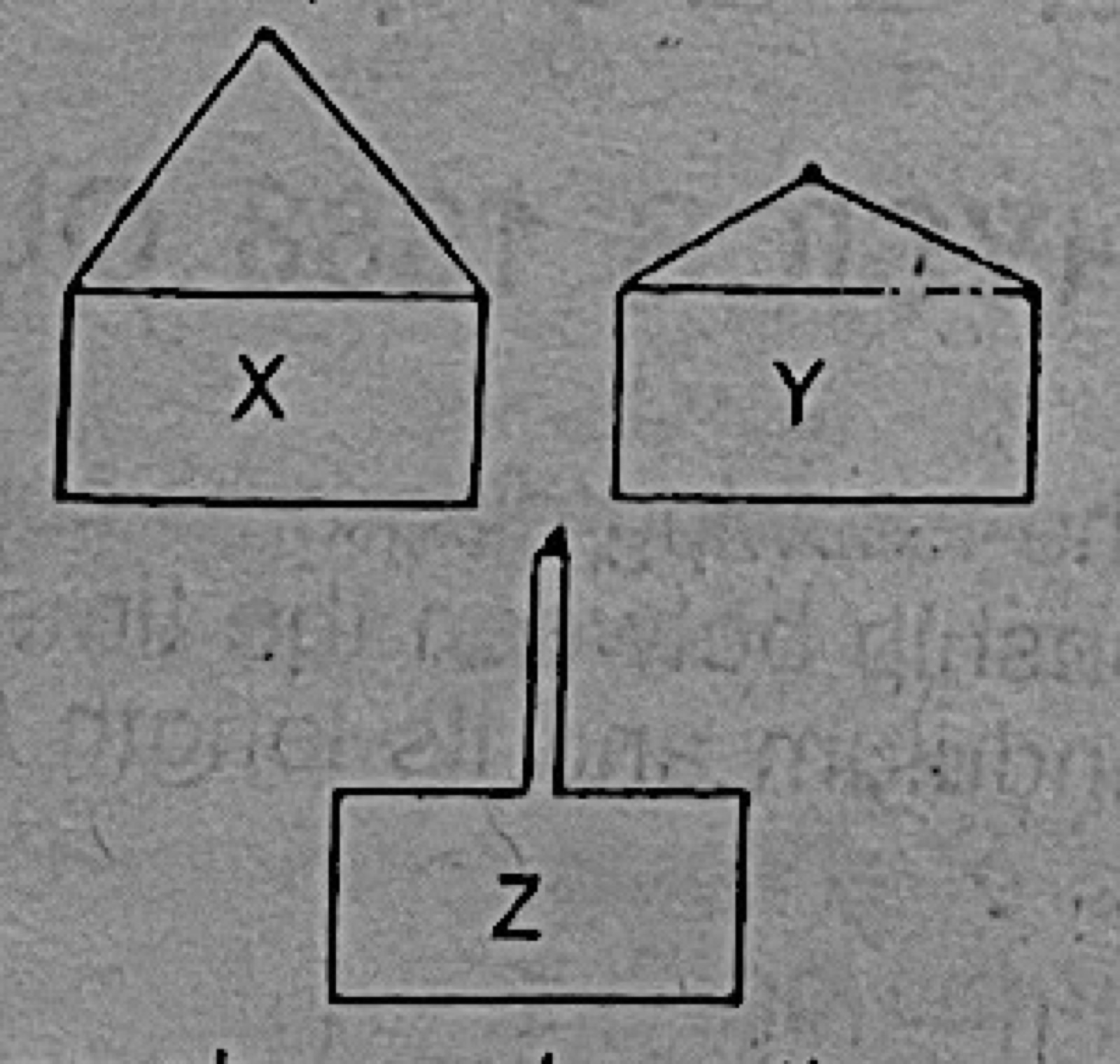
The figures above show three different ways of hanging a heavy picture from a hook. The tension in the string would be

Diagram for this question
  1. A.greatest in X
  2. B.greatest in Y
  3. C.greatest in Z
  4. D.same in each one.
Show the answer and explanation

Answer: B (greatest in Y)

Explanation

Each string's vertical pulls must add up to the weight. The flatter the strings, the smaller their vertical share, so the tension must be larger. The strings in Y are the flattest.

Open this question

Question 11

Work, Energy and Power

How long will it take a 60 kg man to climb a height of 22 m if he expended energy at the rate of 0.25 kW? [g = 10 m s−2]

  1. A.5.3 s
  2. B.34.5 s
  3. C.41.6 s
  4. D.52.8 s.
Show the answer and explanation

Answer: D (52.8 s.)

Explanation

Work = mgh = 60 × 10 × 22 = 13 200 J. Time = 13 200 ÷ 250 = 52.8 s.

Open this question

Question 12

Friction

A force, 10 N, drags a mass 10 kg on a horizontal table with an acceleration of 0.2 m s−2. If the acceleration due to gravity is 10 m s−2, the coefficient of friction between the moving mass and the table is

  1. A.0.02
  2. B.0.08
  3. C.0.20
  4. D.0.80.
Show the answer and explanation

Answer: B (0.08)

Explanation

Net force = 10 × 0.2 = 2 N, so friction = 10 − 2 = 8 N. μ = 8/(10 × 10) = 0.08.

Open this question

Question 13

Simple Machines

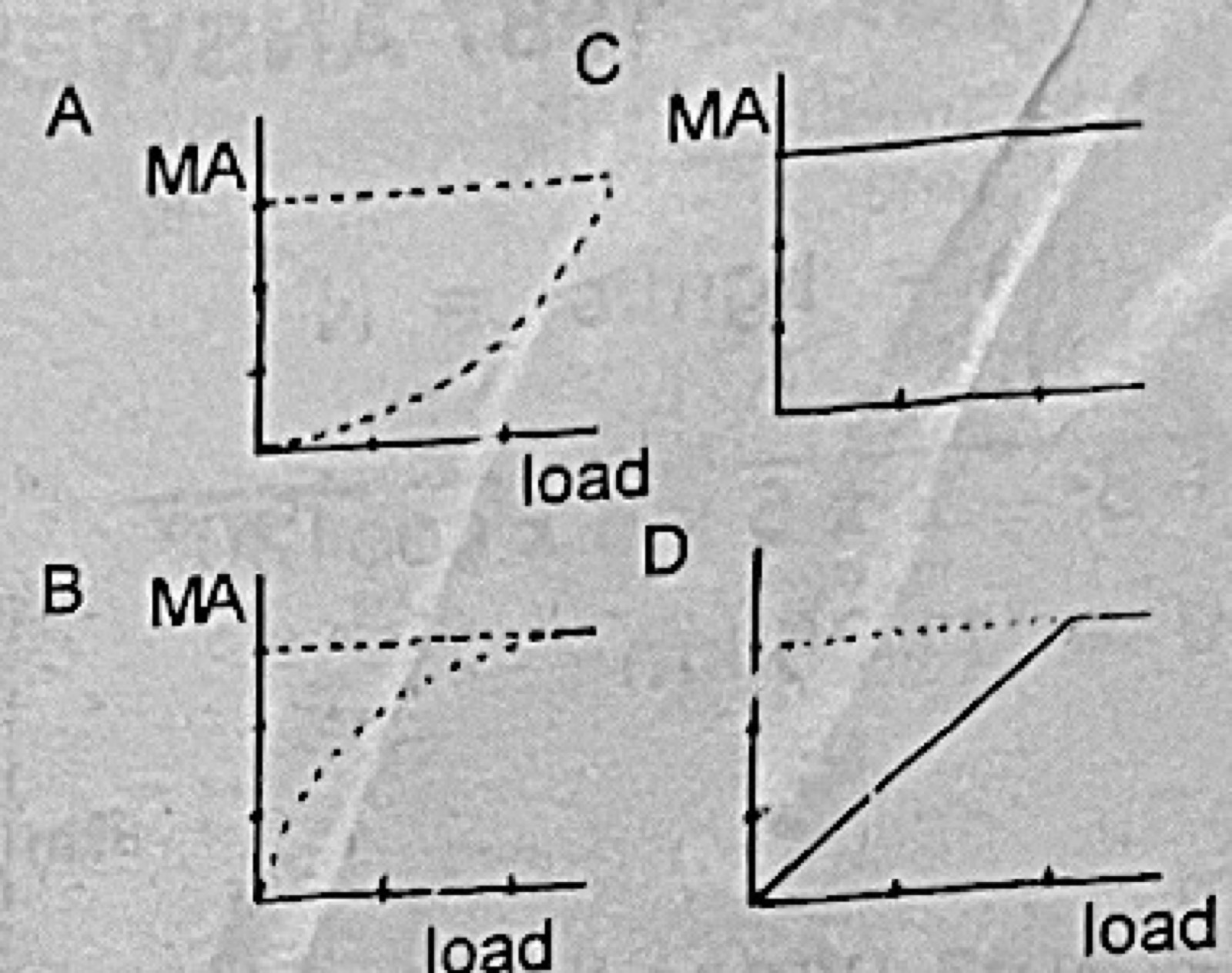
Which of the following graphs correctly describes the variation of the mechanical advantage with load for a simple machine whose velocity ratio is 3?

Diagram for this question
  1. A.A
  2. B.B
  3. C.C
  4. D.D
Show the answer and explanation

Answer: B (B)

Explanation

As the load grows, friction and the weight of moving parts matter less, so the MA rises quickly at first and then levels off below the velocity ratio, as in B.

Open this question

Question 14

Density and Upthrust

A body whose mass is 2 kg and has a volume of 500 cm3 just floats when completely immersed in a liquid. Calculate the density of the liquid.

  1. A.4.0 × 102 kg m−3
  2. B.4.0 × 103 kg m−3
  3. C.1.0 × 103 kg m−3
  4. D.1.0 × 106 kg m−3.
Show the answer and explanation

Answer: B (4.0 × 10³ kg m−3)

Explanation

It just floats when fully immersed, so the liquid's density equals the body's: 2 ÷ (500 × 10−6) = 4.0 × 10³ kg m−3.

Open this question

Question 15

Pressure

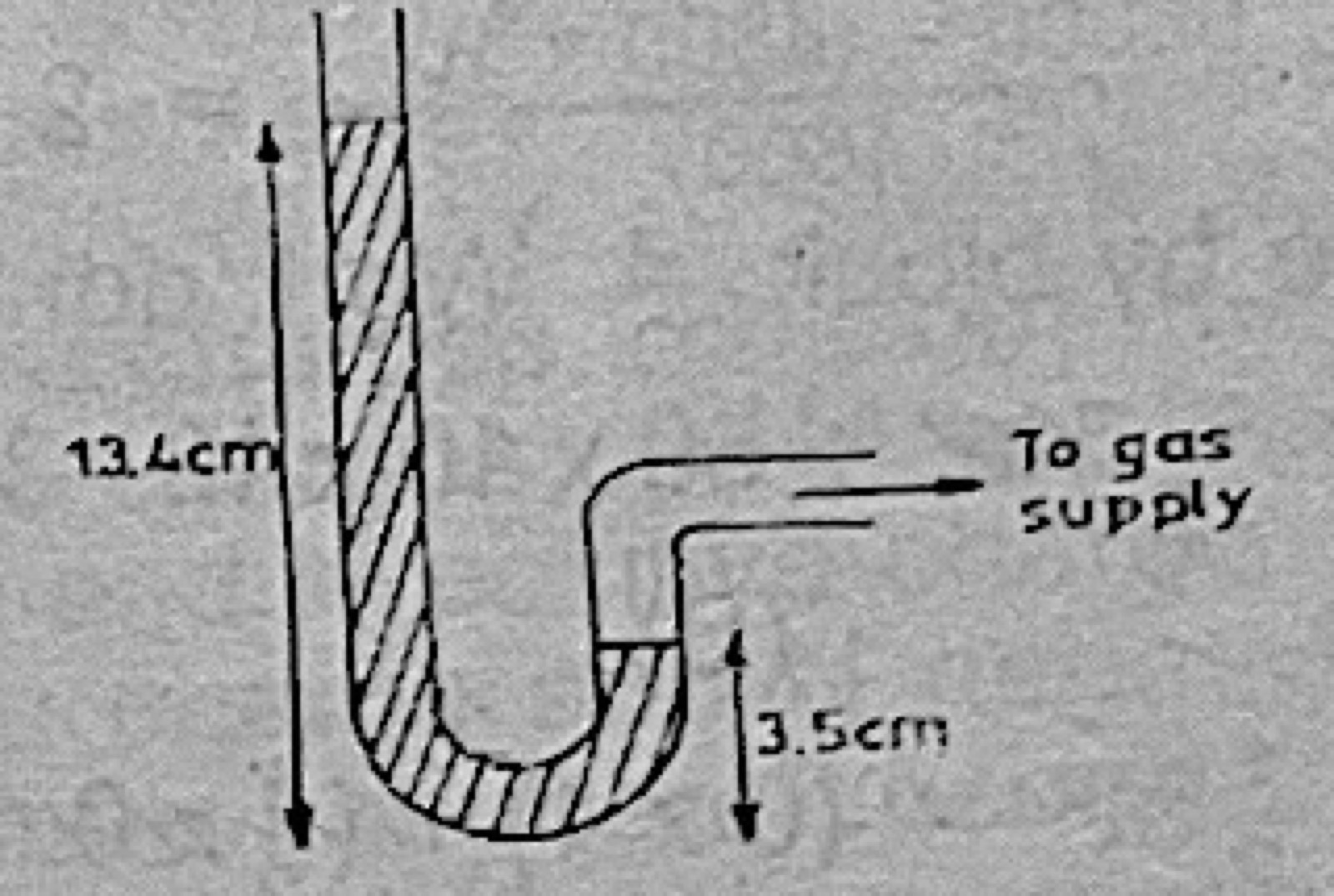
When one arm of a U-tube manometer is connected to a gas supply, the levels of mercury in the two arms of the U-tube are as shown in the diagram above. If the atmospheric pressure is 76.0 cm Hg, the gas pressure is

Diagram for this question
  1. A.62.6 cm Hg
  2. B.72.5 cm Hg
  3. C.79.5 cm Hg
  4. D.85.9 cm Hg
Show the answer and explanation

Answer: D (85.9 cm Hg)

Explanation

The mercury in the open arm stands 13.4 − 3.5 = 9.9 cm higher, so the gas pressure is 76.0 + 9.9 = 85.9 cm Hg.

Open this question

Question 16

Gas Laws

The product PV where P is pressure and V is volume has the same unit as

  1. A.force
  2. B.power
  3. C.energy
  4. D.acceleration.
Show the answer and explanation

Answer: C (energy)

Explanation

PV has units N m−2 × m3 = N m = J, the unit of energy.

Open this question

Question 17

Quantity of Heat

The amount of heat needed to raise the temperature of 10 kg of copper by 1 K is its

  1. A.specific heat capacity
  2. B.heat capacity
  3. C.latent heat
  4. D.internal energy
Show the answer and explanation

Answer: B (heat capacity)

Explanation

The heat needed to raise a whole body by one degree is its heat capacity; specific heat capacity refers to 1 kg.

Open this question

Question 18

Quantity of Heat

A tap supplies water at 25°C while another supplies water at 75°C. If a man wishes to bathe with water at 40°C, the ratio of the mass of cold water to the mass of hot water required is

  1. A.1 : 3
  2. B.15 : 8
  3. C.7 : 3
  4. D.3 : 1
Show the answer and explanation

Answer: C (7 : 3)

Explanation

Heat lost by hot = heat gained by cold: mh × 35 = mc × 15, so mc : mh = 35 : 15 = 7 : 3.

Open this question

Question 19

Change of State and Vapours

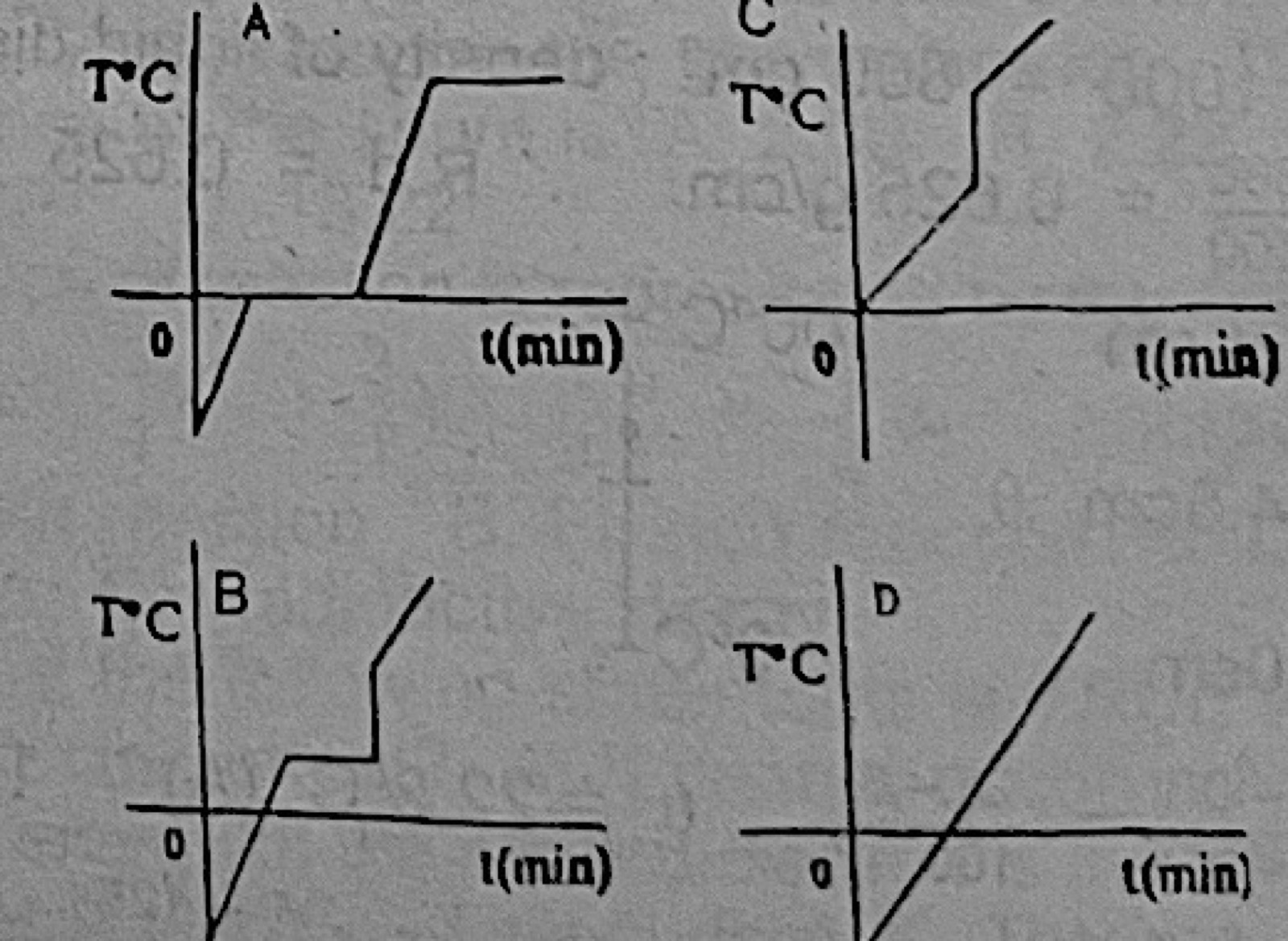
Which of the following graphs clearly illustrates the temperature change which takes place as a piece of ice at − 10°C is heated slowly?

Diagram for this question
  1. A.A
  2. B.B
  3. C.C
  4. D.D
Show the answer and explanation

Answer: A (A)

Explanation

The temperature rises from −10°C to 0°C, stays at 0°C while the ice melts, rises to 100°C and stays there while the water boils, as in A.

Open this question

Question 20

Heat Transfer

When heat is applied to one end of a metal rod, the molecules at the other end soon begin to vibrate with greater amplitude than before because heat has been transferred by

  1. A.radiation
  2. B.convection
  3. C.conduction
  4. D.evaporation.
Show the answer and explanation

Answer: C (conduction)

Explanation

In a solid, heat passes from molecule to molecule by their vibrations (and by free electrons in metals): conduction.

Open this question

Question 21

Sound

Which of the following media allow the transmission of sound waves through them? I. Air II. Liquids III. Solids

  1. A.I and II only
  2. B.I and III only
  3. C.II and III only
  4. D.I, II and III.
Show the answer and explanation

Answer: D (I, II and III.)

Explanation

Sound travels through any material medium: gases, liquids and solids.

Open this question

Question 22

Waves

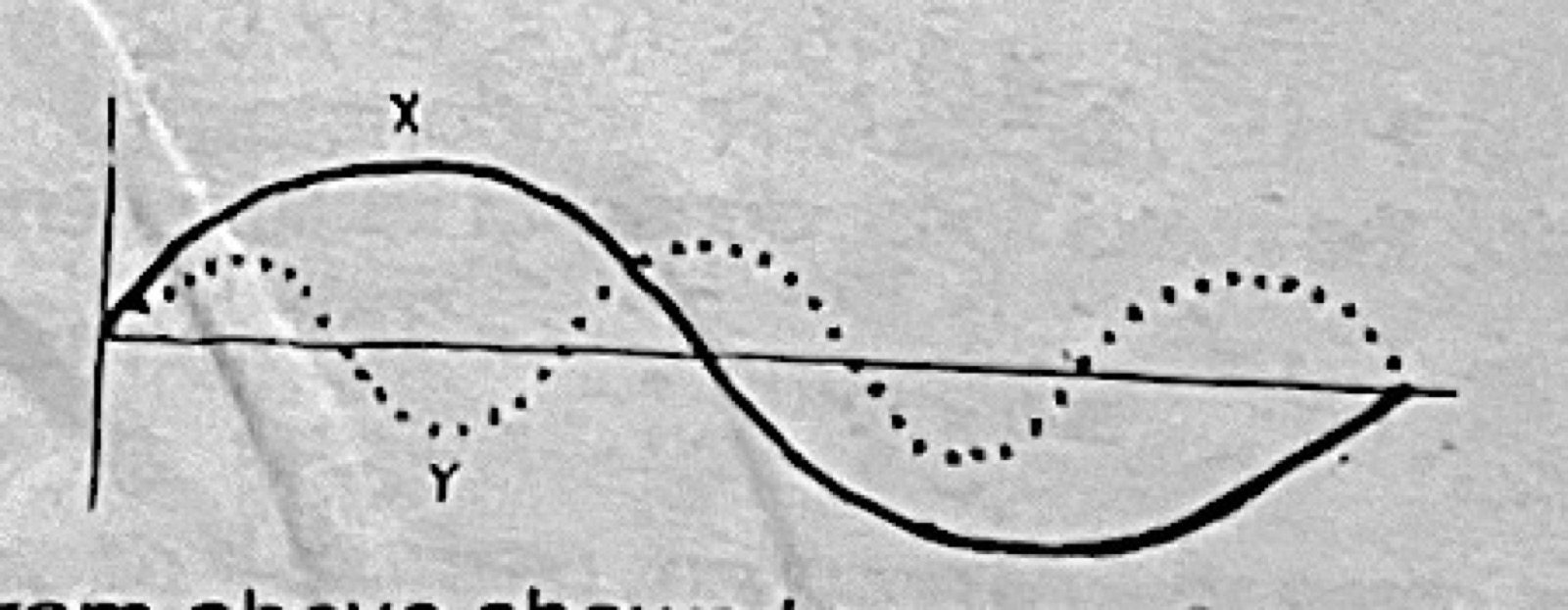
The diagram above shows two waveforms X and Y. If the frequency of X is 30 Hz, what is the frequency of Y?

Diagram for this question
  1. A.12 Hz
  2. B.19 Hz
  3. C.60 Hz
  4. D.75 Hz
Show the answer and explanation

Answer: D (75 Hz)

Explanation

In the same time Y completes 2½ waves while X completes one, so fY = 2.5 × 30 = 75 Hz.

Open this question

Question 23

Waves

Which of the following properties is/are common to all waves? I. Diffraction II. Refraction III. Interference

  1. A.I only
  2. B.III only
  3. C.I and III only
  4. D.I, II and III.
Show the answer and explanation

Answer: D (I, II and III.)

Explanation

All waves, transverse or longitudinal, can be diffracted, refracted and made to interfere.

Open this question

Question 24

Sound

A piano wire 0.5 m long has a total mass of 0.01 kg and is stretched with a tension of 800 N. Calculate the frequency of the wire when it sounds its fundamental note.

  1. A.200 Hz
  2. B.100 Hz
  3. C.4 Hz
  4. D.2 Hz
Show the answer and explanation

Answer: A (200 Hz)

Explanation

Mass per unit length μ = 0.01/0.5 = 0.02 kg m−1. f = (1/2L)√(T/μ) = (1/1) × √(800/0.02) = 200 Hz.

Open this question

Question 25

Sound

A note is called an octave of another note when

  1. A.its frequency is twice that of the first note
  2. B.Its frequency is half of the first note
  3. C.the notes have the same fundamental frequency
  4. D.its periodic time is twice that of the first note.
Show the answer and explanation

Answer: A (its frequency is twice that of the first note)

Explanation

A note one octave above another has double its frequency.

Open this question

Question 26

Sound

Which of the following factors affects the speed of sound in air? I. Temperature II. Pressure III. Frequency

  1. A.I only
  2. B.II only
  3. C.I and II only
  4. D.II and III only.
Show the answer and explanation

Answer: A (I only)

Explanation

The speed of sound in air rises with temperature; at constant temperature it does not depend on pressure or frequency.

Open this question

Question 27

Sound

The speed of sound in air at sea-level is 340 m s−1 while that of light is 300 000 km s−1. How far (to the nearest metre) from the centre of a thunderstorm is an observer who hears a thunder 2 s after a lightening flash?

  1. A.170 m
  2. B.340 m
  3. C.600 m
  4. D.680 m
Show the answer and explanation

Answer: D (680 m)

Explanation

Light arrives almost instantly, so the 2 s delay is the sound's travel time: 340 × 2 = 680 m.

Open this question

Question 28

Sound

A slight loading of a tuning fork has the effect of

  1. A.decreasing its amplitude
  2. B.increasing its amplitude
  3. C.decreasing its frequency
  4. D.increasing its frequency
Show the answer and explanation

Answer: C (decreasing its frequency)

Explanation

Adding mass to the prongs makes them vibrate more slowly, so the frequency falls.

Open this question

Question 29

Sound

Two strings of the same length and under the same tension give notes of frequencies in the ratio 4 : 1. The masses of the strings are in the corresponding ratio of

  1. A.2 : 1
  2. B.1 : 2
  3. C.1 : 4
  4. D.1 : 16.
Show the answer and explanation

Answer: D (1 : 16.)

Explanation

f ∝ 1/√m at fixed length and tension, so m ∝ 1/f². A frequency ratio 4 : 1 gives a mass ratio 1 : 16.

Open this question

Question 30

Lenses and Optical Instruments

To obtain a magnification of 2.5, how far should an object be placed from the pole of a thin converging lens of focal length 0.20 m?

  1. A.0.13 m
  2. B.0.25 m
  3. C.0.28 m
  4. D.0.50 m.
Show the answer and explanation

Answer: C (0.28 m)

Explanation

For a real image v = 2.5u. 1/u + 1/(2.5u) = 1/0.2 gives 3.5/(2.5u) = 5, so u = 0.28 m.

Open this question

Question 31

Light and Reflection

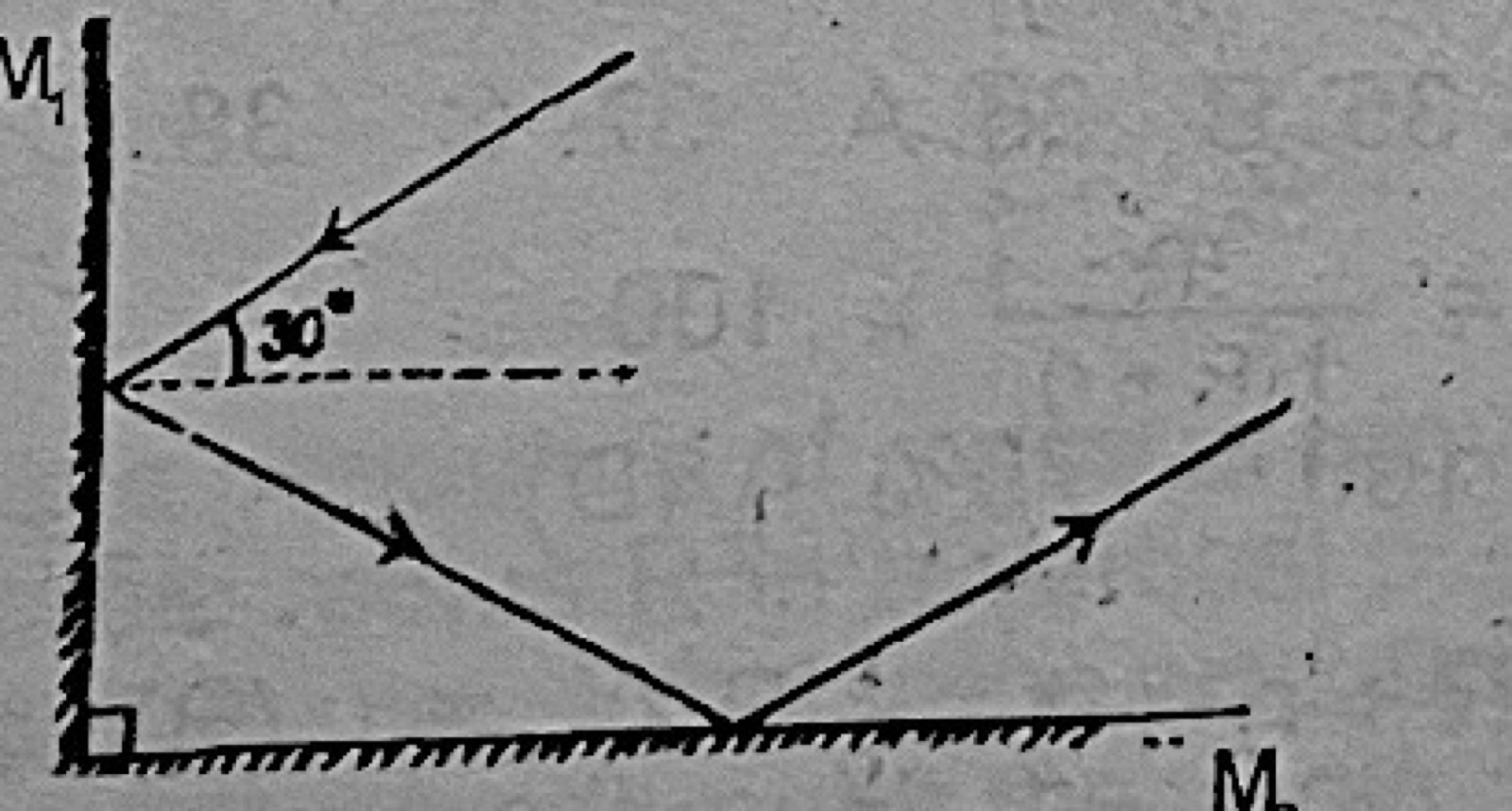
In the figure above, what is the angle of reflection of the ray of light at mirror M2?

Diagram for this question
  1. A.90°
  2. B.60°
  3. C.45°
  4. D.30°
Show the answer and explanation

Answer: B (60°)

Explanation

The ray strikes M1 at 30° to its normal and leaves at 30° below the horizontal. M2 is horizontal, so the ray meets it at 60° to its (vertical) normal and reflects at 60°.

Open this question

Question 32

Light and Reflection

An object is placed 10 cm in front of a concave mirror of focal length 15 cm. What is the position and nature of the image formed?

  1. A.30 cm and virtual
  2. B.6 cm and real
  3. C.6 cm and virtual
  4. D.30 cm and real
Show the answer and explanation

Answer: A (30 cm and virtual)

Explanation

The object is inside the focal length, so the image is virtual. 1/v = 1/15 − 1/10 = −1/30, so it is 30 cm behind the mirror.

Open this question

Question 33

Refraction of Light

Which of the following phenomena explain the formation of a mirage? I. Reflection II. Refraction III. Diffraction

  1. A.I and II only
  2. B.II and III only
  3. C.I and III only
  4. D.I, II and III.
Show the answer and explanation

Answer: A (I and II only)

Explanation

Light from the sky is refracted through layers of air of different temperature and finally totally reflected near the hot ground, so refraction and (total internal) reflection cause a mirage.

Open this question

Question 34

Dispersion of Light and Colours

When white light is dispersed by a spectrometer, the component having the shortest wavelength is

  1. A.orange
  2. B.green
  3. C.violet
  4. D.red.
Show the answer and explanation

Answer: C (violet)

Explanation

Violet has the shortest wavelength of visible light and red the longest.

Open this question

Question 35

Electromagnetic Spectrum

Which of the following statements is TRUE of ultra-violet, visible and infra-red rays?

  1. A.They are all electromagnetic waves with the same wavelength
  2. B.Ultra-violet rays have shorter wavelengths than infra-red rays and produce fluorescence
  3. C.Infra-red rays have shorter wavelengths than visible light and produce the sensation of heat
  4. D.The wavelengths increase in the sequence: visible, ultra-violet, infra-red
Show the answer and explanation

Answer: B (Ultra-violet rays have shorter wavelengths than infra-red rays and produce fluorescence)

Explanation

Ultraviolet has a shorter wavelength than visible light and infra-red, and it makes some substances fluoresce.

Open this question

Question 36

Dispersion of Light and Colours

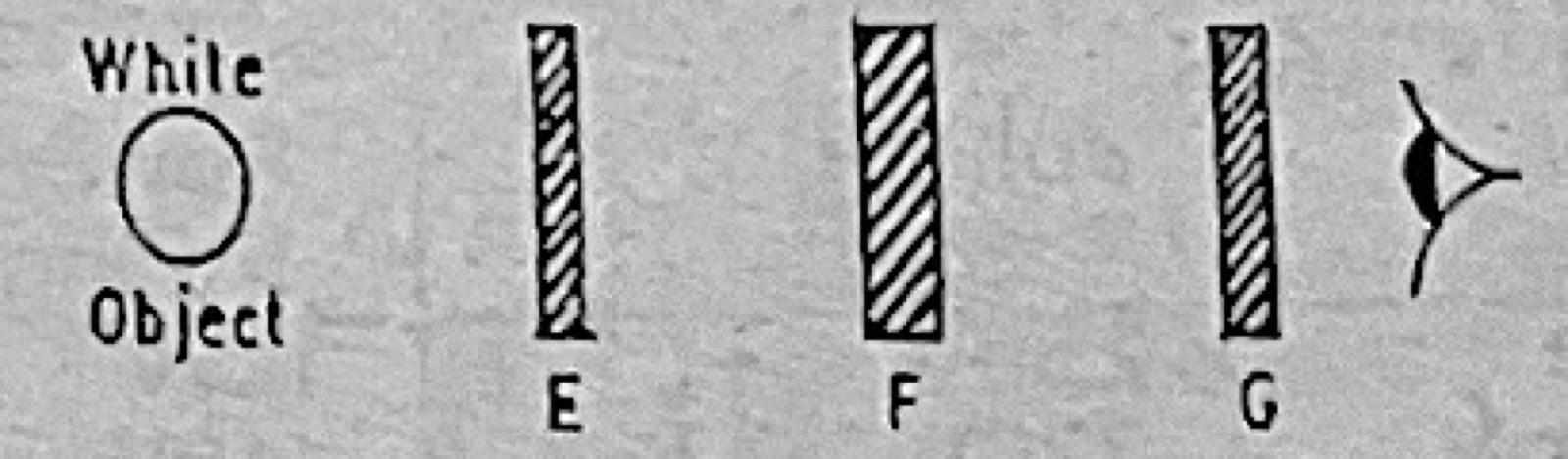
E, F and G are yellow, red and cyan transparent light filters respectively. The colour of a white opaque object when viewed through the arrangement of the filters above is

Diagram for this question
  1. A.yellow
  2. B.red
  3. C.black
  4. D.blue
Show the answer and explanation

Answer: C (black)

Explanation

The yellow filter passes red and green, the red filter then passes only red, and the cyan filter (green + blue) absorbs red. No light gets through, so the object looks black.

Open this question

Question 37

Magnetism

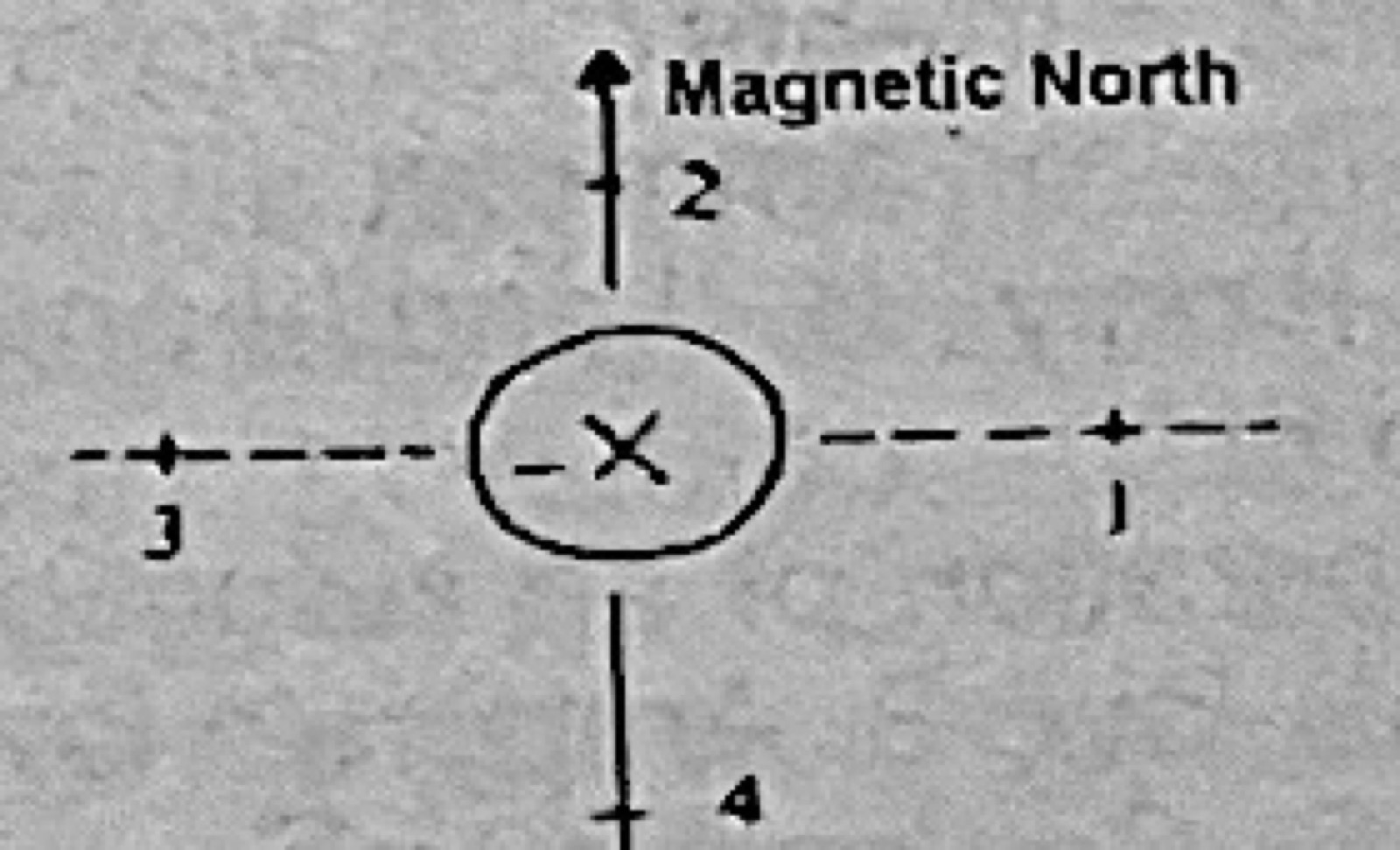
The wire X in the figure above is at right angles to the plane of the paper and carries a current into the paper. At which of the points labelled 1 - 4 will the magnetic flux density due to this current be in the same direction as that of the horizontal component of the earth's magnetic field?

Diagram for this question
  1. A.1
  2. B.2
  3. C.3
  4. D.4
Show the answer and explanation

Answer: C (3)

Explanation

A current into the paper makes clockwise field lines. Going clockwise, the field at point 3 (to the left of the wire) points up the page, towards magnetic north, like the earth's horizontal field.

Open this question

Question 38

Dispersion of Light and Colours

A spectrum of sunlight is said to be impure when

  1. A.it is made of only three colours
  2. B.it has no red colour in it
  3. C.the different colours in it overlap
  4. D.it does not contain white light.
Show the answer and explanation

Answer: C (the different colours in it overlap)

Explanation

In an impure spectrum the colours overlap instead of being separated cleanly.

Open this question

Question 39

Current Electricity

A cell of internal resistance 2 ohms supplies current to a 6-ohm resistor. The efficiency of the cell is

  1. A.12.0%
  2. B.25.0%
  3. C.33.3%
  4. D.75.0%
Show the answer and explanation

Answer: D (75.0%)

Explanation

Efficiency = useful power ÷ total power = R/(R + r) = 6/8 = 75%.

Open this question

Question 41

Current Electricity

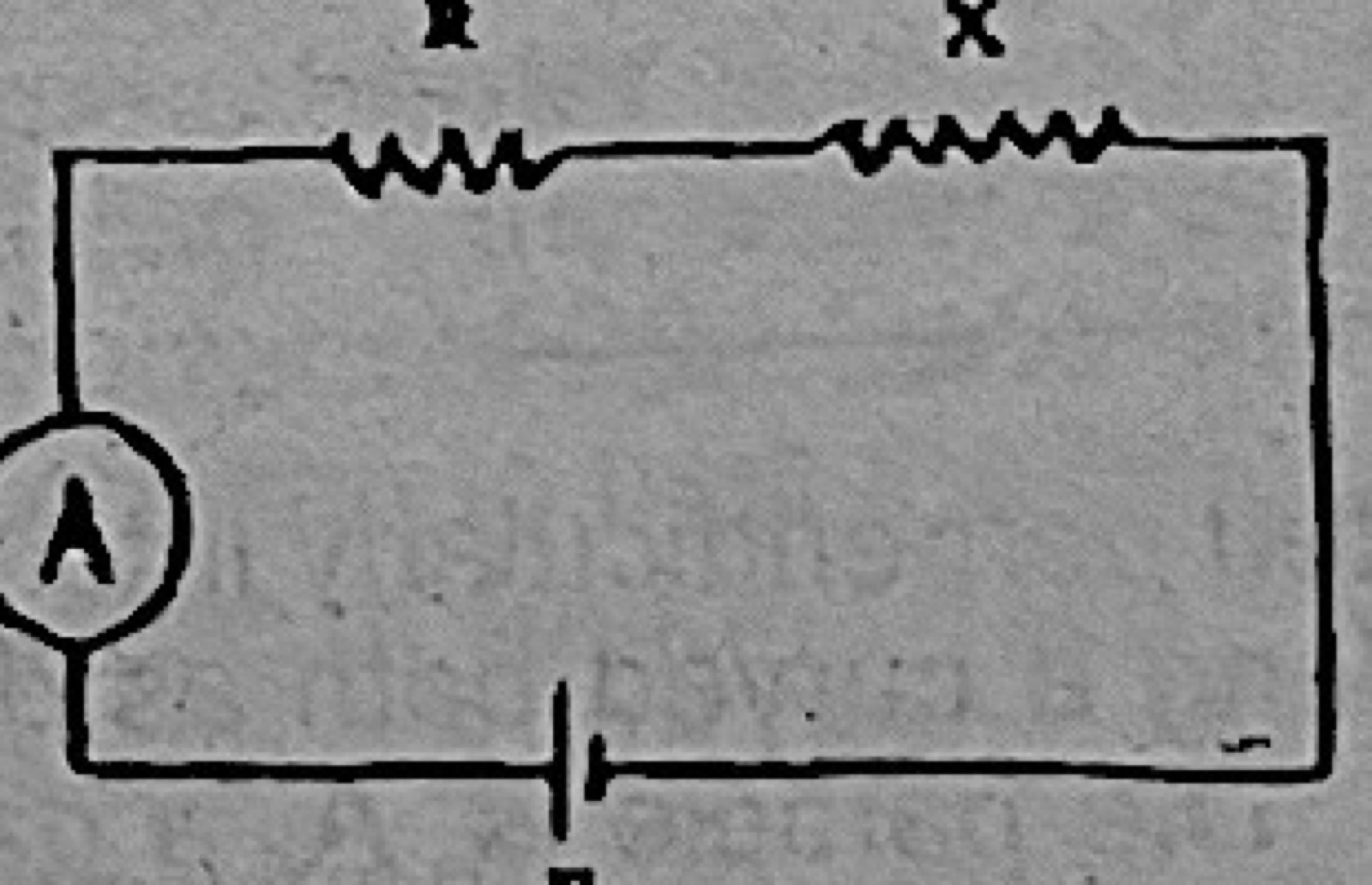
In the circuit diagram above, the ammeter reads a current of 3 amps, when R is 5 ohms and reads 6 amps when R is 2 ohms. The value of the unknown resistance X is

Diagram for this question
  1. A.1
  2. B.2
  3. C.3
  4. D.4
Show the answer and explanation

Answer: A (1)

Explanation

E = 3(5 + X) = 6(2 + X). So 15 + 3X = 12 + 6X, giving X = 1 Ω.

Open this question

Question 42

Capacitors

Which of the following combinations of 2 μF capacitors will give an effective capacitance of 3 μF across terminal XY?

Diagram for this question
  1. A.A
  2. B.B
  3. C.C
  4. D.D
Show the answer and explanation

Answer: A (A)

Explanation

In A, two 2 μF in series give 1 μF, and the third 2 μF in parallel with them adds to 3 μF.

Open this question

Question 43

Electrical Energy and Power

A household refrigerator is rated 200 watts. If electricity costs 5k per kWh, what is the cost of operating it for 20 days?

  1. A.N4.80
  2. B.N48.00
  3. C.N480.00
  4. D.N4800.00
Show the answer and explanation

Answer: A (N4.80)

Explanation

Energy = 0.2 kW × 24 h × 20 = 96 kWh. Cost = 96 × 5k = 480k = N4.80.

Open this question

Question 44

Electrical Energy and Power

Which of the following instruments consumes the highest current? (A. Electric iron: 250 V, 1 kW; B. Television set: 220 V, 110 W; C. Torchlight: 6 V, 30 W; D. Immersion heater: 110 V, 500 W)

  1. A.Electric iron
  2. B.Television set
  3. C.Torchlight
  4. D.Immersion heater
Show the answer and explanation

Answer: C (Torchlight)

Explanation

I = P/V: iron 4 A, television 0.5 A, torch 5 A, heater 4.55 A. The torchlight draws the most.

Open this question

Question 45

Alternating Current Circuits

Which of the following ammeters may be used to measure alternating currents? I. Moving-coil ammeter II. Moving-iron ammeter III. Hot-wire ammeter

  1. A.I and II only
  2. B.II and III only
  3. C.I and III only
  4. D.I, II and III.
Show the answer and explanation

Answer: B (II and III only)

Explanation

Moving-iron and hot-wire meters respond the same way whichever way the current flows. A moving-coil meter's pointer reverses with the current, so it only measures d.c.

Open this question

Question 46

Electromagnetic Induction

The principle of operation of an induction coil is based on

  1. A.Ohm's law
  2. B.Ampere's law
  3. C.Faraday's law
  4. D.Coulomb's law.
Show the answer and explanation

Answer: C (Faraday's law)

Explanation

An induction coil makes a high e.m.f. by electromagnetic induction, described by Faraday's law.

Open this question

Question 47

Electromagnetic Induction

A dynamo primarily converts

  1. A.mechanical energy into electrical energy
  2. B.electrical energy into kinetic energy
  3. C.potential energy into kinetic energy
  4. D.kinetic energy into potential energy.
Show the answer and explanation

Answer: A (mechanical energy into electrical energy)

Explanation

A dynamo (generator) turns the mechanical energy of rotation into electrical energy.

Open this question

Question 48

Radioactivity and Nuclear Physics

In a certain fusion reaction, a deuteron (21H) interacts with a triton (31H) and produces an α-particle (42He) and a second product. The second product is

  1. A.a proton
  2. B.an electron
  3. C.a neutron
  4. D.a gamma ray
Show the answer and explanation

Answer: C (a neutron)

Explanation

Mass numbers: 2 + 3 = 4 + 1, and charges: 1 + 1 = 2 + 0. The missing particle has mass number 1 and charge 0: a neutron.
Open this question

Question 50

Electrostatics

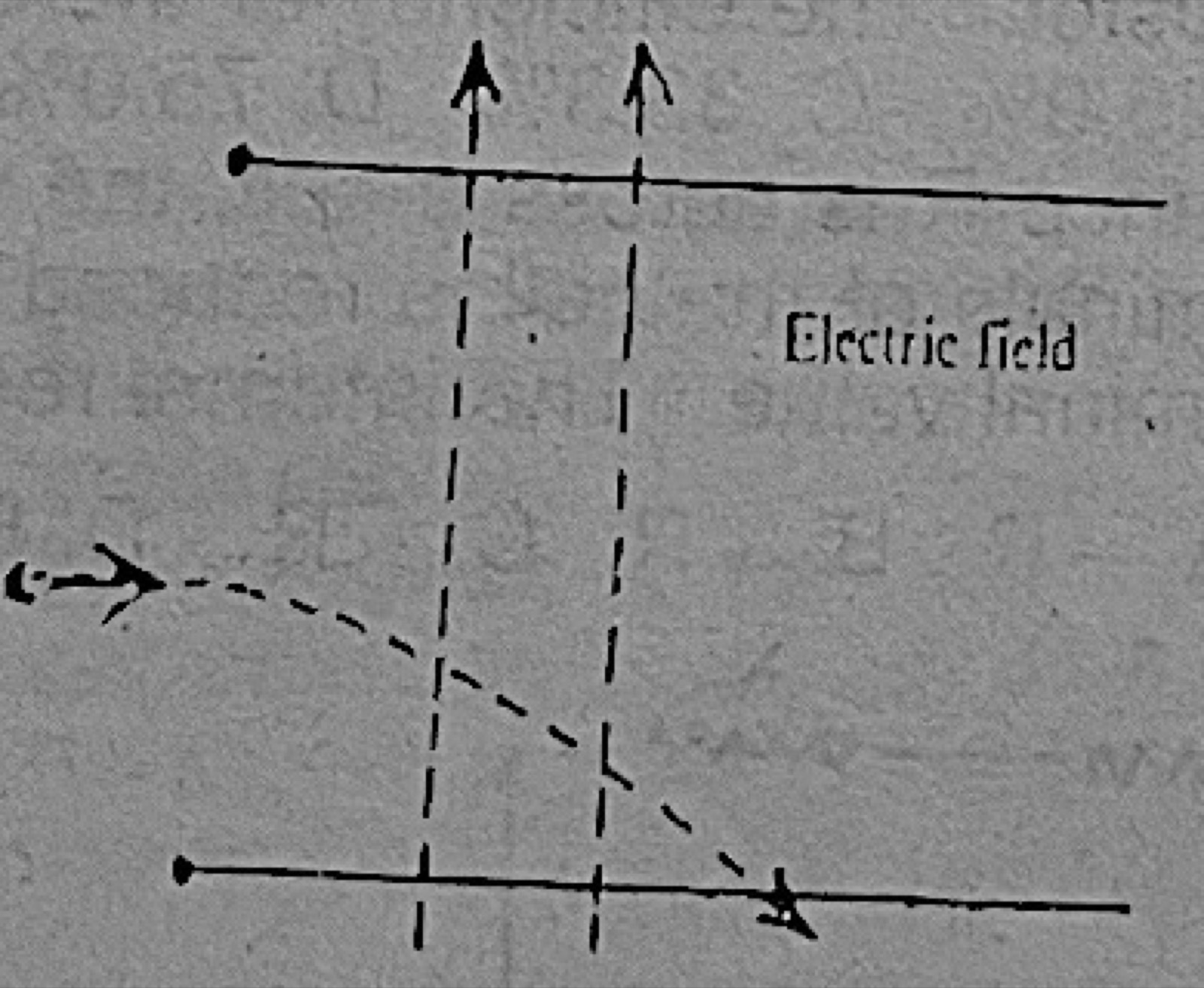
A particle is injected perpendicularly into an electric field. It travels along a curved path as depicted in the figure above. The particle is

Diagram for this question
  1. A.a gamma ray
  2. B.an electron
  3. C.a neutron
  4. D.a proton
Show the answer and explanation

Answer: B (an electron)

Explanation

The field points up the page but the particle bends downwards, against the field, so it is negatively charged: an electron.

Open this question