One of the following readings represents the measurement of the length of a metal rod using vernier callipers. Taking the reading accuracy into consideration, the most likely one is
A.5.16 cm
B.5.165 cm
C.5.0 cm
D.5.160 cm
E.5 cm
Show the answer and explanation
Answer: A (5.16 cm)
Explanation
Vernier callipers read to 0.01 cm, so a reading has two decimal places in centimetres: 5.16 cm.
When equal weights of iron and water are subjected to an equal supply of heat, it is found that the piece of iron becomes much hotter than water after a shorter time because
A.the specific heat of iron is higher than that of water
B.iron is in solid form
C.water is in liquid form
D.the specific heat of water is higher than that of iron
E.the specific heat of iron is infinite
Show the answer and explanation
Answer: D (the specific heat of water is higher than that of iron)
Explanation
Water needs much more heat per kilogram per degree than iron (higher specific heat capacity), so the same heat warms the iron more.
The tyre pressure of a car was found to be 150 cm Hg in the morning at a temperature of 27°C. Hard driving in the afternoon raised the temperature of the tyres to 57°C. The tyre pressure had by the afternoon
A.increased by 15.0 cm Hg
B.decreased by 15.0 cm Hg
C.increased by 22.50 cm Hg
D.decreased by 22.50 cm Hg
E.remained constant.
Show the answer and explanation
Answer: A (increased by 15.0 cm Hg)
Explanation
At constant volume p/T is constant: p₂ = 150 × 330/300 = 165 cm Hg, an increase of 15 cm Hg.
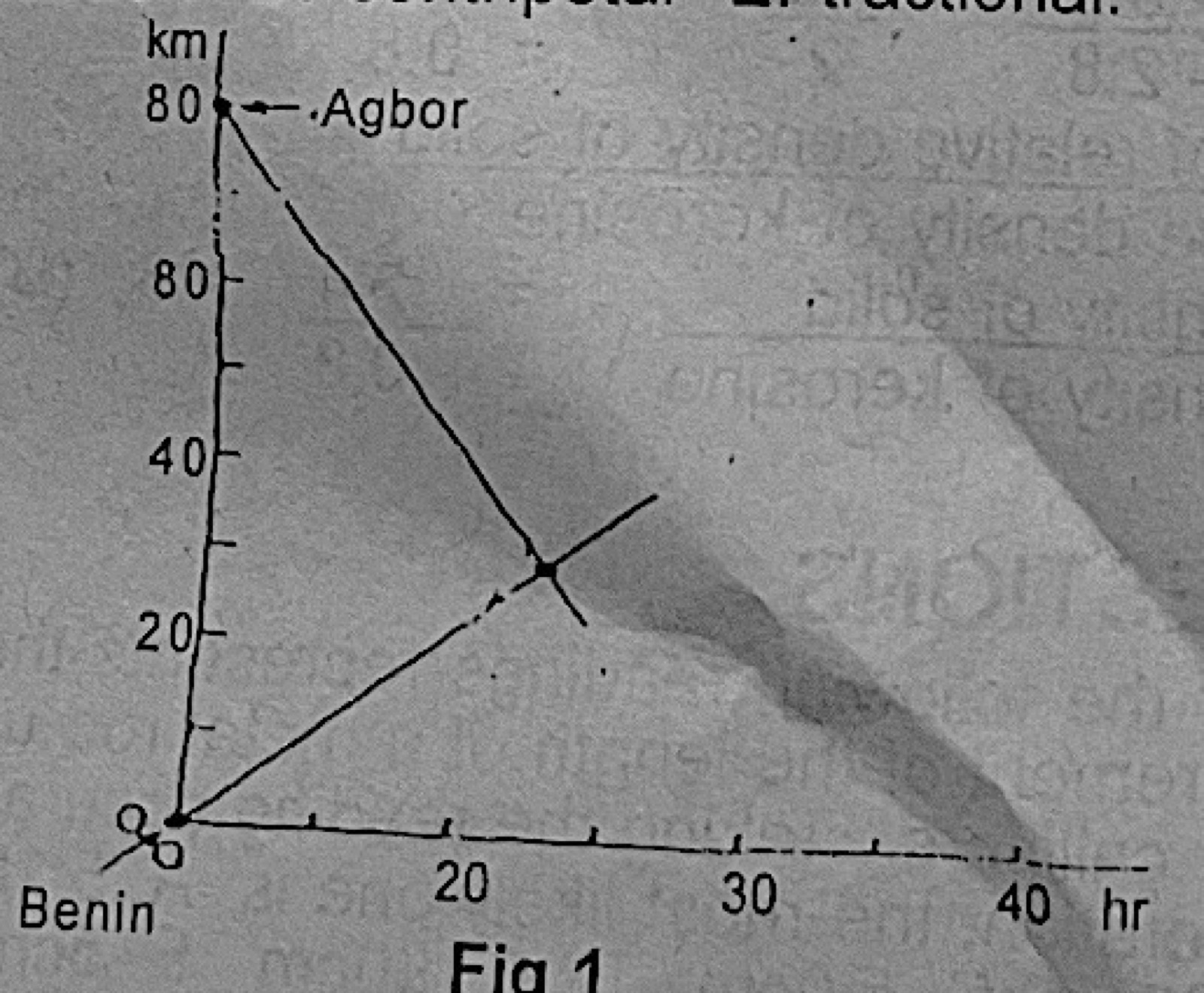
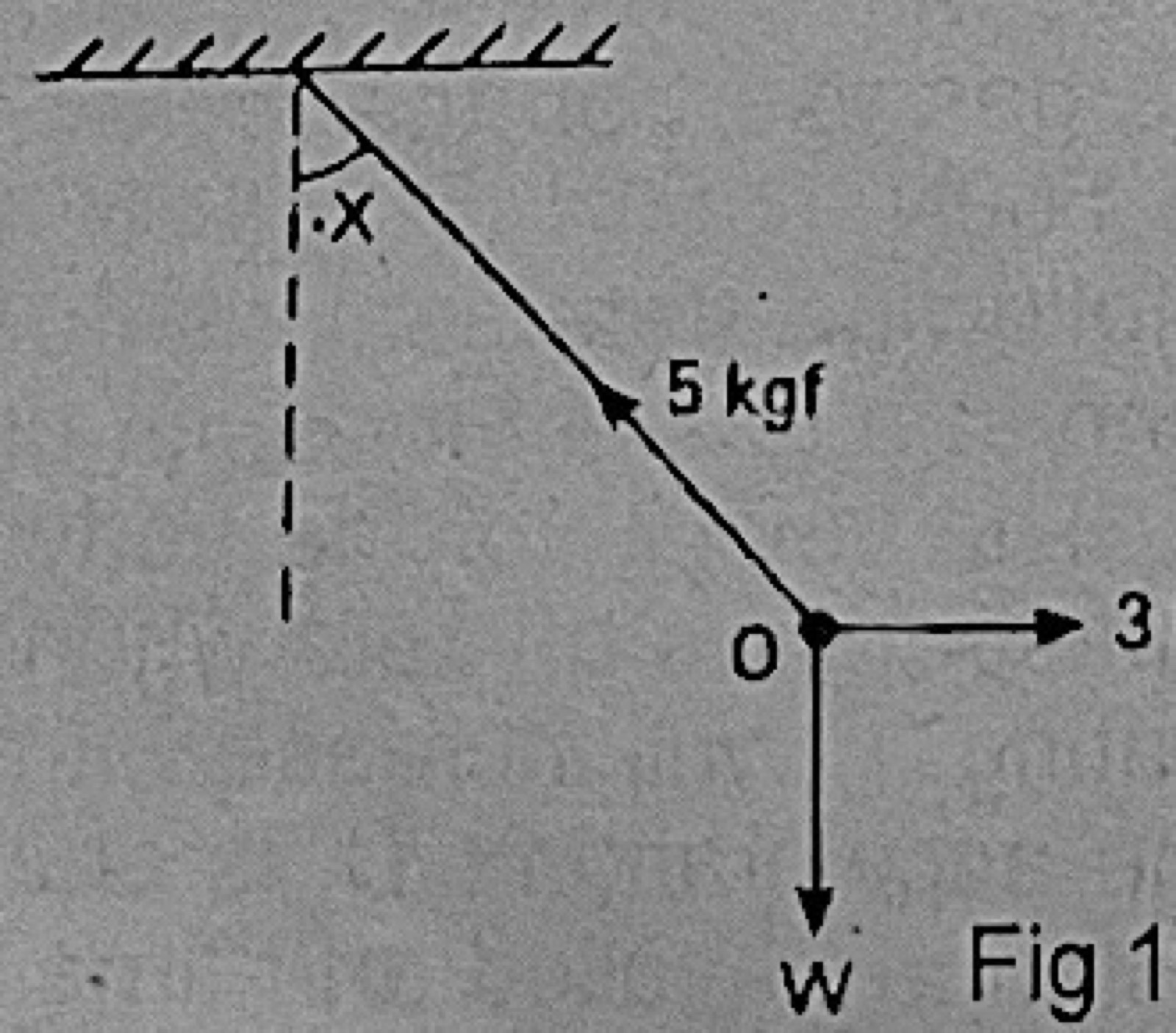
Two taxis leave Benin and Agbor some 80 km apart at 1200 hr (Fig. 1). From the distance time graph shown, the distance of their meeting point P, from Benin, and the time of their meeting are
A.27 km, 1218 hr
B.29 km, 1315 hr
C.40 km, 1418 hr
D.53 km, 1436 hr
E.60 km, 1500 hr
Show the answer and explanation
Answer: B (29 km, 1315 hr)
Explanation
The taxis meet where the two distance–time lines cross. Reading the crossing point off the graph gives about 29 km from Benin at about 1315 hr.
The accurate measurement of the relative density of substances in powder or granular form can be done using a beam balance and a
A.pipette
B.burette
C.measuring cylinder
D.density bottle
E.eureka can
Show the answer and explanation
Answer: D (density bottle)
Explanation
A density bottle holds a fixed, accurately known volume, so weighing it empty, with the powder, with powder and water, and with water alone gives the relative density of a powder.
250 g of lead at 170°C is dropped into 100 g of water at 0°C. If the final temperature is 12°C, the specific heat of lead is (specific heat capacity of water is 4,200 J/kg°C)
A.39.5 J/kg°C
B.50.4 J/kg°C
C.127.6 J/kg°C
D.154.6 J/kg°C
E.173.4 J/kg°C.
Show the answer and explanation
Answer: C (127.6 J/kg°C)
Explanation
Heat lost by lead = heat gained by water: 0.25 × c × 158 = 0.1 × 4200 × 12 = 5040, so c = 5040/39.5 ≈ 127.6 J/kg°C.
A.There is no upthrust on it when completely immersed in water
B.The upthrust on it when completely immersed in water is greater than its weight in air
C.The upthrust on it when completely immersed in water is less than its weight in air
D.Its specific gravity is greater than that of water
E.Its specific gravity is the same as that of water.
Show the answer and explanation
Answer: B (The upthrust on it when completely immersed in water is greater than its weight in air)
Explanation
Cork is less dense than water, so when fully under water it displaces water weighing more than itself. The upthrust is bigger than its weight and pushes it up until it floats.
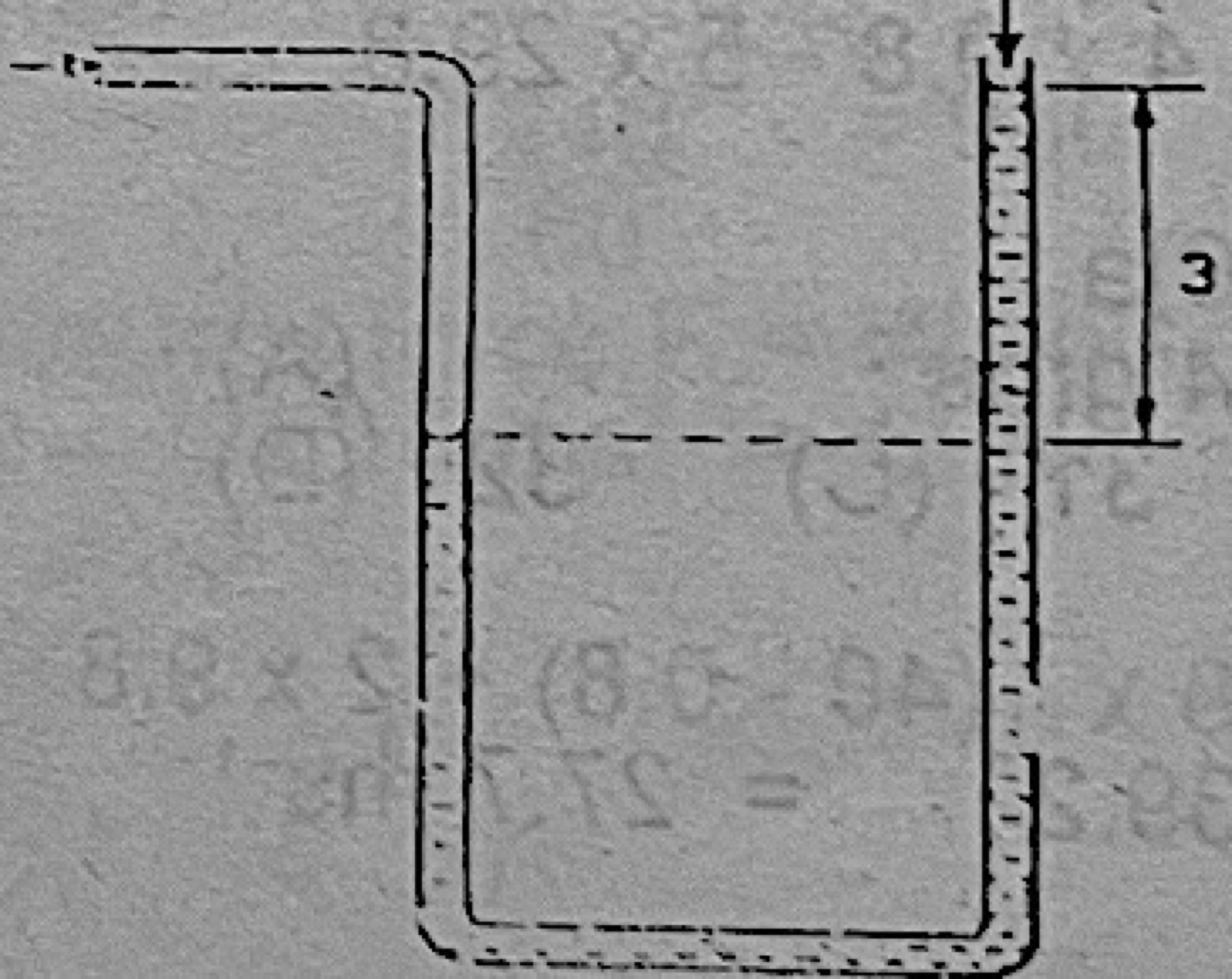
The water manometer in Fig. 2 is measuring the pressure of the gas supply. If the specific gravity of mercury is 13.6 and the atmospheric pressure is 70 cm of mercury, what is the total pressure of the gas supply in cm of water?
A.67 cm
B.73 cm
C.949 cm
D.952 cm
E.955 cm
Show the answer and explanation
Answer: E (955 cm)
Explanation
Atmospheric pressure = 70 × 13.6 = 952 cm of water. The water in the open arm stands 3 cm higher, so the gas pressure is 952 + 3 = 955 cm of water.
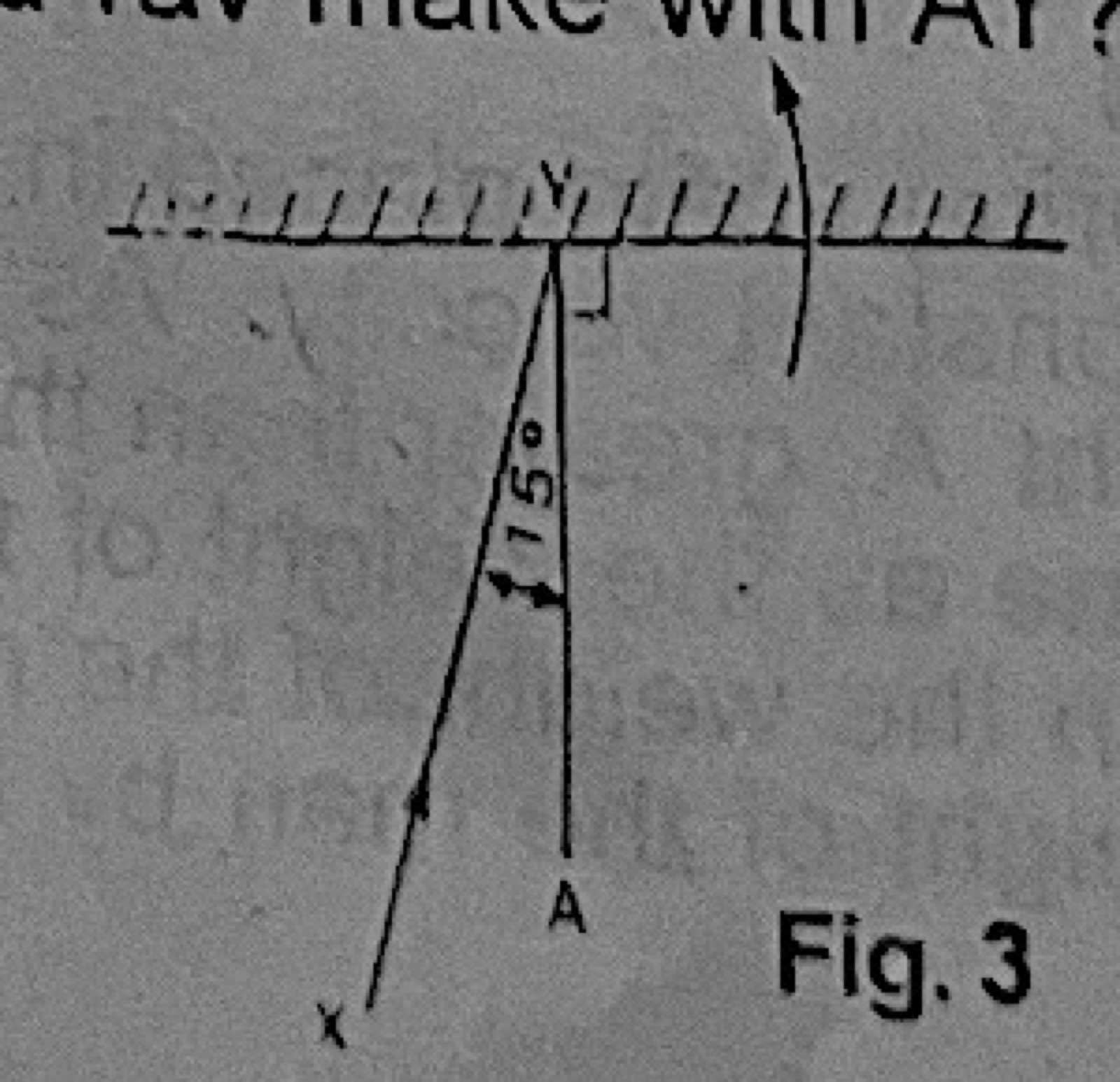
In Fig. 3 an incident ray XY makes an angle of 15° with a fixed line AY which is normal to the surface of a plane mirror. If the mirror is turned as indicated by the arrow, through 40°, what angle will the reflected ray make with AY?
A.25°
B.40°
C.15°
D.55°
E.95°
Show the answer and explanation
Answer: E (95°)
Explanation
Turning the mirror 40° turns its normal 40°, so the angle of incidence becomes 15° + 40° = 55°. The reflected ray is 55° on the other side of the new normal, which is 55° + 40° = 95° from AY.
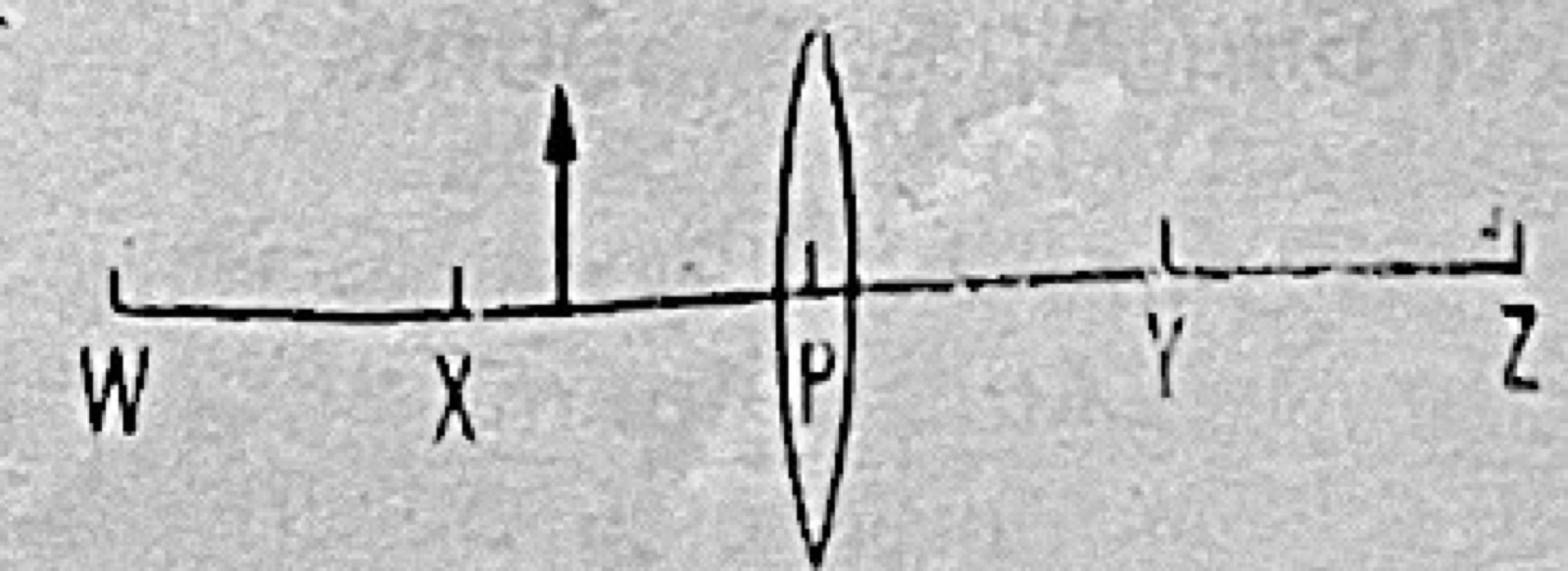
The arrow represents an object in front of a convex lens whose focal points are X and Y (Fig. 4). The image formed is
A.between X and P
B.between P and Y
C.between Y and Z
D.outside W
E.outside Z.
Show the answer and explanation
Answer: D (outside W)
Explanation
The object is between the focus X and the lens, so the image is virtual, upright and magnified, on the same side as the object and further from the lens; with the distances drawn it lies beyond W.
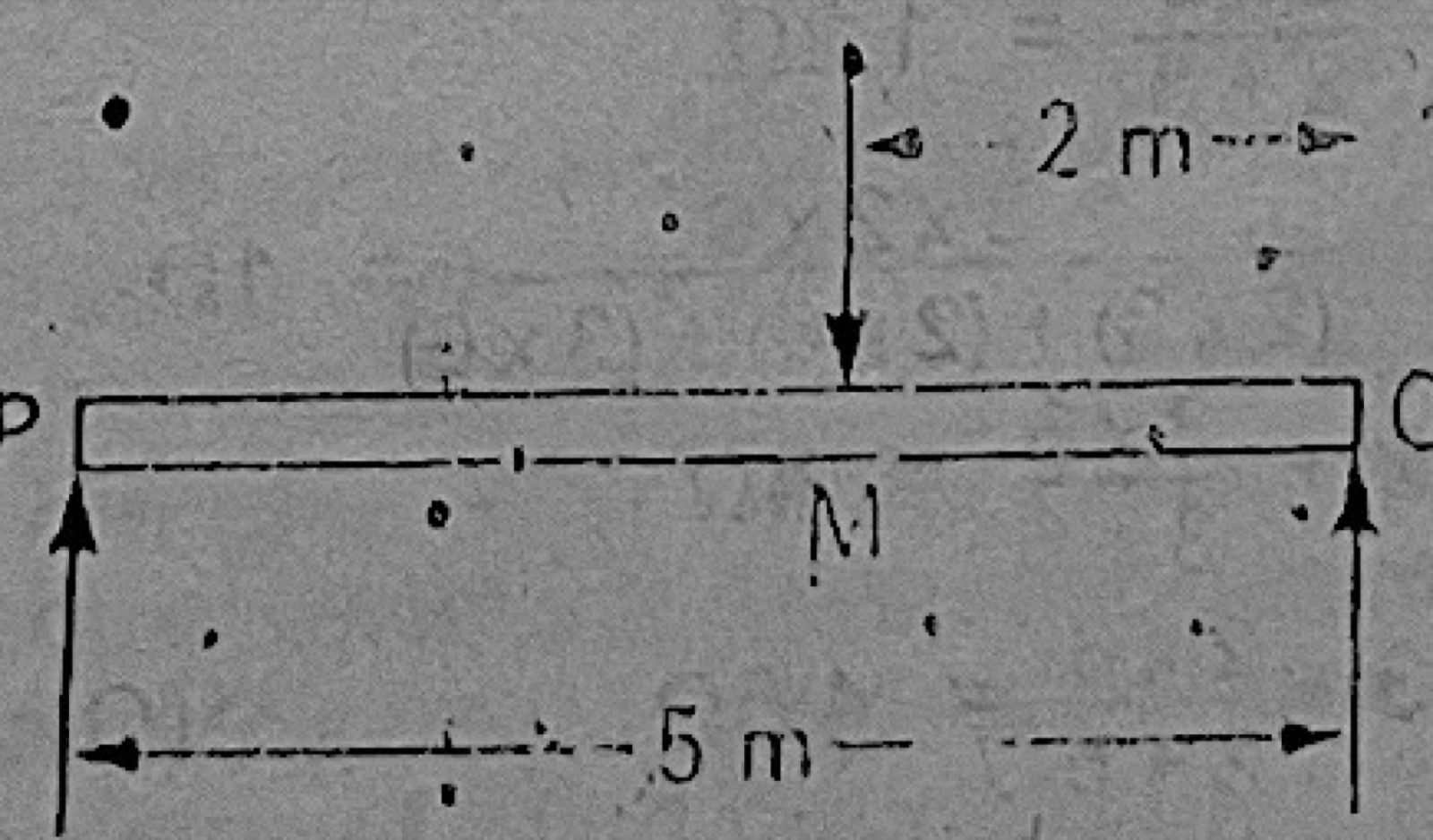
A uniform beam PQ of mass 20 kg and length 5 m is balanced as shown (Fig. 8). A man of weight 800 N stands at M such that QM = 2 m. The reactions at P and Q respectively are (take g = 10 m s−2).
A.300 N and 500 N
B.420 N and 580 N
C.220 N and 380 N
D.580 N and 420 N
E.380 N and 220 N
Show the answer and explanation
Answer: B (420 N and 580 N)
Explanation
Moments about P: 200 × 2.5 + 800 × 3 = Q × 5, so Q = 580 N. Then P = 1000 − 580 = 420 N.
Which of the following statements is NOT true of γ-rays?
A.γ-rays belong to the electromagnetic spectrum
B.γ-rays do not carry an electron charge
C.γ-rays obey the inverse cube law in air
D.The thickness of aluminium which stops β-particles has a negligible effect on γ-radiation.
E.The difference between γ-rays and X-rays is that γ-rays originate from energy changes in the nuclei of atoms, while X-rays come from energy changes associated with the electron structure of atoms.
Show the answer and explanation
Answer: C (γ-rays obey the inverse cube law in air)
Explanation
Radiation spreading out from a point source follows an inverse-square law, not an inverse-cube law.
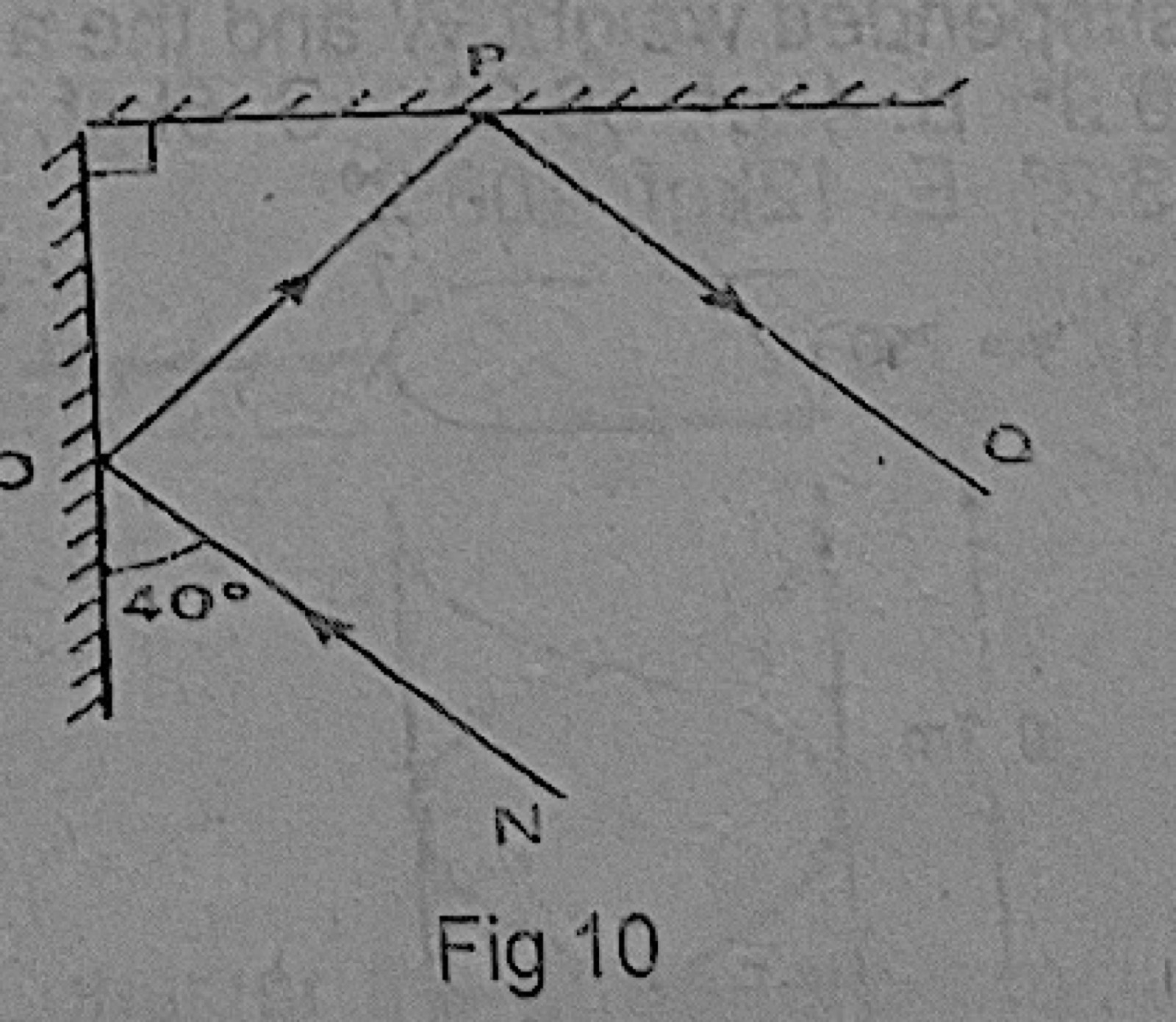
Two mirrors of the same length are arranged as shown in the diagram (Fig. 10). A ray of light NO strikes the system at O and emerges along PQ. The emergent ray has been deviated through
A.220°
B.200°
C.210°
D.180°
E.230°
Show the answer and explanation
Answer: D (180°)
Explanation
The mirrors are at right angles. Each reflection turns the ray, and for two mirrors at 90° the total deviation is always 360° − 2 × 90° = 180°: the ray comes back parallel to its original path.
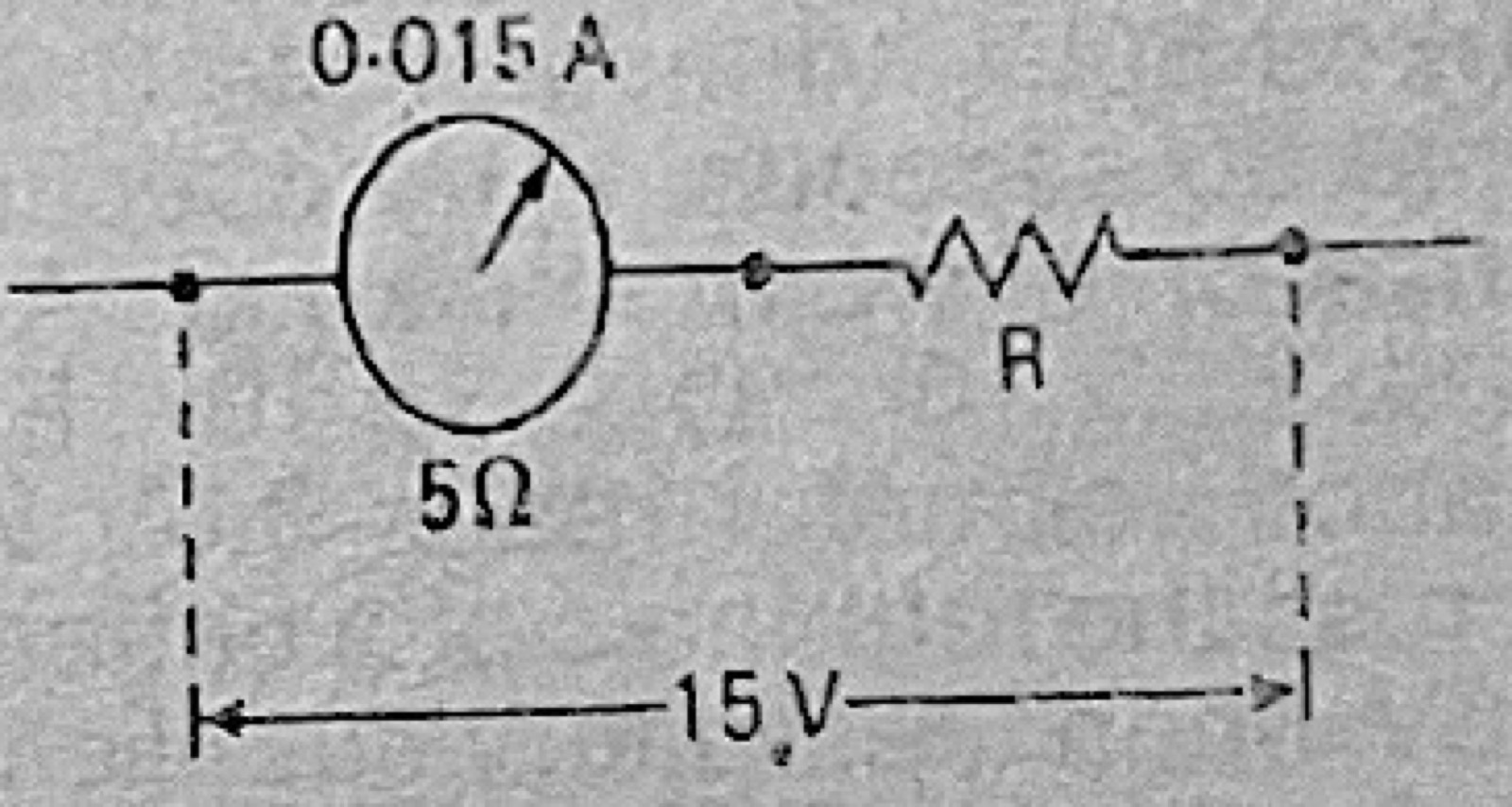
A high-resistance voltmeter reads 3.0 V when connected across the terminals of a battery on open circuit and 2.6 V when the battery supplies a current of 0.2 A through a lamp. The resistance of lamp is
A.2.00 Ω
B.13.00 Ω
C.0.52 Ω
D.0.13 Ω
E.1.50 Ω
Show the answer and explanation
Answer: B (13.00 Ω)
Explanation
The terminal p.d. across the lamp is 2.6 V with 0.2 A flowing, so R = 2.6/0.2 = 13 Ω.
A magnetic needle is suspended first at the earth's north magnetic pole and then at a point on the magnetic equator. The respective angles between the needle and the horizontal are
A.0° and 0°
B.60° and 60°
C.90° and 90°
D.90° and 0°
E.0° and 90°.
Show the answer and explanation
Answer: D (90° and 0°)
Explanation
At a magnetic pole the earth's field is vertical, so the needle dips 90°. At the magnetic equator the field is horizontal, so the angle of dip is 0°.
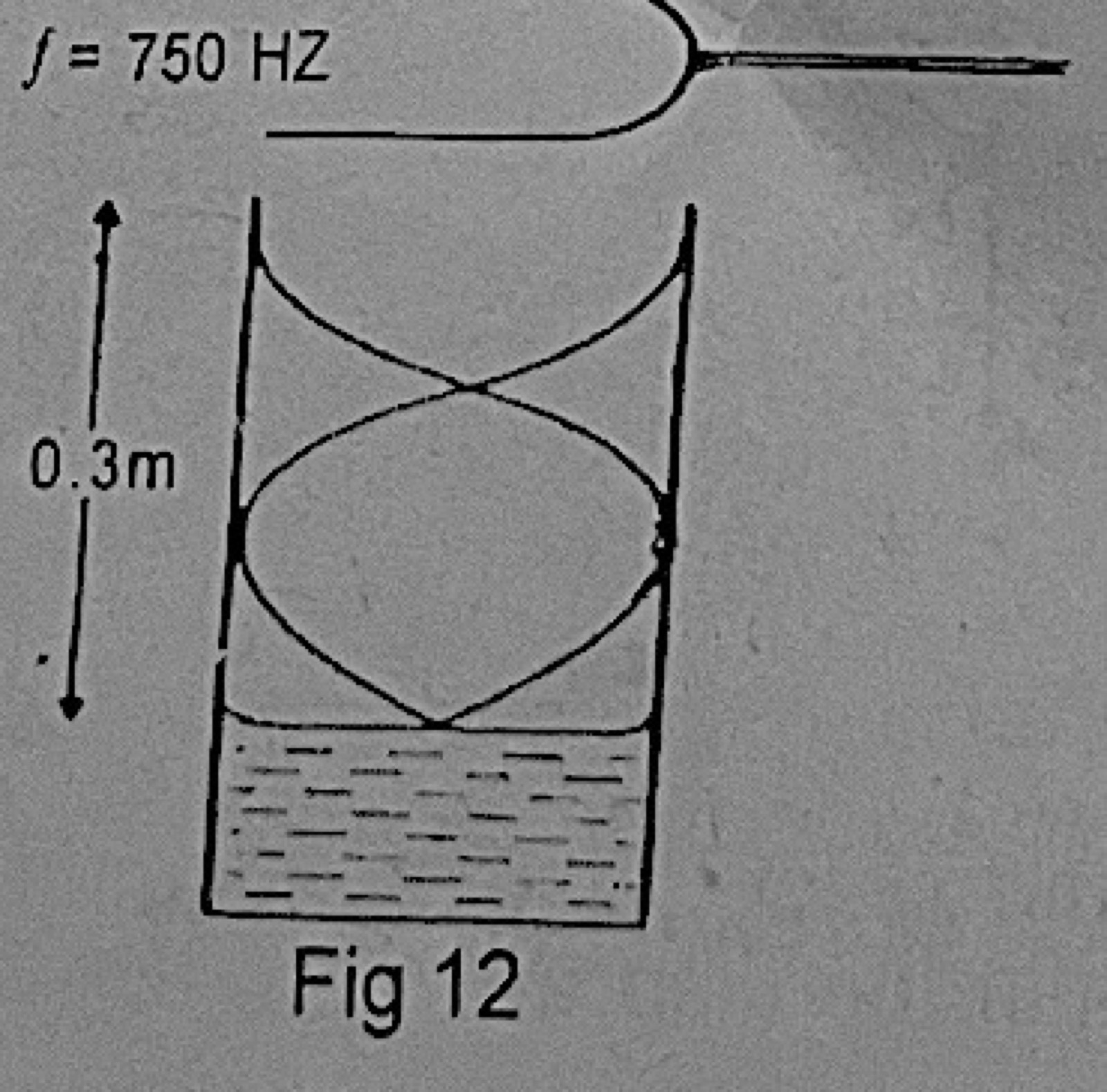
In a resonance tube experiment (Fig. 12) the frequency of the tuning fork is 750 Hz and the resonating length of the air column is 0.3 m as shown. The velocity of the wave is
A.1,850 m s−1
B.225 m s−1
C.300 m s−1
D.53 × 10−5 m s−1
E.2,500 m s−1
Show the answer and explanation
Answer: C (300 m s−1)
Explanation
The diagram shows three-quarters of a wavelength in the 0.3 m column, so λ = 0.4 m and v = fλ = 750 × 0.4 = 300 m s−1.
A 10 g mass placed on the pan of a spring balance causes an extension of 5 cm. If a 15 g mass is placed on the pan of the same spring balance the extension is
A.3.3 cm
B.6.5 cm
C.7.5 cm
D.10.8 cm
E.15.0 cm
Show the answer and explanation
Answer: C (7.5 cm)
Explanation
By Hooke's law extension is proportional to load: 5 × 15/10 = 7.5 cm.