44 questions. Try each one, then open the answer to check yourself and read the explanation.
Question 1
Scalars and Vectors
A man walks 1 km due east and then 1 km due north. His displacement is
A.1 km N 15° E
B.1 km N 30° E
C.√2 km N 45° E
D.√2 km N 60° E
E.2 km N 75° E
Show the answer and explanation
Answer: C (√2 km N 45° E)
Explanation
The two 1 km legs are at right angles, so the resultant is √(1² + 1²) = √2 km. Since both legs are equal, it points midway between north and east: N 45° E.
A.exists only when there is relative motion or tendency for motion
B.acts so as to oppose the motion
C.depends on the normal reaction between the two surfaces
D.is relatively independent of the area in contact
E.has all of these characteristics.
Show the answer and explanation
Answer: E (has all of these characteristics.)
Explanation
Friction appears only when there is motion or a tendency to move, it opposes that motion, it is proportional to the normal reaction and it hardly depends on the area of contact. All four statements are true.
An ice cube floats in a glass of water filled to the brim. What happens when the ice melts?
A.The water level remains the same
B.There is a drop in the level of water in the glass due to condensation on its outside
C.The water in the glass overflows
D.The level of water drops because melted ice occupies less volume.
E.None of the above is correct.
Show the answer and explanation
Answer: A (The water level remains the same)
Explanation
A floating ice cube displaces its own weight of water. When it melts it becomes exactly that much water, which fills the space it was displacing, so the level does not change.
Mercury is a better barometric fluid than water because I. It needs no colouring II. Its density is many times greater than that of water III. It does not wet glass IV. It has a high vapour pressure V. It has a high boiling point. Which of the above statements are true?
A.I and II only
B.I, II and III only
C.III and IV only
D.IV and V only
E.III, IV and V only.
Show the answer and explanation
Answer: B (I, II and III only)
Explanation
Mercury is shiny and easy to see, it is about 13.6 times denser than water (so the column is short) and it does not wet glass. Its vapour pressure is low, not high, so IV is false; I, II and III are the reasons.
A solid suspended by a piece of string is completely immersed in water. On attempting to lift the solid out of the water, the string breaks when the solid is partly out of the water. This is because
A.the tension in the string decreases as the solid is lifted
B.the mass of the solid has increased
C.the solid apparently weighs less when completely immersed in water than when partially immersed
D.part of the solid still in water is exerting more force on the string
E.the solid is no longer in equilibrium with water.
Show the answer and explanation
Answer: C (the solid apparently weighs less when completely immersed in water than when partially immersed)
Explanation
As the solid comes out of the water, less water is displaced, so the upthrust falls and the string must hold more of the weight. The tension is greatest when the solid is partly out, so the string breaks then.
The statements below were made by some students describing what happened during the determination of the melting point of solids. 1. The temperature of the solid was constant until melting started. 2. The temperature of the solid rose until melting started 3. During melting, the temperature was rising 4. During melting, the temperature was constant 5. The temperature continued to rise after all the solid had melted 6. The temperature stopped rising after all the solid had melted. Which of the following gives correct statements in the right order?
A.2, 4 and 5
B.2, 3 and 6
C.1, 3 and 6
D.1, 3 and 5
E.1, 4 and 5.
Show the answer and explanation
Answer: A (2, 4 and 5)
Explanation
When a solid is heated its temperature rises up to the melting point (2), stays constant while it melts because the heat is used as latent heat (4), and then rises again once it is all liquid (5).
A few grains of table salt were put in a cup of cold water, kept at constant temperature and left undisturbed. Eventually all the water tasted salty. This action is due to
A.convection
B.osmosis
C.capillarity
D.diffusion
E.conductivity
Show the answer and explanation
Answer: D (diffusion)
Explanation
The dissolved salt particles spread out on their own from where they are concentrated to the rest of the water by random motion. This is diffusion.
Why is it impossible for the lines of force of an electric field to cross one another?
A.like charges repel each other
B.a charged particle is deflected by an electric field
C.like charges are arranged on the same lines of force
D.a positively charged particle can travel in only one direction at any time
E.none of these is correct.
Show the answer and explanation
Answer: D (a positively charged particle can travel in only one direction at any time)
Explanation
A line of force shows the direction a positive charge would move. If two lines crossed, the charge at that point would have two directions at once, which is impossible.
The electric supply from Kainji Dam is transmitted at high voltages of the order hundreds of kilovolts but is converted to domestic use of about 220 volts by
A.commutators
B.transistors
C.valves and diodes
D.rectifiers
E.transformers
Show the answer and explanation
Answer: E (transformers)
Explanation
Alternating voltages are stepped down from transmission levels to 220 V by step-down transformers.
Two boys are communicating with each other by stretching a string passing through a hole punched in the bottom of each of two tin cans. The physical principle employed is that sound travels
A.mainly through air
B.fainter in stretched string
C.faster through gases than in solids and liquids
D.with greater ease through a string than in air
E.none of the above is correct.
Show the answer and explanation
Answer: D (with greater ease through a string than in air)
Explanation
The taut string carries the sound vibrations from one can to the other much better than the open air would.
A herdsman yelling out to fellow herdsman heard his voice reflected by a cliff 4 s later. What is the velocity of sound in air if the cliff is 680 m away?
A.170 m s−1
B.136 m s−1
C.340 m s−1
D.680 m s−1
E.510 m s−1.
Show the answer and explanation
Answer: C (340 m s−1)
Explanation
The echo travels to the cliff and back, 2 × 680 = 1360 m, in 4 s, so v = 1360/4 = 340 m s−1.
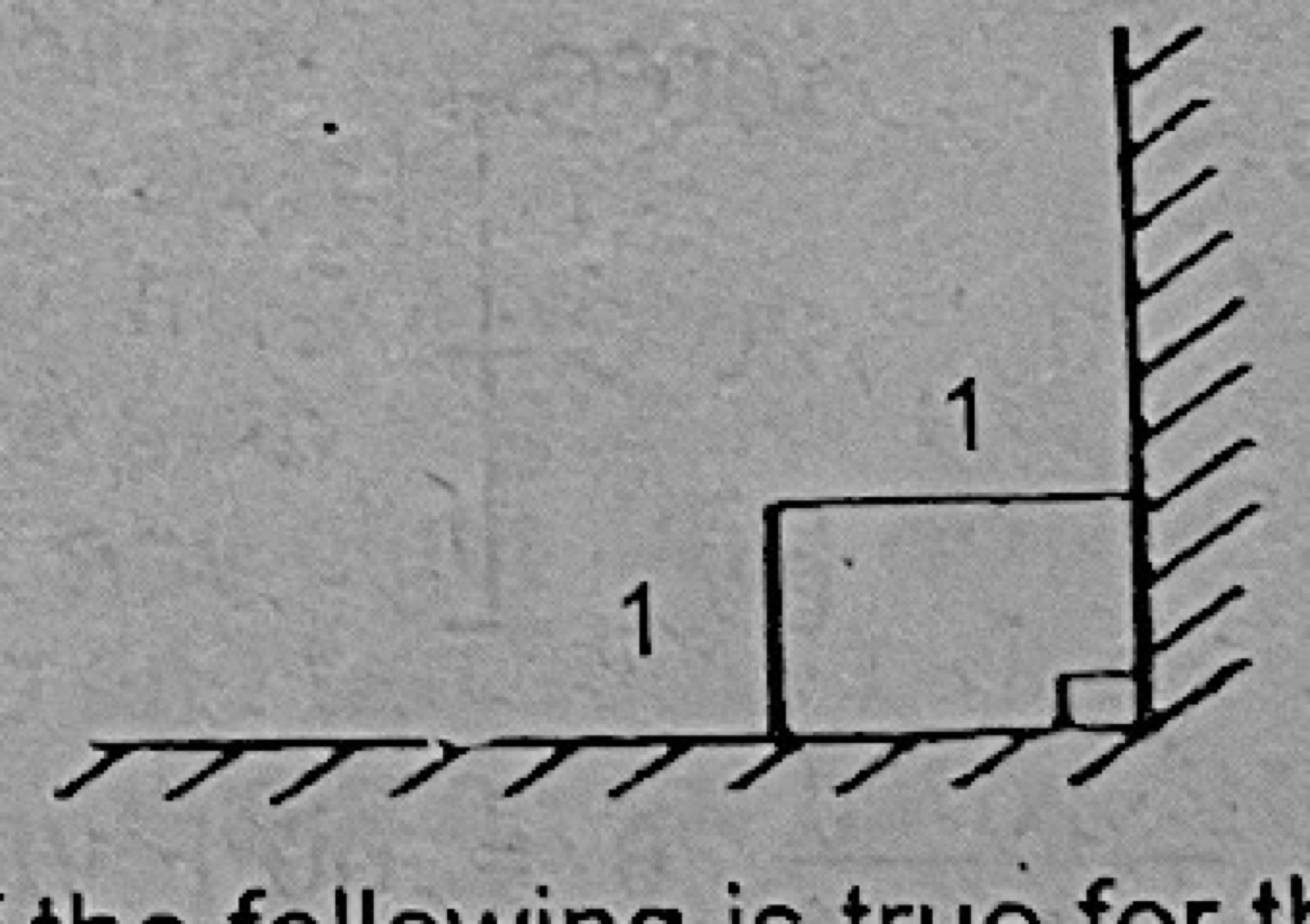
An object is positioned between two plane mirrors inclined at right angles to each other. The object is 1 unit distance from each mirror. The number of images formed is
A.the frequency of the wave is not proportional to the wavelength of the wave
B.the amplitude of vibration is always zero
C.two equal waves are travelling in opposite directions
D.the waves are longitudinal
E.the frequency is directly proportional to the length of the string.
Show the answer and explanation
Answer: C (two equal waves are travelling in opposite directions)
Explanation
A stationary wave forms when two waves of the same frequency and amplitude travel in opposite directions and superpose, e.g. a wave and its reflection.