Question 2
Number BasesIf 2q35 = 778, find q.
- A.2
- B.1
- C.4
- D.0
Show the answer and explanation
Answer: A (2)
Explanation
2q35 = 50 + 5q + 3 and 778 = 63. So 5q = 10 and q = 2.
40 questions. Try each one, then open the answer to check yourself and read the explanation.
If 2q35 = 778, find q.
Answer: A (2)
2q35 = 50 + 5q + 3 and 778 = 63. So 5q = 10 and q = 2.
Simplify (3⅔ × 5/6 × ⅔)/(11/15 × ¾ × 2/27)
Answer: D (50)
The top is 11/3 × 5/6 × 2/3 = 55/27 and the bottom is 11/15 × 3/4 × 2/27 = 11/270. Dividing: 55/27 × 270/11 = 50.
A man invested N5,000 for 9 months at 4%. What is the simple interest?
Answer: A (N150)
I = PRT/100 = 5000 × 4 × (9/12)/100 = N150.
If the numbers M, N, Q are in the ratio 5:4:3, find the value of (2N − Q)/M.
Answer: C (1)
Take M = 5, N = 4, Q = 3: (8 − 3)/5 = 1.
Simplify (16/81)¼ ÷ (9/16)−½.
Answer: B (1/2)
(16/81)¼ = 2/3 and (9/16)−½ = 4/3. So 2/3 ÷ 4/3 = 1/2.
If log318 + log33 − log3x = 3, find x.
Answer: B (2)
log3(54/x) = 3, so 54/x = 27 and x = 2.
Rationalize (2 − √5)/(3 − √5).
Answer: B ((1 − √5)/4)
Multiply by (3 + √5)/(3 + √5): (6 + 2√5 − 3√5 − 5)/(9 − 5) = (1 − √5)/4.
From the Venn diagram above, the complement of the set P∩Q is given by
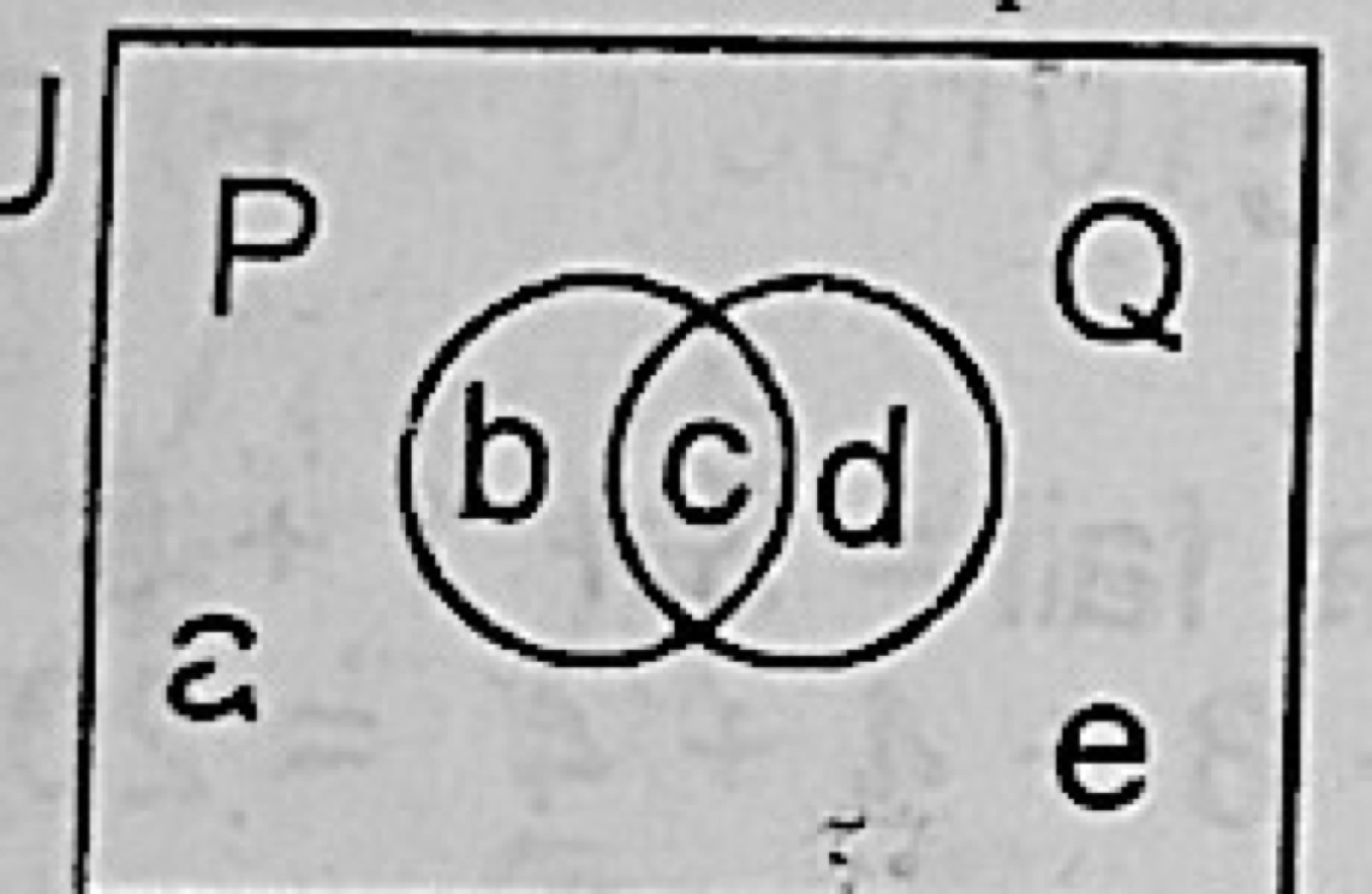
Answer: A ({a, b, d, e})
P ∩ Q = {c}. Its complement is every other element of U: {a, b, d, e}.
Raila has 7 different posters to be hung in her bedroom, living room and kitchen. Assuming she has plans to place, at least, a poster in each of the 3 rooms, how many choices does she have?
Answer: D (210)
Choosing a different poster for each of the 3 rooms, in order, gives 7P3 = 7 × 6 × 5 = 210 choices.
Find the remainder when x3 − 2x2 + 3x − 3 is divided by x2 + 1.
Answer: A (2x − 1)
x3 − 2x2 + 3x − 3 = (x − 2)(x2 + 1) + (2x − 1), so the remainder is 2x − 1.
Factorize completely 9y2 − 16x2.
Answer: D ((3y + 4x)(3y − 4x))
Difference of two squares: (3y)2 − (4x)2 = (3y + 4x)(3y − 4x).
Solve for x and y respectively in the simultaneous equations −2x − 5y = 3, x + 3y = 0
Answer: C (−9, 3)
x = −3y. Then 6y − 5y = 3, so y = 3 and x = −9.
If x varies directly as square root of y and x = 81 when y = 9, find x when y = 1 7/9.
Answer: D (36)
x = k√y: 81 = 3k, so k = 27. y = 16/9 gives √y = 4/3, so x = 27 × 4/3 = 36.
T varies inversely as the cube of R. When R = 3, T = 2/81, find T when R = 2.
Answer: B (1/12)
T = k/R3: k = 2/81 × 27 = 2/3. When R = 2, T = (2/3)/8 = 1/12.
Which of the following diagrams represents the solution of the inequalities y ≤ x − 2 and y ≥ x2 − 4?
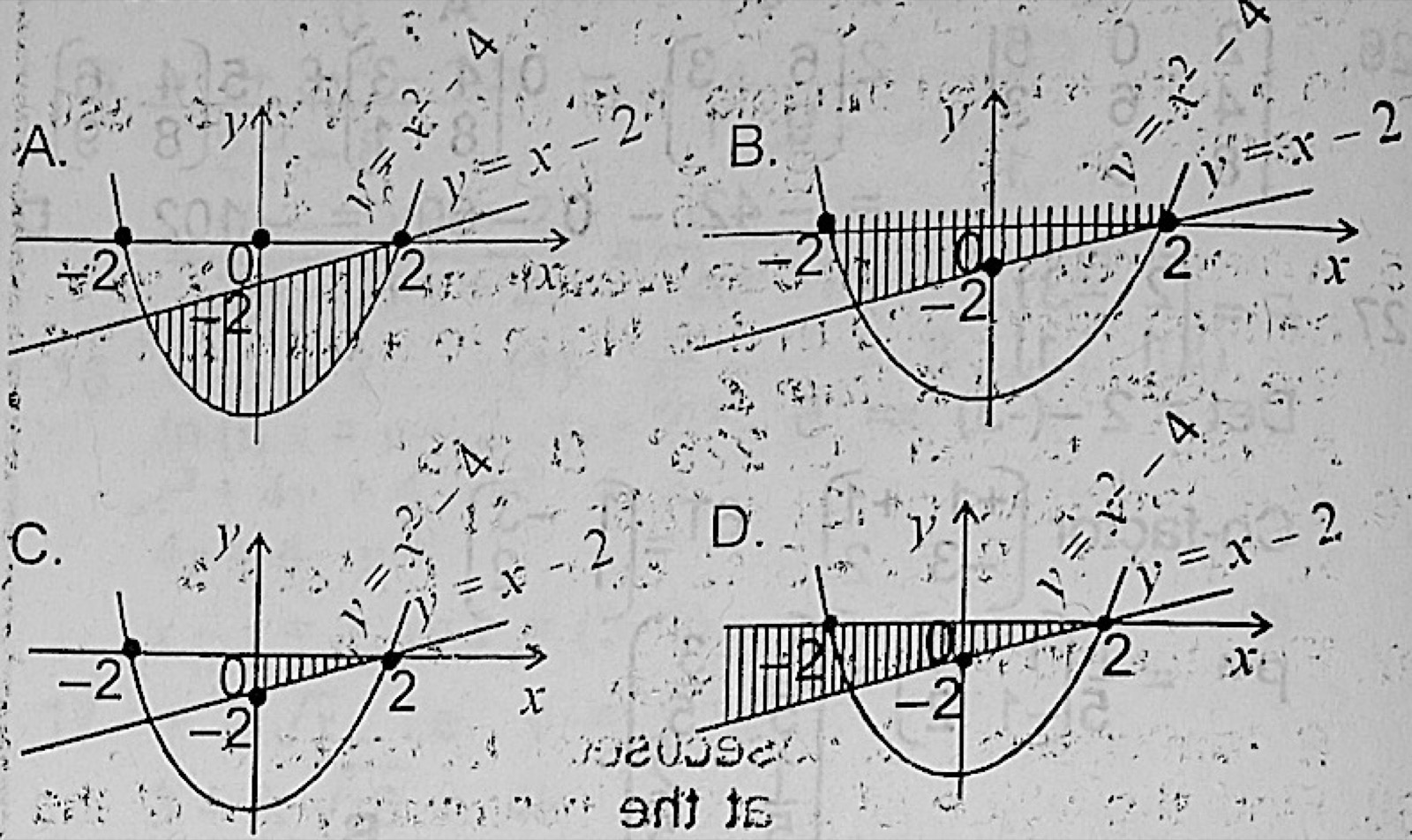
Answer: A (Diagram A)
The points must be on or below the line y = x − 2 and on or above the parabola y = x2 − 4. That is the region inside the parabola's bowl and under the line, between x = −1 and x = 2, which is shaded in A.
Solve the inequalities x2 + 2x > 15.
Answer: D (x > 3 or x < −5)
x2 + 2x − 15 = (x + 5)(x − 3) > 0 when both factors have the same sign: x > 3 or x < −5.
Find the sum of the first 18 terms of the series 3, 6, 9, ..., 36.
Answer: B (513)
a = 3, d = 3: S18 = 18/2 × (6 + 17 × 3) = 9 × 57 = 513.
The second term of a geometric series is 4 while the fourth term is 16. Find the sum of the first five terms.
Answer: B (62)
ar = 4 and ar3 = 16 give r2 = 4, so r = 2 and a = 2. S5 = 2(25 − 1)/(2 − 1) = 62.
If |2 3; 5 3x| = |4 1; 3 2x|, find the value of x. (Determinants written row by row.)
Answer: A (−6)
6x − 15 = 8x − 3, so −2x = 12 and x = −6.
Evaluate |4 2 −1; 2 3 −1; −1 1 3| (determinant written row by row)
Answer: A (25)
4(9 + 1) − 2(6 − 1) + (−1)(2 + 3) = 40 − 10 − 5 = 25.
What is the size of each interior angle of a 12-sided regular polygon?
Answer: B (150°)
Each exterior angle is 360° ÷ 12 = 30°, so each interior angle is 180° − 30° = 150°.
A circle of perimeter 28 cm is opened to form a square. What is the maximum possible area of the square?
Answer: B (49 cm2)
The wire of length 28 cm makes a square of side 7 cm, with area 49 cm2.
A chord of a circle of radius 7 cm is 5 cm from the centre of the circle. What is the length of the chord?
Answer: A (4√6 cm)
Half the chord = √(72 − 52) = √24 = 2√6, so the chord is 4√6 cm.
A solid metal cube of side 3 cm is placed in a rectangular tank of dimensions 3, 4 and 5 cm. What volume of water can the tank now hold?
Answer: B (33 cm3)
The tank holds 3 × 4 × 5 = 60 cm3, and the cube takes up 27 cm3, leaving 33 cm3.
The perpendicular bisector of a line XY is the locus of a point
Answer: D (which is equidistant from the points X and Y.)
Every point on the perpendicular bisector of XY is the same distance from X as from Y.
The midpoint of P(x, y) and Q (8,6) is (5,8). Find x and y.
Answer: A ((2,10))
(x + 8)/2 = 5 gives x = 2, and (y + 6)/2 = 8 gives y = 10.
Find the equation of a line perpendicular to line 2y = 5x + 4 which passes through (4,2).
Answer: B (5y + 2x − 18 = 0)
The line has gradient 5/2, so the perpendicular has gradient −2/5: y − 2 = −2/5 (x − 4), i.e. 5y + 2x − 18 = 0.
In a right angled triangle, if tanθ = 3/4. What is cosθ − sinθ?
Answer: C (1/5)
A 3-4-5 triangle gives sin θ = 3/5 and cos θ = 4/5, so cos θ − sin θ = 1/5.
A man walks 100 m due West from a point X to Y, he then walks 100 m due North to a point Z. Find the bearing of X from Z.
Answer: B (135°)
From Z, X is 100 m east and 100 m south, so it lies exactly south-east: a bearing of 135°.
The derivative of (2x + 1)(3x + 1) is
Answer: D (12x + 5)
Expanding gives 6x2 + 5x + 1, whose derivative is 12x + 5.
Find the derivative of sinθ/cosθ.
Answer: A (sec2θ)
sin θ/cos θ = tan θ, and the derivative of tan θ is sec2θ.
Find the value of x at the minimum point of the curve y = x3 + x2 − x + 1.
Answer: A (1/3)
dy/dx = 3x2 + 2x − 1 = (3x − 1)(x + 1) = 0 at x = 1/3 or −1. The second derivative 6x + 2 is positive at x = 1/3, so that is the minimum.
Find ∫cos 4x dx.
Answer: D (¼ sin 4x + k)
The derivative of sin 4x is 4 cos 4x, so ∫cos 4x dx = ¼ sin 4x + k.
The bar chart above shows the distribution of SS2 students in a school. Find the total number of students.
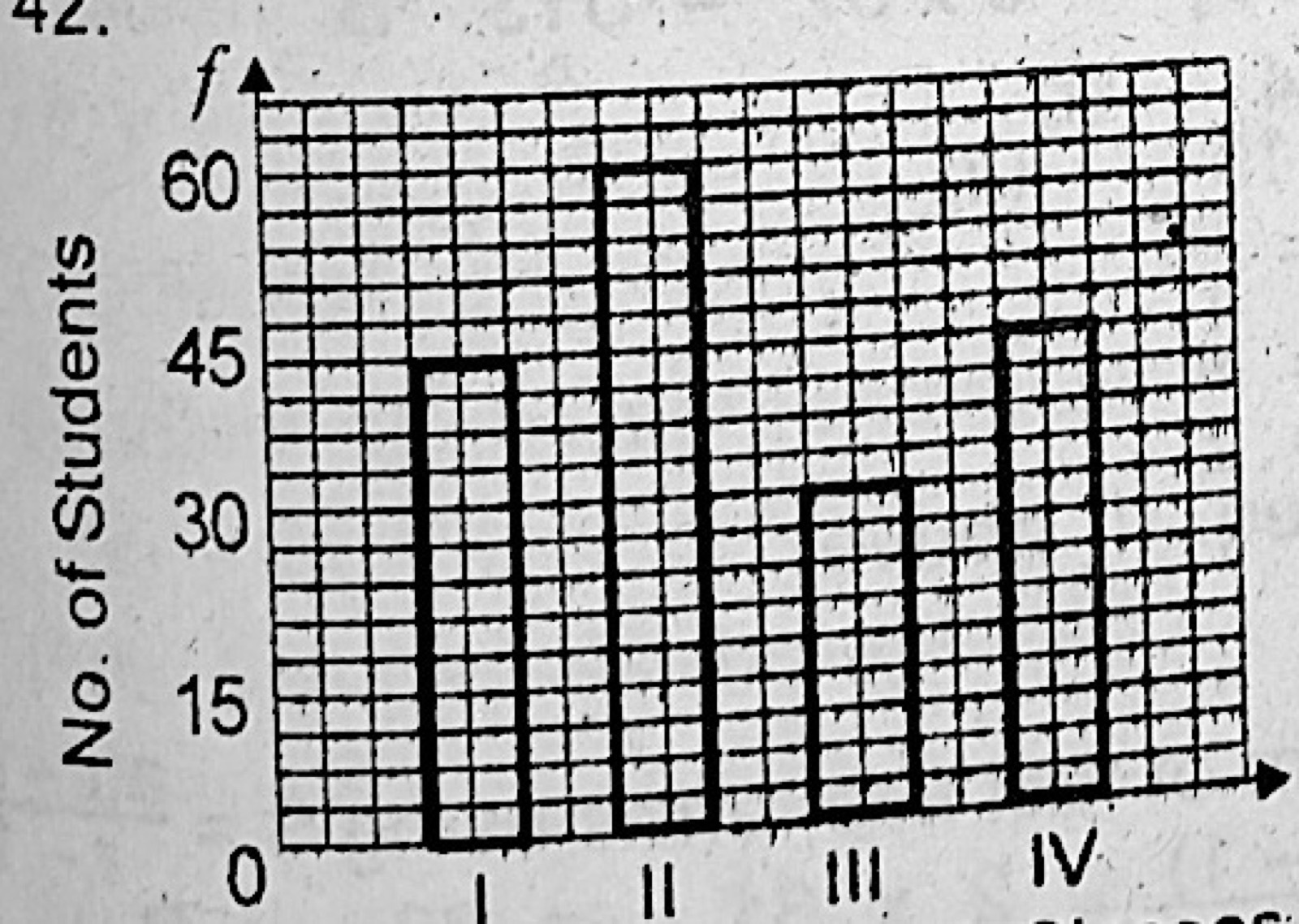
Answer: A (180)
Reading the bars: about 45 + 60 + 30 + 45 = 180 students.
The sum of four consecutive integers is 34. Find the least of these numbers.
Answer: A (7)
n + (n + 1) + (n + 2) + (n + 3) = 34 gives 4n + 6 = 34, so n = 7.
No.: 0, 1, 2, 3, 4, 5
Frequency: 1, 4, 3, 8, 2, 6
From the table above, find the median and range of the data respectively.
Answer: B ((3,5))
There are 24 values. The 12th and 13th values are both 3 (cumulative frequencies 1, 5, 8, 16, ...), so the median is 3. Range = 5 − 0 = 5.
Class Interval: 0-2, 3-5, 6-8, 9-11
Frequency: 3, 2, 5, 3
Find the mode of the above distribution.
Answer: D (7)
The modal class is 6-8 (boundaries 5.5–8.5). Mode = 5.5 + (5 − 2)/((5 − 2) + (5 − 3)) × 3 = 5.5 + 1.8 = 7.3 ≈ 7.
In how many ways can the letters of the word FLATION be arranged?
Answer: B (7!)
FLATION has 7 different letters, so they can be arranged in 7! ways.
In how many ways can five people sit round a circular table?
Answer: A (24)
Around a circle, n people can sit in (n − 1)! ways: 4! = 24.
Find the probability that a number picked at random from the set {43, 44, 45, ..., 60} is a prime number.
Answer: C (2/9)
The set has 18 numbers, and the primes are 43, 47, 53 and 59. So P = 4/18 = 2/9.